Identification
- Summary
Benzylpenicilloyl polylysine is a penicillin derivative used to determine penicillin allergies.
- Brand Names
- Pre-pen
- Generic Name
- Benzylpenicilloyl polylysine
- DrugBank Accession Number
- DB00895
- Background
Benzylpenicilloyl polylysine is used as a skin-testing reagent to detect immunoglobulin E antibodies in people with a history of penicillin allergy. The quantitation of in vitro IgE antibodies to the benzylpenicilloyl determinant is a useful tool for evaluating allergic subjects.
- Type
- Small Molecule
- Groups
- Approved
- Structure
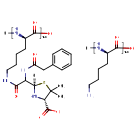
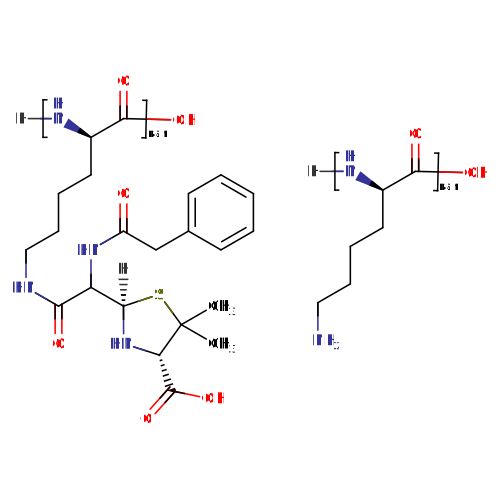
Structure for Benzylpenicilloyl polylysine (DB00895)
- Weight
- Average: 626.765
Monoisotopic: 626.309783168 - Chemical Formula
- C28H46N6O8S
- Synonyms
- Benzyl penicilloyl-polylysine
- Benzylpenicilloyl G polylysine
- Benzylpenicilloyl polylysine
- Benzylpenicilloyl-polylysine

Pharmacology
- Indication
For use as a adjunct in assessing the risk of administering penicillin (benzylpenicillin or penicillin G).
 Reduce drug development failure ratesBuild, train, & validate machine-learning modelswith evidence-based and structured datasets.Build, train, & validate predictive machine-learning models with structured datasets.
- Associated Conditions
Indication Type Indication Combined Product Details Approval Level Age Group Patient Characteristics Dose Form Diagnostic agent Penicillin allergy •••••••••••• Diagnostic agent Beta-lactam antibiotic allergy ••• ••••• - Contraindications & Blackbox Warnings
 Prevent Adverse Drug Events TodayTap into our Clinical API for life-saving information on contraindications & blackbox warnings, population restrictions, harmful risks, & more.Avoid life-threatening adverse drug events with our Clinical API
- Pharmacodynamics
Benylpenicilloyl polylysine is penicilloyl bound to polylysine and is considered to be the major determinant of penicillin metabolism; it is used as a skin-testing reagent to detect immunoglobulin E antibodies in people with a history of penicillin allergy. If skin testing using benzylpenicilloyl and penicillin G (as the sole source of minor determinants) is negative, approximately 97% of patients with a negative skin test will tolerate penicillin.
- Mechanism of action
The skin test for penicillin demonstrates the presence or absence of specific IgE antibodies to major and minor penicillin determinants. IgE antibodies to major determinants can be detected by using benzylpenicilloyl polylysine. A penicillin skin test predicts only the presence of IgE antibodies for the major or minor penicillin determinants at the time of application and does not predict the future development of IgE-mediated reactions during subsequent courses of penicillin. Benzylpenicilloyl polylysine reacts specifically with penicilloyl skin sensitizing antibodies (reagins) to produce immediate wheal and flare reactions which may reflect increased risk of allergic reactions to subsequent penicillin therapy.
Target Actions Organism AHigh affinity immunoglobulin epsilon receptor subunit gamma agonistHumans AHigh affinity immunoglobulin epsilon receptor subunit alpha agonistHumans - Absorption
Not Available
- Volume of distribution
Not Available
- Protein binding
Not Available
- Metabolism
- Not Available
- Route of elimination
Not Available
- Half-life
Not Available
- Clearance
Not Available
- Adverse Effects
 Improve decision support & research outcomesWith structured adverse effects data, including: blackbox warnings, adverse reactions, warning & precautions, & incidence rates. View sample adverse effects data in our new Data Library!Improve decision support & research outcomes with our structured adverse effects data.
- Toxicity
Symptoms of overdose include urticaria, generalized pruritus, local swelling, generalized flushing, anaphylaxis, bronchospasm, fainting and maculopapular eruption.
- Pathways
- Not Available
- Pharmacogenomic Effects/ADRs
- Not Available
Interactions
- Drug Interactions
- This information should not be interpreted without the help of a healthcare provider. If you believe you are experiencing an interaction, contact a healthcare provider immediately. The absence of an interaction does not necessarily mean no interactions exist.
Drug Interaction Integrate drug-drug
interactions in your softwareAcemetacin Acemetacin may decrease the excretion rate of Benzylpenicilloyl polylysine which could result in a higher serum level. Acenocoumarol Benzylpenicilloyl polylysine may increase the anticoagulant activities of Acenocoumarol. Acrivastine Acrivastine may decrease effectiveness of Benzylpenicilloyl polylysine as a diagnostic agent. Albuterol Salbutamol may decrease effectiveness of Benzylpenicilloyl polylysine as a diagnostic agent. Alimemazine Alimemazine may decrease effectiveness of Benzylpenicilloyl polylysine as a diagnostic agent. - Food Interactions
- No interactions found.
Products
 Drug product information from 10+ global regionsOur datasets provide approved product information including:dosage, form, labeller, route of administration, and marketing period.Access drug product information from over 10 global regions.
- Brand Name Prescription Products
Name Dosage Strength Route Labeller Marketing Start Marketing End Region Image Pre-pen Solution 28.8348 mg/1 Intradermal Alk Abello, Inc. 1975-12-31 Not applicable Canada 
Pre-pen Injection 60 umol/0.25mL Intradermal; Subcutaneous AllerQuest LLC 1974-07-25 Not applicable US 
Categories
- ATC Codes
- J01CR50 — Combinations of penicillins
- Drug Categories
- Chemical TaxonomyProvided by Classyfire
- Description
- This compound belongs to the class of organic compounds known as n-acyl-alpha amino acids and derivatives. These are compounds containing an alpha amino acid (or a derivative thereof) which bears an acyl group at its terminal nitrogen atom.
- Kingdom
- Organic compounds
- Super Class
- Organic acids and derivatives
- Class
- Carboxylic acids and derivatives
- Sub Class
- Amino acids, peptides, and analogues
- Direct Parent
- N-acyl-alpha amino acids and derivatives
- Alternative Parents
- Alpha amino acid amides / Beta amino acids and derivatives / Phenylacetamides / D-alpha-amino acids / Medium-chain fatty acids / Heterocyclic fatty acids / Dicarboxylic acids and derivatives / Thiazolidines / Secondary carboxylic acid amides / Amino acids show 10 more
- Substituents
- Alpha-amino acid / Alpha-amino acid amide / Amine / Amino acid / Aromatic heteromonocyclic compound / Azacycle / Benzenoid / Beta amino acid or derivatives / Carbonyl group / Carboxamide group show 27 more
- Molecular Framework
- Not Available
- External Descriptors
- amino acid amide, thiazolidinemonocarboxylic acid, polypeptide, random copolymer (CHEBI:59297)
- Affected organisms
- Humans and other mammals
Chemical Identifiers
- UNII
- 76479814OY
- CAS number
- 31855-75-1
- InChI Key
- IMPVZRLKKKXMKQ-SGDOCVTFSA-N
- InChI
- InChI=1S/C22H32N4O6S.C6H14N2O2/c1-22(2)17(21(31)32)26-19(33-22)16(25-15(27)12-13-8-4-3-5-9-13)18(28)24-11-7-6-10-14(23)20(29)30;7-4-2-1-3-5(8)6(9)10/h3-5,8-9,14,16-17,19,26H,6-7,10-12,23H2,1-2H3,(H,24,28)(H,25,27)(H,29,30)(H,31,32);5H,1-4,7-8H2,(H,9,10)/t14-,16?,17+,19-;5-/m11/s1
- IUPAC Name
- SMILES
References
- General References
- Not Available
- External Links
- Human Metabolome Database
- HMDB0015032
- PubChem Compound
- 45266800
- PubChem Substance
- 46505002
- ChemSpider
- 26331550
- 19079
- ChEBI
- 59297
- ChEMBL
- CHEMBL1201779
- Therapeutic Targets Database
- DAP001314
- PharmGKB
- PA164754810
- Wikipedia
- Benzylpenicilloyl_polylysine
Clinical Trials
- Clinical Trials
Phase Status Purpose Conditions Count 3 Completed Diagnostic History of IgE Dependent Reaction to a Penicillin Product 1
Pharmacoeconomics
- Manufacturers
- Allerquest llc
- Packagers
- Allerquest LLC
- Schwarz Pharma Inc.
- Taylor Pharmaceuticals
- Dosage Forms
Form Route Strength Injection Intradermal; Subcutaneous 60 umol/0.25mL Solution Intradermal 28.8348 mg/1 - Prices
Unit description Cost Unit Pre-pen ampul 72.0USD ampul DrugBank does not sell nor buy drugs. Pricing information is supplied for informational purposes only.- Patents
- Not Available
Properties
- State
- Solid
- Experimental Properties
Property Value Source logP -0.8 Not Available - Predicted Properties
Property Value Source Water Solubility 0.0658 mg/mL ALOGPS logP -0.89 ALOGPS logP -3.8 Chemaxon logS -3.9 ALOGPS pKa (Strongest Acidic) 2.04 Chemaxon pKa (Strongest Basic) 9.53 Chemaxon Physiological Charge 0 Chemaxon Hydrogen Acceptor Count 8 Chemaxon Hydrogen Donor Count 6 Chemaxon Polar Surface Area 170.85 Å2 Chemaxon Rotatable Bond Count 17 Chemaxon Refractivity 122.22 m3·mol-1 Chemaxon Polarizability 50.31 Å3 Chemaxon Number of Rings 2 Chemaxon Bioavailability 0 Chemaxon Rule of Five No Chemaxon Ghose Filter No Chemaxon Veber's Rule No Chemaxon MDDR-like Rule No Chemaxon - Predicted ADMET Features
- Not Available
Spectra
- Mass Spec (NIST)
- Not Available
- Spectra
- Not Available
- Chromatographic Properties
Collision Cross Sections (CCS)
Not Available
Targets

- Kind
- Protein
- Organism
- Humans
- Pharmacological action
- Yes
- Actions
- Agonist
- General Function
- Igg binding
- Specific Function
- Associates with a variety of FcR alpha chains to form a functional signaling complex. Regulates several aspects of the immune response. The gamma subunit has a critical role in allowing the IgE Fc ...
- Gene Name
- FCER1G
- Uniprot ID
- P30273
- Uniprot Name
- High affinity immunoglobulin epsilon receptor subunit gamma
- Molecular Weight
- 9667.355 Da
References
- Overington JP, Al-Lazikani B, Hopkins AL: How many drug targets are there? Nat Rev Drug Discov. 2006 Dec;5(12):993-6. [Article]
- Imming P, Sinning C, Meyer A: Drugs, their targets and the nature and number of drug targets. Nat Rev Drug Discov. 2006 Oct;5(10):821-34. [Article]
- Chandra RK, Joglekar SA, Tomas E: Penicillin allergy: anti-penicillin IgE antibodies and immediate hypersensitivity skin reactions employing major and minor determinants of penicillin. Arch Dis Child. 1980 Nov;55(11):857-60. [Article]
- Chen X, Ji ZL, Chen YZ: TTD: Therapeutic Target Database. Nucleic Acids Res. 2002 Jan 1;30(1):412-5. [Article]
- Kind
- Protein
- Organism
- Humans
- Pharmacological action
- Yes
- Actions
- Agonist
- General Function
- Ige receptor activity
- Specific Function
- Binds to the Fc region of immunoglobulins epsilon. High affinity receptor. Responsible for initiating the allergic response. Binding of allergen to receptor-bound IgE leads to cell activation and t...
- Gene Name
- FCER1A
- Uniprot ID
- P12319
- Uniprot Name
- High affinity immunoglobulin epsilon receptor subunit alpha
- Molecular Weight
- 29595.67 Da
References
- Overington JP, Al-Lazikani B, Hopkins AL: How many drug targets are there? Nat Rev Drug Discov. 2006 Dec;5(12):993-6. [Article]
- Imming P, Sinning C, Meyer A: Drugs, their targets and the nature and number of drug targets. Nat Rev Drug Discov. 2006 Oct;5(10):821-34. [Article]
- Chandra RK, Joglekar SA, Tomas E: Penicillin allergy: anti-penicillin IgE antibodies and immediate hypersensitivity skin reactions employing major and minor determinants of penicillin. Arch Dis Child. 1980 Nov;55(11):857-60. [Article]
- Chen X, Ji ZL, Chen YZ: TTD: Therapeutic Target Database. Nucleic Acids Res. 2002 Jan 1;30(1):412-5. [Article]

Drug created at June 13, 2005 13:24 / Updated at April 26, 2024 00:45