Identification
- Summary
Triazolam is a benzodiazepine used for short term treatment of insomnia.
- Brand Names
- Halcion
- Generic Name
- Triazolam
- DrugBank Accession Number
- DB00897
- Background
Withdrawn in the United Kingdom due to risk of psychiatric adverse drug reactions. This drug continues to be available in the U.S. Internationally, triazolam is a Schedule IV drug under the Convention on Psychotropic Substances.
- Type
- Small Molecule
- Groups
- Approved, Investigational
- Structure

Structure for Triazolam (DB00897)
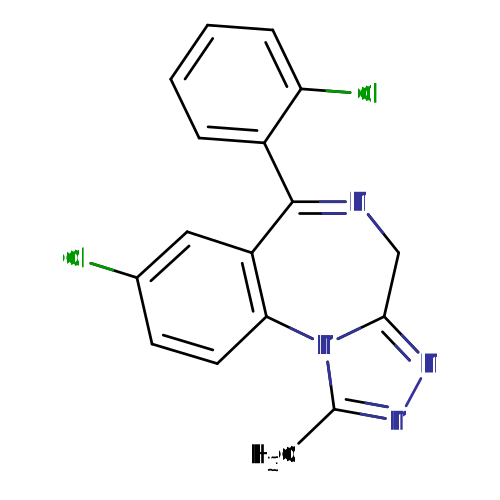
- Weight
- Average: 343.21
Monoisotopic: 342.043901818 - Chemical Formula
- C17H12Cl2N4
- Synonyms
- Triazolam
- Triazolamum
- External IDs
- DEA No. 2887
- N05CD05
- U 33030

Pharmacology
- Indication
For the short-term treatment of insomnia.
 Reduce drug development failure ratesBuild, train, & validate machine-learning modelswith evidence-based and structured datasets.Build, train, & validate predictive machine-learning models with structured datasets.
- Associated Conditions
Indication Type Indication Combined Product Details Approval Level Age Group Patient Characteristics Dose Form Treatment of Insomnia •••••••••••• - Associated Therapies
- Contraindications & Blackbox Warnings
 Prevent Adverse Drug Events TodayTap into our Clinical API for life-saving information on contraindications & blackbox warnings, population restrictions, harmful risks, & more.Avoid life-threatening adverse drug events with our Clinical API
- Pharmacodynamics
A short-acting benzodiazepine used as a hypnotic agent in the treatment of insomnia. Some countries temporarily withdrew triazolam from the market because of concerns about adverse reactions, mostly psychological, associated with higher dose ranges. Its use at lower doses with appropriate care and labeling has been reaffirmed by the FDA and most other countries. Triazolam has a shorter half-life than chlordiazepoxide, flurazepam, and prazepam and does not generate active metabolites.
- Mechanism of action
Benzodiazepines bind nonspecifically to bezodiazepine receptors BNZ1, which mediates sleep, and BNZ2, which affects affects muscle relaxation, anticonvulsant activity, motor coordination, and memory. As benzodiazepine receptors are thought to be coupled to gamma-aminobutyric acid-A (GABAA) receptors, this enhances the effects of GABA by increasing GABA affinity for the GABA receptor. Binding of GABA to the site opens the chloride channel, resulting in a hyperpolarized cell membrane that prevents further excitation of the cell.
Target Actions Organism AGABA(A) Receptor positive allosteric modulatorHumans AGABA(A) Receptor Benzodiazepine Binding Site ligandHumans - Absorption
Bioavailability is 44% (oral) and 53% (sublingual).
- Volume of distribution
Not Available
- Protein binding
Not Available
- Metabolism
Hepatic. Small amounts of unmetabolized triazolam appear in the urine.
Hover over products below to view reaction partners
- Route of elimination
Triazolam and its metabolites, principally as conjugated glucuronides, which are presumably inactive, are excreted primarily in the urine. Only small amounts of unmetabolized triazolam appear in the urine. The two primary metabolites accounted for 79.9% of urinary excretion.
- Half-life
1.5-5.5 hours
- Clearance
Not Available
- Adverse Effects
 Improve decision support & research outcomesWith structured adverse effects data, including: blackbox warnings, adverse reactions, warning & precautions, & incidence rates. View sample adverse effects data in our new Data Library!Improve decision support & research outcomes with our structured adverse effects data.
- Toxicity
Symptoms of overdose include drowsiness, slurred speech, motor inco-ordination, coma, and respiratory depression.
- Pathways
- Not Available
- Pharmacogenomic Effects/ADRs
- Not Available
Interactions
- Drug Interactions
- This information should not be interpreted without the help of a healthcare provider. If you believe you are experiencing an interaction, contact a healthcare provider immediately. The absence of an interaction does not necessarily mean no interactions exist.
Drug Interaction Integrate drug-drug
interactions in your software1,2-Benzodiazepine The risk or severity of CNS depression can be increased when Triazolam is combined with 1,2-Benzodiazepine. Abacavir Triazolam may decrease the excretion rate of Abacavir which could result in a higher serum level. Abametapir The serum concentration of Triazolam can be increased when it is combined with Abametapir. Abatacept The metabolism of Triazolam can be increased when combined with Abatacept. Acalabrutinib The metabolism of Triazolam can be decreased when combined with Acalabrutinib. - Food Interactions
- Avoid alcohol. Ingesting alcohol may increase the risk of complex behaviors like sleep-driving, which the patient does not remember.
- Avoid grapefruit products. Grapefruit may reduce the CYP3A4 metabolism of triazolam, which increases the serum concentration of triazolam.
Products
 Drug product information from 10+ global regionsOur datasets provide approved product information including:dosage, form, labeller, route of administration, and marketing period.Access drug product information from over 10 global regions.
- Product Images
- International/Other Brands
- Apo-Triazo (Apotex) / Arring (YungShin) / Asasion (Choseido Pharmaceutical Co., Ltd) / Ascomarna (Nisshin Seiyaku K.K) / Songar (Valeas S.p.A.)
- Brand Name Prescription Products
Name Dosage Strength Route Labeller Marketing Start Marketing End Region Image Halcion Tablet 0.25 mg/1 Oral Physicians Total Care, Inc. 1982-11-15 2012-06-30 US 
Halcion Tablet 0.25 mg/1 Oral Pharmacia & Upjohn Company LLC 1982-11-15 Not applicable US Halcion Tablet 0.125 mg/1 Oral Physicians Total Care, Inc. 1982-11-15 2012-06-30 US Halcion Tablet 0.125 mg Oral Pfizer Canada Ulc 1980-12-31 2006-08-02 Canada 
Halcion Tablet .125 mg/1 Oral Pharmacia and Upjohn Company 2006-01-19 2006-01-19 US - Generic Prescription Products
Name Dosage Strength Route Labeller Marketing Start Marketing End Region Image Alti-triazolam Tab 0.125mg Tablet .125 mg / tab Oral Altimed Pharma Inc. 1987-12-31 2001-09-05 Canada Alti-triazolam Tab 0.25mg Tablet .25 mg / tab Oral Altimed Pharma Inc. 1987-12-31 2001-09-05 Canada Mylan-triazolam Tablet 0.125 mg Oral Mylan Pharmaceuticals 1992-12-31 2011-03-04 Canada Mylan-triazolam Tablet 0.25 mg Oral Mylan Pharmaceuticals 1992-12-31 2011-03-04 Canada Novo-triolam Tab 0.125mg Tablet .125 mg Oral Novopharm Limited 1990-12-31 2005-08-10 Canada


Categories
- ATC Codes
- N05CD05 — Triazolam
- Drug Categories
- Adjuvants, Anesthesia
- Agents Causing Muscle Toxicity
- Anti-Anxiety Agents
- Benzazepines
- Benzodiazepine hypnotics and sedatives
- Benzodiazepines and benzodiazepine derivatives
- Central Nervous System Agents
- Central Nervous System Depressants
- Cytochrome P-450 CYP2C8 Inhibitors
- Cytochrome P-450 CYP2C8 Inhibitors (strength unknown)
- Cytochrome P-450 CYP3A Substrates
- Cytochrome P-450 CYP3A4 Substrates
- Cytochrome P-450 CYP3A5 Substrates
- Cytochrome P-450 CYP3A7 Substrates
- Cytochrome P-450 Enzyme Inhibitors
- Cytochrome P-450 Substrates
- Drugs that are Mainly Renally Excreted
- GABA Agents
- GABA Modulators
- Heterocyclic Compounds, Fused-Ring
- Hypnotics and Sedatives
- Nervous System
- Neurotransmitter Agents
- Psycholeptics
- Psychotropic Drugs
- Tranquilizing Agents
- Triazolobenzodiazepines
- Chemical TaxonomyProvided by Classyfire
- Description
- This compound belongs to the class of organic compounds known as 1,2,4-triazolo[4,3-a][1,4]benzodiazepines. These are aromatic compounds containing a 1,4-benzodiazepine fused to and sharing a nitrogen atom with a 1,2,4-triazole ring.
- Kingdom
- Organic compounds
- Super Class
- Organoheterocyclic compounds
- Class
- Benzodiazepines
- Sub Class
- 1,4-benzodiazepines
- Direct Parent
- 1,2,4-triazolo[4,3-a][1,4]benzodiazepines
- Alternative Parents
- Chlorobenzenes / Aryl chlorides / Triazoles / Heteroaromatic compounds / Ketimines / Propargyl-type 1,3-dipolar organic compounds / Azacyclic compounds / Organopnictogen compounds / Organochlorides / Hydrocarbon derivatives
- Substituents
- 1,2,4-triazole / 1,2,4-triazolo[4,3-a][1,4]benzodiazepine / Aromatic heteropolycyclic compound / Aryl chloride / Aryl halide / Azacycle / Azole / Benzenoid / Chlorobenzene / Halobenzene
- Molecular Framework
- Aromatic heteropolycyclic compounds
- External Descriptors
- triazolobenzodiazepine (CHEBI:9674)
- Affected organisms
- Humans and other mammals
Chemical Identifiers
- UNII
- 1HM943223R
- CAS number
- 28911-01-5
- InChI Key
- JOFWLTCLBGQGBO-UHFFFAOYSA-N
- InChI
- InChI=1S/C17H12Cl2N4/c1-10-21-22-16-9-20-17(12-4-2-3-5-14(12)19)13-8-11(18)6-7-15(13)23(10)16/h2-8H,9H2,1H3
- IUPAC Name
- 12-chloro-9-(2-chlorophenyl)-3-methyl-2,4,5,8-tetraazatricyclo[8.4.0.0^{2,6}]tetradeca-1(10),3,5,8,11,13-hexaene
- SMILES
- CC1=NN=C2CN=C(C3=CC=CC=C3Cl)C3=C(C=CC(Cl)=C3)N12
References
- General References
- Rickels K: The clinical use of hypnotics: indications for use and the need for a variety of hypnotics. Acta Psychiatr Scand Suppl. 1986;332:132-41. [Article]
- Oelschlager H: [Chemical and pharmacologic aspects of benzodiazepines]. Schweiz Rundsch Med Prax. 1989 Jul 4;78(27-28):766-72. [Article]
- Noguchi H, Kitazumi K, Mori M, Shiba T: Electroencephalographic properties of zaleplon, a non-benzodiazepine sedative/hypnotic, in rats. J Pharmacol Sci. 2004 Mar;94(3):246-51. [Article]
- Tokunaga S, Takeda Y, Shinomiya K, Hirase M, Kamei C: Effects of some H1-antagonists on the sleep-wake cycle in sleep-disturbed rats. J Pharmacol Sci. 2007 Feb;103(2):201-6. Epub 2007 Feb 8. [Article]
- Veje JO, Andersen K, Gjesing S, Kielgast H: [Prescription of tranquilizers and hypnotics in the municipality of Holbaek]. Ugeskr Laeger. 1989 Aug 21;151(34):2134-6. [Article]
- External Links
- Human Metabolome Database
- HMDB0015034
- KEGG Drug
- D00387
- PubChem Compound
- 5556
- PubChem Substance
- 46509147
- ChemSpider
- 5355
- BindingDB
- 50001765
- 10767
- ChEBI
- 9674
- ChEMBL
- CHEMBL646
- ZINC
- ZINC000000002212
- Therapeutic Targets Database
- DAP000244
- PharmGKB
- PA451753
- RxList
- RxList Drug Page
- Drugs.com
- Drugs.com Drug Page
- PDRhealth
- PDRhealth Drug Page
- Wikipedia
- Triazolam
- MSDS
- Download (5.44 KB)
Clinical Trials
- Clinical Trials
Phase Status Purpose Conditions Count 4 Completed Health Services Research Sedation / Surgery 1 3 Completed Treatment Healthy Volunteers (HV) 1 3 Terminated Treatment Anxiety Disorders / Dementia / Depression / Psychosomatic Disorders / Schizophrenia 1 2 Completed Treatment Anxiety / Pain / Sedation 1 2 Completed Treatment Cocaine Related Disorders 1
Pharmacoeconomics
- Manufacturers
- Pharmacia and upjohn co
- Alphapharm party ltd
- Roxane laboratories inc
- Watson laboratories inc
- Packagers
- Alphapharm Party Ltd.
- A-S Medication Solutions LLC
- Bryant Ranch Prepack
- Corepharma LLC
- Direct Dispensing Inc.
- Dispensing Solutions
- Diversified Healthcare Services Inc.
- Genpharm LP
- Greenstone LLC
- H.J. Harkins Co. Inc.
- Keltman Pharmaceuticals Inc.
- Mylan
- Nucare Pharmaceuticals Inc.
- Palmetto Pharmaceuticals Inc.
- Par Pharmaceuticals
- PD-Rx Pharmaceuticals Inc.
- Pfizer Inc.
- Pharmacia Inc.
- Pharmedix
- Physicians Total Care Inc.
- Preferred Pharmaceuticals Inc.
- Prepak Systems Inc.
- Rebel Distributors Corp.
- Roxane Labs
- Southwood Pharmaceuticals
- St Mary's Medical Park Pharmacy
- Dosage Forms
Form Route Strength Tablet Oral .125 mg / tab Tablet Oral .25 mg / tab Tablet Oral .125 mg/1 Tablet Oral 125 MICROGRAMMI Tablet Oral 250 MICROGRAMMI Tablet Oral Tablet Oral 0.125 mg Tablet Oral .125 mg Tablet Oral .25 mg Capsule Solution / drops Oral Tablet Oral 0.1250 mg Tablet Oral 0.125 mg/1 Tablet Oral 0.25 mg/1 Tablet Oral 0.25 mg Tablet Oral 0125 MG - Prices
Unit description Cost Unit Halcion 10 0.25 mg tablet Bottle 21.0USD bottle Triazolam 10 0.125 mg tablet Bottle 6.33USD bottle Triazolam 10 0.25 mg tablet Bottle 6.0USD bottle Halcion 0.25 mg tablet 1.99USD tablet Halcion 0.125 mg tablet 1.37USD tablet Triazolam 0.25 mg tablet 0.67USD tablet Triazolam 0.125 mg tablet 0.65USD tablet Apo-Triazo 0.25 mg Tablet 0.22USD tablet Mylan-Triazolam 0.25 mg Tablet 0.22USD tablet Apo-Triazo 0.125 mg Tablet 0.12USD tablet Mylan-Triazolam 0.125 mg Tablet 0.12USD tablet DrugBank does not sell nor buy drugs. Pricing information is supplied for informational purposes only.- Patents
- Not Available
Properties
- State
- Solid
- Experimental Properties
Property Value Source melting point (°C) 233-235 °C Not Available water solubility 4.53 mg/L Not Available logP 2.42 BIOBYTE (1995) logS -4.08 ADME Research, USCD - Predicted Properties
Property Value Source Water Solubility 0.0183 mg/mL ALOGPS logP 2.94 ALOGPS logP 3.63 Chemaxon logS -4.3 ALOGPS pKa (Strongest Acidic) 17.98 Chemaxon pKa (Strongest Basic) 4.26 Chemaxon Physiological Charge 0 Chemaxon Hydrogen Acceptor Count 3 Chemaxon Hydrogen Donor Count 0 Chemaxon Polar Surface Area 43.07 Å2 Chemaxon Rotatable Bond Count 1 Chemaxon Refractivity 103.68 m3·mol-1 Chemaxon Polarizability 34.19 Å3 Chemaxon Number of Rings 4 Chemaxon Bioavailability 1 Chemaxon Rule of Five Yes Chemaxon Ghose Filter Yes Chemaxon Veber's Rule No Chemaxon MDDR-like Rule No Chemaxon - Predicted ADMET Features
Property Value Probability Human Intestinal Absorption + 1.0 Blood Brain Barrier + 0.9719 Caco-2 permeable + 0.886 P-glycoprotein substrate Non-substrate 0.5252 P-glycoprotein inhibitor I Non-inhibitor 0.6788 P-glycoprotein inhibitor II Inhibitor 0.8331 Renal organic cation transporter Inhibitor 0.7628 CYP450 2C9 substrate Non-substrate 0.7898 CYP450 2D6 substrate Non-substrate 0.9208 CYP450 3A4 substrate Substrate 0.751 CYP450 1A2 substrate Inhibitor 0.8598 CYP450 2C9 inhibitor Inhibitor 0.815 CYP450 2D6 inhibitor Non-inhibitor 0.8226 CYP450 2C19 inhibitor Inhibitor 0.7117 CYP450 3A4 inhibitor Non-inhibitor 0.5596 CYP450 inhibitory promiscuity High CYP Inhibitory Promiscuity 0.9088 Ames test Non AMES toxic 0.9132 Carcinogenicity Non-carcinogens 0.6714 Biodegradation Not ready biodegradable 1.0 Rat acute toxicity 1.9971 LD50, mol/kg Not applicable hERG inhibition (predictor I) Weak inhibitor 0.9638 hERG inhibition (predictor II) Non-inhibitor 0.8806
Spectra
- Mass Spec (NIST)
- Not Available
- Spectra
- Chromatographic Properties
Collision Cross Sections (CCS)
Adduct CCS Value (Å2) Source type Source [M-H]- 174.3785356 predictedDarkChem Lite v0.1.0 [M-H]- 171.45076 predictedDeepCCS 1.0 (2019) [M+H]+ 175.0905356 predictedDarkChem Lite v0.1.0 [M+H]+ 173.80876 predictedDeepCCS 1.0 (2019) [M+Na]+ 174.9081356 predictedDarkChem Lite v0.1.0 [M+Na]+ 180.69753 predictedDeepCCS 1.0 (2019)
Targets

- Kind
- Protein group
- Organism
- Humans
- Pharmacological action
- Yes
- Actions
- Positive allosteric modulator
- Curator comments
- The GABA(A) receptor is pentameric (i.e. comprising 5 subunit proteins) and therefore has a multitude of potential isoforms. The above target is a collection of all possible GABA(A) subunits that may participate in the formation of the pentameric receptor and is not meant to imply direct a drug-protein interaction for each individual subunit.
- General Function
- Inhibitory extracellular ligand-gated ion channel activity
- Specific Function
- Component of the heteropentameric receptor for GABA, the major inhibitory neurotransmitter in the vertebrate brain. Functions also as histamine receptor and mediates cellular responses to histamine...
Components:
References
- Sigel E, Steinmann ME: Structure, function, and modulation of GABA(A) receptors. J Biol Chem. 2012 Nov 23;287(48):40224-31. doi: 10.1074/jbc.R112.386664. Epub 2012 Oct 4. [Article]
- Zhu S, Noviello CM, Teng J, Walsh RM Jr, Kim JJ, Hibbs RE: Structure of a human synaptic GABAA receptor. Nature. 2018 Jul;559(7712):67-72. doi: 10.1038/s41586-018-0255-3. Epub 2018 Jun 27. [Article]
- Kind
- Protein group
- Organism
- Humans
- Pharmacological action
- Yes
- Actions
- Ligand
- Curator comments
- Benzodiazepines modulate GABA(A) function by binding at the interface between alpha (α) and gamma (γ) subunits. Of the 6 α-subunits, only 4 (α-1, -2, -3, and -5) participate in the formation of this binding site. The above target is a collection of all α- and γ-subunits that are known to participate in the formation of the benzodiazepine binding site.
- General Function
- Inhibitory extracellular ligand-gated ion channel activity
- Specific Function
- Component of the heteropentameric receptor for GABA, the major inhibitory neurotransmitter in the vertebrate brain. Functions also as histamine receptor and mediates cellular responses to histamine...
Components:
References
- Sigel E, Steinmann ME: Structure, function, and modulation of GABA(A) receptors. J Biol Chem. 2012 Nov 23;287(48):40224-31. doi: 10.1074/jbc.R112.386664. Epub 2012 Oct 4. [Article]
- Zhu S, Noviello CM, Teng J, Walsh RM Jr, Kim JJ, Hibbs RE: Structure of a human synaptic GABAA receptor. Nature. 2018 Jul;559(7712):67-72. doi: 10.1038/s41586-018-0255-3. Epub 2018 Jun 27. [Article]
Enzymes
- Kind
- Protein
- Organism
- Humans
- Pharmacological action
- Unknown
- Actions
- Substrate
- General Function
- Oxygen binding
- Specific Function
- Cytochromes P450 are a group of heme-thiolate monooxygenases. In liver microsomes, this enzyme is involved in an NADPH-dependent electron transport pathway. It oxidizes a variety of structurally un...
- Gene Name
- CYP3A7
- Uniprot ID
- P24462
- Uniprot Name
- Cytochrome P450 3A7
- Molecular Weight
- 57525.03 Da
References
- Flockhart Table of Drug Interactions [Link]
- Kind
- Protein
- Organism
- Humans
- Pharmacological action
- Unknown
- Actions
- Substrate
- General Function
- Vitamin d3 25-hydroxylase activity
- Specific Function
- Cytochromes P450 are a group of heme-thiolate monooxygenases. In liver microsomes, this enzyme is involved in an NADPH-dependent electron transport pathway. It performs a variety of oxidation react...
- Gene Name
- CYP3A4
- Uniprot ID
- P08684
- Uniprot Name
- Cytochrome P450 3A4
- Molecular Weight
- 57342.67 Da
References
- Williams JA, Ring BJ, Cantrell VE, Jones DR, Eckstein J, Ruterbories K, Hamman MA, Hall SD, Wrighton SA: Comparative metabolic capabilities of CYP3A4, CYP3A5, and CYP3A7. Drug Metab Dispos. 2002 Aug;30(8):883-91. [Article]
- Schrag ML, Wienkers LC: Triazolam substrate inhibition: evidence of competition for heme-bound reactive oxygen within the CYP3A4 active site. Drug Metab Dispos. 2001 Jan;29(1):70-5. [Article]
- Flockhart Table of Drug Interactions [Link]
- Kind
- Protein
- Organism
- Humans
- Pharmacological action
- Unknown
- Actions
- Inhibitor
- Curator comments
- This enzyme relationship is supported by 1 in vitro study available in the literature.
- General Function
- Steroid hydroxylase activity
- Specific Function
- Cytochromes P450 are a group of heme-thiolate monooxygenases. In liver microsomes, this enzyme is involved in an NADPH-dependent electron transport pathway. It oxidizes a variety of structurally un...
- Gene Name
- CYP2C8
- Uniprot ID
- P10632
- Uniprot Name
- Cytochrome P450 2C8
- Molecular Weight
- 55824.275 Da
References
- Ong CE, Coulter S, Birkett DJ, Bhasker CR, Miners JO: The xenobiotic inhibitor profile of cytochrome P4502C8. Br J Clin Pharmacol. 2000 Dec;50(6):573-80. doi: 10.1046/j.1365-2125.2000.00316.x. [Article]
- Kind
- Protein
- Organism
- Humans
- Pharmacological action
- Unknown
- Actions
- Substrate
- General Function
- Oxygen binding
- Specific Function
- Cytochromes P450 are a group of heme-thiolate monooxygenases. In liver microsomes, this enzyme is involved in an NADPH-dependent electron transport pathway. It oxidizes a variety of structurally un...
- Gene Name
- CYP3A5
- Uniprot ID
- P20815
- Uniprot Name
- Cytochrome P450 3A5
- Molecular Weight
- 57108.065 Da
References
- Patki KC, Von Moltke LL, Greenblatt DJ: In vitro metabolism of midazolam, triazolam, nifedipine, and testosterone by human liver microsomes and recombinant cytochromes p450: role of cyp3a4 and cyp3a5. Drug Metab Dispos. 2003 Jul;31(7):938-44. [Article]
- Williams JA, Ring BJ, Cantrell VE, Jones DR, Eckstein J, Ruterbories K, Hamman MA, Hall SD, Wrighton SA: Comparative metabolic capabilities of CYP3A4, CYP3A5, and CYP3A7. Drug Metab Dispos. 2002 Aug;30(8):883-91. [Article]
- Flockhart Table of Drug Interactions [Link]

Drug created at June 13, 2005 13:24 / Updated at April 26, 2024 00:45