Identification
- Summary
Bimatoprost is a prostaglandin analog used to treat hypotrichosis of the eyelashes and intraocular pressure in open angle glaucoma or ocular hypertension.
- Brand Names
- Durysta, Latisse, Lumigan
- Generic Name
- Bimatoprost
- DrugBank Accession Number
- DB00905
- Background
Bimatoprost, also known as Latisse or Lumigan, belongs to a group of drugs called prostamides, which are synthetic structural analogs of prostaglandin. Bimatoprost, marketed by Allergan, is administered in both the ophthalmic solution and implant form. It has the ability to reduce ocular hypotension, proving effective in conditions such as ocular hypertension and glaucoma.13,14,15,20 Bimatoprost is also used to treat eyelash hypotrichosis, or sparse eyelash growth.16 It was initially approved by the FDA in 2001 for ocular hypertension and later approved for hypothrichosis in 2008, as eyelash growth became a desirable adverse effect for patients using this drug.17
- Type
- Small Molecule
- Groups
- Approved, Investigational
- Structure
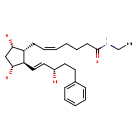
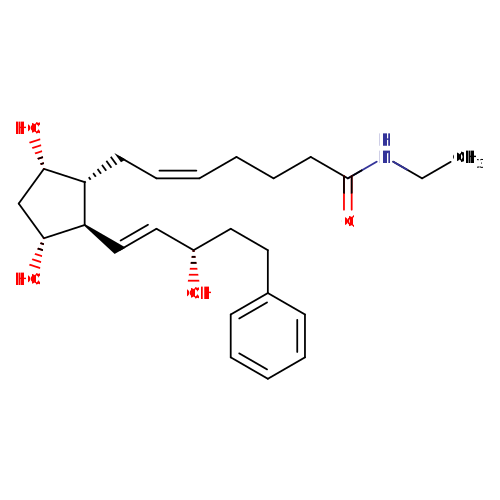
Structure for Bimatoprost (DB00905)
- Weight
- Average: 415.5656
Monoisotopic: 415.272258677 - Chemical Formula
- C25H37NO4
- Synonyms
- (Z)-7-((1R,2R,3R,5S)-3,5-Dihydroxy-2-((1E,3S)-3-hydroxy-5-phenyl-1-pentenyl)cyclopentyl)-N-ethyl-5-heptenamide
- Bimatoprost
- Bimatoprostum
- External IDs
- AGN 192024
- AGN-192024

Pharmacology
- Indication
Bimatoprost is used for the reduction of elevated intraocular pressure in patients with open-angle glaucoma or ocular hypertension. These patients must be intolerant to other intraocular pressure lowering medications or inadequately responsive to other treatments.13
Bimatoprost is also indicated to treat eyelash hypotrichosis.16
 Reduce drug development failure ratesBuild, train, & validate machine-learning modelswith evidence-based and structured datasets.Build, train, & validate predictive machine-learning models with structured datasets.
- Associated Conditions
Indication Type Indication Combined Product Details Approval Level Age Group Patient Characteristics Dose Form Treatment of Hypotrichosis of the eyelashes •••••••••••• •••••••• Treatment of Increased intra ocular pressure (iop) •••••••••••• •••••• •••••••••••• •••••••• • ••••• Treatment of Increased intra ocular pressure (iop) •••••••••••• •••• ••••• •••••••• ••••• •••••••• • ••••• Treatment of Increased intraocular pressure •••••••••••• ••••••• - Contraindications & Blackbox Warnings
 Prevent Adverse Drug Events TodayTap into our Clinical API for life-saving information on contraindications & blackbox warnings, population restrictions, harmful risks, & more.Avoid life-threatening adverse drug events with our Clinical API
- Pharmacodynamics
High intraocular pressure is a major risk factor for glaucoma-related visual field loss. A linear relationship exists between intraocular pressure and the risk of damaging the optic nerve, which can lead to considerable visual impairment.13 Therefore, conditions such as ocular hypertension and glaucoma can cause dangerous elevations of intraocular pressure. Bimatoprost rapidly decreases intraocular pressure and reduces the risk for visual field loss from ocular hypertension due to various causes.13
Other effects of this drug may include gradual changes in eyelid pigmentation, changes in iris pigmentation, changes in eyelash pigmentation, growth and thickness.13 Patients should be informed of these possible effects, especially if this drug is only administered to one eye, which may noticeably change in appearance with bimatoprost treatment.13
- Mechanism of action
Bimatoprost imitates the effects of prostamides, specifically prostaglandin F2α.14 Bimatoprost mildly stimulates aqueous humor outflow, relieving elevated intraocular pressure and decreasing the risk of optic nerve damage. It is thought that bimatoprost reduces intraocular pressure (IOP) in humans by causing an increase in outflow of the aqueous humor via the trabecular meshwork and uveoscleral pathways.13 It achieves the above effects by decreasing tonographic resistance to aqueous humor outflow.6 Bimatoprost does not affect aqueous humor production.5
Target Actions Organism AProstaglandin F2-alpha receptor agonistHumans AProstaglandin E2 receptor EP1 subtype agonistHumans AProstaglandin E2 receptor EP3 subtype agonistHumans - Absorption
This drug is absorbed systemically when administered to the eye. A study was performed on 15 healthy volunteers and bimatoprost ophthalmic solution 0.03% was administered once daily for 14 days. The mean Cmax was approximately 0.08 ng/mL and AUC0-24hr was approximately 0.09 on days 7 and 14 of the study.13 By 10 minutes, peak blood concentration was achieved. Bimatoprost was not detectable at 1.5 hours after administration in most subjects. The maximum blood concentration in a study of 6 healthy volunteers was determined to be 12.2 ng/mL. Steady state was reached in the first week of dosing.13
One drug label mentions that onset of decreased intraocular pressure occurs approximately 4 hours after the first administration and the peak effect occurs in the range of 8-12 hours. Bimatoprost effects may last up to 24 hours.15
- Volume of distribution
The volume of distribution at steady state is 0.67 L/kg.13,15. It penetrates the human cornea and sclera.15
- Protein binding
- Metabolism
Bimatoprost is hydrolyzed to its active form, bimatoprost acid, in the eye.18 Bimatoprost undergoes oxidation, N-deethylation, and glucuronidation after it is systemically absorbed, and this leads to the production of various metabolites.13 In vitro studies show that CYP3A4 is an enzyme that participates in the metabolism of bimatoprost. Despite this, many enzymes and pathways metabolize bimatoprost, therefore, no significant drug-drug interactions are likely to occur.14 Glucuronidated metabolites comprise most of the excreted drug product in the blood, urine, and feces in rats.14
Hover over products below to view reaction partners
- Route of elimination
One pharmacokinetic study of bimatoprost in 6 healthy volunteers determined that 67% of the administered dose was found to be excreted in the urine while 25% of the dose was recovered in the feces.13
- Half-life
The elimination half-life of bimatoprost is approximately 45 minutes.13,14
- Clearance
The clearance was measured to be 1.5 L/hr/kg in healthy subjects receiving IV administration of bimatoprost dosed at 3.12 ug/kg.13,14
- Adverse Effects
 Improve decision support & research outcomesWith structured adverse effects data, including: blackbox warnings, adverse reactions, warning & precautions, & incidence rates. View sample adverse effects data in our new Data Library!Improve decision support & research outcomes with our structured adverse effects data.
- Toxicity
No information is available at this time regarding bimatoprost overdose in humans. Provide supportive symptomatic treatment if an overdose occurs.13
- Pathways
- Not Available
- Pharmacogenomic Effects/ADRs
- Not Available
Interactions
- Drug Interactions
- This information should not be interpreted without the help of a healthcare provider. If you believe you are experiencing an interaction, contact a healthcare provider immediately. The absence of an interaction does not necessarily mean no interactions exist.
Drug Interaction Integrate drug-drug
interactions in your softwareAcebutolol Bimatoprost may increase the hypotensive activities of Acebutolol. Aceclofenac The therapeutic efficacy of Bimatoprost can be decreased when used in combination with Aceclofenac. Acemetacin The therapeutic efficacy of Bimatoprost can be decreased when used in combination with Acemetacin. Acetylsalicylic acid The therapeutic efficacy of Bimatoprost can be decreased when used in combination with Acetylsalicylic acid. Alclofenac The therapeutic efficacy of Bimatoprost can be decreased when used in combination with Alclofenac. - Food Interactions
- No interactions found.
Products
 Drug product information from 10+ global regionsOur datasets provide approved product information including:dosage, form, labeller, route of administration, and marketing period.Access drug product information from over 10 global regions.
- Brand Name Prescription Products
Name Dosage Strength Route Labeller Marketing Start Marketing End Region Image Durysta Implant 10 ug/1 Allergan, Inc. 2020-03-04 Not applicable US 
Latisse Solution / drops 0.3 mg/1mL Ophthalmic Allergan, Inc. 2009-01-26 Not applicable US Latisse Solution 0.03 % w/v Topical Abbvie 2010-11-01 Not applicable Canada 
Latisse Solution / drops 0.3 mg/1mL Ophthalmic Physicians Total Care, Inc. 2009-07-24 2013-06-30 US Lumigan Solution / drops 0.3 mg/ml Ophthalmic Abb Vie Deutschland Gmb H & Co. Kg 2021-02-09 Not applicable EU 
- Generic Prescription Products
Name Dosage Strength Route Labeller Marketing Start Marketing End Region Image Apo-bimatoprost Solution 0.03 % w/v Topical Apotex Corporation Not applicable Not applicable Canada Apo-bimatoprost Solution 0.03 % w/v Ophthalmic Apotex Corporation Not applicable Not applicable Canada Bimatoprost Solution / drops 0.3 mg/1mL Ophthalmic Alembic Pharmaceuticals Inc. 2019-04-12 Not applicable US Bimatoprost Solution / drops 0.3 mg/1mL Ophthalmic Akorn 2018-11-12 Not applicable US Bimatoprost Solution / drops 0.3 mg/1mL Ophthalmic Fosun Pharma USA Inc. 2020-08-10 Not applicable US - Mixture Products
Name Ingredients Dosage Route Labeller Marketing Start Marketing End Region Image BEMATORİN-T 0,3 MG + 5 MG/1 ML GÖZ DAMLASI, ÇÖZELTİ, 1 ADET Bimatoprost (0.3 mg/ml) + Timolol (5 mg/ml) Solution / drops Ophthalmic Deva Holding A.S. 2017-04-21 Not applicable Turkey 
BİMAPRESS DUO 0,3 MG/ML+5 MG/ML GÖZ DAMLASI, ÇÖZELTİ, 1 ADET Bimatoprost (0.3 mg/mL) + Timolol (5 mg/mL) Solution / drops Ophthalmic ROMPHARM İLAÇ SAN. VE TİC. LTD. ŞTİ. 2018-03-29 Not applicable Turkey BİMASOPT %0.03+%0.5 GÖZ DAMLASI, ÇÖZELTİ, 1 ADET Bimatoprost (0.03 %) + Timolol (0.5 %) Solution / drops Ophthalmic World Medicine Ilac San. Ve Tic. a.s. 2018-06-05 Not applicable Turkey Bimatoprost/Timolol 1A Pharma 0,3 mg/ml + 5 mg/ml - Augentropfen, Lösung Bimatoprost (0.3 mg/ml) + Timolol (5 mg/ml) Solution / drops Ophthalmic 1 A Pharma Gmb H 2017-07-21 Not applicable Austria 
Bimatoprost/Timolol STADA 0,3 mg/ml + 5 mg/ml Augentropfen, Lösung Bimatoprost (0.3 mg/ml) + Timolol (5 mg/ml) Solution / drops Ophthalmic Stada Arzneimittel Gmb H 2017-08-17 Not applicable Austria
Categories
- ATC Codes
- S01EE03 — Bimatoprost
- Drug Categories
- Amides
- Antiglaucoma Preparations and Miotics
- Antihypertensive Agents
- Autacoids
- Biological Factors
- Cardiovascular Agents
- Cytochrome P-450 CYP3A Substrates
- Cytochrome P-450 CYP3A4 Substrates
- Cytochrome P-450 CYP3A5 Substrates
- Cytochrome P-450 Substrates
- Drugs that are Mainly Renally Excreted
- Eicosanoids
- Fatty Acids
- Fatty Acids, Unsaturated
- Inflammation Mediators
- Lipids
- Ophthalmologicals
- Prostaglandin analogs reducing intraocular pressure (IOP)
- Prostaglandins
- Prostaglandins F, Synthetic
- Prostaglandins, Synthetic
- Sensory Organs
- Chemical TaxonomyProvided by Classyfire
- Description
- This compound belongs to the class of organic compounds known as prostaglandins and related compounds. These are unsaturated carboxylic acids consisting of a 20 carbon skeleton that also contains a five member ring, and are based upon the fatty acid arachidonic acid.
- Kingdom
- Organic compounds
- Super Class
- Lipids and lipid-like molecules
- Class
- Fatty Acyls
- Sub Class
- Eicosanoids
- Direct Parent
- Prostaglandins and related compounds
- Alternative Parents
- N-acyl amines / Cyclopentanols / Benzene and substituted derivatives / Secondary carboxylic acid amides / Cyclic alcohols and derivatives / Organopnictogen compounds / Organonitrogen compounds / Organic oxides / Hydrocarbon derivatives / Carbonyl compounds
- Substituents
- Alcohol / Aromatic homomonocyclic compound / Benzenoid / Carbonyl group / Carboxamide group / Carboxylic acid derivative / Cyclic alcohol / Cyclopentanol / Fatty amide / Hydrocarbon derivative
- Molecular Framework
- Aromatic homomonocyclic compounds
- External Descriptors
- monocarboxylic acid amide (CHEBI:51230)
- Affected organisms
- Humans and other mammals
Chemical Identifiers
- UNII
- QXS94885MZ
- CAS number
- 155206-00-1
- InChI Key
- AQOKCDNYWBIDND-FTOWTWDKSA-N
- InChI
- InChI=1S/C25H37NO4/c1-2-26-25(30)13-9-4-3-8-12-21-22(24(29)18-23(21)28)17-16-20(27)15-14-19-10-6-5-7-11-19/h3,5-8,10-11,16-17,20-24,27-29H,2,4,9,12-15,18H2,1H3,(H,26,30)/b8-3-,17-16+/t20-,21+,22+,23-,24+/m0/s1
- IUPAC Name
- (5Z)-7-[(1R,2R,3R,5S)-3,5-dihydroxy-2-[(1E,3S)-3-hydroxy-5-phenylpent-1-en-1-yl]cyclopentyl]-N-ethylhept-5-enamide
- SMILES
- CCNC(=O)CCC\C=C/C[C@H]1[C@@H](O)C[C@@H](O)[C@@H]1\C=C\[C@@H](O)CCC1=CC=CC=C1
References
- Synthesis Reference
Jiang Xing Chen, "Process for the production of intermediates for making prostaglandin derivatives such as latanaprost, travaprost, and bimatoprost." U.S. Patent US20090287003, issued November 19, 2009.
US20090287003- General References
- Chen MJ, Cheng CY, Chen YC, Chou CK, Hsu WM: Effects of bimatoprost 0.03% on ocular hemodynamics in normal tension glaucoma. J Ocul Pharmacol Ther. 2006 Jun;22(3):188-93. [Article]
- Kruse P, Rieck P, Sherif Z, Liekfeld A: [Cystoid macular edema in a pseudophakic patient after several glaucoma procedures. Is local therapy with bimatoprost the reason?]. Klin Monbl Augenheilkd. 2006 Jun;223(6):534-7. [Article]
- Steinhauser SL: Decreased high-density lipoprotein serum levels associated with topical bimatoprost therapy. Optometry. 2006 Apr;77(4):177-9. [Article]
- Woodward DF, Krauss AH, Chen J, Lai RK, Spada CS, Burk RM, Andrews SW, Shi L, Liang Y, Kedzie KM, Chen R, Gil DW, Kharlamb A, Archeampong A, Ling J, Madhu C, Ni J, Rix P, Usansky J, Usansky H, Weber A, Welty D, Yang W, Tang-Liu DD, Garst ME, Brar B, Wheeler LA, Kaplan LJ: The pharmacology of bimatoprost (Lumigan). Surv Ophthalmol. 2001 May;45 Suppl 4:S337-45. [Article]
- Lim KS, Nau CB, O'Byrne MM, Hodge DO, Toris CB, McLaren JW, Johnson DH: Mechanism of action of bimatoprost, latanoprost, and travoprost in healthy subjects. A crossover study. Ophthalmology. 2008 May;115(5):790-795.e4. doi: 10.1016/j.ophtha.2007.07.002. [Article]
- Brubaker RF: Mechanism of action of bimatoprost (Lumigan). Surv Ophthalmol. 2001 May;45 Suppl 4:S347-51. [Article]
- Christiansen GA, Nau CB, McLaren JW, Johnson DH: Mechanism of ocular hypotensive action of bimatoprost (Lumigan) in patients with ocular hypertension or glaucoma. Ophthalmology. 2004 Sep;111(9):1658-62. [Article]
- Easthope SE, Perry CM: Topical bimatoprost: a review of its use in open-angle glaucoma and ocular hypertension. Drugs Aging. 2002;19(3):231-48. [Article]
- Patil AJ, Vajaranant TS, Edward DP: Bimatoprost - a review. Expert Opin Pharmacother. 2009 Nov;10(16):2759-68. doi: 10.1517/14656560903292649. [Article]
- Woodward DF, Liang Y, Krauss AH: Prostamides (prostaglandin-ethanolamides) and their pharmacology. Br J Pharmacol. 2008 Feb;153(3):410-9. doi: 10.1038/sj.bjp.0707434. Epub 2007 Aug 27. [Article]
- Law SK: Bimatoprost in the treatment of eyelash hypotrichosis. Clin Ophthalmol. 2010 Apr 26;4:349-58. doi: 10.2147/opth.s6480. [Article]
- Jha AK, Sarkar R, Udayan UK, Roy PK, Jha AK, Chaudhary RKP: Bimatoprost in Dermatology. Indian Dermatol Online J. 2018 May-Jun;9(3):224-228. doi: 10.4103/idoj.IDOJ_62_16. [Article]
- FDA Approved Drug Products: Lumigan (bimatoprost) ophthalmic solution [Link]
- Allergen monograph, Bimatoprost [Link]
- Bitamaprost MedSafe NZ [Link]
- Latisse FDA label [Link]
- FDA Approved Drug Products: Apadaz (benzhydrocodone and acetaminophen) tablets [Link]
- Bimataprost metabolism, MDPI [Link]
- CaymanChem: Bimatoprost MSDS [Link]
- FDA Approved Products: Durysta (bimatoprost) implant for intracameral administration [Link]
- External Links
- Human Metabolome Database
- HMDB0015041
- KEGG Drug
- D02724
- PubChem Compound
- 5311027
- PubChem Substance
- 46505334
- ChemSpider
- 4470565
- BindingDB
- 220120
- 283810
- ChEBI
- 51230
- ChEMBL
- CHEMBL1200963
- ZINC
- ZINC000004474405
- Therapeutic Targets Database
- DAP001217
- PharmGKB
- PA164748867
- Guide to Pharmacology
- GtP Drug Page
- PDBe Ligand
- 15M
- RxList
- RxList Drug Page
- Drugs.com
- Drugs.com Drug Page
- PDRhealth
- PDRhealth Drug Page
- Wikipedia
- Bimatoprost
- PDB Entries
- 2f38
Clinical Trials
- Clinical Trials
Phase Status Purpose Conditions Count 4 Completed Not Available Glaucoma 4 4 Completed Diagnostic Glaucoma / Ocular Hypertension 1 4 Completed Treatment Alopecia Areata (AA) / Eyelash Hypotrichosis 1 4 Completed Treatment Anterior Uveitis (AU) / Macular Edema, Cystoid 1 4 Completed Treatment Application Site Pigmentation Changes / Glaucoma 1
Pharmacoeconomics
- Manufacturers
- Allergan inc
- Packagers
- Allergan Inc.
- Physicians Total Care Inc.
- Dosage Forms
Form Route Strength Solution Ophthalmic 0.03 % w/v Solution / drops Ophthalmic 0.01 % Solution / drops Ophthalmic 0.03 % Solution / drops Ophthalmic Solution / drops Ophthalmic 0.3 mg Solution / drops; suspension / drops Ophthalmic 0.3 MG/ML Solution Topical 3 ug/1mL Solution / drops Ophthalmic Solution / drops Ophthalmic 0.1 mg/ml Solution / drops Ophthalmic 0.3 mg/ml Solution Ophthalmic 0.3 mg Solution Ophthalmic 0.03 %w/v Implant 10 ug/1 Gel Ophthalmic 0.1 MG/G Solution / drops; suspension / drops Ophthalmic Solution Ophthalmic 0.3 mg/ml Liquid Ophthalmic Solution Ophthalmic Solution Conjunctival; Ophthalmic Solution Ophthalmic 0.100 mg Solution Topical 0.03 % w/v Solution Ophthalmic 0.03 % Solution / drops Ophthalmic 0.1 mg/1mL Solution / drops Ophthalmic 0.3 mg/1mL Solution Ophthalmic 0.01 % w/v Solution Ophthalmic 0.1 mg Solution Conjunctival; Ophthalmic 0.3 mg Solution Ophthalmic 0.1 mg/1ml Solution / drops; suspension / drops Ophthalmic 0.1 MG/ML Solution Ophthalmic 0.12 mg Solution Ophthalmic; Topical 0.12 mg Solution Ophthalmic 0.300 mg Solution Ophthalmic 0.30 mg - Prices
Unit description Cost Unit Lumigan .03% 7.5ml Bottle 279.56USD bottle Lumigan .03% 5ml Bottle 171.4USD bottle Lumigan .03% 2.5ml Bottle 91.16USD bottle Lumigan 0.03% eye drops 44.82USD ml Latisse 0.03% eyelash solution 36.0USD ml Lumigan 0.03 % Solution 12.18USD ml DrugBank does not sell nor buy drugs. Pricing information is supplied for informational purposes only.- Patents
Patent Number Pediatric Extension Approved Expires (estimated) Region US6403649 No 2002-06-11 2012-09-21 US CA2585691 No 2009-05-19 2026-03-14 Canada CA2144967 No 2003-11-11 2013-09-09 Canada US8299118 No 2012-10-30 2025-03-16 US US8309605 No 2012-11-13 2025-03-16 US US8338479 No 2012-12-25 2025-03-16 US US8586630 No 2013-11-19 2025-03-16 US US8524777 No 2013-09-03 2025-03-16 US US8772338 No 2014-07-08 2025-03-16 US US9155716 No 2015-10-13 2025-03-16 US US9241918 No 2016-01-26 2025-03-16 US US7851504 No 2010-12-14 2027-06-13 US US8933120 No 2015-01-13 2025-03-16 US US8933127 No 2015-01-13 2025-03-16 US US8278353 No 2012-10-02 2025-03-16 US US7033605 No 2006-04-25 2020-10-20 US US8906962 No 2014-12-09 2021-01-31 US US8038988 No 2011-10-18 2023-08-25 US US8101161 No 2012-01-24 2024-05-25 US US8263054 No 2012-09-11 2023-01-15 US US8632760 No 2014-01-21 2023-01-15 US US8758733 No 2014-06-24 2023-01-15 US US8926953 No 2015-01-06 2023-01-15 US US8541466 No 2013-09-24 2021-01-31 US US7388029 No 2008-06-17 2022-01-21 US US7351404 No 2008-04-01 2024-05-25 US US9216183 No 2015-12-22 2023-01-15 US US9226931 No 2016-01-05 2023-01-15 US US8986715 No 2015-03-24 2023-01-15 US US9579270 No 2017-02-28 2021-01-31 US US8206737 No 2012-06-26 2027-04-07 US US8673341 No 2014-03-18 2025-02-19 US US9980974 No 2018-05-29 2034-10-31 US US10398707 No 2019-09-03 2024-04-30 US US9149428 No 2015-10-06 2026-12-19 US US7799336 No 2010-09-21 2029-04-24 US US8629185 No 2014-01-14 2031-07-15 US US10441543 No 2019-10-15 2026-12-19 US US9492316 No 2016-11-15 2034-10-31 US
Properties
- State
- Solid
- Experimental Properties
Property Value Source melting point (°C) 63-67 https://mri.cts-mrp.eu/Human/Downloads/PT_H_1188_001_PAR.pdf boiling point (°C) 629.8 https://mri.cts-mrp.eu/Human/Downloads/PT_H_1188_001_PAR.pdf water solubility soluble in water https://mri.cts-mrp.eu/Human/Downloads/PT_H_1188_001_PAR.pdf logP 3.2 http://www.hmdb.ca/metabolites/HMDB0015041 pKa 14.3, - 0.23 http://www.hmdb.ca/metabolites/HMDB0015041 - Predicted Properties
Property Value Source Water Solubility 0.0187 mg/mL ALOGPS logP 3.41 ALOGPS logP 2.63 Chemaxon logS -4.4 ALOGPS pKa (Strongest Acidic) 14.35 Chemaxon pKa (Strongest Basic) -1.3 Chemaxon Physiological Charge 0 Chemaxon Hydrogen Acceptor Count 4 Chemaxon Hydrogen Donor Count 4 Chemaxon Polar Surface Area 89.79 Å2 Chemaxon Rotatable Bond Count 12 Chemaxon Refractivity 122.83 m3·mol-1 Chemaxon Polarizability 48.24 Å3 Chemaxon Number of Rings 2 Chemaxon Bioavailability 1 Chemaxon Rule of Five Yes Chemaxon Ghose Filter Yes Chemaxon Veber's Rule No Chemaxon MDDR-like Rule No Chemaxon - Predicted ADMET Features
Property Value Probability Human Intestinal Absorption + 0.9975 Blood Brain Barrier + 0.825 Caco-2 permeable - 0.5699 P-glycoprotein substrate Substrate 0.5541 P-glycoprotein inhibitor I Non-inhibitor 0.8671 P-glycoprotein inhibitor II Non-inhibitor 0.8616 Renal organic cation transporter Non-inhibitor 0.8078 CYP450 2C9 substrate Non-substrate 0.7703 CYP450 2D6 substrate Non-substrate 0.7406 CYP450 3A4 substrate Substrate 0.552 CYP450 1A2 substrate Non-inhibitor 0.6764 CYP450 2C9 inhibitor Non-inhibitor 0.7695 CYP450 2D6 inhibitor Non-inhibitor 0.6384 CYP450 2C19 inhibitor Non-inhibitor 0.7632 CYP450 3A4 inhibitor Non-inhibitor 0.757 CYP450 inhibitory promiscuity Low CYP Inhibitory Promiscuity 0.7049 Ames test Non AMES toxic 0.7646 Carcinogenicity Non-carcinogens 0.9257 Biodegradation Not ready biodegradable 0.6415 Rat acute toxicity 2.1085 LD50, mol/kg Not applicable hERG inhibition (predictor I) Weak inhibitor 0.9251 hERG inhibition (predictor II) Non-inhibitor 0.7822
Spectra
- Mass Spec (NIST)
- Not Available
- Spectra
Spectrum Spectrum Type Splash Key Predicted GC-MS Spectrum - GC-MS Predicted GC-MS splash10-0002-2419000000-01cbf5b797f0f438d1a6 Predicted MS/MS Spectrum - 10V, Positive (Annotated) Predicted LC-MS/MS splash10-001i-0009000000-ca941a37f653f5a4bcb3 Predicted MS/MS Spectrum - 10V, Negative (Annotated) Predicted LC-MS/MS splash10-004i-0009000000-ce99abe8cde3e37128fb Predicted MS/MS Spectrum - 20V, Positive (Annotated) Predicted LC-MS/MS splash10-001m-1249000000-08a0480562d093b75d91 Predicted MS/MS Spectrum - 20V, Negative (Annotated) Predicted LC-MS/MS splash10-0fmi-0019000000-d7ce0099ba5ff3cd4f44 Predicted MS/MS Spectrum - 40V, Negative (Annotated) Predicted LC-MS/MS splash10-054x-5589000000-3b236863bb29d78e51e9 Predicted MS/MS Spectrum - 40V, Positive (Annotated) Predicted LC-MS/MS splash10-02vi-1921000000-02310bd3325de15c1fdc Predicted 1H NMR Spectrum 1D NMR Not Applicable Predicted 13C NMR Spectrum 1D NMR Not Applicable - Chromatographic Properties
Collision Cross Sections (CCS)
Adduct CCS Value (Å2) Source type Source [M-H]- 219.4005598 predictedDarkChem Lite v0.1.0 [M-H]- 206.66043 predictedDeepCCS 1.0 (2019) [M+H]+ 220.4344598 predictedDarkChem Lite v0.1.0 [M+H]+ 208.55585 predictedDeepCCS 1.0 (2019) [M+Na]+ 219.6498598 predictedDarkChem Lite v0.1.0 [M+Na]+ 214.33376 predictedDeepCCS 1.0 (2019)
Targets

- Kind
- Protein
- Organism
- Humans
- Pharmacological action
- Yes
- Actions
- Agonist
- General Function
- Prostaglandin f receptor activity
- Specific Function
- Receptor for prostaglandin F2-alpha (PGF2-alpha). The activity of this receptor is mediated by G proteins which activate a phosphatidylinositol-calcium second messenger system. Initiates luteolysis...
- Gene Name
- PTGFR
- Uniprot ID
- P43088
- Uniprot Name
- Prostaglandin F2-alpha receptor
- Molecular Weight
- 40054.1 Da
References
- Sharif NA, Williams GW, Kelly CR: Bimatoprost and its free acid are prostaglandin FP receptor agonists. Eur J Pharmacol. 2001 Dec 7;432(2-3):211-3. [Article]
- Sharif NA, Kelly CR, Crider JY: Agonist activity of bimatoprost, travoprost, latanoprost, unoprostone isopropyl ester and other prostaglandin analogs at the cloned human ciliary body FP prostaglandin receptor. J Ocul Pharmacol Ther. 2002 Aug;18(4):313-24. [Article]
- Sharif NA, Kelly CR, Crider JY, Williams GW, Xu SX: Ocular hypotensive FP prostaglandin (PG) analogs: PG receptor subtype binding affinities and selectivities, and agonist potencies at FP and other PG receptors in cultured cells. J Ocul Pharmacol Ther. 2003 Dec;19(6):501-15. [Article]
- Lim KS, Nau CB, O'Byrne MM, Hodge DO, Toris CB, McLaren JW, Johnson DH: Mechanism of action of bimatoprost, latanoprost, and travoprost in healthy subjects. A crossover study. Ophthalmology. 2008 May;115(5):790-795.e4. doi: 10.1016/j.ophtha.2007.07.002. [Article]
- Mintz EE: Group supervision: an experiential approach. Int J Group Psychother. 1978 Oct;28(4):467-9. [Article]
- Neacsu AM: [Receptors involved in the mechanism of action of topical prostaglandines]. Oftalmologia. 2009;53(2):3-7. [Article]
- Wan Z, Woodward DF, Cornell CL, Fliri HG, Martos JL, Pettit SN, Wang JW, Kharlamb AB, Wheeler LA, Garst ME, Landsverk KJ, Struble CS, Stamer WD: Bimatoprost, prostamide activity, and conventional drainage. Invest Ophthalmol Vis Sci. 2007 Sep;48(9):4107-15. [Article]
- Kind
- Protein
- Organism
- Humans
- Pharmacological action
- Yes
- Actions
- Agonist
- General Function
- Prostaglandin e receptor activity
- Specific Function
- Receptor for prostaglandin E2 (PGE2). The activity of this receptor is mediated by G(q) proteins which activate a phosphatidylinositol-calcium second messenger system. May play a role as an importa...
- Gene Name
- PTGER1
- Uniprot ID
- P34995
- Uniprot Name
- Prostaglandin E2 receptor EP1 subtype
- Molecular Weight
- 41800.655 Da
References
- Sharif NA, Kelly CR, Crider JY, Williams GW, Xu SX: Ocular hypotensive FP prostaglandin (PG) analogs: PG receptor subtype binding affinities and selectivities, and agonist potencies at FP and other PG receptors in cultured cells. J Ocul Pharmacol Ther. 2003 Dec;19(6):501-15. [Article]
- Ota T, Aihara M, Saeki T, Narumiya S, Araie M: The effects of prostaglandin analogues on prostanoid EP1, EP2, and EP3 receptor-deficient mice. Invest Ophthalmol Vis Sci. 2006 Aug;47(8):3395-9. [Article]
- Kind
- Protein
- Organism
- Humans
- Pharmacological action
- Yes
- Actions
- Agonist
- General Function
- Rna polymerase ii transcription factor activity, ligand-activated sequence-specific dna binding
- Specific Function
- Receptor for prostaglandin E2 (PGE2); the EP3 receptor may be involved in inhibition of gastric acid secretion, modulation of neurotransmitter release in central and peripheral neurons, inhibition ...
- Gene Name
- PTGER3
- Uniprot ID
- P43115
- Uniprot Name
- Prostaglandin E2 receptor EP3 subtype
- Molecular Weight
- 43309.335 Da
References
- Sharif NA, Kelly CR, Crider JY, Williams GW, Xu SX: Ocular hypotensive FP prostaglandin (PG) analogs: PG receptor subtype binding affinities and selectivities, and agonist potencies at FP and other PG receptors in cultured cells. J Ocul Pharmacol Ther. 2003 Dec;19(6):501-15. [Article]
- Gabelt BT, Hennes EA, Bendel MA, Constant CE, Okka M, Kaufman PL: Prostaglandin subtype-selective and non-selective IOP-lowering comparison in monkeys. J Ocul Pharmacol Ther. 2009 Feb;25(1):1-8. doi: 10.1089/jop.2008.0089. [Article]
- Ota T, Aihara M, Saeki T, Narumiya S, Araie M: The effects of prostaglandin analogues on prostanoid EP1, EP2, and EP3 receptor-deficient mice. Invest Ophthalmol Vis Sci. 2006 Aug;47(8):3395-9. [Article]
Enzymes
- Kind
- Protein
- Organism
- Humans
- Pharmacological action
- Unknown
- Actions
- Substrate
- General Function
- Vitamin d3 25-hydroxylase activity
- Specific Function
- Cytochromes P450 are a group of heme-thiolate monooxygenases. In liver microsomes, this enzyme is involved in an NADPH-dependent electron transport pathway. It performs a variety of oxidation react...
- Gene Name
- CYP3A4
- Uniprot ID
- P08684
- Uniprot Name
- Cytochrome P450 3A4
- Molecular Weight
- 57342.67 Da
References
- Allergen monograph, Bimatoprost [Link]
- Kind
- Protein
- Organism
- Humans
- Pharmacological action
- Unknown
- Actions
- Substrate
- General Function
- Oxygen binding
- Specific Function
- Cytochromes P450 are a group of heme-thiolate monooxygenases. In liver microsomes, this enzyme is involved in an NADPH-dependent electron transport pathway. It oxidizes a variety of structurally un...
- Gene Name
- CYP3A5
- Uniprot ID
- P20815
- Uniprot Name
- Cytochrome P450 3A5
- Molecular Weight
- 57108.065 Da
References
- Allergen monograph, Bimatoprost [Link]

Drug created at June 13, 2005 13:24 / Updated at April 27, 2024 09:44