Identification
- Summary
Zonisamide is a sulfonamide anticonvulsant used to treat partial seizures.
- Brand Names
- Zonegran, Zonisade
- Generic Name
- Zonisamide
- DrugBank Accession Number
- DB00909
- Background
Zonisamide is a sulfonamide anticonvulsant used as an adjunctive therapy in adults with partial-onset seizures.7,8 Zonisamide may act by blocking repetitive firing of voltage-gated sodium channels, leading to a reduction of T-type calcium channel currents or by binding allosterically to GABA receptors. This latter action may inhibit the uptake of the inhibitory neurotransmitter GABA while enhancing the uptake of the excitatory neurotransmitter glutamate.7,8 Zonisamide represents an alternative for patients that remain refractory to established antiepileptic drugs. In 1989, it was approved for commercial use in Japan. The US and Europe approved it in 2000 and 2005, respectively.1,4
- Type
- Small Molecule
- Groups
- Approved, Investigational
- Structure
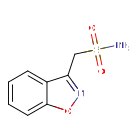
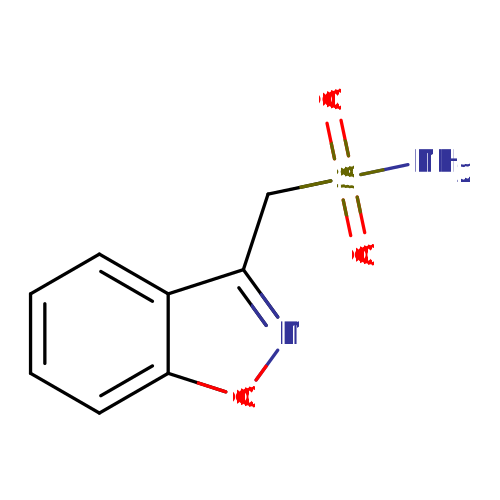
Structure for Zonisamide (DB00909)
- Weight
- Average: 212.226
Monoisotopic: 212.025562822 - Chemical Formula
- C8H8N2O3S
- Synonyms
- 1,2-Benzisoxazole-3-methanesulfonamide
- 3-(Sulfamoylmethyl)-1,2-benzisoxazole
- Benzo[d]isoxazol-3-yl-methanesulfonamide
- Zonisamida
- Zonisamide
- Zonisamidum
- External IDs
- AD-810
- CI-912
- PD-110843

Pharmacology
- Indication
Zonisamide capsules are indicated as adjunctive therapy in the treatment of partial seizures in adults with epilepsy.7 Zonisamide oral suspension is indicated as adjunctive therapy for the treatment of partial-onset seizures in adults and pediatric patients 16 years of age and older.8
 Reduce drug development failure ratesBuild, train, & validate machine-learning modelswith evidence-based and structured datasets.Build, train, & validate predictive machine-learning models with structured datasets.
- Associated Conditions
Indication Type Indication Combined Product Details Approval Level Age Group Patient Characteristics Dose Form Adjunct therapy in treatment of Partial-onset seizures •••••••••••• ••••• ••••••• Adjunct therapy in treatment of Partial-onset seizures •••••••••••• •••••••••• - Contraindications & Blackbox Warnings
 Prevent Adverse Drug Events TodayTap into our Clinical API for life-saving information on contraindications & blackbox warnings, population restrictions, harmful risks, & more.Avoid life-threatening adverse drug events with our Clinical API
- Pharmacodynamics
By stopping the spread of seizure discharges, zonisamide prevents the extensor component of tonic convulsion, restricts the spread of focal seizures and prevents the propagation of seizures from the cortex to subcortical structures.4,5 In animal models, zonisamide was effective against tonic extension seizures but ineffective against clonic seizures. It also increased the threshold for generalized seizures and reduced the duration of cortical focal seizures.7 Aside from its antiepileptic effects, zonisamide is capable of activating neuroprotective mechanisms. It inhibits nitric oxide synthase and reduces ischemia-induced memory impairment and lipid peroxidation.4
The use of zonisamide may lead to potentially fatal reactions. Severe reactions such as Stevens-Johnson syndrome, toxic epidermal necrolysis, fulminant hepatic necrosis, agranulocytosis, and aplastic anemia have been reported in patients treated with sulfonamides such as zonisamide. Zonisamide may also lead to the development of serious hematological events, drug reaction with eosinophilia and systemic symptoms (DRESS) and multi-organ hypersensitivity, acute myopia and secondary angle closure glaucoma, as well as suicidal behaviour and ideation.7,8 Zonisamide is a carbonic anhydrase inhibitor, which may lead to metabolic acidosis in patients treated with this drug. Its therapeutic effects due to this pharmacological action are unknown.7
- Mechanism of action
The mechanism of action by which zonisamide controls seizures has not been fully established. However, its antiepileptic properties may be due to its effects on sodium and calcium channels.7,8 Zonisamide blocks sodium channels and reduces voltage-dependent, transient inward currents, stabilizing neuronal membranes and suppressing neuronal hypersynchronization.7,8 It affects T-type calcium currents, but has no effect on L-type calcium currents.3,4,6
Zonisamide suppresses synaptically-driven electrical activity by altering the synthesis, release, and degradation of neurotransmitters, such as glutamate, gamma-aminobutyric acid (GABA), dopamine, serotonin (5-hydroxytryptamine 5-HT), and acetylcholine.4,2 Furthermore, it binds to the GABA/benzodiazepine receptor ionophore complex without producing changes in chloride flux.7,8 In vitro studies have suggested that zonisamide does not affect postsynaptic GABA or glutamate responses, nor the neuronal or glial uptake of [3H]-GABA.
- Absorption
Between 200 and 400 mg, zonisamide follows a dose-proportional pharmacokinetic profile.7,8 At concentrations higher than 800 mg, the Cmax and AUC increase in a disproportional manner, possibly due to zonisamide binding red blood cells. In healthy volunteers given 200 to 400 mg of zonisamide orally, peak plasma concentrations (Cmax) range between 2 and 5 µg/mL and are reached within 2–6 hours (Tmax).7 In healthy volunteers given 100 mg of zonisamide oral suspension, the Tmax ranged from 0.5 to 5 hours.8 Zonisamide has a high oral bioavailability (95%).4 The Tmax of zonisamide was delayed by food intake (4-6 hours); however, food has no effect on its bioavailability. Steady state is achieved 14 days after a stable dose is reached.7,8
- Volume of distribution
Following a 400 mg oral dose, zonisamide has an apparent volume of distribution (V/F) of 1.45 L/kg.7,8
- Protein binding
At concentrations between 1.0 and 7.0 μg/mL, zonisamide is approximately 40% bound to human plasma proteins.7,8 The concentration of zonisamide is 8-fold higher in red blood cells than in plasma due to its ability to bind extensively to erythrocytes. The presence of therapeutic concentrations of phenytoin, phenobarbital, or carbamazepine does not affect zonisamide protein binding.7,8
- Metabolism
Zonisamide metabolites are generated mainly by principally reductive and conjugative mechanisms. Oxidation reactions play a minor role in the metabolism of zonisamide.4 Zonisamide is metabolized by N-acetyl-transferases to form N-acetyl zonisamide and reduced to form the open ring metabolite, 2–sulfamoylacetylphenol (SMAP). The reduction of zonisamide to SMAP is mediated by CYP3A4.1,4,7,8 Zonisamide does not induce liver enzymes or its own metabolism.1
Hover over products below to view reaction partners
- Route of elimination
Zonisamide is mainly excreted as the parent drug and the glucuronide of a metabolite. Urine is the main route of zonisamide excretion, and only a small portion of this drug is excreted in feces.1 Following multiple doses of radiolabeled zonisamide, 62% of the dose was recovered in the urine, and 3% in feces by day 10. Of the excreted dose of zonisamide, 35% was recovered unchanged, 15% as N-acetyl zonisamide, and 50% as the glucuronide of 2–sulfamoylacetylphenol (SMAP).7,8
- Half-life
In plasma, the elimination half-life of zonisamide is approximately 63 hours. In red blood cells, it is approximately 105 hours.7,8
- Clearance
In patients not taking enzyme-inducing antiepilepsy drugs (AEDs), the plasma clearance of oral zonisamide is approximately 0.30-0.35 mL/min/kg. In patients treated with AEDs, this value increases to 0.5 mL/min/kg.7,8 Renal clearance is approximately 3.5 mL/min after a single-dose of zonisamide.7,8 In red blood cells, the clearance of an oral dose of zonisamide is 2 mL/min.7
- Adverse Effects
 Improve decision support & research outcomesWith structured adverse effects data, including: blackbox warnings, adverse reactions, warning & precautions, & incidence rates. View sample adverse effects data in our new Data Library!Improve decision support & research outcomes with our structured adverse effects data.
- Toxicity
Information on daily doses over 800 mg/day of zonisamide is limited. During clinical development, three patients ingested unknown amounts of zonisamide as suicide attempts, and all of them were hospitalized with central nervous system symptoms. One patient became comatose and developed bradycardia, hypotension, and respiratory depression; 31 hours after zonisamide ingestion, plasma level was 100.1 µg/mL. Zonisamide plasma levels fell with a half-life of 57 hours, and the patient became alert five days later.7,8 There are no specific antidotes for zonisamide overdosage. In case of a suspected recent overdose, emesis should be induced or gastric lavage performed with the usual precautions to protect the airway. General supportive care is indicated, including frequent monitoring of vital signs and close observation.7,8 Due to its long half-life and low protein binding, renal dialysis may be effective in treating zonisamide overdose; however, the effectiveness of this procedure has not been formally studied.8
In vivo studies found no evidence of carcinogenicity at zonisamide doses equivalent to or higher than the maximum recommended human dose (MRHD). In an in vitro chromosomal aberration assay in CHL cells, zonisamide displayed mutagenicity. Signs of reproductive toxicity were also detected in rats treated with a dose 0.5 times the MRHD.7,8
- Pathways
- Not Available
- Pharmacogenomic Effects/ADRs
- Not Available
Interactions
- Drug Interactions
- This information should not be interpreted without the help of a healthcare provider. If you believe you are experiencing an interaction, contact a healthcare provider immediately. The absence of an interaction does not necessarily mean no interactions exist.
Drug Interaction Integrate drug-drug
interactions in your software1,2-Benzodiazepine The risk or severity of CNS depression can be increased when Zonisamide is combined with 1,2-Benzodiazepine. Abacavir Zonisamide may decrease the excretion rate of Abacavir which could result in a higher serum level. Abametapir The serum concentration of Zonisamide can be increased when it is combined with Abametapir. Abatacept The metabolism of Zonisamide can be increased when combined with Abatacept. Abemaciclib The serum concentration of Abemaciclib can be increased when it is combined with Zonisamide. - Food Interactions
- Avoid alcohol. Ingesting alcohol may increase drowsiness and dizziness.
- Take with or without food.
Products
 Drug product information from 10+ global regionsOur datasets provide approved product information including:dosage, form, labeller, route of administration, and marketing period.Access drug product information from over 10 global regions.
- Product Images
- International/Other Brands
- Exceglan / Excegram
- Brand Name Prescription Products
Name Dosage Strength Route Labeller Marketing Start Marketing End Region Image Zonegran Tablet, orally disintegrating 300 mg Oral Amdipharm Limited 2016-09-20 2020-02-07 EU 
Zonegran Capsule 100 mg/1 Oral Eisai Limited 2000-03-27 2018-10-31 US 
Zonegran Tablet, orally disintegrating 100 mg Oral Amdipharm Limited 2016-09-20 2020-02-07 EU Zonegran Tablet, orally disintegrating 25 mg Oral Amdipharm Limited 2016-09-20 2020-02-07 EU Zonegran Capsule 50 mg Oral Amdipharm Limited 2016-09-20 Not applicable EU - Generic Prescription Products
Name Dosage Strength Route Labeller Marketing Start Marketing End Region Image Zonisamide Capsule 25 mg/1 Oral Amerincan Health Packaging 2009-12-10 2014-05-31 US Zonisamide Capsule 100 mg/1 Oral Golden State Medical Supply, Inc. 2006-03-17 2023-03-31 US Zonisamide Capsule 50 mg/1 Oral Barr Laboratories 2010-11-17 2010-11-18 US Zonisamide Capsule 100 mg/1 Oral Apotex Corp. 2005-12-22 2012-03-31 US Zonisamide Capsule 25 mg/1 Oral Mylan Pharmaceuticals Inc. 2005-12-23 2019-11-30 US


Categories
- ATC Codes
- N03AX15 — ZonisamideG01AE10 — Combinations of sulfonamides
- Drug Categories
- Agents causing hyperkalemia
- Amides
- Anti-epileptic Agent
- Antiarrhythmic agents
- Anticonvulsants
- Bradycardia-Causing Agents
- Calcium Channel Blockers
- Calcium-Regulating Hormones and Agents
- Carbonic Anhydrase Inhibitors
- Cardiovascular Agents
- Central Nervous System Agents
- Central Nervous System Depressants
- Compounds used in a research, industrial, or household setting
- Cytochrome P-450 CYP2C19 Inhibitors
- Cytochrome P-450 CYP2C19 Inhibitors (weak)
- Cytochrome P-450 CYP2C19 Substrates
- Cytochrome P-450 CYP3A Substrates
- Cytochrome P-450 CYP3A4 Substrates
- Cytochrome P-450 CYP3A5 Substrates
- Cytochrome P-450 Enzyme Inhibitors
- Cytochrome P-450 Substrates
- Decreased Central Nervous System Disorganized Electrical Activity
- Diuretics
- Drugs that are Mainly Renally Excreted
- Isoxazoles
- Membrane Transport Modulators
- Monoamine Oxidase A Inhibitors for interaction with Monoamine Oxidase A substrates
- Nervous System
- P-glycoprotein inhibitors
- Potential QTc-Prolonging Agents
- QTc Prolonging Agents
- Sulfonamides
- Sulfones
- Sulfur Compounds
- UGT1A1 Substrates
- Chemical TaxonomyProvided by Classyfire
- Description
- This compound belongs to the class of organic compounds known as benzisoxazoles. These are aromatic compounds containing a benzene ring fused to an isoxazole ring. Isoxazole is five-membered ring with three carbon atoms, and an oxygen atom next to a nitrogen atom.
- Kingdom
- Organic compounds
- Super Class
- Organoheterocyclic compounds
- Class
- Benzisoxazoles
- Sub Class
- Not Available
- Direct Parent
- Benzisoxazoles
- Alternative Parents
- Organosulfonamides / Organic sulfonamides / Benzenoids / Isoxazoles / Heteroaromatic compounds / Aminosulfonyl compounds / Oxacyclic compounds / Azacyclic compounds / Organopnictogen compounds / Organooxygen compounds show 3 more
- Substituents
- Aminosulfonyl compound / Aromatic heteropolycyclic compound / Azacycle / Azole / Benzenoid / Benzisoxazole / Heteroaromatic compound / Hydrocarbon derivative / Isoxazole / Organic nitrogen compound show 12 more
- Molecular Framework
- Aromatic heteropolycyclic compounds
- External Descriptors
- sulfonamide, 1,2-benzoxazoles (CHEBI:10127)
- Affected organisms
- Humans and other mammals
Chemical Identifiers
- UNII
- 459384H98V
- CAS number
- 68291-97-4
- InChI Key
- UBQNRHZMVUUOMG-UHFFFAOYSA-N
- InChI
- InChI=1S/C8H8N2O3S/c9-14(11,12)5-7-6-3-1-2-4-8(6)13-10-7/h1-4H,5H2,(H2,9,11,12)
- IUPAC Name
- (1,2-benzoxazol-3-yl)methanesulfonamide
- SMILES
- NS(=O)(=O)CC1=NOC2=CC=CC=C12
References
- Synthesis Reference
Nidam, T. et al. Novel sulfonation method for zonisamide intermediate in zonisamide synthesis and their novel crystal forms. (2003) U.S. Patent US 2003/0144527 A1. Available at: https://patentimages.storage.googleapis.com/25/24/0f/19d95f38252d52/US20030144527A1.pdf
US20030114682- General References
- Leppik IE: Zonisamide: chemistry, mechanism of action, and pharmacokinetics. Seizure. 2004 Dec;13 Suppl 1:S5-9; discussion S10. [Article]
- Ueda Y, Doi T, Tokumaru J, Willmore LJ: Effect of zonisamide on molecular regulation of glutamate and GABA transporter proteins during epileptogenesis in rats with hippocampal seizures. Brain Res Mol Brain Res. 2003 Aug 19;116(1-2):1-6. [Article]
- Schulze-Bonhage A: Zonisamide in the treatment of epilepsy. Expert Opin Pharmacother. 2010 Jan;11(1):115-26. doi: 10.1517/14656560903468728. [Article]
- Kothare SV, Kaleyias J: Zonisamide: review of pharmacology, clinical efficacy, tolerability, and safety. Expert Opin Drug Metab Toxicol. 2008 Apr;4(4):493-506. doi: 10.1517/17425255.4.4.493 . [Article]
- Peters DH, Sorkin EM: Zonisamide. A review of its pharmacodynamic and pharmacokinetic properties, and therapeutic potential in epilepsy. Drugs. 1993 May;45(5):760-87. [Article]
- Sobieszek G, Borowicz KK, Kimber-Trojnar Z, Malek R, Piskorska B, Czuczwar SJ: Zonisamide: a new antiepileptic drug. Pol J Pharmacol. 2003 Sep-Oct;55(5):683-9. [Article]
- FDA Approved Drug Products: ZONEGRAN (zonisamide) capsules for oral use [Link]
- FDA Approved Drug Products: ZONISADE (zonisamide) suspension for oral use [Link]
- External Links
- Human Metabolome Database
- HMDB0015045
- KEGG Drug
- D00538
- KEGG Compound
- C07504
- PubChem Compound
- 5734
- PubChem Substance
- 46505278
- ChemSpider
- 5532
- BindingDB
- 50028010
- 39998
- ChEBI
- 10127
- ChEMBL
- CHEMBL750
- ZINC
- ZINC000000004321
- Therapeutic Targets Database
- DAP000500
- PharmGKB
- PA451978
- PDBe Ligand
- ZON
- RxList
- RxList Drug Page
- Drugs.com
- Drugs.com Drug Page
- PDRhealth
- PDRhealth Drug Page
- Wikipedia
- Zonisamide
- PDB Entries
- 3po7
- FDA label
- Download (124 KB)
- MSDS
- Download (58.3 KB)
Clinical Trials
- Clinical Trials
Phase Status Purpose Conditions Count 4 Active Not Recruiting Treatment Partial Epilepsy 1 4 Completed Treatment Alcohol Abuse / Alcohol Dependency 1 4 Completed Treatment Epilepsy 7 4 Completed Treatment Obesity 1 4 Completed Treatment Partial Epilepsy 1
Pharmacoeconomics
- Manufacturers
- Eisai inc
- Alphapharm party ltd
- Apotex inc etobicoke site
- Banner pharmacaps inc
- Barr laboratories inc
- Corepharma llc
- Dr reddys laboratories ltd
- Glenmark generics inc usa
- Invagen pharmaceuticals inc
- Mutual pharmaceutical co inc
- Mylan pharmaceuticals inc
- Roxane laboratories inc
- Sandoz inc
- Sun pharmaceutical industries ltd
- Teva pharmaceuticals usa
- Watson laboratories inc
- Wockhardt ltd
- Zydus pharmaceuticals usa inc
- Packagers
- Alphapharm Party Ltd.
- Amerisource Health Services Corp.
- Apotex Inc.
- Barr Pharmaceuticals
- Bryant Ranch Prepack
- Corepharma LLC
- Diversified Healthcare Services Inc.
- Doctor Reddys Laboratories Ltd.
- Eisai Inc.
- Elan Pharmaceuticals Inc.
- Eon Labs
- Genpharm LP
- Glenmark Generics Ltd.
- Heartland Repack Services LLC
- InvaGen Pharmaceuticals Inc.
- Kaiser Foundation Hospital
- Lake Erie Medical and Surgical Supply
- Murfreesboro Pharmaceutical Nursing Supply
- Mylan
- Nucare Pharmaceuticals Inc.
- Physicians Total Care Inc.
- Ranbaxy Laboratories
- Rebel Distributors Corp.
- Resource Optimization and Innovation LLC
- Southwood Pharmaceuticals
- Stat Rx Usa
- Sun Pharmaceutical Industries Ltd.
- Teva Pharmaceutical Industries Ltd.
- UDL Laboratories
- Vangard Labs Inc.
- Wockhardt Ltd.
- Dosage Forms
Form Route Strength Capsule Oral 25 mg Tablet, film coated Oral Tablet, orally disintegrating Oral 100 mg Tablet, orally disintegrating Oral 25 mg Tablet, orally disintegrating Oral 300 mg Tablet, orally disintegrating Oral 50 mg Tablet, coated Oral 100 mg Tablet, film coated Oral 100 mg Tablet Oral Capsule Oral 100 mg Capsule Oral 50 mg Suspension Oral 100 mg/5mL Capsule Oral 100 mg/1 Capsule Oral 25 mg/1 Capsule Oral 50 mg/1 Powder Not applicable 1 g/1g Capsule Oral Suspension Oral 20 MG/ML - Prices
Unit description Cost Unit Zonegran 100 mg capsule 3.33USD capsule Zonisamide 100 mg capsule 2.24USD capsule Zonegran 50 mg capsule 1.22USD capsule Zonisamide 50 mg capsule 1.12USD capsule Zonegran 25 mg capsule 0.94USD capsule Zonisamide 25 mg capsule 0.56USD capsule DrugBank does not sell nor buy drugs. Pricing information is supplied for informational purposes only.- Patents
Patent Number Pediatric Extension Approved Expires (estimated) Region US11478456 No 2018-08-18 2038-08-18 US US11529333 No 2018-08-18 2038-08-18 US
Properties
- State
- Solid
- Experimental Properties
Property Value Source melting point (°C) 161-163 °C Dasgupta A. et al. Therapeutic Drug Monitoring Data: A Concise Guide. Academic Press, 2019, 4th edition. water solubility 0.8 mg/mL FDA Label logP 0.5 Not Available pKa 10.2 FDA Label - Predicted Properties
Property Value Source Water Solubility 2.09 mg/mL ALOGPS logP 0.67 ALOGPS logP 0.11 Chemaxon logS -2 ALOGPS pKa (Strongest Acidic) 9.84 Chemaxon pKa (Strongest Basic) -1.7 Chemaxon Physiological Charge 0 Chemaxon Hydrogen Acceptor Count 3 Chemaxon Hydrogen Donor Count 1 Chemaxon Polar Surface Area 86.19 Å2 Chemaxon Rotatable Bond Count 2 Chemaxon Refractivity 50.3 m3·mol-1 Chemaxon Polarizability 19.48 Å3 Chemaxon Number of Rings 2 Chemaxon Bioavailability 1 Chemaxon Rule of Five Yes Chemaxon Ghose Filter Yes Chemaxon Veber's Rule No Chemaxon MDDR-like Rule No Chemaxon - Predicted ADMET Features
Property Value Probability Human Intestinal Absorption + 1.0 Blood Brain Barrier + 0.9755 Caco-2 permeable - 0.6385 P-glycoprotein substrate Non-substrate 0.8681 P-glycoprotein inhibitor I Non-inhibitor 0.9258 P-glycoprotein inhibitor II Non-inhibitor 0.9513 Renal organic cation transporter Non-inhibitor 0.8463 CYP450 2C9 substrate Non-substrate 0.8828 CYP450 2D6 substrate Non-substrate 0.9116 CYP450 3A4 substrate Non-substrate 0.5419 CYP450 1A2 substrate Non-inhibitor 0.5762 CYP450 2C9 inhibitor Non-inhibitor 0.697 CYP450 2D6 inhibitor Non-inhibitor 0.8081 CYP450 2C19 inhibitor Non-inhibitor 0.6007 CYP450 3A4 inhibitor Non-inhibitor 0.8141 CYP450 inhibitory promiscuity Low CYP Inhibitory Promiscuity 0.7315 Ames test Non AMES toxic 0.6276 Carcinogenicity Non-carcinogens 0.7572 Biodegradation Not ready biodegradable 0.9708 Rat acute toxicity 2.0592 LD50, mol/kg Not applicable hERG inhibition (predictor I) Weak inhibitor 0.8549 hERG inhibition (predictor II) Non-inhibitor 0.8937
Spectra
- Mass Spec (NIST)
- Not Available
- Spectra
- Chromatographic Properties
Collision Cross Sections (CCS)
Adduct CCS Value (Å2) Source type Source [M-H]- 144.6951952 predictedDarkChem Lite v0.1.0 [M-H]- 144.6683952 predictedDarkChem Lite v0.1.0 [M-H]- 134.74054 predictedDeepCCS 1.0 (2019) [M+H]+ 145.1431952 predictedDarkChem Lite v0.1.0 [M+H]+ 145.3481952 predictedDarkChem Lite v0.1.0 [M+H]+ 137.1361 predictedDeepCCS 1.0 (2019) [M+Na]+ 145.0032952 predictedDarkChem Lite v0.1.0 [M+Na]+ 144.56233 predictedDeepCCS 1.0 (2019)
Targets

- Kind
- Protein
- Organism
- Humans
- Pharmacological action
- Yes
- Actions
- Inhibitor
- General Function
- Voltage-gated sodium channel activity
- Specific Function
- Mediates the voltage-dependent sodium ion permeability of excitable membranes. Assuming opened or closed conformations in response to the voltage difference across the membrane, the protein forms a...
- Gene Name
- SCN1A
- Uniprot ID
- P35498
- Uniprot Name
- Sodium channel protein type 1 subunit alpha
- Molecular Weight
- 228969.49 Da
References
- Kothare SV, Kaleyias J: Zonisamide: review of pharmacology, clinical efficacy, tolerability, and safety. Expert Opin Drug Metab Toxicol. 2008 Apr;4(4):493-506. doi: 10.1517/17425255.4.4.493 . [Article]
- Schulze-Bonhage A: Zonisamide in the treatment of epilepsy. Expert Opin Pharmacother. 2010 Jan;11(1):115-26. doi: 10.1517/14656560903468728. [Article]
- Sobieszek G, Borowicz KK, Kimber-Trojnar Z, Malek R, Piskorska B, Czuczwar SJ: Zonisamide: a new antiepileptic drug. Pol J Pharmacol. 2003 Sep-Oct;55(5):683-9. [Article]
- Janszky J: [Role of zonisamid in treating epilepsy, Parkinson disorders and other neurological diseases]. Ideggyogy Sz. 2009 Nov 30;62(11-12):383-9. [Article]
- Sonsalla PK, Wong LY, Winnik B, Buckley B: The antiepileptic drug zonisamide inhibits MAO-B and attenuates MPTP toxicity in mice: clinical relevance. Exp Neurol. 2010 Feb;221(2):329-34. doi: 10.1016/j.expneurol.2009.11.018. Epub 2009 Dec 4. [Article]
- Leppik IE: Zonisamide: chemistry, mechanism of action, and pharmacokinetics. Seizure. 2004 Dec;13 Suppl 1:S5-9; discussion S10. [Article]
- Zaccara G, Specchio LM: Long-term safety and effectiveness of zonisamide in the treatment of epilepsy: a review of the literature. Neuropsychiatr Dis Treat. 2009;5:249-59. Epub 2009 May 20. [Article]
- Kind
- Protein
- Organism
- Humans
- Pharmacological action
- Yes
- Actions
- Inhibitor
- General Function
- Voltage-gated sodium channel activity
- Specific Function
- Mediates the voltage-dependent sodium ion permeability of excitable membranes. Assuming opened or closed conformations in response to the voltage difference across the membrane, the protein forms a...
- Gene Name
- SCN2A
- Uniprot ID
- Q99250
- Uniprot Name
- Sodium channel protein type 2 subunit alpha
- Molecular Weight
- 227972.64 Da
References
- Janszky J: [Role of zonisamid in treating epilepsy, Parkinson disorders and other neurological diseases]. Ideggyogy Sz. 2009 Nov 30;62(11-12):383-9. [Article]
- Kothare SV, Kaleyias J: Zonisamide: review of pharmacology, clinical efficacy, tolerability, and safety. Expert Opin Drug Metab Toxicol. 2008 Apr;4(4):493-506. doi: 10.1517/17425255.4.4.493 . [Article]
- Schulze-Bonhage A: Zonisamide in the treatment of epilepsy. Expert Opin Pharmacother. 2010 Jan;11(1):115-26. doi: 10.1517/14656560903468728. [Article]
- Sobieszek G, Borowicz KK, Kimber-Trojnar Z, Malek R, Piskorska B, Czuczwar SJ: Zonisamide: a new antiepileptic drug. Pol J Pharmacol. 2003 Sep-Oct;55(5):683-9. [Article]
- Sonsalla PK, Wong LY, Winnik B, Buckley B: The antiepileptic drug zonisamide inhibits MAO-B and attenuates MPTP toxicity in mice: clinical relevance. Exp Neurol. 2010 Feb;221(2):329-34. doi: 10.1016/j.expneurol.2009.11.018. Epub 2009 Dec 4. [Article]
- Leppik IE: Zonisamide: chemistry, mechanism of action, and pharmacokinetics. Seizure. 2004 Dec;13 Suppl 1:S5-9; discussion S10. [Article]
- Zaccara G, Specchio LM: Long-term safety and effectiveness of zonisamide in the treatment of epilepsy: a review of the literature. Neuropsychiatr Dis Treat. 2009;5:249-59. Epub 2009 May 20. [Article]
- Kind
- Protein
- Organism
- Humans
- Pharmacological action
- Yes
- Actions
- Inhibitor
- General Function
- Voltage-gated sodium channel activity
- Specific Function
- Mediates the voltage-dependent sodium ion permeability of excitable membranes. Assuming opened or closed conformations in response to the voltage difference across the membrane, the protein forms a...
- Gene Name
- SCN3A
- Uniprot ID
- Q9NY46
- Uniprot Name
- Sodium channel protein type 3 subunit alpha
- Molecular Weight
- 226291.905 Da
References
- Janszky J: [Role of zonisamid in treating epilepsy, Parkinson disorders and other neurological diseases]. Ideggyogy Sz. 2009 Nov 30;62(11-12):383-9. [Article]
- Kothare SV, Kaleyias J: Zonisamide: review of pharmacology, clinical efficacy, tolerability, and safety. Expert Opin Drug Metab Toxicol. 2008 Apr;4(4):493-506. doi: 10.1517/17425255.4.4.493 . [Article]
- Schulze-Bonhage A: Zonisamide in the treatment of epilepsy. Expert Opin Pharmacother. 2010 Jan;11(1):115-26. doi: 10.1517/14656560903468728. [Article]
- Sobieszek G, Borowicz KK, Kimber-Trojnar Z, Malek R, Piskorska B, Czuczwar SJ: Zonisamide: a new antiepileptic drug. Pol J Pharmacol. 2003 Sep-Oct;55(5):683-9. [Article]
- Sonsalla PK, Wong LY, Winnik B, Buckley B: The antiepileptic drug zonisamide inhibits MAO-B and attenuates MPTP toxicity in mice: clinical relevance. Exp Neurol. 2010 Feb;221(2):329-34. doi: 10.1016/j.expneurol.2009.11.018. Epub 2009 Dec 4. [Article]
- Leppik IE: Zonisamide: chemistry, mechanism of action, and pharmacokinetics. Seizure. 2004 Dec;13 Suppl 1:S5-9; discussion S10. [Article]
- Zaccara G, Specchio LM: Long-term safety and effectiveness of zonisamide in the treatment of epilepsy: a review of the literature. Neuropsychiatr Dis Treat. 2009;5:249-59. Epub 2009 May 20. [Article]
- Kind
- Protein
- Organism
- Humans
- Pharmacological action
- Yes
- Actions
- Inhibitor
- General Function
- Voltage-gated sodium channel activity
- Specific Function
- This protein mediates the voltage-dependent sodium ion permeability of excitable membranes. Assuming opened or closed conformations in response to the voltage difference across the membrane, the pr...
- Gene Name
- SCN4A
- Uniprot ID
- P35499
- Uniprot Name
- Sodium channel protein type 4 subunit alpha
- Molecular Weight
- 208059.175 Da
References
- Janszky J: [Role of zonisamid in treating epilepsy, Parkinson disorders and other neurological diseases]. Ideggyogy Sz. 2009 Nov 30;62(11-12):383-9. [Article]
- Kothare SV, Kaleyias J: Zonisamide: review of pharmacology, clinical efficacy, tolerability, and safety. Expert Opin Drug Metab Toxicol. 2008 Apr;4(4):493-506. doi: 10.1517/17425255.4.4.493 . [Article]
- Schulze-Bonhage A: Zonisamide in the treatment of epilepsy. Expert Opin Pharmacother. 2010 Jan;11(1):115-26. doi: 10.1517/14656560903468728. [Article]
- Sobieszek G, Borowicz KK, Kimber-Trojnar Z, Malek R, Piskorska B, Czuczwar SJ: Zonisamide: a new antiepileptic drug. Pol J Pharmacol. 2003 Sep-Oct;55(5):683-9. [Article]
- Sonsalla PK, Wong LY, Winnik B, Buckley B: The antiepileptic drug zonisamide inhibits MAO-B and attenuates MPTP toxicity in mice: clinical relevance. Exp Neurol. 2010 Feb;221(2):329-34. doi: 10.1016/j.expneurol.2009.11.018. Epub 2009 Dec 4. [Article]
- Leppik IE: Zonisamide: chemistry, mechanism of action, and pharmacokinetics. Seizure. 2004 Dec;13 Suppl 1:S5-9; discussion S10. [Article]
- Zaccara G, Specchio LM: Long-term safety and effectiveness of zonisamide in the treatment of epilepsy: a review of the literature. Neuropsychiatr Dis Treat. 2009;5:249-59. Epub 2009 May 20. [Article]
- Kind
- Protein
- Organism
- Humans
- Pharmacological action
- Yes
- Actions
- Inhibitor
- General Function
- Voltage-gated sodium channel activity involved in sa node cell action potential
- Specific Function
- This protein mediates the voltage-dependent sodium ion permeability of excitable membranes. Assuming opened or closed conformations in response to the voltage difference across the membrane, the pr...
- Gene Name
- SCN5A
- Uniprot ID
- Q14524
- Uniprot Name
- Sodium channel protein type 5 subunit alpha
- Molecular Weight
- 226937.475 Da
References
- Janszky J: [Role of zonisamid in treating epilepsy, Parkinson disorders and other neurological diseases]. Ideggyogy Sz. 2009 Nov 30;62(11-12):383-9. [Article]
- Kothare SV, Kaleyias J: Zonisamide: review of pharmacology, clinical efficacy, tolerability, and safety. Expert Opin Drug Metab Toxicol. 2008 Apr;4(4):493-506. doi: 10.1517/17425255.4.4.493 . [Article]
- Schulze-Bonhage A: Zonisamide in the treatment of epilepsy. Expert Opin Pharmacother. 2010 Jan;11(1):115-26. doi: 10.1517/14656560903468728. [Article]
- Sobieszek G, Borowicz KK, Kimber-Trojnar Z, Malek R, Piskorska B, Czuczwar SJ: Zonisamide: a new antiepileptic drug. Pol J Pharmacol. 2003 Sep-Oct;55(5):683-9. [Article]
- Sonsalla PK, Wong LY, Winnik B, Buckley B: The antiepileptic drug zonisamide inhibits MAO-B and attenuates MPTP toxicity in mice: clinical relevance. Exp Neurol. 2010 Feb;221(2):329-34. doi: 10.1016/j.expneurol.2009.11.018. Epub 2009 Dec 4. [Article]
- Leppik IE: Zonisamide: chemistry, mechanism of action, and pharmacokinetics. Seizure. 2004 Dec;13 Suppl 1:S5-9; discussion S10. [Article]
- Zaccara G, Specchio LM: Long-term safety and effectiveness of zonisamide in the treatment of epilepsy: a review of the literature. Neuropsychiatr Dis Treat. 2009;5:249-59. Epub 2009 May 20. [Article]
- Kind
- Protein
- Organism
- Humans
- Pharmacological action
- Yes
- Actions
- Inhibitor
- General Function
- Voltage-gated sodium channel activity
- Specific Function
- Mediates the voltage-dependent sodium ion permeability of excitable membranes. Assuming opened or closed conformations in response to the voltage difference across the membrane, the protein forms a...
- Gene Name
- SCN9A
- Uniprot ID
- Q15858
- Uniprot Name
- Sodium channel protein type 9 subunit alpha
- Molecular Weight
- 226370.175 Da
References
- Janszky J: [Role of zonisamid in treating epilepsy, Parkinson disorders and other neurological diseases]. Ideggyogy Sz. 2009 Nov 30;62(11-12):383-9. [Article]
- Kothare SV, Kaleyias J: Zonisamide: review of pharmacology, clinical efficacy, tolerability, and safety. Expert Opin Drug Metab Toxicol. 2008 Apr;4(4):493-506. doi: 10.1517/17425255.4.4.493 . [Article]
- Schulze-Bonhage A: Zonisamide in the treatment of epilepsy. Expert Opin Pharmacother. 2010 Jan;11(1):115-26. doi: 10.1517/14656560903468728. [Article]
- Sobieszek G, Borowicz KK, Kimber-Trojnar Z, Malek R, Piskorska B, Czuczwar SJ: Zonisamide: a new antiepileptic drug. Pol J Pharmacol. 2003 Sep-Oct;55(5):683-9. [Article]
- Sonsalla PK, Wong LY, Winnik B, Buckley B: The antiepileptic drug zonisamide inhibits MAO-B and attenuates MPTP toxicity in mice: clinical relevance. Exp Neurol. 2010 Feb;221(2):329-34. doi: 10.1016/j.expneurol.2009.11.018. Epub 2009 Dec 4. [Article]
- Leppik IE: Zonisamide: chemistry, mechanism of action, and pharmacokinetics. Seizure. 2004 Dec;13 Suppl 1:S5-9; discussion S10. [Article]
- Zaccara G, Specchio LM: Long-term safety and effectiveness of zonisamide in the treatment of epilepsy: a review of the literature. Neuropsychiatr Dis Treat. 2009;5:249-59. Epub 2009 May 20. [Article]
- Kind
- Protein
- Organism
- Humans
- Pharmacological action
- Yes
- Actions
- Inhibitor
- General Function
- Voltage-gated sodium channel activity
- Specific Function
- This protein mediates the voltage-dependent sodium ion permeability of excitable membranes. Assuming opened or closed conformations in response to the voltage difference across the membrane, the pr...
- Gene Name
- SCN11A
- Uniprot ID
- Q9UI33
- Uniprot Name
- Sodium channel protein type 11 subunit alpha
- Molecular Weight
- 204919.66 Da
References
- Janszky J: [Role of zonisamid in treating epilepsy, Parkinson disorders and other neurological diseases]. Ideggyogy Sz. 2009 Nov 30;62(11-12):383-9. [Article]
- Kothare SV, Kaleyias J: Zonisamide: review of pharmacology, clinical efficacy, tolerability, and safety. Expert Opin Drug Metab Toxicol. 2008 Apr;4(4):493-506. doi: 10.1517/17425255.4.4.493 . [Article]
- Schulze-Bonhage A: Zonisamide in the treatment of epilepsy. Expert Opin Pharmacother. 2010 Jan;11(1):115-26. doi: 10.1517/14656560903468728. [Article]
- Sobieszek G, Borowicz KK, Kimber-Trojnar Z, Malek R, Piskorska B, Czuczwar SJ: Zonisamide: a new antiepileptic drug. Pol J Pharmacol. 2003 Sep-Oct;55(5):683-9. [Article]
- Sonsalla PK, Wong LY, Winnik B, Buckley B: The antiepileptic drug zonisamide inhibits MAO-B and attenuates MPTP toxicity in mice: clinical relevance. Exp Neurol. 2010 Feb;221(2):329-34. doi: 10.1016/j.expneurol.2009.11.018. Epub 2009 Dec 4. [Article]
- Leppik IE: Zonisamide: chemistry, mechanism of action, and pharmacokinetics. Seizure. 2004 Dec;13 Suppl 1:S5-9; discussion S10. [Article]
- Zaccara G, Specchio LM: Long-term safety and effectiveness of zonisamide in the treatment of epilepsy: a review of the literature. Neuropsychiatr Dis Treat. 2009;5:249-59. Epub 2009 May 20. [Article]
- Kind
- Protein
- Organism
- Humans
- Pharmacological action
- Yes
- Actions
- Inhibitor
- General Function
- Voltage-gated sodium channel activity involved in purkinje myocyte action potential
- Specific Function
- Crucial in the assembly, expression, and functional modulation of the heterotrimeric complex of the sodium channel. The subunit beta-1 can modulate multiple alpha subunit isoforms from brain, skele...
- Gene Name
- SCN1B
- Uniprot ID
- Q07699
- Uniprot Name
- Sodium channel subunit beta-1
- Molecular Weight
- 24706.955 Da
References
- Janszky J: [Role of zonisamid in treating epilepsy, Parkinson disorders and other neurological diseases]. Ideggyogy Sz. 2009 Nov 30;62(11-12):383-9. [Article]
- Kothare SV, Kaleyias J: Zonisamide: review of pharmacology, clinical efficacy, tolerability, and safety. Expert Opin Drug Metab Toxicol. 2008 Apr;4(4):493-506. doi: 10.1517/17425255.4.4.493 . [Article]
- Schulze-Bonhage A: Zonisamide in the treatment of epilepsy. Expert Opin Pharmacother. 2010 Jan;11(1):115-26. doi: 10.1517/14656560903468728. [Article]
- Sobieszek G, Borowicz KK, Kimber-Trojnar Z, Malek R, Piskorska B, Czuczwar SJ: Zonisamide: a new antiepileptic drug. Pol J Pharmacol. 2003 Sep-Oct;55(5):683-9. [Article]
- Sonsalla PK, Wong LY, Winnik B, Buckley B: The antiepileptic drug zonisamide inhibits MAO-B and attenuates MPTP toxicity in mice: clinical relevance. Exp Neurol. 2010 Feb;221(2):329-34. doi: 10.1016/j.expneurol.2009.11.018. Epub 2009 Dec 4. [Article]
- Leppik IE: Zonisamide: chemistry, mechanism of action, and pharmacokinetics. Seizure. 2004 Dec;13 Suppl 1:S5-9; discussion S10. [Article]
- Zaccara G, Specchio LM: Long-term safety and effectiveness of zonisamide in the treatment of epilepsy: a review of the literature. Neuropsychiatr Dis Treat. 2009;5:249-59. Epub 2009 May 20. [Article]
- Kind
- Protein
- Organism
- Humans
- Pharmacological action
- Yes
- Actions
- Inhibitor
- General Function
- Voltage-gated sodium channel activity involved in cardiac muscle cell action potential
- Specific Function
- Crucial in the assembly, expression, and functional modulation of the heterotrimeric complex of the sodium channel. The subunit beta-2 causes an increase in the plasma membrane surface area and in ...
- Gene Name
- SCN2B
- Uniprot ID
- O60939
- Uniprot Name
- Sodium channel subunit beta-2
- Molecular Weight
- 24325.69 Da
References
- Janszky J: [Role of zonisamid in treating epilepsy, Parkinson disorders and other neurological diseases]. Ideggyogy Sz. 2009 Nov 30;62(11-12):383-9. [Article]
- Kothare SV, Kaleyias J: Zonisamide: review of pharmacology, clinical efficacy, tolerability, and safety. Expert Opin Drug Metab Toxicol. 2008 Apr;4(4):493-506. doi: 10.1517/17425255.4.4.493 . [Article]
- Schulze-Bonhage A: Zonisamide in the treatment of epilepsy. Expert Opin Pharmacother. 2010 Jan;11(1):115-26. doi: 10.1517/14656560903468728. [Article]
- Sobieszek G, Borowicz KK, Kimber-Trojnar Z, Malek R, Piskorska B, Czuczwar SJ: Zonisamide: a new antiepileptic drug. Pol J Pharmacol. 2003 Sep-Oct;55(5):683-9. [Article]
- Sonsalla PK, Wong LY, Winnik B, Buckley B: The antiepileptic drug zonisamide inhibits MAO-B and attenuates MPTP toxicity in mice: clinical relevance. Exp Neurol. 2010 Feb;221(2):329-34. doi: 10.1016/j.expneurol.2009.11.018. Epub 2009 Dec 4. [Article]
- Leppik IE: Zonisamide: chemistry, mechanism of action, and pharmacokinetics. Seizure. 2004 Dec;13 Suppl 1:S5-9; discussion S10. [Article]
- Zaccara G, Specchio LM: Long-term safety and effectiveness of zonisamide in the treatment of epilepsy: a review of the literature. Neuropsychiatr Dis Treat. 2009;5:249-59. Epub 2009 May 20. [Article]
- Kind
- Protein
- Organism
- Humans
- Pharmacological action
- Yes
- Actions
- Inhibitor
- General Function
- Voltage-gated sodium channel activity involved in cardiac muscle cell action potential
- Specific Function
- Modulates channel gating kinetics. Causes unique persistent sodium currents. Inactivates the sodium channel opening more slowly than the subunit beta-1. Its association with neurofascin may target ...
- Gene Name
- SCN3B
- Uniprot ID
- Q9NY72
- Uniprot Name
- Sodium channel subunit beta-3
- Molecular Weight
- 24702.08 Da
References
- Janszky J: [Role of zonisamid in treating epilepsy, Parkinson disorders and other neurological diseases]. Ideggyogy Sz. 2009 Nov 30;62(11-12):383-9. [Article]
- Kothare SV, Kaleyias J: Zonisamide: review of pharmacology, clinical efficacy, tolerability, and safety. Expert Opin Drug Metab Toxicol. 2008 Apr;4(4):493-506. doi: 10.1517/17425255.4.4.493 . [Article]
- Schulze-Bonhage A: Zonisamide in the treatment of epilepsy. Expert Opin Pharmacother. 2010 Jan;11(1):115-26. doi: 10.1517/14656560903468728. [Article]
- Sobieszek G, Borowicz KK, Kimber-Trojnar Z, Malek R, Piskorska B, Czuczwar SJ: Zonisamide: a new antiepileptic drug. Pol J Pharmacol. 2003 Sep-Oct;55(5):683-9. [Article]
- Sonsalla PK, Wong LY, Winnik B, Buckley B: The antiepileptic drug zonisamide inhibits MAO-B and attenuates MPTP toxicity in mice: clinical relevance. Exp Neurol. 2010 Feb;221(2):329-34. doi: 10.1016/j.expneurol.2009.11.018. Epub 2009 Dec 4. [Article]
- Leppik IE: Zonisamide: chemistry, mechanism of action, and pharmacokinetics. Seizure. 2004 Dec;13 Suppl 1:S5-9; discussion S10. [Article]
- Zaccara G, Specchio LM: Long-term safety and effectiveness of zonisamide in the treatment of epilepsy: a review of the literature. Neuropsychiatr Dis Treat. 2009;5:249-59. Epub 2009 May 20. [Article]
- Kind
- Protein
- Organism
- Humans
- Pharmacological action
- Yes
- Actions
- Inhibitor
- General Function
- Voltage-gated sodium channel activity involved in cardiac muscle cell action potential
- Specific Function
- Modulates channel gating kinetics. Causes negative shifts in the voltage dependence of activation of certain alpha sodium channels, but does not affect the voltage dependence of inactivation. Modul...
- Gene Name
- SCN4B
- Uniprot ID
- Q8IWT1
- Uniprot Name
- Sodium channel subunit beta-4
- Molecular Weight
- 24968.755 Da
References
- Janszky J: [Role of zonisamid in treating epilepsy, Parkinson disorders and other neurological diseases]. Ideggyogy Sz. 2009 Nov 30;62(11-12):383-9. [Article]
- Kothare SV, Kaleyias J: Zonisamide: review of pharmacology, clinical efficacy, tolerability, and safety. Expert Opin Drug Metab Toxicol. 2008 Apr;4(4):493-506. doi: 10.1517/17425255.4.4.493 . [Article]
- Schulze-Bonhage A: Zonisamide in the treatment of epilepsy. Expert Opin Pharmacother. 2010 Jan;11(1):115-26. doi: 10.1517/14656560903468728. [Article]
- Sobieszek G, Borowicz KK, Kimber-Trojnar Z, Malek R, Piskorska B, Czuczwar SJ: Zonisamide: a new antiepileptic drug. Pol J Pharmacol. 2003 Sep-Oct;55(5):683-9. [Article]
- Sonsalla PK, Wong LY, Winnik B, Buckley B: The antiepileptic drug zonisamide inhibits MAO-B and attenuates MPTP toxicity in mice: clinical relevance. Exp Neurol. 2010 Feb;221(2):329-34. doi: 10.1016/j.expneurol.2009.11.018. Epub 2009 Dec 4. [Article]
- Leppik IE: Zonisamide: chemistry, mechanism of action, and pharmacokinetics. Seizure. 2004 Dec;13 Suppl 1:S5-9; discussion S10. [Article]
- Zaccara G, Specchio LM: Long-term safety and effectiveness of zonisamide in the treatment of epilepsy: a review of the literature. Neuropsychiatr Dis Treat. 2009;5:249-59. Epub 2009 May 20. [Article]
- Kind
- Protein
- Organism
- Humans
- Pharmacological action
- Yes
- Actions
- Inhibitor
- General Function
- Scaffold protein binding
- Specific Function
- Voltage-sensitive calcium channels (VSCC) mediate the entry of calcium ions into excitable cells and are also involved in a variety of calcium-dependent processes, including muscle contraction, hor...
- Gene Name
- CACNA1G
- Uniprot ID
- O43497
- Uniprot Name
- Voltage-dependent T-type calcium channel subunit alpha-1G
- Molecular Weight
- 262468.62 Da
References
- Kothare SV, Kaleyias J: Zonisamide: review of pharmacology, clinical efficacy, tolerability, and safety. Expert Opin Drug Metab Toxicol. 2008 Apr;4(4):493-506. doi: 10.1517/17425255.4.4.493 . [Article]
- Schulze-Bonhage A: Zonisamide in the treatment of epilepsy. Expert Opin Pharmacother. 2010 Jan;11(1):115-26. doi: 10.1517/14656560903468728. [Article]
- Sobieszek G, Borowicz KK, Kimber-Trojnar Z, Malek R, Piskorska B, Czuczwar SJ: Zonisamide: a new antiepileptic drug. Pol J Pharmacol. 2003 Sep-Oct;55(5):683-9. [Article]
- Janszky J: [Role of zonisamid in treating epilepsy, Parkinson disorders and other neurological diseases]. Ideggyogy Sz. 2009 Nov 30;62(11-12):383-9. [Article]
- Sonsalla PK, Wong LY, Winnik B, Buckley B: The antiepileptic drug zonisamide inhibits MAO-B and attenuates MPTP toxicity in mice: clinical relevance. Exp Neurol. 2010 Feb;221(2):329-34. doi: 10.1016/j.expneurol.2009.11.018. Epub 2009 Dec 4. [Article]
- Leppik IE: Zonisamide: chemistry, mechanism of action, and pharmacokinetics. Seizure. 2004 Dec;13 Suppl 1:S5-9; discussion S10. [Article]
- Murata M: Novel therapeutic effects of the anti-convulsant, zonisamide, on Parkinson's disease. Curr Pharm Des. 2004;10(6):687-93. [Article]
- Murata M: Zonisamide: a new drug for Parkinson's disease. Drugs Today (Barc). 2010 Apr;46(4):251-8. doi: 10.1358/dot.2010.46.4.1490077. [Article]
- Zaccara G, Specchio LM: Long-term safety and effectiveness of zonisamide in the treatment of epilepsy: a review of the literature. Neuropsychiatr Dis Treat. 2009;5:249-59. Epub 2009 May 20. [Article]
- Biton V: Clinical pharmacology and mechanism of action of zonisamide. Clin Neuropharmacol. 2007 Jul-Aug;30(4):230-40. [Article]
- Kind
- Protein
- Organism
- Humans
- Pharmacological action
- Yes
- Actions
- Inhibitor
- General Function
- Scaffold protein binding
- Specific Function
- Voltage-sensitive calcium channels (VSCC) mediate the entry of calcium ions into excitable cells and are also involved in a variety of calcium-dependent processes, including muscle contraction, hor...
- Gene Name
- CACNA1H
- Uniprot ID
- O95180
- Uniprot Name
- Voltage-dependent T-type calcium channel subunit alpha-1H
- Molecular Weight
- 259160.2 Da
References
- Schulze-Bonhage A: Zonisamide in the treatment of epilepsy. Expert Opin Pharmacother. 2010 Jan;11(1):115-26. doi: 10.1517/14656560903468728. [Article]
- Kothare SV, Kaleyias J: Zonisamide: review of pharmacology, clinical efficacy, tolerability, and safety. Expert Opin Drug Metab Toxicol. 2008 Apr;4(4):493-506. doi: 10.1517/17425255.4.4.493 . [Article]
- Sobieszek G, Borowicz KK, Kimber-Trojnar Z, Malek R, Piskorska B, Czuczwar SJ: Zonisamide: a new antiepileptic drug. Pol J Pharmacol. 2003 Sep-Oct;55(5):683-9. [Article]
- Janszky J: [Role of zonisamid in treating epilepsy, Parkinson disorders and other neurological diseases]. Ideggyogy Sz. 2009 Nov 30;62(11-12):383-9. [Article]
- Sonsalla PK, Wong LY, Winnik B, Buckley B: The antiepileptic drug zonisamide inhibits MAO-B and attenuates MPTP toxicity in mice: clinical relevance. Exp Neurol. 2010 Feb;221(2):329-34. doi: 10.1016/j.expneurol.2009.11.018. Epub 2009 Dec 4. [Article]
- Leppik IE: Zonisamide: chemistry, mechanism of action, and pharmacokinetics. Seizure. 2004 Dec;13 Suppl 1:S5-9; discussion S10. [Article]
- Murata M: Novel therapeutic effects of the anti-convulsant, zonisamide, on Parkinson's disease. Curr Pharm Des. 2004;10(6):687-93. [Article]
- Murata M: Zonisamide: a new drug for Parkinson's disease. Drugs Today (Barc). 2010 Apr;46(4):251-8. doi: 10.1358/dot.2010.46.4.1490077. [Article]
- Zaccara G, Specchio LM: Long-term safety and effectiveness of zonisamide in the treatment of epilepsy: a review of the literature. Neuropsychiatr Dis Treat. 2009;5:249-59. Epub 2009 May 20. [Article]
- Biton V: Clinical pharmacology and mechanism of action of zonisamide. Clin Neuropharmacol. 2007 Jul-Aug;30(4):230-40. [Article]
- Kind
- Protein
- Organism
- Humans
- Pharmacological action
- Yes
- Actions
- Inhibitor
- General Function
- Voltage-gated calcium channel activity
- Specific Function
- Voltage-sensitive calcium channels (VSCC) mediate the entry of calcium ions into excitable cells and are also involved in a variety of calcium-dependent processes, including muscle contraction, hor...
- Gene Name
- CACNA1I
- Uniprot ID
- Q9P0X4
- Uniprot Name
- Voltage-dependent T-type calcium channel subunit alpha-1I
- Molecular Weight
- 245100.8 Da
References
- Schulze-Bonhage A: Zonisamide in the treatment of epilepsy. Expert Opin Pharmacother. 2010 Jan;11(1):115-26. doi: 10.1517/14656560903468728. [Article]
- Kothare SV, Kaleyias J: Zonisamide: review of pharmacology, clinical efficacy, tolerability, and safety. Expert Opin Drug Metab Toxicol. 2008 Apr;4(4):493-506. doi: 10.1517/17425255.4.4.493 . [Article]
- Sobieszek G, Borowicz KK, Kimber-Trojnar Z, Malek R, Piskorska B, Czuczwar SJ: Zonisamide: a new antiepileptic drug. Pol J Pharmacol. 2003 Sep-Oct;55(5):683-9. [Article]
- Janszky J: [Role of zonisamid in treating epilepsy, Parkinson disorders and other neurological diseases]. Ideggyogy Sz. 2009 Nov 30;62(11-12):383-9. [Article]
- Sonsalla PK, Wong LY, Winnik B, Buckley B: The antiepileptic drug zonisamide inhibits MAO-B and attenuates MPTP toxicity in mice: clinical relevance. Exp Neurol. 2010 Feb;221(2):329-34. doi: 10.1016/j.expneurol.2009.11.018. Epub 2009 Dec 4. [Article]
- Leppik IE: Zonisamide: chemistry, mechanism of action, and pharmacokinetics. Seizure. 2004 Dec;13 Suppl 1:S5-9; discussion S10. [Article]
- Murata M: Novel therapeutic effects of the anti-convulsant, zonisamide, on Parkinson's disease. Curr Pharm Des. 2004;10(6):687-93. [Article]
- Murata M: Zonisamide: a new drug for Parkinson's disease. Drugs Today (Barc). 2010 Apr;46(4):251-8. doi: 10.1358/dot.2010.46.4.1490077. [Article]
- Zaccara G, Specchio LM: Long-term safety and effectiveness of zonisamide in the treatment of epilepsy: a review of the literature. Neuropsychiatr Dis Treat. 2009;5:249-59. Epub 2009 May 20. [Article]
- Biton V: Clinical pharmacology and mechanism of action of zonisamide. Clin Neuropharmacol. 2007 Jul-Aug;30(4):230-40. [Article]
- Kind
- Protein
- Organism
- Humans
- Pharmacological action
- Unknown
- Actions
- Inhibitor
- General Function
- Zinc ion binding
- Specific Function
- Reversible hydration of carbon dioxide. Can hydrates cyanamide to urea.
- Gene Name
- CA1
- Uniprot ID
- P00915
- Uniprot Name
- Carbonic anhydrase 1
- Molecular Weight
- 28870.0 Da
References
- De Simone G, Di Fiore A, Menchise V, Pedone C, Antel J, Casini A, Scozzafava A, Wurl M, Supuran CT: Carbonic anhydrase inhibitors. Zonisamide is an effective inhibitor of the cytosolic isozyme II and mitochondrial isozyme V: solution and X-ray crystallographic studies. Bioorg Med Chem Lett. 2005 May 2;15(9):2315-20. [Article]
- Supuran CT, Di Fiore A, De Simone G: Carbonic anhydrase inhibitors as emerging drugs for the treatment of obesity. Expert Opin Emerg Drugs. 2008 Jun;13(2):383-92. doi: 10.1517/14728214.13.2.383 . [Article]
- Shank RP, Smith-Swintosky VL, Maryanoff BE: Carbonic anhydrase inhibition. Insight into the characteristics of zonisamide, topiramate, and the sulfamide cognate of topiramate. J Enzyme Inhib Med Chem. 2008 Apr;23(2):271-6. doi: 10.1080/14756360701507001 . [Article]
- Masuda Y, Karasawa T: Inhibitory effect of zonisamide on human carbonic anhydrase in vitro. Arzneimittelforschung. 1993 Apr;43(4):416-8. [Article]
- Farooq MU, Moore PW, Bhatt A, Aburashed R, Kassab MY: Therapeutic role of zonisamide in neuropsychiatric disorders. Mini Rev Med Chem. 2008 Sep;8(10):968-75. [Article]
- Biton V: Clinical pharmacology and mechanism of action of zonisamide. Clin Neuropharmacol. 2007 Jul-Aug;30(4):230-40. [Article]
- Authors unspecified: Zonisamide: new drug. No advantage in refractory partial epilepsy. Prescrire Int. 2007 Jun;16(89):95-7. [Article]
- De Simone G, Scozzafava A, Supuran CT: Which carbonic anhydrases are targeted by the antiepileptic sulfonamides and sulfamates? Chem Biol Drug Des. 2009 Sep;74(3):317-21. doi: 10.1111/j.1747-0285.2009.00857.x. [Article]
- Kind
- Protein
- Organism
- Humans
- Pharmacological action
- Unknown
- Actions
- Inhibitor
- General Function
- Zinc ion binding
- Specific Function
- Essential for bone resorption and osteoclast differentiation (By similarity). Reversible hydration of carbon dioxide. Can hydrate cyanamide to urea. Involved in the regulation of fluid secretion in...
- Gene Name
- CA2
- Uniprot ID
- P00918
- Uniprot Name
- Carbonic anhydrase 2
- Molecular Weight
- 29245.895 Da
References
- De Simone G, Scozzafava A, Supuran CT: Which carbonic anhydrases are targeted by the antiepileptic sulfonamides and sulfamates? Chem Biol Drug Des. 2009 Sep;74(3):317-21. doi: 10.1111/j.1747-0285.2009.00857.x. [Article]
- Supuran CT, Di Fiore A, De Simone G: Carbonic anhydrase inhibitors as emerging drugs for the treatment of obesity. Expert Opin Emerg Drugs. 2008 Jun;13(2):383-92. doi: 10.1517/14728214.13.2.383 . [Article]
- Shank RP, Smith-Swintosky VL, Maryanoff BE: Carbonic anhydrase inhibition. Insight into the characteristics of zonisamide, topiramate, and the sulfamide cognate of topiramate. J Enzyme Inhib Med Chem. 2008 Apr;23(2):271-6. doi: 10.1080/14756360701507001 . [Article]
- De Simone G, Di Fiore A, Menchise V, Pedone C, Antel J, Casini A, Scozzafava A, Wurl M, Supuran CT: Carbonic anhydrase inhibitors. Zonisamide is an effective inhibitor of the cytosolic isozyme II and mitochondrial isozyme V: solution and X-ray crystallographic studies. Bioorg Med Chem Lett. 2005 May 2;15(9):2315-20. [Article]
- Masuda Y, Karasawa T: Inhibitory effect of zonisamide on human carbonic anhydrase in vitro. Arzneimittelforschung. 1993 Apr;43(4):416-8. [Article]
- Farooq MU, Moore PW, Bhatt A, Aburashed R, Kassab MY: Therapeutic role of zonisamide in neuropsychiatric disorders. Mini Rev Med Chem. 2008 Sep;8(10):968-75. [Article]
- Biton V: Clinical pharmacology and mechanism of action of zonisamide. Clin Neuropharmacol. 2007 Jul-Aug;30(4):230-40. [Article]
- Authors unspecified: Zonisamide: new drug. No advantage in refractory partial epilepsy. Prescrire Int. 2007 Jun;16(89):95-7. [Article]
- Kind
- Protein
- Organism
- Humans
- Pharmacological action
- Unknown
- Actions
- Inhibitor
- General Function
- Zinc ion binding
- Specific Function
- Reversible hydration of carbon dioxide.
- Gene Name
- CA3
- Uniprot ID
- P07451
- Uniprot Name
- Carbonic anhydrase 3
- Molecular Weight
- 29557.215 Da
References
- De Simone G, Scozzafava A, Supuran CT: Which carbonic anhydrases are targeted by the antiepileptic sulfonamides and sulfamates? Chem Biol Drug Des. 2009 Sep;74(3):317-21. doi: 10.1111/j.1747-0285.2009.00857.x. [Article]
- Supuran CT, Di Fiore A, De Simone G: Carbonic anhydrase inhibitors as emerging drugs for the treatment of obesity. Expert Opin Emerg Drugs. 2008 Jun;13(2):383-92. doi: 10.1517/14728214.13.2.383 . [Article]
- Farooq MU, Moore PW, Bhatt A, Aburashed R, Kassab MY: Therapeutic role of zonisamide in neuropsychiatric disorders. Mini Rev Med Chem. 2008 Sep;8(10):968-75. [Article]
- Biton V: Clinical pharmacology and mechanism of action of zonisamide. Clin Neuropharmacol. 2007 Jul-Aug;30(4):230-40. [Article]
- Authors unspecified: Zonisamide: new drug. No advantage in refractory partial epilepsy. Prescrire Int. 2007 Jun;16(89):95-7. [Article]
- De Simone G, Di Fiore A, Menchise V, Pedone C, Antel J, Casini A, Scozzafava A, Wurl M, Supuran CT: Carbonic anhydrase inhibitors. Zonisamide is an effective inhibitor of the cytosolic isozyme II and mitochondrial isozyme V: solution and X-ray crystallographic studies. Bioorg Med Chem Lett. 2005 May 2;15(9):2315-20. [Article]
- Shank RP, Smith-Swintosky VL, Maryanoff BE: Carbonic anhydrase inhibition. Insight into the characteristics of zonisamide, topiramate, and the sulfamide cognate of topiramate. J Enzyme Inhib Med Chem. 2008 Apr;23(2):271-6. doi: 10.1080/14756360701507001 . [Article]
- Masuda Y, Karasawa T: Inhibitory effect of zonisamide on human carbonic anhydrase in vitro. Arzneimittelforschung. 1993 Apr;43(4):416-8. [Article]
- Kind
- Protein
- Organism
- Humans
- Pharmacological action
- Unknown
- Actions
- Inhibitor
- General Function
- Zinc ion binding
- Specific Function
- Reversible hydration of carbon dioxide. May stimulate the sodium/bicarbonate transporter activity of SLC4A4 that acts in pH homeostasis. It is essential for acid overload removal from the retina an...
- Gene Name
- CA4
- Uniprot ID
- P22748
- Uniprot Name
- Carbonic anhydrase 4
- Molecular Weight
- 35032.075 Da
References
- De Simone G, Scozzafava A, Supuran CT: Which carbonic anhydrases are targeted by the antiepileptic sulfonamides and sulfamates? Chem Biol Drug Des. 2009 Sep;74(3):317-21. doi: 10.1111/j.1747-0285.2009.00857.x. [Article]
- Supuran CT, Di Fiore A, De Simone G: Carbonic anhydrase inhibitors as emerging drugs for the treatment of obesity. Expert Opin Emerg Drugs. 2008 Jun;13(2):383-92. doi: 10.1517/14728214.13.2.383 . [Article]
- Farooq MU, Moore PW, Bhatt A, Aburashed R, Kassab MY: Therapeutic role of zonisamide in neuropsychiatric disorders. Mini Rev Med Chem. 2008 Sep;8(10):968-75. [Article]
- Biton V: Clinical pharmacology and mechanism of action of zonisamide. Clin Neuropharmacol. 2007 Jul-Aug;30(4):230-40. [Article]
- Authors unspecified: Zonisamide: new drug. No advantage in refractory partial epilepsy. Prescrire Int. 2007 Jun;16(89):95-7. [Article]
- De Simone G, Di Fiore A, Menchise V, Pedone C, Antel J, Casini A, Scozzafava A, Wurl M, Supuran CT: Carbonic anhydrase inhibitors. Zonisamide is an effective inhibitor of the cytosolic isozyme II and mitochondrial isozyme V: solution and X-ray crystallographic studies. Bioorg Med Chem Lett. 2005 May 2;15(9):2315-20. [Article]
- Shank RP, Smith-Swintosky VL, Maryanoff BE: Carbonic anhydrase inhibition. Insight into the characteristics of zonisamide, topiramate, and the sulfamide cognate of topiramate. J Enzyme Inhib Med Chem. 2008 Apr;23(2):271-6. doi: 10.1080/14756360701507001 . [Article]
- Masuda Y, Karasawa T: Inhibitory effect of zonisamide on human carbonic anhydrase in vitro. Arzneimittelforschung. 1993 Apr;43(4):416-8. [Article]
- Kind
- Protein
- Organism
- Humans
- Pharmacological action
- Unknown
- Actions
- Inhibitor
- General Function
- Zinc ion binding
- Specific Function
- Reversible hydration of carbon dioxide. Low activity.
- Gene Name
- CA5A
- Uniprot ID
- P35218
- Uniprot Name
- Carbonic anhydrase 5A, mitochondrial
- Molecular Weight
- 34750.21 Da
References
- De Simone G, Scozzafava A, Supuran CT: Which carbonic anhydrases are targeted by the antiepileptic sulfonamides and sulfamates? Chem Biol Drug Des. 2009 Sep;74(3):317-21. doi: 10.1111/j.1747-0285.2009.00857.x. [Article]
- Supuran CT, Di Fiore A, De Simone G: Carbonic anhydrase inhibitors as emerging drugs for the treatment of obesity. Expert Opin Emerg Drugs. 2008 Jun;13(2):383-92. doi: 10.1517/14728214.13.2.383 . [Article]
- De Simone G, Di Fiore A, Menchise V, Pedone C, Antel J, Casini A, Scozzafava A, Wurl M, Supuran CT: Carbonic anhydrase inhibitors. Zonisamide is an effective inhibitor of the cytosolic isozyme II and mitochondrial isozyme V: solution and X-ray crystallographic studies. Bioorg Med Chem Lett. 2005 May 2;15(9):2315-20. [Article]
- Farooq MU, Moore PW, Bhatt A, Aburashed R, Kassab MY: Therapeutic role of zonisamide in neuropsychiatric disorders. Mini Rev Med Chem. 2008 Sep;8(10):968-75. [Article]
- Biton V: Clinical pharmacology and mechanism of action of zonisamide. Clin Neuropharmacol. 2007 Jul-Aug;30(4):230-40. [Article]
- Authors unspecified: Zonisamide: new drug. No advantage in refractory partial epilepsy. Prescrire Int. 2007 Jun;16(89):95-7. [Article]
- Kind
- Protein
- Organism
- Humans
- Pharmacological action
- Unknown
- Actions
- Inhibitor
- General Function
- Zinc ion binding
- Specific Function
- Reversible hydration of carbon dioxide.
- Gene Name
- CA5B
- Uniprot ID
- Q9Y2D0
- Uniprot Name
- Carbonic anhydrase 5B, mitochondrial
- Molecular Weight
- 36433.43 Da
References
- De Simone G, Scozzafava A, Supuran CT: Which carbonic anhydrases are targeted by the antiepileptic sulfonamides and sulfamates? Chem Biol Drug Des. 2009 Sep;74(3):317-21. doi: 10.1111/j.1747-0285.2009.00857.x. [Article]
- Supuran CT, Di Fiore A, De Simone G: Carbonic anhydrase inhibitors as emerging drugs for the treatment of obesity. Expert Opin Emerg Drugs. 2008 Jun;13(2):383-92. doi: 10.1517/14728214.13.2.383 . [Article]
- De Simone G, Di Fiore A, Menchise V, Pedone C, Antel J, Casini A, Scozzafava A, Wurl M, Supuran CT: Carbonic anhydrase inhibitors. Zonisamide is an effective inhibitor of the cytosolic isozyme II and mitochondrial isozyme V: solution and X-ray crystallographic studies. Bioorg Med Chem Lett. 2005 May 2;15(9):2315-20. [Article]
- Farooq MU, Moore PW, Bhatt A, Aburashed R, Kassab MY: Therapeutic role of zonisamide in neuropsychiatric disorders. Mini Rev Med Chem. 2008 Sep;8(10):968-75. [Article]
- Biton V: Clinical pharmacology and mechanism of action of zonisamide. Clin Neuropharmacol. 2007 Jul-Aug;30(4):230-40. [Article]
- Authors unspecified: Zonisamide: new drug. No advantage in refractory partial epilepsy. Prescrire Int. 2007 Jun;16(89):95-7. [Article]
- Kind
- Protein
- Organism
- Humans
- Pharmacological action
- Unknown
- Actions
- Inhibitor
- General Function
- Zinc ion binding
- Specific Function
- Reversible hydration of carbon dioxide. Its role in saliva is unknown.
- Gene Name
- CA6
- Uniprot ID
- P23280
- Uniprot Name
- Carbonic anhydrase 6
- Molecular Weight
- 35366.615 Da
References
- De Simone G, Scozzafava A, Supuran CT: Which carbonic anhydrases are targeted by the antiepileptic sulfonamides and sulfamates? Chem Biol Drug Des. 2009 Sep;74(3):317-21. doi: 10.1111/j.1747-0285.2009.00857.x. [Article]
- Supuran CT, Di Fiore A, De Simone G: Carbonic anhydrase inhibitors as emerging drugs for the treatment of obesity. Expert Opin Emerg Drugs. 2008 Jun;13(2):383-92. doi: 10.1517/14728214.13.2.383 . [Article]
- Farooq MU, Moore PW, Bhatt A, Aburashed R, Kassab MY: Therapeutic role of zonisamide in neuropsychiatric disorders. Mini Rev Med Chem. 2008 Sep;8(10):968-75. [Article]
- Biton V: Clinical pharmacology and mechanism of action of zonisamide. Clin Neuropharmacol. 2007 Jul-Aug;30(4):230-40. [Article]
- Authors unspecified: Zonisamide: new drug. No advantage in refractory partial epilepsy. Prescrire Int. 2007 Jun;16(89):95-7. [Article]
- Kind
- Protein
- Organism
- Humans
- Pharmacological action
- Unknown
- Actions
- Inhibitor
- General Function
- Zinc ion binding
- Specific Function
- Reversible hydration of carbon dioxide.
- Gene Name
- CA7
- Uniprot ID
- P43166
- Uniprot Name
- Carbonic anhydrase 7
- Molecular Weight
- 29658.235 Da
References
- De Simone G, Scozzafava A, Supuran CT: Which carbonic anhydrases are targeted by the antiepileptic sulfonamides and sulfamates? Chem Biol Drug Des. 2009 Sep;74(3):317-21. doi: 10.1111/j.1747-0285.2009.00857.x. [Article]
- Supuran CT, Di Fiore A, De Simone G: Carbonic anhydrase inhibitors as emerging drugs for the treatment of obesity. Expert Opin Emerg Drugs. 2008 Jun;13(2):383-92. doi: 10.1517/14728214.13.2.383 . [Article]
- Farooq MU, Moore PW, Bhatt A, Aburashed R, Kassab MY: Therapeutic role of zonisamide in neuropsychiatric disorders. Mini Rev Med Chem. 2008 Sep;8(10):968-75. [Article]
- Biton V: Clinical pharmacology and mechanism of action of zonisamide. Clin Neuropharmacol. 2007 Jul-Aug;30(4):230-40. [Article]
- Authors unspecified: Zonisamide: new drug. No advantage in refractory partial epilepsy. Prescrire Int. 2007 Jun;16(89):95-7. [Article]
- Kind
- Protein
- Organism
- Humans
- Pharmacological action
- Unknown
- Actions
- Inhibitor
- General Function
- Zinc ion binding
- Specific Function
- Does not have a carbonic anhydrase catalytic activity.
- Gene Name
- CA8
- Uniprot ID
- P35219
- Uniprot Name
- Carbonic anhydrase-related protein
- Molecular Weight
- 32972.915 Da
References
- De Simone G, Scozzafava A, Supuran CT: Which carbonic anhydrases are targeted by the antiepileptic sulfonamides and sulfamates? Chem Biol Drug Des. 2009 Sep;74(3):317-21. doi: 10.1111/j.1747-0285.2009.00857.x. [Article]
- Supuran CT, Di Fiore A, De Simone G: Carbonic anhydrase inhibitors as emerging drugs for the treatment of obesity. Expert Opin Emerg Drugs. 2008 Jun;13(2):383-92. doi: 10.1517/14728214.13.2.383 . [Article]
- Farooq MU, Moore PW, Bhatt A, Aburashed R, Kassab MY: Therapeutic role of zonisamide in neuropsychiatric disorders. Mini Rev Med Chem. 2008 Sep;8(10):968-75. [Article]
- Biton V: Clinical pharmacology and mechanism of action of zonisamide. Clin Neuropharmacol. 2007 Jul-Aug;30(4):230-40. [Article]
- Authors unspecified: Zonisamide: new drug. No advantage in refractory partial epilepsy. Prescrire Int. 2007 Jun;16(89):95-7. [Article]
- Kind
- Protein
- Organism
- Humans
- Pharmacological action
- Unknown
- Actions
- Inhibitor
- General Function
- Zinc ion binding
- Specific Function
- Reversible hydration of carbon dioxide. Participates in pH regulation. May be involved in the control of cell proliferation and transformation. Appears to be a novel specific biomarker for a cervic...
- Gene Name
- CA9
- Uniprot ID
- Q16790
- Uniprot Name
- Carbonic anhydrase 9
- Molecular Weight
- 49697.36 Da
References
- De Simone G, Scozzafava A, Supuran CT: Which carbonic anhydrases are targeted by the antiepileptic sulfonamides and sulfamates? Chem Biol Drug Des. 2009 Sep;74(3):317-21. doi: 10.1111/j.1747-0285.2009.00857.x. [Article]
- Supuran CT, Di Fiore A, De Simone G: Carbonic anhydrase inhibitors as emerging drugs for the treatment of obesity. Expert Opin Emerg Drugs. 2008 Jun;13(2):383-92. doi: 10.1517/14728214.13.2.383 . [Article]
- Farooq MU, Moore PW, Bhatt A, Aburashed R, Kassab MY: Therapeutic role of zonisamide in neuropsychiatric disorders. Mini Rev Med Chem. 2008 Sep;8(10):968-75. [Article]
- Biton V: Clinical pharmacology and mechanism of action of zonisamide. Clin Neuropharmacol. 2007 Jul-Aug;30(4):230-40. [Article]
- Authors unspecified: Zonisamide: new drug. No advantage in refractory partial epilepsy. Prescrire Int. 2007 Jun;16(89):95-7. [Article]
- Kind
- Protein
- Organism
- Humans
- Pharmacological action
- Unknown
- Actions
- Inhibitor
- General Function
- Not Available
- Specific Function
- Does not have a catalytic activity.
- Gene Name
- CA10
- Uniprot ID
- Q9NS85
- Uniprot Name
- Carbonic anhydrase-related protein 10
- Molecular Weight
- 37562.655 Da
References
- De Simone G, Scozzafava A, Supuran CT: Which carbonic anhydrases are targeted by the antiepileptic sulfonamides and sulfamates? Chem Biol Drug Des. 2009 Sep;74(3):317-21. doi: 10.1111/j.1747-0285.2009.00857.x. [Article]
- Supuran CT, Di Fiore A, De Simone G: Carbonic anhydrase inhibitors as emerging drugs for the treatment of obesity. Expert Opin Emerg Drugs. 2008 Jun;13(2):383-92. doi: 10.1517/14728214.13.2.383 . [Article]
- Farooq MU, Moore PW, Bhatt A, Aburashed R, Kassab MY: Therapeutic role of zonisamide in neuropsychiatric disorders. Mini Rev Med Chem. 2008 Sep;8(10):968-75. [Article]
- Biton V: Clinical pharmacology and mechanism of action of zonisamide. Clin Neuropharmacol. 2007 Jul-Aug;30(4):230-40. [Article]
- Authors unspecified: Zonisamide: new drug. No advantage in refractory partial epilepsy. Prescrire Int. 2007 Jun;16(89):95-7. [Article]
- Kind
- Protein
- Organism
- Humans
- Pharmacological action
- Unknown
- Actions
- Inhibitor
- General Function
- Not Available
- Specific Function
- Does not have a catalytic activity.
- Gene Name
- CA11
- Uniprot ID
- O75493
- Uniprot Name
- Carbonic anhydrase-related protein 11
- Molecular Weight
- 36237.885 Da
References
- De Simone G, Scozzafava A, Supuran CT: Which carbonic anhydrases are targeted by the antiepileptic sulfonamides and sulfamates? Chem Biol Drug Des. 2009 Sep;74(3):317-21. doi: 10.1111/j.1747-0285.2009.00857.x. [Article]
- Supuran CT, Di Fiore A, De Simone G: Carbonic anhydrase inhibitors as emerging drugs for the treatment of obesity. Expert Opin Emerg Drugs. 2008 Jun;13(2):383-92. doi: 10.1517/14728214.13.2.383 . [Article]
- Farooq MU, Moore PW, Bhatt A, Aburashed R, Kassab MY: Therapeutic role of zonisamide in neuropsychiatric disorders. Mini Rev Med Chem. 2008 Sep;8(10):968-75. [Article]
- Biton V: Clinical pharmacology and mechanism of action of zonisamide. Clin Neuropharmacol. 2007 Jul-Aug;30(4):230-40. [Article]
- Authors unspecified: Zonisamide: new drug. No advantage in refractory partial epilepsy. Prescrire Int. 2007 Jun;16(89):95-7. [Article]
- Kind
- Protein
- Organism
- Humans
- Pharmacological action
- Unknown
- Actions
- Inhibitor
- General Function
- Zinc ion binding
- Specific Function
- Reversible hydration of carbon dioxide.
- Gene Name
- CA12
- Uniprot ID
- O43570
- Uniprot Name
- Carbonic anhydrase 12
- Molecular Weight
- 39450.615 Da
References
- De Simone G, Scozzafava A, Supuran CT: Which carbonic anhydrases are targeted by the antiepileptic sulfonamides and sulfamates? Chem Biol Drug Des. 2009 Sep;74(3):317-21. doi: 10.1111/j.1747-0285.2009.00857.x. [Article]
- Supuran CT, Di Fiore A, De Simone G: Carbonic anhydrase inhibitors as emerging drugs for the treatment of obesity. Expert Opin Emerg Drugs. 2008 Jun;13(2):383-92. doi: 10.1517/14728214.13.2.383 . [Article]
- Farooq MU, Moore PW, Bhatt A, Aburashed R, Kassab MY: Therapeutic role of zonisamide in neuropsychiatric disorders. Mini Rev Med Chem. 2008 Sep;8(10):968-75. [Article]
- Biton V: Clinical pharmacology and mechanism of action of zonisamide. Clin Neuropharmacol. 2007 Jul-Aug;30(4):230-40. [Article]
- Authors unspecified: Zonisamide: new drug. No advantage in refractory partial epilepsy. Prescrire Int. 2007 Jun;16(89):95-7. [Article]
- Kind
- Protein
- Organism
- Humans
- Pharmacological action
- Unknown
- Actions
- Inhibitor
- General Function
- Zinc ion binding
- Specific Function
- Reversible hydration of carbon dioxide.
- Gene Name
- CA13
- Uniprot ID
- Q8N1Q1
- Uniprot Name
- Carbonic anhydrase 13
- Molecular Weight
- 29442.895 Da
References
- De Simone G, Scozzafava A, Supuran CT: Which carbonic anhydrases are targeted by the antiepileptic sulfonamides and sulfamates? Chem Biol Drug Des. 2009 Sep;74(3):317-21. doi: 10.1111/j.1747-0285.2009.00857.x. [Article]
- Supuran CT, Di Fiore A, De Simone G: Carbonic anhydrase inhibitors as emerging drugs for the treatment of obesity. Expert Opin Emerg Drugs. 2008 Jun;13(2):383-92. doi: 10.1517/14728214.13.2.383 . [Article]
- Farooq MU, Moore PW, Bhatt A, Aburashed R, Kassab MY: Therapeutic role of zonisamide in neuropsychiatric disorders. Mini Rev Med Chem. 2008 Sep;8(10):968-75. [Article]
- Biton V: Clinical pharmacology and mechanism of action of zonisamide. Clin Neuropharmacol. 2007 Jul-Aug;30(4):230-40. [Article]
- Authors unspecified: Zonisamide: new drug. No advantage in refractory partial epilepsy. Prescrire Int. 2007 Jun;16(89):95-7. [Article]
- Kind
- Protein
- Organism
- Humans
- Pharmacological action
- Unknown
- Actions
- Inhibitor
- General Function
- Metal ion binding
- Specific Function
- Reversible hydration of carbon dioxide.
- Gene Name
- CA14
- Uniprot ID
- Q9ULX7
- Uniprot Name
- Carbonic anhydrase 14
- Molecular Weight
- 37667.37 Da
References
- De Simone G, Scozzafava A, Supuran CT: Which carbonic anhydrases are targeted by the antiepileptic sulfonamides and sulfamates? Chem Biol Drug Des. 2009 Sep;74(3):317-21. doi: 10.1111/j.1747-0285.2009.00857.x. [Article]
- Supuran CT, Di Fiore A, De Simone G: Carbonic anhydrase inhibitors as emerging drugs for the treatment of obesity. Expert Opin Emerg Drugs. 2008 Jun;13(2):383-92. doi: 10.1517/14728214.13.2.383 . [Article]
- Farooq MU, Moore PW, Bhatt A, Aburashed R, Kassab MY: Therapeutic role of zonisamide in neuropsychiatric disorders. Mini Rev Med Chem. 2008 Sep;8(10):968-75. [Article]
- Biton V: Clinical pharmacology and mechanism of action of zonisamide. Clin Neuropharmacol. 2007 Jul-Aug;30(4):230-40. [Article]
- Authors unspecified: Zonisamide: new drug. No advantage in refractory partial epilepsy. Prescrire Int. 2007 Jun;16(89):95-7. [Article]
- Kind
- Protein
- Organism
- Humans
- Pharmacological action
- Unknown
- Actions
- Inhibitor
- General Function
- Primary amine oxidase activity
- Specific Function
- Catalyzes the oxidative deamination of biogenic and xenobiotic amines and has important functions in the metabolism of neuroactive and vasoactive amines in the central nervous system and peripheral...
- Gene Name
- MAOB
- Uniprot ID
- P27338
- Uniprot Name
- Amine oxidase [flavin-containing] B
- Molecular Weight
- 58762.475 Da
References
- Sonsalla PK, Wong LY, Winnik B, Buckley B: The antiepileptic drug zonisamide inhibits MAO-B and attenuates MPTP toxicity in mice: clinical relevance. Exp Neurol. 2010 Feb;221(2):329-34. doi: 10.1016/j.expneurol.2009.11.018. Epub 2009 Dec 4. [Article]
- Murata M: Novel therapeutic effects of the anti-convulsant, zonisamide, on Parkinson's disease. Curr Pharm Des. 2004;10(6):687-93. [Article]
- Murata M, Horiuchi E, Kanazawa I: Zonisamide has beneficial effects on Parkinson's disease patients. Neurosci Res. 2001 Dec;41(4):397-9. [Article]
- Okada M, Kaneko S, Hirano T, Mizuno K, Kondo T, Otani K, Fukushima Y: Effects of zonisamide on dopaminergic system. Epilepsy Res. 1995 Nov;22(3):193-205. [Article]
- Murata M: Zonisamide: a new drug for Parkinson's disease. Drugs Today (Barc). 2010 Apr;46(4):251-8. doi: 10.1358/dot.2010.46.4.1490077. [Article]
- Okada M: [Effects of carbamazepine and zonisamide on dopaminergic system in rat striatum and hippocampus]. Nihon Shinkei Seishin Yakurigaku Zasshi. 1994 Oct;14(5):337-54. [Article]
- Farooq MU, Moore PW, Bhatt A, Aburashed R, Kassab MY: Therapeutic role of zonisamide in neuropsychiatric disorders. Mini Rev Med Chem. 2008 Sep;8(10):968-75. [Article]
- Kind
- Protein
- Organism
- Humans
- Pharmacological action
- Unknown
- Actions
- Inhibitor
- General Function
- Serotonin binding
- Specific Function
- Catalyzes the oxidative deamination of biogenic and xenobiotic amines and has important functions in the metabolism of neuroactive and vasoactive amines in the central nervous system and peripheral...
- Gene Name
- MAOA
- Uniprot ID
- P21397
- Uniprot Name
- Amine oxidase [flavin-containing] A
- Molecular Weight
- 59681.27 Da
References
- Okada M, Kaneko S, Hirano T, Mizuno K, Kondo T, Otani K, Fukushima Y: Effects of zonisamide on dopaminergic system. Epilepsy Res. 1995 Nov;22(3):193-205. [Article]
- Murata M: Zonisamide: a new drug for Parkinson's disease. Drugs Today (Barc). 2010 Apr;46(4):251-8. doi: 10.1358/dot.2010.46.4.1490077. [Article]
- Kind
- Protein group
- Organism
- Humans
- Pharmacological action
- Unknown
- Actions
- Binder
- General Function
- Inhibitory extracellular ligand-gated ion channel activity
- Specific Function
- Component of the heteropentameric receptor for GABA, the major inhibitory neurotransmitter in the vertebrate brain. Functions also as histamine receptor and mediates cellular responses to histamine...
Components:
References
Enzymes
- Kind
- Protein
- Organism
- Humans
- Pharmacological action
- Unknown
- Actions
- Substrate
- General Function
- Vitamin d3 25-hydroxylase activity
- Specific Function
- Cytochromes P450 are a group of heme-thiolate monooxygenases. In liver microsomes, this enzyme is involved in an NADPH-dependent electron transport pathway. It performs a variety of oxidation react...
- Gene Name
- CYP3A4
- Uniprot ID
- P08684
- Uniprot Name
- Cytochrome P450 3A4
- Molecular Weight
- 57342.67 Da
References
- Nakasa H, Komiya M, Ohmori S, Rikihisa T, Kiuchi M, Kitada M: Characterization of human liver microsomal cytochrome P450 involved in the reductive metabolism of zonisamide. Mol Pharmacol. 1993 Jul;44(1):216-21. [Article]
- Schulze-Bonhage A: Zonisamide in the treatment of epilepsy. Expert Opin Pharmacother. 2010 Jan;11(1):115-26. doi: 10.1517/14656560903468728. [Article]
- Zaccara G, Specchio LM: Long-term safety and effectiveness of zonisamide in the treatment of epilepsy: a review of the literature. Neuropsychiatr Dis Treat. 2009;5:249-59. Epub 2009 May 20. [Article]
- Nakasa H, Nakamura H, Ono S, Tsutsui M, Kiuchi M, Ohmori S, Kitada M: Prediction of drug-drug interactions of zonisamide metabolism in humans from in vitro data. Eur J Clin Pharmacol. 1998 Apr;54(2):177-83. [Article]
- FDA Approved Drug Products: ZONEGRAN (zonisamide) capsules for oral use [Link]
- FDA Approved Drug Products: ZONISADE (zonisamide) suspension for oral use [Link]
- Kind
- Protein
- Organism
- Humans
- Pharmacological action
- No
- Actions
- Substrate
- General Function
- Oxygen binding
- Specific Function
- Cytochromes P450 are a group of heme-thiolate monooxygenases. In liver microsomes, this enzyme is involved in an NADPH-dependent electron transport pathway. It oxidizes a variety of structurally un...
- Gene Name
- CYP3A5
- Uniprot ID
- P20815
- Uniprot Name
- Cytochrome P450 3A5
- Molecular Weight
- 57108.065 Da
References
- Nakasa H, Nakamura H, Ono S, Tsutsui M, Kiuchi M, Ohmori S, Kitada M: Prediction of drug-drug interactions of zonisamide metabolism in humans from in vitro data. Eur J Clin Pharmacol. 1998 Apr;54(2):177-83. [Article]
- Kind
- Protein
- Organism
- Humans
- Pharmacological action
- Unknown
- Actions
- SubstrateInhibitor
- General Function
- Steroid hydroxylase activity
- Specific Function
- Responsible for the metabolism of a number of therapeutic agents such as the anticonvulsant drug S-mephenytoin, omeprazole, proguanil, certain barbiturates, diazepam, propranolol, citalopram and im...
- Gene Name
- CYP2C19
- Uniprot ID
- P33261
- Uniprot Name
- Cytochrome P450 2C19
- Molecular Weight
- 55930.545 Da
References
- Nakasa H, Nakamura H, Ono S, Tsutsui M, Kiuchi M, Ohmori S, Kitada M: Prediction of drug-drug interactions of zonisamide metabolism in humans from in vitro data. Eur J Clin Pharmacol. 1998 Apr;54(2):177-83. [Article]
- Ragueneau-Majlessi I, Levy RH, Bergen D, Garnett W, Rosenfeld W, Mather G, Shah J, Grundy JS: Carbamazepine pharmacokinetics are not affected by zonisamide: in vitro mechanistic study and in vivo clinical study in epileptic patients. Epilepsy Res. 2004 Nov;62(1):1-11. doi: 10.1016/j.eplepsyres.2004.06.008. [Article]
- Diaz RA, Sancho J, Serratosa J: Antiepileptic drug interactions. Neurologist. 2008 Nov;14(6 Suppl 1):S55-65. doi: 10.1097/01.nrl.0000340792.61037.40. [Article]
- Kind
- Protein
- Organism
- Humans
- Pharmacological action
- No
- Actions
- Substrate
- Curator comments
- Bond based on UGT metabolism of zonisamide.
- General Function
- Steroid binding
- Specific Function
- UDPGT is of major importance in the conjugation and subsequent elimination of potentially toxic xenobiotics and endogenous compounds. This isoform glucuronidates bilirubin IX-alpha to form both the...
- Gene Name
- UGT1A1
- Uniprot ID
- P22309
- Uniprot Name
- UDP-glucuronosyltransferase 1-1
- Molecular Weight
- 59590.91 Da
References
- Saruwatari J, Ishitsu T, Nakagawa K: Update on the Genetic Polymorphisms of Drug-Metabolizing Enzymes in Antiepileptic Drug Therapy. Pharmaceuticals (Basel). 2010 Aug 20;3(8):2709-2732. doi: 10.3390/ph3082709. [Article]
- Kind
- Protein
- Organism
- Humans
- Pharmacological action
- Unknown
- Actions
- Substrate
- General Function
- Xanthine dehydrogenase activity
- Specific Function
- Oxidase with broad substrate specificity, oxidizing aromatic azaheterocycles, such as N1-methylnicotinamide and N-methylphthalazinium, as well as aldehydes, such as benzaldehyde, retinal, pyridoxal...
- Gene Name
- AOX1
- Uniprot ID
- Q06278
- Uniprot Name
- Aldehyde oxidase
- Molecular Weight
- 147916.735 Da
References
- Sugihara K, Kitamura S, Tatsumi K: Involvement of mammalian liver cytosols and aldehyde oxidase in reductive metabolism of zonisamide. Drug Metab Dispos. 1996 Feb;24(2):199-202. [Article]
- Kitamura S, Ohashi KNK, Sugihara K, Hosokawa R, Akagawa Y, Ohta S: Extremely high drug-reductase activity based on aldehyde oxidase in monkey liver. Biol Pharm Bull. 2001 Jul;24(7):856-9. [Article]
Transporters
- Kind
- Protein
- Organism
- Humans
- Pharmacological action
- Unknown
- Actions
- Inhibitor
- General Function
- Xenobiotic-transporting atpase activity
- Specific Function
- Energy-dependent efflux pump responsible for decreased drug accumulation in multidrug-resistant cells.
- Gene Name
- ABCB1
- Uniprot ID
- P08183
- Uniprot Name
- Multidrug resistance protein 1
- Molecular Weight
- 141477.255 Da
References

Drug created at June 13, 2005 13:24 / Updated at February 02, 2024 22:46