Identification
- Generic Name
- Phenformin
- DrugBank Accession Number
- DB00914
- Background
A biguanide hypoglycemic agent with actions and uses similar to those of metformin. Although it is generally considered to be associated with an unacceptably high incidence of lactic acidosis, often fatal, it is still available in some countries. (From Martindale, The Extra Pharmacopoeia, 30th ed, p290)
- Type
- Small Molecule
- Groups
- Approved, Investigational, Withdrawn
- Structure
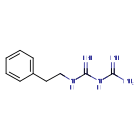
Structure for Phenformin (DB00914)
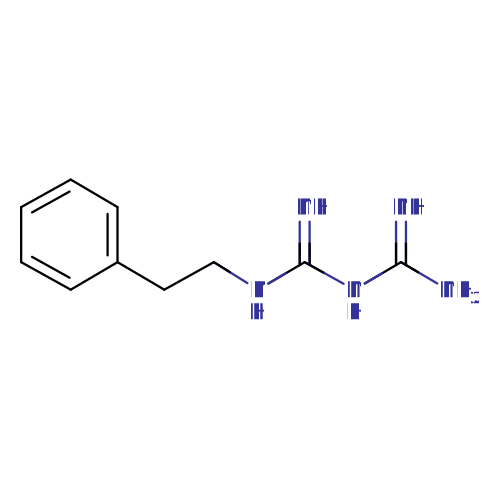
- Weight
- Average: 205.2596
Monoisotopic: 205.132745505 - Chemical Formula
- C10H15N5
- Synonyms
- Fenformin
- Fenformina
- Phenformin
- Phenformine
- Phenforminum
- β-Phenethybiguanide
- External IDs
- W 32

Pharmacology
- Indication
For the reatment of type II diabetes mellitus.
 Reduce drug development failure ratesBuild, train, & validate machine-learning modelswith evidence-based and structured datasets.Build, train, & validate predictive machine-learning models with structured datasets.
- Contraindications & Blackbox Warnings
 Prevent Adverse Drug Events TodayTap into our Clinical API for life-saving information on contraindications & blackbox warnings, population restrictions, harmful risks, & more.Avoid life-threatening adverse drug events with our Clinical API
- Pharmacodynamics
Used to treat diabetes, phenformin is a biguanide (contains 2 guanidino groups) hypoglycemic agent with actions and uses similar to those of metformin (Glucophage). Both drugs work by (1) decreasing the absorption of glucose by the intestines, (2) decreasing the production of glucose in the liver, and by (3) increasing the body's ability to use insulin more effectively. More specifically, phenformin improves glycemic control by improving insulin sensitivity. Phenformin is generally considered to be associated with an unacceptably high incidence of actic acidosis. In general biguanides should be used only in stable type II diabetics who are free of liver, kidney and cardiovascular problems and who cannot be controlled with diet.
- Mechanism of action
Phenformin binds to the AMP-activated protein kinase (AMPK). AMPK is an ultra-sensitive cellular energy sensor that monitors energy consumption and down-regulates ATP-consuming processes when activated. The biguanide phenformin has been shown to independently decrease ion transport processes, influence cellular metabolism and activate AMPK. Phenformin's hypoglycemic activity is related the effect it has in activating AMPK and fooling insulin sensitive cells into thinking that insulin levels are low and causing the body to use glucose as if in a state of low caloric consumption. This drug also seems to inhibit several varients of ATP-sensitive potassium channels (namely the receptor subtype Kir6.1).
Target Actions Organism A5'-AMP-activated protein kinase catalytic subunit alpha-1 activatorHumans UATP-sensitive inward rectifier potassium channel 8 inhibitorHumans - Absorption
Not Available
- Volume of distribution
Not Available
- Protein binding
Not Available
- Metabolism
- Not Available
- Route of elimination
Not Available
- Half-life
Not Available
- Clearance
Not Available
- Adverse Effects
 Improve decision support & research outcomesWith structured adverse effects data, including: blackbox warnings, adverse reactions, warning & precautions, & incidence rates. View sample adverse effects data in our new Data Library!Improve decision support & research outcomes with our structured adverse effects data.
- Toxicity
Not Available
- Pathways
- Not Available
- Pharmacogenomic Effects/ADRs
- Not Available
Interactions
- Drug Interactions
- This information should not be interpreted without the help of a healthcare provider. If you believe you are experiencing an interaction, contact a healthcare provider immediately. The absence of an interaction does not necessarily mean no interactions exist.
Drug Interaction Integrate drug-drug
interactions in your softwareAbatacept The metabolism of Phenformin can be increased when combined with Abatacept. Abiraterone The metabolism of Phenformin can be decreased when combined with Abiraterone. Acarbose The risk or severity of hypoglycemia can be increased when Acarbose is combined with Phenformin. Acebutolol The therapeutic efficacy of Phenformin can be increased when used in combination with Acebutolol. Acetaminophen The metabolism of Phenformin can be decreased when combined with Acetaminophen. - Food Interactions
- Not Available
Products
 Drug product information from 10+ global regionsOur datasets provide approved product information including:dosage, form, labeller, route of administration, and marketing period.Access drug product information from over 10 global regions.
- Product Ingredients
Ingredient UNII CAS InChI Key Phenformin hydrochloride 91XC93EU03 834-28-6 YSUCWSWKRIOILX-UHFFFAOYSA-N - International/Other Brands
- DBI (Ciba-Geigy)
Categories
- ATC Codes
- A10BA01 — Phenformin
- A10BA — Biguanides
- A10B — BLOOD GLUCOSE LOWERING DRUGS, EXCL. INSULINS
- A10 — DRUGS USED IN DIABETES
- A — ALIMENTARY TRACT AND METABOLISM
- Drug Categories
- Chemical TaxonomyProvided by Classyfire
- Description
- This compound belongs to the class of organic compounds known as biguanides. These are organic compounds containing two N-linked guanidines.
- Kingdom
- Organic compounds
- Super Class
- Organic nitrogen compounds
- Class
- Organonitrogen compounds
- Sub Class
- Guanidines
- Direct Parent
- Biguanides
- Alternative Parents
- Benzene and substituted derivatives / Carboximidamides / Organopnictogen compounds / Imines / Hydrocarbon derivatives
- Substituents
- Aromatic homomonocyclic compound / Benzenoid / Biguanide / Carboximidamide / Hydrocarbon derivative / Imine / Monocyclic benzene moiety / Organopnictogen compound
- Molecular Framework
- Aromatic homomonocyclic compounds
- External Descriptors
- biguanides (CHEBI:8064)
- Affected organisms
- Humans and other mammals
Chemical Identifiers
- UNII
- DD5K7529CE
- CAS number
- 114-86-3
- InChI Key
- ICFJFFQQTFMIBG-UHFFFAOYSA-N
- InChI
- InChI=1S/C10H15N5/c11-9(12)15-10(13)14-7-6-8-4-2-1-3-5-8/h1-5H,6-7H2,(H6,11,12,13,14,15)
- IUPAC Name
- 1-carbamimidamido-N-(2-phenylethyl)methanimidamide
- SMILES
- NC(=N)NC(=N)NCCC1=CC=CC=C1
References
- General References
- External Links
- Human Metabolome Database
- HMDB0015050
- KEGG Drug
- D08351
- KEGG Compound
- C07673
- PubChem Compound
- 8249
- PubChem Substance
- 46505230
- ChemSpider
- 7953
- BindingDB
- 50240908
- 8129
- ChEBI
- 8064
- ChEMBL
- CHEMBL170988
- ZINC
- ZINC000005851063
- Therapeutic Targets Database
- DAP000206
- PharmGKB
- PA1000
- PDBe Ligand
- 8CV
- Wikipedia
- Phenformin
- PDB Entries
- 5uih
Clinical Trials
- Clinical Trials
Phase Status Purpose Conditions Count 1 Active Not Recruiting Treatment Melanoma 1 Not Available Completed Not Available Type 2 Diabetes Mellitus 3
Pharmacoeconomics
- Manufacturers
- Not Available
- Packagers
- Not Available
- Dosage Forms
- Not Available
- Prices
- Not Available
- Patents
- Not Available
Properties
- State
- Solid
- Experimental Properties
Property Value Source melting point (°C) 176.5 °C PhysProp water solubility 210 mg/mL Not Available logP -0.83 HANSCH,C ET AL. (1995) - Predicted Properties
Property Value Source Water Solubility 0.232 mg/mL ALOGPS logP -0.72 ALOGPS logP 0.83 Chemaxon logS -3 ALOGPS pKa (Strongest Acidic) 19.18 Chemaxon pKa (Strongest Basic) 11.97 Chemaxon Physiological Charge 2 Chemaxon Hydrogen Acceptor Count 5 Chemaxon Hydrogen Donor Count 5 Chemaxon Polar Surface Area 97.78 Å2 Chemaxon Rotatable Bond Count 3 Chemaxon Refractivity 80.72 m3·mol-1 Chemaxon Polarizability 22.14 Å3 Chemaxon Number of Rings 1 Chemaxon Bioavailability 1 Chemaxon Rule of Five Yes Chemaxon Ghose Filter Yes Chemaxon Veber's Rule No Chemaxon MDDR-like Rule No Chemaxon - Predicted ADMET Features
Property Value Probability Human Intestinal Absorption + 0.9604 Blood Brain Barrier + 0.6967 Caco-2 permeable - 0.5144 P-glycoprotein substrate Non-substrate 0.5078 P-glycoprotein inhibitor I Non-inhibitor 0.9322 P-glycoprotein inhibitor II Non-inhibitor 0.6863 Renal organic cation transporter Inhibitor 0.6874 CYP450 2C9 substrate Non-substrate 0.7776 CYP450 2D6 substrate Substrate 0.8415 CYP450 3A4 substrate Non-substrate 0.7896 CYP450 1A2 substrate Non-inhibitor 0.9045 CYP450 2C9 inhibitor Non-inhibitor 0.9163 CYP450 2D6 inhibitor Inhibitor 0.8875 CYP450 2C19 inhibitor Non-inhibitor 0.9025 CYP450 3A4 inhibitor Non-inhibitor 0.881 CYP450 inhibitory promiscuity Low CYP Inhibitory Promiscuity 0.9116 Ames test Non AMES toxic 0.9133 Carcinogenicity Non-carcinogens 0.928 Biodegradation Not ready biodegradable 0.692 Rat acute toxicity 2.5305 LD50, mol/kg Not applicable hERG inhibition (predictor I) Weak inhibitor 0.9162 hERG inhibition (predictor II) Non-inhibitor 0.901
Spectra
- Mass Spec (NIST)
- Not Available
- Spectra
Spectrum Spectrum Type Splash Key Predicted GC-MS Spectrum - GC-MS Predicted GC-MS splash10-01ox-9500000000-7aebea06c77102624638 Predicted MS/MS Spectrum - 10V, Positive (Annotated) Predicted LC-MS/MS splash10-0a4i-0390000000-35219240ab1220daf3e4 Predicted MS/MS Spectrum - 10V, Negative (Annotated) Predicted LC-MS/MS splash10-052f-9220000000-3d9025f2bf0217f4182c Predicted MS/MS Spectrum - 20V, Positive (Annotated) Predicted LC-MS/MS splash10-0a4i-4900000000-1af7a9202810cb8e3064 Predicted MS/MS Spectrum - 20V, Negative (Annotated) Predicted LC-MS/MS splash10-0006-9000000000-0d53a139f6e29d353b7b Predicted MS/MS Spectrum - 40V, Positive (Annotated) Predicted LC-MS/MS splash10-0a4l-9810000000-3011e456aa4ed8478dca Predicted MS/MS Spectrum - 40V, Negative (Annotated) Predicted LC-MS/MS splash10-0006-9000000000-c740dd03ceeb4051cb98 Predicted 1H NMR Spectrum 1D NMR Not Applicable Predicted 13C NMR Spectrum 1D NMR Not Applicable - Chromatographic Properties
Collision Cross Sections (CCS)
Adduct CCS Value (Å2) Source type Source [M-H]- 159.4847564 predictedDarkChem Lite v0.1.0 [M-H]- 147.80241 predictedDeepCCS 1.0 (2019) [M+H]+ 158.8777564 predictedDarkChem Lite v0.1.0 [M+H]+ 150.16042 predictedDeepCCS 1.0 (2019) [M+Na]+ 158.5939564 predictedDarkChem Lite v0.1.0 [M+Na]+ 157.72723 predictedDeepCCS 1.0 (2019)
Targets

- Kind
- Protein
- Organism
- Humans
- Pharmacological action
- Yes
- Actions
- Activator
- General Function
- Tau-protein kinase activity
- Specific Function
- Catalytic subunit of AMP-activated protein kinase (AMPK), an energy sensor protein kinase that plays a key role in regulating cellular energy metabolism. In response to reduction of intracellular A...
- Gene Name
- PRKAA1
- Uniprot ID
- Q13131
- Uniprot Name
- 5'-AMP-activated protein kinase catalytic subunit alpha-1
- Molecular Weight
- 64008.64 Da
References
- Woollhead AM, Sivagnanasundaram J, Kalsi KK, Pucovsky V, Pellatt LJ, Scott JW, Mustard KJ, Hardie DG, Baines DL: Pharmacological activators of AMP-activated protein kinase have different effects on Na+ transport processes across human lung epithelial cells. Br J Pharmacol. 2007 Aug;151(8):1204-15. Epub 2007 Jul 2. [Article]
- Chen S, Murphy J, Toth R, Campbell DG, Morrice NA, Mackintosh C: Complementary regulation of TBC1D1 and AS160 by growth factors, insulin and AMPK activators. Biochem J. 2008 Jan 15;409(2):449-59. [Article]
- Zhang L, He H, Balschi JA: Metformin and phenformin activate AMP-activated protein kinase in the heart by increasing cytosolic AMP concentration. Am J Physiol Heart Circ Physiol. 2007 Jul;293(1):H457-66. Epub 2007 Mar 16. [Article]
- Kind
- Protein
- Organism
- Humans
- Pharmacological action
- Unknown
- Actions
- Inhibitor
- General Function
- Inward rectifier potassium channel activity
- Specific Function
- This potassium channel is controlled by G proteins. Inward rectifier potassium channels are characterized by a greater tendency to allow potassium to flow into the cell rather than out of it. Their...
- Gene Name
- KCNJ8
- Uniprot ID
- Q15842
- Uniprot Name
- ATP-sensitive inward rectifier potassium channel 8
- Molecular Weight
- 47967.455 Da
References
- Aziz Q, Thomas A, Khambra T, Tinker A: Phenformin has a direct inhibitory effect on the ATP-sensitive potassium channel. Eur J Pharmacol. 2010 May 25;634(1-3):26-32. doi: 10.1016/j.ejphar.2010.02.023. Epub 2010 Feb 25. [Article]
Enzymes
- Kind
- Protein
- Organism
- Humans
- Pharmacological action
- Unknown
- Actions
- Substrate
- General Function
- Steroid hydroxylase activity
- Specific Function
- Responsible for the metabolism of many drugs and environmental chemicals that it oxidizes. It is involved in the metabolism of drugs such as antiarrhythmics, adrenoceptor antagonists, and tricyclic...
- Gene Name
- CYP2D6
- Uniprot ID
- P10635
- Uniprot Name
- Cytochrome P450 2D6
- Molecular Weight
- 55768.94 Da
References
- Shah RR, Smith RL: Addressing phenoconversion: the Achilles' heel of personalized medicine. Br J Clin Pharmacol. 2015 Feb;79(2):222-40. doi: 10.1111/bcp.12441. [Article]
- Kopec KT, Kowalski MJ: Metformin-associated lactic acidosis (MALA): case files of the Einstein Medical Center medical toxicology fellowship. J Med Toxicol. 2013 Mar;9(1):61-6. doi: 10.1007/s13181-012-0278-3. [Article]
- Flockhart Table of Drug Interactions [Link]
Transporters
- Kind
- Protein
- Organism
- Humans
- Pharmacological action
- Unknown
- Actions
- Inhibitor
- General Function
- Quaternary ammonium group transmembrane transporter activity
- Specific Function
- Mediates tubular uptake of organic compounds from circulation. Mediates the influx of agmatine, dopamine, noradrenaline (norepinephrine), serotonin, choline, famotidine, ranitidine, histamin, creat...
- Gene Name
- SLC22A2
- Uniprot ID
- O15244
- Uniprot Name
- Solute carrier family 22 member 2
- Molecular Weight
- 62579.99 Da
References
- Dresser MJ, Xiao G, Leabman MK, Gray AT, Giacomini KM: Interactions of n-tetraalkylammonium compounds and biguanides with a human renal organic cation transporter (hOCT2). Pharm Res. 2002 Aug;19(8):1244-7. [Article]
- Kind
- Protein
- Organism
- Humans
- Pharmacological action
- Unknown
- Actions
- Substrate
- General Function
- Secondary active organic cation transmembrane transporter activity
- Specific Function
- Translocates a broad array of organic cations with various structures and molecular weights including the model compounds 1-methyl-4-phenylpyridinium (MPP), tetraethylammonium (TEA), N-1-methylnico...
- Gene Name
- SLC22A1
- Uniprot ID
- O15245
- Uniprot Name
- Solute carrier family 22 member 1
- Molecular Weight
- 61153.345 Da
References
- Wang DS, Jonker JW, Kato Y, Kusuhara H, Schinkel AH, Sugiyama Y: Involvement of organic cation transporter 1 in hepatic and intestinal distribution of metformin. J Pharmacol Exp Ther. 2002 Aug;302(2):510-5. [Article]
- Sogame Y, Kitamura A, Yabuki M, Komuro S: A comparison of uptake of metformin and phenformin mediated by hOCT1 in human hepatocytes. Biopharm Drug Dispos. 2009 Nov;30(8):476-84. doi: 10.1002/bdd.684. [Article]

Drug created at June 13, 2005 13:24 / Updated at April 09, 2024 18:23