Identification
- Summary
Netilmicin is an aminoglycoside used to treat a wide variety of infections in the body.
- Generic Name
- Netilmicin
- DrugBank Accession Number
- DB00955
- Background
Netilmicin is a semisynthetic 1-N-ethyl derivative of sisomycin, an aminoglycoside antibiotic with action similar to gentamicin, but less ear and kidney toxicity. Netilmicin inhibits protein synthesis in susceptible organisms by binding to the bacterial 30S ribosomal subunit and interfering with mRNA binding and the acceptor tRNA site. The bactericidal effect of netilmiicin is not fully understood.
- Type
- Small Molecule
- Groups
- Approved, Investigational
- Structure
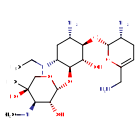
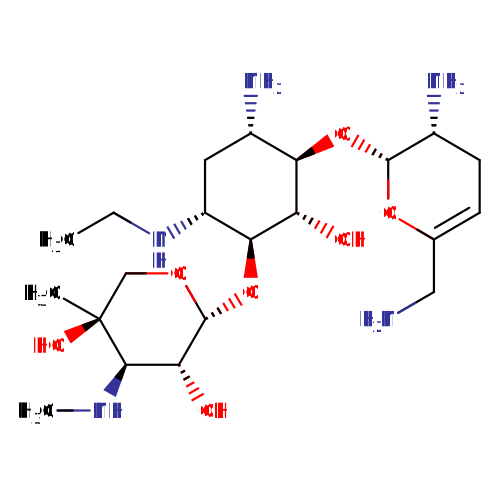
Structure for Netilmicin (DB00955)
- Weight
- Average: 475.587
Monoisotopic: 475.30059868 - Chemical Formula
- C21H41N5O7
- Synonyms
- 1-N-Ethylsisomicin
- Netilmicin
- Netilmycin

Pharmacology
- Indication
For the treatment of bacteremia, septicaemia, respiratory tract infections, skin and soft-tissue infection, burns, wounds, and peri-operative infections caused by susceptible strains.
 Reduce drug development failure ratesBuild, train, & validate machine-learning modelswith evidence-based and structured datasets.Build, train, & validate predictive machine-learning models with structured datasets.
- Associated Conditions
Indication Type Indication Combined Product Details Approval Level Age Group Patient Characteristics Dose Form Treatment of Biliary tract infection •••••••••••• ••••••••• Treatment of Eye infections •••••••••••• •••••••• • ••••• Used in combination to treat Eye inflammation Combination Product in combination with: Dexamethasone (DB01234) •••••••••••• •••••••• • ••••• Treatment of Gastrointestinal infections •••••••••••• ••••••••• Treatment of Kidney infection •••••••••••• ••••••••• - Contraindications & Blackbox Warnings
 Prevent Adverse Drug Events TodayTap into our Clinical API for life-saving information on contraindications & blackbox warnings, population restrictions, harmful risks, & more.Avoid life-threatening adverse drug events with our Clinical API
- Pharmacodynamics
Netilmicin is a semisynthetic, water soluble antibiotic of the aminoglycoside group, produced by the fermentation of Micromonospora inyoensis, a species of actinomycete. Aminoglycosides are useful primarily in infections involving aerobic, Gram-negative bacteria, such as Pseudomonas, Acinetobacter, and Enterobacter. It is active at low concentrations against a wide variety of pathogenic bacteria including Escherichia coli, bacteria of the Klebsiella-Enterobacter-Serratia group, Citrobacter sp., Proteus sp. (indole-positive and indole-negative), including Proteus mirabilis, P. morganii, P. rettgrei, P. vulgaris, Pseudomonas aeruginosa and Neisseria gonorrhoea. Netilmicin is also active in vitro against isolates of Hemophilus influenzae, Salmonella sp., Shigella sp. and against penicillinase and non-penicillinase-producing Staphylococcus including methicillin-resistant strains. Some strains of Providencia sp., Acinetobacter sp. and Aeromonas sp. are also sensitive to netilmicin. Many strains of the above organisms which are found to be resistant to other aminoglycosides, such as kanamycin, gentamicin, tobramycin and sisomicin, are susceptible to netilmicin in vitro. Occasionally, strains have been identified which are resistant to amikacin but susceptible to netilmicin. The combination of netilmicin and penicillin G has a synergistic bactericidal effect against most strains of Streptococcus faecalis (enterococcus). The combined effect of netilmicin and carbenicillin or ticarcillin is synergistic for many strains of Pseudomonas aeruginosa. In addition, many isolates of Serratia, which are resistant to multiple antibiotics, are inhibited by synergistic combinations of netilmicin with carbenicillin, azlocillin, mezlocillin, cefamandole, cefotaxime or moxalactam. Aminoglycosides are mostly ineffective against anaerobic bacteria, fungi and viruses.
- Mechanism of action
Aminoglycosides like netilmicin "irreversibly" bind to specific 30S-subunit proteins and 16S rRNA. Specifically netilmicin binds to four nucleotides of 16S rRNA and a single amino acid of protein S12. This interferes with decoding site in the vicinity of nucleotide 1400 in 16S rRNA of 30S subunit. This region interacts with the wobble base in the anticodon of tRNA. This leads to interference with the initiation complex, misreading of mRNA so incorrect amino acids are inserted into the polypeptide leading to nonfunctional or toxic peptides and the breakup of polysomes into nonfunctional monosomes, leaving the bacterium unable to synthesize proteins vital to its growth.
Target Actions Organism A30S ribosomal protein S12 inhibitorEscherichia coli (strain K12) A16S ribosomal RNA inhibitorEnteric bacteria and other eubacteria - Absorption
Rapidly and completely absorbed after IM administration, peak serum levels were achieved within 30-60 minutes. Aminoglycosides are poorly absorbed orally. Topical absorption is also poor unless severe skin damage is present.
- Volume of distribution
Not Available
- Protein binding
Protein-binding of is low and depends on the test conditions (mainly the concentration of cations in the test medium).
- Metabolism
No evidence of metabolic transformation, typically 80% is recoverable in the urine within 24 hours
- Route of elimination
Not Available
- Half-life
2.5 hours
- Clearance
Not Available
- Adverse Effects
 Improve decision support & research outcomesWith structured adverse effects data, including: blackbox warnings, adverse reactions, warning & precautions, & incidence rates. View sample adverse effects data in our new Data Library!Improve decision support & research outcomes with our structured adverse effects data.
- Toxicity
Netilmicin has nephrotoxic and ototoxic potential. Nephrotoxicity occurs via drug accumulation in renal proximal tubular cells resulting in cellular damage. Tubular cells may regenerate despite continued exposure and nephrotoxicity is usually mild and reversible. Netilmicin is less nephrotoxic than neomycin, gentamicin, tobramycin, and amikacin, likely due to a reduced number of cationic amino groups in its structure. Otoxicity occurs as a result of irreversible damage to hair cells of the cochlea and/or summit of the ampullar cristae in the vestibular complex caused drug accumulation in the endolymph and perilymph of the inner ear. Otoxicity appears to be correlated to total exposure and may be cumulative with further doses of aminoglycosides or other ototoxic drugs (e.g. cisplatin, furosemide). High frequency hearing loss is followed by low frequency hearing loss, which may be followed by retrograde degeneration of the auditory nerve. Vestibular toxicity may cause vertigo, nausea and vomiting, dizziness and loss of balance.
- Pathways
Pathway Category Netilmicin Action Pathway Drug action - Pharmacogenomic Effects/ADRs
- Not Available
Interactions
- Drug Interactions
- This information should not be interpreted without the help of a healthcare provider. If you believe you are experiencing an interaction, contact a healthcare provider immediately. The absence of an interaction does not necessarily mean no interactions exist.
Drug Interaction Integrate drug-drug
interactions in your softwareAbacavir Abacavir may decrease the excretion rate of Netilmicin which could result in a higher serum level. Aceclofenac Aceclofenac may decrease the excretion rate of Netilmicin which could result in a higher serum level. Acemetacin Acemetacin may decrease the excretion rate of Netilmicin which could result in a higher serum level. Acenocoumarol The risk or severity of bleeding can be increased when Netilmicin is combined with Acenocoumarol. Acetaminophen Acetaminophen may decrease the excretion rate of Netilmicin which could result in a higher serum level. - Food Interactions
- No interactions found.
Products
 Drug product information from 10+ global regionsOur datasets provide approved product information including:dosage, form, labeller, route of administration, and marketing period.Access drug product information from over 10 global regions.
- Product Ingredients
Ingredient UNII CAS InChI Key Netilmicin sulfate S741ZJS97U 56391-57-2 Not applicable - International/Other Brands
- Netromycin
- Brand Name Prescription Products
Name Dosage Strength Route Labeller Marketing Start Marketing End Region Image Netromycin Inj 100mg/ml Solution 100 mg / mL Intramuscular; Intravenous Schering Plough 1981-12-31 2004-07-21 Canada 
Netromycin Inj 50mg/ml Solution 50 mg / mL Intramuscular; Intravenous Schering Plough 1981-12-31 2004-07-21 Canada - Mixture Products
Name Ingredients Dosage Route Labeller Marketing Start Marketing End Region Image DEXANETİL % 0,1 + % 0,3 GÖZ DAMLASI, ÇÖZELTİ, 1 ADET Netilmicin sulfate (0.3 %) + Dexamethasone sodium phosphate (0.1 %) Solution / drops Ophthalmic Deva Holding A.S. 2020-01-21 Not applicable Turkey 
GLYDEXİL PLUS % 0.3 + % 0.1 GÖZ DAMLASI, ÇÖZELTİ, 1 ADET Netilmicin sulfate (0.3 %) + Dexamethasone sodium phosphate (0.1 %) Solution / drops Ophthalmic World Medicine Ilac San. Ve Tic. a.s. 2020-02-05 Not applicable Turkey Netildex Netilmicin sulfate (0.3 % w/v) + Dexamethasone sodium phosphate (0.1 % w/v) Solution Ophthalmic Sifi S.P.A. Not applicable Not applicable Canada NETILDEX Netilmicin (3 MG/ML) + Dexamethasone (1 MG/ML) Solution / drops Ophthalmic Sifi S.P.A. 2014-07-08 Not applicable Italy 
Netildex Netilmicin sulfate (0.3 % w/v) + Dexamethasone sodium phosphate (0.1 % w/v) Solution Ophthalmic Sifi S.P.A. Not applicable Not applicable Canada - Unapproved/Other Products
Name Ingredients Dosage Route Labeller Marketing Start Marketing End Region Image NETILDEX GOZ DAMLASI %0,1 DEKSAMETAZON + %0,3 NETILMISIN 0,3 ML × 20 ADET Netilmicin sulfate (0.3 %) + Dexamethasone (0.1 %) Solution / drops Ophthalmic TEKA TEKNİK CİHAZLAR SAN.VE TİC. A.Ş. 2013-01-29 2022-04-11 Turkey NETILDEX GOZ DAMLASI %0,1 DEKSAMETAZON + %0,3 NETILMISIN 5 ML Netilmicin (3 mg) + Dexamethasone (1 mg) Solution / drops Ophthalmic TEKA TEKNİK CİHAZLAR SAN.VE TİC. A.Ş. 2013-01-29 2022-04-11 Turkey NETIRA 5 ML GOZ DAMLASI Netilmicin (5 ml) Solution / drops Ophthalmic TEKA TEKNİK CİHAZLAR SAN.VE TİC. A.Ş. 2013-01-29 2023-01-10 Turkey NETIRA TEK DOZ GOZ DAMLASI Netilmicin (0.3 g/100ml) Solution / drops Ophthalmic TEKA TEKNİK CİHAZLAR SAN.VE TİC. A.Ş. 2013-01-29 2022-04-11 Turkey
Categories
- ATC Codes
- S01AA23 — NetilmicinJ01GB07 — Netilmicin
- Drug Categories
- Agents that produce neuromuscular block (indirect)
- Aminoglycoside Antibacterials
- Anti-Bacterial Agents
- Anti-Infective Agents
- Antibacterials for Systemic Use
- Antiinfectives for Systemic Use
- Carbohydrates
- Drugs that are Mainly Renally Excreted
- Drugs that are Mainly Renally Excreted with a Narrow Therapeutic Index
- Enzyme Inhibitors
- Gentamicins
- Glycosides
- Narrow Therapeutic Index Drugs
- Nephrotoxic agents
- Ophthalmologicals
- Protein Synthesis Inhibitors
- Sensory Organs
- Chemical TaxonomyProvided by Classyfire
- Description
- This compound belongs to the class of organic compounds known as aminocyclitol glycosides. These are organic compounds containing an amicocyclitol moiety glycosidically linked to a carbohydrate moiety. There are two major classes of aminoglycosides containing a 2-streptamine core. They are called 4,5- and 4,6-disubstituted 2-deoxystreptamines.
- Kingdom
- Organic compounds
- Super Class
- Organic oxygen compounds
- Class
- Organooxygen compounds
- Sub Class
- Carbohydrates and carbohydrate conjugates
- Direct Parent
- Aminocyclitol glycosides
- Alternative Parents
- O-glycosyl compounds / Aminocyclitols and derivatives / Cyclohexylamines / Cyclohexanols / Oxanes / Monosaccharides / Tertiary alcohols / 1,2-aminoalcohols / Oxacyclic compounds / Dialkylamines show 4 more
- Substituents
- 1,2-aminoalcohol / Acetal / Alcohol / Aliphatic heteromonocyclic compound / Amine / Amino cyclitol glycoside / Aminocyclitol or derivatives / Cyclic alcohol / Cyclitol or derivatives / Cyclohexanol show 17 more
- Molecular Framework
- Aliphatic heteromonocyclic compounds
- External Descriptors
- Not Available
- Affected organisms
- Enteric bacteria and other eubacteria
Chemical Identifiers
- UNII
- 4O5J85GJJB
- CAS number
- 56391-56-1
- InChI Key
- CIDUJQMULVCIBT-MQDUPKMGSA-N
- InChI
- InChI=1S/C21H41N5O7/c1-4-26-13-7-12(24)16(32-19-11(23)6-5-10(8-22)31-19)14(27)17(13)33-20-15(28)18(25-3)21(2,29)9-30-20/h5,11-20,25-29H,4,6-9,22-24H2,1-3H3/t11-,12+,13-,14+,15-,16-,17+,18-,19-,20-,21+/m1/s1
- IUPAC Name
- (2R,3R,4R,5R)-2-{[(1S,2S,3R,4S,6R)-4-amino-3-{[(2S,3R)-3-amino-6-(aminomethyl)-3,4-dihydro-2H-pyran-2-yl]oxy}-6-(ethylamino)-2-hydroxycyclohexyl]oxy}-5-methyl-4-(methylamino)oxane-3,5-diol
- SMILES
- CCN[C@@H]1C[C@H](N)[C@@H](O[C@H]2OC(CN)=CC[C@H]2N)[C@H](O)[C@H]1O[C@H]1OC[C@](C)(O)[C@H](NC)[C@H]1O
References
- Synthesis Reference
Chou-Hong Tann, Tiruvettipuram K. Thiruvengadam, John S. Chiu, Cesar Colon, "Process for preparing netilmicin." U.S. Patent US4831123, issued June, 1966.
US4831123- General References
- Hemsworth S, Nunn AJ, Selwood K, Osborne C, Jones A, Pizer B: Once-daily netilmicin for neutropenic pyrexia in paediatric oncology. Acta Paediatr. 2005 Mar;94(3):268-74. [Article]
- Klingenberg C, Smabrekke L, Lier T, Flaegstad T: Validation of a simplified netilmicin dosage regimen in infants. Scand J Infect Dis. 2004;36(6-7):474-9. [Article]
- Brooks JR, Marlow N, Reeves BC, Millar MR: Use of once-daily netilmicin to treat infants with suspected sepsis in a neonatal intensive care unit. Biol Neonate. 2004;86(3):170-5. Epub 2004 Jun 29. [Article]
- External Links
- Human Metabolome Database
- HMDB15090
- KEGG Drug
- D08268
- KEGG Compound
- C07657
- PubChem Compound
- 441306
- PubChem Substance
- 46507404
- ChemSpider
- 20152952
- BindingDB
- 50470664
- 7337
- ChEBI
- 7528
- ChEMBL
- CHEMBL1572
- ZINC
- ZINC000052981502
- Therapeutic Targets Database
- DAP000404
- PharmGKB
- PA164754913
- Wikipedia
- Netilmicin
- MSDS
- Download (57 KB)
Clinical Trials
- Clinical Trials
Phase Status Purpose Conditions Count 4 Completed Treatment Ventilator Associated Bacterial Pneumonia (VABP) 1 3 Completed Treatment Cataract Surgery / Cataracts 1 0 Terminated Treatment Osteomyelitis 1
Pharmacoeconomics
- Manufacturers
- Schering corp sub schering plough corp
- Packagers
- Not Available
- Dosage Forms
Form Route Strength Solution Intramuscular; Intravenous 100 mg/1ml Injection Intramuscular; Intravenous Solution / drops Ophthalmic Injection Intramuscular; Intravenous 150 MG/2ML Injection Intramuscular; Intravenous 100 mg/2ml Injection Intramuscular; Intravenous 150 mg/1.5ml Solution Ophthalmic 3 mg Gel Conjunctival Solution Ophthalmic Solution / drops Ophthalmic 3.00 mg Solution / drops Ophthalmic 5 ml Solution / drops Ophthalmic 0.3 g/100ml Solution Intramuscular; Intravenous 100 mg / mL Solution Intramuscular; Intravenous 50 mg / mL Injection, solution Parenteral Solution / drops Ophthalmic Solution / drops Ophthalmic 0.3 % Ointment Ophthalmic Injection, solution Parenteral 100 MG/ML Injection, solution Parenteral 15 MG/1.5ML Injection, solution Parenteral 150 MG/1.5ML Injection, solution Parenteral 200 MG/2ML Injection, solution Parenteral 300 MG/3ML Injection, solution Parenteral 50 MG/ML Solution Intramuscular; Intravenous 50 mg/1ml - Prices
- Not Available
- Patents
- Not Available
Properties
- State
- Solid
- Experimental Properties
Property Value Source water solubility 100 mg/mL Not Available logP -3 Not Available - Predicted Properties
Property Value Source Water Solubility 9.2 mg/mL ALOGPS logP -1.4 ALOGPS logP -3.5 Chemaxon logS -1.7 ALOGPS pKa (Strongest Acidic) 12.55 Chemaxon pKa (Strongest Basic) 9.8 Chemaxon Physiological Charge 5 Chemaxon Hydrogen Acceptor Count 12 Chemaxon Hydrogen Donor Count 8 Chemaxon Polar Surface Area 199.73 Å2 Chemaxon Rotatable Bond Count 8 Chemaxon Refractivity 119.84 m3·mol-1 Chemaxon Polarizability 50.76 Å3 Chemaxon Number of Rings 3 Chemaxon Bioavailability 0 Chemaxon Rule of Five No Chemaxon Ghose Filter No Chemaxon Veber's Rule No Chemaxon MDDR-like Rule Yes Chemaxon - Predicted ADMET Features
Property Value Probability Human Intestinal Absorption - 0.9129 Blood Brain Barrier - 0.9912 Caco-2 permeable - 0.7057 P-glycoprotein substrate Substrate 0.8191 P-glycoprotein inhibitor I Inhibitor 0.5133 P-glycoprotein inhibitor II Non-inhibitor 0.9479 Renal organic cation transporter Non-inhibitor 0.8985 CYP450 2C9 substrate Non-substrate 0.8475 CYP450 2D6 substrate Non-substrate 0.837 CYP450 3A4 substrate Substrate 0.5494 CYP450 1A2 substrate Non-inhibitor 0.8995 CYP450 2C9 inhibitor Non-inhibitor 0.9098 CYP450 2D6 inhibitor Non-inhibitor 0.9237 CYP450 2C19 inhibitor Non-inhibitor 0.9033 CYP450 3A4 inhibitor Non-inhibitor 0.9691 CYP450 inhibitory promiscuity Low CYP Inhibitory Promiscuity 0.8932 Ames test Non AMES toxic 0.7193 Carcinogenicity Non-carcinogens 0.9266 Biodegradation Not ready biodegradable 0.9944 Rat acute toxicity 2.0963 LD50, mol/kg Not applicable hERG inhibition (predictor I) Weak inhibitor 0.981 hERG inhibition (predictor II) Non-inhibitor 0.6924
Spectra
- Mass Spec (NIST)
- Not Available
- Spectra
Spectrum Spectrum Type Splash Key Predicted MS/MS Spectrum - 10V, Positive (Annotated) Predicted LC-MS/MS splash10-004i-0700900000-bca7f7dc4403b51c0de3 Predicted MS/MS Spectrum - 20V, Positive (Annotated) Predicted LC-MS/MS splash10-0h00-1905700000-0f7f44a381ae0c0a9896 Predicted MS/MS Spectrum - 10V, Negative (Annotated) Predicted LC-MS/MS splash10-00di-0002900000-3353be06431ffa662908 Predicted MS/MS Spectrum - 20V, Negative (Annotated) Predicted LC-MS/MS splash10-00di-0612900000-0301cafe7ca5a47e61a6 Predicted MS/MS Spectrum - 40V, Positive (Annotated) Predicted LC-MS/MS splash10-004i-3932200000-4f9204fe01e35a5e31b9 Predicted MS/MS Spectrum - 40V, Negative (Annotated) Predicted LC-MS/MS splash10-00ds-3962400000-fd9ec0d8f01031dbb0e4 Predicted 1H NMR Spectrum 1D NMR Not Applicable Predicted 13C NMR Spectrum 1D NMR Not Applicable - Chromatographic Properties
Collision Cross Sections (CCS)
Adduct CCS Value (Å2) Source type Source [M-H]- 201.28886 predictedDeepCCS 1.0 (2019) [M+H]+ 203.12349 predictedDeepCCS 1.0 (2019) [M+Na]+ 208.8639 predictedDeepCCS 1.0 (2019)
Targets

- Kind
- Protein
- Organism
- Escherichia coli (strain K12)
- Pharmacological action
- Yes
- Actions
- Inhibitor
- General Function
- Trna binding
- Specific Function
- With S4 and S5 plays an important role in translational accuracy.Interacts with and stabilizes bases of the 16S rRNA that are involved in tRNA selection in the A site and with the mRNA backbone. Lo...
- Gene Name
- rpsL
- Uniprot ID
- P0A7S3
- Uniprot Name
- 30S ribosomal protein S12
- Molecular Weight
- 13736.995 Da
References
- Campoli-Richards DM, Chaplin S, Sayce RH, Goa KL: Netilmicin. A review of its antibacterial activity, pharmacokinetic properties and therapeutic use. Drugs. 1989 Nov;38(5):703-56. doi: 10.2165/00003495-198938050-00003. [Article]
References
- Overington JP, Al-Lazikani B, Hopkins AL: How many drug targets are there? Nat Rev Drug Discov. 2006 Dec;5(12):993-6. [Article]
- Imming P, Sinning C, Meyer A: Drugs, their targets and the nature and number of drug targets. Nat Rev Drug Discov. 2006 Oct;5(10):821-34. [Article]
- Tuuminen T, Heinasmaki T, Kerttula T: First report of bacteremia by Asaia bogorensis, in a patient with a history of intravenous-drug abuse. J Clin Microbiol. 2006 Aug;44(8):3048-50. [Article]

Drug created at June 13, 2005 13:24 / Updated at February 02, 2024 22:46