Identification
- Summary
Physostigmine is a cholinesterase inhibitor used to treat glaucoma and anticholinergic toxicity.
- Generic Name
- Physostigmine
- DrugBank Accession Number
- DB00981
- Background
A cholinesterase inhibitor that is rapidly absorbed through membranes. It can be applied topically to the conjunctiva. It also can cross the blood-brain barrier and is used when central nervous system effects are desired, as in the treatment of severe anticholinergic toxicity.
- Type
- Small Molecule
- Groups
- Approved, Investigational
- Structure
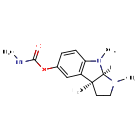
Structure for Physostigmine (DB00981)

- Weight
- Average: 275.3461
Monoisotopic: 275.163376931 - Chemical Formula
- C15H21N3O2
- Synonyms
- Eserine
- Physostigmine
- Physostol
- External IDs
- MCV-4484
- NIH 10421

Pharmacology
- Indication
For the treatment of glaucoma, and in the treatment of severe anticholinergic toxicity.
 Reduce drug development failure ratesBuild, train, & validate machine-learning modelswith evidence-based and structured datasets.Build, train, & validate predictive machine-learning models with structured datasets.
- Associated Conditions
Indication Type Indication Combined Product Details Approval Level Age Group Patient Characteristics Dose Form Treatment of Anticholinergic syndrome •••••••••••• •••••••••• •••••••• Treatment of Anticholinergic syndrome •••••••••••• •••••••••• •••••••• - Contraindications & Blackbox Warnings
 Prevent Adverse Drug Events TodayTap into our Clinical API for life-saving information on contraindications & blackbox warnings, population restrictions, harmful risks, & more.Avoid life-threatening adverse drug events with our Clinical API
- Pharmacodynamics
Physostigmine is a parasympathomimetic, specifically, a reversible cholinesterase inhibitor which effectively increases the concentration of acetylcholine at the sites of cholinergic transmission. Physostigmine is used to treat glaucoma. Because it crosses the blood-brain barrier, it is also used to treat the central nervous system effects of atropine overdose and other anticholinergic drug overdoses. Physostigmine can reverse both central and peripheral anticholinergia.
- Mechanism of action
Physostigmine inhibits acetylcholinesterase, the enzyme responsible for the breakdown of used acetylcholine. By interfering with the metabolism of acetylcholine, physostigmine indirectly stimulates both nicotinic and muscarinic receptors due to the consequential increase in available acetylcholine at the synapse.
Target Actions Organism AAcetylcholinesterase inhibitorHumans UNeuronal acetylcholine receptor subunit alpha-4 Not Available Humans UNeuronal acetylcholine receptor subunit beta-2 Not Available Humans - Absorption
Not Available
- Volume of distribution
Not Available
- Protein binding
Not Available
- Metabolism
Quickly hydrolyzed by cholinesterases
- Route of elimination
Not Available
- Half-life
Not Available
- Clearance
Not Available
- Adverse Effects
 Improve decision support & research outcomesWith structured adverse effects data, including: blackbox warnings, adverse reactions, warning & precautions, & incidence rates. View sample adverse effects data in our new Data Library!Improve decision support & research outcomes with our structured adverse effects data.
- Toxicity
Side effects include increased sweating, loss of bladder control, muscle weakness, nausea, vomiting, diarrhea, or stomach cramps or pain, shortness of breath, tightness in chest, or wheezing, slow or irregular heartbeat, unusual tiredness or weakness, watering of mouth, blurred vision or change in near or distant vision, and eye pain.
- Pathways
- Not Available
- Pharmacogenomic Effects/ADRs
- Not Available
Interactions
- Drug Interactions
- This information should not be interpreted without the help of a healthcare provider. If you believe you are experiencing an interaction, contact a healthcare provider immediately. The absence of an interaction does not necessarily mean no interactions exist.
Drug Interaction Integrate drug-drug
interactions in your softwareAcebutolol Physostigmine may increase the bradycardic activities of Acebutolol. Acetylcholine The risk or severity of adverse effects can be increased when Physostigmine is combined with Acetylcholine. Aclidinium Physostigmine may increase the neuromuscular blocking activities of Aclidinium. Amantadine The therapeutic efficacy of Amantadine can be decreased when used in combination with Physostigmine. Amifampridine The risk or severity of adverse effects can be increased when Physostigmine is combined with Amifampridine. - Food Interactions
- No interactions found.
Products
 Drug product information from 10+ global regionsOur datasets provide approved product information including:dosage, form, labeller, route of administration, and marketing period.Access drug product information from over 10 global regions.
- Product Ingredients
Ingredient UNII CAS InChI Key Physostigmine salicylate 2046ZRO9VU 57-64-7 HZOTZTANVBDFOF-PBCQUBLHSA-N Physostigmine Sulfate G63V2J2N71 64-47-1 YYBNDIVPHIWTPK-KYJQVDHRSA-N - International/Other Brands
- Antilirium
- Brand Name Prescription Products
Name Dosage Strength Route Labeller Marketing Start Marketing End Region Image Anticholium Injection 0.4 mg/1mL Intravenous Provepharm Inc. 2023-10-05 Not applicable US 
Antilirium Inj 1mg/ml Liquid 1 mg / mL Intramuscular; Intravenous Forest Laboratories 1975-12-31 1998-07-07 Canada 
Physostigmine Salicylate Injection 1 mg/1mL Intravenous Henry Schein, Inc. 2022-01-13 Not applicable US Physostigmine Salicylate Injection 1 mg/1mL Intravenous Medical Purchasing Solutions, Llc 2010-08-10 Not applicable US Physostigmine Salicylate Injection 1 mg/1mL Intravenous Cardinal Health 2010-08-10 2018-11-30 US - Unapproved/Other Products
Name Ingredients Dosage Route Labeller Marketing Start Marketing End Region Image Anticholium Physostigmine salicylate (0.4 mg/1mL) Injection Intravenous Provepharm Inc. 2023-10-05 Not applicable US Physostigmine Salicylate Physostigmine salicylate (1 mg/1mL) Injection Intravenous Medical Purchasing Solutions, Llc 2010-08-10 Not applicable US Physostigmine Salicylate Physostigmine salicylate (1 mg/1mL) Injection Intravenous Cardinal Health 2010-08-10 2018-11-30 US Physostigmine Salicylate Physostigmine salicylate (1 mg/1mL) Injection Intravenous Henry Schein, Inc. 2022-01-13 Not applicable US Physostigmine Salicylate Physostigmine salicylate (1 mg/1mL) Injection Intravenous A-S Medication Solutions 2010-08-10 Not applicable US
Categories
- ATC Codes
- S01EB05 — Physostigmine
- S01EB — Parasympathomimetics
- S01E — ANTIGLAUCOMA PREPARATIONS AND MIOTICS
- S01 — OPHTHALMOLOGICALS
- S — SENSORY ORGANS
- Drug Categories
- Acids, Acyclic
- Alkaloids
- Antidotes
- Antiglaucoma Preparations and Miotics
- Autonomic Agents
- Carbamates
- Cholinergic Agents
- Cholinesterase Inhibitors
- Enzyme Inhibitors
- Heterocyclic Compounds, Fused-Ring
- Indole Alkaloids
- Indoles
- Indolizidines
- Indolizines
- Miotics
- Neurotransmitter Agents
- Ophthalmologicals
- Parasympathomimetics
- Peripheral Nervous System Agents
- Phenylcarbamates
- Sensory Organs
- Chemical TaxonomyProvided by Classyfire
- Description
- This compound belongs to the class of organic compounds known as pyrroloindoles. These are compounds containing a pyrroloindole moiety, which is a tricyclic heterocycle which consists of a pyrrole ring fused to an indole. Pyrrole is 5-membered ring consisting of four carbon atoms and one nitrogen atom. Indole is a bicyclic compound consisting of a six-membered benzene ring fused to a five-membered nitrogen-containing pyrrole ring.
- Kingdom
- Organic compounds
- Super Class
- Organoheterocyclic compounds
- Class
- Indoles and derivatives
- Sub Class
- Pyrroloindoles
- Direct Parent
- Pyrroloindoles
- Alternative Parents
- Indoles / Dialkylarylamines / N-alkylpyrrolidines / Benzenoids / Pyrroles / Carbamate esters / Organic carbonic acids and derivatives / Azacyclic compounds / Organopnictogen compounds / Organic oxides show 2 more
- Substituents
- Aromatic heteropolycyclic compound / Azacycle / Benzenoid / Carbamic acid ester / Carbonic acid derivative / Carbonyl group / Dialkylarylamine / Hydrocarbon derivative / Indole / N-alkylpyrrolidine show 9 more
- Molecular Framework
- Aromatic heteropolycyclic compounds
- External Descriptors
- carbamate ester, indole alkaloid (CHEBI:27953) / Alkaloids, Pyrroloindole alkaloids (C06535)
- Affected organisms
- Humans and other mammals
Chemical Identifiers
- UNII
- 9U1VM840SP
- CAS number
- 57-47-6
- InChI Key
- PIJVFDBKTWXHHD-HIFRSBDPSA-N
- InChI
- InChI=1S/C15H21N3O2/c1-15-7-8-17(3)13(15)18(4)12-6-5-10(9-11(12)15)20-14(19)16-2/h5-6,9,13H,7-8H2,1-4H3,(H,16,19)/t13-,15+/m1/s1
- IUPAC Name
- (3aS,8aR)-1,3a,8-trimethyl-1H,2H,3H,3aH,8H,8aH-pyrrolo[2,3-b]indol-5-yl N-methylcarbamate
- SMILES
- [H][C@]12N(C)CC[C@@]1(C)C1=C(C=CC(OC(=O)NC)=C1)N2C
References
- Synthesis Reference
Edward J. Glamkowski, Barbara E. Kurys, "4- and 6-carbamates related to physostigmine and intermediates for the preparation thereof." U.S. Patent US5081117, issued September, 1978.
US5081117- General References
- Not Available
- External Links
- Human Metabolome Database
- HMDB0015116
- KEGG Drug
- D00196
- KEGG Compound
- C06535
- PubChem Compound
- 5983
- PubChem Substance
- 46506998
- ChemSpider
- 5763
- BindingDB
- 50222010
- 8299
- ChEBI
- 27953
- ChEMBL
- CHEMBL94
- ZINC
- ZINC000091689892
- Therapeutic Targets Database
- DAP000561
- PharmGKB
- PA450957
- RxList
- RxList Drug Page
- Drugs.com
- Drugs.com Drug Page
- Wikipedia
- Physostigmine
- MSDS
- Download (73.3 KB)
Clinical Trials
- Clinical Trials
Phase Status Purpose Conditions Count 4 Completed Treatment Anticholinergics Toxicity 1 3 Completed Treatment Postoperative pain 1 3 Unknown Status Treatment CAM-ICU Diagnosed Delirium / Suspected Delirium After Elective or Emergency Heart Surgery 1 0 Completed Basic Science Resistance, Insulin 1 Not Available Completed Other Schizophrenia / Smoking 1
Pharmacoeconomics
- Manufacturers
- Not Available
- Packagers
- Amend
- Hope Pharmaceuticals
- Hospira Inc.
- Nycomed Inc.
- Taylor Pharmaceuticals
- Dosage Forms
Form Route Strength Injection Intravenous 0.4 mg/1mL Injection, solution Intramuscular; Intravenous 2 mg/5ml Liquid Intramuscular; Intravenous 1 mg / mL Injection, solution Intramuscular; Intravenous 1 MG/ML Injection Intravenous 1 mg/1mL - Prices
Unit description Cost Unit Physostigmine salicyl cryst 39.48USD g Physostigmine 1 mg/ml ampul 2.43USD ml DrugBank does not sell nor buy drugs. Pricing information is supplied for informational purposes only.- Patents
- Not Available
Properties
- State
- Solid
- Experimental Properties
Property Value Source melting point (°C) 105.5 °C PhysProp water solubility 7760 mg/L Not Available logP 1.58 HANSCH,C ET AL. (1995) pKa 6.12 MERCK INDEX (1996) - Predicted Properties
Property Value Source Water Solubility 0.992 mg/mL ALOGPS logP 1.8 ALOGPS logP 2.23 Chemaxon logS -2.4 ALOGPS pKa (Strongest Acidic) 14.77 Chemaxon pKa (Strongest Basic) 6.59 Chemaxon Physiological Charge 0 Chemaxon Hydrogen Acceptor Count 3 Chemaxon Hydrogen Donor Count 1 Chemaxon Polar Surface Area 44.81 Å2 Chemaxon Rotatable Bond Count 2 Chemaxon Refractivity 78.4 m3·mol-1 Chemaxon Polarizability 30.63 Å3 Chemaxon Number of Rings 3 Chemaxon Bioavailability 1 Chemaxon Rule of Five Yes Chemaxon Ghose Filter Yes Chemaxon Veber's Rule No Chemaxon MDDR-like Rule No Chemaxon - Predicted ADMET Features
Property Value Probability Human Intestinal Absorption + 1.0 Blood Brain Barrier + 0.9975 Caco-2 permeable + 0.5804 P-glycoprotein substrate Substrate 0.6631 P-glycoprotein inhibitor I Non-inhibitor 0.5442 P-glycoprotein inhibitor II Non-inhibitor 0.8382 Renal organic cation transporter Non-inhibitor 0.7046 CYP450 2C9 substrate Non-substrate 0.7838 CYP450 2D6 substrate Non-substrate 0.6455 CYP450 3A4 substrate Substrate 0.7321 CYP450 1A2 substrate Non-inhibitor 0.9046 CYP450 2C9 inhibitor Non-inhibitor 0.9071 CYP450 2D6 inhibitor Inhibitor 0.8932 CYP450 2C19 inhibitor Non-inhibitor 0.9026 CYP450 3A4 inhibitor Non-inhibitor 0.8309 CYP450 inhibitory promiscuity Low CYP Inhibitory Promiscuity 0.8681 Ames test Non AMES toxic 0.9133 Carcinogenicity Non-carcinogens 0.9232 Biodegradation Not ready biodegradable 0.8652 Rat acute toxicity 4.7557 LD50, mol/kg Not applicable hERG inhibition (predictor I) Weak inhibitor 0.9066 hERG inhibition (predictor II) Non-inhibitor 0.8397
Spectra
- Mass Spec (NIST)
- Download (9.24 KB)
- Spectra
- Chromatographic Properties
Collision Cross Sections (CCS)
Adduct CCS Value (Å2) Source type Source [M-H]- 175.2022542 predictedDarkChem Lite v0.1.0 [M-H]- 170.2063715 predictedDarkChem Lite v0.1.0 [M-H]- 174.9797542 predictedDarkChem Lite v0.1.0 [M-H]- 175.4334542 predictedDarkChem Lite v0.1.0 [M-H]- 160.67613 predictedDeepCCS 1.0 (2019) [M+H]+ 176.9014542 predictedDarkChem Lite v0.1.0 [M+H]+ 167.6393513 predictedDarkChem Lite v0.1.0 [M+H]+ 176.5107542 predictedDarkChem Lite v0.1.0 [M+H]+ 176.7883542 predictedDarkChem Lite v0.1.0 [M+H]+ 163.03413 predictedDeepCCS 1.0 (2019) [M+Na]+ 175.6092542 predictedDarkChem Lite v0.1.0 [M+Na]+ 176.1277542 predictedDarkChem Lite v0.1.0 [M+Na]+ 176.1497542 predictedDarkChem Lite v0.1.0 [M+Na]+ 175.4687542 predictedDarkChem Lite v0.1.0 [M+Na]+ 169.89052 predictedDeepCCS 1.0 (2019)
Targets

- Kind
- Protein
- Organism
- Humans
- Pharmacological action
- Yes
- Actions
- Inhibitor
- General Function
- Serine hydrolase activity
- Specific Function
- Terminates signal transduction at the neuromuscular junction by rapid hydrolysis of the acetylcholine released into the synaptic cleft. Role in neuronal apoptosis.
- Gene Name
- ACHE
- Uniprot ID
- P22303
- Uniprot Name
- Acetylcholinesterase
- Molecular Weight
- 67795.525 Da
References
- Nguyen PV, Aniksztejn L, Catarsi S, Drapeau P: Maturation of neuromuscular transmission during early development in zebrafish. J Neurophysiol. 1999 Jun;81(6):2852-61. [Article]
- Tuovinen K, Kaliste-Korhonen E, Raushel FM, Hanninen O: Success of pyridostigmine, physostigmine, eptastigmine and phosphotriesterase treatments in acute sarin intoxication. Toxicology. 1999 Jun 15;134(2-3):169-78. [Article]
- Blasina MF, Faria AC, Gardino PF, Hokoc JN, Almeida OM, de Mello FG, Arruti C, Dajas F: Evidence for a noncholinergic function of acetylcholinesterase during development of chicken retina as shown by fasciculin. Cell Tissue Res. 2000 Feb;299(2):173-84. [Article]
- Monnet-Tschudi F, Zurich MG, Schilter B, Costa LG, Honegger P: Maturation-dependent effects of chlorpyrifos and parathion and their oxygen analogs on acetylcholinesterase and neuronal and glial markers in aggregating brain cell cultures. Toxicol Appl Pharmacol. 2000 Jun 15;165(3):175-83. [Article]
- Bolognesi ML, Andrisano V, Bartolini M, Minarini A, Rosini M, Tumiatti V, Melchiorre C: Hexahydrochromeno[4,3-b]pyrrole derivatives as acetylcholinesterase inhibitors. J Med Chem. 2001 Jan 4;44(1):105-9. [Article]
- Chen X, Ji ZL, Chen YZ: TTD: Therapeutic Target Database. Nucleic Acids Res. 2002 Jan 1;30(1):412-5. [Article]
- Kind
- Protein
- Organism
- Humans
- Pharmacological action
- Unknown
- Curator comments
- noncompetitive antagonist
- General Function
- Ligand-gated ion channel activity
- Specific Function
- After binding acetylcholine, the AChR responds by an extensive change in conformation that affects all subunits and leads to opening of an ion-conducting channel across the plasma membrane permeabl...
- Gene Name
- CHRNA4
- Uniprot ID
- P43681
- Uniprot Name
- Neuronal acetylcholine receptor subunit alpha-4
- Molecular Weight
- 69956.47 Da
References
- Eaton JB, Peng JH, Schroeder KM, George AA, Fryer JD, Krishnan C, Buhlman L, Kuo YP, Steinlein O, Lukas RJ: Characterization of human alpha 4 beta 2-nicotinic acetylcholine receptors stably and heterologously expressed in native nicotinic receptor-null SH-EP1 human epithelial cells. Mol Pharmacol. 2003 Dec;64(6):1283-94. [Article]
- Kind
- Protein
- Organism
- Humans
- Pharmacological action
- Unknown
- Curator comments
- noncompetitive antagonist
- General Function
- Ligand-gated ion channel activity
- Specific Function
- After binding acetylcholine, the AChR responds by an extensive change in conformation that affects all subunits and leads to opening of an ion-conducting channel across the plasma membrane permeabl...
- Gene Name
- CHRNB2
- Uniprot ID
- P17787
- Uniprot Name
- Neuronal acetylcholine receptor subunit beta-2
- Molecular Weight
- 57018.575 Da
References
- Eaton JB, Peng JH, Schroeder KM, George AA, Fryer JD, Krishnan C, Buhlman L, Kuo YP, Steinlein O, Lukas RJ: Characterization of human alpha 4 beta 2-nicotinic acetylcholine receptors stably and heterologously expressed in native nicotinic receptor-null SH-EP1 human epithelial cells. Mol Pharmacol. 2003 Dec;64(6):1283-94. [Article]


Drug created at June 13, 2005 13:24 / Updated at April 09, 2024 18:23