Identification
- Summary
Atovaquone is an antimicrobial indicated for the prevention and treatment of Pneumocystis jirovecii pneumonia (PCP) and for the prevention and treatment of Plasmodium falciparum malaria.
- Brand Names
- Malarone, Mepron
- Generic Name
- Atovaquone
- DrugBank Accession Number
- DB01117
- Background
Atovaquone is a hydroxynaphthoquinone, or an analog of ubiquinone, that has antimicrobial and antipneumocystis activity. It is being used in antimalarial protocols.
- Type
- Small Molecule
- Groups
- Approved
- Structure
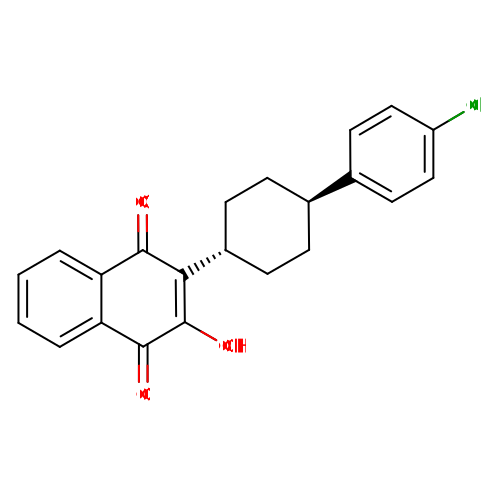
Structure for Atovaquone (DB01117)
- Weight
- Average: 366.837
Monoisotopic: 366.102272181 - Chemical Formula
- C22H19ClO3
- Synonyms
- 2-(trans-4-(p-Chlorophenyl)cyclohexyl)-3-hydroxy-1,4-naphthoquinone
- Atovacuona
- Atovaquone
- External IDs
- 566C
- 566C80
- BW 566C
- BW 566C-80
- DRG-0084

Pharmacology
- Indication
For the treatment or prevention of Pneumocystis carinii pneumonia in patients who are intolerant to trimethoprim-sulfamethoxazole (TMP-SMX). Also indicated for the acute oral treatment of mild to moderate PCP in patients who are intolerant to TMP-SMX.
 Reduce drug development failure ratesBuild, train, & validate machine-learning modelswith evidence-based and structured datasets.Build, train, & validate predictive machine-learning models with structured datasets.
- Associated Conditions
Indication Type Indication Combined Product Details Approval Level Age Group Patient Characteristics Dose Form Used in combination for prophylaxis of Malaria caused by plasmodium falciparum Combination Product in combination with: Proguanil (DB01131) •••••••••••• Prophylaxis of Pneumocystis jiroveci pneumonia •••••••••••• •••••••••• Treatment of Toxoplasma gondii encephalitis ••• ••••• Prophylaxis of Toxoplasma gondii encephalitis ••• ••••• Used in combination to treat Acute, uncomplicated malaria caused by plasmodium falciparum Combination Product in combination with: Proguanil (DB01131) •••••••••••• - Contraindications & Blackbox Warnings
 Prevent Adverse Drug Events TodayTap into our Clinical API for life-saving information on contraindications & blackbox warnings, population restrictions, harmful risks, & more.Avoid life-threatening adverse drug events with our Clinical API
- Pharmacodynamics
Atovaquone is a highly lipophilic drug that closely resembles the structure ubiquinone. Its inhibitory effect being comparable to ubiquinone, atovaquone can act by selectively affecting mitochondrial electron transport and parallel processes such as ATP and pyrimidine biosynthesis in atovaquone-responsive parasites. Cytochrome bc1 complex (complex III) seems to serve as a highly discriminating molecular target for atovaquone in Plasmodia. There is no significant risk for myelosuppression associated with atovaquone, making this drug a beneficial therapeutic agent for recipients of bone marrow transplantation.
- Mechanism of action
The mechanism of action against Pneumocystis carinii has not been fully elucidated. In Plasmodium species, the site of action appears to be the cytochrome bc1 complex (Complex III). Several metabolic enzymes are linked to the mitochondrial electron transport chain via ubiquinone. Inhibition of electron transport by atovaquone will result in indirect inhibition of these enzymes. The ultimate metabolic effects of such blockade may include inhibition of nucleic acid and ATP synthesis. Atovaquone also has been shown to have good in vitro activity against Toxoplasma gondii.
Target Actions Organism ACytochrome b inhibitorPlasmodium falciparum ADihydroorotate dehydrogenase (quinone), mitochondrial inhibitorPlasmodium falciparum (isolate 3D7) UDihydroorotate dehydrogenase (quinone), mitochondrial inhibitorHumans - Absorption
The bioavailability of atovaquone is low and variable and is highly dependent on formulation and diet. Bioavailability of the suspension increases two-fold when administered with meals. When administered with food, bioavailability is approximately 47%. Without food, the bioavailability is 23%.
- Volume of distribution
- 0.60 ± 0.17 L/kg
- Protein binding
Atovaquone is extensively bound to plasma proteins (99.9%) over the concentration range of 1 to 90 µg/mL.
- Metabolism
Some evidence suggests limited metabolism (although no metabolites have been identified).
- Route of elimination
The half-life of atovaquone is long due to presumed enterohepatic cycling and eventual fecal elimination. There was little or no excretion of atovaquone in the urine (less than 0.6%).
- Half-life
2.2 to 3.2 days
- Clearance
- 10.4 +/- 5.5 ml/min [HIV-infected patients receiving IV administration]
- Adverse Effects
 Improve decision support & research outcomesWith structured adverse effects data, including: blackbox warnings, adverse reactions, warning & precautions, & incidence rates. View sample adverse effects data in our new Data Library!Improve decision support & research outcomes with our structured adverse effects data.
- Toxicity
The median lethal dose is higher than the maximum oral dose tested in mice and rats (1825 mg/kg per day). Overdoses up to 31,500 mg of atovaquone have been reported. In one such patient who also took an unspecified dose of dapsone, methemoglobinemia occurred. Rash has also been reported after overdose.
- Pathways
- Not Available
- Pharmacogenomic Effects/ADRs
- Not Available
Interactions
- Drug Interactions
- This information should not be interpreted without the help of a healthcare provider. If you believe you are experiencing an interaction, contact a healthcare provider immediately. The absence of an interaction does not necessarily mean no interactions exist.
Drug Interaction Integrate drug-drug
interactions in your softwareAbametapir The serum concentration of Atovaquone can be increased when it is combined with Abametapir. Abrocitinib The metabolism of Abrocitinib can be decreased when combined with Atovaquone. Acenocoumarol The metabolism of Acenocoumarol can be decreased when combined with Atovaquone. Acetohexamide The metabolism of Acetohexamide can be decreased when combined with Atovaquone. Acetophenazine The risk or severity of QTc prolongation can be increased when Atovaquone is combined with Acetophenazine. - Food Interactions
- Take with food. Administration with a meal significantly enhances bioavailability.
Products
 Drug product information from 10+ global regionsOur datasets provide approved product information including:dosage, form, labeller, route of administration, and marketing period.Access drug product information from over 10 global regions.
- Product Images
- International/Other Brands
- Acuvel / Wellvone
- Brand Name Prescription Products
Name Dosage Strength Route Labeller Marketing Start Marketing End Region Image Gln-atovaquone Suspension 750 mg / 5 mL Oral Glenmark Pharmaceuticals, Inc 2022-06-30 Not applicable Canada 
Mepron Suspension 750 mg/5mL Oral Physicians Total Care, Inc. 1995-02-28 2010-06-30 US 
Mepron Suspension 750 mg/5mL Oral GlaxoSmithKline LLC 1995-02-28 Not applicable US Mepron Tablet 250 mg/1 Oral GlaxoSmithKline 2007-01-09 2007-05-04 US Mepron Suspension 750 mg/5mL Oral Cardinal Health 1998-09-18 2014-08-31 US - Generic Prescription Products
Name Dosage Strength Route Labeller Marketing Start Marketing End Region Image Apo-atovaquone Suspension 750 mg / 5 mL Oral Apotex Corporation Not applicable Not applicable Canada Atovaquone Suspension 750 mg/5mL Oral PAI Holdings, LLC 2018-10-11 Not applicable US Atovaquone Suspension 750 mg/5mL Oral PAI Holdings, LLC 2024-01-10 Not applicable US Atovaquone Suspension 750 mg/5mL Oral Prasco Laboratories 2014-03-20 2020-09-30 US Atovaquone Suspension 750 mg/5mL Oral Golden State Medical Supply, Inc. 2021-03-30 Not applicable US - Mixture Products
Name Ingredients Dosage Route Labeller Marketing Start Marketing End Region Image Atovaquon/Proguanil-Hydrochlorid Glenmark 250 mg /100 mg Filmtabletten Atovaquone (250 mg) + Proguanil hydrochloride (100 mg) Tablet, film coated Oral Glenmark Arzneimittel Gmb H 2017-06-19 Not applicable Austria 
Atovaquon/Proguanilhydrochlorid STADA 250 mg/100 mg Filmtabletten Atovaquone (250 mg) + Proguanil hydrochloride (100 mg) Tablet, film coated Oral Stada Arzneimittel Gmb H 2012-08-22 Not applicable Austria Atovaquone and Proguanil HCl Atovaquone (250 mg/1) + Proguanil hydrochloride (100 mg/1) Tablet, film coated Oral Prasco Laboratories 2012-07-27 Not applicable US Atovaquone and Proguanil HCl Atovaquone (250 mg/1) + Proguanil hydrochloride (100 mg/1) Tablet, film coated Oral PD-Rx Pharmaceuticals, Inc. 2012-07-27 Not applicable US Atovaquone and Proguanil HCl Atovaquone (250 mg/1) + Proguanil hydrochloride (100 mg/1) Tablet, film coated Oral bryant ranch prepack 2012-07-27 Not applicable US


Categories
- ATC Codes
- P01AX06 — Atovaquone
- P01AX — Other agents against amoebiasis and other protozoal diseases
- P01A — AGENTS AGAINST AMOEBIASIS AND OTHER PROTOZOAL DISEASES
- P01 — ANTIPROTOZOALS
- P — ANTIPARASITIC PRODUCTS, INSECTICIDES AND REPELLENTS
- Drug Categories
- Anti-Infective Agents
- Antibiotics for Pneumocystis Pneumonia
- Antimalarials
- Antiparasitic Agents
- Antiparasitic Products, Insecticides and Repellents
- Antiprotozoals
- Biguanides
- Cytochrome P-450 CYP2C9 Inhibitors
- Cytochrome P-450 CYP2C9 Inhibitors (strength unknown)
- Cytochrome P-450 CYP3A Substrates
- Cytochrome P-450 CYP3A4 Substrates
- Cytochrome P-450 Enzyme Inhibitors
- Cytochrome P-450 Substrates
- Enzyme Inhibitors
- Miscellaneous Antiprotozoals
- Naphthalenes
- Naphthoquinones
- P-glycoprotein inhibitors
- Quinones
- Chemical TaxonomyProvided by Classyfire
- Description
- This compound belongs to the class of organic compounds known as naphthoquinones. These are compounds containing a naphthohydroquinone moiety, which consists of a benzene ring linearly fused to a bezene-1,4-dione (quinone).
- Kingdom
- Organic compounds
- Super Class
- Benzenoids
- Class
- Naphthalenes
- Sub Class
- Naphthoquinones
- Direct Parent
- Naphthoquinones
- Alternative Parents
- Quinones / Aryl ketones / Chlorobenzenes / Aryl chlorides / Vinylogous acids / Enols / Organochlorides / Organic oxides / Hydrocarbon derivatives
- Substituents
- Aromatic homopolycyclic compound / Aryl chloride / Aryl halide / Aryl ketone / Chlorobenzene / Enol / Halobenzene / Hydrocarbon derivative / Ketone / Monocyclic benzene moiety
- Molecular Framework
- Aromatic homopolycyclic compounds
- External Descriptors
- naphthoquinone, monochlorobenzenes (CHEBI:575568)
- Affected organisms
- Plasmodium
Chemical Identifiers
- UNII
- Y883P1Z2LT
- CAS number
- 95233-18-4
- InChI Key
- KUCQYCKVKVOKAY-CTYIDZIISA-N
- InChI
- InChI=1S/C22H19ClO3/c23-16-11-9-14(10-12-16)13-5-7-15(8-6-13)19-20(24)17-3-1-2-4-18(17)21(25)22(19)26/h1-4,9-13,15,26H,5-8H2/t13-,15-
- IUPAC Name
- 2-hydroxy-3-[(1r,4r)-4-(4-chlorophenyl)cyclohexyl]-1,4-dihydronaphthalene-1,4-dione
- SMILES
- OC1=C([C@H]2CC[C@@H](CC2)C2=CC=C(Cl)C=C2)C(=O)C2=CC=CC=C2C1=O
References
- Synthesis Reference
- US5053432
- General References
- Not Available
- External Links
- Human Metabolome Database
- HMDB0015249
- KEGG Drug
- D00236
- KEGG Compound
- C06835
- PubChem Compound
- 74989
- PubChem Substance
- 46507298
- ChemSpider
- 10482034
- BindingDB
- 16301
- 60212
- ChEBI
- 575568
- ChEMBL
- CHEMBL1450
- ZINC
- ZINC000116473771
- Therapeutic Targets Database
- DAP000156
- PharmGKB
- PA448502
- PDBe Ligand
- AOQ
- RxList
- RxList Drug Page
- Drugs.com
- Drugs.com Drug Page
- Wikipedia
- Atovaquone
- PDB Entries
- 4pd4 / 6slr / 7tce / 8ab7 / 8wqm
- FDA label
- Download (63 KB)
Clinical Trials
Pharmacoeconomics
- Manufacturers
- Not Available
- Packagers
- Cardinal Health
- GlaxoSmithKline Inc.
- Hetero Drugs Ltd.
- Ivers Lee Division Of Jones Packaging Inc.
- Physicians Total Care Inc.
- Dosage Forms
Form Route Strength Suspension Oral 1500 mg/10mL Tablet Oral Tablet, film coated Oral Tablet, film coated Tablet, film coated Oral 100 MG Suspension Oral 750 mg/5mL Suspension Oral 750 mg / 5 mL Tablet Oral 250 mg/1 Tablet Oral 250 mg / tab Tablet Oral 250 MG - Prices
Unit description Cost Unit Malarone 250-100 mg tablet 7.7USD tablet Mepron 750 mg/5 ml suspension 4.95USD ml Malarone 62.5-25 mg tablet 4.33USD tablet Mepron 150 mg/ml Suspension 2.89USD ml Malarone 62.5-25 mg ped tablet 2.72USD tablet DrugBank does not sell nor buy drugs. Pricing information is supplied for informational purposes only.- Patents
Patent Number Pediatric Extension Approved Expires (estimated) Region US6649659 Yes 2003-11-18 2017-01-10 US US5998449 No 1999-12-07 2014-05-25 US CA2152615 No 2001-10-16 2013-12-23 Canada CA2150234 No 2005-03-22 2013-11-25 Canada
Properties
- State
- Solid
- Experimental Properties
Property Value Source water solubility Practically insoluble Not Available logP 5.8 Not Available - Predicted Properties
Property Value Source Water Solubility 0.000796 mg/mL ALOGPS logP 4.74 ALOGPS logP 5 Chemaxon logS -5.7 ALOGPS pKa (Strongest Acidic) 5.53 Chemaxon pKa (Strongest Basic) -5.3 Chemaxon Physiological Charge -1 Chemaxon Hydrogen Acceptor Count 3 Chemaxon Hydrogen Donor Count 1 Chemaxon Polar Surface Area 54.37 Å2 Chemaxon Rotatable Bond Count 2 Chemaxon Refractivity 103.11 m3·mol-1 Chemaxon Polarizability 39.64 Å3 Chemaxon Number of Rings 4 Chemaxon Bioavailability 1 Chemaxon Rule of Five Yes Chemaxon Ghose Filter Yes Chemaxon Veber's Rule No Chemaxon MDDR-like Rule No Chemaxon - Predicted ADMET Features
Property Value Probability Human Intestinal Absorption + 1.0 Blood Brain Barrier + 0.5625 Caco-2 permeable + 0.6239 P-glycoprotein substrate Substrate 0.536 P-glycoprotein inhibitor I Non-inhibitor 0.693 P-glycoprotein inhibitor II Non-inhibitor 0.7554 Renal organic cation transporter Non-inhibitor 0.7999 CYP450 2C9 substrate Non-substrate 0.7986 CYP450 2D6 substrate Non-substrate 0.9117 CYP450 3A4 substrate Non-substrate 0.5294 CYP450 1A2 substrate Inhibitor 0.9108 CYP450 2C9 inhibitor Inhibitor 0.8949 CYP450 2D6 inhibitor Non-inhibitor 0.9231 CYP450 2C19 inhibitor Non-inhibitor 0.9026 CYP450 3A4 inhibitor Non-inhibitor 0.8309 CYP450 inhibitory promiscuity Low CYP Inhibitory Promiscuity 0.5773 Ames test Non AMES toxic 0.577 Carcinogenicity Non-carcinogens 0.9067 Biodegradation Not ready biodegradable 0.9922 Rat acute toxicity 2.8010 LD50, mol/kg Not applicable hERG inhibition (predictor I) Weak inhibitor 0.8511 hERG inhibition (predictor II) Non-inhibitor 0.8037
Spectra
- Mass Spec (NIST)
- Not Available
- Spectra
- Chromatographic Properties
Collision Cross Sections (CCS)
Adduct CCS Value (Å2) Source type Source [M-H]- 193.6160622 predictedDarkChem Lite v0.1.0 [M-H]- 178.80077 predictedDeepCCS 1.0 (2019) [M+H]+ 193.2528622 predictedDarkChem Lite v0.1.0 [M+H]+ 181.15877 predictedDeepCCS 1.0 (2019) [M+Na]+ 193.6270622 predictedDarkChem Lite v0.1.0 [M+Na]+ 187.52786 predictedDeepCCS 1.0 (2019)
Targets

- Kind
- Protein
- Organism
- Plasmodium falciparum
- Pharmacological action
- Yes
- Actions
- Inhibitor
- General Function
- Oxidoreductase activity
- Specific Function
- Component of the ubiquinol-cytochrome c reductase complex (complex III or cytochrome b-c1 complex), which is a respiratory chain that generates an electrochemical potential coupled to ATP synthesis.
- Gene Name
- MT-CYB
- Uniprot ID
- Q02768
- Uniprot Name
- Cytochrome b
- Molecular Weight
- 43376.225 Da
References
- Winter RW, Kelly JX, Smilkstein MJ, Dodean R, Hinrichs D, Riscoe MK: Antimalarial quinolones: synthesis, potency, and mechanistic studies. Exp Parasitol. 2008 Apr;118(4):487-97. Epub 2007 Nov 7. [Article]
- Cushion MT, Collins M, Hazra B, Kaneshiro ES: Effects of atovaquone and diospyrin-based drugs on the cellular ATP of Pneumocystis carinii f. sp. carinii. Antimicrob Agents Chemother. 2000 Mar;44(3):713-9. [Article]
- Kaneshiro ES: Are cytochrome b gene mutations the only cause of atovaquone resistance in Pneumocystis? Drug Resist Updat. 2001 Oct;4(5):322-9. [Article]
- Srivastava IK, Morrisey JM, Darrouzet E, Daldal F, Vaidya AB: Resistance mutations reveal the atovaquone-binding domain of cytochrome b in malaria parasites. Mol Microbiol. 1999 Aug;33(4):704-11. [Article]
- Syafruddin D, Siregar JE, Marzuki S: Mutations in the cytochrome b gene of Plasmodium berghei conferring resistance to atovaquone. Mol Biochem Parasitol. 1999 Nov 30;104(2):185-94. [Article]
- McFadden DC, Tomavo S, Berry EA, Boothroyd JC: Characterization of cytochrome b from Toxoplasma gondii and Q(o) domain mutations as a mechanism of atovaquone-resistance. Mol Biochem Parasitol. 2000 Apr 30;108(1):1-12. [Article]
- Kazanjian P, Armstrong W, Hossler PA, Lee CH, Huang L, Beard CB, Carter J, Crane L, Duchin J, Burman W, Richardson J, Meshnick SR: Pneumocystis carinii cytochrome b mutations are associated with atovaquone exposure in patients with AIDS. J Infect Dis. 2001 Mar 1;183(5):819-22. Epub 2001 Feb 1. [Article]
- Kessl JJ, Lange BB, Merbitz-Zahradnik T, Zwicker K, Hill P, Meunier B, Palsdottir H, Hunte C, Meshnick S, Trumpower BL: Molecular basis for atovaquone binding to the cytochrome bc1 complex. J Biol Chem. 2003 Aug 15;278(33):31312-8. Epub 2003 Jun 5. [Article]
- Kessl JJ, Ha KH, Merritt AK, Lange BB, Hill P, Meunier B, Meshnick SR, Trumpower BL: Cytochrome b mutations that modify the ubiquinol-binding pocket of the cytochrome bc1 complex and confer anti-malarial drug resistance in Saccharomyces cerevisiae. J Biol Chem. 2005 Apr 29;280(17):17142-8. Epub 2005 Feb 17. [Article]
- Meshnick SR, Berry EA, Nett J, Kazanjian P, Trumpower B: The interaction of atovaquone with the P. carinii cytochrome bc1 complex. J Eukaryot Microbiol. 2001;Suppl:169S-171S. [Article]
- Kind
- Protein
- Organism
- Plasmodium falciparum (isolate 3D7)
- Pharmacological action
- Yes
- Actions
- Inhibitor
- General Function
- Dihydroorotate dehydrogenase activity
- Specific Function
- Catalyzes the conversion of dihydroorotate to orotate with quinone as electron acceptor.
- Gene Name
- Not Available
- Uniprot ID
- Q08210
- Uniprot Name
- Dihydroorotate dehydrogenase (quinone), mitochondrial
- Molecular Weight
- 65557.87 Da
References
- Cushion MT, Collins M, Hazra B, Kaneshiro ES: Effects of atovaquone and diospyrin-based drugs on the cellular ATP of Pneumocystis carinii f. sp. carinii. Antimicrob Agents Chemother. 2000 Mar;44(3):713-9. [Article]
- Ittarat I, Asawamahasakda W, Bartlett MS, Smith JW, Meshnick SR: Effects of atovaquone and other inhibitors on Pneumocystis carinii dihydroorotate dehydrogenase. Antimicrob Agents Chemother. 1995 Feb;39(2):325-8. [Article]
- Seymour KK, Lyons SD, Phillips L, Rieckmann KH, Christopherson RI: Cytotoxic effects of inhibitors of de novo pyrimidine biosynthesis upon Plasmodium falciparum. Biochemistry. 1994 May 3;33(17):5268-74. [Article]
- Chen X, Ji ZL, Chen YZ: TTD: Therapeutic Target Database. Nucleic Acids Res. 2002 Jan 1;30(1):412-5. [Article]
- Kind
- Protein
- Organism
- Humans
- Pharmacological action
- Unknown
- Actions
- Inhibitor
- General Function
- Ubiquinone binding
- Specific Function
- Catalyzes the conversion of dihydroorotate to orotate with quinone as electron acceptor.
- Gene Name
- DHODH
- Uniprot ID
- Q02127
- Uniprot Name
- Dihydroorotate dehydrogenase (quinone), mitochondrial
- Molecular Weight
- 42866.93 Da
References
- Knecht W, Henseling J, Loffler M: Kinetics of inhibition of human and rat dihydroorotate dehydrogenase by atovaquone, lawsone derivatives, brequinar sodium and polyporic acid. Chem Biol Interact. 2000 Jan 3;124(1):61-76. [Article]
- Hansen M, Le Nours J, Johansson E, Antal T, Ullrich A, Loffler M, Larsen S: Inhibitor binding in a class 2 dihydroorotate dehydrogenase causes variations in the membrane-associated N-terminal domain. Protein Sci. 2004 Apr;13(4):1031-42. [Article]
- Ittarat I, Asawamahasakda W, Bartlett MS, Smith JW, Meshnick SR: Effects of atovaquone and other inhibitors on Pneumocystis carinii dihydroorotate dehydrogenase. Antimicrob Agents Chemother. 1995 Feb;39(2):325-8. [Article]
- Seymour KK, Lyons SD, Phillips L, Rieckmann KH, Christopherson RI: Cytotoxic effects of inhibitors of de novo pyrimidine biosynthesis upon Plasmodium falciparum. Biochemistry. 1994 May 3;33(17):5268-74. [Article]
- Seymour KK, Yeo AE, Rieckmann KH, Christopherson RI: dCTP levels are maintained in Plasmodium falciparum subjected to pyrimidine deficiency or excess. Ann Trop Med Parasitol. 1997 Sep;91(6):603-9. [Article]
- Chen X, Ji ZL, Chen YZ: TTD: Therapeutic Target Database. Nucleic Acids Res. 2002 Jan 1;30(1):412-5. [Article]
Enzymes
- Kind
- Protein
- Organism
- Humans
- Pharmacological action
- Unknown
- Actions
- Inhibitor
- Curator comments
- Data supporting this enzyme action are limited. Enzyme action is based on findings of in vitro studies. The inhibition of CYP2C9 is not expected to have clinically significant effects when substrates of this enzyme are coadministered.
- General Function
- Steroid hydroxylase activity
- Specific Function
- Cytochromes P450 are a group of heme-thiolate monooxygenases. In liver microsomes, this enzyme is involved in an NADPH-dependent electron transport pathway. It oxidizes a variety of structurally un...
- Gene Name
- CYP2C9
- Uniprot ID
- P11712
- Uniprot Name
- Cytochrome P450 2C9
- Molecular Weight
- 55627.365 Da
References
- Miller JL, Trepanier LA: Inhibition by atovaquone of CYP2C9-mediated sulphamethoxazole hydroxylamine formation. Eur J Clin Pharmacol. 2002 Apr;58(1):69-72. doi: 10.1007/s00228-002-0424-y. Epub 2002 Mar 7. [Article]
- Kind
- Protein
- Organism
- Humans
- Pharmacological action
- No
- Actions
- Substrate
- General Function
- Vitamin d3 25-hydroxylase activity
- Specific Function
- Cytochromes P450 are a group of heme-thiolate monooxygenases. In liver microsomes, this enzyme is involved in an NADPH-dependent electron transport pathway. It performs a variety of oxidation react...
- Gene Name
- CYP3A4
- Uniprot ID
- P08684
- Uniprot Name
- Cytochrome P450 3A4
- Molecular Weight
- 57342.67 Da
References
- Manjunath P. Pai, Jennifer J. Kiser, Paul O. Gubbins, Keith A. Rodvold (2018). Drug Interactions in Infectious Diseases: Antimicrobial Drug Interactions (4th ed.). Springer. [ISBN:9783319724164]
- Piscitelli S., Rodvold K. and Pai M. (2011). Drug interactions in infectious diseases (3rd ed.). Springer Science. [ISBN:978-1-61779-212-0]
Transporters
- Kind
- Protein
- Organism
- Humans
- Pharmacological action
- No
- Actions
- Inhibitor
- General Function
- Xenobiotic-transporting atpase activity
- Specific Function
- Energy-dependent efflux pump responsible for decreased drug accumulation in multidrug-resistant cells.
- Gene Name
- ABCB1
- Uniprot ID
- P08183
- Uniprot Name
- Multidrug resistance protein 1
- Molecular Weight
- 141477.255 Da
References
- van de Poll ME, Relling MV, Schuetz EG, Harrison PL, Hughes W, Flynn PM: The effect of atovaquone on etoposide pharmacokinetics in children with acute lymphoblastic leukemia. Cancer Chemother Pharmacol. 2001 Jun;47(6):467-72. [Article]

Drug created at June 13, 2005 13:24 / Updated at April 26, 2024 00:45