Identification
- Summary
Terazosin is an alpha-1 adrenergic antagonist used in the treatment of symptomatic benign prostatic hyperplasia and management of hypertension.
- Generic Name
- Terazosin
- DrugBank Accession Number
- DB01162
- Background
Terazosin is a quinazoline derivative alpha-1-selective adrenergic blocking agent indicated for benign prostatic hyperplasia and hypertensionLabel1. Terazosin blocks adrenaline's action on alpha-1 adrenergic receptors, causing relaxation of smooth muscle in blood vessels and the prostate2.
- Type
- Small Molecule
- Groups
- Approved
- Structure
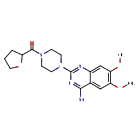
Structure for Terazosin (DB01162)
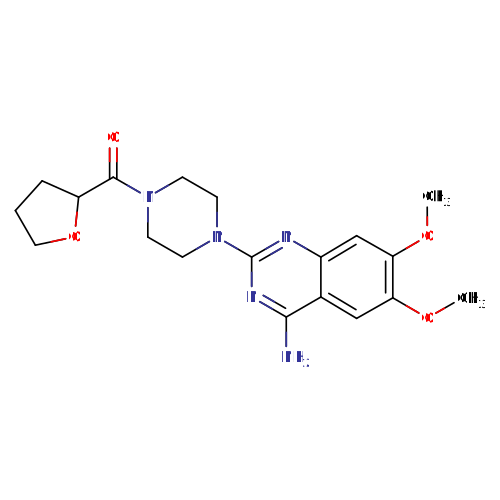
- Weight
- Average: 387.4329
Monoisotopic: 387.190654313 - Chemical Formula
- C19H25N5O4
- Synonyms
- 1-(4-Amino-6,7-dimethoxy-2-quinazolinyl)-4-((tetrahydro-2-furanyl)carbonyl)piperazine
- Terazosin
- Terazosina
- Térazosine
- Terazosine
- Terazosinum
- External IDs
- Abbott 45975

Pharmacology
- Indication
Terazosin is indicated for use in treating symptomatic benign prostatic hyperplasia and hypertensionLabel.
 Reduce drug development failure ratesBuild, train, & validate machine-learning modelswith evidence-based and structured datasets.Build, train, & validate predictive machine-learning models with structured datasets.
- Associated Conditions
Indication Type Indication Combined Product Details Approval Level Age Group Patient Characteristics Dose Form Symptomatic treatment of Benign prostatic hyperplasia •••••••••••• Management of Hypertension •••••••••••• Management of Hypertension ••• ••••• ••••••••• Treatment of Ureteral calculi ••• ••••• - Contraindications & Blackbox Warnings
 Prevent Adverse Drug Events TodayTap into our Clinical API for life-saving information on contraindications & blackbox warnings, population restrictions, harmful risks, & more.Avoid life-threatening adverse drug events with our Clinical API
- Pharmacodynamics
Terazosin is a quinazoline derivative alpha-1-selective adrenergic blockerLabel1,2.
- Mechanism of action
Terazosin is selective for alpha-1-adrenoceptors but not their individual subtypes3,4. Inhibition of these alpha-1-adrenoceptors results in relaxation of smooth muscle in blood vessels and the prostate, lowering blood pressure and improving urinary flow1,2,3,4. Smooth muscle cells accounts for roughly 40% of the volume of the prostate and so their relaxation reduces pressure on the urethra2.
It has also been shown that catecholamines induce factors responsible for mitogenesis and alpha-1-adrenergic receptor blockers inhibit this effect2.
A final long term mechanism of terazosin and other alpha-1-adrenergic receptor blockers is the induction of apoptosis of prostate cells2. Treatment with terazosin enhances the expression of transforming growth factor beta-1 (TGF-beta1), which upregulates p27kip1, and the caspase cascade2,5.
Target Actions Organism AAlpha-1A adrenergic receptor antagonistHumans AAlpha-1B adrenergic receptor antagonistHumans AAlpha-1D adrenergic receptor antagonistHumans ATransforming growth factor beta-1 inducerHumans UPotassium voltage-gated channel subfamily H member 2 inhibitorHumans UPotassium voltage-gated channel subfamily H member 6 inhibitorHumans UPotassium voltage-gated channel subfamily H member 7 inhibitorHumans - Absorption
Approximately 90%1.
- Volume of distribution
25L to 30L1.
- Protein binding
- Metabolism
The majority of terazosin is hepatically metabolized1. The metabolites recovered include 6-O-demethyl terazosin, 7-O-methyl terazosin, a piperozine derivative, and a diamine derivative1.
Hover over products below to view reaction partners
- Route of elimination
Approximately 10% of the oral dose is excreted unchanged in the urine and approximately 20% is excreted in the fecesLabel1. 40% of the total dose is eliminated in urine and 60% of the total dose is eliminated in the fecesLabel1.
- Half-life
Terazosin has a mean half life 12 hours though this can be as high as 14 hours in patients over 70 years and as low as 11.4 hours in patients 20 to 39 years oldLabel1.
- Clearance
Plasma clearance is 80mL/min and renal clearance is 10mL/min1.
- Adverse Effects
 Improve decision support & research outcomesWith structured adverse effects data, including: blackbox warnings, adverse reactions, warning & precautions, & incidence rates. View sample adverse effects data in our new Data Library!Improve decision support & research outcomes with our structured adverse effects data.
- Toxicity
In the event of an overdose, patients may experience hypotensionLabel. Blood pressure and heart rate should be controlled by having the patient lie down or by treating with volume expanders or if necessary vasopressorsLabel. Patients should be monitored for renal functionLabel. Because terazosin is highly protein bound, dialysis is unlikely to provide benefit to overdosing patientsLabel.
The oral LD50 in mice is 5500mg/kgMSDS.
- Pathways
- Not Available
- Pharmacogenomic Effects/ADRs
- Not Available
Interactions
- Drug Interactions
- This information should not be interpreted without the help of a healthcare provider. If you believe you are experiencing an interaction, contact a healthcare provider immediately. The absence of an interaction does not necessarily mean no interactions exist.
Drug Interaction Integrate drug-drug
interactions in your softwareAbaloparatide The risk or severity of adverse effects can be increased when Terazosin is combined with Abaloparatide. Acebutolol Acebutolol may increase the orthostatic hypotensive activities of Terazosin. Aceclofenac The therapeutic efficacy of Terazosin can be decreased when used in combination with Aceclofenac. Acemetacin The therapeutic efficacy of Terazosin can be decreased when used in combination with Acemetacin. Acetylsalicylic acid Acetylsalicylic acid may decrease the antihypertensive activities of Terazosin. - Food Interactions
- Take with or without food. A meal does not significantly affect the extent of absorption but delays Tmax by 40 minutes.
Products
 Drug product information from 10+ global regionsOur datasets provide approved product information including:dosage, form, labeller, route of administration, and marketing period.Access drug product information from over 10 global regions.
- Product Ingredients
Ingredient UNII CAS InChI Key Terazosin hydrochloride 8QOP8Z9955 63074-08-8 IWSWDOUXSCRCKW-UHFFFAOYSA-N Terazosin hydrochloride hydrate D32S14F082 70024-40-7 MWYNOTLRCUQCKD-UHFFFAOYSA-N - Product Images
- International/Other Brands
- Blavin (Baliarda (Argentina)) / Flumarc (Raffo (Argentina)) / Fosfomic (Finadiet (Argentina)) / Heitrin (Abbott (Germany; discontinued)) / Hytrinex (Amdipharm (Sweden)) / Itrin (Keryos (Italy)) / Urodie (Keryos (Italy)) / Vicard (Amdipharm (Austria)) / Zayasel
- Brand Name Prescription Products
Name Dosage Strength Route Labeller Marketing Start Marketing End Region Image Hytrin Capsule, liquid filled 2 mg/1 Oral Physicians Total Care, Inc. 1996-08-16 2010-12-31 US 
Hytrin Tablet 2 mg Oral Bgp Pharma Ulc 1989-12-31 2016-02-19 Canada 
Hytrin Capsule, liquid filled 10 mg/1 Oral Abbott 1994-12-14 2008-03-31 US Hytrin Capsule, liquid filled 1 mg/1 Oral Abbott 1994-12-14 2008-03-31 US Hytrin Tablet 10 mg/1 Oral Abbott 1987-08-07 2008-03-31 US - Generic Prescription Products
Name Dosage Strength Route Labeller Marketing Start Marketing End Region Image Apo-terazosin Tablet 2 mg Oral Apotex Corporation 1997-09-26 Not applicable Canada Apo-terazosin Tablet 1 mg Oral Apotex Corporation 1997-09-26 Not applicable Canada Apo-terazosin Tablet 10 mg Oral Apotex Corporation 1997-09-26 Not applicable Canada Apo-terazosin Tablet 5 mg Oral Apotex Corporation 1997-09-26 Not applicable Canada Dom-terazosin Tablet 10 mg Oral Dominion Pharmacal 2001-10-31 Not applicable Canada - Mixture Products
Name Ingredients Dosage Route Labeller Marketing Start Marketing End Region Image Hytrin-7 Tabs 1mg-7 Tabs 2mg-14 Tabs 5mg Terazosin hydrochloride (1 mg) + Terazosin hydrochloride (2 mg) + Terazosin hydrochloride (5 mg) Kit; Tablet Oral Abbott 1996-12-31 2006-10-17 Canada Hytrin-7 Tabs 1mg-7 Tabs 2mg-14 Tabs 5mg Terazosin hydrochloride (1 mg) + Terazosin hydrochloride (2 mg) + Terazosin hydrochloride (5 mg) Kit; Tablet Oral Abbott 1996-12-31 2006-10-17 Canada Hytrin-7 Tabs 1mg-7 Tabs 2mg-14 Tabs 5mg Terazosin hydrochloride (1 mg) + Terazosin hydrochloride (2 mg) + Terazosin hydrochloride (5 mg) Kit; Tablet Oral Abbott 1996-12-31 2006-10-17 Canada


Categories
- ATC Codes
- G04CA03 — Terazosin
- Drug Categories
- Adrenergic Agents
- Adrenergic alpha-1 Receptor Antagonists
- Adrenergic alpha-Antagonists
- Adrenergic Antagonists
- Antihypertensive Agents
- Antihypertensive Agents Indicated for Hypertension
- Drugs Used in Benign Prostatic Hypertrophy
- Genito Urinary System and Sex Hormones
- Genitourinary Agents
- Heterocyclic Compounds, Fused-Ring
- Hypotensive Agents
- Neurotransmitter Agents
- P-glycoprotein inhibitors
- Peripheral alpha-1 blockers
- Quinazolines
- Urological Agents
- Urologicals
- Chemical TaxonomyProvided by Classyfire
- Description
- This compound belongs to the class of organic compounds known as n-arylpiperazines. These are organic compounds containing a piperazine ring where the nitrogen ring atom carries an aryl group.
- Kingdom
- Organic compounds
- Super Class
- Organoheterocyclic compounds
- Class
- Diazinanes
- Sub Class
- Piperazines
- Direct Parent
- N-arylpiperazines
- Alternative Parents
- Quinazolinamines / Anisoles / Dialkylarylamines / Alkyl aryl ethers / Aminopyrimidines and derivatives / Imidolactams / Tetrahydrofurans / Tertiary carboxylic acid amides / Heteroaromatic compounds / Amino acids and derivatives show 8 more
- Substituents
- Alkyl aryl ether / Amine / Amino acid or derivatives / Aminopyrimidine / Anisole / Aromatic heteropolycyclic compound / Azacycle / Benzenoid / Carbonyl group / Carboxamide group show 22 more
- Molecular Framework
- Aromatic heteropolycyclic compounds
- External Descriptors
- primary amino compound, furans, quinazolines, piperazines (CHEBI:9445)
- Affected organisms
- Humans and other mammals
Chemical Identifiers
- UNII
- 8L5014XET7
- CAS number
- 63590-64-7
- InChI Key
- VCKUSRYTPJJLNI-UHFFFAOYSA-N
- InChI
- InChI=1S/C19H25N5O4/c1-26-15-10-12-13(11-16(15)27-2)21-19(22-17(12)20)24-7-5-23(6-8-24)18(25)14-4-3-9-28-14/h10-11,14H,3-9H2,1-2H3,(H2,20,21,22)
- IUPAC Name
- 6,7-dimethoxy-2-[4-(oxolane-2-carbonyl)piperazin-1-yl]quinazolin-4-amine
- SMILES
- COC1=C(OC)C=C2C(N)=NC(=NC2=C1)N1CCN(CC1)C(=O)C1CCCO1
References
- Synthesis Reference
K. S. Keshava Murthy, Gamini Weeratunga, Tianhao Zhou, Bhaskar Reddy Guntoori, "Process for the manufacture of intermediates suitable to make doxazosin, terazosin, prazosin, tiodazosin and related antihypertensive medicines." U.S. Patent US5919931, issued September, 1986.
US5919931- General References
- Sonders RC: Pharmacokinetics of terazosin. Am J Med. 1986 May 23;80(5B):20-4. [Article]
- Papadopoulos G, Vlachodimitropoulos D, Kyroudi A, Kouloukoussa M, Perrea D, Mitropoulos D: Terazosin treatment induces caspase-3 expression in the rat ventral prostate. J Clin Med Res. 2013 Apr;5(2):127-31. doi: 10.4021/jocmr1215w. Epub 2013 Feb 25. [Article]
- Roehrborn CG, Schwinn DA: Alpha1-adrenergic receptors and their inhibitors in lower urinary tract symptoms and benign prostatic hyperplasia. J Urol. 2004 Mar;171(3):1029-35. [Article]
- Na YJ, Guo YL, Gu FL: Clinical comparison of selective and non-selective alpha 1A-adrenoceptor antagonists for bladder outlet obstruction associated with benign prostatic hyperplasia: studies on tamsulosin and terazosin in Chinese patients. The Chinese Tamsulosin Study Group. J Med. 1998;29(5-6):289-304. [Article]
- Glassman DT, Chon JK, Borkowski A, Jacobs SC, Kyprianou N: Combined effect of terazosin and finasteride on apoptosis, cell proliferation, and transforming growth factor-beta expression in benign prostatic hyperplasia. Prostate. 2001 Jan 1;46(1):45-51. [Article]
- FDA Approved Drug Products: Terazosin Oral Capsules [Link]
- FDA Approved Drug Products: HYTRIN (terazosin) tablets [Link]
- External Links
- Human Metabolome Database
- HMDB0015293
- KEGG Drug
- D08569
- KEGG Compound
- C07127
- PubChem Compound
- 5401
- PubChem Substance
- 46509129
- ChemSpider
- 5208
- BindingDB
- 50033111
- 37798
- ChEBI
- 9445
- ChEMBL
- CHEMBL611
- Therapeutic Targets Database
- DAP000371
- PharmGKB
- PA451612
- RxList
- RxList Drug Page
- Drugs.com
- Drugs.com Drug Page
- Wikipedia
- Terazosin
- FDA label
- Download (112 KB)
- MSDS
- Download (34.2 KB)
Clinical Trials
- Clinical Trials
Phase Status Purpose Conditions Count 4 Completed Diagnostic Hypertension / Type 2 Diabetes Mellitus 1 4 Completed Prevention Atrial Fibrillation 1 4 Completed Treatment Hyperhidrosis 1 4 Completed Treatment Prostatic Hyperplasia 1 4 Not Yet Recruiting Treatment Gait Analysis / Metabolic Diseases / Parkinson's Disease (PD) / Therapy, Directly Observed 1
Pharmacoeconomics
- Manufacturers
- Not Available
- Packagers
- Advanced Pharmaceutical Services Inc.
- Amerisource Health Services Corp.
- Apotex Inc.
- A-S Medication Solutions LLC
- Cadista Pharmaceuticals Inc.
- Cardinal Health
- Comprehensive Consultant Services Inc.
- Direct Dispensing Inc.
- Dispensing Solutions
- Diversified Healthcare Services Inc.
- Golden State Medical Supply Inc.
- H.J. Harkins Co. Inc.
- Heartland Repack Services LLC
- Intas Pharmaceuticals Ltd.
- Ivax Pharmaceuticals
- Kaiser Foundation Hospital
- Major Pharmaceuticals
- Mckesson Corp.
- Murfreesboro Pharmaceutical Nursing Supply
- Mylan
- Nucare Pharmaceuticals Inc.
- Palmetto Pharmaceuticals Inc.
- PD-Rx Pharmaceuticals Inc.
- Pharmaceutical Utilization Management Program VA Inc.
- Physicians Total Care Inc.
- Preferred Pharmaceuticals Inc.
- Prepackage Specialists
- Prepak Systems Inc.
- Ranbaxy Laboratories
- Rebel Distributors Corp.
- Redpharm Drug
- Remedy Repack
- Resource Optimization and Innovation LLC
- Sandoz
- Southwood Pharmaceuticals
- Teva Pharmaceutical Industries Ltd.
- Torpharm Inc.
- Tya Pharmaceuticals
- UDL Laboratories
- Va Cmop Dallas
- Vangard Labs Inc.
- Dosage Forms
Form Route Strength Capsule, liquid filled Oral 1 mg/1 Capsule, liquid filled Oral 10 mg/1 Capsule, liquid filled Oral 2 mg/1 Capsule, liquid filled Oral 5 mg/1 Tablet Oral Tablet Oral 1 mg/1 Tablet Oral 10 mg/1 Tablet Oral 2 mg/1 Tablet Oral 5 mg/1 Tablet Oral 2 mg Tablet Oral 1 mg Kit; tablet Oral Tablet Oral 10 mg Tablet Oral 2.000 mg Solution / drops Ophthalmic 2.5 mg/5mL Tablet Oral 1.187 mg Tablet Oral 2.374 mg Capsule Oral 1 mg/1 Capsule Oral 10 mg/1 Capsule Oral 2 mg/1 Capsule Oral 5 mg/1 Solution / drops Oral 2.5 MG/ML Tablet Oral 5 mg - Prices
Unit description Cost Unit Hytrin 10 mg Tablet 1.85USD tablet Terazosin HCl 1 mg capsule 1.67USD capsule Terazosin HCl 10 mg capsule 1.67USD capsule Terazosin HCl 2 mg capsule 1.67USD capsule Terazosin HCl 5 mg capsule 1.67USD capsule Hytrin 5 mg Tablet 1.26USD tablet Hytrin 2 mg Tablet 0.93USD tablet Apo-Terazosin 10 mg Tablet 0.92USD tablet Novo-Terazosin 10 mg Tablet 0.92USD tablet Nu-Terazosin 10 mg Tablet 0.92USD tablet Pms-Terazosin 10 mg Tablet 0.92USD tablet Ratio-Terazosin 10 mg Tablet 0.92USD tablet Hytrin 1 mg Tablet 0.73USD tablet Apo-Terazosin 5 mg Tablet 0.63USD tablet Novo-Terazosin 5 mg Tablet 0.63USD tablet Nu-Terazosin 5 mg Tablet 0.63USD tablet Pms-Terazosin 5 mg Tablet 0.63USD tablet Ratio-Terazosin 5 mg Tablet 0.63USD tablet Apo-Terazosin 2 mg Tablet 0.46USD tablet Novo-Terazosin 2 mg Tablet 0.46USD tablet Nu-Terazosin 2 mg Tablet 0.46USD tablet Pms-Terazosin 2 mg Tablet 0.46USD tablet Ratio-Terazosin 2 mg Tablet 0.46USD tablet Apo-Terazosin 1 mg Tablet 0.37USD tablet Novo-Terazosin 1 mg Tablet 0.37USD tablet Nu-Terazosin 1 mg Tablet 0.37USD tablet Pms-Terazosin 1 mg Tablet 0.37USD tablet Ratio-Terazosin 1 mg Tablet 0.37USD tablet DrugBank does not sell nor buy drugs. Pricing information is supplied for informational purposes only.- Patents
Patent Number Pediatric Extension Approved Expires (estimated) Region US5294615 No 1994-03-15 2013-04-29 US US5212176 No 1993-05-18 2010-06-29 US
Properties
- State
- Solid
- Experimental Properties
Property Value Source melting point (°C) 271-274 [MSDS] - Predicted Properties
Property Value Source Water Solubility 1.5 mg/mL ALOGPS logP 1.12 ALOGPS logP 1.18 Chemaxon logS -2.4 ALOGPS pKa (Strongest Acidic) 19.93 Chemaxon pKa (Strongest Basic) 7.24 Chemaxon Physiological Charge 1 Chemaxon Hydrogen Acceptor Count 8 Chemaxon Hydrogen Donor Count 1 Chemaxon Polar Surface Area 103.04 Å2 Chemaxon Rotatable Bond Count 4 Chemaxon Refractivity 105.18 m3·mol-1 Chemaxon Polarizability 41.28 Å3 Chemaxon Number of Rings 4 Chemaxon Bioavailability 1 Chemaxon Rule of Five Yes Chemaxon Ghose Filter Yes Chemaxon Veber's Rule No Chemaxon MDDR-like Rule No Chemaxon - Predicted ADMET Features
Property Value Probability Human Intestinal Absorption + 1.0 Blood Brain Barrier + 0.9646 Caco-2 permeable + 0.8868 P-glycoprotein substrate Substrate 0.698 P-glycoprotein inhibitor I Non-inhibitor 0.5666 P-glycoprotein inhibitor II Non-inhibitor 0.8619 Renal organic cation transporter Non-inhibitor 0.6319 CYP450 2C9 substrate Non-substrate 0.8864 CYP450 2D6 substrate Non-substrate 0.8032 CYP450 3A4 substrate Substrate 0.7753 CYP450 1A2 substrate Non-inhibitor 0.9046 CYP450 2C9 inhibitor Non-inhibitor 0.9435 CYP450 2D6 inhibitor Non-inhibitor 0.9628 CYP450 2C19 inhibitor Non-inhibitor 0.9492 CYP450 3A4 inhibitor Non-inhibitor 0.7905 CYP450 inhibitory promiscuity Low CYP Inhibitory Promiscuity 0.901 Ames test Non AMES toxic 0.5943 Carcinogenicity Non-carcinogens 0.906 Biodegradation Not ready biodegradable 0.9785 Rat acute toxicity 2.2262 LD50, mol/kg Not applicable hERG inhibition (predictor I) Weak inhibitor 0.8368 hERG inhibition (predictor II) Inhibitor 0.8204
Spectra
- Mass Spec (NIST)
- Not Available
- Spectra
- Chromatographic Properties
Collision Cross Sections (CCS)
Adduct CCS Value (Å2) Source type Source [M-H]- 219.3514997 predictedDarkChem Lite v0.1.0 [M-H]- 184.86188 predictedDeepCCS 1.0 (2019) [M+H]+ 219.3147997 predictedDarkChem Lite v0.1.0 [M+H]+ 187.27812 predictedDeepCCS 1.0 (2019) [M+Na]+ 219.4181997 predictedDarkChem Lite v0.1.0 [M+Na]+ 194.43929 predictedDeepCCS 1.0 (2019)
Targets

- Kind
- Protein
- Organism
- Humans
- Pharmacological action
- Yes
- Actions
- Antagonist
- General Function
- Protein heterodimerization activity
- Specific Function
- This alpha-adrenergic receptor mediates its action by association with G proteins that activate a phosphatidylinositol-calcium second messenger system. Its effect is mediated by G(q) and G(11) prot...
- Gene Name
- ADRA1A
- Uniprot ID
- P35348
- Uniprot Name
- Alpha-1A adrenergic receptor
- Molecular Weight
- 51486.005 Da
References
- Chapple CR: Medical therapy and quality of life. Eur Urol. 1998;34 Suppl 2:10-7; discussion 46. [Article]
- Chen X, Ji ZL, Chen YZ: TTD: Therapeutic Target Database. Nucleic Acids Res. 2002 Jan 1;30(1):412-5. [Article]
- Lee E, Lee C: Clinical comparison of selective and non-selective alpha 1A-adrenoreceptor antagonists in benign prostatic hyperplasia: studies on tamsulosin in a fixed dose and terazosin in increasing doses. Br J Urol. 1997 Oct;80(4):606-11. [Article]
- Michel MC, Grubbel B, Taguchi K, Verfurth F, Otto T, Kropfl D: Drugs for treatment of benign prostatic hyperplasia: affinity comparison at cloned alpha 1-adrenoceptor subtypes and in human prostate. J Auton Pharmacol. 1996 Feb;16(1):21-8. [Article]
- Na YJ, Guo YL, Gu FL: Clinical comparison of selective and non-selective alpha 1A-adrenoceptor antagonists for bladder outlet obstruction associated with benign prostatic hyperplasia: studies on tamsulosin and terazosin in Chinese patients. The Chinese Tamsulosin Study Group. J Med. 1998;29(5-6):289-304. [Article]
- Roehrborn CG, Schwinn DA: Alpha1-adrenergic receptors and their inhibitors in lower urinary tract symptoms and benign prostatic hyperplasia. J Urol. 2004 Mar;171(3):1029-35. [Article]
- Kind
- Protein
- Organism
- Humans
- Pharmacological action
- Yes
- Actions
- Antagonist
- General Function
- Protein heterodimerization activity
- Specific Function
- This alpha-adrenergic receptor mediates its action by association with G proteins that activate a phosphatidylinositol-calcium second messenger system. Its effect is mediated by G(q) and G(11) prot...
- Gene Name
- ADRA1B
- Uniprot ID
- P35368
- Uniprot Name
- Alpha-1B adrenergic receptor
- Molecular Weight
- 56835.375 Da
References
- Boyle P, Robertson C, Manski R, Padley RJ, Roehrborn CG: Meta-analysis of randomized trials of terazosin in the treatment of benign prostatic hyperplasia. Urology. 2001 Nov;58(5):717-22. [Article]
- Chen X, Ji ZL, Chen YZ: TTD: Therapeutic Target Database. Nucleic Acids Res. 2002 Jan 1;30(1):412-5. [Article]
- Simpson P: Stimulation of hypertrophy of cultured neonatal rat heart cells through an alpha 1-adrenergic receptor and induction of beating through an alpha 1- and beta 1-adrenergic receptor interaction. Evidence for independent regulation of growth and beating. Circ Res. 1985 Jun;56(6):884-94. [Article]
- Vincent J, Dachman W, Blaschke TF, Hoffman BB: Pharmacological tolerance to alpha 1-adrenergic receptor antagonism mediated by terazosin in humans. J Clin Invest. 1992 Nov;90(5):1763-8. [Article]
- Kind
- Protein
- Organism
- Humans
- Pharmacological action
- Yes
- Actions
- Antagonist
- General Function
- Alpha1-adrenergic receptor activity
- Specific Function
- This alpha-adrenergic receptor mediates its effect through the influx of extracellular calcium.
- Gene Name
- ADRA1D
- Uniprot ID
- P25100
- Uniprot Name
- Alpha-1D adrenergic receptor
- Molecular Weight
- 60462.205 Da
References
- Chen X, Ji ZL, Chen YZ: TTD: Therapeutic Target Database. Nucleic Acids Res. 2002 Jan 1;30(1):412-5. [Article]
- Kind
- Protein
- Organism
- Humans
- Pharmacological action
- Yes
- Actions
- Inducer
- General Function
- Type iii transforming growth factor beta receptor binding
- Specific Function
- Multifunctional protein that controls proliferation, differentiation and other functions in many cell types. Many cells synthesize TGFB1 and have specific receptors for it. It positively and negati...
- Gene Name
- TGFB1
- Uniprot ID
- P01137
- Uniprot Name
- Transforming growth factor beta-1
- Molecular Weight
- 44340.685 Da
References
- Papadopoulos G, Vlachodimitropoulos D, Kyroudi A, Kouloukoussa M, Perrea D, Mitropoulos D: Terazosin treatment induces caspase-3 expression in the rat ventral prostate. J Clin Med Res. 2013 Apr;5(2):127-31. doi: 10.4021/jocmr1215w. Epub 2013 Feb 25. [Article]
- Glassman DT, Chon JK, Borkowski A, Jacobs SC, Kyprianou N: Combined effect of terazosin and finasteride on apoptosis, cell proliferation, and transforming growth factor-beta expression in benign prostatic hyperplasia. Prostate. 2001 Jan 1;46(1):45-51. [Article]
- Kind
- Protein
- Organism
- Humans
- Pharmacological action
- Unknown
- Actions
- Inhibitor
- General Function
- Voltage-gated potassium channel activity involved in ventricular cardiac muscle cell action potential repolarization
- Specific Function
- Pore-forming (alpha) subunit of voltage-gated inwardly rectifying potassium channel. Channel properties are modulated by cAMP and subunit assembly. Mediates the rapidly activating component of the ...
- Gene Name
- KCNH2
- Uniprot ID
- Q12809
- Uniprot Name
- Potassium voltage-gated channel subfamily H member 2
- Molecular Weight
- 126653.52 Da
References
- Thomas D, Wimmer AB, Wu K, Hammerling BC, Ficker EK, Kuryshev YA, Kiehn J, Katus HA, Schoels W, Karle CA: Inhibition of human ether-a-go-go-related gene potassium channels by alpha 1-adrenoceptor antagonists prazosin, doxazosin, and terazosin. Naunyn Schmiedebergs Arch Pharmacol. 2004 May;369(5):462-72. Epub 2004 Apr 20. [Article]
- Kind
- Protein
- Organism
- Humans
- Pharmacological action
- Unknown
- Actions
- Inhibitor
- General Function
- Voltage-gated potassium channel activity
- Specific Function
- Pore-forming (alpha) subunit of voltage-gated potassium channel. Elicits a slowly activating, rectifying current (By similarity). Channel properties may be modulated by cAMP and subunit assembly.
- Gene Name
- KCNH6
- Uniprot ID
- Q9H252
- Uniprot Name
- Potassium voltage-gated channel subfamily H member 6
- Molecular Weight
- 109923.705 Da
References
- Thomas D, Wimmer AB, Wu K, Hammerling BC, Ficker EK, Kuryshev YA, Kiehn J, Katus HA, Schoels W, Karle CA: Inhibition of human ether-a-go-go-related gene potassium channels by alpha 1-adrenoceptor antagonists prazosin, doxazosin, and terazosin. Naunyn Schmiedebergs Arch Pharmacol. 2004 May;369(5):462-72. Epub 2004 Apr 20. [Article]
- Kind
- Protein
- Organism
- Humans
- Pharmacological action
- Unknown
- Actions
- Inhibitor
- General Function
- Voltage-gated potassium channel activity
- Specific Function
- Pore-forming (alpha) subunit of voltage-gated potassium channel. Channel properties may be modulated by cAMP and subunit assembly.
- Gene Name
- KCNH7
- Uniprot ID
- Q9NS40
- Uniprot Name
- Potassium voltage-gated channel subfamily H member 7
- Molecular Weight
- 134998.525 Da
References
- Thomas D, Wimmer AB, Wu K, Hammerling BC, Ficker EK, Kuryshev YA, Kiehn J, Katus HA, Schoels W, Karle CA: Inhibition of human ether-a-go-go-related gene potassium channels by alpha 1-adrenoceptor antagonists prazosin, doxazosin, and terazosin. Naunyn Schmiedebergs Arch Pharmacol. 2004 May;369(5):462-72. Epub 2004 Apr 20. [Article]
Transporters
- Kind
- Protein
- Organism
- Humans
- Pharmacological action
- Unknown
- Actions
- Inhibitor
- General Function
- Xenobiotic-transporting atpase activity
- Specific Function
- Energy-dependent efflux pump responsible for decreased drug accumulation in multidrug-resistant cells.
- Gene Name
- ABCB1
- Uniprot ID
- P08183
- Uniprot Name
- Multidrug resistance protein 1
- Molecular Weight
- 141477.255 Da
References
- Takara K, Sakaeda T, Kakumoto M, Tanigawara Y, Kobayashi H, Okumura K, Ohnishi N, Yokoyama T: Effects of alpha-adrenoceptor antagonist doxazosin on MDR1-mediated multidrug resistance and transcellular transport. Oncol Res. 2009;17(11-12):527-33. [Article]

Drug created at June 13, 2005 13:24 / Updated at April 26, 2024 00:45