Identification
- Summary
Propafenone is a Class 1C antiarrhythmic agent used in the management of paroxysmal atrial fibrillation/flutter and ventricular arrhythmias.
- Brand Names
- Rythmol
- Generic Name
- Propafenone
- DrugBank Accession Number
- DB01182
- Background
An antiarrhythmia agent that is particularly effective in ventricular arrhythmias. It also has weak beta-blocking activity. The drug is generally well tolerated.
- Type
- Small Molecule
- Groups
- Approved
- Structure
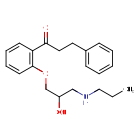
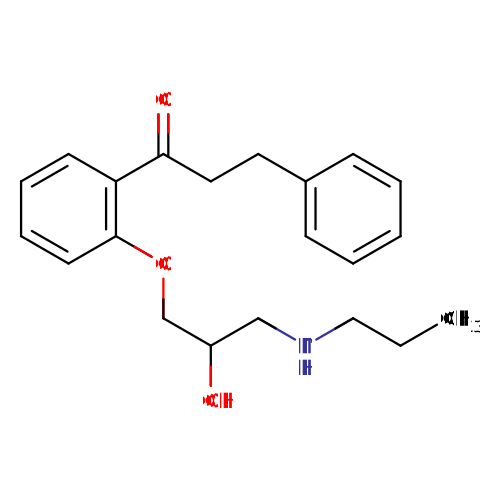
Structure for Propafenone (DB01182)
- Weight
- Average: 341.444
Monoisotopic: 341.199093735 - Chemical Formula
- C21H27NO3
- Synonyms
- 1-(2-(2-hydroxy-3-(propylamino)propoxy)phenyl)-3-phenyl-1-propanone
- 2-(2'-hydroxy-3'-propylaminopropoxy)-ω-phenylpropiophenone
- Propafenona
- Propafenone
- Propafenonum

Pharmacology
- Indication
Used to prolong the time to recurrence of paroxysmal atrial fibrillation/flutter (PAF) associated with disabling symptoms in patients without structural heart disease. Also used for the treatment of life-threatening documented ventricular arrhythmias, such as sustained ventricular tachycardia.
 Reduce drug development failure ratesBuild, train, & validate machine-learning modelswith evidence-based and structured datasets.Build, train, & validate predictive machine-learning models with structured datasets.
- Associated Conditions
Indication Type Indication Combined Product Details Approval Level Age Group Patient Characteristics Dose Form Management of Atrial fibrillation •••••••••••• Management of Paroxysmal atrial fibrillation •••••••••••• •••••••• •••••••• •••••••• ••••••• ••••••• ••••••• ••••••• •••• •••••• Management of Paroxysmal supraventricular tachycardia •••••••••••• ••••••• ••••••• ••••••• ••••••• •••• •••••• Treatment of Ventricular arrhythmias •••••••••••• ••••••• ••••••• ••••••• ••••••• •••• •••••• - Contraindications & Blackbox Warnings
 Prevent Adverse Drug Events TodayTap into our Clinical API for life-saving information on contraindications & blackbox warnings, population restrictions, harmful risks, & more.Avoid life-threatening adverse drug events with our Clinical API
- Pharmacodynamics
Propafenone is a Class 1C antiarrhythmic drug with local anesthetic effects, and a direct stabilizing action on myocardial membranes. It is used in the treatment of atrial and ventricular arrhythmias. It acts by inhibiting sodium channels to restrict the entry of sodium into cardiac cells resulting in reduced excitation. Propafenone has local anesthetic activity approximately equal to procaine.
- Mechanism of action
The electrophysiological effect of propafenone manifests itself in a reduction of upstroke velocity (Phase 0) of the monophasic action potential. In Purkinje fibers, and to a lesser extent myocardial fibers, propafenone reduces the fast inward current carried by sodium ions, which is responsible for the drugs antiarrhythmic actions. Diastolic excitability threshold is increased and effective refractory period prolonged. Propafenone reduces spontaneous automaticity and depresses triggered activity. At very high concentrations in vitro, propafenone can inhibit the slow inward current carried by calcium but this calcium antagonist effect probably does not contribute to antiarrhythmic efficacy.
Target Actions Organism ASodium channel protein type 5 subunit alpha inhibitorHumans APotassium voltage-gated channel subfamily H member 2 inhibitorHumans UBeta-1 adrenergic receptor antagonistHumans UBeta-2 adrenergic receptor antagonistHumans - Absorption
Nearly completely absorbed following oral administration (90%). Systemic bioavailability ranges from 5 to 50%, due to significant first-pass metabolism. This wide range in systemic bioavailability is related to two factors: presence of food (food increases bioavailability) and dosage (bioavailability is 3.4% for a 150-mg tablet compared to 10.6% for a 300-mg tablet).
- Volume of distribution
- 252 L
- Protein binding
97%
- Metabolism
Metabolized primarily in the liver where it is rapidly and extensively metabolized to two active metabolites, 5-hydroxypropafenone and N-depropylpropafenone. These metabolites have antiarrhythmic activity comparable to propafenone but are present in concentrations less than 25% of propafenone concentrations.
Hover over products below to view reaction partners
- Route of elimination
Approximately 50% of propafenone metabolites are excreted in the urine following administration of immediate release tablets.
- Half-life
2-10 hours
- Clearance
Not Available
- Adverse Effects
 Improve decision support & research outcomesWith structured adverse effects data, including: blackbox warnings, adverse reactions, warning & precautions, & incidence rates. View sample adverse effects data in our new Data Library!Improve decision support & research outcomes with our structured adverse effects data.
- Toxicity
Symptoms of propafenone overdose (usually most severe within the first 3 hours) may include convulsions (rarely), heartbeat irregularities, low blood pressure, and sleepiness.
- Pathways
- Not Available
- Pharmacogenomic Effects/ADRs
Interacting Gene/Enzyme Allele name Genotype(s) Defining Change(s) Type(s) Description Details Cytochrome P450 2D6 CYP2D6*3 Not Available C allele ADR Inferred Poor drug metabolizer, increased exposure may lead to cardiac arrhythmias and exaggerated beta-adrenergic blocking activity. Details Cytochrome P450 2D6 CYP2D6*4 Not Available C allele ADR Inferred Poor drug metabolizer, increased exposure may lead to cardiac arrhythmias and exaggerated beta-adrenergic blocking activity. Details Cytochrome P450 2D6 CYP2D6*5 Not Available Whole-gene deletion ADR Inferred Poor drug metabolizer, increased exposure may lead to cardiac arrhythmias and exaggerated beta-adrenergic blocking activity. Details Cytochrome P450 2D6 CYP2D6*6 Not Available 1707delT ADR Inferred Poor drug metabolizer, increased exposure may lead to cardiac arrhythmias and exaggerated beta-adrenergic blocking activity. Details Cytochrome P450 2D6 CYP2D6*7 Not Available 2935A>C ADR Inferred Poor drug metabolizer, increased exposure may lead to cardiac arrhythmias and exaggerated beta-adrenergic blocking activity. Details Cytochrome P450 2D6 CYP2D6*8 Not Available 1758G>T ADR Inferred Poor drug metabolizer, increased exposure may lead to cardiac arrhythmias and exaggerated beta-adrenergic blocking activity. Details Cytochrome P450 2D6 CYP2D6*11 Not Available 883G>C ADR Inferred Poor drug metabolizer, increased exposure may lead to cardiac arrhythmias and exaggerated beta-adrenergic blocking activity. Details Cytochrome P450 2D6 CYP2D6*12 Not Available 124G>A ADR Inferred Poor drug metabolizer, increased exposure may lead to cardiac arrhythmias and exaggerated beta-adrenergic blocking activity. Details Cytochrome P450 2D6 CYP2D6*13 Not Available CYP2D7/2D6 hybrid gene structure ADR Inferred Poor drug metabolizer, increased exposure may lead to cardiac arrhythmias and exaggerated beta-adrenergic blocking activity. Details Cytochrome P450 2D6 CYP2D6*14A Not Available 1758G>A ADR Inferred Poor drug metabolizer, increased exposure may lead to cardiac arrhythmias and exaggerated beta-adrenergic blocking activity. Details Cytochrome P450 2D6 CYP2D6*15 Not Available 137insT, 137_138insT ADR Inferred Poor drug metabolizer, increased exposure may lead to cardiac arrhythmias and exaggerated beta-adrenergic blocking activity. Details Cytochrome P450 2D6 CYP2D6*19 Not Available 2539_2542delAACT ADR Inferred Poor drug metabolizer, increased exposure may lead to cardiac arrhythmias and exaggerated beta-adrenergic blocking activity. Details Cytochrome P450 2D6 CYP2D6*20 Not Available 1973_1974insG ADR Inferred Poor drug metabolizer, increased exposure may lead to cardiac arrhythmias and exaggerated beta-adrenergic blocking activity. Details Cytochrome P450 2D6 CYP2D6*21 Not Available 2573insC ADR Inferred Poor drug metabolizer, increased exposure may lead to cardiac arrhythmias and exaggerated beta-adrenergic blocking activity. Details Cytochrome P450 2D6 CYP2D6*31 Not Available -1770G>A / -1584C>G … show all ADR Inferred Poor drug metabolizer, increased exposure may lead to cardiac arrhythmias and exaggerated beta-adrenergic blocking activity. Details Cytochrome P450 2D6 CYP2D6*36 Not Available 100C>T / -1426C>T … show all ADR Inferred Poor drug metabolizer, increased exposure may lead to cardiac arrhythmias and exaggerated beta-adrenergic blocking activity. Details Cytochrome P450 2D6 CYP2D6*38 Not Available 2587_2590delGACT ADR Inferred Poor drug metabolizer, increased exposure may lead to cardiac arrhythmias and exaggerated beta-adrenergic blocking activity. Details Cytochrome P450 2D6 CYP2D6*40 Not Available 1863_1864ins(TTT CGC CCC)2 ADR Inferred Poor drug metabolizer, increased exposure may lead to cardiac arrhythmias and exaggerated beta-adrenergic blocking activity. Details Cytochrome P450 2D6 CYP2D6*42 Not Available 3259_3260insGT ADR Inferred Poor drug metabolizer, increased exposure may lead to cardiac arrhythmias and exaggerated beta-adrenergic blocking activity. Details Cytochrome P450 2D6 CYP2D6*44 Not Available 2950G>C ADR Inferred Poor drug metabolizer, increased exposure may lead to cardiac arrhythmias and exaggerated beta-adrenergic blocking activity. Details Cytochrome P450 2D6 CYP2D6*47 Not Available 100C>T / -1426C>T … show all ADR Inferred Poor drug metabolizer, increased exposure may lead to cardiac arrhythmias and exaggerated beta-adrenergic blocking activity. Details Cytochrome P450 2D6 CYP2D6*51 Not Available -1584C>G / -1235A>G … show all ADR Inferred Poor drug metabolizer, increased exposure may lead to cardiac arrhythmias and exaggerated beta-adrenergic blocking activity. Details Cytochrome P450 2D6 CYP2D6*56 Not Available 3201C>T ADR Inferred Poor drug metabolizer, increased exposure may lead to cardiac arrhythmias and exaggerated beta-adrenergic blocking activity. Details Cytochrome P450 2D6 CYP2D6*57 Not Available 100C>T / 310G>T … show all ADR Inferred Poor drug metabolizer, increased exposure may lead to cardiac arrhythmias and exaggerated beta-adrenergic blocking activity. Details Cytochrome P450 2D6 CYP2D6*62 Not Available 4044C>T ADR Inferred Poor drug metabolizer, increased exposure may lead to cardiac arrhythmias and exaggerated beta-adrenergic blocking activity. Details Cytochrome P450 2D6 CYP2D6*68A Not Available -1426C>T / -1235A>G … show all ADR Inferred Poor drug metabolizer, increased exposure may lead to cardiac arrhythmias and exaggerated beta-adrenergic blocking activity. Details Cytochrome P450 2D6 CYP2D6*68B Not Available Similar but not identical switch region compared to CYP2D6*68A. Found in tandem arrangement with CYP2D6*4. ADR Inferred Poor drug metabolizer, increased exposure may lead to cardiac arrhythmias and exaggerated beta-adrenergic blocking activity. Details Cytochrome P450 2D6 CYP2D6*69 Not Available 2988G>A / -1426C>T … show all ADR Inferred Poor drug metabolizer, increased exposure may lead to cardiac arrhythmias and exaggerated beta-adrenergic blocking activity. Details Cytochrome P450 2D6 CYP2D6*92 Not Available 1995delC ADR Inferred Poor drug metabolizer, increased exposure may lead to cardiac arrhythmias and exaggerated beta-adrenergic blocking activity. Details Cytochrome P450 2D6 CYP2D6*100 Not Available -1426C>T / -1235A>G … show all ADR Inferred Poor drug metabolizer, increased exposure may lead to cardiac arrhythmias and exaggerated beta-adrenergic blocking activity. Details Cytochrome P450 2D6 CYP2D6*101 Not Available -1426C>T / -1235A>G … show all ADR Inferred Poor drug metabolizer, increased exposure may lead to cardiac arrhythmias and exaggerated beta-adrenergic blocking activity. Details Cytochrome P450 2D6 CYP2D6*9 Not Available 2615-2617delAAG ADR Inferred Poor drug metabolizer, increased exposure may lead to cardiac arrhythmias and exaggerated beta-adrenergic blocking activity. Details Cytochrome P450 2D6 CYP2D6*10 Not Available 100C>T / 1661G>C … show all ADR Inferred Poor drug metabolizer, increased exposure may lead to cardiac arrhythmias and exaggerated beta-adrenergic blocking activity. Details Cytochrome P450 2D6 CYP2D6*14B Not Available 1758G>A ADR Inferred Poor drug metabolizer, increased exposure may lead to cardiac arrhythmias and exaggerated beta-adrenergic blocking activity. Details Cytochrome P450 2D6 CYP2D6*17 Not Available 1023C>T / 2850C>T ADR Inferred Poor drug metabolizer, increased exposure may lead to cardiac arrhythmias and exaggerated beta-adrenergic blocking activity. Details Cytochrome P450 2D6 CYP2D6*18 Not Available 4133dupGTGCCCACT ADR Inferred Poor drug metabolizer, increased exposure may lead to cardiac arrhythmias and exaggerated beta-adrenergic blocking activity. Details Cytochrome P450 2D6 CYP2D6*29 Not Available 1659G>A / 1661G>C … show all ADR Inferred Poor drug metabolizer, increased exposure may lead to cardiac arrhythmias and exaggerated beta-adrenergic blocking activity. Details Cytochrome P450 2D6 CYP2D6*41 Not Available 2988G>A ADR Inferred Poor drug metabolizer, increased exposure may lead to cardiac arrhythmias and exaggerated beta-adrenergic blocking activity. Details Cytochrome P450 2D6 CYP2D6*49 Not Available 100C>T / -1426C>T … show all ADR Inferred Poor drug metabolizer, increased exposure may lead to cardiac arrhythmias and exaggerated beta-adrenergic blocking activity. Details Cytochrome P450 2D6 CYP2D6*50 Not Available 1720A>C ADR Inferred Poor drug metabolizer, increased exposure may lead to cardiac arrhythmias and exaggerated beta-adrenergic blocking activity. Details Cytochrome P450 2D6 CYP2D6*54 Not Available 100C>T / 1039C>T … show all ADR Inferred Poor drug metabolizer, increased exposure may lead to cardiac arrhythmias and exaggerated beta-adrenergic blocking activity. Details Cytochrome P450 2D6 CYP2D6*55 Not Available 1661G>C / 2850C>T … show all ADR Inferred Poor drug metabolizer, increased exposure may lead to cardiac arrhythmias and exaggerated beta-adrenergic blocking activity. Details Cytochrome P450 2D6 CYP2D6*59 Not Available 1661G>C / 2291G>A … show all ADR Inferred Poor drug metabolizer, increased exposure may lead to cardiac arrhythmias and exaggerated beta-adrenergic blocking activity. Details Cytochrome P450 2D6 CYP2D6*72 Not Available -1426C>T / -1235A>G … show all ADR Inferred Poor drug metabolizer, increased exposure may lead to cardiac arrhythmias and exaggerated beta-adrenergic blocking activity. Details Cytochrome P450 3A4 CYP3A4*20 Not Available 1461_1462insA ADR Inferred Poor drug metabolizer, increased exposure may lead to cardiac arrhythmias and exaggerated beta-adrenergic blocking activity. Details Cytochrome P450 3A4 CYP3A4*26 Not Available 802C>T ADR Inferred Poor drug metabolizer, increased exposure may lead to cardiac arrhythmias and exaggerated beta-adrenergic blocking activity. Details Cytochrome P450 3A4 CYP3A4*8 Not Available 13908G>A ADR Inferred Poor drug metabolizer, increased exposure may lead to cardiac arrhythmias and exaggerated beta-adrenergic blocking activity. Details Cytochrome P450 3A4 CYP3A4*11 Not Available 1088C>T ADR Inferred Poor drug metabolizer, increased exposure may lead to cardiac arrhythmias and exaggerated beta-adrenergic blocking activity. Details Cytochrome P450 3A4 CYP3A4*12 Not Available 1117C>T ADR Inferred Poor drug metabolizer, increased exposure may lead to cardiac arrhythmias and exaggerated beta-adrenergic blocking activity. Details Cytochrome P450 3A4 CYP3A4*13 Not Available 1247C>T ADR Inferred Poor drug metabolizer, increased exposure may lead to cardiac arrhythmias and exaggerated beta-adrenergic blocking activity. Details Cytochrome P450 3A4 CYP3A4*16A Not Available 554C>G ADR Inferred Poor drug metabolizer, increased exposure may lead to cardiac arrhythmias and exaggerated beta-adrenergic blocking activity. Details Cytochrome P450 3A4 CYP3A4*16B Not Available 554C>G ADR Inferred Poor drug metabolizer, increased exposure may lead to cardiac arrhythmias and exaggerated beta-adrenergic blocking activity. Details Cytochrome P450 3A4 CYP3A4*17 Not Available 566T>C ADR Inferred Poor drug metabolizer, increased exposure may lead to cardiac arrhythmias and exaggerated beta-adrenergic blocking activity. Details Cytochrome P450 1A2 CYP1A2*6 Not Available 5090C>T ADR Inferred Poor drug metabolizer, increased exposure may lead to cardiac arrhythmias and exaggerated beta-adrenergic blocking activity. Details Cytochrome P450 1A2 CYP1A2*1C Not Available -3860G>A ADR Inferred Poor drug metabolizer, increased exposure may lead to cardiac arrhythmias and exaggerated beta-adrenergic blocking activity. Details Cytochrome P450 1A2 CYP1A2*1K Not Available -739T>G / -729C>T … show all ADR Inferred Poor drug metabolizer, increased exposure may lead to cardiac arrhythmias and exaggerated beta-adrenergic blocking activity. Details Cytochrome P450 1A2 CYP1A2*3 Not Available 2116G>A / 5347T>C ADR Inferred Poor drug metabolizer, increased exposure may lead to cardiac arrhythmias and exaggerated beta-adrenergic blocking activity. Details Cytochrome P450 1A2 CYP1A2*4 Not Available 2499A>T ADR Inferred Poor drug metabolizer, increased exposure may lead to cardiac arrhythmias and exaggerated beta-adrenergic blocking activity. Details Cytochrome P450 1A2 CYP1A2*7 Not Available 3533G>A ADR Inferred Poor drug metabolizer, increased exposure may lead to cardiac arrhythmias and exaggerated beta-adrenergic blocking activity. Details Cytochrome P450 1A2 CYP1A2*8 Not Available 5166G>A / 5347T>C ADR Inferred Poor drug metabolizer, increased exposure may lead to cardiac arrhythmias and exaggerated beta-adrenergic blocking activity. Details Cytochrome P450 1A2 CYP1A2*11 Not Available 558C>A ADR Inferred Poor drug metabolizer, increased exposure may lead to cardiac arrhythmias and exaggerated beta-adrenergic blocking activity. Details Cytochrome P450 1A2 CYP1A2*15 Not Available 125C>G / 5347T>C ADR Inferred Poor drug metabolizer, increased exposure may lead to cardiac arrhythmias and exaggerated beta-adrenergic blocking activity. Details Cytochrome P450 1A2 CYP1A2*16 Not Available 2473G>A / 5347T>C ADR Inferred Poor drug metabolizer, increased exposure may lead to cardiac arrhythmias and exaggerated beta-adrenergic blocking activity. Details
Interactions
- Drug Interactions
- This information should not be interpreted without the help of a healthcare provider. If you believe you are experiencing an interaction, contact a healthcare provider immediately. The absence of an interaction does not necessarily mean no interactions exist.
Drug Interaction Integrate drug-drug
interactions in your softwareAbametapir The serum concentration of Propafenone can be increased when it is combined with Abametapir. Abatacept The metabolism of Propafenone can be increased when combined with Abatacept. Abemaciclib The serum concentration of Abemaciclib can be increased when it is combined with Propafenone. Abiraterone The serum concentration of Propafenone can be increased when it is combined with Abiraterone. Acarbose The therapeutic efficacy of Acarbose can be increased when used in combination with Propafenone. - Food Interactions
- Avoid grapefruit products.
- Take with or without food. Take consistently at the same time in regard to meals.
Products
 Drug product information from 10+ global regionsOur datasets provide approved product information including:dosage, form, labeller, route of administration, and marketing period.Access drug product information from over 10 global regions.
- Product Ingredients
Ingredient UNII CAS InChI Key Propafenone hydrochloride 33XCH0HOCD 34183-22-7 XWIHRGFIPXWGEF-UHFFFAOYSA-N - Product Images
- Brand Name Prescription Products
Name Dosage Strength Route Labeller Marketing Start Marketing End Region Image Propafenone Tablet 150 mg Oral Sanis Health Inc 2010-02-16 Not applicable Canada 
Propafenone Tablet 300 mg Oral Sanis Health Inc 2010-02-16 Not applicable Canada Propafenone HCl Tablet, film coated 225 mg/1 Oral ETHEX 2007-04-02 Not applicable US 
Propafenone HCl Tablet, film coated 150 mg/1 Oral ETHEX 2007-04-02 Not applicable US Propafenone HCl Tablet, film coated 300 mg/1 Oral ETHEX 2007-04-02 Not applicable US - Generic Prescription Products
Name Dosage Strength Route Labeller Marketing Start Marketing End Region Image Apo-propafenone Tablet 300 mg Oral Apotex Corporation 2001-02-22 Not applicable Canada Apo-propafenone Tablet 150 mg Oral Apotex Corporation 2001-02-22 Not applicable Canada Myl-propafenone Tablet 150 mg Oral Mylan Pharmaceuticals 2002-03-08 2018-02-27 Canada Myl-propafenone Tablet 300 mg Oral Mylan Pharmaceuticals 2002-03-08 2018-02-27 Canada Mylan-propafenone Tablet 150 mg Oral Mylan Pharmaceuticals 2017-10-31 Not applicable Canada


Categories
- ATC Codes
- C01BC03 — Propafenone
- Drug Categories
- Adrenergic Antagonists
- Adrenergic beta-Antagonists
- Agents causing hyperkalemia
- Agents that produce hypertension
- Antiarrhythmic agents
- Antiarrhythmics, Class I
- Antiarrhythmics, Class Ic
- Bradycardia-Causing Agents
- Cardiac Therapy
- Cardiovascular Agents
- Cytochrome P-450 CYP1A2 Inhibitors
- Cytochrome P-450 CYP1A2 Inhibitors (strength unknown)
- Cytochrome P-450 CYP1A2 Substrates
- Cytochrome P-450 CYP2D6 Inhibitors
- Cytochrome P-450 CYP2D6 Inhibitors (strong)
- Cytochrome P-450 CYP2D6 Substrates
- Cytochrome P-450 CYP3A Substrates
- Cytochrome P-450 CYP3A4 Substrates
- Cytochrome P-450 Enzyme Inhibitors
- Cytochrome P-450 Substrates
- Ketones
- Membrane Transport Modulators
- Moderate Risk QTc-Prolonging Agents
- P-glycoprotein inhibitors
- Propiophenones
- QTc Prolonging Agents
- Sodium Channel Blockers
- Voltage-Gated Sodium Channel Blockers
- Chemical TaxonomyProvided by Classyfire
- Description
- This compound belongs to the class of organic compounds known as linear 1,3-diarylpropanoids. These are organic compounds with a structure based on a C6-C3-C6 skeleton, where the two benzene rings are not linked together.
- Kingdom
- Organic compounds
- Super Class
- Phenylpropanoids and polyketides
- Class
- Linear 1,3-diarylpropanoids
- Sub Class
- Not Available
- Direct Parent
- Linear 1,3-diarylpropanoids
- Alternative Parents
- Alkyl-phenylketones / Butyrophenones / Phenoxy compounds / Phenol ethers / Benzoyl derivatives / Aryl alkyl ketones / Alkyl aryl ethers / Secondary alcohols / 1,2-aminoalcohols / Dialkylamines show 3 more
- Substituents
- 1,2-aminoalcohol / Alcohol / Alkyl aryl ether / Alkyl-phenylketone / Amine / Aromatic homomonocyclic compound / Aryl alkyl ketone / Aryl ketone / Benzenoid / Benzoyl show 18 more
- Molecular Framework
- Aromatic homomonocyclic compounds
- External Descriptors
- secondary alcohol, secondary amino compound, aromatic ketone (CHEBI:63619)
- Affected organisms
- Humans and other mammals
Chemical Identifiers
- UNII
- 68IQX3T69U
- CAS number
- 54063-53-5
- InChI Key
- JWHAUXFOSRPERK-UHFFFAOYSA-N
- InChI
- InChI=1S/C21H27NO3/c1-2-14-22-15-18(23)16-25-21-11-7-6-10-19(21)20(24)13-12-17-8-4-3-5-9-17/h3-11,18,22-23H,2,12-16H2,1H3
- IUPAC Name
- 1-{2-[2-hydroxy-3-(propylamino)propoxy]phenyl}-3-phenylpropan-1-one
- SMILES
- CCCNCC(O)COC1=C(C=CC=C1)C(=O)CCC1=CC=CC=C1
References
- Synthesis Reference
Helmut Lietz, "Preparation of propafenone." U.S. Patent US4474986, issued May, 1974.
US4474986- General References
- Not Available
- External Links
- Human Metabolome Database
- HMDB0015313
- KEGG Drug
- D08435
- KEGG Compound
- C07381
- PubChem Compound
- 4932
- PubChem Substance
- 46504529
- ChemSpider
- 4763
- BindingDB
- 50067133
- 8754
- ChEBI
- 63619
- ChEMBL
- CHEMBL631
- Therapeutic Targets Database
- DAP000497
- PharmGKB
- PA451131
- Guide to Pharmacology
- GtP Drug Page
- RxList
- RxList Drug Page
- Drugs.com
- Drugs.com Drug Page
- PDRhealth
- PDRhealth Drug Page
- Wikipedia
- Propafenone
- FDA label
- Download (91.1 KB)
- MSDS
- Download (73.7 KB)
Clinical Trials
- Clinical Trials
Phase Status Purpose Conditions Count 4 Completed Not Available Paroxysmal Atrial Fibrillation (PAF) 1 4 Completed Treatment Atrial Fibrillation 1 4 Completed Treatment Septic Shock / Supraventricular Arrhythmias 1 4 Recruiting Treatment Atrial Fibrillation 1 4 Unknown Status Not Available PVC - Premature Ventricular Complex / Ventricular Tachycardia (VT) 1
Pharmacoeconomics
- Manufacturers
- Not Available
- Packagers
- Abbott Laboratories Ltd.
- Amerisource Health Services Corp.
- A-S Medication Solutions LLC
- BASF Corp.
- Cardinal Health
- Ethex Corp.
- GlaxoSmithKline Inc.
- Heartland Repack Services LLC
- KV Pharmaceutical Co.
- Murfreesboro Pharmaceutical Nursing Supply
- Mutual Pharmaceutical Co.
- Neuman Distributors Inc.
- Physicians Total Care Inc.
- Pliva Inc.
- Qualitest
- Reliant Pharmaceuticals
- Resource Optimization and Innovation LLC
- UDL Laboratories
- Vangard Labs Inc.
- Vintage Pharmaceuticals Inc.
- Watson Pharmaceuticals
- Dosage Forms
Form Route Strength Tablet Oral 150 mg Tablet Oral 150.000 mg Tablet Oral 300.000 mg Tablet Oral 300 mg Tablet, film coated Oral 300 MG Tablet, coated Oral 150 MG Tablet, coated Oral 300 MG Tablet, coated Oral 150 mg/1 Tablet, coated Oral 225 mg/1 Tablet, coated Oral 300 mg/1 Tablet, film coated Oral 150 mg/1 Tablet, film coated Oral 225 mg/1 Tablet, film coated Oral 300 mg/1 Tablet Oral 150 mg/1 Tablet Oral 225 mg/1 Tablet Oral 300 mg/1 Capsule, extended release Oral 225 mg/1 Capsule, extended release Oral 325 mg/1 Capsule, extended release Oral 425 mg/1 Capsule 425 MG Capsule, extended release Oral 325 MG Capsule, extended release Oral 425 MG Injection, solution Intravenous; Parenteral 70 MG/20ML Tablet, film coated Oral Tablet, film coated Oral 150 mg Tablet Oral 0.3 g Tablet Oral Injection, solution Intravenous 70 mg - Prices
Unit description Cost Unit Rythmol SR 325 mg 12 Hour Capsule 8.9USD capsule Rythmol SR 425 mg 12 Hour Capsule 8.9USD capsule Rythmol sr 325 mg capsule 8.56USD capsule Rythmol sr 425 mg capsule 8.56USD capsule Rythmol SR 225 mg 12 Hour Capsule 7.02USD capsule Rythmol sr 225 mg capsule 6.75USD capsule Rythmol 225 mg tablet 6.2USD tablet Rythmol 300 mg tablet 5.05USD tablet Rythmol 150 mg tablet 3.95USD tablet Propafenone hcl 300 mg tablet 3.03USD tablet Propafenone hcl 225 mg tablet 2.38USD tablet Rythmol 300 mg Tablet 2.09USD tablet Propafenone hcl 150 mg tablet 1.64USD tablet Rythmol 150 mg Tablet 1.18USD tablet Apo-Propafenone 300 mg Tablet 0.79USD tablet Pms-Propafenone 300 mg Tablet 0.79USD tablet Apo-Propafenone 150 mg Tablet 0.45USD tablet Pms-Propafenone 150 mg Tablet 0.45USD tablet DrugBank does not sell nor buy drugs. Pricing information is supplied for informational purposes only.- Patents
Patent Number Pediatric Extension Approved Expires (estimated) Region US5681588 No 1997-10-28 2014-10-28 US
Properties
- State
- Solid
- Experimental Properties
Property Value Source water solubility Slightly soluble Not Available logP 3.2 Not Available - Predicted Properties
Property Value Source Water Solubility 0.00758 mg/mL ALOGPS logP 3.1 ALOGPS logP 3.54 Chemaxon logS -4.6 ALOGPS pKa (Strongest Acidic) 14.09 Chemaxon pKa (Strongest Basic) 9.63 Chemaxon Physiological Charge 1 Chemaxon Hydrogen Acceptor Count 4 Chemaxon Hydrogen Donor Count 2 Chemaxon Polar Surface Area 58.56 Å2 Chemaxon Rotatable Bond Count 11 Chemaxon Refractivity 100.21 m3·mol-1 Chemaxon Polarizability 39.75 Å3 Chemaxon Number of Rings 2 Chemaxon Bioavailability 1 Chemaxon Rule of Five Yes Chemaxon Ghose Filter Yes Chemaxon Veber's Rule No Chemaxon MDDR-like Rule No Chemaxon - Predicted ADMET Features
Property Value Probability Human Intestinal Absorption + 0.996 Blood Brain Barrier - 0.958 Caco-2 permeable - 0.5433 P-glycoprotein substrate Substrate 0.8548 P-glycoprotein inhibitor I Inhibitor 0.8565 P-glycoprotein inhibitor II Inhibitor 0.874 Renal organic cation transporter Non-inhibitor 0.7204 CYP450 2C9 substrate Non-substrate 0.7897 CYP450 2D6 substrate Substrate 0.8919 CYP450 3A4 substrate Non-substrate 0.5499 CYP450 1A2 substrate Inhibitor 0.9106 CYP450 2C9 inhibitor Non-inhibitor 0.9071 CYP450 2D6 inhibitor Inhibitor 0.8932 CYP450 2C19 inhibitor Non-inhibitor 0.9026 CYP450 3A4 inhibitor Inhibitor 0.7066 CYP450 inhibitory promiscuity Low CYP Inhibitory Promiscuity 0.8931 Ames test Non AMES toxic 0.8446 Carcinogenicity Non-carcinogens 0.8879 Biodegradation Not ready biodegradable 0.803 Rat acute toxicity 2.3795 LD50, mol/kg Not applicable hERG inhibition (predictor I) Weak inhibitor 0.5383 hERG inhibition (predictor II) Inhibitor 0.8915
Spectra
- Mass Spec (NIST)
- Not Available
- Spectra
Spectrum Spectrum Type Splash Key Predicted GC-MS Spectrum - GC-MS Predicted GC-MS splash10-00fu-9661000000-5a3b283abe6f4fa18370 Predicted MS/MS Spectrum - 10V, Positive (Annotated) Predicted LC-MS/MS splash10-0006-5539000000-20db5c5995ca49f82c93 Predicted MS/MS Spectrum - 10V, Negative (Annotated) Predicted LC-MS/MS splash10-0a4i-6933000000-79599a119d9568231030 Predicted MS/MS Spectrum - 20V, Positive (Annotated) Predicted LC-MS/MS splash10-00r5-9210000000-01b5bac484b05a59e483 Predicted MS/MS Spectrum - 20V, Negative (Annotated) Predicted LC-MS/MS splash10-052f-9620000000-22c95e6a720cc875c9c5 Predicted MS/MS Spectrum - 40V, Positive (Annotated) Predicted LC-MS/MS splash10-05mp-8910000000-2fce6142151d33b1b2f9 Predicted MS/MS Spectrum - 40V, Negative (Annotated) Predicted LC-MS/MS splash10-0002-4930000000-344813966a3102b02870 Predicted 1H NMR Spectrum 1D NMR Not Applicable Predicted 13C NMR Spectrum 1D NMR Not Applicable - Chromatographic Properties
Collision Cross Sections (CCS)
Adduct CCS Value (Å2) Source type Source [M-H]- 202.424276 predictedDarkChem Lite v0.1.0 [M-H]- 179.22656 predictedDeepCCS 1.0 (2019) [M+H]+ 202.121676 predictedDarkChem Lite v0.1.0 [M+H]+ 181.58456 predictedDeepCCS 1.0 (2019) [M+Na]+ 202.147376 predictedDarkChem Lite v0.1.0 [M+Na]+ 187.67772 predictedDeepCCS 1.0 (2019)
Targets

- Kind
- Protein
- Organism
- Humans
- Pharmacological action
- Yes
- Actions
- Inhibitor
- General Function
- Voltage-gated sodium channel activity involved in sa node cell action potential
- Specific Function
- This protein mediates the voltage-dependent sodium ion permeability of excitable membranes. Assuming opened or closed conformations in response to the voltage difference across the membrane, the pr...
- Gene Name
- SCN5A
- Uniprot ID
- Q14524
- Uniprot Name
- Sodium channel protein type 5 subunit alpha
- Molecular Weight
- 226937.475 Da
References
- Edrich T, Wang SY, Wang GK: State-dependent block of human cardiac hNav1.5 sodium channels by propafenone. J Membr Biol. 2005 Sep;207(1):35-43. doi: 10.1007/s00232-005-0801-4. [Article]
- Kind
- Protein
- Organism
- Humans
- Pharmacological action
- Yes
- Actions
- Inhibitor
- General Function
- Voltage-gated potassium channel activity involved in ventricular cardiac muscle cell action potential repolarization
- Specific Function
- Pore-forming (alpha) subunit of voltage-gated inwardly rectifying potassium channel. Channel properties are modulated by cAMP and subunit assembly. Mediates the rapidly activating component of the ...
- Gene Name
- KCNH2
- Uniprot ID
- Q12809
- Uniprot Name
- Potassium voltage-gated channel subfamily H member 2
- Molecular Weight
- 126653.52 Da
References
- Mergenthaler J, Haverkamp W, Huttenhofer A, Skryabin BV, Musshoff U, Borggrefe M, Speckmann EJ, Breithardt G, Madeja M: Blocking effects of the antiarrhythmic drug propafenone on the HERG potassium channel. Naunyn Schmiedebergs Arch Pharmacol. 2001 Apr;363(4):472-80. [Article]
- Arias C, Gonzalez T, Moreno I, Caballero R, Delpon E, Tamargo J, Valenzuela C: Effects of propafenone and its main metabolite, 5-hydroxypropafenone, on HERG channels. Cardiovasc Res. 2003 Mar;57(3):660-9. [Article]
- Chen X, Ji ZL, Chen YZ: TTD: Therapeutic Target Database. Nucleic Acids Res. 2002 Jan 1;30(1):412-5. [Article]
- Kind
- Protein
- Organism
- Humans
- Pharmacological action
- Unknown
- Actions
- Antagonist
- General Function
- Receptor signaling protein activity
- Specific Function
- Beta-adrenergic receptors mediate the catecholamine-induced activation of adenylate cyclase through the action of G proteins. This receptor binds epinephrine and norepinephrine with approximately e...
- Gene Name
- ADRB1
- Uniprot ID
- P08588
- Uniprot Name
- Beta-1 adrenergic receptor
- Molecular Weight
- 51322.1 Da
References
- McLeod AA, Stiles GL, Shand DG: Demonstration of beta adrenoceptor blockade by propafenone hydrochloride: clinical pharmacologic, radioligand binding and adenylate cyclase activation studies. J Pharmacol Exp Ther. 1984 Feb;228(2):461-6. [Article]
- Kind
- Protein
- Organism
- Humans
- Pharmacological action
- Unknown
- Actions
- Antagonist
- General Function
- Protein homodimerization activity
- Specific Function
- Beta-adrenergic receptors mediate the catecholamine-induced activation of adenylate cyclase through the action of G proteins. The beta-2-adrenergic receptor binds epinephrine with an approximately ...
- Gene Name
- ADRB2
- Uniprot ID
- P07550
- Uniprot Name
- Beta-2 adrenergic receptor
- Molecular Weight
- 46458.32 Da
References
- McLeod AA, Stiles GL, Shand DG: Demonstration of beta adrenoceptor blockade by propafenone hydrochloride: clinical pharmacologic, radioligand binding and adenylate cyclase activation studies. J Pharmacol Exp Ther. 1984 Feb;228(2):461-6. [Article]
Enzymes
- Kind
- Protein
- Organism
- Humans
- Pharmacological action
- Unknown
- Actions
- SubstrateInhibitor
- General Function
- Steroid hydroxylase activity
- Specific Function
- Responsible for the metabolism of many drugs and environmental chemicals that it oxidizes. It is involved in the metabolism of drugs such as antiarrhythmics, adrenoceptor antagonists, and tricyclic...
- Gene Name
- CYP2D6
- Uniprot ID
- P10635
- Uniprot Name
- Cytochrome P450 2D6
- Molecular Weight
- 55768.94 Da
References
- Botsch S, Gautier JC, Beaune P, Eichelbaum M, Kroemer HK: Identification and characterization of the cytochrome P450 enzymes involved in N-dealkylation of propafenone: molecular base for interaction potential and variable disposition of active metabolites. Mol Pharmacol. 1993 Jan;43(1):120-6. [Article]
- Hemeryck A, De Vriendt C, Belpaire FM: Effect of selective serotonin reuptake inhibitors on the oxidative metabolism of propafenone: in vitro studies using human liver microsomes. J Clin Psychopharmacol. 2000 Aug;20(4):428-34. [Article]
- Flockhart Table of Drug Interactions [Link]
- Propafenone FDA label [File]
- Kind
- Protein
- Organism
- Humans
- Pharmacological action
- Unknown
- Actions
- Substrate
- General Function
- Vitamin d3 25-hydroxylase activity
- Specific Function
- Cytochromes P450 are a group of heme-thiolate monooxygenases. In liver microsomes, this enzyme is involved in an NADPH-dependent electron transport pathway. It performs a variety of oxidation react...
- Gene Name
- CYP3A4
- Uniprot ID
- P08684
- Uniprot Name
- Cytochrome P450 3A4
- Molecular Weight
- 57342.67 Da
References
- Kind
- Protein
- Organism
- Humans
- Pharmacological action
- Unknown
- Actions
- SubstrateInhibitor
- General Function
- Oxidoreductase activity, acting on paired donors, with incorporation or reduction of molecular oxygen, reduced flavin or flavoprotein as one donor, and incorporation of one atom of oxygen
- Specific Function
- Cytochromes P450 are a group of heme-thiolate monooxygenases. In liver microsomes, this enzyme is involved in an NADPH-dependent electron transport pathway. It oxidizes a variety of structurally un...
- Gene Name
- CYP1A2
- Uniprot ID
- P05177
- Uniprot Name
- Cytochrome P450 1A2
- Molecular Weight
- 58293.76 Da
References
- Botsch S, Gautier JC, Beaune P, Eichelbaum M, Kroemer HK: Identification and characterization of the cytochrome P450 enzymes involved in N-dealkylation of propafenone: molecular base for interaction potential and variable disposition of active metabolites. Mol Pharmacol. 1993 Jan;43(1):120-6. [Article]
- Kobayashi K, Nakajima M, Chiba K, Yamamoto T, Tani M, Ishizaki T, Kuroiwa Y: Inhibitory effects of antiarrhythmic drugs on phenacetin O-deethylation catalysed by human CYP1A2. Br J Clin Pharmacol. 1998 Apr;45(4):361-8. [Article]
- Michaud V, Mouksassi MS, Labbe L, Belanger PM, Ferron LA, Gilbert M, Grech-Belanger O, Turgeon J: Inhibitory effects of propafenone on the pharmacokinetics of caffeine in humans. Ther Drug Monit. 2006 Dec;28(6):779-83. doi: 10.1097/01.ftd.0000249945.64978.33. [Article]
- Labbe L, O'Hara G, Lefebvre M, Lessard E, Gilbert M, Adedoyin A, Champagne J, Hamelin B, Turgeon J: Pharmacokinetic and pharmacodynamic interaction between mexiletine and propafenone in human beings. Clin Pharmacol Ther. 2000 Jul;68(1):44-57. doi: 10.1067/mcp.2000.108023. [Article]
- Propafenone FDA label [File]
Transporters
- Kind
- Protein
- Organism
- Humans
- Pharmacological action
- Unknown
- Actions
- Inhibitor
- General Function
- Xenobiotic-transporting atpase activity
- Specific Function
- Energy-dependent efflux pump responsible for decreased drug accumulation in multidrug-resistant cells.
- Gene Name
- ABCB1
- Uniprot ID
- P08183
- Uniprot Name
- Multidrug resistance protein 1
- Molecular Weight
- 141477.255 Da
References
- Schmid D, Ecker G, Kopp S, Hitzler M, Chiba P: Structure-activity relationship studies of propafenone analogs based on P-glycoprotein ATPase activity measurements. Biochem Pharmacol. 1999 Nov 1;58(9):1447-56. [Article]
- Bachmakov I, Rekersbrink S, Hofmann U, Eichelbaum M, Fromm MF: Characterisation of (R/S)-propafenone and its metabolites as substrates and inhibitors of P-glycoprotein. Naunyn Schmiedebergs Arch Pharmacol. 2005 Mar;371(3):195-201. Epub 2005 Apr 15. [Article]
- Singh P, Paul K: Studies of interactions between uracil-based hybrid molecules and P-glycoprotein--search for multidrug resistance modulators. Bioorg Med Chem. 2006 Nov 1;14(21):7183-6. Epub 2006 Jul 14. [Article]
- Woodland C, Verjee Z, Giesbrecht E, Koren G, Ito S: The digoxin-propafenone interaction: characterization of a mechanism using renal tubular cell monolayers. J Pharmacol Exp Ther. 1997 Oct;283(1):39-45. [Article]
- Tmej C, Chiba P, Huber M, Richter E, Hitzler M, Schaper KJ, Ecker G: A combined Hansch/Free-Wilson approach as predictive tool in QSAR studies on propafenone-type modulators of multidrug resistance. Arch Pharm (Weinheim). 1998 Jul-Aug;331(7-8):233-40. [Article]
- FDA Drug Development and Drug Interactions: Table of Substrates, Inhibitors and Inducers [Link]

Drug created at June 13, 2005 13:24 / Updated at April 27, 2024 09:44