Identification
- Summary
Nadolol is a non-selective beta-adrenergic antagonist used for the management of arrhythmias, angina pectoris, and hypertension.
- Brand Names
- Corgard
- Generic Name
- Nadolol
- DrugBank Accession Number
- DB01203
- Background
Nadolol is a nonselective beta adrenal receptor blocker that is used to lower blood pressure.8,9 Nonselective beta adrenal receptor blockers may no longer be first line in the treatment of hypertension as newer generations of beta adrenal receptor blockers have higher selectivity and offer better rates of adverse effects.7
Nadolol was granted FDA approval on 10 December 1979.8
- Type
- Small Molecule
- Groups
- Approved
- Structure
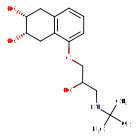
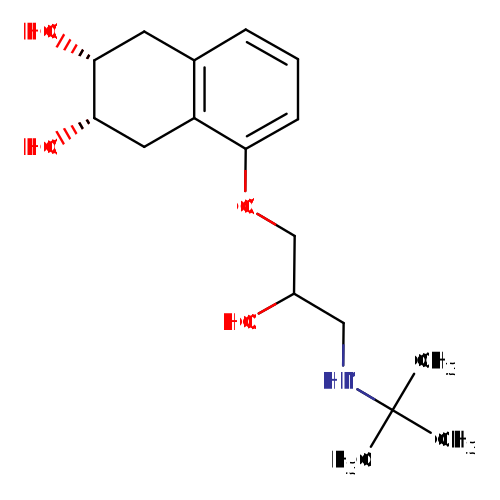
Structure for Nadolol (DB01203)
- Weight
- Average: 309.4006
Monoisotopic: 309.194008357 - Chemical Formula
- C17H27NO4
- Synonyms
- Nadolol

Pharmacology
- Indication
Nadolol is indicated to treat angina pectoris and hypertension.8 Another product formulated with bendroflumethiazide is indicated to treat hypertension.9
 Reduce drug development failure ratesBuild, train, & validate machine-learning modelswith evidence-based and structured datasets.Build, train, & validate predictive machine-learning models with structured datasets.
- Associated Conditions
Indication Type Indication Combined Product Details Approval Level Age Group Patient Characteristics Dose Form Management of Angina pectoris •••••••••••• Management of Atrial fibrillation ••• ••••• Used in combination to manage Hypertension Combination Product in combination with: Bendroflumethiazide (DB00436) •••••••••••• Management of Hypertension •••••••••••• Prophylaxis of Migraine ••• ••••• - Contraindications & Blackbox Warnings
 Prevent Adverse Drug Events TodayTap into our Clinical API for life-saving information on contraindications & blackbox warnings, population restrictions, harmful risks, & more.Avoid life-threatening adverse drug events with our Clinical API
- Pharmacodynamics
Nadolol is a nonselective beta adrenal receptor blocker that is used to lower blood pressure.8,9 It has a long duration of action as it is usually taken once daily and a wide therapeutic index as patients start at doses of 40mg daily but may be increased to doses as high as 240mg daily.8,9 Patients taking nadolol should not aburptly stop taking it as this may lead to exacerbation of ischemic heart disease.8,9
- Mechanism of action
Although nadolol is described as a non selective beta blocker, it does not interact with beta 3 adrenal receptors.1 Antagonism of beta-1 and beta-2 adrenoceptors in the heart inhibits cyclic AMP and its signalling pathway, decreasing the strength and speed of contractions as well as the speed of relaxation and conduction.7 Antagonism of beta-2 adrenoceptors in the smooth muscle cells of the vasculature inhibits their relaxation, leading to an increase in peripheral vascular resistance and reducing the risk of severe hypotension.7 The increase in peripheral vascular resistance may contribute to the decrease in insulin sensitivity associated with nadolol use.6 Antagonism of beta-1 adrenoceptors in the juxtaglomerular apparatus of the kidney inhibits the release of renin, and therefore angiotensin II mediated vasoconstriction, aldosterone mediated water retention, and the release of epinephrine.7 Antagonism of beta-2 adrenoceptors in the liver and skeletal muscle inhibits glycogenolysis, in the lungs prevents bronchodilation, and in the pancrease inhibits insulin release.7
Target Actions Organism ABeta-1 adrenergic receptor antagonistHumans UBeta-2 adrenergic receptor antagonistHumans - Absorption
Oral doses of nadolol are approximately 30% absorbed.8,9 In healthy subjects, nadolol has a Tmax of 2.7h with a Cmax or 69±15ng/mL following a 60mg oral dose and 132±27ng/mL after a 120mg oral dose.2 The AUC following a 60mg oral dose was 1021ng*h/mL and following a 120mg oral dose was 1913±382ng*h/mL.2
- Volume of distribution
In healthy subjects, the volume of distribution of nadolol is 147-157L.3
- Protein binding
Nadolol is approximately 30% bound to plasma protein.8,9 Nadolol binds to alpha-1-acid glycoprotein in plasma.4,5
- Metabolism
- Route of elimination
Nadolol is not metabolized in the liver and excreted mainly in the urine.8,9 In healthy subjects, following intravenous dosing, 60% of a dose is eliminated in the urine and 15% in the feces after 72 hours.3 The remainder of the dose is expected to be eliminated in the feces afterwards.3
- Half-life
- Clearance
In healthy subjects, the total body clearance of nadolol is 219-250mL/min and the renal clearance is 131-150mL/min.3
- Adverse Effects
 Improve decision support & research outcomesWith structured adverse effects data, including: blackbox warnings, adverse reactions, warning & precautions, & incidence rates. View sample adverse effects data in our new Data Library!Improve decision support & research outcomes with our structured adverse effects data.
- Toxicity
The oral LD50 in mice is 4500mg/kg.10
Patients experiencing an overdose may present with bradycardia, cardiac failure, hypotension, and bronchospasm.8,9 An overdose may be treated with atropine for bradycardia, digitalis and diuretics for cardiac failure, vasopressors for hypotension, and beta-2 stimulants for bronchospasms, as well as gastric lavage and hemodialysis.8,9
- Pathways
Pathway Category Nadolol Action Pathway Drug action - Pharmacogenomic Effects/ADRs
- Not Available
Interactions
- Drug Interactions
- This information should not be interpreted without the help of a healthcare provider. If you believe you are experiencing an interaction, contact a healthcare provider immediately. The absence of an interaction does not necessarily mean no interactions exist.
Drug Interaction Integrate drug-drug
interactions in your softwareAbacavir Abacavir may decrease the excretion rate of Nadolol which could result in a higher serum level. Abaloparatide The risk or severity of adverse effects can be increased when Nadolol is combined with Abaloparatide. Abatacept The metabolism of Nadolol can be increased when combined with Abatacept. Abemaciclib The excretion of Abemaciclib can be decreased when combined with Nadolol. Abiraterone The metabolism of Nadolol can be decreased when combined with Abiraterone. - Food Interactions
- Avoid alcohol.
- Avoid natural licorice.
- Take with or without food. The absorption is unaffected by food.
Products
 Drug product information from 10+ global regionsOur datasets provide approved product information including:dosage, form, labeller, route of administration, and marketing period.Access drug product information from over 10 global regions.
- Product Images
- International/Other Brands
- Anabet / Solgol
- Brand Name Prescription Products
Name Dosage Strength Route Labeller Marketing Start Marketing End Region Image Corgard Tablet 40 mg/1 Oral Pfizer Laboratories Div Pfizer Inc 1979-12-10 2017-05-31 US 
Corgard Tablet 40 mg/1 Oral US WorldMeds, LLC 2016-04-01 2022-11-30 US Corgard Tablet 120 mg/1 Oral Bristol-Myers Squibb Company 2006-02-16 2006-02-16 US Corgard Tablet 20 mg/1 Oral Bristol-Myers Squibb Company 2006-02-16 2006-02-16 US Corgard Tablet 20 mg/1 Oral USWM, LLC 2022-02-01 2024-09-30 US - Generic Prescription Products
Name Dosage Strength Route Labeller Marketing Start Marketing End Region Image Apo-nadolol Tablet 160 mg Oral Apotex Corporation 1988-12-31 Not applicable Canada 
Apo-nadolol Tablet 80 mg Oral Apotex Corporation 1988-12-31 Not applicable Canada Apo-nadolol Tablet 40 mg Oral Apotex Corporation 1988-12-31 Not applicable Canada Mint-nadolol Tablet 80 mg Oral Mint Pharmaceuticals Inc 2020-08-19 Not applicable Canada Mint-nadolol Tablet 40 mg Oral Mint Pharmaceuticals Inc 2020-07-21 Not applicable Canada - Mixture Products
Name Ingredients Dosage Route Labeller Marketing Start Marketing End Region Image Corzide Nadolol (80 mg/1) + Bendroflumethiazide (5 mg/1) Tablet Oral Physicians Total Care, Inc. 1983-05-25 2010-06-30 US Corzide Nadolol (80 mg/1) + Bendroflumethiazide (5 mg/1) Tablet Oral Pfizer Laboratories Div Pfizer Inc 1983-05-25 2019-10-31 US Corzide Nadolol (40 mg/1) + Bendroflumethiazide (5 mg/1) Tablet Oral Monarch Pharmaceuticals, Inc. 2006-10-10 2006-10-10 US Corzide Nadolol (40 mg/1) + Bendroflumethiazide (5 mg/1) Tablet Oral Pfizer Laboratories Div Pfizer Inc 1983-05-25 2019-10-31 US Corzide Nadolol (80 mg/1) + Bendroflumethiazide (5 mg/1) Tablet Oral Monarch Pharmaceuticals, Inc. 2006-10-10 2006-10-10 US


Categories
- ATC Codes
- C07BA12 — Nadolol and thiazides
- C07BA — Beta blocking agents, non-selective, and thiazides
- C07B — BETA BLOCKING AGENTS AND THIAZIDES
- C07 — BETA BLOCKING AGENTS
- C — CARDIOVASCULAR SYSTEM
- Drug Categories
- Adrenergic Agents
- Adrenergic Antagonists
- Adrenergic beta-Antagonists
- Agents causing hyperkalemia
- Alcohols
- Amines
- Amino Alcohols
- Antiarrhythmic agents
- Antihypertensive Agents
- Antihypertensive Agents Indicated for Hypertension
- Autonomic Agents
- Beta Blocking Agents and Thiazides
- Beta Blocking Agents, Non-Selective
- Beta Blocking Agents, Non-Selective, and Thiazides
- Bradycardia-Causing Agents
- Cardiovascular Agents
- Cytochrome P-450 CYP2D6 Substrates
- Cytochrome P-450 Substrates
- Drugs causing inadvertant photosensitivity
- Drugs that are Mainly Renally Excreted
- Hypotensive Agents
- MATE 1 Substrates
- MATE 2 Substrates
- MATE substrates
- Negative Inotrope
- Neurotransmitter Agents
- P-glycoprotein substrates
- Peripheral Nervous System Agents
- Phenoxypropanolamines
- Photosensitizing Agents
- Propanolamines
- Propanols
- Sympatholytics
- Chemical TaxonomyProvided by Classyfire
- Description
- This compound belongs to the class of organic compounds known as tetralins. These are polycyclic aromatic compounds containing a tetralin moiety, which consists of a benzene fused to a cyclohexane.
- Kingdom
- Organic compounds
- Super Class
- Benzenoids
- Class
- Tetralins
- Sub Class
- Not Available
- Direct Parent
- Tetralins
- Alternative Parents
- Alkyl aryl ethers / Secondary alcohols / 1,2-aminoalcohols / Dialkylamines / Organopnictogen compounds / Hydrocarbon derivatives
- Substituents
- 1,2-aminoalcohol / Alcohol / Alkyl aryl ether / Amine / Aromatic homopolycyclic compound / Ether / Hydrocarbon derivative / Organic nitrogen compound / Organic oxygen compound / Organonitrogen compound
- Molecular Framework
- Aromatic homopolycyclic compounds
- External Descriptors
- Not Available
- Affected organisms
- Humans and other mammals
Chemical Identifiers
- UNII
- FEN504330V
- CAS number
- 42200-33-9
- InChI Key
- VWPOSFSPZNDTMJ-UCWKZMIHSA-N
- InChI
- InChI=1S/C17H27NO4/c1-17(2,3)18-9-12(19)10-22-16-6-4-5-11-7-14(20)15(21)8-13(11)16/h4-6,12,14-15,18-21H,7-10H2,1-3H3/t12?,14-,15+/m1/s1
- IUPAC Name
- (2R,3S)-5-[3-(tert-butylamino)-2-hydroxypropoxy]-1,2,3,4-tetrahydronaphthalene-2,3-diol
- SMILES
- CC(C)(C)NCC(O)COC1=CC=CC2=C1C[C@H](O)[C@H](O)C2
References
- Synthesis Reference
- US3935267
- General References
- Cernecka H, Sand C, Michel MC: The odd sibling: features of beta3-adrenoceptor pharmacology. Mol Pharmacol. 2014 Nov;86(5):479-84. doi: 10.1124/mol.114.092817. Epub 2014 Jun 2. [Article]
- Schafer-Korting M, Bach N, Knauf H, Mutschler E: Pharmacokinetics of nadolol in healthy subjects. Eur J Clin Pharmacol. 1984;26(1):125-7. [Article]
- Morrison RA, Singhvi SM, Creasey WA, Willard DA: Dose proportionality of nadolol pharmacokinetics after intravenous administration to healthy subjects. Eur J Clin Pharmacol. 1988;33(6):625-8. [Article]
- Patel L, Johnson A, Turner P: Nadolol binding to human serum proteins. J Pharm Pharmacol. 1984 Jun;36(6):414-5. doi: 10.1111/j.2042-7158.1984.tb04413.x. [Article]
- Israili ZH, Dayton PG: Human alpha-1-glycoprotein and its interactions with drugs. Drug Metab Rev. 2001 May;33(2):161-235. doi: 10.1081/DMR-100104402 . [Article]
- Lee WG, Murphy R, McCall JL, Gane EJ, Soop M, Tura A, Plank LD: Nadolol reduces insulin sensitivity in liver cirrhosis: a randomized double-blind crossover trial. Diabetes Metab Res Rev. 2017 Mar;33(3). doi: 10.1002/dmrr.2859. Epub 2016 Nov 10. [Article]
- Gorre F, Vandekerckhove H: Beta-blockers: focus on mechanism of action. Which beta-blocker, when and why? Acta Cardiol. 2010 Oct;65(5):565-70. doi: 10.2143/AC.65.5.2056244. [Article]
- FDA Approved Drug Products: Nadolol Oral Tablets [Link]
- FDA Approved Drug Products: CORZIDE (nadolol and bendroflumethiazide) tablets [Link]
- The Human Metabolome Database: Nadolol MSDS [Link]
- External Links
- Human Metabolome Database
- HMDB0015334
- KEGG Drug
- D00432
- PubChem Compound
- 39147
- PubChem Substance
- 46505509
- ChemSpider
- 35815
- BindingDB
- 25766
- 7226
- ChEBI
- 7444
- ChEMBL
- CHEMBL649
- Therapeutic Targets Database
- DAP000122
- PharmGKB
- PA450573
- Guide to Pharmacology
- GtP Drug Page
- RxList
- RxList Drug Page
- Drugs.com
- Drugs.com Drug Page
- PDRhealth
- PDRhealth Drug Page
- Wikipedia
- Nadolol
- MSDS
- Download (74.1 KB)
Clinical Trials
- Clinical Trials
Phase Status Purpose Conditions Count 4 Completed Other Cardiac Failure / Cardiovascular Disease (CVD) / Heart Failure / Heart Failure With Preserved Ejection Fraction (HFpEF) / Heart Failure, Diastolic 2 4 Completed Prevention Cirrhosis of the Liver / Gastrointestinal Hemorrhage / Portal Hypertension 1 4 Completed Prevention Cirrhosis of the Liver / Variceal Bleeding 1 4 Completed Prevention Variceal Rebleeding 1 4 Completed Treatment Migraine 1
Pharmacoeconomics
- Manufacturers
- Not Available
- Packagers
- Apothecon
- Cardinal Health
- Dispensing Solutions
- Diversified Healthcare Services Inc.
- E.R. Squibb and Sons LLC
- Emcure Pharmaceuticals Ltd.
- Global Pharmaceuticals
- Impax Laboratories Inc.
- Ivax Pharmaceuticals
- King Pharmaceuticals Inc.
- Major Pharmaceuticals
- Mead Johnson and Co.
- Murfreesboro Pharmaceutical Nursing Supply
- Mylan
- Pharmaceutical Utilization Management Program VA Inc.
- Pharmedix
- Physicians Total Care Inc.
- Professional Co.
- Qualitest
- Quality Care
- Resource Optimization and Innovation LLC
- Sandhills Packaging Inc.
- Sandoz
- Teva Pharmaceutical Industries Ltd.
- UDL Laboratories
- Dosage Forms
Form Route Strength Tablet Oral 160 mg Tablet Oral Tablet Oral 120 mg/1 Tablet Oral Tablet Oral 160 mg/1 Tablet Oral 20 mg/1 Tablet Oral 40 mg/1 Tablet Oral 80 mg/1 Tablet, delayed release Oral 80 mg Tablet Oral 80 MG Tablet Oral 40 mg - Prices
Unit description Cost Unit Nadolol powder 94.8USD g Corgard 160 mg tablet 4.4USD tablet Corgard 80 mg tablet 4.33USD tablet Corgard 120 mg tablet 3.96USD tablet Corgard 40 mg tablet 3.11USD tablet Corgard 20 mg tablet 3.04USD tablet Nadolol 160 mg tablet 2.25USD tablet Nadolol 80 mg tablet 1.45USD tablet Apo-Nadol 160 mg Tablet 1.26USD tablet Nadolol 40 mg tablet 1.07USD tablet Naldol 80 mg tablet 1.03USD tablet Nadolol 20 mg tablet 0.92USD tablet Apo-Nadol 80 mg Tablet 0.37USD tablet Novo-Nadolol 80 mg Tablet 0.37USD tablet Apo-Nadol 40 mg Tablet 0.26USD tablet Novo-Nadolol 40 mg Tablet 0.26USD tablet DrugBank does not sell nor buy drugs. Pricing information is supplied for informational purposes only.- Patents
- Not Available
Properties
- State
- Solid
- Experimental Properties
Property Value Source melting point (°C) 124-130 http://www.chemspider.com/Chemical-Structure.35815.html?rid=dffe98eb-8fd9-4c28-9a11-8dfe26bcaad3 boiling point (°C) 526.437 http://www.chemspider.com/Chemical-Structure.35815.html?rid=dffe98eb-8fd9-4c28-9a11-8dfe26bcaad3 water solubility 8330 mg/L (at 25 °C) MCFARLAND,JW ET AL. (2001) logP 0.81 SANGSTER (1994) Caco2 permeability -5.41 ADME Research, USCD pKa 9.67 MERCK INDEX (2001) - Predicted Properties
Property Value Source Water Solubility 2.25 mg/mL ALOGPS logP 1.23 ALOGPS logP 0.87 Chemaxon logS -2.1 ALOGPS pKa (Strongest Acidic) 13.59 Chemaxon pKa (Strongest Basic) 9.76 Chemaxon Physiological Charge 1 Chemaxon Hydrogen Acceptor Count 5 Chemaxon Hydrogen Donor Count 4 Chemaxon Polar Surface Area 81.95 Å2 Chemaxon Rotatable Bond Count 6 Chemaxon Refractivity 85.53 m3·mol-1 Chemaxon Polarizability 34.63 Å3 Chemaxon Number of Rings 2 Chemaxon Bioavailability 1 Chemaxon Rule of Five Yes Chemaxon Ghose Filter Yes Chemaxon Veber's Rule No Chemaxon MDDR-like Rule No Chemaxon - Predicted ADMET Features
Property Value Probability Human Intestinal Absorption + 0.9788 Blood Brain Barrier - 0.966 Caco-2 permeable - 0.8957 P-glycoprotein substrate Substrate 0.8317 P-glycoprotein inhibitor I Inhibitor 0.6192 P-glycoprotein inhibitor II Non-inhibitor 0.7842 Renal organic cation transporter Non-inhibitor 0.8736 CYP450 2C9 substrate Non-substrate 0.7934 CYP450 2D6 substrate Substrate 0.7284 CYP450 3A4 substrate Non-substrate 0.5456 CYP450 1A2 substrate Non-inhibitor 0.9046 CYP450 2C9 inhibitor Non-inhibitor 0.9106 CYP450 2D6 inhibitor Non-inhibitor 0.9231 CYP450 2C19 inhibitor Non-inhibitor 0.9026 CYP450 3A4 inhibitor Non-inhibitor 0.8308 CYP450 inhibitory promiscuity Low CYP Inhibitory Promiscuity 0.8072 Ames test Non AMES toxic 0.9133 Carcinogenicity Non-carcinogens 0.8934 Biodegradation Not ready biodegradable 1.0 Rat acute toxicity 1.7972 LD50, mol/kg Not applicable hERG inhibition (predictor I) Weak inhibitor 0.9455 hERG inhibition (predictor II) Inhibitor 0.5781
Spectra
- Mass Spec (NIST)
- Not Available
- Spectra
- Chromatographic Properties
Collision Cross Sections (CCS)
Adduct CCS Value (Å2) Source type Source [M-H]- 190.4061334 predictedDarkChem Lite v0.1.0 [M-H]- 181.0311334 predictedDarkChem Lite v0.1.0 [M-H]- 172.62099 predictedDeepCCS 1.0 (2019) [M+H]+ 190.3191334 predictedDarkChem Lite v0.1.0 [M+H]+ 179.8459334 predictedDarkChem Lite v0.1.0 [M+H]+ 174.97899 predictedDeepCCS 1.0 (2019) [M+Na]+ 190.5988334 predictedDarkChem Lite v0.1.0 [M+Na]+ 180.4545334 predictedDarkChem Lite v0.1.0 [M+Na]+ 183.5001 predictedDeepCCS 1.0 (2019)
Targets

- Kind
- Protein
- Organism
- Humans
- Pharmacological action
- Yes
- Actions
- Antagonist
- General Function
- Receptor signaling protein activity
- Specific Function
- Beta-adrenergic receptors mediate the catecholamine-induced activation of adenylate cyclase through the action of G proteins. This receptor binds epinephrine and norepinephrine with approximately e...
- Gene Name
- ADRB1
- Uniprot ID
- P08588
- Uniprot Name
- Beta-1 adrenergic receptor
- Molecular Weight
- 51322.1 Da
References
- Chen X, Ji ZL, Chen YZ: TTD: Therapeutic Target Database. Nucleic Acids Res. 2002 Jan 1;30(1):412-5. [Article]
- Wheeldon NM, McDevitt DG, Lipworth BJ: The effects of lower than conventional doses of oral nadolol on relative beta 1/beta 2-adrenoceptor blockade. Br J Clin Pharmacol. 1994 Aug;38(2):103-8. [Article]
- Koshiji M, Ito H, Minatoguchi S, Watanabe H, Imai Y, Kakami M, Hirakawa S: A comparison of guanfacine, bunazosin, atenolol and nadolol on blood pressure and plasma noradrenaline responses to cold pressor testing. Clin Exp Pharmacol Physiol. 1992 Jul;19(7):481-8. [Article]
- Varma DR, Shen H, Deng XF, Peri KG, Chemtob S, Mulay S: Inverse agonist activities of beta-adrenoceptor antagonists in rat myocardium. Br J Pharmacol. 1999 Jun;127(4):895-902. [Article]
- Varma DR: Ligand-independent negative chronotropic responses of rat and mouse right atria to beta-adrenoceptor antagonists. Can J Physiol Pharmacol. 1999 Dec;77(12):943-9. [Article]
- Wheeldon NM, McDevitt DG, Lipworth BJ: Cardiac effects of the beta 3-adrenoceptor agonist BRL35135 in man. Br J Clin Pharmacol. 1994 Apr;37(4):363-9. [Article]
- Kind
- Protein
- Organism
- Humans
- Pharmacological action
- Unknown
- Actions
- Antagonist
- General Function
- Protein homodimerization activity
- Specific Function
- Beta-adrenergic receptors mediate the catecholamine-induced activation of adenylate cyclase through the action of G proteins. The beta-2-adrenergic receptor binds epinephrine with an approximately ...
- Gene Name
- ADRB2
- Uniprot ID
- P07550
- Uniprot Name
- Beta-2 adrenergic receptor
- Molecular Weight
- 46458.32 Da
References
- Chen X, Ji ZL, Chen YZ: TTD: Therapeutic Target Database. Nucleic Acids Res. 2002 Jan 1;30(1):412-5. [Article]
- Wheeldon NM, McDevitt DG, Lipworth BJ: The effects of lower than conventional doses of oral nadolol on relative beta 1/beta 2-adrenoceptor blockade. Br J Clin Pharmacol. 1994 Aug;38(2):103-8. [Article]
- Ozakca I, Arioglu E, Guner S, Altan VM, Ozcelikay AT: Role of beta-3-adrenoceptor in catecholamine-induced relaxations in gastric fundus from control and diabetic rats. Pharmacology. 2007;80(4):227-38. Epub 2007 Jul 6. [Article]
- Liu YL, Toubro S, Astrup A, Stock MJ: Contribution of beta 3-adrenoceptor activation to ephedrine-induced thermogenesis in humans. Int J Obes Relat Metab Disord. 1995 Sep;19(9):678-85. [Article]
- Wheeldon NM, McDevitt DG, Lipworth BJ: Evaluation of in vivo partial beta 1/beta 2-agonist activity: a dose-ranging study with carteolol. Br J Clin Pharmacol. 1992 Apr;33(4):411-6. [Article]
- Varma DR, Shen H, Deng XF, Peri KG, Chemtob S, Mulay S: Inverse agonist activities of beta-adrenoceptor antagonists in rat myocardium. Br J Pharmacol. 1999 Jun;127(4):895-902. [Article]
Carriers
- Kind
- Protein group
- Organism
- Humans
- Pharmacological action
- Unknown
- Actions
- Binder
- General Function
- Not Available
- Specific Function
- Functions as transport protein in the blood stream. Binds various ligands in the interior of its beta-barrel domain. Also binds synthetic drugs and influences their distribution and availability in...
Components:
References
- Patel L, Johnson A, Turner P: Nadolol binding to human serum proteins. J Pharm Pharmacol. 1984 Jun;36(6):414-5. doi: 10.1111/j.2042-7158.1984.tb04413.x. [Article]
- Israili ZH, Dayton PG: Human alpha-1-glycoprotein and its interactions with drugs. Drug Metab Rev. 2001 May;33(2):161-235. doi: 10.1081/DMR-100104402 . [Article]
Transporters
- Kind
- Protein
- Organism
- Humans
- Pharmacological action
- Unknown
- Actions
- Substrate
- General Function
- Xenobiotic-transporting atpase activity
- Specific Function
- Energy-dependent efflux pump responsible for decreased drug accumulation in multidrug-resistant cells.
- Gene Name
- ABCB1
- Uniprot ID
- P08183
- Uniprot Name
- Multidrug resistance protein 1
- Molecular Weight
- 141477.255 Da
References
- Terao T, Hisanaga E, Sai Y, Tamai I, Tsuji A: Active secretion of drugs from the small intestinal epithelium in rats by P-glycoprotein functioning as an absorption barrier. J Pharm Pharmacol. 1996 Oct;48(10):1083-9. [Article]
- Misaka S, Knop J, Singer K, Hoier E, Keiser M, Muller F, Glaeser H, Konig J, Fromm MF: The Nonmetabolized beta-Blocker Nadolol Is a Substrate of OCT1, OCT2, MATE1, MATE2-K, and P-Glycoprotein, but Not of OATP1B1 and OATP1B3. Mol Pharm. 2016 Feb 1;13(2):512-9. doi: 10.1021/acs.molpharmaceut.5b00733. Epub 2016 Jan 19. [Article]
- Kind
- Protein
- Organism
- Humans
- Pharmacological action
- Unknown
- Actions
- Substrate
- General Function
- Transcription factor that binds to the octamer motif (5'-ATTTGCAT-3') and activates the promoters of the genes for some small nuclear RNAs (snRNA) and of genes such as those for histone H2B and immunoglobulins. Modulates transcription transactivation by NR3C1, AR and PGR (By similarity). In case of human herpes simplex virus (HSV) infection, POU2F1 forms a multiprotein-DNA complex with the viral transactivator protein VP16 and HCFC1 thereby enabling the transcription of the viral immediate early genes.
- Specific Function
- Dna binding
- Gene Name
- POU2F1
- Uniprot ID
- P14859
- Uniprot Name
- POU domain, class 2, transcription factor 1
- Molecular Weight
- 76470.82 Da
References
- Misaka S, Knop J, Singer K, Hoier E, Keiser M, Muller F, Glaeser H, Konig J, Fromm MF: The Nonmetabolized beta-Blocker Nadolol Is a Substrate of OCT1, OCT2, MATE1, MATE2-K, and P-Glycoprotein, but Not of OATP1B1 and OATP1B3. Mol Pharm. 2016 Feb 1;13(2):512-9. doi: 10.1021/acs.molpharmaceut.5b00733. Epub 2016 Jan 19. [Article]
- Kind
- Protein
- Organism
- Humans
- Pharmacological action
- Unknown
- Actions
- Substrate
- General Function
- Transcriptional activator activity, rna polymerase ii core promoter proximal region sequence-specific binding
- Specific Function
- Transcription factor that specifically binds to the octamer motif (5'-ATTTGCAT-3'). Regulates transcription in a number of tissues in addition to activating immunoglobulin gene expression. Modulate...
- Gene Name
- POU2F2
- Uniprot ID
- P09086
- Uniprot Name
- POU domain, class 2, transcription factor 2
- Molecular Weight
- 51208.51 Da
References
- Misaka S, Knop J, Singer K, Hoier E, Keiser M, Muller F, Glaeser H, Konig J, Fromm MF: The Nonmetabolized beta-Blocker Nadolol Is a Substrate of OCT1, OCT2, MATE1, MATE2-K, and P-Glycoprotein, but Not of OATP1B1 and OATP1B3. Mol Pharm. 2016 Feb 1;13(2):512-9. doi: 10.1021/acs.molpharmaceut.5b00733. Epub 2016 Jan 19. [Article]
- Kind
- Protein
- Organism
- Humans
- Pharmacological action
- Unknown
- Actions
- Substrate
- General Function
- Monovalent cation:proton antiporter activity
- Specific Function
- Solute transporter for tetraethylammonium (TEA), 1-methyl-4-phenylpyridinium (MPP), cimetidine, N-methylnicotinamide (NMN), metformin, creatinine, guanidine, procainamide, topotecan, estrone sulfat...
- Gene Name
- SLC47A1
- Uniprot ID
- Q96FL8
- Uniprot Name
- Multidrug and toxin extrusion protein 1
- Molecular Weight
- 61921.585 Da
References
- Misaka S, Knop J, Singer K, Hoier E, Keiser M, Muller F, Glaeser H, Konig J, Fromm MF: The Nonmetabolized beta-Blocker Nadolol Is a Substrate of OCT1, OCT2, MATE1, MATE2-K, and P-Glycoprotein, but Not of OATP1B1 and OATP1B3. Mol Pharm. 2016 Feb 1;13(2):512-9. doi: 10.1021/acs.molpharmaceut.5b00733. Epub 2016 Jan 19. [Article]
- Kind
- Protein
- Organism
- Humans
- Pharmacological action
- Unknown
- Actions
- Substrate
- General Function
- Drug transmembrane transporter activity
- Specific Function
- Solute transporter for tetraethylammonium (TEA), 1-methyl-4-phenylpyridinium (MPP), cimetidine, N-methylnicotinamide, metformin, creatinine, guanidine, procainamide, topotecan, estrone sulfate, acy...
- Gene Name
- SLC47A2
- Uniprot ID
- Q86VL8
- Uniprot Name
- Multidrug and toxin extrusion protein 2
- Molecular Weight
- 65083.915 Da
References
- Misaka S, Knop J, Singer K, Hoier E, Keiser M, Muller F, Glaeser H, Konig J, Fromm MF: The Nonmetabolized beta-Blocker Nadolol Is a Substrate of OCT1, OCT2, MATE1, MATE2-K, and P-Glycoprotein, but Not of OATP1B1 and OATP1B3. Mol Pharm. 2016 Feb 1;13(2):512-9. doi: 10.1021/acs.molpharmaceut.5b00733. Epub 2016 Jan 19. [Article]

Drug created at June 13, 2005 13:24 / Updated at April 27, 2024 09:44