Identification
- Generic Name
- Temafloxacin
- DrugBank Accession Number
- DB01405
- Background
Temafloxacin is an antibiotic agent belonging to the fluoroquinolone drug class. It was first approved for use in the U.S. market in 1992, but was withdrawn shortly due to the reports of serious adverse reactions, such as allergic reactions and hemolyric anemia, resulting in three deaths.
- Type
- Small Molecule
- Groups
- Withdrawn
- Structure
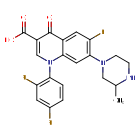
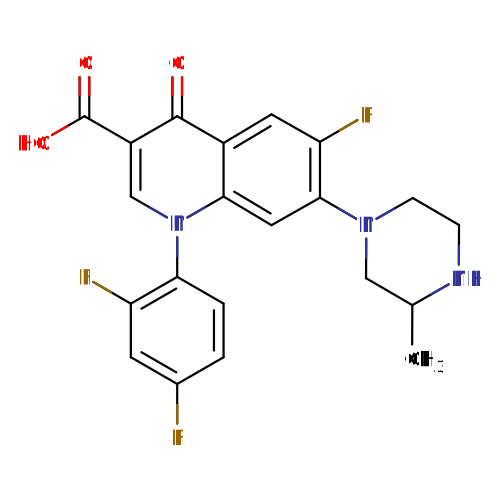
Structure for Temafloxacin (DB01405)
- Weight
- Average: 417.3811
Monoisotopic: 417.130026072 - Chemical Formula
- C21H18F3N3O3
- Synonyms
- Temafloxacin
- Temafloxacina
- Temafloxacine
- Temafloxacinum

Pharmacology
- Indication
For the treatment of lower respiratory tract infections, genital and urinary infections like prostatitis, and skin infections.
 Reduce drug development failure ratesBuild, train, & validate machine-learning modelswith evidence-based and structured datasets.Build, train, & validate predictive machine-learning models with structured datasets.
- Contraindications & Blackbox Warnings
 Prevent Adverse Drug Events TodayTap into our Clinical API for life-saving information on contraindications & blackbox warnings, population restrictions, harmful risks, & more.Avoid life-threatening adverse drug events with our Clinical API
- Pharmacodynamics
Temafloxacin is a fluoroquinolone antibiotic drug, marketed as Omniflox by Abbot Laboratories, which was withdrawn from the market in 1992 due to fatal adverse effects. Flouroquinolones such as lomefloxacin possess excellent activity against gram-negative aerobic bacteria such as E.coli and Neisseria gonorrhoea as well as gram-positive bacteria including S. pneumoniae and Staphylococcus aureus. They also posses effective activity against shigella, salmonella, campylobacter, gonococcal organisms, and multi drug resistant pseudomonas and enterobacter.
- Mechanism of action
The bactericidal action of temafloxacin results from interference with the activity of the bacterial enzymes DNA gyrase and topoisomerase IV, which are needed for the transcription and replication of bacterial DNA. DNA gyrase appears to be the primary quinolone target for gram-negative bacteria. Topoisomerase IV appears to be the preferential target in gram-positive organisms. Interference with these two topoisomerases results in strand breakage of the bacterial chromosome, supercoiling, and resealing. As a result DNA replication and transcription is inhibited.
Target Actions Organism ADNA gyrase subunit A inhibitorHaemophilus influenzae (strain ATCC 51907 / DSM 11121 / KW20 / Rd) ADNA topoisomerase 4 subunit A inhibitorHaemophilus influenzae (strain ATCC 51907 / DSM 11121 / KW20 / Rd) - Absorption
Studies in healthy volunteers indicate that the average bioavailability of temafloxacin exceeds 90%, with little intersubject variability.
- Volume of distribution
Not Available
- Protein binding
Not Available
- Metabolism
Hepatic.
- Route of elimination
Not Available
- Half-life
Approximately 8 hours in patients with normal renal function.
- Clearance
Not Available
- Adverse Effects
 Improve decision support & research outcomesWith structured adverse effects data, including: blackbox warnings, adverse reactions, warning & precautions, & incidence rates. View sample adverse effects data in our new Data Library!Improve decision support & research outcomes with our structured adverse effects data.
- Toxicity
Severe allergic reactions and hemolytic anemia were observed during the first few months of use leading to fatalities and the drug's eventual withdrawal from the market.
- Pathways
- Not Available
- Pharmacogenomic Effects/ADRs
- Not Available
Interactions
- Drug Interactions
- This information should not be interpreted without the help of a healthcare provider. If you believe you are experiencing an interaction, contact a healthcare provider immediately. The absence of an interaction does not necessarily mean no interactions exist.
Drug Interaction Integrate drug-drug
interactions in your softwareAbametapir The serum concentration of Temafloxacin can be increased when it is combined with Abametapir. Abatacept The metabolism of Temafloxacin can be increased when combined with Abatacept. Abiraterone The serum concentration of Temafloxacin can be increased when it is combined with Abiraterone. Acarbose The therapeutic efficacy of Acarbose can be increased when used in combination with Temafloxacin. Aceclofenac Aceclofenac may increase the neuroexcitatory activities of Temafloxacin. - Food Interactions
- Not Available
Products
 Drug product information from 10+ global regionsOur datasets provide approved product information including:dosage, form, labeller, route of administration, and marketing period.Access drug product information from over 10 global regions.
- Product Ingredients
Ingredient UNII CAS InChI Key Temafloxacin hydrochloride OC5IGJ7J6I 105784-61-0 DDVJEYDLTXRYAJ-UHFFFAOYSA-N - International/Other Brands
- Omniflox
Categories
- ATC Codes
- J01MA05 — Temafloxacin
- Drug Categories
- Anti-Bacterial Agents
- Anti-Infective Agents
- Antibacterials for Systemic Use
- Antiinfectives for Systemic Use
- Cytochrome P-450 CYP1A2 Inhibitors
- Cytochrome P-450 CYP1A2 Inhibitors (strength unknown)
- Cytochrome P-450 CYP1A2 Substrates
- Cytochrome P-450 Enzyme Inhibitors
- Cytochrome P-450 Substrates
- Enzyme Inhibitors
- Fluoroquinolones
- Heterocyclic Compounds, Fused-Ring
- Highest Risk QTc-Prolonging Agents
- QTc Prolonging Agents
- Quinolines
- Quinolones
- Topoisomerase II Inhibitors
- Topoisomerase Inhibitors
- Chemical TaxonomyProvided by Classyfire
- Description
- This compound belongs to the class of organic compounds known as phenylquinolines. These are heterocyclic compounds containing a quinoline moiety substituted with a phenyl group.
- Kingdom
- Organic compounds
- Super Class
- Organoheterocyclic compounds
- Class
- Quinolines and derivatives
- Sub Class
- Phenylquinolines
- Direct Parent
- Phenylquinolines
- Alternative Parents
- Quinoline carboxylic acids / Fluoroquinolones / N-arylpiperazines / Haloquinolines / Hydroquinolones / Aminoquinolines and derivatives / Hydroquinolines / Pyridinecarboxylic acids / Dialkylarylamines / Fluorobenzenes show 13 more
- Substituents
- 1,4-diazinane / Amine / Amino acid / Amino acid or derivatives / Aminoquinoline / Aromatic heteropolycyclic compound / Aryl fluoride / Aryl halide / Azacycle / Benzenoid show 33 more
- Molecular Framework
- Aromatic heteropolycyclic compounds
- External Descriptors
- organofluorine compound, tertiary amino compound, N-arylpiperazine, monocarboxylic acid, secondary amino compound, amino acid, quinolone antibiotic, quinolone (CHEBI:77796)
- Affected organisms
- Enteric bacteria and other eubacteria
Chemical Identifiers
- UNII
- 1WZ12GTT67
- CAS number
- 108319-06-8
- InChI Key
- QKDHBVNJCZBTMR-UHFFFAOYSA-N
- InChI
- InChI=1S/C21H18F3N3O3/c1-11-9-26(5-4-25-11)19-8-18-13(7-16(19)24)20(28)14(21(29)30)10-27(18)17-3-2-12(22)6-15(17)23/h2-3,6-8,10-11,25H,4-5,9H2,1H3,(H,29,30)
- IUPAC Name
- 1-(2,4-difluorophenyl)-6-fluoro-7-(3-methylpiperazin-1-yl)-4-oxo-1,4-dihydroquinoline-3-carboxylic acid
- SMILES
- CC1CN(CCN1)C1=C(F)C=C2C(=O)C(=CN(C2=C1)C1=C(F)C=C(F)C=C1)C(O)=O
References
- General References
- Not Available
- External Links
- KEGG Drug
- D02469
- PubChem Compound
- 60021
- PubChem Substance
- 46508032
- ChemSpider
- 54143
- 37771
- ChEBI
- 77796
- ChEMBL
- CHEMBL277100
- Wikipedia
- Temafloxacin
Clinical Trials
Pharmacoeconomics
- Manufacturers
- Not Available
- Packagers
- Not Available
- Dosage Forms
- Not Available
- Prices
- Not Available
- Patents
- Not Available
Properties
- State
- Solid
- Experimental Properties
Property Value Source logP -0.20 BIOBYTE (1995) - Predicted Properties
Property Value Source Water Solubility 0.0144 mg/mL ALOGPS logP 0.94 ALOGPS logP 1.05 Chemaxon logS -4.5 ALOGPS pKa (Strongest Acidic) 5.41 Chemaxon pKa (Strongest Basic) 8.85 Chemaxon Physiological Charge 0 Chemaxon Hydrogen Acceptor Count 6 Chemaxon Hydrogen Donor Count 2 Chemaxon Polar Surface Area 72.88 Å2 Chemaxon Rotatable Bond Count 3 Chemaxon Refractivity 104.53 m3·mol-1 Chemaxon Polarizability 39.68 Å3 Chemaxon Number of Rings 4 Chemaxon Bioavailability 1 Chemaxon Rule of Five Yes Chemaxon Ghose Filter Yes Chemaxon Veber's Rule No Chemaxon MDDR-like Rule No Chemaxon - Predicted ADMET Features
Property Value Probability Human Intestinal Absorption + 0.9914 Blood Brain Barrier - 0.9863 Caco-2 permeable - 0.7526 P-glycoprotein substrate Substrate 0.8741 P-glycoprotein inhibitor I Non-inhibitor 0.8985 P-glycoprotein inhibitor II Non-inhibitor 0.9081 Renal organic cation transporter Non-inhibitor 0.7441 CYP450 2C9 substrate Non-substrate 0.8128 CYP450 2D6 substrate Non-substrate 0.9072 CYP450 3A4 substrate Non-substrate 0.7309 CYP450 1A2 substrate Non-inhibitor 0.8664 CYP450 2C9 inhibitor Non-inhibitor 0.9304 CYP450 2D6 inhibitor Non-inhibitor 0.9413 CYP450 2C19 inhibitor Non-inhibitor 0.9048 CYP450 3A4 inhibitor Non-inhibitor 0.8858 CYP450 inhibitory promiscuity Low CYP Inhibitory Promiscuity 0.6993 Ames test AMES toxic 0.9067 Carcinogenicity Non-carcinogens 0.8318 Biodegradation Not ready biodegradable 1.0 Rat acute toxicity 2.0973 LD50, mol/kg Not applicable hERG inhibition (predictor I) Weak inhibitor 0.8332 hERG inhibition (predictor II) Non-inhibitor 0.7289
Spectra
- Mass Spec (NIST)
- Not Available
- Spectra
Spectrum Spectrum Type Splash Key Predicted MS/MS Spectrum - 10V, Positive (Annotated) Predicted LC-MS/MS splash10-0gb9-0000900000-8f95f38d7b1ba1491738 Predicted MS/MS Spectrum - 10V, Negative (Annotated) Predicted LC-MS/MS splash10-0udi-0009000000-9e4bfa83b4b8117dffd7 Predicted MS/MS Spectrum - 20V, Positive (Annotated) Predicted LC-MS/MS splash10-0udi-0000900000-ed36b2d3844ac1b061e3 Predicted MS/MS Spectrum - 20V, Negative (Annotated) Predicted LC-MS/MS splash10-0uk9-0009000000-996ba9a6c5465bcdae5b Predicted MS/MS Spectrum - 40V, Positive (Annotated) Predicted LC-MS/MS splash10-0ue9-0009200000-adb0f97a043f9fdd1e28 Predicted MS/MS Spectrum - 40V, Negative (Annotated) Predicted LC-MS/MS splash10-0udi-0009000000-ef290c06e4bf0a301610 Predicted 1H NMR Spectrum 1D NMR Not Applicable Predicted 13C NMR Spectrum 1D NMR Not Applicable - Chromatographic Properties
Collision Cross Sections (CCS)
Adduct CCS Value (Å2) Source type Source [M-H]- 193.32384 predictedDeepCCS 1.0 (2019) [M+H]+ 195.71939 predictedDeepCCS 1.0 (2019) [M+Na]+ 201.63191 predictedDeepCCS 1.0 (2019)
Targets

- Kind
- Protein
- Organism
- Haemophilus influenzae (strain ATCC 51907 / DSM 11121 / KW20 / Rd)
- Pharmacological action
- Yes
- Actions
- Inhibitor
- General Function
- Dna topoisomerase type ii (atp-hydrolyzing) activity
- Specific Function
- DNA gyrase negatively supercoils closed circular double-stranded DNA in an ATP-dependent manner and also catalyzes the interconversion of other topological isomers of double-stranded DNA rings, inc...
- Gene Name
- gyrA
- Uniprot ID
- P43700
- Uniprot Name
- DNA gyrase subunit A
- Molecular Weight
- 97817.145 Da
References
- Overington JP, Al-Lazikani B, Hopkins AL: How many drug targets are there? Nat Rev Drug Discov. 2006 Dec;5(12):993-6. [Article]
- Imming P, Sinning C, Meyer A: Drugs, their targets and the nature and number of drug targets. Nat Rev Drug Discov. 2006 Oct;5(10):821-34. [Article]
- Frank KE, Devasthale PV, Gentry EJ, Ravikumar VT, Keschavarz-Shokri A, Mitscher LA, Nilius A, Shen LL, Shawar R, Baker WR: A simple, inexpensive apparatus for performance of preparative scale solution phase multiple parallel synthesis of drug analogs. II. Biological evaluation of a retrospective library of quinolone antiinfective agents. Comb Chem High Throughput Screen. 1998 Jun;1(2):89-99. [Article]
- Nakanishi N, Yoshida S, Wakebe H, Inoue M, Yamaguchi T, Mitsuhashi S: Mechanisms of clinical resistance to fluoroquinolones in Staphylococcus aureus. Antimicrob Agents Chemother. 1991 Dec;35(12):2562-7. [Article]
- Nakanishi N, Yoshida S, Wakebe H, Inoue M, Mitsuhashi S: Mechanisms of clinical resistance to fluoroquinolones in Enterococcus faecalis. Antimicrob Agents Chemother. 1991 Jun;35(6):1053-9. [Article]
- Appelbaum PC: Mechanisms and frequency of resistance to temafloxacin. Am J Med. 1991 Dec 30;91(6A):27S-30S. [Article]
- Kind
- Protein
- Organism
- Haemophilus influenzae (strain ATCC 51907 / DSM 11121 / KW20 / Rd)
- Pharmacological action
- Yes
- Actions
- Inhibitor
- General Function
- Dna topoisomerase type ii (atp-hydrolyzing) activity
- Specific Function
- Topoisomerase IV is essential for chromosome segregation. It relaxes supercoiled DNA. Performs the decatenation events required during the replication of a circular DNA molecule.
- Gene Name
- parC
- Uniprot ID
- P43702
- Uniprot Name
- DNA topoisomerase 4 subunit A
- Molecular Weight
- 83366.24 Da
References
- Overington JP, Al-Lazikani B, Hopkins AL: How many drug targets are there? Nat Rev Drug Discov. 2006 Dec;5(12):993-6. [Article]
- Imming P, Sinning C, Meyer A: Drugs, their targets and the nature and number of drug targets. Nat Rev Drug Discov. 2006 Oct;5(10):821-34. [Article]
- Nakanishi N, Yoshida S, Wakebe H, Inoue M, Yamaguchi T, Mitsuhashi S: Mechanisms of clinical resistance to fluoroquinolones in Staphylococcus aureus. Antimicrob Agents Chemother. 1991 Dec;35(12):2562-7. [Article]
- Nakanishi N, Yoshida S, Wakebe H, Inoue M, Mitsuhashi S: Mechanisms of clinical resistance to fluoroquinolones in Enterococcus faecalis. Antimicrob Agents Chemother. 1991 Jun;35(6):1053-9. [Article]
- Appelbaum PC: Mechanisms and frequency of resistance to temafloxacin. Am J Med. 1991 Dec 30;91(6A):27S-30S. [Article]
Enzymes
- Kind
- Protein
- Organism
- Humans
- Pharmacological action
- Unknown
- Actions
- SubstrateInhibitor
- Curator comments
- Fluoroquinolone drugs are believed to inhibit CYP1A2 enzyme.
- General Function
- Oxidoreductase activity, acting on paired donors, with incorporation or reduction of molecular oxygen, reduced flavin or flavoprotein as one donor, and incorporation of one atom of oxygen
- Specific Function
- Cytochromes P450 are a group of heme-thiolate monooxygenases. In liver microsomes, this enzyme is involved in an NADPH-dependent electron transport pathway. It oxidizes a variety of structurally un...
- Gene Name
- CYP1A2
- Uniprot ID
- P05177
- Uniprot Name
- Cytochrome P450 1A2
- Molecular Weight
- 58293.76 Da
References
- Fuhr U, Anders EM, Mahr G, Sorgel F, Staib AH: Inhibitory potency of quinolone antibacterial agents against cytochrome P450IA2 activity in vivo and in vitro. Antimicrob Agents Chemother. 1992 May;36(5):942-8. [Article]
- Randinitis EJ, Alvey CW, Koup JR, Rausch G, Abel R, Bron NJ, Hounslow NJ, Vassos AB, Sedman AJ: Drug interactions with clinafloxacin. Antimicrob Agents Chemother. 2001 Sep;45(9):2543-52. [Article]
- Ciprofloxacin FDA label [File]

Drug created at July 13, 2007 20:27 / Updated at March 03, 2024 02:34