Identification
- Summary
Ciclesonide is a glucocorticoid used in the symptomatic relief of nasal symptoms associated with seasonal and perennial allergic rhinitis in adults and adolescents.
- Brand Names
- Alvesco, Omnaris, Zetonna
- Generic Name
- Ciclesonide
- DrugBank Accession Number
- DB01410
- Background
Ciclesonide is a glucocorticoid used to treat obstructive airway diseases. It is marketed under the brand name Alvesco.
- Type
- Small Molecule
- Groups
- Approved, Investigational
- Structure
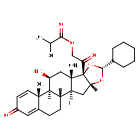
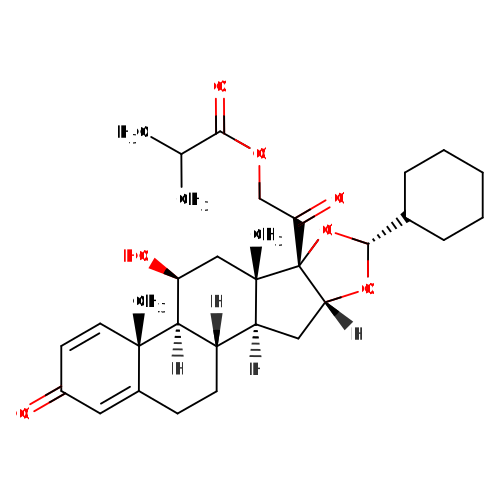
Structure for Ciclesonide (DB01410)
- Weight
- Average: 540.697
Monoisotopic: 540.308703757 - Chemical Formula
- C32H44O7
- Synonyms
- Ciclesonida
- Ciclesonide
- External IDs
- BI54903
- RPR-251526
- RPR251526

Pharmacology
- Indication
For the treatment of nasal symptoms associated with seasonal and perennial allergic rhinitis in adults and adolescents 12 years of age and older.
 Reduce drug development failure ratesBuild, train, & validate machine-learning modelswith evidence-based and structured datasets.Build, train, & validate predictive machine-learning models with structured datasets.
- Associated Conditions
Indication Type Indication Combined Product Details Approval Level Age Group Patient Characteristics Dose Form Used in combination to manage Asthma Combination Product in combination with: Carmoterol (DB15784) •••••••••••• •••••• Used in combination to manage Asthma Combination Product in combination with: Formoterol (DB00983) •••••••••••• ••••••• Management of Asthma •••••••••••• •••••••• Used in combination to prevent Bronchoconstriction Combination Product in combination with: Tiotropium (DB01409) •••••••••••• •••••• Used in combination to manage Chronic obstructive pulmonary disease (copd) Combination Product in combination with: Carmoterol (DB15784) •••••••••••• •••••• - Contraindications & Blackbox Warnings
 Prevent Adverse Drug Events TodayTap into our Clinical API for life-saving information on contraindications & blackbox warnings, population restrictions, harmful risks, & more.Avoid life-threatening adverse drug events with our Clinical API
- Pharmacodynamics
Ciclesonide is a pro-drug that is enzymatically hydrolyzed to a pharmacologically active metabolite, C21-desisobutyryl-ciclesonide (des-ciclesonide or RM1) following intranasal application. Des-ciclesonide has anti-inflammatory activity with affinity for the glucocorticoid receptor that is 120 times higher than the parent compound. The precise mechanism through which ciclesonide affects allergic rhinitis symptoms is not known. Corticosteroids have been shown to have a wide range of effects on multiple cell types (e.g., mast cells, eosinophils, neutrophils, macrophages, and lymphocytes) and mediators (e.g., histamine, eicosanoids, leukotrienes, and cytokines) involved in allergic inflammation.
- Mechanism of action
Glucocorticoids such as ciclesonide can inhibit leukocyte infiltration at the site of inflammation, interfere with mediators of inflammatory response, and suppress humoral immune responses. The antiinflammatory actions of glucocorticoids are thought to involve phospholipase A2 inhibitory proteins, lipocortins, which control the biosynthesis of potent mediators of inflammation such as prostaglandins and leukotrienes. Ciclesonide reduces inflammatory reaction by limiting the capillary dilatation and permeability of the vascular structures. These compounds restrict the accumulation of polymorphonuclear leukocytes and macrophages and reduce the release of vasoactive kinins. Recent research suggests that corticosteroids may inhibit the release of arachidonic acid from phospholipids, thereby reducing the formation of prostaglandins. Ciclesonide is a glucocorticoid receptor agonist. On binding, the corticoreceptor-ligand complex translocates itself into the cell nucleus, where it binds to many glucocorticoid response elements (GRE) in the promoter region of the target genes. The DNA bound receptor then interacts with basic transcription factors, causing an increase or decrease in expression of specific target genes, including suppression of IL2 (interleukin 2) expression.
Target Actions Organism AGlucocorticoid receptor agonistHumans - Absorption
Ciclesonide and des-ciclesonide have negligible oral bioavailability (both less than 1%) due to low gastrointestinal absorption and high first-pass metabolism. The intranasal administration of ciclesonide at recommended doses results in negligible serum concentrations of ciclesonide.
- Volume of distribution
Not Available
- Protein binding
The percentage of ciclesonide and des-ciclesonide bound to human plasma proteins averaged ≥ 99% each, with ≤ 1% of unbound drug detected in the systemic circulation.
- Metabolism
Des-ciclesonide undergoes metabolism in the liver to additional metabolites mainly by the cytochrome P450 (CYP) 3A4 isozyme and to a lesser extent by CYP 2D6.
- Route of elimination
Not Available
- Half-life
Not Available
- Clearance
- 152 L/hr [Following IV administration of 800 mcg of ciclesonide]
- Adverse Effects
 Improve decision support & research outcomesWith structured adverse effects data, including: blackbox warnings, adverse reactions, warning & precautions, & incidence rates. View sample adverse effects data in our new Data Library!Improve decision support & research outcomes with our structured adverse effects data.
- Toxicity
Not Available
- Pathways
- Not Available
- Pharmacogenomic Effects/ADRs
- Not Available
Interactions
- Drug Interactions
- This information should not be interpreted without the help of a healthcare provider. If you believe you are experiencing an interaction, contact a healthcare provider immediately. The absence of an interaction does not necessarily mean no interactions exist.
Drug Interaction Integrate drug-drug
interactions in your softwareAbametapir The serum concentration of Ciclesonide can be increased when it is combined with Abametapir. Abatacept The metabolism of Ciclesonide can be increased when combined with Abatacept. Abiraterone The metabolism of Ciclesonide can be decreased when combined with Abiraterone. Acarbose The risk or severity of hyperglycemia can be increased when Ciclesonide is combined with Acarbose. Acebutolol The metabolism of Ciclesonide can be decreased when combined with Acebutolol. - Food Interactions
- No interactions found.
Products
 Drug product information from 10+ global regionsOur datasets provide approved product information including:dosage, form, labeller, route of administration, and marketing period.Access drug product information from over 10 global regions.
- International/Other Brands
- Omniair
- Brand Name Prescription Products
Name Dosage Strength Route Labeller Marketing Start Marketing End Region Image Alvesco Aerosol, metered 160 ug/1 Respiratory (inhalation) Covis Pharma US, Inc 2018-03-26 Not applicable US 
Alvesco Aerosol, metered 80 ug/1 Respiratory (inhalation) Physicians Total Care, Inc. 2009-02-19 Not applicable US Alvesco Aerosol, metered 50 mcg / act Respiratory (inhalation) Takeda Not applicable Not applicable Canada 
Alvesco Aerosol, metered 80 ug/1 Respiratory (inhalation) Covis Pharma US, Inc 2018-03-26 Not applicable US Alvesco Aerosol, metered 160 ug/1 Respiratory (inhalation) Sunovion Pharmaceuticals Inc. 2008-10-01 2019-12-01 US - Generic Prescription Products
Name Dosage Strength Route Labeller Marketing Start Marketing End Region Image Apo-ciclesonide Spray, metered 50 mcg / act Nasal Apotex Corporation 2016-11-25 Not applicable Canada Ciclesonide Aerosol, metered 37 ug/1 Nasal Prasco Laboratories 2022-04-23 Not applicable US Ciclesonide Aerosol, metered 80 ug/1 Respiratory (inhalation) Prasco Laboratories 2021-05-01 Not applicable US Ciclesonide Aerosol, metered 160 ug/1 Respiratory (inhalation) Prasco Laboratories 2021-05-01 Not applicable US - Mixture Products
Name Ingredients Dosage Route Labeller Marketing Start Marketing End Region Image DUESONIT 18/200 MCG INHALASYON ICIN TOZ ICEREN KAPSUL, 120 ADET Ciclesonide (200 mcg) + Tiotropium (18 mcg) Powder Respiratory (inhalation) NEUTEC İLAÇ SAN. TİC. A.Ş. 2012-04-26 Not applicable Turkey 
DUESONIT 18/200 MCG INHALASYON ICIN TOZ ICEREN KAPSUL, 60 ADET Ciclesonide (200 mcg) + Tiotropium (18 mcg) Powder Respiratory (inhalation) NEUTEC İLAÇ SAN. TİC. A.Ş. 2012-04-26 Not applicable Turkey DUESONIT 18/400 MCG INHALASYON ICIN TOZ ICEREN KAPSUL, 120 ADET Ciclesonide (400 mcg) + Tiotropium (18 mcg) Powder Respiratory (inhalation) NEUTEC İLAÇ SAN. TİC. A.Ş. 2012-04-26 Not applicable Turkey DUESONIT 18/400 MCG INHALASYON ICIN TOZ ICEREN KAPSUL, 60 ADET Ciclesonide (400 mcg) + Tiotropium (18 mcg) Powder Respiratory (inhalation) NEUTEC İLAÇ SAN. TİC. A.Ş. 2012-04-26 Not applicable Turkey FORLEX 6/200MCG INHALASYON IÇIN ÖLÇÜLÜ DOZLU AEROSOL, 120 DOZ Ciclesonide (200 mcg) + Formoterol fumarate (6 mcg) Aerosol Respiratory (inhalation) NEUTEC İNHALER İLAÇ SAN. VE TİC. A.Ş. 2013-09-11 Not applicable Turkey
Categories
- ATC Codes
- R03BA08 — Ciclesonide
- R03BA — Glucocorticoids
- R03B — OTHER DRUGS FOR OBSTRUCTIVE AIRWAY DISEASES, INHALANTS
- R03 — DRUGS FOR OBSTRUCTIVE AIRWAY DISEASES
- R — RESPIRATORY SYSTEM
- Drug Categories
- Adrenal Cortex Hormones
- Adrenals
- Agents to Treat Airway Disease
- Anti-Allergic Agents
- Corticosteroids
- Cytochrome P-450 CYP2D6 Substrates
- Cytochrome P-450 CYP3A Substrates
- Cytochrome P-450 CYP3A4 Substrates
- Cytochrome P-450 Substrates
- Drugs for Obstructive Airway Diseases
- Fused-Ring Compounds
- Glucocorticoids
- Hormones
- Hormones, Hormone Substitutes, and Hormone Antagonists
- Hyperglycemia-Associated Agents
- Immunosuppressive Agents
- Nasal Preparations
- Pregnanes
- Pregnenes
- Steroids
- Thyroxine-binding globulin inhibitors
- Chemical TaxonomyProvided by Classyfire
- Description
- This compound belongs to the class of organic compounds known as gluco/mineralocorticoids, progestogins and derivatives. These are steroids with a structure based on a hydroxylated prostane moiety.
- Kingdom
- Organic compounds
- Super Class
- Lipids and lipid-like molecules
- Class
- Steroids and steroid derivatives
- Sub Class
- Pregnane steroids
- Direct Parent
- Gluco/mineralocorticoids, progestogins and derivatives
- Alternative Parents
- 20-oxosteroids / 3-oxo delta-1,4-steroids / 11-beta-hydroxysteroids / Delta-1,4-steroids / Alpha-acyloxy ketones / 1,3-dioxolanes / Secondary alcohols / Cyclic ketones / Cyclic alcohols and derivatives / Carboxylic acid esters show 5 more
- Substituents
- 11-beta-hydroxysteroid / 11-hydroxysteroid / 20-oxosteroid / 3-oxo-delta-1,4-steroid / 3-oxosteroid / Acetal / Alcohol / Aliphatic heteropolycyclic compound / Alpha-acyloxy ketone / Carbonyl group show 18 more
- Molecular Framework
- Aliphatic heteropolycyclic compounds
- External Descriptors
- Not Available
- Affected organisms
- Humans and other mammals
Chemical Identifiers
- UNII
- S59502J185
- CAS number
- 126544-47-6
- InChI Key
- LUKZNWIVRBCLON-GXOBDPJESA-N
- InChI
- InChI=1S/C32H44O7/c1-18(2)28(36)37-17-25(35)32-26(38-29(39-32)19-8-6-5-7-9-19)15-23-22-11-10-20-14-21(33)12-13-30(20,3)27(22)24(34)16-31(23,32)4/h12-14,18-19,22-24,26-27,29,34H,5-11,15-17H2,1-4H3/t22-,23-,24-,26+,27+,29+,30-,31-,32+/m0/s1
- IUPAC Name
- 2-[(1S,2S,4R,6R,8S,9S,11S,12S,13R)-6-cyclohexyl-11-hydroxy-9,13-dimethyl-16-oxo-5,7-dioxapentacyclo[10.8.0.0²,⁹.0⁴,⁸.0¹³,¹⁸]icosa-14,17-dien-8-yl]-2-oxoethyl 2-methylpropanoate
- SMILES
- [H][C@@]12C[C@@]3([H])[C@]4([H])CCC5=CC(=O)C=C[C@]5(C)[C@@]4([H])[C@@H](O)C[C@]3(C)[C@@]1(O[C@@H](O2)C1CCCCC1)C(=O)COC(=O)C(C)C
References
- Synthesis Reference
Beate Schmidt, "Process for preparing crystalline ciclesonide with defined particle size." U.S. Patent US20060128954, issued June 15, 2006.
US20060128954- General References
- Mutch E, Nave R, McCracken N, Zech K, Williams FM: The role of esterases in the metabolism of ciclesonide to desisobutyryl-ciclesonide in human tissue. Biochem Pharmacol. 2007 May 15;73(10):1657-64. Epub 2007 Jan 28. [Article]
- TITCK Product Information: Tivenos (ciclesonide/tiotropium bromide) powder for inhalation [Link]
- External Links
- KEGG Drug
- D01703
- PubChem Compound
- 6918155
- PubChem Substance
- 46508553
- ChemSpider
- 5293368
- BindingDB
- 50247997
- 274964
- ChEBI
- 31397
- ChEMBL
- CHEMBL2040682
- ZINC
- ZINC000003915154
- Therapeutic Targets Database
- DAP000423
- PharmGKB
- PA164781399
- RxList
- RxList Drug Page
- Drugs.com
- Drugs.com Drug Page
- Wikipedia
- Ciclesonide
Clinical Trials
- Clinical Trials
Phase Status Purpose Conditions Count 4 Completed Treatment Allergic Rhinitis (AR) 2 4 Completed Treatment Asthma 4 4 Completed Treatment Bronchial Asthma 1 4 Completed Treatment Perennial Allergic Rhinitis (PAR) 2 4 Recruiting Prevention Asthma 1
Pharmacoeconomics
- Manufacturers
- Not Available
- Packagers
- 3M Health Care
- Nycomed Inc.
- Physicians Total Care Inc.
- Sepracor Pharmaceuticals Inc.
- Dosage Forms
Form Route Strength Powder Respiratory (inhalation) 200 mcg Powder Respiratory (inhalation) 400 mcg Aerosol Buccal 0.840 mg Aerosol, metered Respiratory (inhalation) 100 mcg / act Aerosol, metered Respiratory (inhalation) 160 ug/1 Aerosol, metered Respiratory (inhalation) 160 MCG Aerosol, metered Respiratory (inhalation) 200 mcg / act Aerosol, metered Respiratory (inhalation) 40 MCG Aerosol, metered Respiratory (inhalation) 50 mcg / act Aerosol, metered Respiratory (inhalation) 80 MCG Aerosol, metered Respiratory (inhalation) 80 ug/1 Aerosol, metered Oropharyngeal 160 mcg Aerosol, spray 160 mcg Aerosol; solution Respiratory (inhalation) 160 mcg Aerosol, metered Respiratory (inhalation) 160 Mikrogramm Gas Respiratory (inhalation) 160 UG Aerosol, metered Oropharyngeal 80 mcg Aerosol, spray 80 mcg/spray Aerosol, spray 80 mcg Aerosol; solution Respiratory (inhalation) 80 mcg Aerosol, metered Respiratory (inhalation) 80 Mikrogramm Gas Respiratory (inhalation) 80 UG Aerosol Respiratory (inhalation) 0.34 % w/w Aerosol Respiratory (inhalation) 80 mcg Suspension Oral; Respiratory (inhalation) 160 mcg Suspension Respiratory (inhalation) 160 mcg Suspension Respiratory (inhalation) 80 mcg Aerosol, metered Respiratory (inhalation) 160 MICROGRAMMI Aerosol, metered Respiratory (inhalation) 320 MICROGRAMMI Aerosol, metered Respiratory (inhalation) 80 MICROGRAMMI Solution Respiratory (inhalation) 160 mcg Aerosol Respiratory (inhalation) 160 mcg Suspension Intrasinal; Nasal 50 mcg Aerosol Respiratory (inhalation) Solution Respiratory (inhalation) 80 mcg Powder Respiratory (inhalation) Spray Nasal 50 ug/1 Spray, metered Nasal 50 mcg / act Suspension Nasal 0.714 mg Spray, suspension Nasal 50 mcg/1dose Spray, metered; spray, suspension Nasal 50 mcg/spray Spray, metered; spray, suspension Nasal Aerosol, metered Nasal 50 mcg / act Spray Nasal 50 mcg Spray, suspension Nasal 0.05 mg Suspension Intrasinal; Nasal 0.714 mg Powder Respiratory (inhalation) Spray, suspension Nasal 50 mcg Aerosol, metered Nasal 37 ug/1 Aerosol, metered Respiratory (inhalation) 160 mcg/1dose Aerosol, metered Respiratory (inhalation) 80 mcg/1dose - Prices
Unit description Cost Unit Alvesco 160 mcg/act Aerosol 6.1 gm Inhaler 162.24USD inhaler Alvesco 80 mcg/act Aerosol 6.1 gm Inhaler 162.24USD inhaler Alvesco 160 mcg inhaler 31.1USD g Alvesco 80 mcg inhaler 31.1USD g Omnaris 50 mcg nasal spray 11.01USD g Alvesco 200 mcg/dose Metered Dose Aerosol 0.66USD dose Alvesco 100 mcg/dose Metered Dose Aerosol 0.4USD dose DrugBank does not sell nor buy drugs. Pricing information is supplied for informational purposes only.- Patents
Patent Number Pediatric Extension Approved Expires (estimated) Region US5695743 No 1997-12-09 2010-07-06 US CA2388325 No 2007-09-18 2020-10-20 Canada CA2050812 No 2003-07-29 2011-09-06 Canada US5775321 No 1998-07-07 2015-07-07 US US5482934 No 1996-01-09 2017-10-24 US US8371292 No 2013-02-12 2028-02-01 US US7235247 No 2007-06-26 2019-04-21 US US6767901 No 2004-07-27 2020-10-21 US US6939559 No 2005-09-06 2019-04-21 US US8383611 No 2013-02-26 2020-10-20 US US6264923 No 2001-07-24 2018-05-13 US US6006745 No 1999-12-28 2016-12-28 US US6120752 No 2000-09-19 2018-05-13 US
Properties
- State
- Solid
- Experimental Properties
- Not Available
- Predicted Properties
Property Value Source Water Solubility 0.00157 mg/mL ALOGPS logP 4.08 ALOGPS logP 5.32 Chemaxon logS -5.5 ALOGPS pKa (Strongest Acidic) 14.78 Chemaxon pKa (Strongest Basic) -2.9 Chemaxon Physiological Charge 0 Chemaxon Hydrogen Acceptor Count 6 Chemaxon Hydrogen Donor Count 1 Chemaxon Polar Surface Area 99.13 Å2 Chemaxon Rotatable Bond Count 6 Chemaxon Refractivity 146.28 m3·mol-1 Chemaxon Polarizability 60.18 Å3 Chemaxon Number of Rings 6 Chemaxon Bioavailability 0 Chemaxon Rule of Five No Chemaxon Ghose Filter No Chemaxon Veber's Rule No Chemaxon MDDR-like Rule Yes Chemaxon - Predicted ADMET Features
Property Value Probability Human Intestinal Absorption + 0.9907 Blood Brain Barrier + 0.9439 Caco-2 permeable - 0.6847 P-glycoprotein substrate Substrate 0.7787 P-glycoprotein inhibitor I Inhibitor 0.8247 P-glycoprotein inhibitor II Inhibitor 0.9476 Renal organic cation transporter Non-inhibitor 0.7744 CYP450 2C9 substrate Non-substrate 0.8232 CYP450 2D6 substrate Non-substrate 0.915 CYP450 3A4 substrate Substrate 0.774 CYP450 1A2 substrate Non-inhibitor 0.9046 CYP450 2C9 inhibitor Non-inhibitor 0.7104 CYP450 2D6 inhibitor Non-inhibitor 0.9407 CYP450 2C19 inhibitor Non-inhibitor 0.9151 CYP450 3A4 inhibitor Non-inhibitor 0.6192 CYP450 inhibitory promiscuity Low CYP Inhibitory Promiscuity 0.8478 Ames test Non AMES toxic 0.9032 Carcinogenicity Non-carcinogens 0.9367 Biodegradation Not ready biodegradable 0.9897 Rat acute toxicity 3.5547 LD50, mol/kg Not applicable hERG inhibition (predictor I) Weak inhibitor 0.9738 hERG inhibition (predictor II) Non-inhibitor 0.595
Spectra
- Mass Spec (NIST)
- Not Available
- Spectra
- Chromatographic Properties
Collision Cross Sections (CCS)
Adduct CCS Value (Å2) Source type Source [M-H]- 245.3986459 predictedDarkChem Lite v0.1.0 [M-H]- 226.19966 predictedDeepCCS 1.0 (2019) [M+H]+ 244.3375459 predictedDarkChem Lite v0.1.0 [M+H]+ 228.09508 predictedDeepCCS 1.0 (2019) [M+Na]+ 233.87302 predictedDeepCCS 1.0 (2019)
Targets

- Kind
- Protein
- Organism
- Humans
- Pharmacological action
- Yes
- Actions
- Agonist
- General Function
- Zinc ion binding
- Specific Function
- Receptor for glucocorticoids (GC). Has a dual mode of action: as a transcription factor that binds to glucocorticoid response elements (GRE), both for nuclear and mitochondrial DNA, and as a modula...
- Gene Name
- NR3C1
- Uniprot ID
- P04150
- Uniprot Name
- Glucocorticoid receptor
- Molecular Weight
- 85658.57 Da
References
- Barnes NC: The properties of inhaled corticosteroids: similarities and differences. Prim Care Respir J. 2007 Jun;16(3):149-54. [Article]
Enzymes
- Kind
- Protein
- Organism
- Humans
- Pharmacological action
- Unknown
- Actions
- Substrate
- General Function
- Triglyceride lipase activity
- Specific Function
- Involved in the detoxification of xenobiotics and in the activation of ester and amide prodrugs. Hydrolyzes aromatic and aliphatic esters, but has no catalytic activity toward amides or a fatty acy...
- Gene Name
- CES1
- Uniprot ID
- P23141
- Uniprot Name
- Liver carboxylesterase 1
- Molecular Weight
- 62520.62 Da
References
- Mutch E, Nave R, McCracken N, Zech K, Williams FM: The role of esterases in the metabolism of ciclesonide to desisobutyryl-ciclesonide in human tissue. Biochem Pharmacol. 2007 May 15;73(10):1657-64. Epub 2007 Jan 28. [Article]
- Kind
- Protein
- Organism
- Humans
- Pharmacological action
- No
- Actions
- Substrate
- General Function
- Vitamin d3 25-hydroxylase activity
- Specific Function
- Cytochromes P450 are a group of heme-thiolate monooxygenases. In liver microsomes, this enzyme is involved in an NADPH-dependent electron transport pathway. It performs a variety of oxidation react...
- Gene Name
- CYP3A4
- Uniprot ID
- P08684
- Uniprot Name
- Cytochrome P450 3A4
- Molecular Weight
- 57342.67 Da
References
- Dvorak Z, Pavek P: Regulation of drug-metabolizing cytochrome P450 enzymes by glucocorticoids. Drug Metab Rev. 2010 Nov;42(4):621-35. doi: 10.3109/03602532.2010.484462. [Article]
- Bohmer GM, Drollmann A, Gleiter CH, Nave R: Effect of coadministered ketoconazole, a strong cytochrome P450 3A4 enzyme inhibitor, on the pharmacokinetics of ciclesonide and its active metabolite desisobutyryl-ciclesonide. Clin Pharmacokinet. 2008;47(5):343-9. doi: 10.2165/00003088-200847050-00005. [Article]
- Nave R, McCracken N: Metabolism of ciclesonide in the upper and lower airways: review of available data. J Asthma Allergy. 2008 Sep 7;1:11-8. [Article]
- Kind
- Protein
- Organism
- Humans
- Pharmacological action
- Unknown
- Actions
- Substrate
- General Function
- Steroid hydroxylase activity
- Specific Function
- Responsible for the metabolism of many drugs and environmental chemicals that it oxidizes. It is involved in the metabolism of drugs such as antiarrhythmics, adrenoceptor antagonists, and tricyclic...
- Gene Name
- CYP2D6
- Uniprot ID
- P10635
- Uniprot Name
- Cytochrome P450 2D6
- Molecular Weight
- 55768.94 Da
References
- Peet CF, Enos T, Nave R, Zech K, Hall M: Identification of enzymes involved in phase I metabolism of ciclesonide by human liver microsomes. Eur J Drug Metab Pharmacokinet. 2005 Oct-Dec;30(4):275-86. [Article]
Carriers
- Kind
- Protein
- Organism
- Humans
- Pharmacological action
- No
- Actions
- Binder
- General Function
- Steroid binding
- Specific Function
- Major transport protein for glucocorticoids and progestins in the blood of almost all vertebrate species.
- Gene Name
- SERPINA6
- Uniprot ID
- P08185
- Uniprot Name
- Corticosteroid-binding globulin
- Molecular Weight
- 45140.49 Da
References
- Chen X, Ji ZL, Chen YZ: TTD: Therapeutic Target Database. Nucleic Acids Res. 2002 Jan 1;30(1):412-5. [Article]

Drug created at July 17, 2007 12:38 / Updated at April 27, 2024 09:44