Identification
- Generic Name
- Diprenorphine
- DrugBank Accession Number
- DB01548
- Background
A narcotic antagonist similar in action to naloxone. It is used to remobilize animals after etorphine neuroleptanalgesia and is considered a specific antagonist to etorphine. [PubChem]
- Type
- Small Molecule
- Groups
- Illicit, Vet approved
- Structure
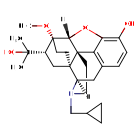
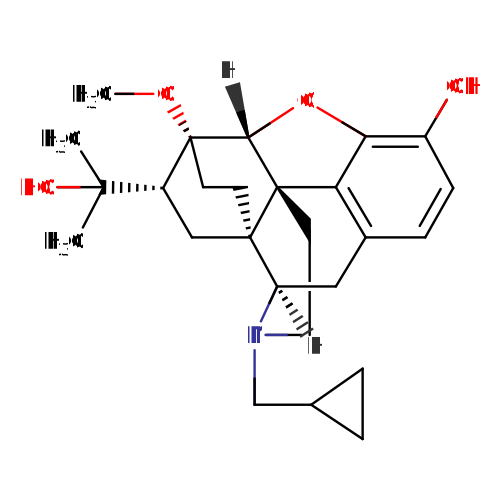
Structure for Diprenorphine (DB01548)
- Weight
- Average: 425.569
Monoisotopic: 425.256608611 - Chemical Formula
- C26H35NO4
- Synonyms
- Diprenorfin
- Diprenorphine
- External IDs
- M-5050
- M5050

Pharmacology
- Indication
Diprenorphine is indicated to reverse the effects of powerful opioids including etorphine and carfentanil, often used for tranquilizing large animals. This drug is not approved for use in humans.
 Reduce drug development failure ratesBuild, train, & validate machine-learning modelswith evidence-based and structured datasets.Build, train, & validate predictive machine-learning models with structured datasets.
- Contraindications & Blackbox Warnings
 Prevent Adverse Drug Events TodayTap into our Clinical API for life-saving information on contraindications & blackbox warnings, population restrictions, harmful risks, & more.Avoid life-threatening adverse drug events with our Clinical API
- Pharmacodynamics
Not Available
- Mechanism of action
Diprenorphine binds approximately equally to the three subtypes of opioid receptorsand antagonizes them.
Target Actions Organism AMu-type opioid receptor antagonistHumans ADelta-type opioid receptor antagonistHumans UKappa-type opioid receptor antagonistHumans UE3 ubiquitin-protein ligase TRIM13 Not Available Humans - Absorption
Not Available
- Volume of distribution
Not Available
- Protein binding
Not Available
- Metabolism
- Not Available
- Route of elimination
Not Available
- Half-life
Not Available
- Clearance
Not Available
- Adverse Effects
 Improve decision support & research outcomesWith structured adverse effects data, including: blackbox warnings, adverse reactions, warning & precautions, & incidence rates. View sample adverse effects data in our new Data Library!Improve decision support & research outcomes with our structured adverse effects data.
- Toxicity
Not Available
- Pathways
- Not Available
- Pharmacogenomic Effects/ADRs
- Not Available
Interactions
- Drug Interactions
- This information should not be interpreted without the help of a healthcare provider. If you believe you are experiencing an interaction, contact a healthcare provider immediately. The absence of an interaction does not necessarily mean no interactions exist.
Drug Interaction Integrate drug-drug
interactions in your softwareAlfentanil The therapeutic efficacy of Alfentanil can be decreased when used in combination with Diprenorphine. Benzhydrocodone The therapeutic efficacy of Benzhydrocodone can be decreased when used in combination with Diprenorphine. Buprenorphine The therapeutic efficacy of Buprenorphine can be decreased when used in combination with Diprenorphine. Butorphanol The therapeutic efficacy of Butorphanol can be decreased when used in combination with Diprenorphine. Codeine The therapeutic efficacy of Codeine can be decreased when used in combination with Diprenorphine. - Food Interactions
- Not Available
Products
 Drug product information from 10+ global regionsOur datasets provide approved product information including:dosage, form, labeller, route of administration, and marketing period.Access drug product information from over 10 global regions.
- Product Ingredients
Ingredient UNII CAS InChI Key Diprenorphine hydrochloride WBS7IEP4SN 16808-86-9 UNPUINKKJUSSDZ-UVGWPQHUSA-N - International/Other Brands
- M5050 / Revivon
Categories
- Drug Categories
- Chemical TaxonomyProvided by Classyfire
- Description
- This compound belongs to the class of organic compounds known as phenanthrenes and derivatives. These are polycyclic compounds containing a phenanthrene moiety, which is a tricyclic aromatic compound with three non-linearly fused benzene.
- Kingdom
- Organic compounds
- Super Class
- Benzenoids
- Class
- Phenanthrenes and derivatives
- Sub Class
- Not Available
- Direct Parent
- Phenanthrenes and derivatives
- Alternative Parents
- Tetralins / Azaspirodecane derivatives / Coumarans / Aralkylamines / Alkyl aryl ethers / 1-hydroxy-2-unsubstituted benzenoids / Piperidines / Tertiary alcohols / Trialkylamines / Oxacyclic compounds show 4 more
- Substituents
- 1-hydroxy-2-unsubstituted benzenoid / Alcohol / Alkyl aryl ether / Amine / Aralkylamine / Aromatic heteropolycyclic compound / Azacycle / Azaspirodecane / Coumaran / Dialkyl ether show 15 more
- Molecular Framework
- Aromatic heteropolycyclic compounds
- External Descriptors
- morphinane alkaloid (CHEBI:4650)
- Affected organisms
- Not Available
Chemical Identifiers
- UNII
- 1F0L5N25ZZ
- CAS number
- 14357-78-9
- InChI Key
- OIJXLIIMXHRJJH-KNLIIKEYSA-N
- InChI
- InChI=1S/C26H35NO4/c1-23(2,29)18-13-24-8-9-26(18,30-3)22-25(24)10-11-27(14-15-4-5-15)19(24)12-16-6-7-17(28)21(31-22)20(16)25/h6-7,15,18-19,22,28-29H,4-5,8-14H2,1-3H3/t18-,19-,22-,24-,25+,26-/m1/s1
- IUPAC Name
- (1S,2R,6S,14R,15R,16R)-3-(cyclopropylmethyl)-16-(2-hydroxypropan-2-yl)-15-methoxy-13-oxa-3-azahexacyclo[13.2.2.1²,⁸.0¹,⁶.0⁶,¹⁴.0⁷,¹²]icosa-7,9,11-trien-11-ol
- SMILES
- [H][C@@]12OC3=C(O)C=CC4=C3[C@@]11CCN(CC3CC3)[C@]([H])(C4)[C@]11CC[C@@]2(OC)[C@H](C1)C(C)(C)O
References
- General References
- Not Available
- External Links
- KEGG Compound
- C11794
- PubChem Compound
- 443408
- PubChem Substance
- 46506559
- ChemSpider
- 391634
- BindingDB
- 50001714
- ChEBI
- 4650
- ChEMBL
- CHEMBL281786
- ZINC
- ZINC000004102215
- Guide to Pharmacology
- GtP Drug Page
- Wikipedia
- Diprenorphine
Clinical Trials
- Clinical Trials
Phase Status Purpose Conditions Count Not Available Completed Diagnostic Anorexia / Dysmorphic Disorder, Body 1
Pharmacoeconomics
- Manufacturers
- Not Available
- Packagers
- Not Available
- Dosage Forms
- Not Available
- Prices
- Not Available
- Patents
- Not Available
Properties
- State
- Solid
- Experimental Properties
- Not Available
- Predicted Properties
Property Value Source Water Solubility 0.104 mg/mL ALOGPS logP 3.52 ALOGPS logP 2.28 Chemaxon logS -3.6 ALOGPS pKa (Strongest Acidic) 10.42 Chemaxon pKa (Strongest Basic) 9.63 Chemaxon Physiological Charge 1 Chemaxon Hydrogen Acceptor Count 5 Chemaxon Hydrogen Donor Count 2 Chemaxon Polar Surface Area 62.16 Å2 Chemaxon Rotatable Bond Count 4 Chemaxon Refractivity 118.37 m3·mol-1 Chemaxon Polarizability 47.86 Å3 Chemaxon Number of Rings 7 Chemaxon Bioavailability 1 Chemaxon Rule of Five Yes Chemaxon Ghose Filter Yes Chemaxon Veber's Rule No Chemaxon MDDR-like Rule No Chemaxon - Predicted ADMET Features
Property Value Probability Human Intestinal Absorption + 0.9055 Blood Brain Barrier + 0.9401 Caco-2 permeable + 0.6893 P-glycoprotein substrate Substrate 0.9126 P-glycoprotein inhibitor I Inhibitor 0.5192 P-glycoprotein inhibitor II Non-inhibitor 0.6992 Renal organic cation transporter Inhibitor 0.5797 CYP450 2C9 substrate Non-substrate 0.8366 CYP450 2D6 substrate Substrate 0.8919 CYP450 3A4 substrate Substrate 0.8142 CYP450 1A2 substrate Non-inhibitor 0.9153 CYP450 2C9 inhibitor Non-inhibitor 0.8692 CYP450 2D6 inhibitor Non-inhibitor 0.6721 CYP450 2C19 inhibitor Non-inhibitor 0.7801 CYP450 3A4 inhibitor Non-inhibitor 0.8322 CYP450 inhibitory promiscuity Low CYP Inhibitory Promiscuity 0.9212 Ames test Non AMES toxic 0.7448 Carcinogenicity Non-carcinogens 0.9391 Biodegradation Not ready biodegradable 1.0 Rat acute toxicity 3.1511 LD50, mol/kg Not applicable hERG inhibition (predictor I) Weak inhibitor 0.8366 hERG inhibition (predictor II) Non-inhibitor 0.586
Spectra
- Mass Spec (NIST)
- Not Available
- Spectra
Spectrum Spectrum Type Splash Key Predicted GC-MS Spectrum - GC-MS Predicted GC-MS splash10-0a4i-9004000000-425c5226acb0254103d3 Predicted MS/MS Spectrum - 10V, Negative (Annotated) Predicted LC-MS/MS splash10-00di-0000900000-5340da7623f93722200f Predicted MS/MS Spectrum - 10V, Positive (Annotated) Predicted LC-MS/MS splash10-004i-0000900000-f2decdfb37d381015574 Predicted MS/MS Spectrum - 20V, Positive (Annotated) Predicted LC-MS/MS splash10-004i-0000900000-09f9de390fda03d1bbc1 Predicted MS/MS Spectrum - 20V, Negative (Annotated) Predicted LC-MS/MS splash10-00di-0000900000-12a380fb41b92b8db02e Predicted MS/MS Spectrum - 40V, Positive (Annotated) Predicted LC-MS/MS splash10-003r-0009700000-9b7f7fe75a9b7f735167 Predicted MS/MS Spectrum - 40V, Negative (Annotated) Predicted LC-MS/MS splash10-00di-0002900000-0193725eef7982cf3110 Predicted 1H NMR Spectrum 1D NMR Not Applicable Predicted 13C NMR Spectrum 1D NMR Not Applicable - Chromatographic Properties
Collision Cross Sections (CCS)
Adduct CCS Value (Å2) Source type Source [M-H]- 207.67902 predictedDeepCCS 1.0 (2019) [M+H]+ 209.57445 predictedDeepCCS 1.0 (2019) [M+Na]+ 215.35236 predictedDeepCCS 1.0 (2019)
Targets

Build, predict & validate machine-learning models
Use our structured and evidence-based datasets to unlock newinsights and accelerate drug research.
Use our structured and evidence-based datasets to unlock new insights and accelerate drug research.
- Kind
- Protein
- Organism
- Humans
- Pharmacological action
- Yes
- Actions
- Antagonist
- General Function
- Voltage-gated calcium channel activity
- Specific Function
- Receptor for endogenous opioids such as beta-endorphin and endomorphin. Receptor for natural and synthetic opioids including morphine, heroin, DAMGO, fentanyl, etorphine, buprenorphin and methadone...
- Gene Name
- OPRM1
- Uniprot ID
- P35372
- Uniprot Name
- Mu-type opioid receptor
- Molecular Weight
- 44778.855 Da
References
- Leung K: [6-O-methyl-11C]Diprenorphine . [Article]
- Kind
- Protein
- Organism
- Humans
- Pharmacological action
- Yes
- Actions
- Antagonist
- General Function
- Opioid receptor activity
- Specific Function
- G-protein coupled receptor that functions as receptor for endogenous enkephalins and for a subset of other opioids. Ligand binding causes a conformation change that triggers signaling via guanine n...
- Gene Name
- OPRD1
- Uniprot ID
- P41143
- Uniprot Name
- Delta-type opioid receptor
- Molecular Weight
- 40368.235 Da
References
- Willoch F, Tolle TR, Wester HJ, Munz F, Petzold A, Schwaiger M, Conrad B, Bartenstein P: Central pain after pontine infarction is associated with changes in opioid receptor binding: a PET study with 11C-diprenorphine. AJNR Am J Neuroradiol. 1999 Apr;20(4):686-90. [Article]
- Jones AK, Kitchen ND, Watabe H, Cunningham VJ, Jones T, Luthra SK, Thomas DG: Measurement of changes in opioid receptor binding in vivo during trigeminal neuralgic pain using [11C] diprenorphine and positron emission tomography. J Cereb Blood Flow Metab. 1999 Jul;19(7):803-8. [Article]
- Kampa M, Hatzoglou A, Notas G, Niniraki M, Kouroumalis E, Castanas E: Opioids are non-competitive inhibitors of nitric oxide synthase in T47D human breast cancer cells. Cell Death Differ. 2001 Sep;8(9):943-52. [Article]
- Marie N, Lecoq I, Jauzac P, Allouche S: Differential sorting of human delta-opioid receptors after internalization by peptide and alkaloid agonists. J Biol Chem. 2003 Jun 20;278(25):22795-804. Epub 2003 Apr 2. [Article]
- Webster JM, Bentley MT, Wojcikiewicz RJ: N,N,N',N'-tetrakis(2-pyridylmethyl)ethylenediamine inhibits ligand binding to certain G protein-coupled receptors. Eur J Pharmacol. 2003 Aug 1;474(1):1-5. [Article]
- Leung K: [6-O-methyl-11C]Diprenorphine . [Article]
- Kind
- Protein
- Organism
- Humans
- Pharmacological action
- Unknown
- Actions
- Antagonist
- General Function
- Opioid receptor activity
- Specific Function
- G-protein coupled opioid receptor that functions as receptor for endogenous alpha-neoendorphins and dynorphins, but has low affinity for beta-endorphins. Also functions as receptor for various synt...
- Gene Name
- OPRK1
- Uniprot ID
- P41145
- Uniprot Name
- Kappa-type opioid receptor
- Molecular Weight
- 42644.665 Da
References
- Leung K: [6-O-methyl-11C]Diprenorphine . [Article]
- Kind
- Protein
- Organism
- Humans
- Pharmacological action
- Unknown
- General Function
- Zinc ion binding
- Specific Function
- E3 ubiquitin ligase involved in the retrotranslocation and turnover of membrane and secretory proteins from the ER through a set of processes named ER-associated degradation (ERAD). This process ac...
- Gene Name
- TRIM13
- Uniprot ID
- O60858
- Uniprot Name
- E3 ubiquitin-protein ligase TRIM13
- Molecular Weight
- 46987.08 Da
References
- Law PY, Hom DS, Loh HH: Multiple affinity states of opiate receptor in neuroblastoma x glioma NG108-15 hybrid cells. Opiate agonist association rate is a function of receptor occupancy. J Biol Chem. 1985 Mar 25;260(6):3561-9. [Article]
- Pfeiffer A, Herz A: Discrimination of three opiate receptor binding sites with the use of a computerized curve-fitting technique. Mol Pharmacol. 1982 Mar;21(2):266-71. [Article]
- Chang KJ, Hazum E, Cuatrecasas P: Novel opiate binding sites selective for benzomorphan drugs. Proc Natl Acad Sci U S A. 1981 Jul;78(7):4141-5. [Article]
- Pfeiffer A, Herz A: Enhancement of delta- but not mu-opiate agonist binding by calcium. Naunyn Schmiedebergs Arch Pharmacol. 1982 May;319(2):147-53. [Article]
- Cvejic S, Trapaidze N, Cyr C, Devi LA: Thr353, located within the COOH-terminal tail of the delta opiate receptor, is involved in receptor down-regulation. J Biol Chem. 1996 Feb 23;271(8):4073-6. [Article]

Drug created at July 31, 2007 13:10 / Updated at February 21, 2021 18:51