Identification
- Summary
Dimetindene is a 1st generation selective H1 antagonist used topically as an antipruritic and orally to treat allergies.
- Generic Name
- Dimetindene
- DrugBank Accession Number
- DB08801
- Background
Dimetindene (Fenistil) is an antihistamine/anticholinergic used orally and locally as an antipruritic.
- Type
- Small Molecule
- Groups
- Approved, Investigational
- Structure
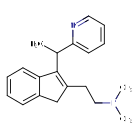
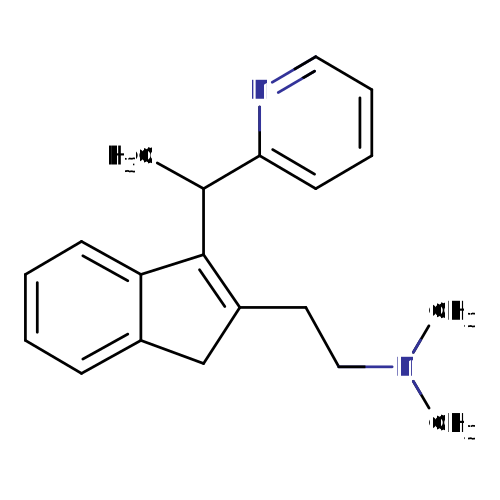
Structure for Dimetindene (DB08801)
- Weight
- Average: 292.418
Monoisotopic: 292.193948778 - Chemical Formula
- C20H24N2
- Synonyms
- Dimethindene
- Dimetindene
- Dimetindeno

Pharmacology
- Indication
Indicated as symptomatic treatment of allergic reactions: urticaria, allergies of the upper respiratory tract such as hey fever and perennial rhinitis, food and drug allergies; pruritus of various origins, except pruritus due to cholestasis; insect bites. Dimethindene is also indicated for pruritus in eruptive skin diseases such as chicken-pox. Dimethindene can also be used as an adjuvant in eczema and other pruriginous dermatoses of allergic origin.
 Reduce drug development failure ratesBuild, train, & validate machine-learning modelswith evidence-based and structured datasets.Build, train, & validate predictive machine-learning models with structured datasets.
- Associated Conditions
Indication Type Indication Combined Product Details Approval Level Age Group Patient Characteristics Dose Form Used in combination for symptomatic treatment of Acute sinusitis Combination Product in combination with: Phenylephrine (DB00388) •••••••••••• •••• ••••••••• •••••••• • •••••• ••••• Treatment of Allergies •••••••••••• •••• ••••••••• ••••••• ••••••• •••••• Treatment of Anaphylaxis •••••••••••• ••••••••• Prevention of Anaphylaxis caused by anaesthesia therapy •••••••••••• ••••••••• Used in combination for symptomatic treatment of Chronic rhinitis Combination Product in combination with: Phenylephrine (DB00388) •••••••••••• •••• ••••••••• •••••••• • •••••• ••••• - Contraindications & Blackbox Warnings
 Prevent Adverse Drug Events TodayTap into our Clinical API for life-saving information on contraindications & blackbox warnings, population restrictions, harmful risks, & more.Avoid life-threatening adverse drug events with our Clinical API
- Pharmacodynamics
Dimethindene occurs as a racemic mixture. The (S)-(+)-dimethindene is a potent M2-selective muscarinic receptor antagonist (with lower affinity for M1, M3, and M4 muscarinic receptors). The (R)-(-)-enantiomer is the eutomer (responsible for bioactivity) for histamine H1 receptor binding.
- Mechanism of action
Dimethindene is a selective histamine H1 antagonist and binds to the histamine H1 receptor. This blocks the action of endogenous histamine, which subsequently leads to temporary relief of the negative symptoms brought on by histamine.
Target Actions Organism AHistamine H1 receptor antagonistHumans AMuscarinic acetylcholine receptor M2 antagonistHumans - Absorption
Not Available
- Volume of distribution
Not Available
- Protein binding
Not Available
- Metabolism
- Not Available
- Route of elimination
Not Available
- Half-life
Not Available
- Clearance
Not Available
- Adverse Effects
 Improve decision support & research outcomesWith structured adverse effects data, including: blackbox warnings, adverse reactions, warning & precautions, & incidence rates. View sample adverse effects data in our new Data Library!Improve decision support & research outcomes with our structured adverse effects data.
- Toxicity
As with other antihistaminic drugs, overdosage can produce the following symptoms: CNS depression accompanied by drowsiness (especially in adults), CNS stimulation and antimuscarinic effects (especially in children) including the following: excitation, ataxia, hallucinations, tonic or clonic spasms, mydriasis, dryness of the mouth, redness of the face, urine retention, fever and tachycardia. Blood hypotension is also possible. In its terminal phase, coma can be aggravated by cardiorespiratory colapse and death. There has been no report of a fatal outcome of Dimethindene overdosage.
- Pathways
Pathway Category Dimetindene H1-Antihistamine Action Drug action - Pharmacogenomic Effects/ADRs
- Not Available
Interactions
- Drug Interactions
- This information should not be interpreted without the help of a healthcare provider. If you believe you are experiencing an interaction, contact a healthcare provider immediately. The absence of an interaction does not necessarily mean no interactions exist.
Drug Interaction Integrate drug-drug
interactions in your softwareAclidinium The risk or severity of adverse effects can be increased when Dimetindene is combined with Aclidinium. Adenosine The risk or severity of Tachycardia can be increased when Adenosine is combined with Dimetindene. Albuterol The risk or severity of Tachycardia can be increased when Salbutamol is combined with Dimetindene. Alfentanil The risk or severity of adverse effects can be increased when Dimetindene is combined with Alfentanil. Alloin The therapeutic efficacy of Alloin can be decreased when used in combination with Dimetindene. - Food Interactions
- Not Available
Products
 Drug product information from 10+ global regionsOur datasets provide approved product information including:dosage, form, labeller, route of administration, and marketing period.Access drug product information from over 10 global regions.
- Product Ingredients
Ingredient UNII CAS InChI Key Dimetindene maleate 6LL60J9E0O 3614-69-5 SWECWXGUJQLXJF-BTJKTKAUSA-N - International/Other Brands
- Fenistil (Novartis) / Foristal (Novartis) / Vibrocil (Novartis)
- Over the Counter Products
Name Dosage Strength Route Labeller Marketing Start Marketing End Region Image เฟนีสติล เจล Gel 0.1 %w/w Topical บริษัท แกล็กโซสมิทไคล์น คอนซูมเมอร์ เฮลธ์แคร์ (ประเทศไทย) จำกัด 2016-04-25 Not applicable Thailand 
- Mixture Products
Name Ingredients Dosage Route Labeller Marketing Start Marketing End Region Image Vibrocil Nasenspray Dimetindene maleate (0.25 mg) + Phenylephrine (2.5 mg) Spray Nasal Gsk Gebro Consumer Healthcare Gmb H 1990-07-25 Not applicable Austria 
Vibrocil Nasentropfen Dimetindene maleate (0.25 mg) + Phenylephrine (2.5 mg) Solution / drops; Suspension / drops Nasal Gsk Gebro Consumer Healthcare Gmb H 1985-08-09 Not applicable Austria
Categories
- ATC Codes
- R06AB03 — Dimetindene
- R06AB — Substituted alkylamines
- R06A — ANTIHISTAMINES FOR SYSTEMIC USE
- R06 — ANTIHISTAMINES FOR SYSTEMIC USE
- R — RESPIRATORY SYSTEM
- Drug Categories
- Agents producing tachycardia
- Anti-Allergic Agents
- Anticholinergic Agents
- Antihistamines for Systemic Use
- Antihistamines for Topical Use
- Antipruritics
- Antipruritics, Incl. Antihistamines, Anesthetics, Etc.
- Dermatologicals
- Histamine Agents
- Histamine Antagonists
- Histamine H1 Antagonists
- Indenes
- Muscarinic Antagonists
- Neurotransmitter Agents
- Pyridines
- Substituted Alkylamines
- Chemical TaxonomyProvided by Classyfire
- Description
- This compound belongs to the class of organic compounds known as indenes and isoindenes. These are compounds containing an indene moiety(which consists of a cyclopentadiene fused to a benzene ring), or a isoindene moiety (which consists of a cyclopentadiene fused to cyclohexadiene ring).
- Kingdom
- Organic compounds
- Super Class
- Benzenoids
- Class
- Indenes and isoindenes
- Sub Class
- Not Available
- Direct Parent
- Indenes and isoindenes
- Alternative Parents
- Pyridines and derivatives / Heteroaromatic compounds / Trialkylamines / Azacyclic compounds / Organopnictogen compounds / Hydrocarbon derivatives
- Substituents
- Amine / Aromatic heteropolycyclic compound / Azacycle / Heteroaromatic compound / Hydrocarbon derivative / Indene / Organic nitrogen compound / Organoheterocyclic compound / Organonitrogen compound / Organopnictogen compound
- Molecular Framework
- Aromatic heteropolycyclic compounds
- External Descriptors
- Not Available
- Affected organisms
- Humans and other mammals
Chemical Identifiers
- UNII
- 661FH77Z3P
- CAS number
- 5636-83-9
- InChI Key
- MVMQESMQSYOVGV-UHFFFAOYSA-N
- InChI
- InChI=1S/C20H24N2/c1-15(19-10-6-7-12-21-19)20-17(11-13-22(2)3)14-16-8-4-5-9-18(16)20/h4-10,12,15H,11,13-14H2,1-3H3
- IUPAC Name
- dimethyl(2-{3-[1-(pyridin-2-yl)ethyl]-1H-inden-2-yl}ethyl)amine
- SMILES
- CC(C1=C(CCN(C)C)CC2=CC=CC=C12)C1=CC=CC=N1
References
- Synthesis Reference
Huebner, C.F.; U S . Patent 2,970,149; January 31, 1961; assigned to Ciba Pharmaceutical Products, Inc.
- General References
- Lambrecht G, Gross J, Mutschler E: Neuronal soma-dendritic and prejunctional M1-M4 receptors in gastrointestinal and genitourinary smooth muscle. Life Sci. 1999;64(6-7):403-10. [Article]
- External Links
- Human Metabolome Database
- HMDB0015691
- KEGG Drug
- D07853
- PubChem Compound
- 21855
- PubChem Substance
- 99445271
- ChemSpider
- 20541
- BindingDB
- 81452
- 3449
- ChEBI
- 135222
- ChEMBL
- CHEMBL22108
- PharmGKB
- PA165958420
- Wikipedia
- Dimetindene
- MSDS
- Download (72.8 KB)
Clinical Trials
- Clinical Trials
Phase Status Purpose Conditions Count 3 Completed Treatment Nasal Congestion / Rhinorrhoea / Sneezing / Upper Respiratory Tract Infection 1 1, 2 Withdrawn Not Available Arrhythmia / Blood Pressures / Heart Rates 1 Not Available Completed Treatment Atopic Dermatitis 1
Pharmacoeconomics
- Manufacturers
- Not Available
- Packagers
- Not Available
- Dosage Forms
Form Route Strength Capsule, extended release 4 MG Emulsion Topical 0.1 % Gel Topical 0.1 % Gel Topical 30 G Solution Oral 1 mg Solution / drops Oral 1 MG/ML Solution / drops; suspension / drops Tablet Oral 1 mg Tablet, coated Oral Tablet, coated Oral 1 MG Tablet, sugar coated Oral 1 mg Gel Topical 1 mg/g Solution Oral 1 mg/mL Injection, solution Parenteral 1 mg/ml Spray Nasal Solution / drops; suspension / drops Nasal Gel Topical 0.1 %w/w - Prices
- Not Available
- Patents
- Not Available
Properties
- State
- Solid
- Experimental Properties
Property Value Source melting point (°C) 158 Huebner, C.F.; U S . Patent 2,970,149; January 31, 1961; assigned to Ciba Pharmaceutical Products, Inc. water solubility 239 mg/L (at 37 °C) YALKOWSKY,SH & DANNENFELSER,RM (1992) - Predicted Properties
Property Value Source Water Solubility 0.0384 mg/mL ALOGPS logP 4.03 ALOGPS logP 3.74 Chemaxon logS -3.9 ALOGPS pKa (Strongest Acidic) 18.19 Chemaxon pKa (Strongest Basic) 9.7 Chemaxon Physiological Charge 1 Chemaxon Hydrogen Acceptor Count 2 Chemaxon Hydrogen Donor Count 0 Chemaxon Polar Surface Area 16.13 Å2 Chemaxon Rotatable Bond Count 5 Chemaxon Refractivity 93.57 m3·mol-1 Chemaxon Polarizability 34.99 Å3 Chemaxon Number of Rings 3 Chemaxon Bioavailability 1 Chemaxon Rule of Five Yes Chemaxon Ghose Filter Yes Chemaxon Veber's Rule Yes Chemaxon MDDR-like Rule No Chemaxon - Predicted ADMET Features
Property Value Probability Human Intestinal Absorption + 0.9924 Blood Brain Barrier + 0.9643 Caco-2 permeable + 0.7598 P-glycoprotein substrate Substrate 0.7931 P-glycoprotein inhibitor I Inhibitor 0.8852 P-glycoprotein inhibitor II Inhibitor 0.6697 Renal organic cation transporter Inhibitor 0.7693 CYP450 2C9 substrate Non-substrate 0.8291 CYP450 2D6 substrate Substrate 0.6025 CYP450 3A4 substrate Substrate 0.7558 CYP450 1A2 substrate Inhibitor 0.9107 CYP450 2C9 inhibitor Inhibitor 0.895 CYP450 2D6 inhibitor Inhibitor 0.8932 CYP450 2C19 inhibitor Inhibitor 0.8994 CYP450 3A4 inhibitor Non-inhibitor 0.8308 CYP450 inhibitory promiscuity High CYP Inhibitory Promiscuity 0.5637 Ames test Non AMES toxic 0.5454 Carcinogenicity Non-carcinogens 0.9431 Biodegradation Not ready biodegradable 0.9888 Rat acute toxicity 2.7060 LD50, mol/kg Not applicable hERG inhibition (predictor I) Weak inhibitor 0.7746 hERG inhibition (predictor II) Inhibitor 0.639
Spectra
- Mass Spec (NIST)
- Not Available
- Spectra
Spectrum Spectrum Type Splash Key Predicted GC-MS Spectrum - GC-MS Predicted GC-MS splash10-0a6r-9580000000-d988cb2b7d041f1d29b4 Predicted MS/MS Spectrum - 10V, Positive (Annotated) Predicted LC-MS/MS splash10-052f-2390000000-716e195bbe4ee3452dd1 Predicted MS/MS Spectrum - 10V, Negative (Annotated) Predicted LC-MS/MS splash10-000f-0690000000-d2f35eab733f1e6d7c5b Predicted MS/MS Spectrum - 20V, Positive (Annotated) Predicted LC-MS/MS splash10-0pb9-1940000000-93792a02dd1b0776a3bc Predicted MS/MS Spectrum - 20V, Negative (Annotated) Predicted LC-MS/MS splash10-054o-3930000000-3b156432deb7e97f3f55 Predicted MS/MS Spectrum - 40V, Positive (Annotated) Predicted LC-MS/MS splash10-052f-9610000000-26c1a7713b0284fad382 Predicted MS/MS Spectrum - 40V, Negative (Annotated) Predicted LC-MS/MS splash10-0006-0900000000-5bc8b7c5fd03588a0117 Predicted 1H NMR Spectrum 1D NMR Not Applicable Predicted 13C NMR Spectrum 1D NMR Not Applicable - Chromatographic Properties
Collision Cross Sections (CCS)
Adduct CCS Value (Å2) Source type Source [M-H]- 186.9898261 predictedDarkChem Lite v0.1.0 [M-H]- 169.48335 predictedDeepCCS 1.0 (2019) [M+H]+ 187.7801261 predictedDarkChem Lite v0.1.0 [M+H]+ 171.84134 predictedDeepCCS 1.0 (2019) [M+Na]+ 187.3687261 predictedDarkChem Lite v0.1.0 [M+Na]+ 177.93446 predictedDeepCCS 1.0 (2019)
Targets

- Kind
- Protein
- Organism
- Humans
- Pharmacological action
- Yes
- Actions
- Antagonist
- General Function
- Histamine receptor activity
- Specific Function
- In peripheral tissues, the H1 subclass of histamine receptors mediates the contraction of smooth muscles, increase in capillary permeability due to contraction of terminal venules, and catecholamin...
- Gene Name
- HRH1
- Uniprot ID
- P35367
- Uniprot Name
- Histamine H1 receptor
- Molecular Weight
- 55783.61 Da
References
- Moree WJ, Li BF, Zamani-Kord S, Yu J, Coon T, Huang C, Marinkovic D, Tucci FC, Malany S, Bradbury MJ, Hernandez LM, Wen J, Wang H, Hoare SR, Petroski RE, Jalali K, Yang C, Sacaan A, Madan A, Crowe PD, Beaton G: Identification of a novel selective H1-antihistamine with optimized pharmacokinetic properties for clinical evaluation in the treatment of insomnia. Bioorg Med Chem Lett. 2010 Oct 1;20(19):5874-8. doi: 10.1016/j.bmcl.2010.07.117. Epub 2010 Aug 3. [Article]
- Pfaff O, Hildebrandt C, Waelbroeck M, Hou X, Moser U, Mutschler E, Lambrecht G: The (S)-(+)-enantiomer of dimethindene: a novel M2-selective muscarinic receptor antagonist. Eur J Pharmacol. 1995 Nov 24;286(3):229-40. [Article]
- Horak F, Unkauf M, Beckers C, Mittermaier EM: Efficacy and tolerability of intranasally applied dimetindene maleate solution versus placebo in the treatment of seasonal allergic rhinitis. Arzneimittelforschung. 2000 Dec;50(12):1099-105. doi: 10.1055/s-0031-1300341. [Article]
- Rehn D, Geissler H, Schonbrunn U, Lukas H, Hennings G: Effect-time-relation of the H1-receptor antagonist dimethindene maleate following intravenous injection. Agents Actions. 1990 Apr;30(1-2):178-81. doi: 10.1007/BF01969031. [Article]
- Rehn D, Haack D, Vecsei P, Hennings G: The influence of dimetindene maleate on the endogenous hydrocortisone synthesis suppressing potency of betamethasone. Arzneimittelforschung. 1985;35(6):970-2. [Article]
- Duda D, Lorenz W, Celik I: Histamine release in mesenteric traction syndrome during abdominal aortic aneurysm surgery: prophylaxis with H1 and H2 antihistamines. Inflamm Res. 2002 Oct;51(10):495-9. doi: 10.1007/pl00012418. [Article]
- Schaffler K, Wauschkuhn CH, Brunnauer H, Rehn D: Evaluation of the local anaesthetic activity of dimetindene maleate by means of laser algesimetry in healthy volunteers. Arzneimittelforschung. 1992 Nov;42(11):1332-5. [Article]
- Rubinstein R, Nissenkorn I, Cohen S: Acetylcholine mediation of the contractile response to histamine in human bladder detrusor muscle. Eur J Pharmacol. 1987 Oct 6;142(1):45-50. doi: 10.1016/0014-2999(87)90652-2. [Article]
- Kirchhoff CH, Kremer B, Haaf-von Below S, Kyrein HJ, Mosges R: Effects of dimethindene maleate nasal spray on the quality of life in seasonal allergic rhinitis. Rhinology. 2003 Sep;41(3):159-66. [Article]
- Humphreys F, Shuster S: The effect of topical dimethindene maleate on weal reactions. Br J Clin Pharmacol. 1987 Feb;23(2):234-6. doi: 10.1111/j.1365-2125.1987.tb03035.x. [Article]
- Doenicke A, Moss J, Lorenz W, Hoernecke R, Gottardis M: Are hypotension and rash after atracurium really caused by histamine release? Anesth Analg. 1994 May;78(5):967-72. doi: 10.1213/00000539-199405000-00023. [Article]
- Rehn D, Geissler H, Schuster O, Lukas H, Hennings G: Effect-kinetic characterization of dimethindene maleate following oral administration (Fenistil, Tropfen). Fundam Clin Pharmacol. 1990;4(6):673-83. doi: 10.1111/j.1472-8206.1990.tb00047.x. [Article]
- Casy AF, Drake AF, Ganellin CR, Mercer AD, Upton C: Stereochemical studies of chiral H-1 antagonists of histamine: the resolution, chiral analysis, and biological evaluation of four antipodal pairs. Chirality. 1992;4(6):356-66. doi: 10.1002/chir.530040606. [Article]
- Kind
- Protein
- Organism
- Humans
- Pharmacological action
- Yes
- Actions
- Antagonist
- General Function
- G-protein coupled acetylcholine receptor activity
- Specific Function
- The muscarinic acetylcholine receptor mediates various cellular responses, including inhibition of adenylate cyclase, breakdown of phosphoinositides and modulation of potassium channels through the...
- Gene Name
- CHRM2
- Uniprot ID
- P08172
- Uniprot Name
- Muscarinic acetylcholine receptor M2
- Molecular Weight
- 51714.605 Da
References
- Pfaff O, Hildebrandt C, Waelbroeck M, Hou X, Moser U, Mutschler E, Lambrecht G: The (S)-(+)-enantiomer of dimethindene: a novel M2-selective muscarinic receptor antagonist. Eur J Pharmacol. 1995 Nov 24;286(3):229-40. [Article]

Drug created at October 15, 2010 15:48 / Updated at December 02, 2023 06:58