Identification
- Summary
Methyclothiazide is a diuretic drug used to treat hypertension and edema caused by heart failure, renal conditions, treatment with corticosteroids, and estrogen therapy.
- Generic Name
- Methyclothiazide
- DrugBank Accession Number
- DB00232
- Background
A thiazide diuretic with properties similar to those of hydrochlorothiazide. (From Martindale, The Extra Pharmacopoeia, 30th ed, p825)
- Type
- Small Molecule
- Groups
- Withdrawn
- Structure
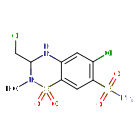
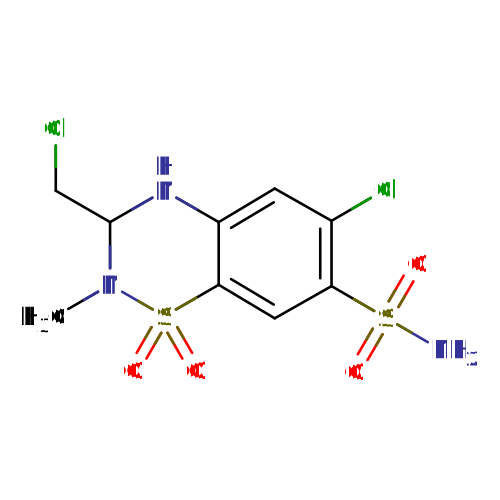
Structure for Methyclothiazide (DB00232)
- Weight
- Average: 360.237
Monoisotopic: 358.956802649 - Chemical Formula
- C9H11Cl2N3O4S2
- Synonyms
- Methyclothiazide

Pharmacology
- Indication
For use in the management of hypertension either as the sole therapeutic agent or to enhance the effect of other antihypertensive drugs in the more severe forms of hypertension. Also used as adjunctive therapy in edema associated with congestive heart failure, hepatic cirrhosis, and corticosteroid and estrogen therapy.
 Reduce drug development failure ratesBuild, train, & validate machine-learning modelswith evidence-based and structured datasets.Build, train, & validate predictive machine-learning models with structured datasets.
- Associated Conditions
Indication Type Indication Combined Product Details Approval Level Age Group Patient Characteristics Dose Form Adjunct therapy in treatment of Edema •••••••••••• Adjunct therapy in treatment of Edema •••••••••••• Adjunct therapy in treatment of Edema •••••••••••• Adjunct therapy in treatment of Edema •••••••••••• Adjunct therapy in treatment of Edema •••••••••••• - Contraindications & Blackbox Warnings
 Prevent Adverse Drug Events TodayTap into our Clinical API for life-saving information on contraindications & blackbox warnings, population restrictions, harmful risks, & more.Avoid life-threatening adverse drug events with our Clinical API
- Pharmacodynamics
Methyclothiazide, a diuretic-antihypertensive agent, is a member of the benzothiadiazine (thiazide) class of drugs. Methyclothiazide has a per mg natriuretic activity approximately 100 times that of the prototype thiazide, chlorothiazide. At maximal therapeutic dosages, all thiazides are approximately equal in their diuretic/natriuretic effects. Like other benzothiadiazines, methyclothiazide also has antihypertensive properties, and may be used for this purpose either alone or to enhance the antihypertensive action of other drugs.
- Mechanism of action
Methyclothiazide appears to block the active reabsorption of chloride and possibly sodium in the ascending loop of Henle, altering electrolyte transfer in the proximal tubule. This results in excretion of sodium, chloride, and water and, hence, diuresis. As a diuretic, methyclothiazide inhibits active chloride reabsorption at the early distal tubule via the Na-Cl cotransporter, resulting in an increase in the excretion of sodium, chloride, and water. Thiazides like methyclothiazide also inhibit sodium ion transport across the renal tubular epithelium through binding to the thiazide sensitive sodium-chloride transporter. This results in an increase in potassium excretion via the sodium-potassium exchange mechanism. The antihypertensive mechanism of methyclothiazide is less well understood although it may be mediated through its action on carbonic anhydrases in the smooth muscle or through its action on the large-conductance calcium-activated potassium (KCa) channel, also found in the smooth muscle.
Target Actions Organism ASolute carrier family 12 member 1 inhibitorHumans UCarbonic anhydrase 1 inhibitorHumans UCarbonic anhydrase 2 inhibitorHumans UCarbonic anhydrase 4 inhibitorHumans - Absorption
Rapidly absorbed following oral administration.
- Volume of distribution
Not Available
- Protein binding
Not Available
- Metabolism
- Not Available
- Route of elimination
Not Available
- Half-life
Not Available
- Clearance
Not Available
- Adverse Effects
 Improve decision support & research outcomesWith structured adverse effects data, including: blackbox warnings, adverse reactions, warning & precautions, & incidence rates. View sample adverse effects data in our new Data Library!Improve decision support & research outcomes with our structured adverse effects data.
- Toxicity
Acute oral toxicity (LD50): >4000 mg/kg [Rat]. Symptoms of overdosage include electrolyte imbalance and signs of potassium deficiency such as confusion, dizziness, muscular weakness, and gastrointestinal disturbances.
- Pathways
Pathway Category Methyclothiazide Action Pathway Drug action - Pharmacogenomic Effects/ADRs
- Not Available
Interactions
- Drug Interactions
- This information should not be interpreted without the help of a healthcare provider. If you believe you are experiencing an interaction, contact a healthcare provider immediately. The absence of an interaction does not necessarily mean no interactions exist.
Drug Interaction Integrate drug-drug
interactions in your softwareAbacavir Methyclothiazide may increase the excretion rate of Abacavir which could result in a lower serum level and potentially a reduction in efficacy. Abaloparatide The risk or severity of adverse effects can be increased when Methyclothiazide is combined with Abaloparatide. Abciximab The therapeutic efficacy of Abciximab can be decreased when used in combination with Methyclothiazide. Acarbose The therapeutic efficacy of Acarbose can be decreased when used in combination with Methyclothiazide. Acebutolol The therapeutic efficacy of Acebutolol can be increased when used in combination with Methyclothiazide. - Food Interactions
- Not Available
Products
 Drug product information from 10+ global regionsOur datasets provide approved product information including:dosage, form, labeller, route of administration, and marketing period.Access drug product information from over 10 global regions.
- International/Other Brands
- Aquatensen / Duretic / Enduron
- Brand Name Prescription Products
Name Dosage Strength Route Labeller Marketing Start Marketing End Region Image Duretic 5mg Tablet 5 mg Oral Abbott 1960-12-31 1999-08-09 Canada 
- Generic Prescription Products
Name Dosage Strength Route Labeller Marketing Start Marketing End Region Image Methyclothiazide Tablet 5 mg/1 Oral Mylan Pharmaceuticals Inc. 1982-08-17 2019-12-31 US 
- Mixture Products
Name Ingredients Dosage Route Labeller Marketing Start Marketing End Region Image Enduronyl Methyclothiazide (5 mg/1) + Deserpidine (0.25 mg/1) Tablet Oral Abbvie 1961-08-01 2002-04-30 US Enduronyl Methyclothiazide (5 mg/1) + Deserpidine (0.25 mg/1) Tablet Oral Physicians Total Care, Inc. 1961-08-01 2006-12-31 US Enduronyl Forte Methyclothiazide (5 mg/1) + Deserpidine (0.5 mg/1) Tablet Oral Abbvie 1961-08-01 2001-04-30 US
Categories
- ATC Codes
- C03AA08 — Methyclothiazide
- C03AA — Thiazides, plain
- C03A — LOW-CEILING DIURETICS, THIAZIDES
- C03 — DIURETICS
- C — CARDIOVASCULAR SYSTEM
- Drug Categories
- Benzothiadiazines
- Diuretics
- Drugs causing inadvertant photosensitivity
- Heterocyclic Compounds, Fused-Ring
- Hyperglycemia-Associated Agents
- Hypotensive Agents
- Increased Diuresis
- Membrane Transport Modulators
- Natriuretic Agents
- Photosensitizing Agents
- Sodium Chloride Symporter Inhibitors
- Sulfonamides
- Sulfones
- Sulfur Compounds
- Thiazides
- Chemical TaxonomyProvided by Classyfire
- Description
- This compound belongs to the class of organic compounds known as 1,2,4-benzothiadiazine-1,1-dioxides. These are aromatic heterocyclic compounds containing a 1,2,4-benzothiadiazine ring system with two S=O bonds at the 1-position.
- Kingdom
- Organic compounds
- Super Class
- Organoheterocyclic compounds
- Class
- Thiadiazines
- Sub Class
- Benzothiadiazines
- Direct Parent
- 1,2,4-benzothiadiazine-1,1-dioxides
- Alternative Parents
- Secondary alkylarylamines / Organosulfonamides / Benzenoids / Aryl chlorides / Aminosulfonyl compounds / Azacyclic compounds / Organopnictogen compounds / Organochlorides / Organic oxides / Hydrocarbon derivatives show 1 more
- Substituents
- 1,2,4-benzothiadiazine-1,1-dioxide / Alkyl chloride / Alkyl halide / Amine / Aminosulfonyl compound / Aromatic heteropolycyclic compound / Aryl chloride / Aryl halide / Azacycle / Benzenoid show 15 more
- Molecular Framework
- Aromatic heteropolycyclic compounds
- External Descriptors
- benzothiadiazine (CHEBI:6847)
- Affected organisms
- Humans and other mammals
Chemical Identifiers
- UNII
- L3H46UAC61
- CAS number
- 135-07-9
- InChI Key
- CESYKOGBSMNBPD-UHFFFAOYSA-N
- InChI
- InChI=1S/C9H11Cl2N3O4S2/c1-14-9(4-10)13-6-2-5(11)7(19(12,15)16)3-8(6)20(14,17)18/h2-3,9,13H,4H2,1H3,(H2,12,15,16)
- IUPAC Name
- 6-chloro-3-(chloromethyl)-2-methyl-1,1-dioxo-3,4-dihydro-2H-1lambda6,2,4-benzothiadiazine-7-sulfonamide
- SMILES
- CN1C(CCl)NC2=CC(Cl)=C(C=C2S1(=O)=O)S(N)(=O)=O
References
- General References
- Not Available
- External Links
- Human Metabolome Database
- HMDB0014377
- KEGG Drug
- D00656
- KEGG Compound
- C07765
- PubChem Compound
- 4121
- PubChem Substance
- 46509197
- ChemSpider
- 3978
- 6860
- ChEBI
- 6847
- ChEMBL
- CHEMBL1577
- Therapeutic Targets Database
- DAP000746
- PharmGKB
- PA164748094
- RxList
- RxList Drug Page
- Drugs.com
- Drugs.com Drug Page
- Wikipedia
- Methyclothiazide
- MSDS
- Download (74.8 KB)
Clinical Trials
Pharmacoeconomics
- Manufacturers
- Medpointe pharmaceuticals medpointe healthcare inc
- Abbott laboratories pharmaceutical products div
- Ivax pharmaceuticals inc
- Mylan pharmaceuticals inc
- Par pharmaceutical inc
- Sandoz inc
- Usl pharma inc
- Watson laboratories inc
- Packagers
- Ivax Pharmaceuticals
- Medisca Inc.
- Mylan
- Pharmaceutical Utilization Management Program VA Inc.
- Pharmedix
- Physicians Total Care Inc.
- Sandhills Packaging Inc.
- Dosage Forms
Form Route Strength Tablet Oral 5 mg Tablet Oral Tablet Oral 5 mg/1 - Prices
Unit description Cost Unit Methyclothiazide powder 11.32USD g Enduron 5 mg tablet 0.77USD tablet Methyclothiazide 5 mg tablet 0.77USD tablet DrugBank does not sell nor buy drugs. Pricing information is supplied for informational purposes only.- Patents
- Not Available
Properties
- State
- Solid
- Experimental Properties
Property Value Source melting point (°C) 225 °C PhysProp water solubility 11.2 mg/L Not Available logP 1.42 HANSCH,C ET AL. (1995) pKa 9.4 MERCK INDEX (2001) - Predicted Properties
Property Value Source Water Solubility 0.824 mg/mL ALOGPS logP 0.93 ALOGPS logP 0.53 Chemaxon logS -2.6 ALOGPS pKa (Strongest Acidic) 9.29 Chemaxon pKa (Strongest Basic) -3.4 Chemaxon Physiological Charge 0 Chemaxon Hydrogen Acceptor Count 5 Chemaxon Hydrogen Donor Count 2 Chemaxon Polar Surface Area 109.57 Å2 Chemaxon Rotatable Bond Count 2 Chemaxon Refractivity 77.28 m3·mol-1 Chemaxon Polarizability 31.65 Å3 Chemaxon Number of Rings 2 Chemaxon Bioavailability 1 Chemaxon Rule of Five Yes Chemaxon Ghose Filter Yes Chemaxon Veber's Rule No Chemaxon MDDR-like Rule No Chemaxon - Predicted ADMET Features
Property Value Probability Human Intestinal Absorption + 0.9834 Blood Brain Barrier - 0.6866 Caco-2 permeable - 0.6992 P-glycoprotein substrate Substrate 0.5317 P-glycoprotein inhibitor I Non-inhibitor 0.8518 P-glycoprotein inhibitor II Non-inhibitor 0.8888 Renal organic cation transporter Non-inhibitor 0.8177 CYP450 2C9 substrate Non-substrate 0.631 CYP450 2D6 substrate Non-substrate 0.8261 CYP450 3A4 substrate Non-substrate 0.532 CYP450 1A2 substrate Non-inhibitor 0.6883 CYP450 2C9 inhibitor Non-inhibitor 0.6493 CYP450 2D6 inhibitor Non-inhibitor 0.858 CYP450 2C19 inhibitor Non-inhibitor 0.808 CYP450 3A4 inhibitor Inhibitor 0.5094 CYP450 inhibitory promiscuity Low CYP Inhibitory Promiscuity 0.7345 Ames test Non AMES toxic 0.8905 Carcinogenicity Non-carcinogens 0.82 Biodegradation Not ready biodegradable 0.9971 Rat acute toxicity 1.9853 LD50, mol/kg Not applicable hERG inhibition (predictor I) Weak inhibitor 0.9384 hERG inhibition (predictor II) Non-inhibitor 0.9318
Spectra
- Mass Spec (NIST)
- Not Available
- Spectra
- Chromatographic Properties
Collision Cross Sections (CCS)
Adduct CCS Value (Å2) Source type Source [M-H]- 170.7063754 predictedDarkChem Lite v0.1.0 [M-H]- 170.4978 predictedDeepCCS 1.0 (2019) [M+H]+ 171.1539754 predictedDarkChem Lite v0.1.0 [M+H]+ 172.8558 predictedDeepCCS 1.0 (2019) [M+Na]+ 170.8906754 predictedDarkChem Lite v0.1.0 [M+Na]+ 178.94896 predictedDeepCCS 1.0 (2019)
Targets

- Kind
- Protein
- Organism
- Humans
- Pharmacological action
- Yes
- Actions
- Inhibitor
- General Function
- Sodium:potassium:chloride symporter activity
- Specific Function
- Electrically silent transporter system. Mediates sodium and chloride reabsorption. Plays a vital role in the regulation of ionic balance and cell volume.
- Gene Name
- SLC12A1
- Uniprot ID
- Q13621
- Uniprot Name
- Solute carrier family 12 member 1
- Molecular Weight
- 121449.13 Da
References
- Overington JP, Al-Lazikani B, Hopkins AL: How many drug targets are there? Nat Rev Drug Discov. 2006 Dec;5(12):993-6. [Article]
- Imming P, Sinning C, Meyer A: Drugs, their targets and the nature and number of drug targets. Nat Rev Drug Discov. 2006 Oct;5(10):821-34. [Article]
- Chen X, Ji ZL, Chen YZ: TTD: Therapeutic Target Database. Nucleic Acids Res. 2002 Jan 1;30(1):412-5. [Article]
- Kind
- Protein
- Organism
- Humans
- Pharmacological action
- Unknown
- Actions
- Inhibitor
- General Function
- Zinc ion binding
- Specific Function
- Reversible hydration of carbon dioxide. Can hydrates cyanamide to urea.
- Gene Name
- CA1
- Uniprot ID
- P00915
- Uniprot Name
- Carbonic anhydrase 1
- Molecular Weight
- 28870.0 Da
References
- Puscas I, Coltau M, Baican M, Domuta G, Hecht A: Vasodilatory effect of diuretics is dependent on inhibition of vascular smooth muscle carbonic anhydrase by a direct mechanism of action. Drugs Exp Clin Res. 1999;25(6):271-9. [Article]
- Couloigner V, Loiseau A, Sterkers O, Amiel C, Ferrary E: Effect of locally applied drugs on the endolymphatic sac potential. Laryngoscope. 1998 Apr;108(4 Pt 1):592-8. [Article]
- Temperini C, Cecchi A, Scozzafava A, Supuran CT: Carbonic anhydrase inhibitors. Comparison of chlorthalidone, indapamide, trichloromethiazide, and furosemide X-ray crystal structures in adducts with isozyme II, when several water molecules make the difference. Bioorg Med Chem. 2009 Feb 1;17(3):1214-21. doi: 10.1016/j.bmc.2008.12.023. Epub 2008 Dec 24. [Article]
- Kind
- Protein
- Organism
- Humans
- Pharmacological action
- Unknown
- Actions
- Inhibitor
- General Function
- Zinc ion binding
- Specific Function
- Essential for bone resorption and osteoclast differentiation (By similarity). Reversible hydration of carbon dioxide. Can hydrate cyanamide to urea. Involved in the regulation of fluid secretion in...
- Gene Name
- CA2
- Uniprot ID
- P00918
- Uniprot Name
- Carbonic anhydrase 2
- Molecular Weight
- 29245.895 Da
References
- Meyerson LR, Nesta D: [3H]acetazolamide binding to carbonic anhydrase in normal and transformed cells. Biochem Pharmacol. 1991 Mar 15-Apr 1;41(6-7):995-1000. [Article]
- Schaeffer P, Vigne P, Frelin C, Lazdunski M: Identification and pharmacological properties of binding sites for the atypical thiazide diuretic, indapamide. Eur J Pharmacol. 1990 Jul 17;182(3):503-8. [Article]
- Temperini C, Cecchi A, Scozzafava A, Supuran CT: Carbonic anhydrase inhibitors. Comparison of chlorthalidone, indapamide, trichloromethiazide, and furosemide X-ray crystal structures in adducts with isozyme II, when several water molecules make the difference. Bioorg Med Chem. 2009 Feb 1;17(3):1214-21. doi: 10.1016/j.bmc.2008.12.023. Epub 2008 Dec 24. [Article]
- Kind
- Protein
- Organism
- Humans
- Pharmacological action
- Unknown
- Actions
- Inhibitor
- General Function
- Zinc ion binding
- Specific Function
- Reversible hydration of carbon dioxide. May stimulate the sodium/bicarbonate transporter activity of SLC4A4 that acts in pH homeostasis. It is essential for acid overload removal from the retina an...
- Gene Name
- CA4
- Uniprot ID
- P22748
- Uniprot Name
- Carbonic anhydrase 4
- Molecular Weight
- 35032.075 Da
References
- Puscas I, Coltau M, Baican M, Domuta G, Hecht A: Vasodilatory effect of diuretics is dependent on inhibition of vascular smooth muscle carbonic anhydrase by a direct mechanism of action. Drugs Exp Clin Res. 1999;25(6):271-9. [Article]
- Temperini C, Cecchi A, Scozzafava A, Supuran CT: Carbonic anhydrase inhibitors. Comparison of chlorthalidone, indapamide, trichloromethiazide, and furosemide X-ray crystal structures in adducts with isozyme II, when several water molecules make the difference. Bioorg Med Chem. 2009 Feb 1;17(3):1214-21. doi: 10.1016/j.bmc.2008.12.023. Epub 2008 Dec 24. [Article]

Drug created at June 13, 2005 13:24 / Updated at April 09, 2024 18:13