Identification
- Summary
Meprobamate is an anxiolytic drug used for the short-term management of anxiety symptoms.
- Brand Names
- Equagesic
- Generic Name
- Meprobamate
- DrugBank Accession Number
- DB00371
- Background
A carbamate with hypnotic, sedative, and some muscle relaxant properties, although in therapeutic doses reduction of anxiety rather than a direct effect may be responsible for muscle relaxation. Meprobamate has been reported to have anticonvulsant actions against petit mal seizures, but not against grand mal seizures (which may be exacerbated). It is used in the treatment of anxiety disorders, and also for the short-term management of insomnia but has largely been superseded by the benzodiazepines. (From Martindale, The Extra Pharmacopoeia, 30th ed, p603) Meprobamate is a controlled substance in the U.S.
- Type
- Small Molecule
- Groups
- Approved, Illicit
- Structure
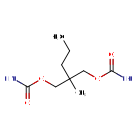
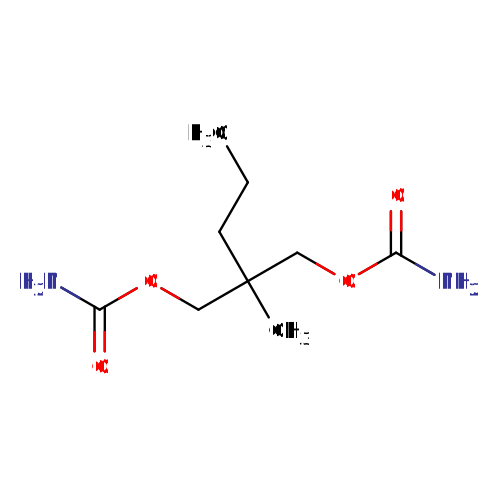
Structure for Meprobamate (DB00371)
- Weight
- Average: 218.2502
Monoisotopic: 218.126657074 - Chemical Formula
- C9H18N2O4
- Synonyms
- Meprobamat
- Meprobamate
- Meprobamato
- Meprobamatum
- Meprobamic acid
- External IDs
- DEA No. 2820

Pharmacology
- Indication
For the management of anxiety disorders or for the short-term relief of the symptoms of anxiety.
 Reduce drug development failure ratesBuild, train, & validate machine-learning modelswith evidence-based and structured datasets.Build, train, & validate predictive machine-learning models with structured datasets.
- Associated Conditions
Indication Type Indication Combined Product Details Approval Level Age Group Patient Characteristics Dose Form Management of Anxiety disorders •••••••••••• Used as adjunct in combination to manage Pain Combination Product in combination with: Acetylsalicylic acid (DB00945) •••••••••••• •••••• - Contraindications & Blackbox Warnings
 Prevent Adverse Drug Events TodayTap into our Clinical API for life-saving information on contraindications & blackbox warnings, population restrictions, harmful risks, & more.Avoid life-threatening adverse drug events with our Clinical API
- Pharmacodynamics
Meprobamate is an anxiolytic drug. It was the best selling minor tranquilizer for a time but has largely been replaced by benzodiazepines. Meprobamate has most of the pharmacological effects and dangers of the barbiturates (though it was marketed as being safer) but it is less sedating at effective doses. Meprobamate exhibits some anticonvulsant effects in absence seizures; however, it is reported to potentially exacerbate generalized tonic-clonic seizures. It has also been used as a hypnotic (sleeping pill). However, its is currently only licensed as an anxiolytic and it is a third or fourth-order choice.
- Mechanism of action
Meprobamate's mechanism of action is not fully understood; in animal studies, meprobamate is reported to act at multiple sites in the central nervous system, such as the thalamus and limbic system. It binds to the GABAA receptors, leading to inhibitory effects on the neurons transmitting signals in the reticular formation and spinal cord. Consequently, effects such as sedation and altered perception of pain are observed.
Target Actions Organism AGABA(A) Receptor positive allosteric modulatorHumans AGamma-aminobutyric acid receptor subunit alpha-1 agonistHumans AGamma-aminobutyric acid receptor subunit alpha-2 agonistHumans AGamma-aminobutyric acid receptor subunit alpha-3 agonistHumans AGamma-aminobutyric acid receptor subunit alpha-4 agonistHumans AGamma-aminobutyric acid receptor subunit alpha-5 agonistHumans AGamma-aminobutyric acid receptor subunit alpha-6 agonistHumans - Absorption
Well absorbed from the gastrointestinal tract.
- Volume of distribution
Not Available
- Protein binding
Not Available
- Metabolism
Meprobamate undergoes hepatic metabolism.
- Route of elimination
Not Available
- Half-life
Plasma half-life is about 10 hours.
- Clearance
Not Available
- Adverse Effects
 Improve decision support & research outcomesWith structured adverse effects data, including: blackbox warnings, adverse reactions, warning & precautions, & incidence rates. View sample adverse effects data in our new Data Library!Improve decision support & research outcomes with our structured adverse effects data.
- Toxicity
Symptoms of overdose include coma, drowsiness, loss of muscle control, severely impaired breathing, shock, sluggishness, and unresponsiveness. There have been a case of death resulting from oral ingestion of 12 g of meprobamate. One case study reports the consumption of 40 g of meprobamate resulting in successful survival.
- Pathways
Pathway Category Capecitabine Action Pathway Drug action Capecitabine Metabolism Pathway Drug metabolism - Pharmacogenomic Effects/ADRs
- Not Available
Interactions
- Drug Interactions
- This information should not be interpreted without the help of a healthcare provider. If you believe you are experiencing an interaction, contact a healthcare provider immediately. The absence of an interaction does not necessarily mean no interactions exist.
Drug Interaction Integrate drug-drug
interactions in your software1,2-Benzodiazepine The risk or severity of CNS depression can be increased when Meprobamate is combined with 1,2-Benzodiazepine. Acetazolamide The risk or severity of CNS depression can be increased when Meprobamate is combined with Acetazolamide. Acetophenazine The risk or severity of CNS depression can be increased when Meprobamate is combined with Acetophenazine. Agomelatine The risk or severity of CNS depression can be increased when Meprobamate is combined with Agomelatine. Alfentanil The risk or severity of CNS depression can be increased when Meprobamate is combined with Alfentanil. - Food Interactions
- Avoid alcohol.
- Take with or without food. Food does not significantly affect absorption.
Products
 Drug product information from 10+ global regionsOur datasets provide approved product information including:dosage, form, labeller, route of administration, and marketing period.Access drug product information from over 10 global regions.
- International/Other Brands
- Equanil (Wyeth) / Meprospan / Miltown (Wallace Laboratories)
- Brand Name Prescription Products
Name Dosage Strength Route Labeller Marketing Start Marketing End Region Image Equanil Tablets 400mg Tablet 400 mg / tab Oral Wyeth Ayerst Canada Inc. 1994-12-31 2000-03-07 Canada 
Meditran 400mg Tablet 400 mg Oral Medic Laboratory LtÉe 1959-12-31 1996-09-09 Canada Meprobamate Tab 400mg Tablet 400 mg / tab Oral Pro Doc Limitee 1959-12-31 2001-10-15 Canada Meprobamate Tab 400mg Tablet 400 mg / tab Oral Duchesnay Inc. 1978-12-31 2001-10-15 Canada - Generic Prescription Products
Name Dosage Strength Route Labeller Marketing Start Marketing End Region Image Apo Meprobamate Tab 400mg Tablet 400 mg / tab Oral Apotex Corporation 1975-12-31 2001-10-09 Canada Meprobamate Tablet 200 mg/1 Oral Heritage 2009-05-01 2018-01-10 US 
Meprobamate Tablet 400 mg/1 Oral Dr Reddy's Laboratories 2008-01-03 Not applicable US Meprobamate Tablet 200 mg/1 Oral Cipla USA Inc. 2021-06-07 Not applicable US Meprobamate Tablet 200 mg/1 Oral Avera McKennan Hospital 2015-11-03 2017-05-24 US - Mixture Products
Name Ingredients Dosage Route Labeller Marketing Start Marketing End Region Image 282 Mep Tab Meprobamate (200 mg) + Acetylsalicylic acid (350 mg) + Caffeine citrate (30 mg) + Codeine phosphate (15 mg) Tablet Oral Merck Frosst Canada & Cie, Merck Frosst Canada & Co. 1959-12-31 1998-08-14 Canada Equagesic Meprobamate (200 mg/1) + Acetylsalicylic acid (325 mg/1) Tablet Oral Mikart, Inc. 2008-01-15 Not applicable US Equagesic Tablets Meprobamate (200 mg / tab) + Acetylsalicylic acid (250 mg / tab) + Ethoheptazine citrate (75 mg / tab) Tablet Oral Wyeth Ayerst Canada Inc. 1995-12-31 1997-01-14 Canada
Categories
- ATC Codes
- N05BC51 — Meprobamate, combinationsN05CX01 — Meprobamate, combinations
- N05CX — Hypnotics and sedatives in combination, excl. barbiturates
- N05C — HYPNOTICS AND SEDATIVES
- N05 — PSYCHOLEPTICS
- N — NERVOUS SYSTEM
- Drug Categories
- Chemical TaxonomyProvided by Classyfire
- Description
- This compound belongs to the class of organic compounds known as carbamate esters. These are compounds containing an ester of carbamic acid with the general structure R2NC(=O)OR' (R' not H). They are esters of carbamic acids.
- Kingdom
- Organic compounds
- Super Class
- Organic acids and derivatives
- Class
- Carboxylic acids and derivatives
- Sub Class
- Amino acids, peptides, and analogues
- Direct Parent
- Carbamate esters
- Alternative Parents
- Organic carbonic acids and derivatives / Organopnictogen compounds / Organonitrogen compounds / Organic oxides / Hydrocarbon derivatives / Carbonyl compounds
- Substituents
- Aliphatic acyclic compound / Carbamic acid ester / Carbonic acid derivative / Carbonyl group / Hydrocarbon derivative / Organic nitrogen compound / Organic oxide / Organic oxygen compound / Organonitrogen compound / Organooxygen compound
- Molecular Framework
- Aliphatic acyclic compounds
- External Descriptors
- Not Available
- Affected organisms
- Humans and other mammals
Chemical Identifiers
- UNII
- 9I7LNY769Q
- CAS number
- 57-53-4
- InChI Key
- NPPQSCRMBWNHMW-UHFFFAOYSA-N
- InChI
- InChI=1S/C9H18N2O4/c1-3-4-9(2,5-14-7(10)12)6-15-8(11)13/h3-6H2,1-2H3,(H2,10,12)(H2,11,13)
- IUPAC Name
- 2-[(carbamoyloxy)methyl]-2-methylpentyl carbamate
- SMILES
- CCCC(C)(COC(N)=O)COC(N)=O
References
- General References
- Not Available
- External Links
- Human Metabolome Database
- HMDB0014515
- KEGG Drug
- D00376
- PubChem Compound
- 4064
- PubChem Substance
- 46508142
- ChemSpider
- 3924
- 6760
- ChEBI
- 6761
- ChEMBL
- CHEMBL979
- ZINC
- ZINC000001530701
- Therapeutic Targets Database
- DAP001507
- PharmGKB
- PA450377
- RxList
- RxList Drug Page
- Drugs.com
- Drugs.com Drug Page
- PDRhealth
- PDRhealth Drug Page
- Wikipedia
- Meprobamate
- MSDS
- Download (52.6 KB)
Clinical Trials
Pharmacoeconomics
- Manufacturers
- Glaxosmithkline llc
- Medpointe pharmaceuticals medpointe healthcare inc
- Wyeth ayerst laboratories
- Ferndale laboratories inc
- Alra laboratories inc
- Teva pharmaceuticals usa inc
- Alembic ltd
- Barr laboratories inc
- Elkins sinn div ah robins co inc
- Heather drug co inc
- Impax laboratories inc
- Invagen pharmaceuticals inc
- Ivax pharmaceuticals inc sub teva pharmaceuticals usa
- Ivc industries inc dba inverness medical nutritionals group
- Lannett co inc
- Lederle laboratories div american cyanamid co
- Km lee laboratories inc
- Mallard inc
- Mk laboratories inc
- Mutual pharmaceutical co inc
- Mylan pharmaceuticals inc
- Nexgen pharma inc
- Parke davis div warner lambert co
- L perrigo co
- Pharmavite pharmaceuticals
- Purepac pharmaceutical co
- Private formulations inc
- Roxane laboratories inc
- Sandoz inc
- Scherer laboratories inc
- Solvay pharmaceuticals
- Stanlabs pharmaceutical co sub simpak corp
- Tablicaps inc
- Usl pharma inc
- Valeant pharmaceuticals international
- Vangard laboratories inc div midway medical co
- Watson laboratories inc
- West ward pharmaceutical corp
- Whiteworth towne paulsen inc
- Halsey drug co inc
- Packagers
- C.O. Truxton Inc.
- Calvin Scott and Co. Inc.
- Dispensing Solutions
- Doctor Reddys Laboratories Ltd.
- GlaxoSmithKline Inc.
- Group Health Cooperative
- Heritage Pharmaceuticals
- InvaGen Pharmaceuticals Inc.
- Major Pharmaceuticals
- Mikart Inc.
- Nexgen Pharma Inc.
- PD-Rx Pharmaceuticals Inc.
- Prescript Pharmaceuticals
- Qualitest
- United Research Laboratories Inc.
- Watson Pharmaceuticals
- Dosage Forms
Form Route Strength Tablet Oral Tablet Oral 400 mg / tab Tablet Oral 400 mg Tablet Oral 200 mg/1 Tablet Oral 400 mg/1 Tablet Oral 200 mg - Prices
Unit description Cost Unit Mepron 750 mg/5ml Suspension 5.41USD ml Mepron 750 mg/5 ml suspension 4.95USD ml Meprobamate 200 mg tablet 1.42USD tablet Meprobamate 400 mg tablet 0.84USD tablet Meprozine 50-25 mg capsule 0.78USD capsule DrugBank does not sell nor buy drugs. Pricing information is supplied for informational purposes only.- Patents
Patent Number Pediatric Extension Approved Expires (estimated) Region US6649659 Yes 2003-11-18 2017-01-10 US US4981874 No 1991-01-01 2009-08-15 US CA2152615 No 2001-10-16 2013-12-23 Canada CA1336266 No 1995-07-11 2012-07-11 Canada
Properties
- State
- Solid
- Experimental Properties
Property Value Source melting point (°C) 105 °C PhysProp water solubility 4700 mg/L (at 25 °C) YALKOWSKY,SH & DANNENFELSER,RM (1992) logP 0.70 HANSCH,C ET AL. (1995) logS -1.67 ADME Research, USCD - Predicted Properties
Property Value Source Water Solubility 2.47 mg/mL ALOGPS logP 1.06 ALOGPS logP 0.93 Chemaxon logS -2 ALOGPS pKa (Strongest Acidic) 15.17 Chemaxon Physiological Charge 0 Chemaxon Hydrogen Acceptor Count 2 Chemaxon Hydrogen Donor Count 2 Chemaxon Polar Surface Area 104.64 Å2 Chemaxon Rotatable Bond Count 8 Chemaxon Refractivity 53.04 m3·mol-1 Chemaxon Polarizability 22.65 Å3 Chemaxon Number of Rings 0 Chemaxon Bioavailability 1 Chemaxon Rule of Five Yes Chemaxon Ghose Filter Yes Chemaxon Veber's Rule No Chemaxon MDDR-like Rule No Chemaxon - Predicted ADMET Features
Property Value Probability Human Intestinal Absorption + 0.9534 Blood Brain Barrier + 0.9864 Caco-2 permeable - 0.5731 P-glycoprotein substrate Non-substrate 0.5282 P-glycoprotein inhibitor I Non-inhibitor 0.8781 P-glycoprotein inhibitor II Non-inhibitor 0.9033 Renal organic cation transporter Non-inhibitor 0.945 CYP450 2C9 substrate Non-substrate 0.9108 CYP450 2D6 substrate Non-substrate 0.8961 CYP450 3A4 substrate Non-substrate 0.7032 CYP450 1A2 substrate Non-inhibitor 0.8381 CYP450 2C9 inhibitor Non-inhibitor 0.8799 CYP450 2D6 inhibitor Non-inhibitor 0.8764 CYP450 2C19 inhibitor Non-inhibitor 0.8754 CYP450 3A4 inhibitor Non-inhibitor 0.8735 CYP450 inhibitory promiscuity Low CYP Inhibitory Promiscuity 0.8914 Ames test Non AMES toxic 0.8706 Carcinogenicity Non-carcinogens 0.7304 Biodegradation Not ready biodegradable 0.965 Rat acute toxicity 2.4075 LD50, mol/kg Not applicable hERG inhibition (predictor I) Weak inhibitor 0.9943 hERG inhibition (predictor II) Non-inhibitor 0.9322
Spectra
- Mass Spec (NIST)
- Download (10.1 KB)
- Spectra
- Chromatographic Properties
Collision Cross Sections (CCS)
Adduct CCS Value (Å2) Source type Source [M-H]- 153.604831 predictedDarkChem Lite v0.1.0 [M-H]- 153.565731 predictedDarkChem Lite v0.1.0 [M-H]- 152.3863 predictedDeepCCS 1.0 (2019) [M+H]+ 154.885831 predictedDarkChem Lite v0.1.0 [M+H]+ 154.057831 predictedDarkChem Lite v0.1.0 [M+H]+ 155.60036 predictedDeepCCS 1.0 (2019) [M+Na]+ 153.132431 predictedDarkChem Lite v0.1.0 [M+Na]+ 153.151631 predictedDarkChem Lite v0.1.0 [M+Na]+ 164.41544 predictedDeepCCS 1.0 (2019)
Targets

- Kind
- Protein group
- Organism
- Humans
- Pharmacological action
- Yes
- Actions
- Positive allosteric modulator
- General Function
- Inhibitory extracellular ligand-gated ion channel activity
- Specific Function
- Component of the heteropentameric receptor for GABA, the major inhibitory neurotransmitter in the vertebrate brain. Functions also as histamine receptor and mediates cellular responses to histamine...
Components:
References
- ChEMBL Compound Report Card [Link]
- Kind
- Protein
- Organism
- Humans
- Pharmacological action
- Yes
- Actions
- Agonist
- General Function
- Inhibitory extracellular ligand-gated ion channel activity
- Specific Function
- Component of the heteropentameric receptor for GABA, the major inhibitory neurotransmitter in the vertebrate brain. Functions also as histamine receptor and mediates cellular responses to histamine...
- Gene Name
- GABRA1
- Uniprot ID
- P14867
- Uniprot Name
- Gamma-aminobutyric acid receptor subunit alpha-1
- Molecular Weight
- 51801.395 Da
References
- Rho JM, Donevan SD, Rogawski MA: Barbiturate-like actions of the propanediol dicarbamates felbamate and meprobamate. J Pharmacol Exp Ther. 1997 Mar;280(3):1383-91. [Article]
- Gonzalez LA, Gatch MB, Taylor CM, Bell-Horner CL, Forster MJ, Dillon GH: Carisoprodol-mediated modulation of GABAA receptors: in vitro and in vivo studies. J Pharmacol Exp Ther. 2009 May;329(2):827-37. doi: 10.1124/jpet.109.151142. Epub 2009 Feb 24. [Article]
- Chen X, Ji ZL, Chen YZ: TTD: Therapeutic Target Database. Nucleic Acids Res. 2002 Jan 1;30(1):412-5. [Article]
- Kind
- Protein
- Organism
- Humans
- Pharmacological action
- Yes
- Actions
- Agonist
- General Function
- Inhibitory extracellular ligand-gated ion channel activity
- Specific Function
- GABA, the major inhibitory neurotransmitter in the vertebrate brain, mediates neuronal inhibition by binding to the GABA/benzodiazepine receptor and opening an integral chloride channel.
- Gene Name
- GABRA2
- Uniprot ID
- P47869
- Uniprot Name
- Gamma-aminobutyric acid receptor subunit alpha-2
- Molecular Weight
- 51325.85 Da
References
- Rho JM, Donevan SD, Rogawski MA: Barbiturate-like actions of the propanediol dicarbamates felbamate and meprobamate. J Pharmacol Exp Ther. 1997 Mar;280(3):1383-91. [Article]
- Gonzalez LA, Gatch MB, Taylor CM, Bell-Horner CL, Forster MJ, Dillon GH: Carisoprodol-mediated modulation of GABAA receptors: in vitro and in vivo studies. J Pharmacol Exp Ther. 2009 May;329(2):827-37. doi: 10.1124/jpet.109.151142. Epub 2009 Feb 24. [Article]
- Kind
- Protein
- Organism
- Humans
- Pharmacological action
- Yes
- Actions
- Agonist
- General Function
- Inhibitory extracellular ligand-gated ion channel activity
- Specific Function
- GABA, the major inhibitory neurotransmitter in the vertebrate brain, mediates neuronal inhibition by binding to the GABA/benzodiazepine receptor and opening an integral chloride channel.
- Gene Name
- GABRA3
- Uniprot ID
- P34903
- Uniprot Name
- Gamma-aminobutyric acid receptor subunit alpha-3
- Molecular Weight
- 55164.055 Da
References
- Rho JM, Donevan SD, Rogawski MA: Barbiturate-like actions of the propanediol dicarbamates felbamate and meprobamate. J Pharmacol Exp Ther. 1997 Mar;280(3):1383-91. [Article]
- Gonzalez LA, Gatch MB, Taylor CM, Bell-Horner CL, Forster MJ, Dillon GH: Carisoprodol-mediated modulation of GABAA receptors: in vitro and in vivo studies. J Pharmacol Exp Ther. 2009 May;329(2):827-37. doi: 10.1124/jpet.109.151142. Epub 2009 Feb 24. [Article]
- Kind
- Protein
- Organism
- Humans
- Pharmacological action
- Yes
- Actions
- Agonist
- General Function
- Inhibitory extracellular ligand-gated ion channel activity
- Specific Function
- GABA, the major inhibitory neurotransmitter in the vertebrate brain, mediates neuronal inhibition by binding to the GABA/benzodiazepine receptor and opening an integral chloride channel.
- Gene Name
- GABRA4
- Uniprot ID
- P48169
- Uniprot Name
- Gamma-aminobutyric acid receptor subunit alpha-4
- Molecular Weight
- 61622.645 Da
References
- Rho JM, Donevan SD, Rogawski MA: Barbiturate-like actions of the propanediol dicarbamates felbamate and meprobamate. J Pharmacol Exp Ther. 1997 Mar;280(3):1383-91. [Article]
- Gonzalez LA, Gatch MB, Taylor CM, Bell-Horner CL, Forster MJ, Dillon GH: Carisoprodol-mediated modulation of GABAA receptors: in vitro and in vivo studies. J Pharmacol Exp Ther. 2009 May;329(2):827-37. doi: 10.1124/jpet.109.151142. Epub 2009 Feb 24. [Article]
- Kind
- Protein
- Organism
- Humans
- Pharmacological action
- Yes
- Actions
- Agonist
- General Function
- Transporter activity
- Specific Function
- GABA, the major inhibitory neurotransmitter in the vertebrate brain, mediates neuronal inhibition by binding to the GABA/benzodiazepine receptor and opening an integral chloride channel.
- Gene Name
- GABRA5
- Uniprot ID
- P31644
- Uniprot Name
- Gamma-aminobutyric acid receptor subunit alpha-5
- Molecular Weight
- 52145.645 Da
References
- Rho JM, Donevan SD, Rogawski MA: Barbiturate-like actions of the propanediol dicarbamates felbamate and meprobamate. J Pharmacol Exp Ther. 1997 Mar;280(3):1383-91. [Article]
- Gonzalez LA, Gatch MB, Taylor CM, Bell-Horner CL, Forster MJ, Dillon GH: Carisoprodol-mediated modulation of GABAA receptors: in vitro and in vivo studies. J Pharmacol Exp Ther. 2009 May;329(2):827-37. doi: 10.1124/jpet.109.151142. Epub 2009 Feb 24. [Article]
- Kind
- Protein
- Organism
- Humans
- Pharmacological action
- Yes
- Actions
- Agonist
- General Function
- Inhibitory extracellular ligand-gated ion channel activity
- Specific Function
- GABA, the major inhibitory neurotransmitter in the vertebrate brain, mediates neuronal inhibition by binding to the GABA/benzodiazepine receptor and opening an integral chloride channel.
- Gene Name
- GABRA6
- Uniprot ID
- Q16445
- Uniprot Name
- Gamma-aminobutyric acid receptor subunit alpha-6
- Molecular Weight
- 51023.69 Da
References
- Rho JM, Donevan SD, Rogawski MA: Barbiturate-like actions of the propanediol dicarbamates felbamate and meprobamate. J Pharmacol Exp Ther. 1997 Mar;280(3):1383-91. [Article]
- Gonzalez LA, Gatch MB, Taylor CM, Bell-Horner CL, Forster MJ, Dillon GH: Carisoprodol-mediated modulation of GABAA receptors: in vitro and in vivo studies. J Pharmacol Exp Ther. 2009 May;329(2):827-37. doi: 10.1124/jpet.109.151142. Epub 2009 Feb 24. [Article]


Drug created at June 13, 2005 13:24 / Updated at March 03, 2024 02:24