Identification
- Summary
Chlordiazepoxide is a benzodiazepine used to treat the withdrawal symptoms of acute alcoholism, to treat preoperative anxiety, and to treat anxiety over a short term period.
- Brand Names
- Chlorax, Librax
- Generic Name
- Chlordiazepoxide
- DrugBank Accession Number
- DB00475
- Background
An anxiolytic benzodiazepine derivative with anticonvulsant, sedative, and amnesic properties. It has also been used in the symptomatic treatment of alcohol withdrawal.
- Type
- Small Molecule
- Groups
- Approved, Illicit, Investigational
- Structure
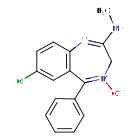
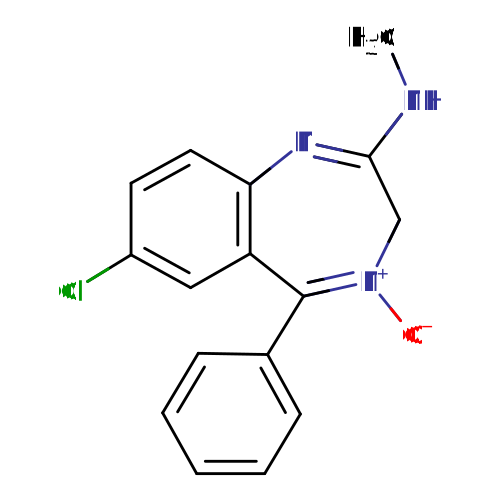
Structure for Chlordiazepoxide (DB00475)
- Weight
- Average: 299.755
Monoisotopic: 299.082539792 - Chemical Formula
- C16H14ClN3O
- Synonyms
- 7-chloro-2-methylamino-5-phenyl-3H-1,4-benzodiazepin-4-oxide
- CDP
- Chloradiazepoxide
- Chlordiazepoxide
- Chlordiazepoxidum
- Clopoxide
- Clordiazepóxido
- Methaminodiazepoxide

Pharmacology
- Indication
Chlordiazepoxide is indicated for the management of anxiety disorders or for the short-term relief of symptoms of anxiety, withdrawal symptoms of acute alcoholism, and preoperative apprehension and anxiety.8
In combination with amitriptyline, chlordiazepoxide is indicated for the treatment of moderate to severe depression.7 In combination with clidinium, chlordiazepoxide is indicated to control emotional and somatic factors in gastrointestinal disorders, and is used as adjunctive therapy in the treatment of peptic ulcer, irritable bowel syndrome and acute enterocolitis.6
 Reduce drug development failure ratesBuild, train, & validate machine-learning modelswith evidence-based and structured datasets.Build, train, & validate predictive machine-learning models with structured datasets.
- Associated Conditions
Indication Type Indication Combined Product Details Approval Level Age Group Patient Characteristics Dose Form Management of Alcohol withdrawal syndrome •••••••••••• Management of Anxiety disorders •••••••••••• Used in combination to manage Depression Combination Product in combination with: Amitriptyline (DB00321) •••••••••••• •••••••• •• •••••• •••••••• Used as adjunct in combination to manage Irritable bowel syndrome (ibs) Combination Product in combination with: Clidinium (DB00771) •••••••••••• Used as adjunct in combination to manage Peptic ulcer disease Combination Product in combination with: Clidinium (DB00771) •••••••••••• - Contraindications & Blackbox Warnings
 Prevent Adverse Drug Events TodayTap into our Clinical API for life-saving information on contraindications & blackbox warnings, population restrictions, harmful risks, & more.Avoid life-threatening adverse drug events with our Clinical API
- Pharmacodynamics
Chlordiazepoxide has antianxiety, sedative, appetite-stimulating and weak analgesic actions. The drug seems to block EEG arousal from stimulation in the brain stem reticular formation. The drug has been studied extensively in many species of animals and these studies are suggestive of action on the limbic system of the brain, which recent evidence indicates is involved in emotional responses. Hostile monkeys were made tame by oral drug doses which did not cause sedation. Chlordiazepoxide revealed a "taming" action with the elimination of fear and aggression. The taming effect of chlordiazepoxide was further demonstrated in rats made vicious by lesions in the septal area of the brain. The drug dosage which effectively blocked the vicious reaction was well below the dose which caused sedation in these animals.
- Mechanism of action
Chlordiazepoxide binds to stereospecific benzodiazepine (BZD) binding sites on GABA (A) receptor complexes at several sites within the central nervous system, including the limbic system and reticular formation. This results in an increased binding of the inhibitory neurotransmitter GABA to the GABA(A) receptor. BZDs, therefore, enhance GABA-mediated chloride influx through GABA receptor channels, causing membrane hyperpolarization. The net neuro-inhibitory effects result in the observed sedative, hypnotic, anxiolytic, and muscle relaxant properties.
Target Actions Organism AGABA(A) Receptor positive allosteric modulatorHumans AGABA(A) Receptor Benzodiazepine Binding Site ligandHumans - Absorption
Not Available
- Volume of distribution
Not Available
- Protein binding
Not Available
- Metabolism
Hepatic.
- Route of elimination
Chlordiazepoxide is excreted in the urine, with 1% to 2% unchanged and 3% to 6% as conjugate.
- Half-life
24-48 hours
- Clearance
Not Available
- Adverse Effects
 Improve decision support & research outcomesWith structured adverse effects data, including: blackbox warnings, adverse reactions, warning & precautions, & incidence rates. View sample adverse effects data in our new Data Library!Improve decision support & research outcomes with our structured adverse effects data.
- Toxicity
LD50=537 mg/kg (Orally in rats). Signs of overdose include respiratory depression, muscle weakness, somnolence (general depressed activity).
- Pathways
- Not Available
- Pharmacogenomic Effects/ADRs
- Not Available
Interactions
- Drug Interactions
- This information should not be interpreted without the help of a healthcare provider. If you believe you are experiencing an interaction, contact a healthcare provider immediately. The absence of an interaction does not necessarily mean no interactions exist.
Drug Interaction Integrate drug-drug
interactions in your software1,2-Benzodiazepine The risk or severity of CNS depression can be increased when Chlordiazepoxide is combined with 1,2-Benzodiazepine. Acetazolamide The risk or severity of CNS depression can be increased when Chlordiazepoxide is combined with Acetazolamide. Acetophenazine The risk or severity of CNS depression can be increased when Chlordiazepoxide is combined with Acetophenazine. Agomelatine The risk or severity of CNS depression can be increased when Chlordiazepoxide is combined with Agomelatine. Alfentanil The risk or severity of adverse effects can be increased when Alfentanil is combined with Chlordiazepoxide. - Food Interactions
- Avoid alcohol.
- Take with or without food. The absorption is unaffected by food.
Products
 Drug product information from 10+ global regionsOur datasets provide approved product information including:dosage, form, labeller, route of administration, and marketing period.Access drug product information from over 10 global regions.
- Product Ingredients
Ingredient UNII CAS InChI Key Chlordiazepoxide hydrochloride MFM6K1XWDK 438-41-5 DMLFJMQTNDSRFU-UHFFFAOYSA-N - Product Images
- International/Other Brands
- Angirex / Elenium (Polfa Tarchomin) / Helogaphen / Klopoxid (Nycomed) / Libritabs / Multum / Napoton / Radepur (AWD) / Risolid (Actavis) / Silibrin / Sonimen / Tropium
- Brand Name Prescription Products
Name Dosage Strength Route Labeller Marketing Start Marketing End Region Image Chlordiazepoxide Capsule 10 mg Oral Aa Pharma Inc 1981-12-31 Not applicable Canada 
Chlordiazepoxide Capsule 5 mg Oral Aa Pharma Inc 1981-12-31 Not applicable Canada Chlordiazepoxide Capsule 25 mg Oral Aa Pharma Inc 1981-12-31 Not applicable Canada Chlordiazepoxide Cap 10mg Capsule 10 mg / cap Oral Pro Doc Limitee 1969-12-31 2010-07-13 Canada Chlordiazepoxide Cap 5mg Capsule 5 mg / cap Oral Pro Doc Limitee 1976-12-31 2009-07-23 Canada - Generic Prescription Products
Name Dosage Strength Route Labeller Marketing Start Marketing End Region Image Chlordiazepoxide Capsule, gelatin coated 25 mg/1 Oral Direct Rx 2016-03-04 Not applicable US 
Chlordiazepoxide Capsule 25 mg/1 Oral Direct Rx 2016-03-04 2016-03-28 US Chlordiazepoxide Hydrochloride Capsule 25 mg/1 Oral Clinical Solutions Wholesale, LLC 2018-12-12 Not applicable US Chlordiazepoxide Hydrochloride Capsule 5 mg/1 Oral REMEDYREPACK INC. 2008-08-29 2017-12-15 US Chlordiazepoxide Hydrochloride Capsule 5 mg/1 Oral Physicians Total Care, Inc. 1993-01-01 Not applicable US 
- Mixture Products
Name Ingredients Dosage Route Labeller Marketing Start Marketing End Region Image AA PHARMA CHLORAX CAPSULE Chlordiazepoxide hydrochloride (5 mg) + Clidinium Bromide (2.5 mg) Capsule Oral PHARMAFORTE SINGAPORE PTE LTD 1989-07-06 Not applicable Singapore 
CHLOBAX TABLET Chlordiazepoxide (5 mg) + Clidinium Bromide (2.5 mg) Tablet, sugar coated Oral BEACONS PHARMACEUTICALS PTE. LTD. 1996-04-19 Not applicable Singapore Chlorax Chlordiazepoxide hydrochloride (5 mg) + Clidinium Bromide (2.5 mg) Capsule Oral Aa Pharma Inc 1984-12-31 Not applicable Canada Chlordiazepoxide and Amitriptyline HCl Chlordiazepoxide (5 mg/1) + Amitriptyline hydrochloride (12.5 mg/1) Tablet Oral Par Pharmaceutical 1988-05-09 1999-07-16 US Chlordiazepoxide and Amitriptyline HCl Chlordiazepoxide (10 mg/1) + Amitriptyline hydrochloride (25 mg/1) Tablet Oral Par Pharmaceutical 1988-05-09 1999-07-16 US - Unapproved/Other Products
Name Ingredients Dosage Route Labeller Marketing Start Marketing End Region Image Chlordiazepoxide Clidinium Chlordiazepoxide hydrochloride (5 mg/1) + Clidinium Bromide (2.5 mg/1) Capsule Oral River's Edge Pharmaceuticals, LLC 2009-06-02 2012-03-31 US Chlordiazepoxide Hydrochloride Chlordiazepoxide hydrochloride (10 mg/1) Capsule Oral Remedy Repack 2011-08-04 2011-12-28 US 
Chlordiazepoxide Hydrochloride and Clidinium Bromide Chlordiazepoxide hydrochloride (5 mg/1) + Clidinium Bromide (2.5 mg/1) Capsule Oral Marlex Pharmaceuticals Inc 2016-07-01 Not applicable US Chlordiazepoxide Hydrochloride and Clidinium Bromide Chlordiazepoxide hydrochloride (5 mg/1) + Clidinium Bromide (2.5 mg/1) Capsule Oral Av Kare, Inc. 2013-01-03 2013-11-04 US Chlordiazepoxide Hydrochloride and Clidinium Bromide Chlordiazepoxide hydrochloride (5 mg/1) + Clidinium Bromide (2.5 mg/1) Capsule Oral Boca Pharmacal, Inc. 2009-11-19 2010-12-20 US 


Categories
- ATC Codes
- N05BA02 — Chlordiazepoxide
- Drug Categories
- Adjuvants, Anesthesia
- Anti-Anxiety Agents
- Benzazepines
- Benzodiazepines and benzodiazepine derivatives
- Central Nervous System Agents
- Central Nervous System Depressants
- Cytochrome P-450 CYP3A Substrates
- Cytochrome P-450 CYP3A4 Substrates
- Cytochrome P-450 CYP3A4 Substrates (strength unknown)
- Cytochrome P-450 Substrates
- Cytosine Nucleotides
- GABA Agents
- GABA Modulators
- Heterocyclic Compounds, Fused-Ring
- Hypnotics and Sedatives
- Nervous System
- Neurotransmitter Agents
- Nucleic Acids, Nucleotides, and Nucleosides
- Nucleotides
- Psycholeptics
- Psychotropic Drugs
- Pyrimidine Nucleotides
- Pyrimidines
- Ribonucleotides
- Tranquilizing Agents
- Chemical TaxonomyProvided by Classyfire
- Description
- This compound belongs to the class of organic compounds known as 1,4-benzodiazepines. These are organic compounds containing a benzene ring fused to a 1,4-azepine.
- Kingdom
- Organic compounds
- Super Class
- Organoheterocyclic compounds
- Class
- Benzodiazepines
- Sub Class
- 1,4-benzodiazepines
- Direct Parent
- 1,4-benzodiazepines
- Alternative Parents
- Imidolactams / Benzene and substituted derivatives / Aryl chlorides / Nitrones / Propargyl-type 1,3-dipolar organic compounds / Carboxamidines / Azacyclic compounds / Organopnictogen compounds / Organochlorides / Organic zwitterions show 2 more
- Substituents
- 1,4-benzodiazepine / Allyl-type 1,3-dipolar organic compound / Amidine / Aromatic heteropolycyclic compound / Aryl chloride / Aryl halide / Azacycle / Benzenoid / Carboxylic acid amidine / Hydrocarbon derivative show 13 more
- Molecular Framework
- Aromatic heteropolycyclic compounds
- External Descriptors
- organochlorine compound, secondary amino compound, N-oxide, benzodiazepine (CHEBI:3611)
- Affected organisms
- Humans and other mammals
Chemical Identifiers
- UNII
- 6RZ6XEZ3CR
- CAS number
- 58-25-3
- InChI Key
- ANTSCNMPPGJYLG-UHFFFAOYSA-N
- InChI
- InChI=1S/C16H14ClN3O/c1-18-15-10-20(21)16(11-5-3-2-4-6-11)13-9-12(17)7-8-14(13)19-15/h2-9H,10H2,1H3,(H,18,19)
- IUPAC Name
- 7-chloro-2-(methylamino)-5-phenyl-3H-1,4-benzodiazepin-4-ium-4-olate
- SMILES
- CNC1=NC2=C(C=C(Cl)C=C2)C(C2=CC=CC=C2)=[N+]([O-])C1
References
- Synthesis Reference
Sternbach, L.H.; US. Patent 2,893,992; July 7,1959; assigned to Hoffmann-LaRoche, Inc.
- General References
- Skerritt JH, Johnston GA: Enhancement of GABA binding by benzodiazepines and related anxiolytics. Eur J Pharmacol. 1983 May 6;89(3-4):193-8. [Article]
- Oishi R, Nishibori M, Itoh Y, Saeki K: Diazepam-induced decrease in histamine turnover in mouse brain. Eur J Pharmacol. 1986 May 27;124(3):337-42. [Article]
- Earley JV, Fryer RI, Ning RY: Quinazolines and 1,4-benzodiazepines. LXXXIX: Haptens useful in benzodiazepine immunoassay development. J Pharm Sci. 1979 Jul;68(7):845-50. [Article]
- Olive G, Dreux C: [Pharmacologic bases of use of benzodiazepines in pereinatal medicine]. Arch Fr Pediatr. 1977 Jan;34(1):74-89. [Article]
- Vozeh S: [Pharmacokinetic of benzodiazepines in old age]. Schweiz Med Wochenschr. 1981 Nov 21;111(47):1789-93. [Article]
- FDA Approved Drug Products: Librax (chlordiazepoxide hydrochloride and clidinium bromide) capsules for oral use [Link]
- FDA Approved Drug Products: LIMBITROL (chlordiazepoxide and amitriptyline HCI) double strength tablets [Link]
- DailyMed Label: Chlordiazepoxide hydrochloride Oral Capsules [Link]
- External Links
- Human Metabolome Database
- HMDB0014618
- KEGG Drug
- D00267
- PubChem Compound
- 2712
- PubChem Substance
- 46505044
- ChemSpider
- 10248513
- BindingDB
- 50007664
- 2356
- ChEBI
- 3611
- ChEMBL
- CHEMBL451
- ZINC
- ZINC000019632917
- Therapeutic Targets Database
- DAP000084
- PharmGKB
- PA448932
- RxList
- RxList Drug Page
- Drugs.com
- Drugs.com Drug Page
- PDRhealth
- PDRhealth Drug Page
- Wikipedia
- Chlordiazepoxide
- MSDS
- Download (74.9 KB)
Clinical Trials
- Clinical Trials
Phase Status Purpose Conditions Count 4 Completed Treatment Alcohol Withdrawal Syndrome 2 3 Completed Treatment Alcohol Dependency / Alcohol Withdrawal Syndrome 1 2, 3 Completed Treatment Major Depressive Disorder (MDD) 1 Not Available Unknown Status Treatment Chest Pain 1
Pharmacoeconomics
- Manufacturers
- Valeant pharmaceuticals international
- Abbott laboratories pharmaceutical products div
- Rachelle laboratories inc
- Ascot hosp pharmaceuticals inc div travenol laboratories inc
- Barr laboratories inc
- John j ferrante
- Halsey drug co inc
- Impax laboratories inc
- Ivax pharmaceuticals inc sub teva pharmaceuticals usa
- Lederle laboratories div american cyanamid co
- Mm mast and co
- Mylan pharmaceuticals inc
- Parke davis div warner lambert co
- Pioneer pharmaceuticals inc
- Purepac pharmaceutical co
- Roxane laboratories inc
- Sandoz inc
- Superpharm corp
- Teva pharmaceuticals usa inc
- Usl pharma inc
- Vangard laboratories inc div midway medical co
- Watson laboratories inc
- West ward pharmaceutical corp
- Alra laboratories inc
- Packagers
- A-S Medication Solutions LLC
- Barr Pharmaceuticals
- Cardinal Health
- Coupler Enterprises Inc.
- Direct Dispensing Inc.
- Dispensing Solutions
- Diversified Healthcare Services Inc.
- H and H Laboratories
- Heartland Repack Services LLC
- Innoviant Pharmacy Inc.
- Kaiser Foundation Hospital
- Legacy Pharmaceuticals Packaging LLC
- Liberty Pharmaceuticals
- Major Pharmaceuticals
- Merrell Pharmaceuticals Inc.
- Murfreesboro Pharmaceutical Nursing Supply
- Mylan
- Nucare Pharmaceuticals Inc.
- Palmetto Pharmaceuticals Inc.
- Par Pharmaceuticals
- Patheon Inc.
- PCA LLC
- PD-Rx Pharmaceuticals Inc.
- Pharmedix
- Physicians Total Care Inc.
- Prepackage Specialists
- Prepak Systems Inc.
- Qualitest
- Remedy Repack
- Sandhills Packaging Inc.
- Solco Healthcare US LLC
- Southwood Pharmaceuticals
- Stat Rx Usa
- UDL Laboratories
- Va Cmop Dallas
- Valeant Ltd.
- Dosage Forms
Form Route Strength Capsule Oral 10 mg Tablet, sugar coated Oral 5 mg Capsule Oral 25 mg Capsule Oral 5 mg Tablet Oral Tablet, film coated Oral Capsule Oral Capsule Oral 10 mg/1 Capsule Oral 25 mg/1 Capsule Oral 5 mg/1 Capsule, gelatin coated Oral Tablet Tablet, coated Oral Capsule Oral 10 mg / cap Capsule Oral 25 mg / cap Pill Tablet, sugar coated Oral 5 mg Tablet, film coated Pill Oral Tablet, coated Oral Tablet, sugar coated Oral Capsule, gelatin coated Oral 10 mg/1 Capsule, gelatin coated Oral 25 mg/1 Capsule, gelatin coated Oral 5 mg/1 Tablet, film coated Oral 25 MG Capsule Oral 5 mg / cap Capsule Oral Solution / drops - Prices
Unit description Cost Unit Librax 2.5-5 mg capsule 6.5USD capsule Librax capsule 5.78USD capsule Librium 25 mg capsule 2.14USD capsule Limbitrol DS 10-25 mg tablet 1.93USD tablet Librium 10 mg capsule 1.61USD capsule Librium 5 mg capsule 0.84USD capsule Chlordiazepoxide 25 mg capsule 0.72USD capsule ChlordiazePOXIDE HCl 25 mg capsule 0.32USD capsule ChlordiazePOXIDE HCl 10 mg capsule 0.31USD capsule ChlordiazePOXIDE HCl 5 mg capsule 0.31USD capsule Chlordiazepoxide 5 mg capsule 0.2USD capsule Apo-Chlordiazepoxide 25 mg Capsule 0.17USD capsule Chlordiazepoxide 10 mg capsule 0.14USD capsule Apo-Chlordiazepoxide 10 mg Capsule 0.11USD capsule Apo-Chlordiazepoxide 5 mg Capsule 0.07USD capsule DrugBank does not sell nor buy drugs. Pricing information is supplied for informational purposes only.- Patents
- Not Available
Properties
- State
- Solid
- Experimental Properties
Property Value Source melting point (°C) 236-236.5 Sternbach, L.H.; US. Patent 2,893,992; July 7,1959; assigned to Hoffmann-LaRoche, Inc. water solubility 2000 mg/L YALKOWSKY,SH & DANNENFELSER,RM (1992) logP 2.44 HANSCH,C ET AL. (1995) pKa 4.8 MERCK INDEX (1996) - Predicted Properties
Property Value Source Water Solubility 0.0199 mg/mL ALOGPS logP 2.01 ALOGPS logP 0.19 Chemaxon logS -4.2 ALOGPS pKa (Strongest Acidic) -2.7 Chemaxon pKa (Strongest Basic) 7.06 Chemaxon Physiological Charge 1 Chemaxon Hydrogen Acceptor Count 3 Chemaxon Hydrogen Donor Count 1 Chemaxon Polar Surface Area 50.46 Å2 Chemaxon Rotatable Bond Count 1 Chemaxon Refractivity 87.34 m3·mol-1 Chemaxon Polarizability 31.22 Å3 Chemaxon Number of Rings 3 Chemaxon Bioavailability 1 Chemaxon Rule of Five Yes Chemaxon Ghose Filter Yes Chemaxon Veber's Rule No Chemaxon MDDR-like Rule No Chemaxon - Predicted ADMET Features
Property Value Probability Human Intestinal Absorption + 1.0 Blood Brain Barrier + 0.9758 Caco-2 permeable + 0.5868 P-glycoprotein substrate Substrate 0.6705 P-glycoprotein inhibitor I Non-inhibitor 0.521 P-glycoprotein inhibitor II Non-inhibitor 0.7434 Renal organic cation transporter Non-inhibitor 0.5502 CYP450 2C9 substrate Non-substrate 0.6991 CYP450 2D6 substrate Non-substrate 0.9116 CYP450 3A4 substrate Substrate 0.7408 CYP450 1A2 substrate Inhibitor 0.7564 CYP450 2C9 inhibitor Non-inhibitor 0.6038 CYP450 2D6 inhibitor Non-inhibitor 0.7862 CYP450 2C19 inhibitor Non-inhibitor 0.5 CYP450 3A4 inhibitor Inhibitor 0.7067 CYP450 inhibitory promiscuity High CYP Inhibitory Promiscuity 0.6372 Ames test Non AMES toxic 0.593 Carcinogenicity Non-carcinogens 0.7108 Biodegradation Not ready biodegradable 1.0 Rat acute toxicity 2.8520 LD50, mol/kg Not applicable hERG inhibition (predictor I) Weak inhibitor 0.9198 hERG inhibition (predictor II) Non-inhibitor 0.8828
Spectra
- Mass Spec (NIST)
- Not Available
- Spectra
- Chromatographic Properties
Collision Cross Sections (CCS)
Adduct CCS Value (Å2) Source type Source [M-H]- 172.553974 predictedDarkChem Lite v0.1.0 [M-H]- 165.91515 predictedDeepCCS 1.0 (2019) [M+H]+ 173.028374 predictedDarkChem Lite v0.1.0 [M+H]+ 168.27315 predictedDeepCCS 1.0 (2019) [M+Na]+ 172.533774 predictedDarkChem Lite v0.1.0 [M+Na]+ 174.87038 predictedDeepCCS 1.0 (2019)
Targets

- Kind
- Protein group
- Organism
- Humans
- Pharmacological action
- Yes
- Actions
- Positive allosteric modulator
- Curator comments
- The GABA(A) receptor is pentameric (i.e. comprising 5 subunit proteins) and therefore has a multitude of potential isoforms. The above target is a collection of all possible GABA(A) subunits that may participate in the formation of the pentameric receptor and is not meant to imply direct a drug-protein interaction for each individual subunit.
- General Function
- Inhibitory extracellular ligand-gated ion channel activity
- Specific Function
- Component of the heteropentameric receptor for GABA, the major inhibitory neurotransmitter in the vertebrate brain. Functions also as histamine receptor and mediates cellular responses to histamine...
Components:
References
- Zhu S, Noviello CM, Teng J, Walsh RM Jr, Kim JJ, Hibbs RE: Structure of a human synaptic GABAA receptor. Nature. 2018 Jul;559(7712):67-72. doi: 10.1038/s41586-018-0255-3. Epub 2018 Jun 27. [Article]
- Sigel E, Steinmann ME: Structure, function, and modulation of GABA(A) receptors. J Biol Chem. 2012 Nov 23;287(48):40224-31. doi: 10.1074/jbc.R112.386664. Epub 2012 Oct 4. [Article]
- Kind
- Protein group
- Organism
- Humans
- Pharmacological action
- Yes
- Actions
- Ligand
- Curator comments
- Benzodiazepines modulate GABA(A) function by binding at the interface between alpha (α) and gamma (γ) subunits. Of the 6 α-subunits, only 4 (α-1, -2, -3, and -5) participate in the formation of this binding site. The above target is a collection of all α- and γ-subunits that are known to participate in the formation of the benzodiazepine binding site.
- General Function
- Inhibitory extracellular ligand-gated ion channel activity
- Specific Function
- Component of the heteropentameric receptor for GABA, the major inhibitory neurotransmitter in the vertebrate brain. Functions also as histamine receptor and mediates cellular responses to histamine...
Components:
References
- Sigel E, Steinmann ME: Structure, function, and modulation of GABA(A) receptors. J Biol Chem. 2012 Nov 23;287(48):40224-31. doi: 10.1074/jbc.R112.386664. Epub 2012 Oct 4. [Article]
- Zhu S, Noviello CM, Teng J, Walsh RM Jr, Kim JJ, Hibbs RE: Structure of a human synaptic GABAA receptor. Nature. 2018 Jul;559(7712):67-72. doi: 10.1038/s41586-018-0255-3. Epub 2018 Jun 27. [Article]
Enzymes
- Kind
- Protein
- Organism
- Humans
- Pharmacological action
- Unknown
- Actions
- Substrate
- General Function
- Vitamin d3 25-hydroxylase activity
- Specific Function
- Cytochromes P450 are a group of heme-thiolate monooxygenases. In liver microsomes, this enzyme is involved in an NADPH-dependent electron transport pathway. It performs a variety of oxidation react...
- Gene Name
- CYP3A4
- Uniprot ID
- P08684
- Uniprot Name
- Cytochrome P450 3A4
- Molecular Weight
- 57342.67 Da
References
- Stolbach A, Paziana K, Heverling H, Pham P: A Review of the Toxicity of HIV Medications II: Interactions with Drugs and Complementary and Alternative Medicine Products. J Med Toxicol. 2015 Sep;11(3):326-41. doi: 10.1007/s13181-015-0465-0. [Article]

Drug created at June 13, 2005 13:24 / Updated at April 27, 2024 09:44