Identification
- Summary
Foscarnet is an antiviral used to treat CMV, HIV, and HSV infections.
- Brand Names
- Foscavir
- Generic Name
- Foscarnet
- DrugBank Accession Number
- DB00529
- Background
An antiviral agent used in the treatment of cytomegalovirus retinitis. Foscarnet also shows activity against human herpes viruses and HIV.
- Type
- Small Molecule
- Groups
- Approved
- Structure
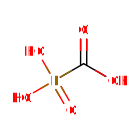
Structure for Foscarnet (DB00529)

- Weight
- Average: 126.0053
Monoisotopic: 125.971809718 - Chemical Formula
- CH3O5P
- Synonyms
- Carboxyphosphonic acid
- Foscarmet
- Phosphonoformate
- Phosphonoformic acid
- Phosphonomethanoic acid

Pharmacology
- Indication
For the treatment of CMV retinitis in patients with acquired immunodeficiency syndrome (AIDS) and for treatment of acyclovir-resistant mucocutaneous HSV infections in immunocompromised patients.
 Reduce drug development failure ratesBuild, train, & validate machine-learning modelswith evidence-based and structured datasets.Build, train, & validate predictive machine-learning models with structured datasets.
- Associated Conditions
Indication Type Indication Combined Product Details Approval Level Age Group Patient Characteristics Dose Form Used in combination to treat Cytomegalovirus retinitis Regimen in combination with: Ganciclovir (DB01004) •••••••••••• •••••••••• •••••••• •• ••••••••••• Treatment of Cytomegalovirus retinitis •••••••••••• Treatment of Herpes simplex infections •••••••••••• •••••••••••••••••• ••••••••• •••••••••• Management of Vericella-zoster infection ••• ••••• - Contraindications & Blackbox Warnings
 Prevent Adverse Drug Events TodayTap into our Clinical API for life-saving information on contraindications & blackbox warnings, population restrictions, harmful risks, & more.Avoid life-threatening adverse drug events with our Clinical API
- Pharmacodynamics
Foscarnet is an organic analogue of inorganic pyrophosphate that inhibits replication of herpes viruses in vitro including cytomegalovirus (CMV) and herpes simplex virus types 1 and 2 (HSV-1 and HSV-2). Foscarnet does not require activation (phosphorylation) by thymidine kinase or other kinases and therefore is active in vitro against HSV TK deficient mutants and CMV UL97 mutants. Thus, HSV strains resistant to acyclovir or CMV strains resistant to ganciclovir may be sensitive to foscarnet. However, acyclovir or ganciclovir resistant mutants with alterations in the viral DNA polymerase may be resistant to foscarnet and may not respond to therapy with foscarnet. The combination of foscarnet and ganciclovir has been shown to have enhanced activity in vitro.
- Mechanism of action
Foscarnet exerts its antiviral activity by a selective inhibition at the pyrophosphate binding site on virus-specific DNA polymerases at concentrations that do not affect cellular DNA polymerases.
Target Actions Organism ADNA polymerase catalytic subunit inhibitorHHV-1 ADNA polymerase catalytic subunit inhibitorHHV-5 - Absorption
Poorly absorbed after oral administration (bioavailability from 12 to 22%).
- Volume of distribution
Not Available
- Protein binding
14-17%
- Metabolism
Not metabolized.
- Route of elimination
Not Available
- Half-life
3.3-6.8 hours
- Clearance
- 2.13 +/- 0.71 mL/min/kg [patients had normal renal function (CrCl > 80 mL/min]
- 68 +/- 8 mL/min/kg [CrCl was 50-80 mL/min]
- 34 +/- 9 mL/min/kg [CrCl was 25-49 mL/min]
- 20 +/- 4 mL/min/kg [CrCl was 10 - 24 mL/min]
- Adverse Effects
 Improve decision support & research outcomesWith structured adverse effects data, including: blackbox warnings, adverse reactions, warning & precautions, & incidence rates. View sample adverse effects data in our new Data Library!Improve decision support & research outcomes with our structured adverse effects data.
- Toxicity
Oral, rat LD50: >2,000 mg/kg. Signs of overdose include renal impairment.
- Pathways
- Not Available
- Pharmacogenomic Effects/ADRs
- Not Available
Interactions
- Drug Interactions
- This information should not be interpreted without the help of a healthcare provider. If you believe you are experiencing an interaction, contact a healthcare provider immediately. The absence of an interaction does not necessarily mean no interactions exist.
Drug Interaction Integrate drug-drug
interactions in your softwareAbacavir Foscarnet may decrease the excretion rate of Abacavir which could result in a higher serum level. Aceclofenac The risk or severity of nephrotoxicity can be increased when Aceclofenac is combined with Foscarnet. Acemetacin The risk or severity of nephrotoxicity can be increased when Acemetacin is combined with Foscarnet. Acetaminophen Foscarnet may decrease the excretion rate of Acetaminophen which could result in a higher serum level. Acetylsalicylic acid The risk or severity of nephrotoxicity can be increased when Acetylsalicylic acid is combined with Foscarnet. - Food Interactions
- No interactions found.
Products
 Drug product information from 10+ global regionsOur datasets provide approved product information including:dosage, form, labeller, route of administration, and marketing period.Access drug product information from over 10 global regions.
- Product Ingredients
Ingredient UNII CAS InChI Key Foscarnet sodium 8C5OQ81LWT 63585-09-1 DFHAXXVZCFXGOQ-UHFFFAOYSA-K - International/Other Brands
- Triapten
- Brand Name Prescription Products
Name Dosage Strength Route Labeller Marketing Start Marketing End Region Image Foscavir Injection 24 mg/1mL Intravenous Astra Zeneca Lp 2007-10-31 Not applicable US 
Foscavir Injection, solution 24 mg/1mL Intravenous Clinigen Limited 2021-04-06 Not applicable US Foscavir UK Injection, solution 24 mg/1mL Intravenous Clinigen Healthcare Ltd. 2010-09-22 2015-01-01 US Vocarvi Solution 24 mg / mL Intravenous Sterimax Inc 2021-03-30 Not applicable Canada 
- Generic Prescription Products
Name Dosage Strength Route Labeller Marketing Start Marketing End Region Image Foscarnet Injection, solution 24 mg/1mL Intravenous Fresenius Kabi USA, LLC 2021-01-29 Not applicable US Foscarnet Sodium Injection, solution 24 mg/1mL Intravenous Hospira, Inc. 2006-01-26 2012-02-01 US Foscarnet Sodium Injection, solution 6000 mg/250mL Intravenous Baxter Healthcare Corporation 2023-08-28 Not applicable US Foscarnet Sodium Injection, solution 24 mg/1mL Intravenous Gland Pharma Limited 2021-04-21 Not applicable US Foscarnet Sodium Injection, solution 24 mg/1mL Intravenous Hikma Pharmaceuticals USA Inc. 2023-11-29 Not applicable US - Unapproved/Other Products
Name Ingredients Dosage Route Labeller Marketing Start Marketing End Region Image Foscavir UK Foscarnet sodium (24 mg/1mL) Injection, solution Intravenous Clinigen Healthcare Ltd. 2010-09-22 2015-01-01 US
Categories
- ATC Codes
- J05AD01 — Foscarnet
- Drug Categories
- Acetates
- Acids, Acyclic
- Anti-Infective Agents
- Anti-Retroviral Agents
- Antiinfectives for Systemic Use
- Antiviral Agents
- Antivirals for Systemic Use
- Chelating Activity
- Direct Acting Antivirals
- Enzyme Inhibitors
- Nephrotoxic agents
- Nucleic Acid Synthesis Inhibitors
- OAT1/SLC22A6 inhibitors
- Organophosphonates
- Organophosphorus Compounds
- Phosphonic Acid Derivatives
- Potential QTc-Prolonging Agents
- Pyrophosphate Analog DNA Polymerase Inhibitor
- QTc Prolonging Agents
- Reverse Transcriptase Inhibitors
- Chemical TaxonomyProvided by Classyfire
- Description
- This compound belongs to the class of organic compounds known as organic phosphonic acids. These are organic compounds containing phosphonic acid.
- Kingdom
- Organic compounds
- Super Class
- Organic acids and derivatives
- Class
- Organic phosphonic acids and derivatives
- Sub Class
- Organic phosphonic acids
- Direct Parent
- Organic phosphonic acids
- Alternative Parents
- Organic carbonic acids and derivatives / Organopnictogen compounds / Organophosphorus compounds / Organooxygen compounds / Organic oxides / Hydrocarbon derivatives
- Substituents
- Aliphatic acyclic compound / Carbonic acid derivative / Hydrocarbon derivative / Organic oxide / Organic oxygen compound / Organooxygen compound / Organophosphonic acid / Organophosphorus compound / Organopnictogen compound
- Molecular Framework
- Aliphatic acyclic compounds
- External Descriptors
- one-carbon compound, phosphonic acids, carboxylic acid (CHEBI:127780)
- Affected organisms
- Human Herpes Virus
Chemical Identifiers
- UNII
- 364P9RVW4X
- CAS number
- 4428-95-9
- InChI Key
- ZJAOAACCNHFJAH-UHFFFAOYSA-N
- InChI
- InChI=1S/CH3O5P/c2-1(3)7(4,5)6/h(H,2,3)(H2,4,5,6)
- IUPAC Name
- phosphonoformic acid
- SMILES
- OC(=O)P(O)(O)=O
References
- Synthesis Reference
Charles E. McKenna, "Preparation and use of thiophosphonates and thio-analogues of phosphonoformic acid." U.S. Patent US5072032, issued February, 1953.
US5072032- General References
- Not Available
- External Links
- Human Metabolome Database
- HMDB0014670
- KEGG Drug
- D00579
- KEGG Compound
- C06456
- PubChem Compound
- 3415
- PubChem Substance
- 46507873
- ChemSpider
- 3297
- BindingDB
- 50011181
- 33562
- ChEBI
- 127780
- ChEMBL
- CHEMBL666
- ZINC
- ZINC000008101109
- Therapeutic Targets Database
- DAP001383
- PharmGKB
- PA449706
- PDBe Ligand
- PPF
- RxList
- RxList Drug Page
- Drugs.com
- Drugs.com Drug Page
- Wikipedia
- Foscarnet
- PDB Entries
- 1ei6 / 1nki / 2it4 / 2rk8 / 3t01 / 4mv7 / 5hp1 / 8dtd
- FDA label
- Download (101 KB)
- MSDS
- Download (50.2 KB)
Clinical Trials
- Clinical Trials
Phase Status Purpose Conditions Count 4 Completed Treatment Cytomegalovirus (CMV) Infections / Hematologic Disease and Disorders 1 4 Completed Treatment Cytomegalovirus (CMV) Infections / Human Immunodeficiency Virus (HIV) Infections / Hypocalcemia 1 4 Completed Treatment Cytomegalovirus Retinitis / Human Immunodeficiency Virus (HIV) Infections 1 4 Completed Treatment Herpes Zoster 1 4 Completed Treatment Viral sepsis 1
Pharmacoeconomics
- Manufacturers
- Hospira inc
- Clinigen healthcare ltd
- Packagers
- AstraZeneca Inc.
- Hospira Inc.
- Spectrum Pharmaceuticals
- Dosage Forms
Form Route Strength Injection, solution Intravenous Injection, solution Intravenous 24 mg/1mL Injection, solution Intravenous 6000 mg/250mL Injection Intravenous 24 mg/1mL Injection Intravenous 500 ML Injection, solution Intravenous 24 MG/ML Injection Intravenous 24 mg/ml Solution Intravenous 24 mg / mL - Prices
Unit description Cost Unit Sodium phosphonoformate powder 286.3USD g Foscavir 24 mg/ml infus bottle 0.43USD ml Foscarnet 24 mg/ml infus bttl 0.37USD ml DrugBank does not sell nor buy drugs. Pricing information is supplied for informational purposes only.- Patents
- Not Available
Properties
- State
- Solid
- Experimental Properties
Property Value Source melting point (°C) 88.06 °C Not Available water solubility Complete Not Available logP -2.1 Not Available - Predicted Properties
Property Value Source Water Solubility 16.8 mg/mL ALOGPS logP -1.6 ALOGPS logP -0.83 Chemaxon logS -0.88 ALOGPS pKa (Strongest Acidic) -0.096 Chemaxon Physiological Charge -2 Chemaxon Hydrogen Acceptor Count 5 Chemaxon Hydrogen Donor Count 3 Chemaxon Polar Surface Area 94.83 Å2 Chemaxon Rotatable Bond Count 1 Chemaxon Refractivity 19.07 m3·mol-1 Chemaxon Polarizability 7.89 Å3 Chemaxon Number of Rings 0 Chemaxon Bioavailability 1 Chemaxon Rule of Five Yes Chemaxon Ghose Filter No Chemaxon Veber's Rule No Chemaxon MDDR-like Rule No Chemaxon - Predicted ADMET Features
Property Value Probability Human Intestinal Absorption - 0.9396 Blood Brain Barrier + 0.9382 Caco-2 permeable - 0.8957 P-glycoprotein substrate Non-substrate 0.8162 P-glycoprotein inhibitor I Non-inhibitor 0.9783 P-glycoprotein inhibitor II Non-inhibitor 0.9962 Renal organic cation transporter Non-inhibitor 0.9731 CYP450 2C9 substrate Non-substrate 0.8114 CYP450 2D6 substrate Non-substrate 0.861 CYP450 3A4 substrate Non-substrate 0.7282 CYP450 1A2 substrate Non-inhibitor 0.8825 CYP450 2C9 inhibitor Non-inhibitor 0.9124 CYP450 2D6 inhibitor Non-inhibitor 0.9086 CYP450 2C19 inhibitor Non-inhibitor 0.9202 CYP450 3A4 inhibitor Non-inhibitor 0.9608 CYP450 inhibitory promiscuity Low CYP Inhibitory Promiscuity 0.996 Ames test Non AMES toxic 0.9139 Carcinogenicity Non-carcinogens 0.5461 Biodegradation Not ready biodegradable 0.5449 Rat acute toxicity 1.7117 LD50, mol/kg Not applicable hERG inhibition (predictor I) Weak inhibitor 0.9831 hERG inhibition (predictor II) Non-inhibitor 0.96
Spectra
- Mass Spec (NIST)
- Not Available
- Spectra
- Chromatographic Properties
Collision Cross Sections (CCS)
Adduct CCS Value (Å2) Source type Source [M-H]- 115.265166 predictedDarkChem Lite v0.1.0 [M-H]- 115.189566 predictedDarkChem Lite v0.1.0 [M-H]- 115.192666 predictedDarkChem Lite v0.1.0 [M-H]- 115.855225 predictedDeepCCS 1.0 (2019) [M+H]+ 118.654655 predictedDeepCCS 1.0 (2019) [M+Na]+ 126.90885 predictedDeepCCS 1.0 (2019)
Targets

- Kind
- Protein
- Organism
- HHV-1
- Pharmacological action
- Yes
- Actions
- Inhibitor
- General Function
- Rna-dna hybrid ribonuclease activity
- Specific Function
- Replicates viral genomic DNA. The replication complex is composed of six viral proteins: the DNA polymerase, processivity factor, primase, primase-associated factor, helicase, and ssDNA-binding pro...
- Gene Name
- Not Available
- Uniprot ID
- P04293
- Uniprot Name
- DNA polymerase catalytic subunit
- Molecular Weight
- 136419.66 Da
References
- Overington JP, Al-Lazikani B, Hopkins AL: How many drug targets are there? Nat Rev Drug Discov. 2006 Dec;5(12):993-6. [Article]
- Imming P, Sinning C, Meyer A: Drugs, their targets and the nature and number of drug targets. Nat Rev Drug Discov. 2006 Oct;5(10):821-34. [Article]
- Ducancelle A, Alain S, Petit F, Sanson Le Pors MJ, Mazeron MC: Development and validation of a non-radioactive DNA polymerase assay for studying cytomegalovirus resistance to foscarnet. J Virol Methods. 2007 May;141(2):212-5. Epub 2007 Jan 2. [Article]
- Bonnafous P, Naesens L, Petrella S, Gautheret-Dejean A, Boutolleau D, Sougakoff W, Agut H: Different mutations in the HHV-6 DNA polymerase gene accounting for resistance to foscarnet. Antivir Ther. 2007;12(6):877-88. [Article]
- Tchesnokov EP, Gilbert C, Boivin G, Gotte M: Role of helix P of the human cytomegalovirus DNA polymerase in resistance and hypersusceptibility to the antiviral drug foscarnet. J Virol. 2006 Feb;80(3):1440-50. [Article]
- Kind
- Protein
- Organism
- HHV-5
- Pharmacological action
- Yes
- Actions
- Inhibitor
- General Function
- Nucleotide binding
- Specific Function
- Replicates viral genomic DNA in the late phase of lytic infection, producing long concatemeric DNA. The replication complex is composed of six viral proteins: the DNA polymerase, processivity facto...
- Gene Name
- UL54
- Uniprot ID
- P08546
- Uniprot Name
- DNA polymerase catalytic subunit
- Molecular Weight
- 137100.705 Da
References
- Overington JP, Al-Lazikani B, Hopkins AL: How many drug targets are there? Nat Rev Drug Discov. 2006 Dec;5(12):993-6. [Article]
- Imming P, Sinning C, Meyer A: Drugs, their targets and the nature and number of drug targets. Nat Rev Drug Discov. 2006 Oct;5(10):821-34. [Article]
- Ducancelle A, Alain S, Petit F, Sanson Le Pors MJ, Mazeron MC: Development and validation of a non-radioactive DNA polymerase assay for studying cytomegalovirus resistance to foscarnet. J Virol Methods. 2007 May;141(2):212-5. Epub 2007 Jan 2. [Article]
- Bonnafous P, Naesens L, Petrella S, Gautheret-Dejean A, Boutolleau D, Sougakoff W, Agut H: Different mutations in the HHV-6 DNA polymerase gene accounting for resistance to foscarnet. Antivir Ther. 2007;12(6):877-88. [Article]
- Tchesnokov EP, Gilbert C, Boivin G, Gotte M: Role of helix P of the human cytomegalovirus DNA polymerase in resistance and hypersusceptibility to the antiviral drug foscarnet. J Virol. 2006 Feb;80(3):1440-50. [Article]
Transporters
- Kind
- Protein
- Organism
- Humans
- Pharmacological action
- Unknown
- Actions
- Inhibitor
- General Function
- Sodium-independent organic anion transmembrane transporter activity
- Specific Function
- Involved in the renal elimination of endogenous and exogenous organic anions. Functions as organic anion exchanger when the uptake of one molecule of organic anion is coupled with an efflux of one ...
- Gene Name
- SLC22A6
- Uniprot ID
- Q4U2R8
- Uniprot Name
- Solute carrier family 22 member 6
- Molecular Weight
- 61815.78 Da
References
- Wada S, Tsuda M, Sekine T, Cha SH, Kimura M, Kanai Y, Endou H: Rat multispecific organic anion transporter 1 (rOAT1) transports zidovudine, acyclovir, and other antiviral nucleoside analogs. J Pharmacol Exp Ther. 2000 Sep;294(3):844-9. [Article]
- Kind
- Protein
- Organism
- Humans
- Pharmacological action
- Unknown
- Actions
- Substrate
- General Function
- Symporter activity
- Specific Function
- Proton-coupled monocarboxylate transporter. Catalyzes the rapid transport across the plasma membrane of many monocarboxylates such as lactate, pyruvate, branched-chain oxo acids derived from leucin...
- Gene Name
- SLC16A1
- Uniprot ID
- P53985
- Uniprot Name
- Monocarboxylate transporter 1
- Molecular Weight
- 53943.685 Da
References
- Tamai I, Sai Y, Ono A, Kido Y, Yabuuchi H, Takanaga H, Satoh E, Ogihara T, Amano O, Izeki S, Tsuji A: Immunohistochemical and functional characterization of pH-dependent intestinal absorption of weak organic acids by the monocarboxylic acid transporter MCT1. J Pharm Pharmacol. 1999 Oct;51(10):1113-21. [Article]

Drug created at June 13, 2005 13:24 / Updated at April 23, 2024 11:38