Identification
- Summary
Nafarelin is a gonadotropin releasing hormone agonist used to treat central precocious puberty.
- Brand Names
- Synarel
- Generic Name
- Nafarelin
- DrugBank Accession Number
- DB00666
- Background
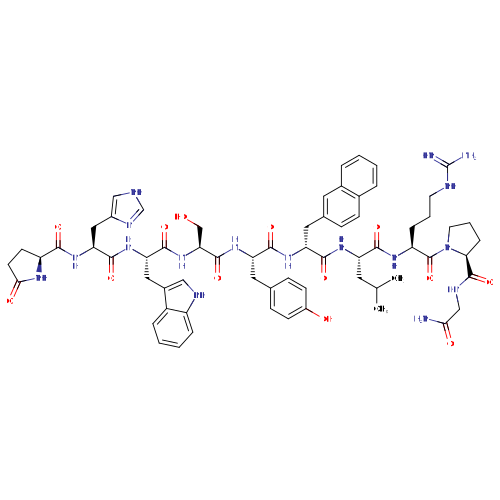
Nafarelin is a potent synthetic agonist of gonadotropin-releasing hormone with 3-(2-naphthyl)-D-alanine substitution at residue 6. Nafarelin has been used in the treatments of central precocious puberty and endometriosis.
- Type
- Small Molecule
- Groups
- Approved
- Structure
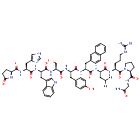
Structure for Nafarelin (DB00666)
- Weight
- Average: 1322.496
Monoisotopic: 1321.635625801 - Chemical Formula
- C66H83N17O13
- Synonyms
- Nafarelin
- Nafarelina
- Nafaréline
- Nafarelinum
- External IDs
- RS-94991-298

Pharmacology
- Indication
For treatment of central precocious puberty (true precocious puberty, GnRH-dependent precocious precocity, complete isosexual precocity) in children of both sexes and for the treatment of endometriosis.
 Reduce drug development failure ratesBuild, train, & validate machine-learning modelswith evidence-based and structured datasets.Build, train, & validate predictive machine-learning models with structured datasets.
- Associated Conditions
Indication Type Indication Combined Product Details Approval Level Age Group Patient Characteristics Dose Form Treatment of Central precocious puberty •••••••••••• Symptomatic treatment of Endometriosis •••••••••••• - Contraindications & Blackbox Warnings
 Prevent Adverse Drug Events TodayTap into our Clinical API for life-saving information on contraindications & blackbox warnings, population restrictions, harmful risks, & more.Avoid life-threatening adverse drug events with our Clinical API
- Pharmacodynamics
Nafarelin is a potent agonistic analog of gonadotropin-releasing hormone (GnRH). At the onset of administration, nafarelin stimulates the release of the pituitary gonadotropins, luteinizing hormone (LH) and follicle-stimulating hormone (FSH), resulting in a temporary increase of gonadal steroidogenesis. Repeated dosing abolishes the stimulatory effect on the pituitary gland. Twice daily administration leads to decreased secretion of gonadal steroids by about 4 weeks; consequently, tissues and functions that depend on gonadal steroids for their maintenance become quiescent. After nafarelin therapy is discontinued, pituitary and ovarian function normalize and estradiol serum concentrations increase to pretreatment levels. Recurrences of endometriosis are frequent after cessation of any hormonal therapy, or surgery that leaves the ovaries and/or uterus intact.
- Mechanism of action
Like GnRH, initial or intermittent administration of nafarelin stimulates release of the gonadotropins luteinizing hormone (LH) and follicle-stimulating hormone (FSH) from the pituitary gland, which in turn transiently increases production of estradiol in females and testosterone in both sexes. However, with continuous daily administration, nafarelin continuously occupies the GnRH receptor, leading to a reversible down-regulation of the GnRH receptors in the pituitary gland and desensitization of the pituitary gonadotropes. This causes a significant and sustained decline in the production of LH and FSH. A decline in gonadotropin production and release causes a dramatic reversible decrease in synthesis of estradiol, progesterone, and testosterone by the ovaries or testes. Like normal endometrium, endometriotic implants contain estrogen receptors. Estrogen stimulates the growth of endometrium. Use of nafarelin induces anovulation and amenorrhea and decreases serum concentrations of estradiol to the postmenopausal range, which induces atrophy of endometriotic implants. However, nafarelin does not abolish the underlying pathophysiology of endometriosis. In children with central precocious puberty receiving nafarelin, serum LH, testosterone, and estradiol concentrations return to prepubertal levels. This results in the supression of secondary sexual characteristics and decrased rate of linear growth and skeletal maturation. Following disconinuation of nafarelin, the effects of the drug is reversed, meaning FSH and LH concentrations usually return to pretreatment levels.
Target Actions Organism AGonadotropin-releasing hormone receptor agonistHumans APutative gonadotropin-releasing hormone II receptor agonistHumans - Absorption
Rapidly absorbed into the systemic circulation after intranasal administration. Bioavailability from a 400 µg dose averaged 2.8% (range 1.2 to 5.6%). Not absorbed after oral administration.
- Volume of distribution
Not Available
- Protein binding
Approximately 80%.
- Metabolism
Enzymatic hydrolysis.
- Route of elimination
Not Available
- Half-life
3 hours
- Clearance
Not Available
- Adverse Effects
 Improve decision support & research outcomesWith structured adverse effects data, including: blackbox warnings, adverse reactions, warning & precautions, & incidence rates. View sample adverse effects data in our new Data Library!Improve decision support & research outcomes with our structured adverse effects data.
- Toxicity
In experimental animals, a single subcutaneous administration of up to 60 times the recommended human dose (on a µg/kg basis, not adjusted for bioavailability) had no adverse effects. At present, there is no clinical evidence of adverse effects following overdosage of GnRH analogs.
- Pathways
- Not Available
- Pharmacogenomic Effects/ADRs
- Not Available
Interactions
- Drug Interactions
- This information should not be interpreted without the help of a healthcare provider. If you believe you are experiencing an interaction, contact a healthcare provider immediately. The absence of an interaction does not necessarily mean no interactions exist.
Drug Interaction Integrate drug-drug
interactions in your softwareAcipimox The risk or severity of myopathy, rhabdomyolysis, and myoglobinuria can be increased when Nafarelin is combined with Acipimox. Alendronic acid The risk or severity of myopathy, rhabdomyolysis, and myoglobinuria can be increased when Alendronic acid is combined with Nafarelin. Amiodarone The risk or severity of myopathy, rhabdomyolysis, and myoglobinuria can be increased when Nafarelin is combined with Amiodarone. Amphotericin B The risk or severity of myopathy, rhabdomyolysis, and myoglobinuria can be increased when Nafarelin is combined with Amphotericin B. Atorvastatin The risk or severity of myopathy, rhabdomyolysis, and myoglobinuria can be increased when Nafarelin is combined with Atorvastatin. - Food Interactions
- Avoid excessive or chronic alcohol consumption. Ingesting alcohol in excess may increase the risk of bone thinning associated with taking nafarelin.
Products
 Drug product information from 10+ global regionsOur datasets provide approved product information including:dosage, form, labeller, route of administration, and marketing period.Access drug product information from over 10 global regions.
- Product Ingredients
Ingredient UNII CAS InChI Key Nafarelin acetate 8ENZ0QJW4H 86220-42-0 FSBTYDWUUWLHBD-UDXTWCDOSA-N - International/Other Brands
- Nafarelil (Fuji Yakuhin) / Nasanyl (Pfizer) / Synarela (Pfizer) / Synrelina (Pfizer)
- Brand Name Prescription Products
Name Dosage Strength Route Labeller Marketing Start Marketing End Region Image Synarel Spray, metered 2 mg/1mL Nasal Pfizer Laboratories Div Pfizer Inc 1990-02-13 Not applicable US 
Synarel Aerosol, metered 200 mcg / act Nasal Pfizer Canada Ulc 1996-11-25 Not applicable Canada 
Synarel Nas Sol 2mg/ml Liquid 2 mg / mL Nasal Syntex Inc. 1991-12-31 1996-09-30 Canada
Categories
- ATC Codes
- H01CA02 — Nafarelin
- Drug Categories
- Adrenal Cortex Hormones
- Agents Causing Muscle Toxicity
- Amino Acids, Peptides, and Proteins
- Fertility Agents
- Fertility Agents, Female
- Gonadotropin Releasing Hormone Receptor Agonist
- Gonadotropin Releasing Hormone Receptor Agonists
- Gonadotropin-releasing hormone agonist
- Gonadotropins and Antigonadotropins
- Hormones
- Hormones, Hormone Substitutes, and Hormone Antagonists
- Hypothalamic Hormones
- Nerve Tissue Proteins
- Neuropeptides
- Oligopeptides
- Peptide Hormones
- Peptides
- Pituitary and Hypothalamic Hormones and Analogues
- Pituitary Hormone-Releasing Hormones
- Proteins
- Reproductive Control Agents
- Systemic Hormonal Preparations, Excl. Sex Hormones and Insulins
- Chemical TaxonomyProvided by Classyfire
- Description
- This compound belongs to the class of organic compounds known as polypeptides. These are peptides containing ten or more amino acid residues.
- Kingdom
- Organic compounds
- Super Class
- Organic Polymers
- Class
- Polypeptides
- Sub Class
- Not Available
- Direct Parent
- Polypeptides
- Alternative Parents
- Peptides / Tyrosine and derivatives / Phenylalanine and derivatives / Histidine and derivatives / Leucine and derivatives / N-acyl-alpha amino acids and derivatives / Proline and derivatives / Alpha amino acid amides / Serine and derivatives / Tryptamines and derivatives show 24 more
- Substituents
- 1-hydroxy-2-unsubstituted benzenoid / 2-pyrrolidone / 3-alkylindole / Alcohol / Alpha peptide / Alpha-amino acid amide / Alpha-amino acid or derivatives / Amphetamine or derivatives / Aromatic heteropolycyclic compound / Azacycle show 49 more
- Molecular Framework
- Aromatic heteropolycyclic compounds
- External Descriptors
- Not Available
- Affected organisms
- Humans and other mammals
Chemical Identifiers
- UNII
- 1X0094V6JV
- CAS number
- 76932-56-4
- InChI Key
- RWHUEXWOYVBUCI-ITQXDASVSA-N
- InChI
- InChI=1S/C66H83N17O13/c1-36(2)25-48(58(89)76-47(13-7-23-71-66(68)69)65(96)83-24-8-14-54(83)64(95)73-33-55(67)86)77-60(91)50(28-38-15-18-39-9-3-4-10-40(39)26-38)78-59(90)49(27-37-16-19-43(85)20-17-37)79-63(94)53(34-84)82-61(92)51(29-41-31-72-45-12-6-5-11-44(41)45)80-62(93)52(30-42-32-70-35-74-42)81-57(88)46-21-22-56(87)75-46/h3-6,9-12,15-20,26,31-32,35-36,46-54,72,84-85H,7-8,13-14,21-25,27-30,33-34H2,1-2H3,(H2,67,86)(H,70,74)(H,73,95)(H,75,87)(H,76,89)(H,77,91)(H,78,90)(H,79,94)(H,80,93)(H,81,88)(H,82,92)(H4,68,69,71)/t46-,47-,48-,49-,50+,51-,52-,53-,54-/m0/s1
- IUPAC Name
- (2S)-N-[(2S)-5-carbamimidamido-1-[(2S)-2-[(carbamoylmethyl)carbamoyl]pyrrolidin-1-yl]-1-oxopentan-2-yl]-2-[(2R)-2-[(2S)-2-[(2S)-3-hydroxy-2-[(2S)-2-[(2S)-3-(1H-imidazol-4-yl)-2-{[(2S)-5-oxopyrrolidin-2-yl]formamido}propanamido]-3-(1H-indol-3-yl)propanamido]propanamido]-3-(4-hydroxyphenyl)propanamido]-3-(naphthalen-2-yl)propanamido]-4-methylpentanamide
- SMILES
- CC(C)C[C@H](NC(=O)[C@@H](CC1=CC2=C(C=CC=C2)C=C1)NC(=O)[C@H](CC1=CC=C(O)C=C1)NC(=O)[C@H](CO)NC(=O)[C@H](CC1=CNC2=CC=CC=C12)NC(=O)[C@H](CC1=CNC=N1)NC(=O)[C@@H]1CCC(=O)N1)C(=O)N[C@@H](CCCNC(N)=N)C(=O)N1CCC[C@H]1C(=O)NCC(N)=O
References
- General References
- Hugues JN, Cedrin Durnerin IC: Revisiting gonadotrophin-releasing hormone agonist protocols and management of poor ovarian responses to gonadotrophins. Hum Reprod Update. 1998 Jan-Feb;4(1):83-101. [Article]
- Garner C: Uses of GnRH agonists. J Obstet Gynecol Neonatal Nurs. 1994 Sep;23(7):563-70. [Article]
- Henzl MR: Gonadotropin-releasing hormone analogs: update on new findings. Am J Obstet Gynecol. 1992 Feb;166(2):757-61. [Article]
- Burry KA: Nafarelin in the management of endometriosis: quality of life assessment. Am J Obstet Gynecol. 1992 Feb;166(2):735-9. [Article]
- Saltiel E, Garabedian-Ruffalo SM: Pharmacologic management of endometriosis. Clin Pharm. 1991 Jul;10(7):518-31. [Article]
- Chrisp P, Goa KL: Nafarelin. A review of its pharmacodynamic and pharmacokinetic properties, and clinical potential in sex hormone-related conditions. Drugs. 1990 Apr;39(4):523-51. [Article]
- Letassy NA, Thompson DF, Britton ML, Suda RR Sr: Nafarelin acetate: a gonadotropin-releasing hormone agonist for the treatment of endometriosis. DICP. 1990 Dec;24(12):1204-9. [Article]
- External Links
- KEGG Compound
- C07613
- PubChem Compound
- 25077405
- PubChem Substance
- 46506496
- ChemSpider
- 10482014
- BindingDB
- 84707
- 28656
- ChEBI
- 7445
- ChEMBL
- CHEMBL1201309
- Therapeutic Targets Database
- DAP001051
- PharmGKB
- PA164754805
- RxList
- RxList Drug Page
- Drugs.com
- Drugs.com Drug Page
- Wikipedia
- Nafarelin
- FDA label
- Download (200 KB)
- MSDS
- Download (55.5 KB)
Clinical Trials
- Clinical Trials
Phase Status Purpose Conditions Count 4 Completed Treatment Infertility 1 4 Recruiting Treatment Ovarian Hyper Stimulation Syndrome (OHSS) / Pregnancy Early / Spontaneous Abortions 1 3 Not Yet Recruiting Treatment ICSI Intracytoplasmic Spermatozoid Injection / In Vitro Fertilization (IVF) 1 2 Not Yet Recruiting Treatment Fertility Disorders 1 1, 2 Completed Treatment Endometriosis / Pelvic Pain 1
Pharmacoeconomics
- Manufacturers
- Gd searle llc
- Packagers
- GD Searle LLC
- Pfizer Inc.
- Pharmacia Inc.
- Dosage Forms
Form Route Strength Aerosol, metered Nasal 200 mcg / act Spray, metered Nasal 2 mg/1mL Liquid Nasal 2 mg / mL - Prices
Unit description Cost Unit Synarel 2 mg/ml Solution 8ml Bottle 1150.16USD bottle Synarel 2 mg/ml nasal spray 138.24USD ml Synarel 2 mg/ml Solution 39.53USD ml DrugBank does not sell nor buy drugs. Pricing information is supplied for informational purposes only.- Patents
Patent Number Pediatric Extension Approved Expires (estimated) Region CA1336401 No 1999-07-25 2012-07-25 Canada
Properties
- State
- Solid
- Experimental Properties
- Not Available
- Predicted Properties
Property Value Source Water Solubility 0.0166 mg/mL ALOGPS logP 1.21 ALOGPS logP -2.7 Chemaxon logS -4.9 ALOGPS pKa (Strongest Acidic) 9.49 Chemaxon pKa (Strongest Basic) 11.92 Chemaxon Physiological Charge 1 Chemaxon Hydrogen Acceptor Count 17 Chemaxon Hydrogen Donor Count 17 Chemaxon Polar Surface Area 472.13 Å2 Chemaxon Rotatable Bond Count 33 Chemaxon Refractivity 357.8 m3·mol-1 Chemaxon Polarizability 135.67 Å3 Chemaxon Number of Rings 8 Chemaxon Bioavailability 0 Chemaxon Rule of Five No Chemaxon Ghose Filter No Chemaxon Veber's Rule No Chemaxon MDDR-like Rule Yes Chemaxon - Predicted ADMET Features
Property Value Probability Human Intestinal Absorption + 0.9695 Blood Brain Barrier - 0.9781 Caco-2 permeable - 0.8941 P-glycoprotein substrate Substrate 0.8607 P-glycoprotein inhibitor I Non-inhibitor 0.8452 P-glycoprotein inhibitor II Non-inhibitor 0.7859 Renal organic cation transporter Non-inhibitor 0.6797 CYP450 2C9 substrate Non-substrate 0.769 CYP450 2D6 substrate Non-substrate 0.7647 CYP450 3A4 substrate Substrate 0.5996 CYP450 1A2 substrate Non-inhibitor 0.842 CYP450 2C9 inhibitor Non-inhibitor 0.8493 CYP450 2D6 inhibitor Non-inhibitor 0.9054 CYP450 2C19 inhibitor Non-inhibitor 0.8136 CYP450 3A4 inhibitor Non-inhibitor 0.7529 CYP450 inhibitory promiscuity Low CYP Inhibitory Promiscuity 0.9411 Ames test Non AMES toxic 0.6992 Carcinogenicity Non-carcinogens 0.7961 Biodegradation Not ready biodegradable 0.9933 Rat acute toxicity 2.6799 LD50, mol/kg Not applicable hERG inhibition (predictor I) Weak inhibitor 0.9038 hERG inhibition (predictor II) Non-inhibitor 0.5274
Spectra
- Mass Spec (NIST)
- Not Available
- Spectra
- Chromatographic Properties
Collision Cross Sections (CCS)
Adduct CCS Value (Å2) Source type Source [M-H]- 344.12238 predictedDeepCCS 1.0 (2019) [M+H]+ 345.77554 predictedDeepCCS 1.0 (2019) [M+Na]+ 351.9324 predictedDeepCCS 1.0 (2019)
Targets

- Kind
- Protein
- Organism
- Humans
- Pharmacological action
- Yes
- Actions
- Agonist
- General Function
- Peptide binding
- Specific Function
- Receptor for gonadotropin releasing hormone (GnRH) that mediates the action of GnRH to stimulate the secretion of the gonadotropic hormones luteinizing hormone (LH) and follicle-stimulating hormone...
- Gene Name
- GNRHR
- Uniprot ID
- P30968
- Uniprot Name
- Gonadotropin-releasing hormone receptor
- Molecular Weight
- 37730.355 Da
References
- Barbieri RL: Comparison of the pharmacology of nafarelin and danazol. Am J Obstet Gynecol. 1990 Feb;162(2):581-5. [Article]
- Suh J, Lee E, Hwang S, Yoon S, Yoon BK, Bae D, Choi D: Dose of GnRH agonist (nafarelin acetate) affects intrafollicular PAPP-A expression in controlled ovarian hyperstimulation cycle. Eur J Obstet Gynecol Reprod Biol. 2004 Jan 15;112(1):65-8. [Article]
- Valle RF, Sciarra JJ: Endometriosis: treatment strategies. Ann N Y Acad Sci. 2003 Nov;997:229-39. [Article]
- Batzer FR: GnRH analogs: options for endometriosis-associated pain treatment. J Minim Invasive Gynecol. 2006 Nov-Dec;13(6):539-45. [Article]
- Hugues JN, Cedrin Durnerin IC: Revisiting gonadotrophin-releasing hormone agonist protocols and management of poor ovarian responses to gonadotrophins. Hum Reprod Update. 1998 Jan-Feb;4(1):83-101. [Article]
- Garner C: Uses of GnRH agonists. J Obstet Gynecol Neonatal Nurs. 1994 Sep;23(7):563-70. [Article]
- Saltiel E, Garabedian-Ruffalo SM: Pharmacologic management of endometriosis. Clin Pharm. 1991 Jul;10(7):518-31. [Article]
- Chrisp P, Goa KL: Nafarelin. A review of its pharmacodynamic and pharmacokinetic properties, and clinical potential in sex hormone-related conditions. Drugs. 1990 Apr;39(4):523-51. [Article]
- Letassy NA, Thompson DF, Britton ML, Suda RR Sr: Nafarelin acetate: a gonadotropin-releasing hormone agonist for the treatment of endometriosis. DICP. 1990 Dec;24(12):1204-9. [Article]
- Chen X, Ji ZL, Chen YZ: TTD: Therapeutic Target Database. Nucleic Acids Res. 2002 Jan 1;30(1):412-5. [Article]
- Kind
- Protein
- Organism
- Humans
- Pharmacological action
- Yes
- Actions
- Agonist
- General Function
- Gonadotropin-releasing hormone receptor activity
- Specific Function
- Putative receptor for gonadotropin releasing hormone II (GnRH II) which is most probably non-functional.
- Gene Name
- GNRHR2
- Uniprot ID
- Q96P88
- Uniprot Name
- Putative gonadotropin-releasing hormone II receptor
- Molecular Weight
- 32536.935 Da
References
- Overington JP, Al-Lazikani B, Hopkins AL: How many drug targets are there? Nat Rev Drug Discov. 2006 Dec;5(12):993-6. [Article]
- Imming P, Sinning C, Meyer A: Drugs, their targets and the nature and number of drug targets. Nat Rev Drug Discov. 2006 Oct;5(10):821-34. [Article]
- Valle RF, Sciarra JJ: Endometriosis: treatment strategies. Ann N Y Acad Sci. 2003 Nov;997:229-39. [Article]
- Barbieri RL: Comparison of the pharmacology of nafarelin and danazol. Am J Obstet Gynecol. 1990 Feb;162(2):581-5. [Article]
- Suh J, Lee E, Hwang S, Yoon S, Yoon BK, Bae D, Choi D: Dose of GnRH agonist (nafarelin acetate) affects intrafollicular PAPP-A expression in controlled ovarian hyperstimulation cycle. Eur J Obstet Gynecol Reprod Biol. 2004 Jan 15;112(1):65-8. [Article]
- Batzer FR: GnRH analogs: options for endometriosis-associated pain treatment. J Minim Invasive Gynecol. 2006 Nov-Dec;13(6):539-45. [Article]
- Hugues JN, Cedrin Durnerin IC: Revisiting gonadotrophin-releasing hormone agonist protocols and management of poor ovarian responses to gonadotrophins. Hum Reprod Update. 1998 Jan-Feb;4(1):83-101. [Article]
- Garner C: Uses of GnRH agonists. J Obstet Gynecol Neonatal Nurs. 1994 Sep;23(7):563-70. [Article]
- Saltiel E, Garabedian-Ruffalo SM: Pharmacologic management of endometriosis. Clin Pharm. 1991 Jul;10(7):518-31. [Article]
- Chrisp P, Goa KL: Nafarelin. A review of its pharmacodynamic and pharmacokinetic properties, and clinical potential in sex hormone-related conditions. Drugs. 1990 Apr;39(4):523-51. [Article]
- Letassy NA, Thompson DF, Britton ML, Suda RR Sr: Nafarelin acetate: a gonadotropin-releasing hormone agonist for the treatment of endometriosis. DICP. 1990 Dec;24(12):1204-9. [Article]

Drug created at June 13, 2005 13:24 / Updated at April 26, 2024 00:45