Identification
- Summary
Deferoxamine is a chelating agent used to treat iron or aluminum toxicity and some blood transfusion dependent anemias.
- Brand Names
- Desferal
- Generic Name
- Deferoxamine
- DrugBank Accession Number
- DB00746
- Background
Natural product isolated from Streptomyces pilosus. It forms iron complexes and is used as a chelating agent, particularly in the mesylate form.
- Type
- Small Molecule
- Groups
- Approved, Investigational
- Structure
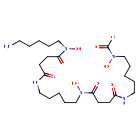
Structure for Deferoxamine (DB00746)
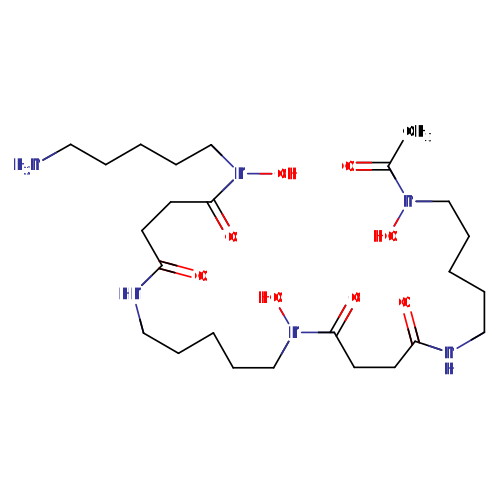
- Weight
- Average: 560.684
Monoisotopic: 560.353362542 - Chemical Formula
- C25H48N6O8
- Synonyms
- Deferoxamin
- Deferoxamina
- Déferoxamine
- Deferoxamine
- Deferoxaminum
- Deferrioxamine
- Deferrioxamine B
- Desferrioxamine
- DFO
- DFOA
- DFOM
- External IDs
- Ba 29837
- Ba 33112
- NSC-527604

Pharmacology
- Indication
Used to treat acute iron or aluminum toxicity (an excess of aluminum in the body) in certain patients. Also used in certain patients with anemia who must receive many blood transfusions.
 Reduce drug development failure ratesBuild, train, & validate machine-learning modelswith evidence-based and structured datasets.Build, train, & validate predictive machine-learning models with structured datasets.
- Associated Conditions
Indication Type Indication Combined Product Details Approval Level Age Group Patient Characteristics Dose Form Diagnostic agent Aluminum overload •••••••••••• Treatment of Chronic iron overload •••••••••••• Treatment of Chronic aluminum overload •••••••••••• Treatment of Acute iron intoxication •••••••••••• - Contraindications & Blackbox Warnings
 Prevent Adverse Drug Events TodayTap into our Clinical API for life-saving information on contraindications & blackbox warnings, population restrictions, harmful risks, & more.Avoid life-threatening adverse drug events with our Clinical API
- Pharmacodynamics
Deferoxamine, otherwise known as desferrioxamine or desferal, is a chelating agent used to remove excess iron or aluminum from the body. It acts by binding free iron or aluminum in the bloodstream and enhancing its elimination in the urine. By removing excess iron or aluminum, the agent reduces the damage done to various organs and tissues, such as the liver.
- Mechanism of action
Deferoxamine works in treating iron toxicity by binding trivalent (ferric) iron (for which it has a strong affinity), forming ferrioxamine, a stable complex which is eliminated via the kidneys. 100 mg of deferoxamine is capable of binding approximately 8.5 mg of trivalent (ferric) iron. Deferoxamine works in treating aluminum toxicity by binding to tissue-bound aluminum to form aluminoxamine, a stable, water-soluble complex. The formation of aluminoxamine increases blood concentrations of aluminum, resulting in an increased concentration gradient between the blood and dialysate, boosting the removal of aluminum during dialysis. 100 mg of deferoxamine is capable of binding approximately 4.1 mg of aluminum.
Target Actions Organism AIron chelatorHumans AAluminum chelatorHumans UAmyloid beta A4 protein Not Available Humans - Absorption
Deferoxamine is rapidly absorbed after intramuscular or subcutaneous administration, but only poorly absorbed from the gastrointestinal tract in the presence of intact mucosa.
- Volume of distribution
Not Available
- Protein binding
Less than 10% bound to serum proteins in vitro.
- Metabolism
Deferoxamine is mainly metabolised in the plasma and hepatic metabolism is minimal. A number of metabolites have been isolated but not characterised. Some metabolites of deferoxamine, most notably the product of oxidative deamination, also chelate iron, and thus the antidotal effect of the drug appears unaffected by hepatic metabolism.
- Route of elimination
Deferoxamine mesylate is metabolized principally by plasma enzymes, but the pathways have not yet been defined. Some is also excreted in the feces via the bile.
- Half-life
Biphasic elimination pattern in healthy volunteers with a first rapid phase half life of 1 hour and a second slow phase half-life of 6 hours.
- Clearance
Not Available
- Adverse Effects
 Improve decision support & research outcomesWith structured adverse effects data, including: blackbox warnings, adverse reactions, warning & precautions, & incidence rates. View sample adverse effects data in our new Data Library!Improve decision support & research outcomes with our structured adverse effects data.
- Toxicity
Intravenous LD50 in mouse, rat, and rabbit is 340 mg/kg, 520 mg/kg, and 600 mg/kg, respectively. Subcutaneous LD50 in mouse and rat is 1600 mg/kg and >1000 mg/kg, respectively. Oral LD50 in mouse and rat is >3000 mg/kg and >1000 mg/kg, respectively. Nephrotoxicity, ototoxicity and retinal toxicity have been reported following long-term administration for chronic iron overload.
- Pathways
- Not Available
- Pharmacogenomic Effects/ADRs
- Not Available
Interactions
- Drug Interactions
- This information should not be interpreted without the help of a healthcare provider. If you believe you are experiencing an interaction, contact a healthcare provider immediately. The absence of an interaction does not necessarily mean no interactions exist.
Drug Interaction Integrate drug-drug
interactions in your softwareAscorbic acid The risk or severity of Cardiovascular Impairment can be increased when Ascorbic acid is combined with Deferoxamine. Calcium ascorbate The risk or severity of Cardiovascular Impairment can be increased when Calcium ascorbate is combined with Deferoxamine. Niacinamide ascorbate The risk or severity of Cardiovascular Impairment can be increased when Niacinamide ascorbate is combined with Deferoxamine. Prochlorperazine The risk or severity of adverse effects can be increased when Deferoxamine is combined with Prochlorperazine. Sodium ascorbate The risk or severity of Cardiovascular Impairment can be increased when Sodium ascorbate is combined with Deferoxamine. - Food Interactions
- No interactions found.
Products
 Drug product information from 10+ global regionsOur datasets provide approved product information including:dosage, form, labeller, route of administration, and marketing period.Access drug product information from over 10 global regions.
- Product Ingredients
Ingredient UNII CAS InChI Key Deferoxamine hydrochloride G9VYJ96FOJ 1950-39-6 KCRQZLMAZHZDCL-UHFFFAOYSA-N Deferoxamine mesylate V9TKO7EO6K 138-14-7 IDDIJAWJANBQLJ-UHFFFAOYSA-N - International/Other Brands
- Desferin (Novartis)
- Brand Name Prescription Products
Name Dosage Strength Route Labeller Marketing Start Marketing End Region Image Deferoxamine Mesylate for Injection Powder, for solution 500 mg / vial Intramuscular; Intraperitoneal; Intravenous; Subcutaneous Pfizer Canada Ulc 2000-04-12 Not applicable Canada 
Deferoxamine Mesylate for Injection Powder, for solution 2 g / vial Intramuscular; Intraperitoneal; Intravenous; Subcutaneous Pfizer Canada Ulc 2004-01-12 Not applicable Canada Deferoxamine Mesylate for Injection Powder, for solution 2 g / vial Intramuscular; Intraperitoneal; Intravenous; Subcutaneous Sandoz Canada Incorporated Not applicable Not applicable Canada Desferal Injection, powder, lyophilized, for solution 500 mg/1 Intramuscular; Intravenous; Subcutaneous Novartis Pharmaceuticals Corporation 1968-04-02 Not applicable US 
Desferal Injection, powder, lyophilized, for solution 2 g/1 Intramuscular; Intravenous; Subcutaneous Novartis Pharmaceuticals Corporation 2006-07-19 2006-07-19 US - Generic Prescription Products
Name Dosage Strength Route Labeller Marketing Start Marketing End Region Image Deferoxamine Injection, powder, lyophilized, for solution 95 mg/1mL Intramuscular; Intravenous; Subcutaneous Fresenius Kabi USA, LLC 2009-12-15 Not applicable US Deferoxamine Injection, powder, lyophilized, for solution 95 mg/1mL Intramuscular; Intravenous; Subcutaneous Fresenius Kabi USA, LLC 2009-12-15 Not applicable US Deferoxamine mesylate Injection, powder, lyophilized, for solution 500 mg/5.3mL Intramuscular; Intravenous; Subcutaneous Bedford Pharmaceuticals 2010-06-18 2012-07-31 US Deferoxamine mesylate Injection, powder, lyophilized, for solution 2 g/1 Intramuscular; Intravenous; Subcutaneous Gland Pharma Limited 2017-10-09 Not applicable US Deferoxamine Mesylate Injection, powder, lyophilized, for solution 2 g/1 Intramuscular; Intravenous; Subcutaneous Hospira, Inc. 2005-03-31 Not applicable US
Categories
- ATC Codes
- V03AC01 — Deferoxamine
- Drug Categories
- Chemical TaxonomyProvided by Classyfire
- Description
- This compound belongs to the class of organic compounds known as acetohydroxamic acids. These are organic compounds that contain a hydroxamic acid group carrying a methyl group attached to its carbon center.
- Kingdom
- Organic compounds
- Super Class
- Organic acids and derivatives
- Class
- Carboxylic acids and derivatives
- Sub Class
- Carboxylic acid derivatives
- Direct Parent
- Acetohydroxamic acids
- Alternative Parents
- Acetamides / Amino acids and derivatives / Propargyl-type 1,3-dipolar organic compounds / Carboximidic acids / Organopnictogen compounds / Organic oxides / Monoalkylamines / Hydrocarbon derivatives / Carbonyl compounds
- Substituents
- Acetamide / Acetohydroxamic acid / Aliphatic acyclic compound / Amine / Amino acid or derivatives / Carbonyl group / Carboximidic acid / Carboximidic acid derivative / Hydrocarbon derivative / Organic 1,3-dipolar compound
- Molecular Framework
- Aliphatic acyclic compounds
- External Descriptors
- acyclic desferrioxamine (CHEBI:4356) / a hydroxamate siderophore (CPD-3764)
- Affected organisms
- Humans and other mammals
Chemical Identifiers
- UNII
- J06Y7MXW4D
- CAS number
- 70-51-9
- InChI Key
- UBQYURCVBFRUQT-UHFFFAOYSA-N
- InChI
- InChI=1S/C25H48N6O8/c1-21(32)29(37)18-9-3-6-16-27-22(33)12-14-25(36)31(39)20-10-4-7-17-28-23(34)11-13-24(35)30(38)19-8-2-5-15-26/h37-39H,2-20,26H2,1H3,(H,27,33)(H,28,34)
- IUPAC Name
- N-(5-aminopentyl)-N-hydroxy-N'-[5-(N-hydroxy-3-{[5-(N-hydroxyacetamido)pentyl]carbamoyl}propanamido)pentyl]butanediamide
- SMILES
- CC(=O)N(O)CCCCCNC(=O)CCC(=O)N(O)CCCCCNC(=O)CCC(=O)N(O)CCCCCN
References
- Synthesis Reference
Zoltan Konyari, Vilmos Keri, Antal Kovacs, Sandor Horkay, Laszlo Eszenyi, Janos Erdelyi, Ilona Himesi, Gyorgy Toth, Janos Balint, SzilaJudit, Ferenc Vinczi, Csaba Szabo, Nelli Sas, "Process for the preparation of high-purity deferoxamine salts." U.S. Patent US5374771, issued July, 1965.
US5374771- General References
- Link [Link]
- External Links
- Human Metabolome Database
- HMDB0014884
- KEGG Drug
- D03670
- KEGG Compound
- C06940
- PubChem Compound
- 2973
- PubChem Substance
- 46506395
- ChemSpider
- 2867
- BindingDB
- 47715
- 3131
- ChEBI
- 4356
- ChEMBL
- CHEMBL556
- ZINC
- ZINC000003830635
- PharmGKB
- PA164746490
- PDBe Ligand
- KTY
- Drugs.com
- Drugs.com Drug Page
- Wikipedia
- Deferoxamine
- PDB Entries
- 7w8f
- MSDS
- Download (52.1 KB)
Clinical Trials
- Clinical Trials
Phase Status Purpose Conditions Count 4 Completed Treatment Beta-Thalassemia / Thalassemia Major 1 4 Completed Treatment Cardiomyopathy / Iron Overload 1 4 Completed Treatment Hemosiderosis / Thalassemia Major 1 4 Completed Treatment Sickle Cell Disease (SCD) / Thalassemia Major / Transfusion-dependent Hemachromatosis 1 4 Terminated Treatment Iron Overload / Other Anemias / Sickle Cell Disease (SCD) 1
Pharmacoeconomics
- Manufacturers
- App pharmaceuticals llc
- Bedford laboratories div ben venue laboratories inc
- Hospira inc
- Watson laboratories inc
- Novartis pharmaceuticals corp
- Packagers
- APP Pharmaceuticals
- Barr Pharmaceuticals
- Bedford Labs
- Ben Venue Laboratories Inc.
- Hospira Inc.
- Novartis AG
- Teva Pharmaceutical Industries Ltd.
- Watson Pharmaceuticals
- Dosage Forms
Form Route Strength Injection, powder, for solution Injection, powder, for solution Parenteral 500 MG Powder, for solution Intramuscular; Intraperitoneal; Intravenous; Subcutaneous 2 G Injection, powder, lyophilized, for solution Intramuscular; Intravenous; Subcutaneous 95 mg/1mL Injection, powder, lyophilized, for solution Intramuscular; Intravenous 2 g/1 Injection, powder, lyophilized, for solution Intramuscular; Intravenous; Subcutaneous 2 g/20mL Injection, powder, lyophilized, for solution Intramuscular; Intravenous; Subcutaneous 2 g/1 Injection, powder, lyophilized, for solution Intramuscular; Intravenous; Subcutaneous 2 g/21.1mL Injection, powder, lyophilized, for solution Intramuscular; Intravenous; Subcutaneous 500 mg/5mL Injection, powder, lyophilized, for solution Intramuscular; Intravenous; Subcutaneous 500 mg/1 Injection, powder, lyophilized, for solution Intramuscular; Intravenous; Subcutaneous 500 mg/5.3mL Powder, for solution Intramuscular; Intraperitoneal; Intravenous; Subcutaneous 2 g / vial Injection, powder, for solution Intramuscular; Intravenous 500 mg Injection, powder, for solution Intramuscular; Intravenous; Subcutaneous 500 mg Injection, powder, for solution Parenteral 2 G/20ML Injection, powder, for solution Parenteral 500 MG/5ML Powder 500 mg/1vial Injection Intramuscular; Intravenous 500 mg Powder, for solution Intramuscular; Intraperitoneal; Intravenous; Subcutaneous 500 mg / vial Injection, powder, lyophilized, for solution Intravenous; Subcutaneous 500 mg Powder 500 mg - Prices
Unit description Cost Unit Desferal 2 gram vial 113.94USD vial Desferal 2 g/vial 60.52USD vial Deferoxamine 2 gram vial 46.25USD vial Desferrioxamine Mesilate 2 g/vial 33.89USD vial Pms-Deferoxamine 2 g/vial 33.89USD vial Desferal 500 mg Solution Vial 23.92USD vial Desferal 500 mg/vial 15.07USD vial Desferrioxamine Mesilate 500 mg/vial 8.44USD vial Pms-Deferoxamine 500 mg/vial 8.44USD vial DrugBank does not sell nor buy drugs. Pricing information is supplied for informational purposes only.- Patents
- Not Available
Properties
- State
- Solid
- Experimental Properties
Property Value Source melting point (°C) 140 °C PhysProp water solubility 1.2E+004 mg/L (at 20 °C) MERCK INDEX (1996) logP -2.2 Not Available - Predicted Properties
Property Value Source Water Solubility 0.099 mg/mL ALOGPS logP 0.93 ALOGPS logP -3.4 Chemaxon logS -3.8 ALOGPS pKa (Strongest Acidic) 7.92 Chemaxon pKa (Strongest Basic) 10.23 Chemaxon Physiological Charge 1 Chemaxon Hydrogen Acceptor Count 9 Chemaxon Hydrogen Donor Count 6 Chemaxon Polar Surface Area 205.84 Å2 Chemaxon Rotatable Bond Count 23 Chemaxon Refractivity 144.95 m3·mol-1 Chemaxon Polarizability 62.42 Å3 Chemaxon Number of Rings 0 Chemaxon Bioavailability 0 Chemaxon Rule of Five No Chemaxon Ghose Filter No Chemaxon Veber's Rule No Chemaxon MDDR-like Rule No Chemaxon - Predicted ADMET Features
Property Value Probability Human Intestinal Absorption - 0.5 Blood Brain Barrier + 0.9242 Caco-2 permeable - 0.8957 P-glycoprotein substrate Substrate 0.5 P-glycoprotein inhibitor I Non-inhibitor 0.8856 P-glycoprotein inhibitor II Non-inhibitor 0.9649 Renal organic cation transporter Non-inhibitor 0.9141 CYP450 2C9 substrate Non-substrate 0.8027 CYP450 2D6 substrate Non-substrate 0.7876 CYP450 3A4 substrate Non-substrate 0.6312 CYP450 1A2 substrate Non-inhibitor 0.8767 CYP450 2C9 inhibitor Non-inhibitor 0.8442 CYP450 2D6 inhibitor Non-inhibitor 0.9103 CYP450 2C19 inhibitor Non-inhibitor 0.8236 CYP450 3A4 inhibitor Non-inhibitor 0.7574 CYP450 inhibitory promiscuity Low CYP Inhibitory Promiscuity 0.9786 Ames test AMES toxic 0.5388 Carcinogenicity Non-carcinogens 0.6595 Biodegradation Not ready biodegradable 0.8749 Rat acute toxicity 2.0628 LD50, mol/kg Not applicable hERG inhibition (predictor I) Weak inhibitor 0.9839 hERG inhibition (predictor II) Non-inhibitor 0.7688
Spectra
- Mass Spec (NIST)
- Not Available
- Spectra
- Chromatographic Properties
Collision Cross Sections (CCS)
Adduct CCS Value (Å2) Source type Source [M-H]- 279.9779632 predictedDarkChem Lite v0.1.0 [M-H]- 227.58138 predictedDeepCCS 1.0 (2019) [M+H]+ 279.0948632 predictedDarkChem Lite v0.1.0 [M+H]+ 229.93938 predictedDeepCCS 1.0 (2019) [M+Na]+ 280.0906632 predictedDarkChem Lite v0.1.0 [M+Na]+ 236.03252 predictedDeepCCS 1.0 (2019)
Targets

References
- Elihu N, Anandasbapathy S, Frishman WH: Chelation therapy in cardiovascular disease: ethylenediaminetetraacetic acid, deferoxamine, and dexrazoxane. J Clin Pharmacol. 1998 Feb;38(2):101-5. [Article]
- Hershko C, Link G, Konijn AM, Cabantchik ZI: Objectives and mechanism of iron chelation therapy. Ann N Y Acad Sci. 2005;1054:124-35. [Article]
- Cappellini MD, Musallam KM, Taher AT: Overview of iron chelation therapy with desferrioxamine and deferiprone. Hemoglobin. 2009;33 Suppl 1:S58-69. doi: 10.3109/03630260903346924. [Article]
References
- Kontoghiorghes GJ: Comparative efficacy and toxicity of desferrioxamine, deferiprone and other iron and aluminium chelating drugs. Toxicol Lett. 1995 Oct;80(1-3):1-18. [Article]
- Yokel RA: Aluminum chelation: chemistry, clinical, and experimental studies and the search for alternatives to desferrioxamine. J Toxicol Environ Health. 1994 Feb;41(2):131-74. [Article]
- Day JP, Ackrill P: The chemistry of desferrioxamine chelation for aluminum overload in renal dialysis patients. Ther Drug Monit. 1993 Dec;15(6):598-601. [Article]
- Domingo JL: The use of chelating agents in the treatment of aluminum overload. J Toxicol Clin Toxicol. 1989;27(6):355-67. [Article]
- Kind
- Protein
- Organism
- Humans
- Pharmacological action
- Unknown
- General Function
- Transition metal ion binding
- Specific Function
- Functions as a cell surface receptor and performs physiological functions on the surface of neurons relevant to neurite growth, neuronal adhesion and axonogenesis. Involved in cell mobility and tra...
- Gene Name
- APP
- Uniprot ID
- P05067
- Uniprot Name
- Amyloid beta A4 protein
- Molecular Weight
- 86942.715 Da
References
- Venti A, Giordano T, Eder P, Bush AI, Lahiri DK, Greig NH, Rogers JT: The integrated role of desferrioxamine and phenserine targeted to an iron-responsive element in the APP-mRNA 5'-untranslated region. Ann N Y Acad Sci. 2004 Dec;1035:34-48. [Article]
Enzymes
- Kind
- Protein
- Organism
- Humans
- Pharmacological action
- Unknown
- Actions
- Inhibitor
- General Function
- Xanthine oxidase activity
- Specific Function
- Key enzyme in purine degradation. Catalyzes the oxidation of hypoxanthine to xanthine. Catalyzes the oxidation of xanthine to uric acid. Contributes to the generation of reactive oxygen species. Ha...
- Gene Name
- XDH
- Uniprot ID
- P47989
- Uniprot Name
- Xanthine dehydrogenase/oxidase
- Molecular Weight
- 146422.99 Da
References
- Rinaldo JE, Gorry M: Protection by deferoxamine from endothelial injury: a possible link with inhibition of intracellular xanthine oxidase. Am J Respir Cell Mol Biol. 1990 Dec;3(6):525-33. [Article]

Drug created at June 13, 2005 13:24 / Updated at April 26, 2024 00:45