Identification
- Summary
Vitamin C is a vitamin used to correct vitamin C deficiency and to increase the intestinal absorption of iron.
- Brand Names
- Ascor, Citranatal B-calm Kit, Concept Ob, Ferralet 90, Hematogen, Infuvite, Infuvite Pediatric, Moviprep, Mvc-fluoride, Mvi Pediatric, Natafort, Plenvu, Pregvit, Vitafol-one
- Generic Name
- Ascorbic acid
Commonly known or available as Vitamin C - DrugBank Accession Number
- DB00126
- Background
A six carbon compound related to glucose. It is found naturally in citrus fruits and many vegetables. Ascorbic acid is an essential nutrient in human diets, and necessary to maintain connective tissue and bone. Its biologically active form, vitamin C, functions as a reducing agent and coenzyme in several metabolic pathways. Vitamin C is considered an antioxidant.
- Type
- Small Molecule
- Groups
- Approved, Nutraceutical
- Structure
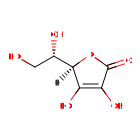
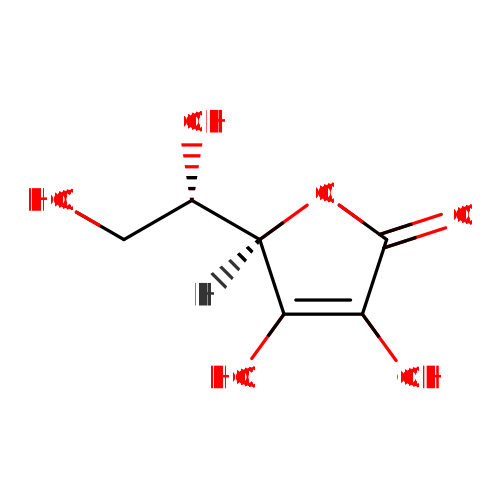
Structure for Ascorbic acid (DB00126)
- Weight
- Average: 176.1241
Monoisotopic: 176.032087988 - Chemical Formula
- C6H8O6
- Synonyms
- acide ascorbique
- ácido ascórbico
- Acidum ascorbicum
- acidum ascorbinicum
- Ascorbate
- Ascorbic acid
- Ascorbinsäure
- L-(+)-ascorbic acid
- L-Ascorbate
- L-Ascorbic Acid
- Vitamin C
- Vitamina C
- External IDs
- E 300
- E-300
- E300
- FEMA NO. 2109
- INS NO.300
- INS-300
- NSC-218455
- NSC-33832

Pharmacology
- Indication
Used to treat vitamin C deficiency, scurvy, delayed wound and bone healing, urine acidification, and in general as an antioxidant. It has also been suggested to be an effective antiviral agent.
 Reduce drug development failure ratesBuild, train, & validate machine-learning modelswith evidence-based and structured datasets.Build, train, & validate predictive machine-learning models with structured datasets.
- Associated Conditions
Indication Type Indication Combined Product Details Approval Level Age Group Patient Characteristics Dose Form Used in combination for symptomatic treatment of Common cold Combination Product in combination with: Carbaspirin calcium (DB13612) ••• ••• ••••••• Used in combination for symptomatic treatment of Common cold Combination Product in combination with: Acetaminophen (DB00316), Acetylsalicylic acid (DB00945) •••••••••••• •••••• Used in combination for symptomatic treatment of Common cold Combination Product in combination with: Acetylcysteine (DB06151), Acetaminophen (DB00316) •••••••••••• •••••• Used in combination to prevent Deficiency, vitamin a Combination Product in combination with: Vitamin D (DB11094), Vitamin A (DB00162) ••• ••• •••••••• • •••••• ••••• Used in combination to prevent Deficiency, vitamin d Combination Product in combination with: Vitamin A (DB00162), Vitamin D (DB11094) ••• ••• •••••••• • •••••• ••••• - Associated Therapies
- Contraindications & Blackbox Warnings
 Prevent Adverse Drug Events TodayTap into our Clinical API for life-saving information on contraindications & blackbox warnings, population restrictions, harmful risks, & more.Avoid life-threatening adverse drug events with our Clinical API
- Pharmacodynamics
Ascorbic Acid (vitamin C) is a water-soluble vitamin indicated for the prevention and treatment of scurvy, as ascorbic acid deficiency results in scurvy. Collagenous structures are primarily affected, and lesions develop in bones and blood vessels. Administration of ascorbic acid completely reverses the symptoms of ascorbic acid deficiency.
- Mechanism of action
In humans, an exogenous source of ascorbic acid is required for collagen formation and tissue repair by acting as a cofactor in the posttranslational formation of 4-hydroxyproline in -Xaa-Pro-Gly- sequences in collagens and other proteins. Ascorbic acid is reversibly oxidized to dehydroascorbic acid in the body. These two forms of the vitamin are believed to be important in oxidation-reduction reactions. The vitamin is involved in tyrosine metabolism, conversion of folic acid to folinic acid, carbohydrate metabolism, synthesis of lipids and proteins, iron metabolism, resistance to infections, and cellular respiration.
- Absorption
70% to 90%
- Volume of distribution
Not Available
- Protein binding
25%
- Metabolism
Hepatic. Ascorbic acid is reversibly oxidised (by removal of the hydrogen from the enediol group of ascorbic acid) to dehydroascorbic acid. The two forms found in body fluids are physiologically active. Some ascorbic acid is metabolized to inactive compounds including ascorbic acid-2-sulfate and oxalic acid.
Hover over products below to view reaction partners
- Route of elimination
Not Available
- Half-life
16 days (3.4 hours in people who have excess levels of vitamin C)
- Clearance
Not Available
- Adverse Effects
 Improve decision support & research outcomesWith structured adverse effects data, including: blackbox warnings, adverse reactions, warning & precautions, & incidence rates. View sample adverse effects data in our new Data Library!Improve decision support & research outcomes with our structured adverse effects data.
- Toxicity
Not Available
- Pathways
Pathway Category Oxidation of Branched-Chain Fatty Acids Metabolic Aromatic L-Aminoacid Decarboxylase Deficiency Disease The Oncogenic Action of Fumarate Disease Tyrosine Metabolism Metabolic Catecholamine Biosynthesis Metabolic Tyrosinemia Type I Disease Disulfiram Action Pathway Drug action Phytanic Acid Peroxisomal Oxidation Metabolic Carnitine Synthesis Metabolic The Oncogenic Action of Succinate Disease Alkaptonuria Disease Hawkinsinuria Disease Refsum Disease Disease Tyrosinemia, Transient, of the Newborn Disease Tyrosine Hydroxylase Deficiency Disease Dopamine beta-Hydroxylase Deficiency Disease Monoamine Oxidase-A Deficiency (MAO-A) Disease - Pharmacogenomic Effects/ADRs
- Not Available
Interactions
- Drug Interactions
- This information should not be interpreted without the help of a healthcare provider. If you believe you are experiencing an interaction, contact a healthcare provider immediately. The absence of an interaction does not necessarily mean no interactions exist.
Drug Interaction Integrate drug-drug
interactions in your softwareAluminum hydroxide Ascorbic acid can cause an increase in the absorption of Aluminum hydroxide resulting in an increased serum concentration and potentially a worsening of adverse effects. Amphetamine The serum concentration of Amphetamine can be decreased when it is combined with Ascorbic acid. Benzphetamine The serum concentration of Benzphetamine can be decreased when it is combined with Ascorbic acid. Bleomycin The therapeutic efficacy of Bleomycin can be decreased when used in combination with Ascorbic acid. Bortezomib The therapeutic efficacy of Bortezomib can be decreased when used in combination with Ascorbic acid. - Food Interactions
- Avoid multivalent ions. Do not infuse with elemental compounds that can be reduced, such as copper.
Products
 Drug product information from 10+ global regionsOur datasets provide approved product information including:dosage, form, labeller, route of administration, and marketing period.Access drug product information from over 10 global regions.
- Product Images
- International/Other Brands
- Ascoltin / Ascorbicap
- Brand Name Prescription Products
Name Dosage Strength Route Labeller Marketing Start Marketing End Region Image Ascor Injection 500 mg/1mL Intravenous McGuff Pharmaceuticals, Inc. 2018-01-15 Not applicable US 
Ascor L 500 Injection, solution 25 g/50mL Intravenous McGuff Pharmaceuticals, Inc. 2002-10-21 Not applicable US Ascor L 500 Solution 500 mg / mL Intramuscular; Intravenous; Subcutaneous Mcguff Pharmaceuticals Inc 2014-09-11 Not applicable Canada 
Ascorbic Acid Injection, solution 500 mg/1mL Intramuscular; Intravenous; Subcutaneous Mylan Institutional LLC 1999-06-01 2022-03-31 US Ascorbic Acid Injection, solution 500 mg/1mL Intramuscular; Intravenous; Subcutaneous American Regent 1989-12-15 2008-03-28 US - Over the Counter Products
Name Dosage Strength Route Labeller Marketing Start Marketing End Region Image Acerotab Tablet 100 mg Oral Frega Inc. 1979-12-31 2008-02-13 Canada Acti-scorb 1000 Caplet 1000mg Tablet 1 g Oral Acti Form Ltd. 1991-12-31 2005-03-21 Canada Acti-scorb 500 Caplet 500mg Tablet 500 mg Oral Acti Form Ltd. 1991-12-31 2005-03-21 Canada All Natural Source Juicy Orange Vitamin C Tablet 500 mg Oral Wn Pharmaceuticals Ltd. 1998-06-29 2009-09-28 Canada Aromacura Shower Filter Liquid 39 g/70g Topical Value Added Technology co., Ltd 2019-01-01 2019-02-01 US - Mixture Products
Name Ingredients Dosage Route Labeller Marketing Start Marketing End Region Image 24 Multivitamins + Minerals Ascorbic acid (150 mg) + Beta carotene (10000 unit) + Biotin (25 mcg) + Calcium (130 mg) + Cholecalciferol (400 unit) + Choline bitartrate (25 mg) + Chromium (20 mcg) + Copper (1 mg) + Cyanocobalamin (25 mcg) + Ferrous fumarate (15 mg) + Folic acid (.8 mg) + Inositol (25 mg) + Magnesium (65 mg) + Manganese (2 mg) + Molybdenum (20 mcg) + Niacin (25 mg) + Calcium pantothenate (25 mg) + Potassium (15 mg) + Potassium Iodide (.1 mg) + Pyridoxine hydrochloride (25 mg) + Racemethionine (25 mg) + Riboflavin (25 mg) + Selenium (20 mcg) + Thiamine hydrochloride (25 mg) + Vanadium (20 mcg) + Vitamin A palmitate (5000 unit) + Vitamin E (50 unit) + Zinc (10 mg) Tablet Oral Stanley Pharmaceuticals, A Division Of Vita Health Products Inc. 1997-04-30 2002-07-31 Canada 50 Plus Ascorbic acid (200 mg) + Biotin (20 mcg) + Choline bitartrate (20 mg) + Cyanocobalamin (20 mcg) + Folic acid (.2 mg) + Inositol (20 mg) + Niacin (20 mg) + Calcium pantothenate (20 mg) + Pyridoxine hydrochloride (20 mg) + Racemethionine (20 mg) + Riboflavin (20 mg) + Thiamine hydrochloride (20 mg) + Vitamin A palmitate (10000 unit) + Vitamin D (400 unit) + Vitamin E (20 unit) Tablet Oral Quest Vitamins A Div Of Purity Life Health Products 1998-08-04 2001-07-06 Canada 50 Plus Multiple Vitamins & Minerals Ascorbic acid (90 mg) + Biotin (45 mcg) + Calcium (200 mg) + Cholecalciferol (400 unit) + Chromium (10 mcg) + Copper (2 mg) + Cyanocobalamin (25 mcg) + Folic acid (0.4 mg) + Magnesium (100 mg) + Manganese (5 mg) + Molybdenum (25 mcg) + Nicotinamide (40 mg) + Pantothenic acid (10 mg) + Potassium Iodide (0.15 mg) + Pyridoxine hydrochloride (3 mg) + Riboflavin (3.2 mg) + Selenium (25 mcg) + Thiamine mononitrate (2.25 mg) + Vanadium (10 mcg) + Vitamin A palmitate (6000 unit) + Zinc (15 mg) Tablet Oral Gfr Pharma Ltd. 2002-10-20 2004-06-15 Canada A & C Powder Ascorbic acid (7 mg / g) + Vitamin A (930 unit / g) Powder, for solution Oral Standard Process Inc. Not applicable Not applicable Canada A.C.E.S. Capsules Ascorbic acid (250 mg / cap) + Beta carotene (10000 unit / cap) + Selenium (.025 mg / cap) + Vitamin E (400 unit / cap) Capsule Oral Bioforce Canada Inc. 1994-12-31 1997-04-04 Canada - Unapproved/Other Products
Name Ingredients Dosage Route Labeller Marketing Start Marketing End Region Image Abavite Ascorbic acid (60 mg/1) + Cholecalciferol (0.025 mg/1) + DL-alpha tocopheryl acetate (13.5 mg/1) + Ferrous sulfate (30 mg/1) + Folic acid (1 mg/1) + Magnesium oxide (25 mg/1) + Mecobalamin (0.5 mg/1) + Niacin (15 mg/1) + Calcium pantothenate (5 mg/1) + Potassium Iodide (0.25 mg/1) + Riboflavin (1.8 mg/1) + Thiamine mononitrate (1.6 mg/1) + Vitamin A palmitate (0.33 mg/1) + Zinc oxide (15 mg/1) Tablet Oral ABACOS HEALTH 2021-03-31 Not applicable US Active FE Ascorbic acid (160 mg/1) + Beta carotene (2100 [iU]/1) + Cholecalciferol (400 [iU]/1) + Cupric oxide (1 mg/1) + Cyanocobalamin (30 ug/1) + DL-alpha tocopheryl acetate (40 [iU]/1) + Folic acid (1250 ug/1) + Iron (75 mg/1) + Magnesium oxide (30 mg/1) + Nicotinamide (20 mg/1) + Pyridoxine hydrochloride (20 mg/1) + Riboflavin (4 mg/1) + Thiamine hydrochloride (4 mg/1) + Zinc oxide (20 mg/1) Tablet Oral Gm Pharmaceuticals 2013-11-11 Not applicable US Active OB Ascorbic acid (100 mg/1) + Cholecalciferol (400 [iU]/1) + Cupric sulfate pentahydrate (2 mg/1) + Cyanocobalamin (30 ug/1) + D-alpha-Tocopherol acetate (30 [iU]/1) + Doconexent (320 mg/1) + Folic acid (1 mg/1) + Iron (20 mg/1) + Pyridoxine hydrochloride (20 mg/1) + Riboflavin (4 mg/1) + Thiamine mononitrate (2 mg/1) + Zinc oxide (30 mg/1) Capsule, liquid filled Oral Gm Pharmaceuticals 2013-10-28 2017-03-31 US Aromacura Shower Filter Ascorbic acid (39 g/70g) Liquid Topical Value Added Technology co., Ltd 2019-01-01 2019-02-01 US Aromacura Shower Filter Ascorbic acid (39 g/100g) Liquid Topical Value Added Technology co., Ltd 2019-01-01 Not applicable US


Categories
- ATC Codes
- G01AD03 — Ascorbic acid
- G01AD — Organic acids
- G01A — ANTIINFECTIVES AND ANTISEPTICS, EXCL. COMBINATIONS WITH CORTICOSTEROIDS
- G01 — GYNECOLOGICAL ANTIINFECTIVES AND ANTISEPTICS
- G — GENITO URINARY SYSTEM AND SEX HORMONES
- A11GA — Ascorbic acid (vitamin C), plain
- A11G — ASCORBIC ACID (VITAMIN C), INCL. COMBINATIONS
- A11 — VITAMINS
- A — ALIMENTARY TRACT AND METABOLISM
- A11GB — Ascorbic acid (vitamin C), combinations
- A11G — ASCORBIC ACID (VITAMIN C), INCL. COMBINATIONS
- A11 — VITAMINS
- A — ALIMENTARY TRACT AND METABOLISM
- Drug Categories
- Acids, Acyclic
- Alimentary Tract and Metabolism
- Antioxidants
- Biological Factors
- Carbohydrates
- Compounds used in a research, industrial, or household setting
- Diet, Food, and Nutrition
- Food
- Gastrointestinal Acidifying Agents
- Genito Urinary System and Sex Hormones
- Growth Substances
- Gynecological Antiinfectives and Antiseptics
- Hydroxy Acids
- Micronutrients
- Ophthalmologicals
- Organic Acids
- Physiological Phenomena
- Protective Agents
- Sensory Organs
- Sugar Acids
- Urinary Acidifying Agents
- Vitamin C and analogues
- Vitamins
- Chemical TaxonomyProvided by Classyfire
- Description
- This compound belongs to the class of organic compounds known as butenolides. These are dihydrofurans with a carbonyl group at the C2 carbon atom.
- Kingdom
- Organic compounds
- Super Class
- Organoheterocyclic compounds
- Class
- Dihydrofurans
- Sub Class
- Furanones
- Direct Parent
- Butenolides
- Alternative Parents
- Vinylogous acids / Enoate esters / Secondary alcohols / Lactones / Enediols / 1,2-diols / Oxacyclic compounds / Monocarboxylic acids and derivatives / Primary alcohols / Organic oxides show 2 more
- Substituents
- 1,2-diol / 2-furanone / Alcohol / Aliphatic heteromonocyclic compound / Alpha,beta-unsaturated carboxylic ester / Carbonyl group / Carboxylic acid derivative / Carboxylic acid ester / Enediol / Enoate ester show 10 more
- Molecular Framework
- Aliphatic heteromonocyclic compounds
- External Descriptors
- ascorbic acid (CHEBI:29073) / Water-soluble vitamins (C00072)
- Affected organisms
- Humans and other mammals
Chemical Identifiers
- UNII
- PQ6CK8PD0R
- CAS number
- 50-81-7
- InChI Key
- CIWBSHSKHKDKBQ-JLAZNSOCSA-N
- InChI
- InChI=1S/C6H8O6/c7-1-2(8)5-3(9)4(10)6(11)12-5/h2,5,7-10H,1H2/t2-,5+/m0/s1
- IUPAC Name
- (5R)-5-[(1S)-1,2-dihydroxyethyl]-3,4-dihydroxy-2,5-dihydrofuran-2-one
- SMILES
- [H][C@@]1(OC(=O)C(O)=C1O)[C@@H](O)CO
References
- Synthesis Reference
Lewis D. Morse, Paul A. Hammes, "Beverage containing stabilized vitamin C and iron and method of making same." U.S. Patent US3958017, issued October, 1972.
US3958017- General References
- Padayatty SJ, Katz A, Wang Y, Eck P, Kwon O, Lee JH, Chen S, Corpe C, Dutta A, Dutta SK, Levine M: Vitamin C as an antioxidant: evaluation of its role in disease prevention. J Am Coll Nutr. 2003 Feb;22(1):18-35. [Article]
- Meister A: Glutathione-ascorbic acid antioxidant system in animals. J Biol Chem. 1994 Apr 1;269(13):9397-400. [Article]
- Englard S, Seifter S: The biochemical functions of ascorbic acid. Annu Rev Nutr. 1986;6:365-406. [Article]
- Banhegyi G, Mandl J: The hepatic glycogenoreticular system. Pathol Oncol Res. 2001;7(2):107-10. [Article]
- Proctor P: Similar functions of uric acid and ascorbate in man? Nature. 1970 Nov 28;228(5274):868. [Article]
- Korcok J, Dixon SJ, Lo TC, Wilson JX: Differential effects of glucose on dehydroascorbic acid transport and intracellular ascorbate accumulation in astrocytes and skeletal myocytes. Brain Res. 2003 Dec 12;993(1-2):201-7. [Article]
- FDA Approved Drug Products: Ascor Ascorbic Acid Intravenous Injection [Link]
- External Links
- Human Metabolome Database
- HMDB0000044
- KEGG Drug
- D00018
- KEGG Compound
- C00072
- PubChem Compound
- 54670067
- PubChem Substance
- 46505070
- ChemSpider
- 10189562
- BindingDB
- 50090256
- 1151
- ChEBI
- 29073
- ChEMBL
- CHEMBL196
- ZINC
- ZINC000100006770
- Therapeutic Targets Database
- DNC000259
- PharmGKB
- PA451898
- PDBe Ligand
- ASC
- RxList
- RxList Drug Page
- Drugs.com
- Drugs.com Drug Page
- PDRhealth
- PDRhealth Drug Page
- Wikipedia
- Vitamin_C
- PDB Entries
- 1e71 / 1e72 / 1e73 / 1f9g / 1oaf / 1xid / 2x08 / 2ydg / 2yld / 2ylg … show 36 more
- MSDS
- Download (74.6 KB)
Clinical Trials
- Clinical Trials
Phase Status Purpose Conditions Count 4 Active Not Recruiting Basic Science BCG Vaccine / Epigenetics / Trained Immunity 1 4 Active Not Recruiting Prevention Post-operative Atrial Fibrillation (POAF) 1 4 Active Not Recruiting Treatment Parkinson's Disease (PD) 1 4 Active Not Recruiting Treatment Shoulder Stiffness 1 4 Active Not Recruiting Treatment Spinal Canal Stenosis / Spinal Stenosis of Lumbar Region 1
Pharmacoeconomics
- Manufacturers
- Not Available
- Packagers
- American Regent
- American Therapeutics Medicines Inc.
- Bergen Brunswig
- Bioniche Pharma
- Chain Drug
- CVS Pharmacy
- Hainan Poly Pharm Co. Ltd.
- Hospira Inc.
- Ivax Pharmaceuticals
- Luitpold Pharmaceuticals Inc.
- Mason Distributors
- McGuff Co. Inc.
- Medicine Shop
- Merit Pharmaceuticals
- Miller Pharmacal
- Particle Dynamics Co.
- Physicians Total Care Inc.
- Procter & Gamble
- Rite Aid Corp.
- Rugby Laboratories
- Spectrum Pharmaceuticals
- Torrance Co.
- Walgreen Co.
- Dosage Forms
Form Route Strength Syrup Oral Solution Oral 2000 UI Tablet, chewable Oral 250 mg/1 Injection, solution Intravenous 500 mg/5ml Tablet, chewable Oral Tablet, effervescent Oral Liquid Topical 39 g/100g Liquid Topical 39 g/70g Injection Intravenous 500 mg/1mL Injection, solution Intravenous 25 g/50mL Solution Intramuscular; Intravenous; Subcutaneous 500 mg / mL Injection 100 mg Injection, solution Intramuscular; Intravenous; Subcutaneous 500 mg/1mL Injection, solution Intravenous 500 mg/1mL Syrup Oral Solution Intramuscular; Intravenous 500 mg / mL Injection Intramuscular; Intravenous 500 mg/5ml Powder Oral 5 g / 5 mL Granule, effervescent Oral Tablet, effervescent Oral Tablet, effervescent Oral 400 MG Solution Intravenous 1.914 mg Bar, chewable Oral Liquid Intramuscular; Intravenous Elixir Oral Powder Topical 0.375 g/75g Tablet Oral 40.000 mg Powder, for solution Intramuscular; Intravenous Powder, for solution Intravenous Tablet Transmucosal Tablet, film coated Oral 750 mg Tablet Oral 600 mg Granule Oral Tablet Oral 1000 mg / tab Powder Oral 272 mg / g Tablet Oral 350 mg / tab Tablet Oral 500 mg / tab Wafer Oral 300 mg / waf Tablet Oral 150 mg Liquid Oral 50 mg / mL Capsule Oral 375 mg / cap Solution Granule Oral 8.33 g Tablet Oral 333 mg / tab Tablet Oral 5.7 mg / tab Solution / drops Oral 50 mg / drop Solution Oral 83.33 mg Granule Oral 1 G Granule Oral 1000 mg Granule Oral 500 mg Paste, dentifrice Dental 3.5 % Solution Oral 100.000 mg Solution / drops Oral 100 MG/ML Solution Oral 50 mg Solution Oral 10000000 mg Granule, for solution Oral Liquid Topical 15 g/100mL Tablet Oral 500.000 mg Lozenge Oral Injection, powder, for solution Intramuscular; Intravenous Injection, powder, for solution Parenteral Injection, powder, for solution Intravenous Capsule Oral Injection, solution Parenteral 1000 mg/5ml Injection, solution Parenteral 500 mg/2ml Tablet Oral 300 mg / tab Wafer Oral 500 mg / waf Tablet, effervescent Oral 500 mg Liquid Oral 250 mg/5ml Kit; tablet; tablet, film coated Oral Tablet Oral 125 mg / tab Granule Oral 10 g Liquid Topical 5 g/100mL Liquid Topical 1.5 g/100mL Capsule Oral 120 mg / cap Capsule, coated Oral Patch Cutaneous Soap Cutaneous Tablet Capsule Tablet Oral 300 mg Powder Topical Wafer Oral Kit; liquid Topical 0.005 1/5mL Capsule, gelatin coated; kit; tablet Oral Tablet Oral 1.000 g Capsule Oral 200 mg / cap Tablet, effervescent Oral 1 g / tab Injection, solution Intramuscular; Intravenous Tablet, film coated Oral Tablet Oral 200 mg / tab Tablet Oral 1 mg Tablet Vaginal 250.000 mg Tablet, extended release Oral Capsule, liquid filled; kit; tablet Oral Insert Vaginal 250 mg Powder Oral 15 mg / g Tablet Oral 15 mg / tab Solution Oral 10 g Tablet Oral 125 mg Powder Oral Tablet, delayed release Oral Solution Intravenous Tablet, coated Oral 150 mcg Paste Cutaneous Kit; powder Oral Tablet Oral 750 mg / tab Liquid Cutaneous Gel Cutaneous Tablet, coated Oral Tablet Oral 100.00 mg Pastille Oral Tablet, effervescent Oral 1000 mg / tab Tablet, effervescent Oral 500 mg / tab Solution Parenteral 1000.000 mg Injection Capsule, extended release Oral 0 - Tablet, chewable Oral 125 mg/1 Liquid Oral 60 mg / mL Liquid Dental Lotion Cutaneous Spray Cutaneous Liquid Oral 250 mg / 5 mL Liquid Oral 100 mg / mL Injection, solution, concentrate; kit Intravenous Injection, powder, lyophilized, for solution Intravenous Kit Intravenous Liquid Intramuscular; Intravenous; Subcutaneous 500 mg / mL Solution 500 mg/2ml Kit Oral Kit; solution Oral Tablet, chewable Oral 30 mg Tablet, chewable Oral Solution Oral Tablet, sugar coated Oral Tablet Oral Liquid Intravenous Solution Parenteral Solution / drops Infiltration Tablet, film coated Tablet Oral 250 mg / tab Powder, for solution Oral 16.666 g Tablet, orally disintegrating Oral Powder, for solution Oral Gum, chewing Oral Capsule Oral 25 mg / cap Tablet, chewable Buccal 500 mg Capsule Oral 150 mg / cap Liquid Topical Capsule, liquid filled; kit; tablet, film coated Oral Oil Cutaneous Tablet Oral 150 mg / tab Solution Intravenous 7.5 g Injection, solution; kit Intravenous Injection, solution Intravenous Kit; powder, for solution Oral Solution / drops Oral Tablet Oral 1000 mg Tablet, film coated Oral Capsule, gelatin coated Oral Injection 200 mg Injection Intravenous 500 mg/5ml Solution Oral 200 mg Injection, solution 1 G/5ML Injection, solution 500 MG/5ML Solution Parenteral 1.000 g Tablet Oral 1000.000 mg Tablet Oral 500.00 mg Tablet Oral 2 g Tablet Oral 100.0000 mg Tablet, effervescent Oral 2 g Stick Cutaneous Syrup Powder Oral 1 g / 1.5 g Capsule; kit; tablet, coated Oral Injection, solution Intramuscular; Intravenous 500 mg/5ml Tablet, chewable Oral 100 mg Cream Cutaneous Stick Oral 300 mg / g Injection, powder, for solution Intravenous 100 mg Capsule Oral 250 mg Tablet, extended release Oral 1500 mg / tab Kit Oral 30 mg / pck Liquid; tablet Oral Lozenge Oral 100 mg / loz Capsule Oral 650 mg Solution Intravenous 100.000 mg Tablet Oral 162.00 mg Kit; tablet; tablet, coated Oral Capsule Oral 8 mg / cap Tablet, extended release Oral 1 g / srt Tablet, extended release Oral 1000 mg / tab Capsule; liquid Oral Capsule, extended release Oral Capsule Oral Liquid Oral Capsule; kit; tablet, film coated Oral Solution Oral 0.3 mg / mL Injection Intravenous Suppository Vaginal 250 mg Capsule; kit; tablet Oral Injection, powder, lyophilized, for solution Intramuscular; Intravenous Tablet, chewable Buccal Injection, solution Intramuscular Granule Oral 33.33 mg Capsule, coated Oral 500 mg Tablet, extended release Oral 1 g / tab Granule Oral 0.5 g Liquid Oral 550 mg / amp Powder, for solution Oral 25 g Liquid Topical 15 g/100g Solution Intravenous 500 mg Solution Intravenous 200 mg Solution Intramuscular; Intravenous; Subcutaneous 500 mg Capsule, liquid filled; kit Oral Capsule, liquid filled Oral Emulsion Oral Tablet Oral 500 mg/1 Injection, solution Parenteral 7.5 g Liquid Topical 10 mg/100mL Capsule Oral 1000 mg Powder, for solution Oral 7 g/1 Capsule Oral 1 g / cap Tablet, extended release Oral 1000 mg / srt Capsule Oral 100 mg / cap Liquid Topical 15 mg/100mL Tablet Oral 1.5 g Capsule Oral 250 mg / cap Tablet Oral 400 mg / tab Tablet, extended release Oral 500 mg / srt Granule Oral 1000 mg / g Powder Oral 1.3 g / 1.25 mL Powder Oral 100 % Powder Oral 1200 mg / 0.25 tsp Powder Oral 2 g / 5 mL Powder Oral 3 g / tab Powder Oral 4 g / 5 mL Tablet, chewable, extended release Sublingual 2.25 mg/100mg Tablet, extended release Oral 1.8 g / tab Tablet Oral Injection, solution Parenteral 150 mg/ml Powder Oral 1250 mg / 0.25 tsp Capsule, extended release Oral 500 mg / cap Tablet, extended release Oral 1.5 g / tab Tablet, extended release Oral 1.5 g / srt Powder Oral 1 g / 5 mL Tablet Oral 100 mg / tab Tablet, extended release Oral Capsule, liquid filled Oral 500 mg Tablet, film coated Oral 1072.5 mg Tablet, chewable Buccal 250 mg Solution Parenteral 500 mg Tablet Oral 0.5 g Solution Oral 10.4 g Solution Intravenous 100 mg Capsule, extended release Oral Solution Oral 100 mg Injection, solution Solution Intramuscular; Intravenous 500 mg Tablet, chewable Oral 50000000 mg Pill Injection Intravenous 1 g Injection Intravenous 2 g Solution Oral 1 G Tablet Oral 1 g Tablet, effervescent Oral 1 G Syrup Oral 1.5 g Tablet Oral 1 g / tab Liquid Oral 1 g / vial Capsule Oral 150 mg Tablet, extended release Oral 500 mg Capsule Oral 500 mg / cap Liquid Oral 500 mg / 10 mL Tablet, extended release Oral 500 mg / tab Liquid Topical 36 g/70g Tablet Oral 300.000 mg Capsule Oral 450 mg Paste, dentifrice Topical Tablet Oral 300 mg Powder Capsule Oral 500 mg Capsule, extended release Oral 500 mg Tablet Oral 500 mg Tablet Oral 250 mg Tablet Oral 50 mg Tablet Oral 200 mg Tablet, film coated Oral 250 mg Tablet, extended release Tablet, coated Oral 500 mg Solution 100 mg/1ml Injection, solution 100 mg/1ml Syrup Oral 100 mg/5ml Solution 250 mg/1ml Tablet, chewable Oral 250 mg Tablet, chewable Oral 500 mg Tablet, extended release Oral 1000 mg Tablet, effervescent Oral 1000 mg Tablet, effervescent Oral 430 mg Tablet, film coated Oral 1000 mg Tablet, film coated Oral 500 mg Solution Tablet, effervescent Powder 1000 mg/1sachet Tablet, sugar coated Oral 500 mg Tablet, film coated Oral 100 mg Tablet, sugar coated Oral 100 mg Tablet Oral 100 mg Tablet Oral 25 mg - Prices
Unit description Cost Unit Cenolate 500 mg/1 ml ampul 1.74USD ml Cenolate 1 gm/2 ml ampul 1.21USD ml Calcium ascorbate powder 0.79USD g Ascorbic acid 222 mg/ml vial 0.35USD ml Ascor l 500 500 mg/ml vial 0.24USD ml Vitamin c 1500 mg tablet sa 0.22USD tablet CVS Pharmacy vit c ener boost 1000 mg 0.21USD each Cemill+bioflavonoids tablet 0.09USD tablet Vitamin c 1000 mg tablet sa 0.09USD tablet Cemill-1000 tablet 0.08USD tablet Vitamin c 1000 mg tablet 0.08USD tablet Cemill-500 tablet sa 0.07USD tablet CVS Pharmacy vitamin c 1000 mg tablet chw 0.06USD tablet Vitamin c 1000 mg caplet 0.06USD caplet Ascorbic acid 500 mg tablet 0.04USD tablet CVS Pharmacy vitamin c 1000 mg caplet 0.04USD caplet Pv ester-c 500 mg tablet 0.04USD tablet Vitamin c 500 mg chew tablet 0.04USD tablet Vitamin c 500 mg tablet 0.04USD tablet Vitamin c drops 0.04USD tablet Ra vitamin c cough drops 0.03USD tablet Vitamin c 250 mg tablet 0.03USD tablet Vitamin c 250 mg tablet chew 0.03USD tablet CVS Pharmacy vitamin c 500 mg caplet 0.02USD caplet CVS Pharmacy vitamin c 500 mg tablet 0.02USD tablet Ra vitamin c 100 mg tablet 0.02USD tablet Vicks vitamin c 60 mg drops 0.02USD tablet DrugBank does not sell nor buy drugs. Pricing information is supplied for informational purposes only.- Patents
Patent Number Pediatric Extension Approved Expires (estimated) Region US7169381 No 2007-01-30 2024-09-01 US US7658914 No 2010-02-09 2024-09-01 US US9326969 No 2016-05-03 2033-09-10 US US9592252 No 2017-03-14 2032-08-11 US US9707297 No 2017-07-18 2033-09-10 US US8999313 No 2015-04-07 2033-09-10 US US10016504 No 2018-07-10 2033-09-10 US US10646512 No 2020-05-12 2032-03-25 US US10792306 No 2020-10-06 2032-03-09 US US10780112 No 2020-09-22 2032-03-09 US US10918723 No 2021-02-16 2033-09-10 US US11529368 No 2012-03-09 2032-03-09 US
Properties
- State
- Solid
- Experimental Properties
Property Value Source melting point (°C) 191 dec °C PhysProp water solubility 4E+005 mg/L (at 40 °C) MERCK INDEX (1996) logP -1.85 AVDEEF,A (1997) pKa 4.7 (at 10 °C) KORTUM,G ET AL (1961) - Predicted Properties
Property Value Source Water Solubility 245.0 mg/mL ALOGPS logP -1.6 ALOGPS logP -1.9 Chemaxon logS 0.14 ALOGPS pKa (Strongest Acidic) 4.16 Chemaxon pKa (Strongest Basic) -3 Chemaxon Physiological Charge -1 Chemaxon Hydrogen Acceptor Count 5 Chemaxon Hydrogen Donor Count 4 Chemaxon Polar Surface Area 107.22 Å2 Chemaxon Rotatable Bond Count 2 Chemaxon Refractivity 37.03 m3·mol-1 Chemaxon Polarizability 14.93 Å3 Chemaxon Number of Rings 1 Chemaxon Bioavailability 1 Chemaxon Rule of Five Yes Chemaxon Ghose Filter No Chemaxon Veber's Rule No Chemaxon MDDR-like Rule No Chemaxon - Predicted ADMET Features
Property Value Probability Human Intestinal Absorption + 0.6559 Blood Brain Barrier + 0.8532 Caco-2 permeable - 0.771 P-glycoprotein substrate Non-substrate 0.6077 P-glycoprotein inhibitor I Non-inhibitor 0.9097 P-glycoprotein inhibitor II Non-inhibitor 0.9807 Renal organic cation transporter Non-inhibitor 0.9008 CYP450 2C9 substrate Non-substrate 0.8133 CYP450 2D6 substrate Non-substrate 0.8696 CYP450 3A4 substrate Non-substrate 0.6361 CYP450 1A2 substrate Non-inhibitor 0.8958 CYP450 2C9 inhibitor Non-inhibitor 0.9478 CYP450 2D6 inhibitor Non-inhibitor 0.9347 CYP450 2C19 inhibitor Non-inhibitor 0.9383 CYP450 3A4 inhibitor Non-inhibitor 0.9662 CYP450 inhibitory promiscuity Low CYP Inhibitory Promiscuity 0.9249 Ames test Non AMES toxic 0.8941 Carcinogenicity Non-carcinogens 0.9417 Biodegradation Ready biodegradable 0.9526 Rat acute toxicity 1.3059 LD50, mol/kg Not applicable hERG inhibition (predictor I) Weak inhibitor 0.9676 hERG inhibition (predictor II) Non-inhibitor 0.9286
Spectra
- Mass Spec (NIST)
- Download (8.32 KB)
- Spectra
- Chromatographic Properties
Collision Cross Sections (CCS)
Adduct CCS Value (Å2) Source type Source [M-H]- 137.5267793 predictedDarkChem Lite v0.1.0 [M-H]- 126.4624116 predictedDarkChem Standard v0.1.0 [M-H]- 137.0258793 predictedDarkChem Lite v0.1.0 [M-H]- 137.01707 predictedDeepCCS 1.0 (2019) [M+H]+ 138.7774793 predictedDarkChem Lite v0.1.0 [M+H]+ 138.2337793 predictedDarkChem Lite v0.1.0 [M+H]+ 136.0901793 predictedDarkChem Lite v0.1.0 [M+H]+ 139.092 predictedDeepCCS 1.0 (2019) [M+Na]+ 137.8507793 predictedDarkChem Lite v0.1.0 [M+Na]+ 146.4683031 predictedDarkChem Standard v0.1.0 [M+Na]+ 135.9167793 predictedDarkChem Lite v0.1.0 [M+Na]+ 145.00452 predictedDeepCCS 1.0 (2019)
Targets

- Kind
- Protein
- Organism
- Streptococcus pneumoniae serotype 4 (strain ATCC BAA-334 / TIGR4)
- Pharmacological action
- Unknown
- Actions
- Inhibitor
- General Function
- Hyaluronate lyase activity
- Specific Function
- Not Available
- Gene Name
- Not Available
- Uniprot ID
- Q54873
- Uniprot Name
- Hyaluronate lyase
- Molecular Weight
- 120770.645 Da
References
- Li S, Taylor KB, Kelly SJ, Jedrzejas MJ: Vitamin C inhibits the enzymatic activity of Streptococcus pneumoniae hyaluronate lyase. J Biol Chem. 2001 May 4;276(18):15125-30. Epub 2001 Jan 12. [Article]
- Okorukwu ON, Vercruysse KP: Effects of ascorbic acid and analogs on the activity of testicular hyaluronidase and hyaluronan lyase on hyaluronan. J Enzyme Inhib Med Chem. 2003 Aug;18(4):377-82. [Article]
- Botzki A, Rigden DJ, Braun S, Nukui M, Salmen S, Hoechstetter J, Bernhardt G, Dove S, Jedrzejas MJ, Buschauer A: L-Ascorbic acid 6-hexadecanoate, a potent hyaluronidase inhibitor. X-ray structure and molecular modeling of enzyme-inhibitor complexes. J Biol Chem. 2004 Oct 29;279(44):45990-7. Epub 2004 Aug 18. [Article]
References
- Guarnieri S, Loft S, Riso P, Porrini M, Risom L, Poulsen HE, Dragsted LO, Moller P: DNA repair phenotype and dietary antioxidant supplementation. Br J Nutr. 2008 May;99(5):1018-24. Epub 2007 Oct 10. [Article]
- Singh S, Rana SV: Amelioration of arsenic toxicity by L-Ascorbic acid in laboratory rat. J Environ Biol. 2007 Apr;28(2 Suppl):377-84. [Article]
- Manna P, Sinha M, Sil PC: Protection of arsenic-induced hepatic disorder by arjunolic acid. Basic Clin Pharmacol Toxicol. 2007 Nov;101(5):333-8. [Article]
- Chiou SH, Chang WC, Jou YS, Chung HM, Lo TB: Specific cleavages of DNA by ascorbate in the presence of copper ion or copper chelates. J Biochem. 1985 Dec;98(6):1723-6. doi: 10.1093/oxfordjournals.jbchem.a135445. [Article]
- Kind
- Protein
- Organism
- Streptomyces rubiginosus
- Pharmacological action
- Unknown
- Actions
- Substrate
- General Function
- Xylose isomerase activity
- Specific Function
- Involved in D-xylose catabolism.
- Gene Name
- xylA
- Uniprot ID
- P24300
- Uniprot Name
- Xylose isomerase
- Molecular Weight
- 43226.915 Da
References
- Li S, Taylor KB, Kelly SJ, Jedrzejas MJ: Vitamin C inhibits the enzymatic activity of Streptococcus pneumoniae hyaluronate lyase. J Biol Chem. 2001 May 4;276(18):15125-30. Epub 2001 Jan 12. [Article]
- Kind
- Protein
- Organism
- Humans
- Pharmacological action
- Unknown
- Actions
- Cofactor
- General Function
- Procollagen-lysine 5-dioxygenase activity
- Specific Function
- Forms hydroxylysine residues in -Xaa-Lys-Gly- sequences in collagens. These hydroxylysines serve as sites of attachment for carbohydrate units and are essential for the stability of the intermolecu...
- Gene Name
- PLOD2
- Uniprot ID
- O00469
- Uniprot Name
- Procollagen-lysine,2-oxoglutarate 5-dioxygenase 2
- Molecular Weight
- 84685.07 Da
References
- Yeowell HN, Walker LC, Murad S, Pinnell SR: A common duplication in the lysyl hydroxylase gene of patients with Ehlers Danlos syndrome type VI results in preferential stimulation of lysyl hydroxylase activity and mRNA by hydralazine. Arch Biochem Biophys. 1997 Nov 1;347(1):126-31. doi: 10.1006/abbi.1997.0319. [Article]
- Kind
- Protein
- Organism
- Humans
- Pharmacological action
- Unknown
- Actions
- Cofactor
- General Function
- Phytanoyl-coa dioxygenase activity
- Specific Function
- Converts phytanoyl-CoA to 2-hydroxyphytanoyl-CoA.
- Gene Name
- PHYH
- Uniprot ID
- O14832
- Uniprot Name
- Phytanoyl-CoA dioxygenase, peroxisomal
- Molecular Weight
- 38538.065 Da
References
- Mukherji M, Chien W, Kershaw NJ, Clifton IJ, Schofield CJ, Wierzbicki AS, Lloyd MD: Structure-function analysis of phytanoyl-CoA 2-hydroxylase mutations causing Refsum's disease. Hum Mol Genet. 2001 Sep 1;10(18):1971-82. doi: 10.1093/hmg/10.18.1971. [Article]
- Kind
- Protein
- Organism
- Humans
- Pharmacological action
- Unknown
- Actions
- Cofactor
- General Function
- Procollagen-lysine 5-dioxygenase activity
- Specific Function
- Forms hydroxylysine residues in -Xaa-Lys-Gly- sequences in collagens. These hydroxylysines serve as sites of attachment for carbohydrate units and are essential for the stability of the intermolecu...
- Gene Name
- PLOD3
- Uniprot ID
- O60568
- Uniprot Name
- Procollagen-lysine,2-oxoglutarate 5-dioxygenase 3
- Molecular Weight
- 84784.505 Da
References
- Yeowell HN, Walker LC, Murad S, Pinnell SR: A common duplication in the lysyl hydroxylase gene of patients with Ehlers Danlos syndrome type VI results in preferential stimulation of lysyl hydroxylase activity and mRNA by hydralazine. Arch Biochem Biophys. 1997 Nov 1;347(1):126-31. doi: 10.1006/abbi.1997.0319. [Article]
- Kind
- Protein
- Organism
- Humans
- Pharmacological action
- Unknown
- Actions
- Cofactor
- General Function
- Zinc ion binding
- Specific Function
- Catalyzes the formation of L-carnitine from gamma-butyrobetaine.
- Gene Name
- BBOX1
- Uniprot ID
- O75936
- Uniprot Name
- Gamma-butyrobetaine dioxygenase
- Molecular Weight
- 44714.6 Da
References
- Dunn WA, Rettura G, Seifter E, Englard S: Carnitine biosynthesis from gamma-butyrobetaine and from exogenous protein-bound 6-N-trimethyl-L-lysine by the perfused guinea pig liver. Effect of ascorbate deficiency on the in situ activity of gamma-butyrobetaine hydroxylase. J Biol Chem. 1984 Sep 10;259(17):10764-70. [Article]
- Vaz FM, van Gool S, Ofman R, IJlst L, Wanders RJ: Carnitine biosynthesis. Purification of gamma-butyrobetaine hydroxylase from rat liver. Adv Exp Med Biol. 1999;466:117-24. [Article]
- Rebouche CJ: Ascorbic acid and carnitine biosynthesis. Am J Clin Nutr. 1991 Dec;54(6 Suppl):1147S-1152S. [Article]
- Kind
- Protein
- Organism
- Humans
- Pharmacological action
- Unknown
- Actions
- Cofactor
- General Function
- L-ascorbic acid binding
- Specific Function
- Conversion of dopamine to noradrenaline.
- Gene Name
- DBH
- Uniprot ID
- P09172
- Uniprot Name
- Dopamine beta-hydroxylase
- Molecular Weight
- 69064.45 Da
References
- Suzuki E, Kurata T, Shibata M, Mori M, Arakawa N: Activities of D- and L-xyloascorbic acid and D- and L-araboascorbic acid as a cofactor for dopamine beta-hydroxylase reaction. J Nutr Sci Vitaminol (Tokyo). 1997 Oct;43(5):491-6. [Article]
- Pettingill TM, Strange RW, Blackburn NJ: Carbonmonoxy dopamine beta-hydroxylase. Structural characterization by Fourier transform infrared, fluorescence, and x-ray absorption spectroscopy. J Biol Chem. 1991 Sep 15;266(26):16996-7003. [Article]
- Feng J, Shi J, Sirimanne SR, Mounier-Lee CE, May SW: Kinetic and stereochemical studies on novel inactivators of C-terminal amidation. Biochem J. 2000 Sep 1;350 Pt 2:521-30. [Article]
- Menniti FS, Knoth J, Diliberto EJ Jr: Role of ascorbic acid in dopamine beta-hydroxylation. The endogenous enzyme cofactor and putative electron donor for cofactor regeneration. J Biol Chem. 1986 Dec 25;261(36):16901-8. [Article]
- Kind
- Protein
- Organism
- Humans
- Pharmacological action
- Unknown
- Actions
- Cofactor
- General Function
- Zinc ion binding
- Specific Function
- Bifunctional enzyme that catalyzes 2 sequential steps in C-terminal alpha-amidation of peptides. The monooxygenase part produces an unstable peptidyl(2-hydroxyglycine) intermediate that is dismutat...
- Gene Name
- PAM
- Uniprot ID
- P19021
- Uniprot Name
- Peptidyl-glycine alpha-amidating monooxygenase
- Molecular Weight
- 108331.35 Da
References
- Romero I, Teresa Sanchez-Ballesta M, Maldonado R, Isabel Escribano M, Merodio C: Anthocyanin, antioxidant activity and stress-induced gene expression in high CO2-treated table grapes stored at low temperature. J Plant Physiol. 2008;165(5):522-30. Epub 2007 Jun 13. [Article]
- Floryszak-Wieczorek J, Milczarek G, Arasimowicz M, Ciszewski A: Do nitric oxide donors mimic endogenous NO-related response in plants? Planta. 2006 Nov;224(6):1363-72. Epub 2006 Jun 14. [Article]
- Crespo A, Marti MA, Roitberg AE, Amzel LM, Estrin DA: The catalytic mechanism of peptidylglycine alpha-hydroxylating monooxygenase investigated by computer simulation. J Am Chem Soc. 2006 Oct 4;128(39):12817-28. [Article]
- Kolhekar AS, Mains RE, Eipper BA: Peptidylglycine alpha-amidating monooxygenase: an ascorbate-requiring enzyme. Methods Enzymol. 1997;279:35-43. doi: 10.1016/s0076-6879(97)79007-4. [Article]
- Kind
- Protein
- Organism
- Humans
- Pharmacological action
- Unknown
- Actions
- Cofactor
- General Function
- Protein complex binding
- Specific Function
- Basement membrane-associated chondroitin sulfate proteoglycan (CSPG). Has prolyl 3-hydroxylase activity catalyzing the post-translational formation of 3-hydroxyproline in -Xaa-Pro-Gly- sequences in...
- Gene Name
- P3H1
- Uniprot ID
- Q32P28
- Uniprot Name
- Prolyl 3-hydroxylase 1
- Molecular Weight
- 83393.195 Da
References
- Osipyants AI, Poloznikov AA, Smirnova NA, Hushpulian DM, Khristichenko AY, Chubar TA, Zakhariants AA, Ahuja M, Gaisina IN, Thomas B, Brown AM, Gazaryan IG, Tishkov VI: L-ascorbic acid: A true substrate for HIF prolyl hydroxylase? Biochimie. 2018 Apr;147:46-54. doi: 10.1016/j.biochi.2017.12.011. Epub 2017 Dec 28. [Article]
- Kind
- Protein
- Organism
- Humans
- Pharmacological action
- Unknown
- Actions
- Cofactor
- General Function
- Procollagen-proline 3-dioxygenase activity
- Specific Function
- Shows prolyl 3-hydroxylase activity catalyzing the post-translational formation of 3-hydroxyproline in -Xaa-Pro-Gly-sequences in collagens, especially types II, IV and V.
- Gene Name
- P3H2
- Uniprot ID
- Q8IVL5
- Uniprot Name
- Prolyl 3-hydroxylase 2
- Molecular Weight
- 80983.685 Da
References
- Osipyants AI, Poloznikov AA, Smirnova NA, Hushpulian DM, Khristichenko AY, Chubar TA, Zakhariants AA, Ahuja M, Gaisina IN, Thomas B, Brown AM, Gazaryan IG, Tishkov VI: L-ascorbic acid: A true substrate for HIF prolyl hydroxylase? Biochimie. 2018 Apr;147:46-54. doi: 10.1016/j.biochi.2017.12.011. Epub 2017 Dec 28. [Article]
- Kind
- Protein
- Organism
- Humans
- Pharmacological action
- Unknown
- Actions
- Cofactor
- General Function
- Procollagen-proline 3-dioxygenase activity
- Specific Function
- Has prolyl 3-hydroxylase activity catalyzing the post-translational formation of 3-hydroxyproline in -Xaa-Pro-Gly-sequences in collagens, especially types IV and V.
- Gene Name
- P3H3
- Uniprot ID
- Q8IVL6
- Uniprot Name
- Prolyl 3-hydroxylase 3
- Molecular Weight
- 81835.705 Da
References
- Osipyants AI, Poloznikov AA, Smirnova NA, Hushpulian DM, Khristichenko AY, Chubar TA, Zakhariants AA, Ahuja M, Gaisina IN, Thomas B, Brown AM, Gazaryan IG, Tishkov VI: L-ascorbic acid: A true substrate for HIF prolyl hydroxylase? Biochimie. 2018 Apr;147:46-54. doi: 10.1016/j.biochi.2017.12.011. Epub 2017 Dec 28. [Article]
- Kind
- Protein
- Organism
- Humans
- Pharmacological action
- Unknown
- Actions
- Cofactor
- General Function
- Procollagen-proline 4-dioxygenase activity
- Specific Function
- Catalyzes the post-translational formation of 4-hydroxyproline in -Xaa-Pro-Gly- sequences in collagens and other proteins.
- Gene Name
- P4HA1
- Uniprot ID
- P13674
- Uniprot Name
- Prolyl 4-hydroxylase subunit alpha-1
- Molecular Weight
- 61048.775 Da
References
- Osipyants AI, Poloznikov AA, Smirnova NA, Hushpulian DM, Khristichenko AY, Chubar TA, Zakhariants AA, Ahuja M, Gaisina IN, Thomas B, Brown AM, Gazaryan IG, Tishkov VI: L-ascorbic acid: A true substrate for HIF prolyl hydroxylase? Biochimie. 2018 Apr;147:46-54. doi: 10.1016/j.biochi.2017.12.011. Epub 2017 Dec 28. [Article]
- Kind
- Protein
- Organism
- Humans
- Pharmacological action
- Unknown
- Actions
- Cofactor
- General Function
- Peptidyl-proline dioxygenase activity
- Specific Function
- Prolyl 3-hydroxylase that catalyzes 3-hydroxylation of 'Pro-62' of small ribosomal subunit RPS23, thereby regulating protein translation termination efficiency. Involved in stress granule formation.
- Gene Name
- OGFOD1
- Uniprot ID
- Q8N543
- Uniprot Name
- Prolyl 3-hydroxylase OGFOD1
- Molecular Weight
- 63245.655 Da
References
- Kuiper C, Vissers MC: Ascorbate as a co-factor for fe- and 2-oxoglutarate dependent dioxygenases: physiological activity in tumor growth and progression. Front Oncol. 2014 Dec 10;4:359. doi: 10.3389/fonc.2014.00359. eCollection 2014. [Article]
- Kind
- Protein
- Organism
- Humans
- Pharmacological action
- Unknown
- Actions
- Cofactor
- General Function
- Oxidoreductase activity, acting on paired donors, with incorporation or reduction of molecular oxygen
- Specific Function
- Not Available
- Gene Name
- OGFOD2
- Uniprot ID
- Q6N063
- Uniprot Name
- 2-oxoglutarate and iron-dependent oxygenase domain-containing protein 2
- Molecular Weight
- 38996.065 Da
References
- Kuiper C, Vissers MC: Ascorbate as a co-factor for fe- and 2-oxoglutarate dependent dioxygenases: physiological activity in tumor growth and progression. Front Oncol. 2014 Dec 10;4:359. doi: 10.3389/fonc.2014.00359. eCollection 2014. [Article]
- Kind
- Protein
- Organism
- Humans
- Pharmacological action
- Unknown
- Actions
- Activator
- General Function
- Ferrous iron binding
- Specific Function
- Dioxygenase that repairs alkylated DNA and RNA containing 1-methyladenine and 3-methylcytosine by oxidative demethylation. Can also repair alkylated DNA containing 1-ethenoadenine (in vitro). Has s...
- Gene Name
- ALKBH2
- Uniprot ID
- Q6NS38
- Uniprot Name
- DNA oxidative demethylase ALKBH2
- Molecular Weight
- 29322.22 Da
References
- Duncan T, Trewick SC, Koivisto P, Bates PA, Lindahl T, Sedgwick B: Reversal of DNA alkylation damage by two human dioxygenases. Proc Natl Acad Sci U S A. 2002 Dec 24;99(26):16660-5. Epub 2002 Dec 16. [Article]
- Kind
- Protein
- Organism
- Humans
- Pharmacological action
- Unknown
- Actions
- Activator
- General Function
- L-ascorbic acid binding
- Specific Function
- Dioxygenase that repairs alkylated DNA containing 1-methyladenine (1meA) and 3-methylcytosine (3meC) by oxidative demethylation. Has a strong preference for single-stranded DNA. Able to process alk...
- Gene Name
- ALKBH3
- Uniprot ID
- Q96Q83
- Uniprot Name
- Alpha-ketoglutarate-dependent dioxygenase alkB homolog 3
- Molecular Weight
- 33374.495 Da
References
- Duncan T, Trewick SC, Koivisto P, Bates PA, Lindahl T, Sedgwick B: Reversal of DNA alkylation damage by two human dioxygenases. Proc Natl Acad Sci U S A. 2002 Dec 24;99(26):16660-5. Epub 2002 Dec 16. [Article]
- Kind
- Protein
- Organism
- Humans
- Pharmacological action
- Unknown
- Actions
- Cofactor
- General Function
- Zinc ion binding
- Specific Function
- Histone demethylase that specifically demethylates 'Lys-4' of histone H3, thereby playing a central role in histone code. Does not demethylate histone H3 'Lys-9', H3 'Lys-27', H3 'Lys-36', H3 'Lys-...
- Gene Name
- KDM5D
- Uniprot ID
- Q9BY66
- Uniprot Name
- Lysine-specific demethylase 5D
- Molecular Weight
- 174071.34 Da
References
- Lee MG, Norman J, Shilatifard A, Shiekhattar R: Physical and functional association of a trimethyl H3K4 demethylase and Ring6a/MBLR, a polycomb-like protein. Cell. 2007 Mar 9;128(5):877-87. Epub 2007 Feb 22. [Article]
- Kind
- Protein
- Organism
- Humans
- Pharmacological action
- Unknown
- Actions
- Cofactor
- General Function
- Protein homodimerization activity
- Specific Function
- Forms hydroxylysine residues in -Xaa-Lys-Gly- sequences in collagens. These hydroxylysines serve as sites of attachment for carbohydrate units and are essential for the stability of the intermolecu...
- Gene Name
- PLOD1
- Uniprot ID
- Q02809
- Uniprot Name
- Procollagen-lysine,2-oxoglutarate 5-dioxygenase 1
- Molecular Weight
- 83549.55 Da
References
- Salavoura K, Valari M, Kolialexi A, Mavrou A, Kitsiou S: A case of Ehlers Danlos syndrome type VI. Genet Couns. 2006;17(3):291-4. [Article]
- Chen X, Ji ZL, Chen YZ: TTD: Therapeutic Target Database. Nucleic Acids Res. 2002 Jan 1;30(1):412-5. [Article]
- Yeowell HN, Walker LC, Murad S, Pinnell SR: A common duplication in the lysyl hydroxylase gene of patients with Ehlers Danlos syndrome type VI results in preferential stimulation of lysyl hydroxylase activity and mRNA by hydralazine. Arch Biochem Biophys. 1997 Nov 1;347(1):126-31. doi: 10.1006/abbi.1997.0319. [Article]
- Kind
- Protein
- Organism
- Humans
- Pharmacological action
- Unknown
- Actions
- Cofactor
- General Function
- Trimethyllysine dioxygenase activity
- Specific Function
- Converts trimethyllysine (TML) into hydroxytrimethyllysine (HTML).
- Gene Name
- TMLHE
- Uniprot ID
- Q9NVH6
- Uniprot Name
- Trimethyllysine dioxygenase, mitochondrial
- Molecular Weight
- 49517.2 Da
References
- van Vlies N, Ofman R, Wanders RJ, Vaz FM: Submitochondrial localization of 6-N-trimethyllysine dioxygenase - implications for carnitine biosynthesis. FEBS J. 2007 Nov;274(22):5845-51. doi: 10.1111/j.1742-4658.2007.06108.x. Epub 2007 Oct 18. [Article]
- Kind
- Protein
- Organism
- Humans
- Pharmacological action
- Unknown
- Actions
- Cofactor
- General Function
- Oxidoreductase activity, acting on paired donors, with incorporation or reduction of molecular oxygen, 2-oxoglutarate as one donor, and incorporation of one atom each of oxygen into both donors
- Specific Function
- Catalyzes the post-translational formation of 4-hydroxyproline in hypoxia-inducible factor (HIF) alpha proteins. Hydroxylates HIF1A at 'Pro-402' and 'Pro-564'. May function as a cellular oxygen sen...
- Gene Name
- P4HTM
- Uniprot ID
- Q9NXG6
- Uniprot Name
- Transmembrane prolyl 4-hydroxylase
- Molecular Weight
- 56660.535 Da
References
- Vasta JD, Raines RT: Human Collagen Prolyl 4-Hydroxylase Is Activated by Ligands for Its Iron Center. Biochemistry. 2016 Jun 14;55(23):3224-33. doi: 10.1021/acs.biochem.6b00251. Epub 2016 May 31. [Article]
- Kind
- Protein
- Organism
- Humans
- Pharmacological action
- Unknown
- Actions
- Cofactor
- General Function
- Peptidyl-proline dioxygenase activity
- Specific Function
- Cellular oxygen sensor that catalyzes, under normoxic conditions, the post-translational formation of 4-hydroxyproline in hypoxia-inducible factor (HIF) alpha proteins. Hydroxylates a specific prol...
- Gene Name
- EGLN1
- Uniprot ID
- Q9GZT9
- Uniprot Name
- Egl nine homolog 1
- Molecular Weight
- 46020.585 Da
References
- Smirnoff N: Ascorbic acid metabolism and functions: A comparison of plants and mammals. Free Radic Biol Med. 2018 Jul;122:116-129. doi: 10.1016/j.freeradbiomed.2018.03.033. Epub 2018 Mar 20. [Article]
- Kind
- Protein
- Organism
- Humans
- Pharmacological action
- Unknown
- Actions
- Cofactor
- General Function
- Peptidyl-proline 4-dioxygenase activity
- Specific Function
- Cellular oxygen sensor that catalyzes, under normoxic conditions, the post-translational formation of 4-hydroxyproline in hypoxia-inducible factor (HIF) alpha proteins. Hydroxylates a specific prol...
- Gene Name
- EGLN2
- Uniprot ID
- Q96KS0
- Uniprot Name
- Egl nine homolog 2
- Molecular Weight
- 43650.03 Da
References
- Nytko KJ, Spielmann P, Camenisch G, Wenger RH, Stiehl DP: Regulated function of the prolyl-4-hydroxylase domain (PHD) oxygen sensor proteins. Antioxid Redox Signal. 2007 Sep;9(9):1329-38. [Article]
- Bruegge K, Jelkmann W, Metzen E: Hydroxylation of hypoxia-inducible transcription factors and chemical compounds targeting the HIF-alpha hydroxylases. Curr Med Chem. 2007;14(17):1853-62. [Article]
- Smirnoff N: Ascorbic acid metabolism and functions: A comparison of plants and mammals. Free Radic Biol Med. 2018 Jul;122:116-129. doi: 10.1016/j.freeradbiomed.2018.03.033. Epub 2018 Mar 20. [Article]
- Kind
- Protein
- Organism
- Humans
- Pharmacological action
- Unknown
- Actions
- Cofactor
- General Function
- Peptidyl-proline 4-dioxygenase activity
- Specific Function
- Cellular oxygen sensor that catalyzes, under normoxic conditions, the post-translational formation of 4-hydroxyproline in hypoxia-inducible factor (HIF) alpha proteins. Hydroxylates a specific prol...
- Gene Name
- EGLN3
- Uniprot ID
- Q9H6Z9
- Uniprot Name
- Egl nine homolog 3
- Molecular Weight
- 27261.06 Da
References
- Smirnoff N: Ascorbic acid metabolism and functions: A comparison of plants and mammals. Free Radic Biol Med. 2018 Jul;122:116-129. doi: 10.1016/j.freeradbiomed.2018.03.033. Epub 2018 Mar 20. [Article]
Enzymes
- Kind
- Protein
- Organism
- Humans
- Pharmacological action
- Unknown
- Actions
- Substrate
- General Function
- Thioredoxin-disulfide reductase activity
- Specific Function
- Isoform 1 may possess glutaredoxin activity as well as thioredoxin reductase activity and induces actin and tubulin polymerization, leading to formation of cell membrane protrusions. Isoform 4 enha...
- Gene Name
- TXNRD1
- Uniprot ID
- Q16881
- Uniprot Name
- Thioredoxin reductase 1, cytoplasmic
- Molecular Weight
- 70905.58 Da
References
- Figueroa-Mendez R, Rivas-Arancibia S: Vitamin C in Health and Disease: Its Role in the Metabolism of Cells and Redox State in the Brain. Front Physiol. 2015 Dec 23;6:397. doi: 10.3389/fphys.2015.00397. eCollection 2015. [Article]
Carriers
- Kind
- Protein
- Organism
- Humans
- Pharmacological action
- Unknown
- Actions
- Binder
- General Function
- Toxic substance binding
- Specific Function
- Serum albumin, the main protein of plasma, has a good binding capacity for water, Ca(2+), Na(+), K(+), fatty acids, hormones, bilirubin and drugs. Its main function is the regulation of the colloid...
- Gene Name
- ALB
- Uniprot ID
- P02768
- Uniprot Name
- Serum albumin
- Molecular Weight
- 69365.94 Da
References
- Lozinsky E, Novoselsky A, Glaser R, Shames AI, Likhtenshtein GI, Meyerstein D: Effect of ionic strength on the binding of ascorbate to albumin. Biochim Biophys Acta. 2002 Jul 3;1571(3):239-44. doi: 10.1016/s0304-4165(02)00257-x. [Article]
- Oelrichs BA, Kratzing CC, Kelly JD, Winzor DJ: The binding of ascorbate to bovine serum albumin. Int J Vitam Nutr Res. 1984;54(1):61-4. [Article]
Transporters
- Kind
- Protein
- Organism
- Humans
- Pharmacological action
- Unknown
- Actions
- Substrate
- General Function
- Sodium-dependent l-ascorbate transmembrane transporter activity
- Specific Function
- Sodium/ascorbate cotransporter. Mediates electrogenic uptake of vitamin C, with a stoichiometry of 2 Na(+) for each ascorbate.
- Gene Name
- SLC23A1
- Uniprot ID
- Q9UHI7
- Uniprot Name
- Solute carrier family 23 member 1
- Molecular Weight
- 64830.445 Da
References
- Tsukaguchi H, Tokui T, Mackenzie B, Berger UV, Chen XZ, Wang Y, Brubaker RF, Hediger MA: A family of mammalian Na+-dependent L-ascorbic acid transporters. Nature. 1999 May 6;399(6731):70-5. [Article]
- Wilson JX: Regulation of vitamin C transport. Annu Rev Nutr. 2005;25:105-25. doi: 10.1146/annurev.nutr.25.050304.092647. [Article]
- Kang JS, Kim HN, Jung da J, Kim JE, Mun GH, Kim YS, Cho D, Shin DH, Hwang YI, Lee WJ: Regulation of UVB-induced IL-8 and MCP-1 production in skin keratinocytes by increasing vitamin C uptake via the redistribution of SVCT-1 from the cytosol to the membrane. J Invest Dermatol. 2007 Mar;127(3):698-706. Epub 2006 Sep 28. [Article]
- Johnston L, Laverty G: Vitamin C transport and SVCT1 transporter expression in chick renal proximal tubule cells in culture. Comp Biochem Physiol A Mol Integr Physiol. 2007 Mar;146(3):327-34. Epub 2006 Dec 5. [Article]
- Savini I, Rossi A, Pierro C, Avigliano L, Catani MV: SVCT1 and SVCT2: key proteins for vitamin C uptake. Amino Acids. 2008 Apr;34(3):347-55. Epub 2007 Jun 1. [Article]
- Perez MJ, Castano B, Gonzalez-Buitrago JM, Marin JJ: Multiple protective effects of melatonin against maternal cholestasis-induced oxidative stress and apoptosis in the rat fetal liver-placenta-maternal liver trio. J Pineal Res. 2007 Sep;43(2):130-9. [Article]
- Steiling H, Longet K, Moodycliffe A, Mansourian R, Bertschy E, Smola H, Mauch C, Williamson G: Sodium-dependent vitamin C transporter isoforms in skin: Distribution, kinetics, and effect of UVB-induced oxidative stress. Free Radic Biol Med. 2007 Sep 1;43(5):752-62. Epub 2007 May 10. [Article]
- Kind
- Protein
- Organism
- Humans
- Pharmacological action
- Unknown
- Actions
- Substrate
- General Function
- Sodium/ascorbate cotransporter. Mediates electrogenic uptake of vitamin C, with a stoichiometry of 2 Na(+) for each ascorbate.
- Specific Function
- L-ascorbic acid transmembrane transporter activity
- Gene Name
- SLC23A2
- Uniprot ID
- Q9UGH3
- Uniprot Name
- Solute carrier family 23 member 2
- Molecular Weight
- 70336.235 Da
References
- Wilson JX: Regulation of vitamin C transport. Annu Rev Nutr. 2005;25:105-25. doi: 10.1146/annurev.nutr.25.050304.092647. [Article]
- Kind
- Protein
- Organism
- Humans
- Pharmacological action
- Unknown
- Actions
- Substrate
- General Function
- Xenobiotic transporter activity
- Specific Function
- Facilitative glucose transporter. This isoform may be responsible for constitutive or basal glucose uptake. Has a very broad substrate specificity; can transport a wide range of aldoses including b...
- Gene Name
- SLC2A1
- Uniprot ID
- P11166
- Uniprot Name
- Solute carrier family 2, facilitated glucose transporter member 1
- Molecular Weight
- 54083.325 Da
References
- Wilson JX: Regulation of vitamin C transport. Annu Rev Nutr. 2005;25:105-25. doi: 10.1146/annurev.nutr.25.050304.092647. [Article]
- Kind
- Protein
- Organism
- Humans
- Pharmacological action
- Unknown
- Actions
- Substrate
- General Function
- Glucose transmembrane transporter activity
- Specific Function
- Facilitative glucose transporter that can also mediate the uptake of various other monosaccharides across the cell membrane (PubMed:9477959, PubMed:26176916). Mediates the uptake of glucose, 2-deox...
- Gene Name
- SLC2A3
- Uniprot ID
- P11169
- Uniprot Name
- Solute carrier family 2, facilitated glucose transporter member 3
- Molecular Weight
- 53923.785 Da
References
- Wilson JX: Regulation of vitamin C transport. Annu Rev Nutr. 2005;25:105-25. doi: 10.1146/annurev.nutr.25.050304.092647. [Article]
- Kind
- Protein
- Organism
- Humans
- Pharmacological action
- Unknown
- Actions
- Substrate
- General Function
- Glucose transmembrane transporter activity
- Specific Function
- Insulin-regulated facilitative glucose transporter.
- Gene Name
- SLC2A4
- Uniprot ID
- P14672
- Uniprot Name
- Solute carrier family 2, facilitated glucose transporter member 4
- Molecular Weight
- 54786.79 Da
References
- Wilson JX: Regulation of vitamin C transport. Annu Rev Nutr. 2005;25:105-25. doi: 10.1146/annurev.nutr.25.050304.092647. [Article]


Drug created at June 13, 2005 13:24 / Updated at April 26, 2024 04:06