Identification
- Summary
Perindopril is an ACE inhibitor prodrug used to treat hypertension, mild to moderate congestive heart failure, and to reduce cardiovascular risk in patients with hypertension or post-myocardial infarction.
- Brand Names
- Aceon, Coversyl, Prestalia, Viacoram
- Generic Name
- Perindopril
- DrugBank Accession Number
- DB00790
- Background
Perindopril is a nonsulfhydryl prodrug that belongs to the angiotensin-converting enzyme (ACE) inhibitor class of medications. It is rapidly metabolized in the liver to perindoprilat, its active metabolite, following oral administration. Perindoprilat is a potent, competitive inhibitor of ACE, the enzyme responsible for the conversion of angiotensin I (ATI) to angiotensin II (ATII). ATII regulates blood pressure and is a key component of the renin-angiotensin-aldosterone system (RAAS). Perindopril may be used to treat mild to moderate essential hypertension, mild to moderate congestive heart failure, and to reduce the cardiovascular risk of individuals with hypertension or post-myocardial infarction and stable coronary disease.
- Type
- Small Molecule
- Groups
- Approved
- Structure
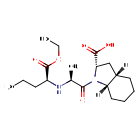
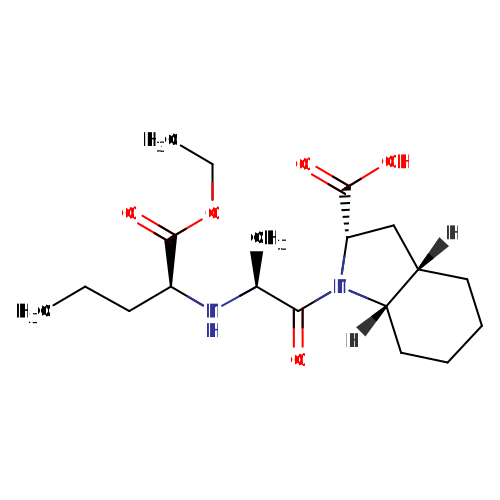
Structure for Perindopril (DB00790)
- Weight
- Average: 368.4678
Monoisotopic: 368.231122144 - Chemical Formula
- C19H32N2O5
- Synonyms
- (2S,3aS,7aS)-1-[(2S)-2-{[(2S)-1-ethoxy-1-oxopentan-2-yl]amino}propanoyl]octahydro-1H-indole-2-carboxylic acid
- Perindopril
- Perindoprilum

Pharmacology
- Indication
For the treatment of mild to moderate essential hypertension, mild to moderate congestive heart failure, and to reduce the cardiovascular risk of individuals with hypertension or post-myocardial infarction and stable coronary disease.
 Reduce drug development failure ratesBuild, train, & validate machine-learning modelswith evidence-based and structured datasets.Build, train, & validate predictive machine-learning models with structured datasets.
- Associated Conditions
Indication Type Indication Combined Product Details Approval Level Age Group Patient Characteristics Dose Form Used in combination to prevent Cardiovascular events Combination Product in combination with: Atorvastatin (DB01076) •••••••••••• ••••• •••••••••• •••••••••• •• •••••••••••• •••••••••••••• •• ••••••••• •••••• •••• •••••••••••••• •••• ••••••• Management of Diabetic nephropathy ••• ••••• Management of Essential hypertension •••••••••••• Used in combination to manage Hypertension Combination Product in combination with: Amlodipine (DB00381) •••••••••••• •••••••••• •••••••• •• ••••••••••• ••••••••••• Used in combination to manage Hypertension Combination Product in combination with: Indapamide (DB00808) •••••••••••• •••••••••• •••••••• •• ••••••••••• ••••••••••• - Contraindications & Blackbox Warnings
 Prevent Adverse Drug Events TodayTap into our Clinical API for life-saving information on contraindications & blackbox warnings, population restrictions, harmful risks, & more.Avoid life-threatening adverse drug events with our Clinical API
- Pharmacodynamics
Perindopril is a nonsulfhydryl prodrug that is metabolized via first pass effect (62%) and systemic hydrolysis (38%) to perindoprilat, its active metabolite, following oral administration. Perindoprilat lowers blood pressure by antagonizing the effect of the RAAS. The RAAS is a homeostatic mechanism for regulating hemodynamics, water and electrolyte balance. During sympathetic stimulation or when renal blood pressure or blood flow is reduced, renin is released from the granular cells of the juxtaglomerular apparatus in the kidneys. In the blood stream, renin cleaves circulating angiotensinogen to ATI, which is subsequently cleaved to ATII by ACE. ATII increases blood pressure using a number of mechanisms. First, it stimulates the secretion of aldosterone from the adrenal cortex. Aldosterone travels to the distal convoluted tubule (DCT) and collecting tubule of nephrons where it increases sodium and water reabsorption by increasing the number of sodium channels and sodium-potassium ATPases on cell membranes. Second, ATII stimulates the secretion of vasopressin (also known as antidiuretic hormone or ADH) from the posterior pituitary gland. ADH stimulates further water reabsorption from the kidneys via insertion of aquaporin-2 channels on the apical surface of cells of the DCT and collecting tubules. Third, ATII increases blood pressure through direct arterial vasoconstriction. Stimulation of the Type 1 ATII receptor on vascular smooth muscle cells leads to a cascade of events resulting in myocyte contraction and vasoconstriction. In addition to these major effects, ATII induces the thirst response via stimulation of hypothalamic neurons. ACE inhibitors inhibit the rapid conversion of ATI to ATII and antagonize RAAS-induced increases in blood pressure. ACE (also known as kininase II) is also involved in the enzymatic deactivation of bradykinin, a vasodilator. Inhibiting the deactivation of bradykinin increases bradykinin levels and may sustain the effects of perindoprilat by causing increased vasodilation and decreased blood pressure.
- Mechanism of action
There are two isoforms of ACE: the somatic isoform, which exists as a glycoprotein comprised of a single polypeptide chain of 1277; and the testicular isoform, which has a lower molecular mass and is thought to play a role in sperm maturation and binding of sperm to the oviduct epithelium. Somatic ACE has two functionally active domains, N and C, which arise from tandem gene duplication. Although the two domains have high sequence similarity, they play distinct physiological roles. The C-domain is predominantly involved in blood pressure regulation while the N-domain plays a role in hematopoietic stem cell differentiation and proliferation. ACE inhibitors bind to and inhibit the activity of both domains, but have much greater affinity for and inhibitory activity against the C-domain. Perindoprilat, the active metabolite of perindopril, competes with ATI for binding to ACE and inhibits and enzymatic proteolysis of ATI to ATII. Decreasing ATII levels in the body decreases blood pressure by inhibiting the pressor effects of ATII as described in the Pharmacology section above. Perindopril also causes an increase in plasma renin activity likely due to a loss of feedback inhibition mediated by ATII on the release of renin and/or stimulation of reflex mechanisms via baroreceptors.
Target Actions Organism AAngiotensin-converting enzyme inhibitorHumans USecreted frizzled-related protein 4 inhibitorHumans - Absorption
Rapidly absorbed with peak plasma concentrations occurring approximately 1 hour after oral administration. Bioavailability is 65-75%. Following absorption, perindopril is hydrolyzed to perindoprilat, which has an average bioavailability of 20%. The rate and extent of absorption is unaffected by food. However, food decreases the extent of biotransformation to peridoprilat and reduces its bioavailability by 35%.
- Volume of distribution
Not Available
- Protein binding
Perindoprilat, 10-20% bound to plasma proteins
- Metabolism
Extensively metabolized, with only 4-12% of the dose recovered in urine following oral administration. Six metabolites have been identified: perindoprilat, perindopril glucuronide, perindoprilat glucuronide, a perindopril lactam, and two perindoprilat lactams. Only perindoprilat is pharmacologically active. Peridoprilat and perindoprilat glucuronide are the two main circulating metabolites.
Hover over products below to view reaction partners
- Route of elimination
Perindopril is extensively metabolized following oral administration, with only 4 to 12% of the dose recovered unchanged in the urine.
- Half-life
Perindopril, 1.2 hours; Peridoprilat, 30-120 hours. The long half life of peridoprilat is due to its slow dissociation from ACE binding sites.
- Clearance
- 219 - 362 mL/min [oral administration]
- Adverse Effects
 Improve decision support & research outcomesWith structured adverse effects data, including: blackbox warnings, adverse reactions, warning & precautions, & incidence rates. View sample adverse effects data in our new Data Library!Improve decision support & research outcomes with our structured adverse effects data.
- Toxicity
The most likely symptom of overdose is severe hypotension. The most common adverse effects observed in controlled clinical trials include cough, digestive symptoms, fatigue, headache, and dizziness.
- Pathways
Pathway Category Perindopril Action Pathway Drug action - Pharmacogenomic Effects/ADRs
- Not Available
Interactions
- Drug Interactions
- This information should not be interpreted without the help of a healthcare provider. If you believe you are experiencing an interaction, contact a healthcare provider immediately. The absence of an interaction does not necessarily mean no interactions exist.
Drug Interaction Integrate drug-drug
interactions in your softwareAbacavir Perindopril may decrease the excretion rate of Abacavir which could result in a higher serum level. Abaloparatide The risk or severity of adverse effects can be increased when Perindopril is combined with Abaloparatide. Acebutolol Perindopril may increase the hypotensive activities of Acebutolol. Aceclofenac The risk or severity of renal failure, hyperkalemia, and hypertension can be increased when Aceclofenac is combined with Perindopril. Acemetacin The risk or severity of renal failure, hyperkalemia, and hypertension can be increased when Acemetacin is combined with Perindopril. - Food Interactions
- Avoid hypertensive herbs (e.g. bayberry, blue cohosh, cayenne, ephedra, and licorice).
- Avoid potassium-containing products. Potassium products increase the risk of hyperkalemia.
- Limit salt intake. Salt may attenuate the antihypertensive effect.
- Take with or without food. The absorption is unaffected by food.
Products
 Drug product information from 10+ global regionsOur datasets provide approved product information including:dosage, form, labeller, route of administration, and marketing period.Access drug product information from over 10 global regions.
- Product Ingredients
Ingredient UNII CAS InChI Key Perindopril arginine TFT5IM1KGB 612548-45-5 RYCSJJXKEWBUTI-YDYAIEMNSA-N Perindopril erbumine 1964X464OJ 107133-36-8 IYNMDWMQHSMDDE-MHXJNQAMSA-N Perindopril tosylate G092350E9M 1258291-80-3 FWZROZSADJGJER-MHXJNQAMSA-N - Active Moieties
Name Kind UNII CAS InChI Key Perindoprilat prodrug 2UV6ZNQ92K 95153-31-4 ODAIHABQVKJNIY-PEDHHIEDSA-N - Product Images


- Brand Name Prescription Products
Name Dosage Strength Route Labeller Marketing Start Marketing End Region Image Aceon Tablet 2 mg/1 Oral Symplmed Pharmaceuticals, Llc 2014-10-10 2017-03-01 US 
Aceon Tablet 8 mg/1 Oral Abbvie 2010-12-14 2014-01-01 US Aceon Tablet 4 mg/1 Oral XOMA (US) LLC 1993-12-30 Not applicable US Aceon Tablet 8 mg/1 Oral Symplmed Pharmaceuticals, Llc 2014-10-10 2017-03-01 US Aceon Tablet 8 mg/1 Oral Physicians Total Care, Inc. 2004-10-26 2011-06-30 US - Generic Prescription Products
Name Dosage Strength Route Labeller Marketing Start Marketing End Region Image Ag-perindopril Tablet 2 mg Oral Angita Pharma Inc. 2018-12-24 Not applicable Canada 
Ag-perindopril Tablet 8 mg Oral Angita Pharma Inc. 2018-12-24 Not applicable Canada Ag-perindopril Tablet 4 mg Oral Angita Pharma Inc. 2018-12-24 Not applicable Canada Ag-perindopril Erbumine Tablet 8 mg Oral Angita Pharma Inc. 2022-12-16 Not applicable Canada Ag-perindopril Erbumine Tablet 4 mg Oral Angita Pharma Inc. 2022-12-16 Not applicable Canada - Mixture Products
Name Ingredients Dosage Route Labeller Marketing Start Marketing End Region Image ACEPER PLUS 2 MG/0.625 MG TABLET, 30 ADET Perindopril erbumine (2 mg) + Indapamide (0.625 mg) Tablet Oral GENVEON İLAÇ SAN. VE TİC. A.Ş. 2020-08-14 Not applicable Turkey 
ACEPER PLUS 4 MG/1,25 MG TABLET, 30 ADET Perindopril (4 mg) + Indapamide (1.25 mg) Tablet Oral GENVEON İLAÇ SAN. VE TİC. A.Ş. 2011-05-05 Not applicable Turkey AMLOPER 4/5MG FILM KAPLI TABLET, 30 ADET Perindopril erbumine (4 mg) + Amlodipine besylate (5 mg) Tablet, coated Oral CELTİS İLAÇ SAN. VE TİC. A.Ş. 2020-08-14 Not applicable Turkey AMLOPER 4/5MG FILM KAPLI TABLET, 90 ADET Perindopril erbumine (4 mg) + Amlodipine besylate (5 mg) Tablet, coated Oral CELTİS İLAÇ SAN. VE TİC. A.Ş. 2013-03-26 Not applicable Turkey AMLOPER 8/10MG FILM KAPLI TABLET, 30 ADET Perindopril erbumine (8 mg) + Amlodipine besylate (10 mg) Tablet, coated Oral CELTİS İLAÇ SAN. VE TİC. A.Ş. 2020-08-14 Not applicable Turkey


Categories
- ATC Codes
- C09BX01 — Perindopril, amlodipine and indapamide
- C09BX — ACE inhibitors, other combinations
- C09B — ACE INHIBITORS, COMBINATIONS
- C09 — AGENTS ACTING ON THE RENIN-ANGIOTENSIN SYSTEM
- C — CARDIOVASCULAR SYSTEM
- C09BA — ACE inhibitors and diuretics
- C09B — ACE INHIBITORS, COMBINATIONS
- C09 — AGENTS ACTING ON THE RENIN-ANGIOTENSIN SYSTEM
- C — CARDIOVASCULAR SYSTEM
- C10BX — Lipid modifying agents in combination with other drugs
- C10B — LIPID MODIFYING AGENTS, COMBINATIONS
- C10 — LIPID MODIFYING AGENTS
- C — CARDIOVASCULAR SYSTEM
- C10BX — Lipid modifying agents in combination with other drugs
- C10B — LIPID MODIFYING AGENTS, COMBINATIONS
- C10 — LIPID MODIFYING AGENTS
- C — CARDIOVASCULAR SYSTEM
- C09AA — ACE inhibitors, plain
- C09A — ACE INHIBITORS, PLAIN
- C09 — AGENTS ACTING ON THE RENIN-ANGIOTENSIN SYSTEM
- C — CARDIOVASCULAR SYSTEM
- C09BX — ACE inhibitors, other combinations
- C09B — ACE INHIBITORS, COMBINATIONS
- C09 — AGENTS ACTING ON THE RENIN-ANGIOTENSIN SYSTEM
- C — CARDIOVASCULAR SYSTEM
- C10BX — Lipid modifying agents in combination with other drugs
- C10B — LIPID MODIFYING AGENTS, COMBINATIONS
- C10 — LIPID MODIFYING AGENTS
- C — CARDIOVASCULAR SYSTEM
- C09BB — ACE inhibitors and calcium channel blockers
- C09B — ACE INHIBITORS, COMBINATIONS
- C09 — AGENTS ACTING ON THE RENIN-ANGIOTENSIN SYSTEM
- C — CARDIOVASCULAR SYSTEM
- C10BX — Lipid modifying agents in combination with other drugs
- C10B — LIPID MODIFYING AGENTS, COMBINATIONS
- C10 — LIPID MODIFYING AGENTS
- C — CARDIOVASCULAR SYSTEM
- C10BX — Lipid modifying agents in combination with other drugs
- C10B — LIPID MODIFYING AGENTS, COMBINATIONS
- C10 — LIPID MODIFYING AGENTS
- C — CARDIOVASCULAR SYSTEM
- Drug Categories
- ACE Inhibitors and Calcium Channel Blockers
- ACE Inhibitors and Diuretics
- Agents Acting on the Renin-Angiotensin System
- Agents causing angioedema
- Agents causing hyperkalemia
- Alkanes
- Amines
- Angiotensin-Converting Enzyme Inhibitors
- Antihypertensive Agents
- Antihypertensive Agents Indicated for Hypertension
- Butanes
- Cardiovascular Agents
- Cholinesterase Inhibitors
- Drugs that are Mainly Renally Excreted
- Enzyme Inhibitors
- Heterocyclic Compounds, Fused-Ring
- Hydrocarbons, Acyclic
- Hypotensive Agents
- Indoles
- Lipid Modifying Agents
- Protease Inhibitors
- Chemical TaxonomyProvided by Classyfire
- Description
- This compound belongs to the class of organic compounds known as dipeptides. These are organic compounds containing a sequence of exactly two alpha-amino acids joined by a peptide bond.
- Kingdom
- Organic compounds
- Super Class
- Organic acids and derivatives
- Class
- Carboxylic acids and derivatives
- Sub Class
- Amino acids, peptides, and analogues
- Direct Parent
- Dipeptides
- Alternative Parents
- Alpha amino acid esters / N-acyl-L-alpha-amino acids / Alpha amino acid amides / Indoles and derivatives / Pyrrolidine carboxylic acids / N-acylpyrrolidines / Fatty acid esters / Dicarboxylic acids and derivatives / Tertiary carboxylic acid amides / Carboxylic acid esters show 8 more
- Substituents
- Aliphatic heteropolycyclic compound / Alpha-amino acid amide / Alpha-amino acid ester / Alpha-amino acid or derivatives / Alpha-dipeptide / Amine / Amino acid / Amino acid or derivatives / Azacycle / Carbonyl group show 25 more
- Molecular Framework
- Aliphatic heteropolycyclic compounds
- External Descriptors
- dicarboxylic acid monoester, ethyl ester, alpha-amino acid ester, organic heterobicyclic compound (CHEBI:8024)
- Affected organisms
- Humans and other mammals
Chemical Identifiers
- UNII
- Y5GMK36KGY
- CAS number
- 82834-16-0
- InChI Key
- IPVQLZZIHOAWMC-QXKUPLGCSA-N
- InChI
- InChI=1S/C19H32N2O5/c1-4-8-14(19(25)26-5-2)20-12(3)17(22)21-15-10-7-6-9-13(15)11-16(21)18(23)24/h12-16,20H,4-11H2,1-3H3,(H,23,24)/t12-,13-,14-,15-,16-/m0/s1
- IUPAC Name
- (2S,3aS,7aS)-1-[(2S)-2-{[(2S)-1-ethoxy-1-oxopentan-2-yl]amino}propanoyl]-octahydro-1H-indole-2-carboxylic acid
- SMILES
- [H][C@]12C[C@H](N(C(=O)[C@H](C)N[C@@H](CCC)C(=O)OCC)[C@@]1([H])CCCC2)C(O)=O
References
- Synthesis Reference
Michel Vincent, Jean Baliarda, Bernard Marchand, Georges Remond, "Process for the industrial synthesis of perindopril." U.S. Patent US4914214, issued April 03, 1990.
US4914214- General References
- Hurst M, Jarvis B: Perindopril: an updated review of its use in hypertension. Drugs. 2001;61(6):867-96. [Article]
- Jastrzebskal M, Widecka K, Naruszewicz M, Ciechanowicz A, Janczak-Bazan A, Foltynska A, Goracy I, Chetstowski K, Wesotowska T: Effects of perindopril treatment on hemostatic function in patients with essential hypertension in relation to angiotensin converting enzyme (ACE) and plasminogen activator inhibitor-1 (PAI-1) gene polymorphisms. Nutr Metab Cardiovasc Dis. 2004 Oct;14(5):259-69. [Article]
- Parker E, Aarons L, Rowland M, Resplandy G: The pharmacokinetics of perindoprilat in normal volunteers and patients: influence of age and disease state. Eur J Pharm Sci. 2005 Sep;26(1):104-13. [Article]
- Simpson D, Noble S, Goa KL: Perindopril: in congestive heart failure. Drugs. 2002;62(9):1367-77; discussion 1378-9. [Article]
- Yasumatsu R, Nakashima T, Masuda M, Ito A, Kuratomi Y, Nakagawa T, Komune S: Effects of the angiotensin-I converting enzyme inhibitor perindopril on tumor growth and angiogenesis in head and neck squamous cell carcinoma cells. J Cancer Res Clin Oncol. 2004 Oct;130(10):567-73. Epub 2004 Jul 27. [Article]
- Yoshiji H, Kuriyama S, Kawata M, Yoshii J, Ikenaka Y, Noguchi R, Nakatani T, Tsujinoue H, Fukui H: The angiotensin-I-converting enzyme inhibitor perindopril suppresses tumor growth and angiogenesis: possible role of the vascular endothelial growth factor. Clin Cancer Res. 2001 Apr;7(4):1073-8. [Article]
- External Links
- Human Metabolome Database
- HMDB0014928
- KEGG Drug
- D03753
- KEGG Compound
- C07706
- PubChem Compound
- 107807
- PubChem Substance
- 46508767
- ChemSpider
- 96956
- BindingDB
- 50493988
- 54552
- ChEBI
- 8024
- ChEMBL
- CHEMBL1581
- ZINC
- ZINC000003812867
- Therapeutic Targets Database
- DNC001114
- PharmGKB
- PA450877
- RxList
- RxList Drug Page
- Drugs.com
- Drugs.com Drug Page
- PDRhealth
- PDRhealth Drug Page
- Wikipedia
- Perindopril
- FDA label
- Download (149 KB)
Clinical Trials
- Clinical Trials
Phase Status Purpose Conditions Count 4 Completed Treatment Blood Pressures / Chronic Kidney Disease (CKD) / Proteinuria 1 4 Completed Treatment Hypertension 6 4 Completed Treatment Hypertension / Hyperuricemia / Menopause 1 4 Completed Treatment Hypertension / Type 2 Diabetes Mellitus 2 4 Completed Treatment Induction of Intraoperative Hypotension 1
Pharmacoeconomics
- Manufacturers
- Abbott products inc
- Aurobindo pharma ltd
- Ivax pharmaceuticals inc
- Lupin ltd
- Roxane laboratories inc
- Packagers
- Aurobindo Pharma Ltd.
- Inyx Usa Ltd.
- Ipca Laboratories Ltd.
- Lupin Pharmaceuticals Inc.
- Murfreesboro Pharmaceutical Nursing Supply
- Roxane Labs
- Servier Canada Inc.
- Solvay Pharmaceuticals
- Dosage Forms
Form Route Strength Tablet, coated Oral Tablet Oral 10 mg Tablet Oral 2.5 mg Tablet Oral 5 mg Tablet, film coated Oral Tablet, film coated Oral 2.5 MG Tablet Oral 2 mg Tablet, film coated Oral 6.790 mg Tablet Oral 4 mg Tablet, film coated Oral 3.395 mg Tablet, coated Oral 10 mg Tablet, coated Oral 5 mg Tablet, orally disintegrating Oral 10 mg Tablet, orally disintegrating Oral 2.5 mg Tablet, orally disintegrating Oral 5 mg Tablet, film coated Oral 0.625 mg Tablet, film coated Oral 1.25 mg Tablet Oral 1.25 mg Tablet Oral 8 mg Capsule Oral Tablet Oral 4.00 mg Tablet Oral Tablet, film coated, extended release Oral Tablet, film coated Oral 2 mg Tablet, film coated Oral 4 mg Tablet Oral 2 mg/1 Tablet Oral 4 mg/1 Tablet Oral 8 mg/1 Tablet Oral 4.0 mg Tablet, coated Oral 2.5 mg Tablet Oral Tablet Oral 0.625 mg Tablet, film coated Oral Tablet, film coated Oral 5 mg Tablet, film coated Oral 10 mg Tablet, film coated Oral 10 mg Tablet, film coated Oral 5 mg - Prices
Unit description Cost Unit Aceon 8 mg tablet 3.14USD tablet Perindopril erbumine 8 mg tablet 2.8USD tablet Aceon 4 mg tablet 2.58USD tablet Perindopril erbumine 4 mg tablet 2.3USD tablet Aceon 2 mg tablet 2.22USD tablet Perindopril erbumine 2 mg tablet 1.98USD tablet Coversyl 8 mg Tablet 1.23USD tablet Coversyl 4 mg Tablet 0.88USD tablet Coversyl 2 mg Tablet 0.7USD tablet DrugBank does not sell nor buy drugs. Pricing information is supplied for informational purposes only.- Patents
Patent Number Pediatric Extension Approved Expires (estimated) Region US5162362 No 1992-11-10 2009-11-10 US CA2473205 No 2010-05-18 2023-01-22 Canada CA1341196 No 2001-03-06 2018-03-06 Canada US7846961 No 2010-12-07 2029-10-05 US US6696481 No 2004-02-24 2023-04-15 US
Properties
- State
- Solid
- Experimental Properties
Property Value Source logP 2.6 Not Available - Predicted Properties
Property Value Source Water Solubility 1.22 mg/mL ALOGPS logP 0.56 ALOGPS logP 0.63 Chemaxon logS -2.5 ALOGPS pKa (Strongest Acidic) 3.79 Chemaxon pKa (Strongest Basic) 5.48 Chemaxon Physiological Charge -1 Chemaxon Hydrogen Acceptor Count 5 Chemaxon Hydrogen Donor Count 2 Chemaxon Polar Surface Area 95.94 Å2 Chemaxon Rotatable Bond Count 9 Chemaxon Refractivity 95.69 m3·mol-1 Chemaxon Polarizability 39.99 Å3 Chemaxon Number of Rings 2 Chemaxon Bioavailability 1 Chemaxon Rule of Five Yes Chemaxon Ghose Filter Yes Chemaxon Veber's Rule No Chemaxon MDDR-like Rule No Chemaxon - Predicted ADMET Features
Property Value Probability Human Intestinal Absorption + 0.9156 Blood Brain Barrier - 0.8411 Caco-2 permeable - 0.7871 P-glycoprotein substrate Substrate 0.6826 P-glycoprotein inhibitor I Inhibitor 0.5 P-glycoprotein inhibitor II Inhibitor 0.8589 Renal organic cation transporter Non-inhibitor 0.919 CYP450 2C9 substrate Non-substrate 0.8638 CYP450 2D6 substrate Non-substrate 0.8542 CYP450 3A4 substrate Substrate 0.549 CYP450 1A2 substrate Non-inhibitor 0.8796 CYP450 2C9 inhibitor Non-inhibitor 0.8612 CYP450 2D6 inhibitor Non-inhibitor 0.9088 CYP450 2C19 inhibitor Non-inhibitor 0.8375 CYP450 3A4 inhibitor Non-inhibitor 0.7142 CYP450 inhibitory promiscuity Low CYP Inhibitory Promiscuity 0.5951 Ames test Non AMES toxic 0.8814 Carcinogenicity Non-carcinogens 0.9266 Biodegradation Not ready biodegradable 0.9082 Rat acute toxicity 1.9432 LD50, mol/kg Not applicable hERG inhibition (predictor I) Weak inhibitor 0.9839 hERG inhibition (predictor II) Non-inhibitor 0.8678
Spectra
- Mass Spec (NIST)
- Not Available
- Spectra
Spectrum Spectrum Type Splash Key Predicted GC-MS Spectrum - GC-MS Predicted GC-MS splash10-006t-9432000000-cd5a3e77250a4c168d5f Predicted MS/MS Spectrum - 10V, Positive (Annotated) Predicted LC-MS/MS splash10-014j-1039000000-b957a673d9629f4c21ea Predicted MS/MS Spectrum - 10V, Negative (Annotated) Predicted LC-MS/MS splash10-014r-0009000000-334d0b178dc9f6fc18de Predicted MS/MS Spectrum - 20V, Positive (Annotated) Predicted LC-MS/MS splash10-0005-8964000000-9f0d93ae0e844e61b5b0 Predicted MS/MS Spectrum - 20V, Negative (Annotated) Predicted LC-MS/MS splash10-0gb9-2913000000-f04e410ea5b599a6f73b Predicted MS/MS Spectrum - 40V, Negative (Annotated) Predicted LC-MS/MS splash10-014i-0900000000-602da46b0a9be040723d Predicted MS/MS Spectrum - 40V, Positive (Annotated) Predicted LC-MS/MS splash10-00dj-5920000000-78c3bf8e9c381d8424f8 Predicted 1H NMR Spectrum 1D NMR Not Applicable Predicted 13C NMR Spectrum 1D NMR Not Applicable - Chromatographic Properties
Collision Cross Sections (CCS)
Adduct CCS Value (Å2) Source type Source [M-H]- 202.7032343 predictedDarkChem Lite v0.1.0 [M-H]- 195.1227 predictedDeepCCS 1.0 (2019) [M+H]+ 203.5029343 predictedDarkChem Lite v0.1.0 [M+H]+ 197.51825 predictedDeepCCS 1.0 (2019) [M+Na]+ 202.3678343 predictedDarkChem Lite v0.1.0 [M+Na]+ 203.4308 predictedDeepCCS 1.0 (2019)
Targets

- Kind
- Protein
- Organism
- Humans
- Pharmacological action
- Yes
- Actions
- Inhibitor
- General Function
- Zinc ion binding
- Specific Function
- Converts angiotensin I to angiotensin II by release of the terminal His-Leu, this results in an increase of the vasoconstrictor activity of angiotensin. Also able to inactivate bradykinin, a potent...
- Gene Name
- ACE
- Uniprot ID
- P12821
- Uniprot Name
- Angiotensin-converting enzyme
- Molecular Weight
- 149713.675 Da
References
- Alfakih K, Hall AS: Perindopril. Expert Opin Pharmacother. 2006 Jan;7(1):63-71. [Article]
- Brugts JJ, Ferrari R, Simoons ML: Angiotensin-converting enzyme inhibition by perindopril in the treatment of cardiovascular disease. Expert Rev Cardiovasc Ther. 2009 Apr;7(4):345-60. doi: 10.1586/erc.09.2. [Article]
- Chen X, Ji ZL, Chen YZ: TTD: Therapeutic Target Database. Nucleic Acids Res. 2002 Jan 1;30(1):412-5. [Article]
- Song JC, White CM: Clinical pharmacokinetics and selective pharmacodynamics of new angiotensin converting enzyme inhibitors: an update. Clin Pharmacokinet. 2002;41(3):207-24. [Article]
- Kind
- Protein
- Organism
- Humans
- Pharmacological action
- Unknown
- Actions
- Inhibitor
- General Function
- Soluble frizzled-related proteins (sFRPS) function as modulators of Wnt signaling through direct interaction with Wnts. They have a role in regulating cell growth and differentiation in specific cell types (By similarity). SFRP4 plays a role in bone morphogenesis. May also act as a regulator of adult uterine morphology and function. May also increase apoptosis during ovulation possibly through modulation of FZ1/FZ4/WNT4 signaling (By similarity). Has phosphaturic effects by specifically inhibiting sodium-dependent phosphate uptake (PubMed:12952927).
- Specific Function
- Wnt-protein binding
- Gene Name
- SFRP4
- Uniprot ID
- Q6FHJ7
- Uniprot Name
- Secreted frizzled-related protein 4
- Molecular Weight
- 39826.305 Da
References
- Bukhari SA, Shamshari WA, Ur-Rahman M, Zia-Ul-Haq M, Jaafar HZ: Computer aided screening of secreted frizzled-related protein 4 (SFRP4): a potential control for diabetes mellitus. Molecules. 2014 Jul 11;19(7):10129-36. doi: 10.3390/molecules190710129. [Article]
Enzymes
- Kind
- Protein
- Organism
- Humans
- Pharmacological action
- Unknown
- Actions
- Inhibitor
- General Function
- Identical protein binding
- Specific Function
- Esterase with broad substrate specificity. Contributes to the inactivation of the neurotransmitter acetylcholine. Can degrade neurotoxic organophosphate esters.
- Gene Name
- BCHE
- Uniprot ID
- P06276
- Uniprot Name
- Cholinesterase
- Molecular Weight
- 68417.575 Da
References
- Mehta A, Iyer L, Parmar S, Shah G, Goyal R: Oculohypotensive effect of perindopril in acute and chronic models of glaucoma in rabbits. Can J Physiol Pharmacol. 2010 May;88(5):595-600. doi: 10.1139/y10-026. [Article]
Transporters
- Kind
- Protein
- Organism
- Humans
- Pharmacological action
- Unknown
- Actions
- Substrate
- General Function
- Proton-dependent oligopeptide secondary active transmembrane transporter activity
- Specific Function
- Proton-coupled intake of oligopeptides of 2 to 4 amino acids with a preference for dipeptides. May constitute a major route for the absorption of protein digestion end-products.
- Gene Name
- SLC15A1
- Uniprot ID
- P46059
- Uniprot Name
- Solute carrier family 15 member 1
- Molecular Weight
- 78805.265 Da
References
- Knutter I, Wollesky C, Kottra G, Hahn MG, Fischer W, Zebisch K, Neubert RH, Daniel H, Brandsch M: Transport of angiotensin-converting enzyme inhibitors by H+/peptide transporters revisited. J Pharmacol Exp Ther. 2008 Nov;327(2):432-41. doi: 10.1124/jpet.108.143339. Epub 2008 Aug 19. [Article]
- Kind
- Protein
- Organism
- Humans
- Pharmacological action
- Unknown
- Actions
- Substrate
- General Function
- Peptide:proton symporter activity
- Specific Function
- Proton-coupled intake of oligopeptides of 2 to 4 amino acids with a preference for dipeptides.
- Gene Name
- SLC15A2
- Uniprot ID
- Q16348
- Uniprot Name
- Solute carrier family 15 member 2
- Molecular Weight
- 81782.77 Da
References
- Knutter I, Wollesky C, Kottra G, Hahn MG, Fischer W, Zebisch K, Neubert RH, Daniel H, Brandsch M: Transport of angiotensin-converting enzyme inhibitors by H+/peptide transporters revisited. J Pharmacol Exp Ther. 2008 Nov;327(2):432-41. doi: 10.1124/jpet.108.143339. Epub 2008 Aug 19. [Article]

Drug created at June 13, 2005 13:24 / Updated at April 26, 2024 00:45