Identification
- Summary
Dicyclomine is an antimuscarinic agent used to treat IBS.
- Brand Names
- Bentyl
- Generic Name
- Dicyclomine
- DrugBank Accession Number
- DB00804
- Background
Dicyclomine is a muscarinic M1, M3, and M2 receptor antagonist as well as a non-competitive inhibitor of histamine and bradykinin used to treat spasms of the intestines seen in functional bowel disorder and irritable bowel syndrome.3,4,5,6 Though it is commonly prescribed, its recommendation may have been based on a small amount of evidence and so its prescription is becoming less favourable.7
Dicyclomine was granted FDA approval on 11 May 1950.6
- Type
- Small Molecule
- Groups
- Approved
- Structure

Structure for Dicyclomine (DB00804)
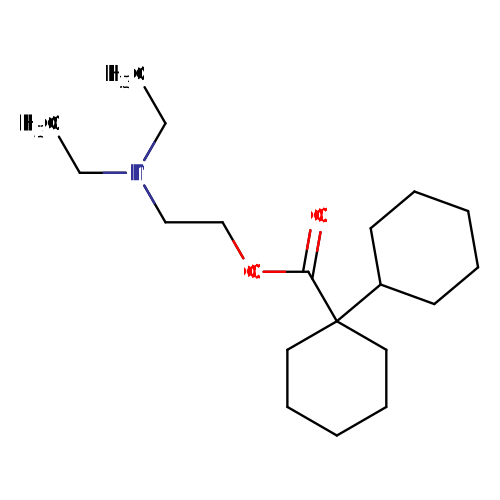
- Weight
- Average: 309.4867
Monoisotopic: 309.266779369 - Chemical Formula
- C19H35NO2
- Synonyms
- 2-(diethylamino)ethyl 1-cyclohexylcyclohexanecarboxylate
- Bicyclohexyl-1-carboxylic acid 2-diethylamino-ethyl ester
- Dicicloverina
- Dicyclomine
- Dicycloverin
- Dicycloverine
- Dicycloverinum

Pharmacology
- Indication
Dicyclomine is indicated for the treatment of functional bowel disorder and irritable bowel syndrome.6
 Reduce drug development failure ratesBuild, train, & validate machine-learning modelswith evidence-based and structured datasets.Build, train, & validate predictive machine-learning models with structured datasets.
- Associated Conditions
Indication Type Indication Combined Product Details Approval Level Age Group Patient Characteristics Dose Form Symptomatic treatment of Functional bowel syndrome •••••••••••• Symptomatic treatment of Irritable bowel syndrome •••••••••••• Used in combination to treat Gastrointestinal cramps caused by gas Combination Product in combination with: Simethicone (DB09512) •••••••••••• ••••••••• •••••• ••••• - Contraindications & Blackbox Warnings
 Prevent Adverse Drug Events TodayTap into our Clinical API for life-saving information on contraindications & blackbox warnings, population restrictions, harmful risks, & more.Avoid life-threatening adverse drug events with our Clinical API
- Pharmacodynamics
Dicyclomine is an anticholinergic drug used to relax the smooth muscles of the intestines.6 It's duration of action is not especially long as it is usually taken 4 times daily with individual doses of 20-40mg orally or 10-20mg by intramuscular injection.6 Dicyclomine should not be administered intravenously.6
- Mechanism of action
Dicyclomine achieves its action partially through direct antimuscarinic activity of the M1, M3, and M2 receptors; and partially through antagonism of bradykinin and histamine.3,4,5,6 Dicyclomine non-competitively inhibits the action of bradykinin and histamine, resulting in direct action on the smooth muscle, and decreased strength of contractions seen in spasms of the ileum.4
Target Actions Organism AMuscarinic acetylcholine receptor M1 antagonistHumans UMuscarinic acetylcholine receptor M3 antagonistHumans UMuscarinic acetylcholine receptor M2 antagonistHumans - Absorption
The bioavailability of dicyclomine has not been determined,2 though it is likely well absorbed as the primary route of elimination is in the urine.1,6 Dicyclomine has a Tmax of 1-1.5h.6
- Volume of distribution
The volume of distribution for a 20mg oral dose is 3.65L/kg.6
- Protein binding
Data regarding plasma protein binding of dicyclomine is not readily available.6
- Metabolism
The metabolism of dicyclomine has not been well researched.1
- Route of elimination
Dicyclomine is 79.5% eliminated in the urine and 8.4% in the feces.1,6
- Half-life
The mean plasma elimination half life is approximately 1.8 hours.1,6
- Clearance
Data regarding the clearance of dicyclomine is not readily available.6
- Adverse Effects
 Improve decision support & research outcomesWith structured adverse effects data, including: blackbox warnings, adverse reactions, warning & precautions, & incidence rates. View sample adverse effects data in our new Data Library!Improve decision support & research outcomes with our structured adverse effects data.
- Toxicity
Patients experiencing an overdose may present with headache, nausea, vomiting, blurred vision, dilated pupils, dizziness, dry mouth, difficulty swallowing, CNS stimulation, as well as hot, dry skin.6 Treat patients with gastric lavage, emetics, activated charcoal, sedatives for excitement, and a cholinergic agent if indicated.6
The oral LD50 in mice is 625mg/kg.6
- Pathways
- Not Available
- Pharmacogenomic Effects/ADRs
- Not Available
Interactions
- Drug Interactions
- This information should not be interpreted without the help of a healthcare provider. If you believe you are experiencing an interaction, contact a healthcare provider immediately. The absence of an interaction does not necessarily mean no interactions exist.
Drug Interaction Integrate drug-drug
interactions in your softwareAbacavir Dicyclomine may decrease the excretion rate of Abacavir which could result in a higher serum level. Aceclofenac Aceclofenac may decrease the excretion rate of Dicyclomine which could result in a higher serum level. Acemetacin Acemetacin may decrease the excretion rate of Dicyclomine which could result in a higher serum level. Acetaminophen Acetaminophen may decrease the excretion rate of Dicyclomine which could result in a higher serum level. Acetazolamide Acetazolamide may increase the excretion rate of Dicyclomine which could result in a lower serum level and potentially a reduction in efficacy. - Food Interactions
- Avoid alcohol. Alcohol may increase drowsiness caused by dicyclomine.
- Drink plenty of fluids. Dicyclomine may reduce sweating, increasing the risk of overheating in warm weather or during exercise.
Products
 Drug product information from 10+ global regionsOur datasets provide approved product information including:dosage, form, labeller, route of administration, and marketing period.Access drug product information from over 10 global regions.
- Product Ingredients
Ingredient UNII CAS InChI Key Dicyclomine hydrochloride CQ903KQA31 67-92-5 GUBNMFJOJGDCEL-UHFFFAOYSA-N - Product Images
- International/Other Brands
- Byclomine / Di-Spaz / Dibent / Dilomine / Dyspas (Savage) / Merbentyl (Sanofi)
- Brand Name Prescription Products
Name Dosage Strength Route Labeller Marketing Start Marketing End Region Image Bentyl Syrup 10 mg/5mL Oral Axcan Scandipharm Inc. 2006-10-23 2006-10-23 US 
Bentyl Injection, solution 20 mg/2mL Intramuscular Allergan, Inc. 1952-08-13 2025-04-30 US Bentyl Tablet 20.6 mg/1 Oral Physicians Total Care, Inc. 1950-05-11 2011-06-30 US Bentyl Capsule 10 mg/1 Oral Allergan, Inc. 1950-05-11 2018-08-31 US Bentyl Tablet 20.6 mg/1 Oral Allergan, Inc. 1950-05-11 Not applicable US - Generic Prescription Products
Name Dosage Strength Route Labeller Marketing Start Marketing End Region Image Dicyclomine Tablet 20 mg/1 Oral Stat Rx USA 1996-10-01 Not applicable US 
Dicyclomine Tablet 20 mg/1 Oral Liberty Pharmaceuticals, Inc. 1996-10-01 2015-03-05 US Dicyclomine Tablet 20 mg/1 Oral H.J. Harkins Company 1996-10-01 Not applicable US 
Dicyclomine Tablet 20 mg/1 Oral RedPharm Drug, Inc. 2020-01-01 Not applicable US Dicyclomine Tablet 20 mg/1 Oral Remedy Repack 2013-03-15 2013-08-23 US - Over the Counter Products
Name Dosage Strength Route Labeller Marketing Start Marketing End Region Image RELESTAL PEDIATRIC SYRUP 10 mg/5 ml Syrup 10 mg/5ml Oral FAR EAST DRUG COMPANY (PRIVATE) LIMITED 2003-04-25 Not applicable Singapore 
- Mixture Products
Name Ingredients Dosage Route Labeller Marketing Start Marketing End Region Image ACOLIC SYRUP Dicyclomine hydrochloride (5 mg/5ml) + Simethicone (50 mg/5ml) Syrup Oral GOLDPLUS UNIVERSAL PTE LTD 1998-04-11 Not applicable Singapore COLIMIX SYRUP Dicyclomine hydrochloride (5 mg/5ml) + Simethicone (50 mg/5ml) Syrup Oral APEX PHARMA MARKETING PTE. LTD. 1989-06-16 Not applicable Singapore Diclophen Dicyclomine hydrochloride (10 mg) + Phenobarbital (15 mg) Capsule Oral Pro Doc Limitee 1970-12-31 2009-07-23 Canada 
SPASMANOL PAEDIATRIC DROPS Dicyclomine (10 MG/1ML) + Simethicone (40 MG/1ML) Syrup Oral บริษัท ฟาร์มาแลนด์ (1982) จำกัด 2018-01-17 Not applicable Thailand 
Spasmo Nil Tab Dicyclomine hydrochloride (2.5 mg) + Aluminum hydroxide (75 mg) + Dimethicone (7.5 mg) + Magnesium trisilicate (75 mg) Tablet Oral Duchesnay Inc. 1978-12-31 2003-07-18 Canada


Categories
- ATC Codes
- A03AA07 — Dicycloverine
- Drug Categories
- Acids, Carbocyclic
- Agents producing tachycardia
- Alimentary Tract and Metabolism
- Anticholinergic Agents
- Antimuscarinics Antispasmodics
- Autonomic Agents
- Cholinergic Agents
- Cyclohexanecarboxylic Acids
- Cyclohexanes
- Cycloparaffins
- Drugs for Functional Gastrointestinal Disorders
- Drugs that are Mainly Renally Excreted
- Muscarinic Antagonists
- Neurotransmitter Agents
- Parasympatholytics
- Peripheral Nervous System Agents
- Synthetic Anticholinergics, Esters With Tertiary Amino Group
- Chemical TaxonomyProvided by Classyfire
- Description
- This compound belongs to the class of organic compounds known as carboxylic acid esters. These are carboxylic acid derivatives in which the carbon atom from the carbonyl group is attached to an alkyl or an aryl moiety through an oxygen atom (forming an ester group).
- Kingdom
- Organic compounds
- Super Class
- Organic acids and derivatives
- Class
- Carboxylic acids and derivatives
- Sub Class
- Carboxylic acid derivatives
- Direct Parent
- Carboxylic acid esters
- Alternative Parents
- Trialkylamines / Amino acids and derivatives / Monocarboxylic acids and derivatives / Organopnictogen compounds / Organic oxides / Hydrocarbon derivatives / Carbonyl compounds
- Substituents
- Aliphatic homomonocyclic compound / Amine / Amino acid or derivatives / Carbonyl group / Carboxylic acid ester / Hydrocarbon derivative / Monocarboxylic acid or derivatives / Organic nitrogen compound / Organic oxide / Organic oxygen compound
- Molecular Framework
- Aliphatic homomonocyclic compounds
- External Descriptors
- tertiary amine, carboxylic ester (CHEBI:4514)
- Affected organisms
- Humans and other mammals
Chemical Identifiers
- UNII
- 4KV4X8IF6V
- CAS number
- 77-19-0
- InChI Key
- CURUTKGFNZGFSE-UHFFFAOYSA-N
- InChI
- InChI=1S/C19H35NO2/c1-3-20(4-2)15-16-22-18(21)19(13-9-6-10-14-19)17-11-7-5-8-12-17/h17H,3-16H2,1-2H3
- IUPAC Name
- 2-(diethylamino)ethyl [1,1'-bi(cyclohexane)]-1-carboxylate
- SMILES
- CCN(CC)CCOC(=O)C1(CCCCC1)C1CCCCC1
References
- Synthesis Reference
Van Campen, M.G. Jr. and Tilford, C.H.; US.Patent 2,474,796; June 28, 1949; assigned to The Wm. S. Merrell Company.
- General References
- Danhof I, Schreiber E, Wiggans D, Leyland H: Metabolic dynamics of dicyclomine hydrochloride in man as influenced by various dose schedules and formulations Toxicology and Applied Pharmacology. 1967 Dec 18;13(1):16-23. [Article]
- Walker BJ, Lang JF, Okerholm RA: Quantitative analysis of dicyclomine in human plasma by capillary gas chromatography and nitrogen-selective detection. J Chromatogr. 1987 Apr 24;416(1):150-3. doi: 10.1016/0378-4347(87)80496-6. [Article]
- Pavia J, Munoz M, Jimenez E, Martos F, Gonzalez-Correa JA, De la Cruz JP, Garcia V, Sanchez de la Cuesta F: Pharmacological characterization and distribution of muscarinic receptors in human placental syncytiotrophoblast brush-border and basal plasma membranes. Eur J Pharmacol. 1997 Feb 12;320(2-3):209-14. [Article]
- MCGRATH WR, LEWIS RE, KUHN WL: THE DUAL MODE OF THE ANTISPASMODIC EFFECT OF DICYCLOMINE HYDROCHLORIDE. J Pharmacol Exp Ther. 1964 Dec;146:354-8. [Article]
- Doods HN, Mathy MJ, Davidesko D, van Charldorp KJ, de Jonge A, van Zwieten PA: Selectivity of muscarinic antagonists in radioligand and in vivo experiments for the putative M1, M2 and M3 receptors. J Pharmacol Exp Ther. 1987 Jul;242(1):257-62. [Article]
- FDA Approved Drug Products: Dicyclomine Oral Capsules, Oral Tablets, and Intramuscular Injections [Link]
- Canadian Agency for Drugs and Technologies in Health: Dicyclomine for Gastrointestinal Conditions: A Review of the Clinical Effectiveness, Safety, and Guidelines [Link]
- External Links
- Human Metabolome Database
- HMDB0014942
- KEGG Compound
- C06951
- PubChem Compound
- 3042
- PubChem Substance
- 46505371
- ChemSpider
- 2934
- BindingDB
- 50010101
- 3361
- ChEBI
- 4514
- ChEMBL
- CHEMBL1123
- ZINC
- ZINC000001530613
- Therapeutic Targets Database
- DAP001118
- PharmGKB
- PA164744928
- Guide to Pharmacology
- GtP Drug Page
- RxList
- RxList Drug Page
- Drugs.com
- Drugs.com Drug Page
- Wikipedia
- Dicycloverine
- FDA label
- Download (230 KB)
Clinical Trials
Pharmacoeconomics
- Manufacturers
- Axcan pharma us inc
- Lannett co inc
- Mutual pharmaceutical co inc
- Mylan pharmaceuticals inc
- Pioneer pharmaceuticals inc
- Watson laboratories inc
- West ward pharmaceutical corp
- Bedford laboratories div ben venue laboratories inc
- Alpharma us pharmaceuticals division
- Mikart inc
- Packagers
- Advanced Pharmaceutical Services Inc.
- Amerisource Health Services Corp.
- Apotheca Inc.
- A-S Medication Solutions LLC
- Atlantic Biologicals Corporation
- Axcan Pharma Inc.
- Bedford Labs
- Ben Venue Laboratories Inc.
- Bryant Ranch Prepack
- Cardinal Health
- Comprehensive Consultant Services Inc.
- Dept Health Central Pharmacy
- Direct Dispensing Inc.
- Dispensing Solutions
- Diversified Healthcare Services Inc.
- Endo Pharmaceuticals Inc.
- Gallipot
- H.J. Harkins Co. Inc.
- Heartland Repack Services LLC
- Huffman Laboratories
- International Ethical Labs Inc.
- Lannett Co. Inc.
- Liberty Pharmaceuticals
- Major Pharmaceuticals
- Merrell Pharmaceuticals Inc.
- Mikart Inc.
- Murfreesboro Pharmaceutical Nursing Supply
- Mylan
- Nucare Pharmaceuticals Inc.
- Palmetto Pharmaceuticals Inc.
- Patheon Inc.
- Patient First Corp.
- PCA LLC
- PD-Rx Pharmaceuticals Inc.
- Pharma Pac LLC
- Pharmedix
- Physicians Total Care Inc.
- Preferred Pharmaceuticals Inc.
- Prepackage Specialists
- Prepak Systems Inc.
- Qualitest
- Rebel Distributors Corp.
- Redpharm Drug
- Remedy Repack
- Resource Optimization and Innovation LLC
- Santec Chemicals Corp.
- Southwood Pharmaceuticals
- Stat Rx Usa
- Taylor Pharmaceuticals
- Tya Pharmaceuticals
- UDL Laboratories
- United Research Laboratories Inc.
- Vangard Labs Inc.
- Veratex Corp.
- Watson Pharmaceuticals
- West-Ward Pharmaceuticals
- Dosage Forms
Form Route Strength Capsule Oral 10.000 mg Syrup Oral 10 mg/5mL Tablet Oral 20.6 mg/1 Syrup Oral 10 mg / 5 mL Tablet, extended release Oral 30 mg / tab Liquid Intramuscular 10 mg / mL Tablet Oral 20 mg Syrup Oral Syrup Oral 5 mg/5ml Capsule Oral Injection Intramuscular 20 mg/2mL Tablet Oral 20 mg/1 Capsule Oral 10 mg/1 Injection Intramuscular 10 mg/1mL Injection, solution Intramuscular 10 mg/1mL Injection, solution Intramuscular 20 mg/2mL Solution Oral 10 mg/5mL Syrup Oral 10 mg/1mL Tablet Oral 10 mg/1 Solution Intramuscular 10 mg / mL Capsule Oral 10 mg Tablet Oral Tablet Oral Capsule Oral 10 mg / cap Tablet Solution Tablet, coated Oral 10 mg Tablet Oral 10 mg Suspension Tablet, film coated Tablet, film coated 10 mg - Prices
Unit description Cost Unit Bentyl 10 mg/ml ampul 12.28USD ml Dicyclomine 10 mg/ml vial 8.58USD ml Dicyclomine Hydrochloride 10 mg/ml 3.41USD ml Dicyclomine hcl powder 1.0USD g Bentyl 10 mg capsule 0.79USD capsule Bentyl 20 mg tablet 0.75USD tablet Dicyclomine HCl 10 mg capsule 0.47USD capsule Dicyclomine HCl 20 mg tablet 0.4USD tablet Dicyclomine 20 mg tablet 0.31USD tablet Bentylol 20 mg Tablet 0.23USD tablet Bentyl 10 mg/5ml Syrup 0.15USD ml Bentylol 10 mg Tablet 0.12USD tablet Dicyclomine HCl 10 mg/5ml Solution 0.1USD ml Bentylol 2 mg/ml Syrup 0.06USD ml DrugBank does not sell nor buy drugs. Pricing information is supplied for informational purposes only.- Patents
- Not Available
Properties
- State
- Solid
- Experimental Properties
Property Value Source melting point (°C) 165-166 Van Campen, M.G. Jr. and Tilford, C.H.; US.Patent 2,474,796; June 28, 1949; assigned to The Wm. S. Merrell Company. - Predicted Properties
Property Value Source Water Solubility 0.00327 mg/mL ALOGPS logP 5.82 ALOGPS logP 4.93 Chemaxon logS -5 ALOGPS pKa (Strongest Basic) 8.96 Chemaxon Physiological Charge 1 Chemaxon Hydrogen Acceptor Count 2 Chemaxon Hydrogen Donor Count 0 Chemaxon Polar Surface Area 29.54 Å2 Chemaxon Rotatable Bond Count 8 Chemaxon Refractivity 91.78 m3·mol-1 Chemaxon Polarizability 37.52 Å3 Chemaxon Number of Rings 2 Chemaxon Bioavailability 1 Chemaxon Rule of Five Yes Chemaxon Ghose Filter Yes Chemaxon Veber's Rule Yes Chemaxon MDDR-like Rule No Chemaxon - Predicted ADMET Features
Property Value Probability Human Intestinal Absorption + 0.995 Blood Brain Barrier + 0.9769 Caco-2 permeable + 0.6616 P-glycoprotein substrate Substrate 0.6141 P-glycoprotein inhibitor I Non-inhibitor 0.6115 P-glycoprotein inhibitor II Non-inhibitor 0.5806 Renal organic cation transporter Inhibitor 0.5184 CYP450 2C9 substrate Non-substrate 0.8373 CYP450 2D6 substrate Non-substrate 0.8226 CYP450 3A4 substrate Substrate 0.5092 CYP450 1A2 substrate Inhibitor 0.9107 CYP450 2C9 inhibitor Non-inhibitor 0.907 CYP450 2D6 inhibitor Inhibitor 0.8932 CYP450 2C19 inhibitor Non-inhibitor 0.9026 CYP450 3A4 inhibitor Inhibitor 0.796 CYP450 inhibitory promiscuity High CYP Inhibitory Promiscuity 0.6193 Ames test Non AMES toxic 0.8524 Carcinogenicity Non-carcinogens 0.52 Biodegradation Not ready biodegradable 0.9876 Rat acute toxicity 3.1919 LD50, mol/kg Not applicable hERG inhibition (predictor I) Weak inhibitor 0.873 hERG inhibition (predictor II) Inhibitor 0.6714
Spectra
- Mass Spec (NIST)
- Not Available
- Spectra
- Chromatographic Properties
Collision Cross Sections (CCS)
Adduct CCS Value (Å2) Source type Source [M-H]- 184.8501848 predictedDarkChem Lite v0.1.0 [M-H]- 175.02115 predictedDeepCCS 1.0 (2019) [M+H]+ 184.8733848 predictedDarkChem Lite v0.1.0 [M+H]+ 177.37915 predictedDeepCCS 1.0 (2019) [M+Na]+ 184.5868848 predictedDarkChem Lite v0.1.0 [M+Na]+ 183.47229 predictedDeepCCS 1.0 (2019)
Targets

- Kind
- Protein
- Organism
- Humans
- Pharmacological action
- Yes
- Actions
- Antagonist
- General Function
- Phosphatidylinositol phospholipase c activity
- Specific Function
- The muscarinic acetylcholine receptor mediates various cellular responses, including inhibition of adenylate cyclase, breakdown of phosphoinositides and modulation of potassium channels through the...
- Gene Name
- CHRM1
- Uniprot ID
- P11229
- Uniprot Name
- Muscarinic acetylcholine receptor M1
- Molecular Weight
- 51420.375 Da
References
- Overington JP, Al-Lazikani B, Hopkins AL: How many drug targets are there? Nat Rev Drug Discov. 2006 Dec;5(12):993-6. [Article]
- Imming P, Sinning C, Meyer A: Drugs, their targets and the nature and number of drug targets. Nat Rev Drug Discov. 2006 Oct;5(10):821-34. [Article]
- Jin CH, Shin EJ, Park JB, Jang CG, Li Z, Kim MS, Koo KH, Yoon HJ, Park SJ, Choi WC, Yamada K, Nabeshima T, Kim HC: Fustin flavonoid attenuates beta-amyloid (1-42)-induced learning impairment. J Neurosci Res. 2009 Dec;87(16):3658-70. doi: 10.1002/jnr.22159. [Article]
- Chen X, Ji ZL, Chen YZ: TTD: Therapeutic Target Database. Nucleic Acids Res. 2002 Jan 1;30(1):412-5. [Article]
- Doods HN, Mathy MJ, Davidesko D, van Charldorp KJ, de Jonge A, van Zwieten PA: Selectivity of muscarinic antagonists in radioligand and in vivo experiments for the putative M1, M2 and M3 receptors. J Pharmacol Exp Ther. 1987 Jul;242(1):257-62. [Article]
- Jiang ZW, Gong QZ, Di X, Zhu J, Lyeth BG: Dicyclomine, an M1 muscarinic antagonist, reduces infarct volume in a rat subdural hematoma model. Brain Res. 2000 Jan 3;852(1):37-44. doi: 10.1016/s0006-8993(99)02230-1. [Article]
- Fornari RV, Moreira KM, Oliveira MG: Effects of the selective M1 muscarinic receptor antagonist dicyclomine on emotional memory. Learn Mem. 2000 Sep-Oct;7(5):287-92. doi: 10.1101/lm.34900. [Article]
- Kind
- Protein
- Organism
- Humans
- Pharmacological action
- Unknown
- Actions
- Antagonist
- General Function
- Receptor activity
- Specific Function
- The muscarinic acetylcholine receptor mediates various cellular responses, including inhibition of adenylate cyclase, breakdown of phosphoinositides and modulation of potassium channels through the...
- Gene Name
- CHRM3
- Uniprot ID
- P20309
- Uniprot Name
- Muscarinic acetylcholine receptor M3
- Molecular Weight
- 66127.445 Da
References
- Doods HN, Mathy MJ, Davidesko D, van Charldorp KJ, de Jonge A, van Zwieten PA: Selectivity of muscarinic antagonists in radioligand and in vivo experiments for the putative M1, M2 and M3 receptors. J Pharmacol Exp Ther. 1987 Jul;242(1):257-62. [Article]
- Kilbinger H, von Bardeleben RS, Siefken H, Wolf D: Prejunctional muscarinic receptors regulating neurotransmitter release in airways. Life Sci. 1995;56(11-12):981-7. doi: 10.1016/0024-3205(95)00037-7. [Article]
- Kind
- Protein
- Organism
- Humans
- Pharmacological action
- Unknown
- Actions
- Antagonist
- General Function
- G-protein coupled acetylcholine receptor activity
- Specific Function
- The muscarinic acetylcholine receptor mediates various cellular responses, including inhibition of adenylate cyclase, breakdown of phosphoinositides and modulation of potassium channels through the...
- Gene Name
- CHRM2
- Uniprot ID
- P08172
- Uniprot Name
- Muscarinic acetylcholine receptor M2
- Molecular Weight
- 51714.605 Da
References
- Pavia J, Munoz M, Jimenez E, Martos F, Gonzalez-Correa JA, De la Cruz JP, Garcia V, Sanchez de la Cuesta F: Pharmacological characterization and distribution of muscarinic receptors in human placental syncytiotrophoblast brush-border and basal plasma membranes. Eur J Pharmacol. 1997 Feb 12;320(2-3):209-14. [Article]
- Doods HN, Mathy MJ, Davidesko D, van Charldorp KJ, de Jonge A, van Zwieten PA: Selectivity of muscarinic antagonists in radioligand and in vivo experiments for the putative M1, M2 and M3 receptors. J Pharmacol Exp Ther. 1987 Jul;242(1):257-62. [Article]

Drug created at June 13, 2005 13:24 / Updated at April 26, 2024 00:45