Identification
- Generic Name
- Etretinate
- DrugBank Accession Number
- DB00926
- Background
Etretinate is a medication used to treat severe psoriasis. It is a synthetic aromatic retinoid. The mechanism of action of etretinate is still incompletely understood although, like retinoic acid, it is thought to interfere with the terminal differentiation of keratinocytes. It is thought to bind to the retinoic acid receptors. Etretinate is also believed to enhance the binding of cAMP to the regulatory RI subunit of cAMP dependent protein kinases. Etretinate was taken off the market in Canada in 1996 and America in 1998 due to the risk of birth defects. Etretinate is now used to treat T-cell lymphomas. It also appears to inhibit NADH oxidase activity.
- Type
- Small Molecule
- Groups
- Withdrawn
- Structure
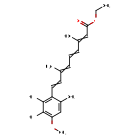
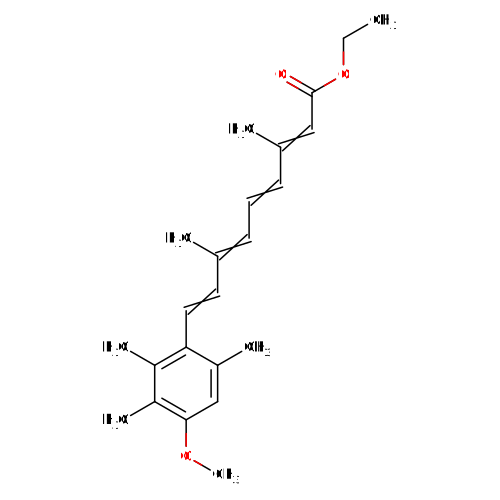
Structure for Etretinate (DB00926)
- Weight
- Average: 354.4825
Monoisotopic: 354.219494826 - Chemical Formula
- C23H30O3
- Synonyms
- Etretinate
- etretinato
- External IDs
- RO 10-9359
- RO-10-9359

Pharmacology
- Indication
For the treatment of severe psoriasis in adults.
 Reduce drug development failure ratesBuild, train, & validate machine-learning modelswith evidence-based and structured datasets.Build, train, & validate predictive machine-learning models with structured datasets.
- Contraindications & Blackbox Warnings
 Prevent Adverse Drug Events TodayTap into our Clinical API for life-saving information on contraindications & blackbox warnings, population restrictions, harmful risks, & more.Avoid life-threatening adverse drug events with our Clinical API
- Pharmacodynamics
The active metabolite responsible for etretinate's effects, acitretin, is a retinoid. Retinoids have a structure similar to vitamin A and are involved in the normal growth of skin cells. Acitretin works by inhibiting the excessive cell growth and keratinisation (process by which skin cells become thickened due to the deposition of a protein within them) seen in psoriasis. It therefore reduces the thickening of the skin, plaque formation and scaling.
- Mechanism of action
The mechanism of action of the active metabolite, acitretin, is unknown, however it is believed to work by targeting specific receptors (retinoid receptors) in the skin which help normalize the growth cycle of skin cells.
Target Actions Organism ARetinoic acid receptor alpha agonistHumans ARetinoic acid receptor RXR-alpha agonistHumans ARetinoic acid receptor beta agonistHumans ARetinoic acid receptor RXR-gamma agonistHumans ARetinoic acid receptor RXR-beta agonistHumans ARetinoic acid receptor gamma agonistHumans - Absorption
Absorbed in the small intestine. Studies in normal volunteers indicate that the absorption of etretinate is greater in patients consuming whole milk or a high-fat diet than in patients in a fasting state.
- Volume of distribution
Not Available
- Protein binding
More than 99% bound to plasma proteins, predominantly lipoproteins, whereas its active metabolite, acetretin (etretin), is predominantly bound to albumin.
- Metabolism
Extensively metabolized, with significant first-pass metabolism to the pharmacologically active acid form. Subsequent metabolism results in the inactive 13-cis acid form, chain-shortened breakdown products, and conjugates that are ultimately excreted.
- Route of elimination
Not Available
- Half-life
In one study, the apparent terminal half-life of etretinate after 6 months of therapy was approximately 120 days. In another study of 47 patients who had undergone chronic therapy with etretinate, 5 patients had detectable serum drug concentrations (0.5 to 12 ng/mL) 2.1 to 2.9 years after therapy was completed.
- Clearance
Not Available
- Adverse Effects
 Improve decision support & research outcomesWith structured adverse effects data, including: blackbox warnings, adverse reactions, warning & precautions, & incidence rates. View sample adverse effects data in our new Data Library!Improve decision support & research outcomes with our structured adverse effects data.
- Toxicity
Symptoms of overdose include headache and vertigo.
- Pathways
- Not Available
- Pharmacogenomic Effects/ADRs
- Not Available
Interactions
- Drug Interactions
- This information should not be interpreted without the help of a healthcare provider. If you believe you are experiencing an interaction, contact a healthcare provider immediately. The absence of an interaction does not necessarily mean no interactions exist.
Drug Interaction Integrate drug-drug
interactions in your softwareCyproterone acetate The therapeutic efficacy of Cyproterone acetate can be decreased when used in combination with Etretinate. Demeclocycline The risk or severity of pseudotumor cerebri can be increased when Etretinate is combined with Demeclocycline. Desogestrel The therapeutic efficacy of Desogestrel can be decreased when used in combination with Etretinate. Dienogest The therapeutic efficacy of Dienogest can be decreased when used in combination with Etretinate. Diethylstilbestrol The therapeutic efficacy of Diethylstilbestrol can be decreased when used in combination with Etretinate. - Food Interactions
- Avoid alcohol. Alcohol should be completely avoided for up to 2 months after discontinuation.
- Take with food. Food increases absorption.
Products
 Drug product information from 10+ global regionsOur datasets provide approved product information including:dosage, form, labeller, route of administration, and marketing period.Access drug product information from over 10 global regions.
- International/Other Brands
- Tegison / Tigason (Chugai Pharmaceutical)
Categories
- ATC Codes
- D05BB01 — Etretinate
- Drug Categories
- Chemical TaxonomyProvided by Classyfire
- Description
- This compound belongs to the class of organic compounds known as retinoid esters. These are ester derivatives of retinoic acid. These are obtained by formal condensation of the hydroxy group of retinol with the carboxy group of any carboxylic acid.
- Kingdom
- Organic compounds
- Super Class
- Lipids and lipid-like molecules
- Class
- Prenol lipids
- Sub Class
- Retinoids
- Direct Parent
- Retinoid esters
- Alternative Parents
- Sesquiterpenoids / Styrenes / Phenoxy compounds / Methoxybenzenes / Anisoles / Fatty acid esters / Alkyl aryl ethers / Enoate esters / Monocarboxylic acids and derivatives / Organic oxides show 2 more
- Substituents
- Alkyl aryl ether / Alpha,beta-unsaturated carboxylic ester / Anisole / Aromatic homomonocyclic compound / Benzenoid / Carbonyl group / Carboxylic acid derivative / Carboxylic acid ester / Cyclofarsesane sesquiterpenoid / Enoate ester show 15 more
- Molecular Framework
- Aromatic homomonocyclic compounds
- External Descriptors
- Not Available
- Affected organisms
- Humans and other mammals
Chemical Identifiers
- UNII
- 65M2UDR9AG
- CAS number
- 54350-48-0
- InChI Key
- HQMNCQVAMBCHCO-DJRRULDNSA-N
- InChI
- InChI=1S/C23H30O3/c1-8-26-23(24)14-17(3)11-9-10-16(2)12-13-21-18(4)15-22(25-7)20(6)19(21)5/h9-15H,8H2,1-7H3/b11-9+,13-12+,16-10+,17-14+
- IUPAC Name
- ethyl 9-(4-methoxy-2,3,6-trimethylphenyl)-3,7-dimethylnona-2,4,6,8-tetraenoate
- SMILES
- CCOC(=O)C=C(C)C=CC=C(C)C=CC1=C(C)C(C)=C(OC)C=C1C
References
- Synthesis Reference
Bollag. W., Ruegg, R. and Ryser, G.; U.S.Patent 4,105,681; August 8,1978; assigned to Hoffmann-LaRoche, Inc. Bollag, W., Ruegg, R. and Ryser, G.; U.S. Patent 4,215,215; July 29, 1980; assigned to Hoffmann-La Roche, Inc.
- General References
- Not Available
- External Links
Clinical Trials
Pharmacoeconomics
- Manufacturers
- Hoffmann la roche inc
- Packagers
- Not Available
- Dosage Forms
Form Route Strength Capsule - Prices
- Not Available
- Patents
- Not Available
Properties
- State
- Solid
- Experimental Properties
Property Value Source melting point (°C) 104-105 Bollag. W., Ruegg, R. and Ryser, G.; U.S.Patent 4,105,681; August 8,1978; assigned to Hoffmann-LaRoche, Inc. Bollag, W., Ruegg, R. and Ryser, G.; U.S. Patent 4,215,215; July 29, 1980; assigned to Hoffmann-La Roche, Inc. logP 6.5 Not Available - Predicted Properties
Property Value Source Water Solubility 0.000405 mg/mL ALOGPS logP 6.32 ALOGPS logP 6.32 Chemaxon logS -5.9 ALOGPS pKa (Strongest Basic) -4.8 Chemaxon Physiological Charge 0 Chemaxon Hydrogen Acceptor Count 2 Chemaxon Hydrogen Donor Count 0 Chemaxon Polar Surface Area 35.53 Å2 Chemaxon Rotatable Bond Count 8 Chemaxon Refractivity 113.68 m3·mol-1 Chemaxon Polarizability 42.98 Å3 Chemaxon Number of Rings 1 Chemaxon Bioavailability 1 Chemaxon Rule of Five No Chemaxon Ghose Filter No Chemaxon Veber's Rule Yes Chemaxon MDDR-like Rule No Chemaxon - Predicted ADMET Features
Property Value Probability Human Intestinal Absorption + 1.0 Blood Brain Barrier + 0.541 Caco-2 permeable + 0.8686 P-glycoprotein substrate Non-substrate 0.5795 P-glycoprotein inhibitor I Inhibitor 0.5432 P-glycoprotein inhibitor II Non-inhibitor 0.884 Renal organic cation transporter Non-inhibitor 0.8439 CYP450 2C9 substrate Non-substrate 0.8474 CYP450 2D6 substrate Non-substrate 0.8222 CYP450 3A4 substrate Substrate 0.5411 CYP450 1A2 substrate Inhibitor 0.824 CYP450 2C9 inhibitor Non-inhibitor 0.7544 CYP450 2D6 inhibitor Non-inhibitor 0.9149 CYP450 2C19 inhibitor Inhibitor 0.5241 CYP450 3A4 inhibitor Non-inhibitor 0.8499 CYP450 inhibitory promiscuity High CYP Inhibitory Promiscuity 0.8041 Ames test Non AMES toxic 0.6898 Carcinogenicity Non-carcinogens 0.7795 Biodegradation Ready biodegradable 0.8896 Rat acute toxicity 1.8763 LD50, mol/kg Not applicable hERG inhibition (predictor I) Weak inhibitor 0.9002 hERG inhibition (predictor II) Non-inhibitor 0.9289
Spectra
- Mass Spec (NIST)
- Not Available
- Spectra
Spectrum Spectrum Type Splash Key Predicted MS/MS Spectrum - 10V, Positive (Annotated) Predicted LC-MS/MS splash10-06vi-0494000000-4e1208174e5b1c41e560 Predicted MS/MS Spectrum - 10V, Negative (Annotated) Predicted LC-MS/MS splash10-0a6r-2059000000-3e93734beb13d7aa3027 Predicted MS/MS Spectrum - 20V, Negative (Annotated) Predicted LC-MS/MS splash10-05r0-1393000000-1b867c2685dbe14e2667 Predicted MS/MS Spectrum - 20V, Positive (Annotated) Predicted LC-MS/MS splash10-0w2a-0490000000-f2d08f466da14611e2d0 Predicted MS/MS Spectrum - 40V, Negative (Annotated) Predicted LC-MS/MS splash10-00kf-1090000000-0c68a1ab4a1c8f30e7b2 Predicted MS/MS Spectrum - 40V, Positive (Annotated) Predicted LC-MS/MS splash10-0cgl-1921000000-811fef0e1d8457d78aa5 Predicted 1H NMR Spectrum 1D NMR Not Applicable Predicted 13C NMR Spectrum 1D NMR Not Applicable - Chromatographic Properties
Collision Cross Sections (CCS)
Not Available
Targets

- Kind
- Protein
- Organism
- Humans
- Pharmacological action
- Yes
- Actions
- Agonist
- General Function
- Zinc ion binding
- Specific Function
- Receptor for retinoic acid. Retinoic acid receptors bind as heterodimers to their target response elements in response to their ligands, all-trans or 9-cis retinoic acid, and regulate gene expressi...
- Gene Name
- RARA
- Uniprot ID
- P10276
- Uniprot Name
- Retinoic acid receptor alpha
- Molecular Weight
- 50770.805 Da
References
- Harnish DC, Barua AB, Soprano KJ, Soprano DR: Induction of beta-retinoic acid receptor mRNA by teratogenic doses of retinoids in murine fetuses. Differentiation. 1990 Nov;45(2):103-8. [Article]
- Saurat JH: Retinoids and psoriasis: novel issues in retinoid pharmacology and implications for psoriasis treatment. J Am Acad Dermatol. 1999 Sep;41(3 Pt 2):S2-6. [Article]
- Zitnik RJ, Kotloff RM, Latifpour J, Zheng T, Whiting NL, Schwalb J, Elias JA: Retinoic acid inhibition of IL-1-induced IL-6 production by human lung fibroblasts. J Immunol. 1994 Feb 1;152(3):1419-27. [Article]
- Orfanos CE, Zouboulis CC, Almond-Roesler B, Geilen CC: Current use and future potential role of retinoids in dermatology. Drugs. 1997 Mar;53(3):358-88. [Article]
- Billoni N, Gautier B, Mahe YF, Bernard BA: Expression of retinoid nuclear receptor superfamily members in human hair follicles and its implication in hair growth. Acta Derm Venereol. 1997 Sep;77(5):350-5. [Article]
- Kind
- Protein
- Organism
- Humans
- Pharmacological action
- Yes
- Actions
- Agonist
- General Function
- Zinc ion binding
- Specific Function
- Receptor for retinoic acid. Retinoic acid receptors bind as heterodimers to their target response elements in response to their ligands, all-trans or 9-cis retinoic acid, and regulate gene expressi...
- Gene Name
- RXRA
- Uniprot ID
- P19793
- Uniprot Name
- Retinoic acid receptor RXR-alpha
- Molecular Weight
- 50810.835 Da
References
- Zitnik RJ, Kotloff RM, Latifpour J, Zheng T, Whiting NL, Schwalb J, Elias JA: Retinoic acid inhibition of IL-1-induced IL-6 production by human lung fibroblasts. J Immunol. 1994 Feb 1;152(3):1419-27. [Article]
- Orfanos CE, Zouboulis CC, Almond-Roesler B, Geilen CC: Current use and future potential role of retinoids in dermatology. Drugs. 1997 Mar;53(3):358-88. [Article]
- Billoni N, Gautier B, Mahe YF, Bernard BA: Expression of retinoid nuclear receptor superfamily members in human hair follicles and its implication in hair growth. Acta Derm Venereol. 1997 Sep;77(5):350-5. [Article]
- Kind
- Protein
- Organism
- Humans
- Pharmacological action
- Yes
- Actions
- Agonist
- General Function
- Zinc ion binding
- Specific Function
- Receptor for retinoic acid. Retinoic acid receptors bind as heterodimers to their target response elements in response to their ligands, all-trans or 9-cis retinoic acid, and regulate gene expressi...
- Gene Name
- RARB
- Uniprot ID
- P10826
- Uniprot Name
- Retinoic acid receptor beta
- Molecular Weight
- 50488.63 Da
References
- Zitnik RJ, Kotloff RM, Latifpour J, Zheng T, Whiting NL, Schwalb J, Elias JA: Retinoic acid inhibition of IL-1-induced IL-6 production by human lung fibroblasts. J Immunol. 1994 Feb 1;152(3):1419-27. [Article]
- Billoni N, Gautier B, Mahe YF, Bernard BA: Expression of retinoid nuclear receptor superfamily members in human hair follicles and its implication in hair growth. Acta Derm Venereol. 1997 Sep;77(5):350-5. [Article]
- Kind
- Protein
- Organism
- Humans
- Pharmacological action
- Yes
- Actions
- Agonist
- General Function
- Zinc ion binding
- Specific Function
- Receptor for retinoic acid. Retinoic acid receptors bind as heterodimers to their target response elements in response to their ligands, all-trans or 9-cis retinoic acid, and regulate gene expressi...
- Gene Name
- RXRG
- Uniprot ID
- P48443
- Uniprot Name
- Retinoic acid receptor RXR-gamma
- Molecular Weight
- 50870.72 Da
References
- Overington JP, Al-Lazikani B, Hopkins AL: How many drug targets are there? Nat Rev Drug Discov. 2006 Dec;5(12):993-6. [Article]
- Imming P, Sinning C, Meyer A: Drugs, their targets and the nature and number of drug targets. Nat Rev Drug Discov. 2006 Oct;5(10):821-34. [Article]
- Billoni N, Gautier B, Mahe YF, Bernard BA: Expression of retinoid nuclear receptor superfamily members in human hair follicles and its implication in hair growth. Acta Derm Venereol. 1997 Sep;77(5):350-5. [Article]
- Kind
- Protein
- Organism
- Humans
- Pharmacological action
- Yes
- Actions
- Agonist
- General Function
- Zinc ion binding
- Specific Function
- Receptor for retinoic acid. Retinoic acid receptors bind as heterodimers to their target response elements in response to their ligands, all-trans or 9-cis retinoic acid, and regulate gene expressi...
- Gene Name
- RXRB
- Uniprot ID
- P28702
- Uniprot Name
- Retinoic acid receptor RXR-beta
- Molecular Weight
- 56921.38 Da
References
- Kind
- Protein
- Organism
- Humans
- Pharmacological action
- Yes
- Actions
- Agonist
- General Function
- Zinc ion binding
- Specific Function
- Receptor for retinoic acid. Retinoic acid receptors bind as heterodimers to their target response elements in response to their ligands, all-trans or 9-cis retinoic acid, and regulate gene expressi...
- Gene Name
- RARG
- Uniprot ID
- P13631
- Uniprot Name
- Retinoic acid receptor gamma
- Molecular Weight
- 50341.405 Da
References
- Overington JP, Al-Lazikani B, Hopkins AL: How many drug targets are there? Nat Rev Drug Discov. 2006 Dec;5(12):993-6. [Article]
- Imming P, Sinning C, Meyer A: Drugs, their targets and the nature and number of drug targets. Nat Rev Drug Discov. 2006 Oct;5(10):821-34. [Article]
- Berman HM, Westbrook J, Feng Z, Gilliland G, Bhat TN, Weissig H, Shindyalov IN, Bourne PE: The Protein Data Bank. Nucleic Acids Res. 2000 Jan 1;28(1):235-42. [Article]
Enzymes
- Kind
- Protein
- Organism
- Humans
- Pharmacological action
- Unknown
- Actions
- Inhibitor
- General Function
- Oxygen binding
- Specific Function
- Catalyzes the formation of aromatic C18 estrogens from C19 androgens.
- Gene Name
- CYP19A1
- Uniprot ID
- P11511
- Uniprot Name
- Aromatase
- Molecular Weight
- 57882.48 Da
References
- Ciolino HP, Wang TT, Sathyamoorthy N: Inhibition of aromatase activity and expression in MCF-7 cells by the chemopreventive retinoid N-(4-hydroxy-phenyl)-retinamide. Br J Cancer. 2000 Aug;83(3):333-7. doi: 10.1054/bjoc.2000.1269. [Article]
Carriers
- Kind
- Protein
- Organism
- Humans
- Pharmacological action
- Unknown
- General Function
- Transporter activity
- Specific Function
- Cytosolic CRABPs may regulate the access of retinoic acid to the nuclear retinoic acid receptors.
- Gene Name
- CRABP1
- Uniprot ID
- P29762
- Uniprot Name
- Cellular retinoic acid-binding protein 1
- Molecular Weight
- 15565.45 Da
References
- Madani K, Bazzano G, Chou A: Evaluation of retinoids as inhibitors of [3H] all-trans retinoic acid binding to cellular retinoic acid-binding protein in rat skin and testes. Arch Dermatol Res. 1986;278(4):302-6. [Article]

Drug created at June 13, 2005 13:24 / Updated at February 02, 2024 22:46