Identification
- Summary
Cyproterone acetate is a steroid used in combination with ethinyl estradiol to treat women with severe acne and symptoms of androgenization. Also used alone at much higher doses for palliative treatment of patients with prostate cancer
- Brand Names
- Androcur, Cléo -35, Cyestra-35, Diane
- Generic Name
- Cyproterone acetate
- DrugBank Accession Number
- DB04839
- Background
An anti-androgen that, in the form of its acetate (cyproterone acetate), also has progestational properties. It is used in the treatment of hypersexuality in males, as a palliative in prostatic carcinoma, and, in combination with estrogen, for the therapy of severe acne and hirsutism in females.
- Type
- Small Molecule
- Groups
- Approved, Investigational
- Structure
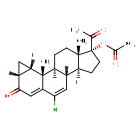
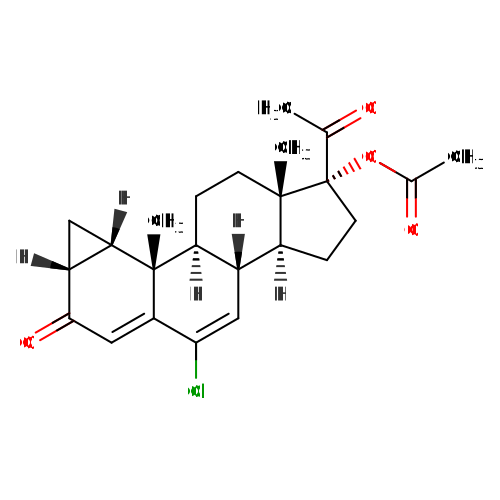
Structure for Cyproterone acetate (DB04839)
- Weight
- Average: 416.938
Monoisotopic: 416.175437123 - Chemical Formula
- C24H29ClO4
- Synonyms
- Cyproterone 17-O-acetate
- Cyproterone acetate
- External IDs
- NSC-81430
- SH 714
- SH-714

Pharmacology
- Indication
For the palliative treatment of patients with advanced prostatic carcinoma.
 Reduce drug development failure ratesBuild, train, & validate machine-learning modelswith evidence-based and structured datasets.Build, train, & validate predictive machine-learning models with structured datasets.
- Associated Conditions
Indication Type Indication Combined Product Details Approval Level Age Group Patient Characteristics Dose Form Symptomatic treatment of Advanced prostate carcinoma •••••••••••• Used in combination to treat Menstrual irregularities Combination Product in combination with: Estradiol valerate (DB13956) •••••••••••• ••••••• •••••• Symptomatic treatment of Metastatic prostate carcinoma •••••••••••• Used in combination to prevent Osteoporosis Combination Product in combination with: Estradiol (DB00783) •••••••••••• •••••••••••••• ••••••• •••••• Management of Paraphilia ••• ••••• - Associated Therapies
- Contraindications & Blackbox Warnings
 Prevent Adverse Drug Events TodayTap into our Clinical API for life-saving information on contraindications & blackbox warnings, population restrictions, harmful risks, & more.Avoid life-threatening adverse drug events with our Clinical API
- Pharmacodynamics
Cyproterone is an antiandrogen. It suppresses the actions of testosterone (and its metabolite dihydrotestosterone) on tissues. It acts by blocking androgen receptors which prevents androgens from binding to them and suppresses luteinizing hormone (which in turn reduces testosterone levels).
- Mechanism of action
The direct antiandrogenic effect of cyproterone is blockage of the binding of dihydrotestosterone to the specific receptors in the prostatic carcinoma cell. In addition, cyproterone exerts a negative feed-back on the hypothalamo-pituitary axis, by inhibiting the secretion of luteinizing hormone resulting in diminished production of testicular testosterone.
Target Actions Organism AAndrogen receptor antagonistHumans UProstate-specific antigen Not Available Humans - Absorption
Completely absorbed following oral administration.
- Volume of distribution
Not Available
- Protein binding
Not Available
- Metabolism
Primarily hepatic. Cyproterone acetate is metabolized by the CYP3A4 enzyme, forming the active metabolite 15beta-hydroxycyproterone acetate, which retains its antiandrogen activity, but has reduced progestational activity.
Hover over products below to view reaction partners
- Route of elimination
It is excreted approximately 60% in the bile and 33% through the kidneys.
- Half-life
Elimination Following oral or intramuscular administration, the plasma half-life is 38 and 96 hours, respectively.
- Clearance
Not Available
- Adverse Effects
 Improve decision support & research outcomesWith structured adverse effects data, including: blackbox warnings, adverse reactions, warning & precautions, & incidence rates. View sample adverse effects data in our new Data Library!Improve decision support & research outcomes with our structured adverse effects data.
- Toxicity
Not Available
- Pathways
- Not Available
- Pharmacogenomic Effects/ADRs
- Not Available
Interactions
- Drug Interactions
- This information should not be interpreted without the help of a healthcare provider. If you believe you are experiencing an interaction, contact a healthcare provider immediately. The absence of an interaction does not necessarily mean no interactions exist.
Drug Interaction Integrate drug-drug
interactions in your softwareAbametapir The serum concentration of Cyproterone acetate can be increased when it is combined with Abametapir. Abciximab The risk or severity of adverse effects can be increased when Cyproterone acetate is combined with Abciximab. Abemaciclib The metabolism of Abemaciclib can be decreased when combined with Cyproterone acetate. Acalabrutinib The metabolism of Acalabrutinib can be decreased when combined with Cyproterone acetate. Acarbose The therapeutic efficacy of Acarbose can be decreased when used in combination with Cyproterone acetate. - Food Interactions
- Avoid alcohol.
- Take after a meal.
Products
 Drug product information from 10+ global regionsOur datasets provide approved product information including:dosage, form, labeller, route of administration, and marketing period.Access drug product information from over 10 global regions.
- International/Other Brands
- Cyprostat (Bayer)
- Brand Name Prescription Products
Name Dosage Strength Route Labeller Marketing Start Marketing End Region Image Androcur Tablet 50 mg Oral Bayer 1987-12-31 Not applicable Canada 
Androcur Depot Solution 100 mg / mL Intramuscular Bayer 1990-12-31 Not applicable Canada Cyproterone Tablet 50 mg Oral Aa Pharma Inc 2004-04-20 Not applicable Canada Cyproterone Tablet 50 mg Oral Bdh Inc. 1998-10-08 2000-08-03 Canada - Generic Prescription Products
Name Dosage Strength Route Labeller Marketing Start Marketing End Region Image Alti-cpa Tablet 50 mg Oral Altimed Pharma Inc. 1997-09-22 2005-05-27 Canada Med-cyproterone Tablet 50 mg Oral Generic Medical Partners Inc 2012-10-02 Not applicable Canada Mylan-cyproterone Tablet 50 mg Oral Mylan Pharmaceuticals 1997-09-19 2011-03-04 Canada Novo-cyproterone Tablet 50 mg Oral Novopharm Limited 1997-09-17 2015-10-26 Canada Riva-cyproterone Tablet 50 mg Oral Laboratoire Riva Inc 2012-11-28 Not applicable Canada - Mixture Products
Name Ingredients Dosage Route Labeller Marketing Start Marketing End Region Image Alisma Gynial 2 mg/0,035 mg Filmtabletten Cyproterone acetate (2 mg) + Ethinylestradiol (0.035 mg) Tablet, film coated Oral Gynial Gmb H 2020-08-07 Not applicable Austria 
Bellgyn "ratiopharm" 2 mg/ 0,035 mg - überzogene Tabletten Cyproterone acetate (2 mg) + Ethinylestradiol (0.035 mg) Tablet, coated Oral Teva B.V. 2004-03-29 Not applicable Austria BENAKLIN® Cyproterone acetate (2 mg) + Ethinylestradiol (0.035 mg) Tablet, coated Oral MEGALABS COLOMBIA S.A.S. 2019-05-17 Not applicable Colombia 
Cléo -35 Cyproterone acetate (2 mg) + Ethinylestradiol (0.035 mg) Tablet Oral Altius Healthcare Inc 2015-10-30 Not applicable Canada CLIMEN Cyproterone acetate (1 mg) + Estradiol valerate (2 MG) + Estradiol valerate (2 mg) Kit; Tablet, coated Oral Bayer S.P.A. 2014-07-08 Not applicable Italy 
Categories
- ATC Codes
- G03HB01 — Cyproterone and estrogen
- G03HB — Antiandrogens and estrogens
- G03H — ANTIANDROGENS
- G03 — SEX HORMONES AND MODULATORS OF THE GENITAL SYSTEM
- G — GENITO URINARY SYSTEM AND SEX HORMONES
- Drug Categories
- Adrenal Cortex Hormones
- Antiandrogens
- Antiandrogens and Estrogens
- Antineoplastic Agents
- Combination Contraceptives (with Estrogen and derivatives)
- Contraceptive Agents, Female
- Contraceptive Agents, Male
- Contraceptives, Oral
- Cytochrome P-450 CYP3A Inhibitors
- Cytochrome P-450 CYP3A Substrates
- Cytochrome P-450 CYP3A4 Inhibitors
- Cytochrome P-450 CYP3A4 Inhibitors (weak)
- Cytochrome P-450 CYP3A4 Substrates
- Cytochrome P-450 Enzyme Inhibitors
- Cytochrome P-450 Substrates
- Fused-Ring Compounds
- Genito Urinary System and Sex Hormones
- Hormonal Contraceptives for Systemic Use
- Hormone Antagonists
- Hormones, Hormone Substitutes, and Hormone Antagonists
- Hyperglycemia-Associated Agents
- Other Miscellaneous Therapeutic Agents
- Pregnadienes
- Pregnanes
- Progestin Contraceptives
- Progestins
- Reproductive Control Agents
- Sex Hormones and Modulators of the Genital System
- Steroids
- Steroids, Chlorinated
- Chemical TaxonomyProvided by Classyfire
- Description
- This compound belongs to the class of organic compounds known as gluco/mineralocorticoids, progestogins and derivatives. These are steroids with a structure based on a hydroxylated prostane moiety.
- Kingdom
- Organic compounds
- Super Class
- Lipids and lipid-like molecules
- Class
- Steroids and steroid derivatives
- Sub Class
- Pregnane steroids
- Direct Parent
- Gluco/mineralocorticoids, progestogins and derivatives
- Alternative Parents
- Steroid esters / 20-oxosteroids / Halogenated steroids / 3-oxosteroids / Cyclohexenones / Alpha-acyloxy ketones / Carboxylic acid esters / Vinyl chlorides / Monocarboxylic acids and derivatives / Chloroalkenes show 3 more
- Substituents
- 20-oxosteroid / 3-oxosteroid / 6-halo-steroid / Aliphatic homopolycyclic compound / Alpha-acyloxy ketone / Carbonyl group / Carboxylic acid derivative / Carboxylic acid ester / Chloroalkene / Cyclohexenone show 15 more
- Molecular Framework
- Aliphatic homopolycyclic compounds
- External Descriptors
- acetate ester, 3-oxo Delta(4)-steroid, steroid ester, 20-oxo steroid, chlorinated steroid (CHEBI:50743)
- Affected organisms
- Humans and other mammals
Chemical Identifiers
- UNII
- 4KM2BN5JHF
- CAS number
- 427-51-0
- InChI Key
- UWFYSQMTEOIJJG-FDTZYFLXSA-N
- InChI
- InChI=1S/C24H29ClO4/c1-12(26)24(29-13(2)27)8-6-16-14-10-20(25)19-11-21(28)15-9-18(15)23(19,4)17(14)5-7-22(16,24)3/h10-11,14-18H,5-9H2,1-4H3/t14-,15+,16-,17-,18-,22-,23-,24-/m0/s1
- IUPAC Name
- (1S,2S,3S,5R,11R,12S,15R,16S)-15-acetyl-9-chloro-2,16-dimethyl-6-oxopentacyclo[9.7.0.0^{2,8}.0^{3,5}.0^{12,16}]octadeca-7,9-dien-15-yl acetate
- SMILES
- [H][C@@]12C[C@]1([H])[C@@]1(C)C(=CC2=O)C(Cl)=C[C@@]2([H])[C@]3([H])CC[C@](OC(C)=O)(C(C)=O)[C@@]3(C)CC[C@]12[H]
References
- Synthesis Reference
Aranya Manosroi, "Synthesis of cyproterone acetate." U.S. Patent US20040024230, issued February 05, 2004.
US20040024230- General References
- Giorgi EP, Shirley IM, Grant JK, Stewart JC: Androgen dynamics in vitro in the human prostate gland. Effect of cyproterone and cyproterone acetate. Biochem J. 1973 Mar;132(3):465-74. [Article]
- Pham-Huu-Trung MT, de Smitter N, Bogyo A, Girard F: Effects of cyproterone acetate on adrenal steroidogenesis in vitro. Horm Res. 1984;20(2):108-15. [Article]
- Stadtler FA, Langner V: The effect of cyproterone and gonadotrophins on the adrenal gland of juvenile and adult rats. A morphological and morphometrical study. Pathol Res Pract. 1985 Mar;179(4-5):493-8. [Article]
- Honer C, Nam K, Fink C, Marshall P, Ksander G, Chatelain RE, Cornell W, Steele R, Schweitzer R, Schumacher C: Glucocorticoid receptor antagonism by cyproterone acetate and RU486. Mol Pharmacol. 2003 May;63(5):1012-20. [Article]
- Holdaway IM, Croxson MS, Evans MC, France J, Sheehan A, Wilson T, Ibbertson HK: Effect of cyproterone acetate on glucocorticoid secretion in patients treated for hirsutism. Acta Endocrinol (Copenh). 1983 Oct;104(2):222-6. [Article]
- External Links
- KEGG Drug
- D01368
- PubChem Compound
- 9880
- PubChem Substance
- 46506931
- ChemSpider
- 9496
- BindingDB
- 50094569
- 22054
- ChEBI
- 50743
- ChEMBL
- CHEMBL139835
- ZINC
- ZINC000003814423
- Therapeutic Targets Database
- DAP000906
- PharmGKB
- PA10049
- PDBe Ligand
- CA4
- Wikipedia
- Cyproterone_acetate
- PDB Entries
- 2oz7
Clinical Trials
- Clinical Trials
Phase Status Purpose Conditions Count 4 Completed Basic Science Transsexualism 1 4 Completed Treatment Acne Vulgaris 1 4 Completed Treatment Obesity / Overweight / Polycystic Ovarian Syndrome (PCOS) 1 4 Completed Treatment Polycystic Ovarian Syndrome (PCOS) 2 4 Unknown Status Basic Science Gender Dysphoria 1
Pharmacoeconomics
- Manufacturers
- Not Available
- Packagers
- Not Available
- Dosage Forms
Form Route Strength Tablet Oral Injection, suspension, extended release Intramuscular 300 MG/3ML Tablet Oral 50.000 mg Tablet Oral 10 mg Solution Intramuscular 100 mg / mL Solution Parenteral 300 mg Injection, solution Parenteral Tablet, film coated Oral 50 mg Injection, solution Intramuscular Tablet, coated Oral Kit; tablet, coated Oral Tablet Oral 100 MG Tablet, delayed release Oral Tablet, film coated Oral 2 mg Tablet, sugar coated Oral Capsule, liquid filled Oral Tablet, film coated Oral Tablet Oral 50 mg Tablet Oral - Prices
- Not Available
- Patents
- Not Available
Properties
- State
- Solid
- Experimental Properties
Property Value Source melting point (°C) 200-201 Wiechert, R.; U S . Patent 3,234,093; February 8, 1966; assigned to Schering AG, Germany. - Predicted Properties
Property Value Source Water Solubility 0.00152 mg/mL ALOGPS logP 3.81 ALOGPS logP 3.64 Chemaxon logS -5.4 ALOGPS pKa (Strongest Acidic) 17.83 Chemaxon pKa (Strongest Basic) -5.6 Chemaxon Physiological Charge 0 Chemaxon Hydrogen Acceptor Count 3 Chemaxon Hydrogen Donor Count 0 Chemaxon Polar Surface Area 60.44 Å2 Chemaxon Rotatable Bond Count 3 Chemaxon Refractivity 111.81 m3·mol-1 Chemaxon Polarizability 44.64 Å3 Chemaxon Number of Rings 5 Chemaxon Bioavailability 1 Chemaxon Rule of Five Yes Chemaxon Ghose Filter Yes Chemaxon Veber's Rule No Chemaxon MDDR-like Rule No Chemaxon - Predicted ADMET Features
Property Value Probability Human Intestinal Absorption + 1.0 Blood Brain Barrier + 0.9673 Caco-2 permeable + 0.7033 P-glycoprotein substrate Substrate 0.7292 P-glycoprotein inhibitor I Inhibitor 0.5265 P-glycoprotein inhibitor II Non-inhibitor 0.9016 Renal organic cation transporter Non-inhibitor 0.8036 CYP450 2C9 substrate Non-substrate 0.8 CYP450 2D6 substrate Non-substrate 0.9116 CYP450 3A4 substrate Substrate 0.7834 CYP450 1A2 substrate Non-inhibitor 0.8944 CYP450 2C9 inhibitor Non-inhibitor 0.7229 CYP450 2D6 inhibitor Non-inhibitor 0.8951 CYP450 2C19 inhibitor Non-inhibitor 0.737 CYP450 3A4 inhibitor Non-inhibitor 0.8309 CYP450 inhibitory promiscuity Low CYP Inhibitory Promiscuity 0.8919 Ames test Non AMES toxic 0.7067 Carcinogenicity Non-carcinogens 0.926 Biodegradation Not ready biodegradable 1.0 Rat acute toxicity 1.8261 LD50, mol/kg Not applicable hERG inhibition (predictor I) Weak inhibitor 0.9704 hERG inhibition (predictor II) Non-inhibitor 0.6939
Spectra
- Mass Spec (NIST)
- Not Available
- Spectra
- Chromatographic Properties
Collision Cross Sections (CCS)
Adduct CCS Value (Å2) Source type Source [M-H]- 203.1436992 predictedDarkChem Lite v0.1.0 [M-H]- 190.35492 predictedDeepCCS 1.0 (2019) [M+H]+ 203.6893992 predictedDarkChem Lite v0.1.0 [M+H]+ 192.25032 predictedDeepCCS 1.0 (2019) [M+Na]+ 204.0377992 predictedDarkChem Lite v0.1.0 [M+Na]+ 197.92232 predictedDeepCCS 1.0 (2019)
Targets

- Kind
- Protein
- Organism
- Humans
- Pharmacological action
- Yes
- Actions
- Antagonist
- General Function
- Zinc ion binding
- Specific Function
- Steroid hormone receptors are ligand-activated transcription factors that regulate eukaryotic gene expression and affect cellular proliferation and differentiation in target tissues. Transcription ...
- Gene Name
- AR
- Uniprot ID
- P10275
- Uniprot Name
- Androgen receptor
- Molecular Weight
- 98987.9 Da
References
- Overington JP, Al-Lazikani B, Hopkins AL: How many drug targets are there? Nat Rev Drug Discov. 2006 Dec;5(12):993-6. [Article]
- Imming P, Sinning C, Meyer A: Drugs, their targets and the nature and number of drug targets. Nat Rev Drug Discov. 2006 Oct;5(10):821-34. [Article]
- Agoulnik IU, Weigel NL: Coactivator selective regulation of androgen receptor activity. Steroids. 2009 Aug;74(8):669-74. doi: 10.1016/j.steroids.2009.02.007. Epub 2009 Mar 9. [Article]
- Cabeza M, Flores M, Bratoeff E, de la Pena A, Mendez E, Ceballos G: Intracellular Ca2+ stimulates the binding to androgen receptors in platelets. Steroids. 2004 Oct-Nov;69(11-12):767-72. [Article]
- Sonneveld E, Jansen HJ, Riteco JA, Brouwer A, van der Burg B: Development of androgen- and estrogen-responsive bioassays, members of a panel of human cell line-based highly selective steroid-responsive bioassays. Toxicol Sci. 2005 Jan;83(1):136-48. Epub 2004 Oct 13. [Article]
- Kind
- Protein
- Organism
- Humans
- Pharmacological action
- Unknown
- General Function
- Hydrolyzes semenogelin-1 thus leading to the liquefaction of the seminal coagulum.
- Specific Function
- Endopeptidase activity
- Gene Name
- KLK3
- Uniprot ID
- P07288
- Uniprot Name
- Prostate-specific antigen
- Molecular Weight
- 28741.1 Da
References
- Kang Z, Janne OA, Palvimo JJ: Coregulator recruitment and histone modifications in transcriptional regulation by the androgen receptor. Mol Endocrinol. 2004 Nov;18(11):2633-48. Epub 2004 Aug 12. [Article]
Enzymes
- Kind
- Protein
- Organism
- Humans
- Pharmacological action
- No
- Actions
- SubstrateInhibitor
- General Function
- Vitamin d3 25-hydroxylase activity
- Specific Function
- Cytochromes P450 are a group of heme-thiolate monooxygenases. In liver microsomes, this enzyme is involved in an NADPH-dependent electron transport pathway. It performs a variety of oxidation react...
- Gene Name
- CYP3A4
- Uniprot ID
- P08684
- Uniprot Name
- Cytochrome P450 3A4
- Molecular Weight
- 57342.67 Da
References
- Kind
- Protein
- Organism
- Humans
- Pharmacological action
- Unknown
- Actions
- Inhibitor
- General Function
- Oxygen binding
- Specific Function
- Catalyzes the formation of aromatic C18 estrogens from C19 androgens.
- Gene Name
- CYP19A1
- Uniprot ID
- P11511
- Uniprot Name
- Aromatase
- Molecular Weight
- 57882.48 Da
References
- Karolczak M, Kuppers E, Beyer C: Developmental expression and regulation of aromatase- and 5alpha-reductase type I mRNA in the male and female mouse hypothalamus. J Neuroendocrinol. 1998 Apr;10(4):267-74. [Article]

Drug created at September 26, 2007 15:23 / Updated at April 26, 2024 00:46