Identification
- Summary
Cilostazol is an antiplatelet agent and vasodilator used for the symptomatic relief of intermittent claudication.
- Generic Name
- Cilostazol
- DrugBank Accession Number
- DB01166
- Background
Cilostazol is a quinolinone derivative and antiplatelet agent with vasodilating properties that has been used in the symptomatic treatment of intermittent claudication in patients with peripheral ischaemia. It is marketed under the brand name Pletal by Otsuka Pharmaceutical Co.. Cilostazol works by inhibiting both primary and secondary aggregation and reducing calcium-induced contractions.
- Type
- Small Molecule
- Groups
- Approved, Investigational
- Structure
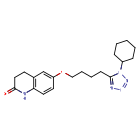
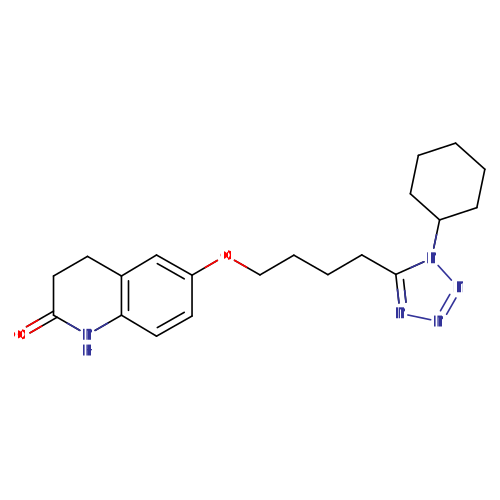
Structure for Cilostazol (DB01166)
- Weight
- Average: 369.4607
Monoisotopic: 369.216475133 - Chemical Formula
- C20H27N5O2
- Synonyms
- 3,4-dihydro-6-(4-(1-cyclohexyl-1H-tetrazol-5-yl)butoxy)-2(1H)-quinolinone
- 6-(4-(1-cyclohexyl-1H-tetrazol-5-yl)butoxy)-3,4-dihydro-2(1H)-quinolinone
- 6-(4-(1-cyclohexyl-1H-tetrazol-5-yl)butoxy)-3,4-dihydrocarbostyril
- 6-[4-(1-Cyclohexyl-1H-tetrazol-5-yl)-butoxy]-3,4-dihydro-1H-quinolin-2-one
- Cilostazol
- Cilostazole
- Cilostazolum
- External IDs
- OPC 13013
- OPC 21
- OPC-13013
- OPC-21

Pharmacology
- Indication
Indicated for the alleviation of symptoms of intermittent claudication (pain in the legs that occurs with walking and disappears with rest).
 Reduce drug development failure ratesBuild, train, & validate machine-learning modelswith evidence-based and structured datasets.Build, train, & validate predictive machine-learning models with structured datasets.
- Associated Conditions
Indication Type Indication Combined Product Details Approval Level Age Group Patient Characteristics Dose Form Symptomatic treatment of Intermittent claudication •••••••••••• - Contraindications & Blackbox Warnings
 Prevent Adverse Drug Events TodayTap into our Clinical API for life-saving information on contraindications & blackbox warnings, population restrictions, harmful risks, & more.Avoid life-threatening adverse drug events with our Clinical API
- Pharmacodynamics
Cilostazol reduces the symptoms of intermittent claudication, as indicated by an increased walking distance. Intermittent claudication is pain in the legs that occurs with walking and disappears with rest. The pain occurs due to reduced blood flow to the legs.
- Mechanism of action
Cilostazol and several of its metabolites are cyclic AMP (cAMP) phosphodiesterase III inhibitors (PDE III inhibitors), inhibiting phosphodiesterase activity and suppressing cAMP degradation with a resultant increase in cAMP in platelets and blood vessels, leading to inhibition of platelet aggregation and vasodilation.
Target Actions Organism AcGMP-inhibited 3',5'-cyclic phosphodiesterase A inhibitorHumans - Absorption
Cilostazol is absorbed after oral administration. A high fat meal increases absorption, with an approximately 90% increase in Cmax and a 25% increase in AUC. Absolute bioavailability is not known.
- Volume of distribution
Not Available
- Protein binding
95-98%
- Metabolism
Hepatic. Cilostazol is extensively metabolized by hepatic cytochrome P-450 enzymes, mainly 3A4, and, to a lesser extent, 2C19, with metabolites largely excreted in urine. Two metabolites are active, with one metabolite appearing to account for at least 50% of the pharmacologic (PDE III inhibition) activity after administration of cilostazol.
- Route of elimination
Cilostazol is extensively metabolized by hepatic cytochrome P-450 enzymes, mainly 3A4, and, to a lesser extent, 2C19, with metabolites largely excreted in urine. Cilostazol is eliminated predominately by metabolism and subsequent urinary excretion of metabolites. The primary route of elimination was via the urine (74%), with the remainder excreted in feces (20%). No measurable amount of unchanged cilostazol was excreted in the urine, and less than 2% of the dose was excreted as 3,4-dehydro-cilostazol. About 30% of the dose was excreted in urine as 4'-trans-hydroxy-cilostazol.
- Half-life
11-13 hours.
- Clearance
Not Available
- Adverse Effects
 Improve decision support & research outcomesWith structured adverse effects data, including: blackbox warnings, adverse reactions, warning & precautions, & incidence rates. View sample adverse effects data in our new Data Library!Improve decision support & research outcomes with our structured adverse effects data.
- Toxicity
Information on acute overdosage with cilostazol in humans is limited. The signs and symptoms of an acute overdose can be anticipated to be those of excessive pharmacologic effect: severe headache, diarrhea, hypotension, tachycardia, and possibly cardiac arrhythmias. The oral LD50 of cilostazol is >5.0 g/kg in mice and rats and >2.0 g/kg in dogs.
- Pathways
Pathway Category Cilostazol Action Pathway Drug action - Pharmacogenomic Effects/ADRs
- Not Available
Interactions
- Drug Interactions
- This information should not be interpreted without the help of a healthcare provider. If you believe you are experiencing an interaction, contact a healthcare provider immediately. The absence of an interaction does not necessarily mean no interactions exist.
Drug Interaction Integrate drug-drug
interactions in your softwareAbacavir Abacavir may decrease the excretion rate of Cilostazol which could result in a higher serum level. Abametapir The serum concentration of Cilostazol can be increased when it is combined with Abametapir. Abatacept The metabolism of Cilostazol can be increased when combined with Abatacept. Abciximab The risk or severity of bleeding can be increased when Cilostazol is combined with Abciximab. Abiraterone The serum concentration of Cilostazol can be increased when it is combined with Abiraterone. - Food Interactions
- Avoid grapefruit products.
- Take on an empty stomach. A high fat meal will increase absorption.
Products
 Drug product information from 10+ global regionsOur datasets provide approved product information including:dosage, form, labeller, route of administration, and marketing period.Access drug product information from over 10 global regions.
- Product Images
- International/Other Brands
- Pletaal
- Brand Name Prescription Products
Name Dosage Strength Route Labeller Marketing Start Marketing End Region Image Cilostazol Tablet 50 mg/1 Oral TEVA PHARMACEUTICALS USA 2007-01-08 2007-01-08 US 
Pletal Tablet 100 mg/1 Oral Physicians Total Care, Inc. 1999-01-15 2011-07-31 US Pletal Tablet 100 mg/1 Oral Otsuka Pharmaceutical Co., Ltd. 1999-01-15 2016-06-30 US Pletal Tablet 50 mg/1 Oral Physicians Total Care, Inc. 1999-01-15 2011-07-31 US Pletal Tablet 50 mg/1 Oral Otsuka Pharmaceutical Co., Ltd. 1999-01-15 2017-11-30 US - Generic Prescription Products
Name Dosage Strength Route Labeller Marketing Start Marketing End Region Image Cilostazol Tablet 100 mg/1 Oral Carilion Materials Management 2005-05-17 Not applicable US 
Cilostazol Tablet 50 mg/1 Oral ALHPAPHARM PTY LTD 2010-01-01 2013-01-01 US Cilostazol Tablet 50 mg/1 Oral bryant ranch prepack 2012-04-24 Not applicable US Cilostazol Tablet 100 mg/1 Oral Eon Labs, Inc. 2004-11-23 2022-07-31 US Cilostazol Tablet 100 mg/1 Oral Mylan Institutional 2010-02-26 2013-03-31 US


Categories
- ATC Codes
- B01AC23 — Cilostazol
- Drug Categories
- Agents producing tachycardia
- Anti-Asthmatic Agents
- Antiplatelet agents
- Autonomic Agents
- Blood and Blood Forming Organs
- Bronchodilator Agents
- Cardiovascular Agents
- Central Nervous System Agents
- Compounds used in a research, industrial, or household setting
- Cytochrome P-450 CYP1A2 Substrates
- Cytochrome P-450 CYP2C19 Substrates
- Cytochrome P-450 CYP2D6 Substrates
- Cytochrome P-450 CYP3A Substrates
- Cytochrome P-450 CYP3A4 Substrates
- Cytochrome P-450 CYP3A5 Substrates
- Cytochrome P-450 CYP3A7 Substrates
- Cytochrome P-450 Substrates
- Drugs that are Mainly Renally Excreted
- Enzyme Inhibitors
- Fibrin Modulating Agents
- Hematologic Agents
- Heterocyclic Compounds, Fused-Ring
- Neuroprotective Agents
- Peripheral Nervous System Agents
- Phosphodiesterase 3 Inhibitors
- Phosphodiesterase Inhibitors
- Platelet Aggregation Inhibitors Excl. Heparin
- Potential QTc-Prolonging Agents
- Protective Agents
- QTc Prolonging Agents
- Quinolines
- Respiratory System Agents
- Tetrazoles
- Vasodilating Agents
- Chemical TaxonomyProvided by Classyfire
- Description
- This compound belongs to the class of organic compounds known as hydroquinolones. These are compounds containing a hydrogenated quinoline bearing a ketone group.
- Kingdom
- Organic compounds
- Super Class
- Organoheterocyclic compounds
- Class
- Quinolines and derivatives
- Sub Class
- Quinolones and derivatives
- Direct Parent
- Hydroquinolones
- Alternative Parents
- Hydroquinolines / Alkyl aryl ethers / Benzenoids / Tetrazoles / Heteroaromatic compounds / Secondary carboxylic acid amides / Lactams / Azacyclic compounds / Organopnictogen compounds / Organonitrogen compounds show 3 more
- Substituents
- Alkyl aryl ether / Aromatic heteropolycyclic compound / Azacycle / Azole / Benzenoid / Carbonyl group / Carboxamide group / Carboxylic acid derivative / Ether / Heteroaromatic compound show 12 more
- Molecular Framework
- Aromatic heteropolycyclic compounds
- External Descriptors
- tetrazoles, lactam (CHEBI:31401)
- Affected organisms
- Humans and other mammals
Chemical Identifiers
- UNII
- N7Z035406B
- CAS number
- 73963-72-1
- InChI Key
- RRGUKTPIGVIEKM-UHFFFAOYSA-N
- InChI
- InChI=1S/C20H27N5O2/c26-20-12-9-15-14-17(10-11-18(15)21-20)27-13-5-4-8-19-22-23-24-25(19)16-6-2-1-3-7-16/h10-11,14,16H,1-9,12-13H2,(H,21,26)
- IUPAC Name
- 6-[4-(1-cyclohexyl-1H-1,2,3,4-tetrazol-5-yl)butoxy]-1,2,3,4-tetrahydroquinolin-2-one
- SMILES
- O=C1CCC2=C(N1)C=CC(OCCCCC1=NN=NN1C1CCCCC1)=C2
References
- Synthesis Reference
Marioara Mendelovici, "Processes for preparing cilostazol." U.S. Patent US20020099213, issued July 25, 2002.
US20020099213- General References
- Not Available
- External Links
- Human Metabolome Database
- HMDB0015297
- KEGG Drug
- D01896
- PubChem Compound
- 2754
- PubChem Substance
- 46506317
- ChemSpider
- 2652
- BindingDB
- 50225508
- 21107
- ChEBI
- 31401
- ChEMBL
- CHEMBL799
- ZINC
- ZINC000001552174
- Therapeutic Targets Database
- DAP000191
- PharmGKB
- PA164746334
- RxList
- RxList Drug Page
- Drugs.com
- Drugs.com Drug Page
- Wikipedia
- Cilostazol
- MSDS
- Download (35.9 KB)
Clinical Trials
- Clinical Trials
Phase Status Purpose Conditions Count 4 Completed Health Services Research Ischemic Stroke / Peripheral Arterial Disease (PAD) / Type 2 Diabetes Mellitus 1 4 Completed Other Intermittent Claudication / Peripheral Arterial Disease (PAD) / Peripheral Vascular Disease Patient 1 4 Completed Prevention Infarction Cerebral 1 4 Completed Prevention Noncardioembolic Cerebral Infarction 1 4 Completed Treatment Acute Coronary Syndrome (ACS) 1
Pharmacoeconomics
- Manufacturers
- Not Available
- Packagers
- Alphapharm Party Ltd.
- Apotex Inc.
- Breckenridge Pharmaceuticals
- Corepharma LLC
- Diversified Healthcare Services Inc.
- Eon Labs
- Heartland Repack Services LLC
- Murfreesboro Pharmaceutical Nursing Supply
- Mylan
- Otsuka America
- Physicians Total Care Inc.
- Prasco Labs
- Resource Optimization and Innovation LLC
- Roxane Labs
- Stat Rx Usa
- Teva Pharmaceutical Industries Ltd.
- UDL Laboratories
- United Research Laboratories Inc.
- Vangard Labs Inc.
- Dosage Forms
Form Route Strength Tablet Oral 100.000 mg Tablet Oral 50 mg Tablet Conjunctival; Oral 100 mg/1 Tablet Oral 100 mg/1 Tablet Oral 100 mg Tablet Oral 50.000 mg Powder Oral Tablet Capsule, extended release Oral 100 MG Capsule, extended release 100 mg Tablet Oral Tablet Oral 50 mg/1 Tablet Oral 100.00 mg Tablet 100 mg Tablet 50 mg - Prices
Unit description Cost Unit Pletal 100 mg tablet 2.51USD tablet Pletal 50 mg tablet 2.39USD tablet Cilostazol 100 mg tablet 1.86USD tablet Cilostazol 50 mg tablet 1.86USD tablet DrugBank does not sell nor buy drugs. Pricing information is supplied for informational purposes only.- Patents
- Not Available
Properties
- State
- Solid
- Experimental Properties
Property Value Source melting point (°C) 160 °C PhysProp logP 2.3 Not Available - Predicted Properties
Property Value Source Water Solubility 0.0324 mg/mL ALOGPS logP 3.38 ALOGPS logP 3.31 Chemaxon logS -4.1 ALOGPS pKa (Strongest Acidic) 14.42 Chemaxon pKa (Strongest Basic) -0.67 Chemaxon Physiological Charge 0 Chemaxon Hydrogen Acceptor Count 5 Chemaxon Hydrogen Donor Count 1 Chemaxon Polar Surface Area 81.93 Å2 Chemaxon Rotatable Bond Count 7 Chemaxon Refractivity 117.13 m3·mol-1 Chemaxon Polarizability 41.15 Å3 Chemaxon Number of Rings 4 Chemaxon Bioavailability 1 Chemaxon Rule of Five Yes Chemaxon Ghose Filter Yes Chemaxon Veber's Rule No Chemaxon MDDR-like Rule Yes Chemaxon - Predicted ADMET Features
Property Value Probability Human Intestinal Absorption + 1.0 Blood Brain Barrier + 0.9909 Caco-2 permeable - 0.5666 P-glycoprotein substrate Non-substrate 0.5361 P-glycoprotein inhibitor I Inhibitor 0.7886 P-glycoprotein inhibitor II Inhibitor 0.8387 Renal organic cation transporter Non-inhibitor 0.5794 CYP450 2C9 substrate Non-substrate 0.7887 CYP450 2D6 substrate Non-substrate 0.7734 CYP450 3A4 substrate Substrate 0.7407 CYP450 1A2 substrate Non-inhibitor 0.9045 CYP450 2C9 inhibitor Non-inhibitor 0.9071 CYP450 2D6 inhibitor Non-inhibitor 0.9231 CYP450 2C19 inhibitor Non-inhibitor 0.9026 CYP450 3A4 inhibitor Inhibitor 0.7959 CYP450 inhibitory promiscuity High CYP Inhibitory Promiscuity 0.9486 Ames test Non AMES toxic 0.5436 Carcinogenicity Non-carcinogens 0.9085 Biodegradation Not ready biodegradable 0.9636 Rat acute toxicity 1.9002 LD50, mol/kg Not applicable hERG inhibition (predictor I) Weak inhibitor 0.7518 hERG inhibition (predictor II) Non-inhibitor 0.7075
Spectra
- Mass Spec (NIST)
- Not Available
- Spectra
- Chromatographic Properties
Collision Cross Sections (CCS)
Adduct CCS Value (Å2) Source type Source [M-H]- 211.2817102 predictedDarkChem Lite v0.1.0 [M-H]- 211.4616102 predictedDarkChem Lite v0.1.0 [M-H]- 186.14026 predictedDeepCCS 1.0 (2019) [M+H]+ 211.9863102 predictedDarkChem Lite v0.1.0 [M+H]+ 211.9354102 predictedDarkChem Lite v0.1.0 [M+H]+ 188.49826 predictedDeepCCS 1.0 (2019) [M+Na]+ 211.6461102 predictedDarkChem Lite v0.1.0 [M+Na]+ 194.5914 predictedDeepCCS 1.0 (2019)
Targets

- Kind
- Protein
- Organism
- Humans
- Pharmacological action
- Yes
- Actions
- Inhibitor
- General Function
- Metal ion binding
- Specific Function
- Cyclic nucleotide phosphodiesterase with a dual-specificity for the second messengers cAMP and cGMP, which are key regulators of many important physiological processes.
- Gene Name
- PDE3A
- Uniprot ID
- Q14432
- Uniprot Name
- cGMP-inhibited 3',5'-cyclic phosphodiesterase A
- Molecular Weight
- 124978.06 Da
References
- Chen X, Ji ZL, Chen YZ: TTD: Therapeutic Target Database. Nucleic Acids Res. 2002 Jan 1;30(1):412-5. [Article]
- Hong KW, Lee JH, Kima KY, Park SY, Lee WS: Cilostazol: therapeutic potential against focal cerebral ischemic damage. Curr Pharm Des. 2006;12(5):565-73. [Article]
- Schror K: The pharmacology of cilostazol. Diabetes Obes Metab. 2002 Mar;4 Suppl 2:S14-9. [Article]
- Mokry J, Mokra D, Nosalova G, Beharkova M, Feherova Z: Influence of selective inhibitors of phosphodiesterase 3 and 4 on cough and airway reactivity. J Physiol Pharmacol. 2008 Dec;59 Suppl 6:473-82. [Article]
- Parkkonen J, Hasala H, Moilanen E, Giembycz MA, Kankaanranta H: Phosphodiesterase 4 inhibitors delay human eosinophil and neutrophil apoptosis in the absence and presence of salbutamol. Pulm Pharmacol Ther. 2008;21(3):499-506. doi: 10.1016/j.pupt.2007.11.003. Epub 2007 Nov 22. [Article]
Enzymes
- Kind
- Protein
- Organism
- Humans
- Pharmacological action
- Unknown
- Actions
- Substrate
- General Function
- Oxidoreductase activity, acting on paired donors, with incorporation or reduction of molecular oxygen, reduced flavin or flavoprotein as one donor, and incorporation of one atom of oxygen
- Specific Function
- Cytochromes P450 are a group of heme-thiolate monooxygenases. In liver microsomes, this enzyme is involved in an NADPH-dependent electron transport pathway. It oxidizes a variety of structurally un...
- Gene Name
- CYP1A2
- Uniprot ID
- P05177
- Uniprot Name
- Cytochrome P450 1A2
- Molecular Weight
- 58293.76 Da
References
- Kind
- Protein
- Organism
- Humans
- Pharmacological action
- Unknown
- Actions
- Substrate
- General Function
- Steroid hydroxylase activity
- Specific Function
- Responsible for the metabolism of many drugs and environmental chemicals that it oxidizes. It is involved in the metabolism of drugs such as antiarrhythmics, adrenoceptor antagonists, and tricyclic...
- Gene Name
- CYP2D6
- Uniprot ID
- P10635
- Uniprot Name
- Cytochrome P450 2D6
- Molecular Weight
- 55768.94 Da
References
- Suri A, Forbes WP, Bramer SL: Effects of CYP3A inhibition on the metabolism of cilostazol. Clin Pharmacokinet. 1999;37 Suppl 2:61-8. [Article]
- Kind
- Protein
- Organism
- Humans
- Pharmacological action
- Unknown
- Actions
- Substrate
- General Function
- Steroid hydroxylase activity
- Specific Function
- Responsible for the metabolism of a number of therapeutic agents such as the anticonvulsant drug S-mephenytoin, omeprazole, proguanil, certain barbiturates, diazepam, propranolol, citalopram and im...
- Gene Name
- CYP2C19
- Uniprot ID
- P33261
- Uniprot Name
- Cytochrome P450 2C19
- Molecular Weight
- 55930.545 Da
References
- Suri A, Forbes WP, Bramer SL: Effects of CYP3A inhibition on the metabolism of cilostazol. Clin Pharmacokinet. 1999;37 Suppl 2:61-8. [Article]
- Kind
- Protein
- Organism
- Humans
- Pharmacological action
- Unknown
- Actions
- Substrate
- General Function
- Vitamin d3 25-hydroxylase activity
- Specific Function
- Cytochromes P450 are a group of heme-thiolate monooxygenases. In liver microsomes, this enzyme is involved in an NADPH-dependent electron transport pathway. It performs a variety of oxidation react...
- Gene Name
- CYP3A4
- Uniprot ID
- P08684
- Uniprot Name
- Cytochrome P450 3A4
- Molecular Weight
- 57342.67 Da
References
- Kind
- Protein
- Organism
- Humans
- Pharmacological action
- Unknown
- Actions
- Substrate
- General Function
- Oxygen binding
- Specific Function
- Cytochromes P450 are a group of heme-thiolate monooxygenases. In liver microsomes, this enzyme is involved in an NADPH-dependent electron transport pathway. It oxidizes a variety of structurally un...
- Gene Name
- CYP3A5
- Uniprot ID
- P20815
- Uniprot Name
- Cytochrome P450 3A5
- Molecular Weight
- 57108.065 Da
References
- Kind
- Protein
- Organism
- Humans
- Pharmacological action
- Unknown
- Actions
- Substrate
- General Function
- Oxygen binding
- Specific Function
- Cytochromes P450 are a group of heme-thiolate monooxygenases. In liver microsomes, this enzyme is involved in an NADPH-dependent electron transport pathway. It oxidizes a variety of structurally un...
- Gene Name
- CYP3A7
- Uniprot ID
- P24462
- Uniprot Name
- Cytochrome P450 3A7
- Molecular Weight
- 57525.03 Da
References

Drug created at June 13, 2005 13:24 / Updated at May 07, 2021 21:25