Identification
- Summary
Methotrimeprazine is a phenothiazine used in the management of psychosis, particular those of schizophrenia, and manic phases of bipolar disorder.
- Brand Names
- Nozinan
- Generic Name
- Methotrimeprazine
- DrugBank Accession Number
- DB01403
- Background
A phenothiazine with pharmacological activity similar to that of both chlorpromazine and promethazine. It has the histamine-antagonist properties of the antihistamines together with central nervous system effects resembling those of chlorpromazine. (From Martindale, The Extra Pharmacopoeia, 30th ed, p604)
- Type
- Small Molecule
- Groups
- Approved, Investigational
- Structure
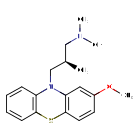
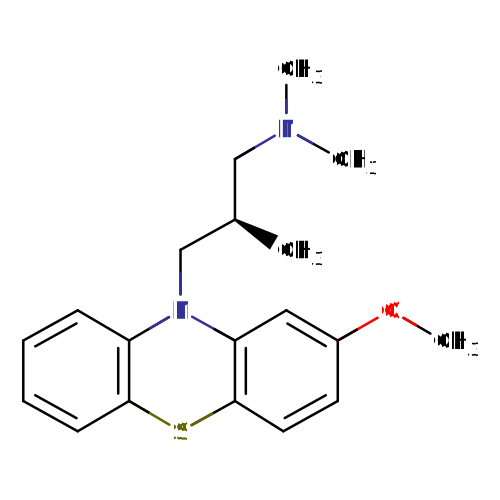
Structure for Methotrimeprazine (DB01403)
- Weight
- Average: 328.472
Monoisotopic: 328.16093409 - Chemical Formula
- C19H24N2OS
- Synonyms
- (-)-(2R)-3-(2-methoxy-10H-phenothiazin-10-yl)-N,N,2-trimethylpropan-1-amine
- (-)-10-(3-(Dimethylamino)-2-methylpropyl)-2-methoxyphenothiazine
- 2-Methoxytrimeprazine
- Levomepromazina
- Levomepromazine
- Lévomépromazine
- Levomepromazinum
- Methotrimeprazine
- External IDs
- CL 36467
- CL 39743
- N05AA02
- RP 7044
- RP-7044
- SK&F 5116
- XP-03
- XP03

Pharmacology
- Indication
For the treatment of psychosis, particular those of schizophrenia, and manic phases of bipolar disorder.
 Reduce drug development failure ratesBuild, train, & validate machine-learning modelswith evidence-based and structured datasets.Build, train, & validate predictive machine-learning models with structured datasets.
- Associated Conditions
Indication Type Indication Combined Product Details Approval Level Age Group Patient Characteristics Dose Form Management of Amnesia •••••••••••• Management of Anxiety •••••••••••• Symptomatic treatment of Cancer pain •••••••••••• Management of Manic depression •••••••••••• Treatment of Nausea and vomiting •••••••••••• - Associated Therapies
- Contraindications & Blackbox Warnings
 Prevent Adverse Drug Events TodayTap into our Clinical API for life-saving information on contraindications & blackbox warnings, population restrictions, harmful risks, & more.Avoid life-threatening adverse drug events with our Clinical API
- Pharmacodynamics
Methotrimeprazine is a phenothiazine with pharmacological activity similar to that of both chlorpromazine and promethazine. It has the histamine-antagonist properties of the antihistamines together with central nervous system effects resembling those of chlorpromazine. (From Martindale, The Extra Pharmacopoeia, 30th ed, p604)
- Mechanism of action
Methotrimeprazine's antipsychotic effect is largely due to its antagonism of dopamine receptors in the brain. In addition, its binding to 5HT2 receptors may also play a role.
Target Actions Organism ADopamine D2 receptor antagonistHumans UDopamine D1 receptor antagonistHumans UDopamine D5 receptor antagonistHumans UDopamine D3 receptor antagonistHumans UDopamine D4 receptor antagonistHumans U5-hydroxytryptamine receptor 2A antagonistHumans U5-hydroxytryptamine receptor 2C antagonistHumans UHistamine H1 receptor antagonistHumans UMuscarinic acetylcholine receptor M1 antagonistHumans UMuscarinic acetylcholine receptor M2 antagonistHumans UMuscarinic acetylcholine receptor M3 antagonistHumans UMuscarinic acetylcholine receptor M4 antagonistHumans UMuscarinic acetylcholine receptor M5 antagonistHumans UAlpha-1A adrenergic receptor antagonistHumans UAlpha-1B adrenergic receptor antagonistHumans UAlpha-1D adrenergic receptor antagonistHumans UAlpha-2A adrenergic receptor antagonistHumans UAlpha-2B adrenergic receptor antagonistHumans UAlpha-2C adrenergic receptor antagonistHumans - Absorption
Methotrimeprazine has an incomplete oral bioavailability, because it undergoes considerable first-pass-metabolism in the liver. Oral bioavailability is approximately 50 to 60%.
- Volume of distribution
Not Available
- Protein binding
Not Available
- Metabolism
Hepatic. Methotrimeprazine is metabolized in the liver and degraded to a sulfoxid-, a glucuronid- and a demethyl-moiety.
- Route of elimination
Not Available
- Half-life
Approximately 20 hours.
- Clearance
Not Available
- Adverse Effects
 Improve decision support & research outcomesWith structured adverse effects data, including: blackbox warnings, adverse reactions, warning & precautions, & incidence rates. View sample adverse effects data in our new Data Library!Improve decision support & research outcomes with our structured adverse effects data.
- Toxicity
Symptoms of overdose include convulsions, spastic movements, and coma.
- Pathways
- Not Available
- Pharmacogenomic Effects/ADRs
- Not Available
Interactions
- Drug Interactions
- This information should not be interpreted without the help of a healthcare provider. If you believe you are experiencing an interaction, contact a healthcare provider immediately. The absence of an interaction does not necessarily mean no interactions exist.
Drug Interaction Integrate drug-drug
interactions in your software1,2-Benzodiazepine 1,2-Benzodiazepine may increase the central nervous system depressant (CNS depressant) activities of Methotrimeprazine. Abatacept The metabolism of Methotrimeprazine can be increased when combined with Abatacept. Abiraterone The metabolism of Methotrimeprazine can be decreased when combined with Abiraterone. Acarbose The therapeutic efficacy of Acarbose can be decreased when used in combination with Methotrimeprazine. Acebutolol The metabolism of Acebutolol can be decreased when combined with Methotrimeprazine. - Food Interactions
- Take with food. Food reduces irritation.
Products
 Drug product information from 10+ global regionsOur datasets provide approved product information including:dosage, form, labeller, route of administration, and marketing period.Access drug product information from over 10 global regions.
- Product Ingredients
Ingredient UNII CAS InChI Key Methotrimeprazine hydrochloride 42BB1Y2586 1236-99-3 ODLGFPIWRAEFAN-PFEQFJNWSA-N Methotrimeprazine maleate 5KN5Y9V01K 7104-38-3 IFLZPECPTYCEBR-VIEYUMQNSA-N - International/Other Brands
- Levoprome / Neurocil / Nosinan / Nozinan
- Brand Name Prescription Products
Name Dosage Strength Route Labeller Marketing Start Marketing End Region Image Methoprazine Tablet 5 mg Oral Aa Pharma Inc 1998-07-20 Not applicable Canada 
Methoprazine Tablet 50 mg Oral Aa Pharma Inc 1998-07-20 Not applicable Canada Methoprazine Tablet 2 mg Oral Aa Pharma Inc 1998-07-20 Not applicable Canada Methoprazine Tablet 25 mg Oral Aa Pharma Inc 1998-07-20 Not applicable Canada Methotrimeprazine-2 Tablet 2 mg Oral Pro Doc Limitee 1999-05-10 2009-07-23 Canada - Generic Prescription Products
Name Dosage Strength Route Labeller Marketing Start Marketing End Region Image Novo Meprazine Tab 25mg Tablet 25 mg Oral Novopharm Limited 1996-12-31 2018-05-02 Canada Novo Meprazine Tab 5mg Tablet 5 mg Oral Novopharm Limited 1995-07-17 2018-05-02 Canada PMS-methotrimeprazine Tablet 5 mg Oral Pharmascience Inc 1997-10-20 2017-11-14 Canada PMS-methotrimeprazine Tablet 50 mg Oral Pharmascience Inc 1997-10-20 2017-09-30 Canada PMS-methotrimeprazine Tablet 25 mg Oral Pharmascience Inc 1997-10-20 2017-09-30 Canada
Categories
- ATC Codes
- N05AA02 — Levomepromazine
- Drug Categories
- Adrenergic alpha-1 Receptor Antagonists
- Adrenergic alpha-Antagonists
- Adrenergic Antagonists
- Agents producing tachycardia
- Agents that produce hypertension
- Analgesics
- Analgesics, Non-Narcotic
- Anticholinergic Agents
- Antidepressive Agents
- Antipsychotic Agents
- Antipsychotic Agents (First Generation [Typical])
- Central Nervous System Agents
- Central Nervous System Depressants
- Cytochrome P-450 CYP2D6 Inhibitors
- Cytochrome P-450 CYP2D6 Inhibitors (strong)
- Cytochrome P-450 CYP2D6 Substrates
- Cytochrome P-450 CYP2E1 Inhibitors
- Cytochrome P-450 CYP2E1 Inhibitors (strength unknown)
- Cytochrome P-450 Enzyme Inhibitors
- Cytochrome P-450 Substrates
- Dopamine Agents
- Dopamine Antagonists
- Dopamine D2 Receptor Antagonists
- Drugs causing inadvertant photosensitivity
- Heterocyclic Compounds, Fused-Ring
- Histamine Antagonists
- Histamine H1 Antagonists
- Hyperglycemia-Associated Agents
- Muscarinic Antagonists
- Nervous System
- Neurotoxic agents
- Neurotransmitter Agents
- Peripheral Nervous System Agents
- Phenothiazines
- Phenothiazines With Aliphatic Side-Chain
- Photosensitizing Agents
- Potential QTc-Prolonging Agents
- Psycholeptics
- Psychotropic Drugs
- QTc Prolonging Agents
- Sensory System Agents
- Serotonergic Drugs Shown to Increase Risk of Serotonin Syndrome
- Serotonin 5-HT2 Receptor Antagonists
- Serotonin 5-HT2A Receptor Antagonists
- Serotonin 5-HT2C Receptor Antagonists
- Serotonin Agents
- Serotonin Receptor Antagonists
- Sulfur Compounds
- Tranquilizing Agents
- Chemical TaxonomyProvided by Classyfire
- Description
- This compound belongs to the class of organic compounds known as phenothiazines. These are polycyclic aromatic compounds containing a phenothiazine moiety, which is a linear tricyclic system that consists of a two benzene rings joined by a para-thiazine ring.
- Kingdom
- Organic compounds
- Super Class
- Organoheterocyclic compounds
- Class
- Benzothiazines
- Sub Class
- Phenothiazines
- Direct Parent
- Phenothiazines
- Alternative Parents
- Alkyldiarylamines / Diarylthioethers / Anisoles / Alkyl aryl ethers / 1,4-thiazines / Trialkylamines / Azacyclic compounds / Organopnictogen compounds / Hydrocarbon derivatives
- Substituents
- Alkyl aryl ether / Alkyldiarylamine / Amine / Anisole / Aromatic heteropolycyclic compound / Aryl thioether / Azacycle / Benzenoid / Diarylthioether / Ether
- Molecular Framework
- Aromatic heteropolycyclic compounds
- External Descriptors
- phenothiazines, tertiary amine (CHEBI:6838)
- Affected organisms
- Humans and other mammals
Chemical Identifiers
- UNII
- 9G0LAW7ATQ
- CAS number
- 60-99-1
- InChI Key
- VRQVVMDWGGWHTJ-CQSZACIVSA-N
- InChI
- InChI=1S/C19H24N2OS/c1-14(12-20(2)3)13-21-16-7-5-6-8-18(16)23-19-10-9-15(22-4)11-17(19)21/h5-11,14H,12-13H2,1-4H3/t14-/m1/s1
- IUPAC Name
- [(2R)-3-(2-methoxy-10H-phenothiazin-10-yl)-2-methylpropyl]dimethylamine
- SMILES
- COC1=CC2=C(SC3=C(C=CC=C3)N2C[C@H](C)CN(C)C)C=C1
References
- Synthesis Reference
Christian Berger, "Process for preparing levomepromazine hydrogen maleate." U.S. Patent US4798895, issued January 17, 1989.
US4798895- General References
- Link [Link]
- External Links
- Human Metabolome Database
- HMDB0015474
- KEGG Drug
- D00403
- KEGG Compound
- C07192
- PubChem Compound
- 72287
- PubChem Substance
- 46507223
- ChemSpider
- 65239
- BindingDB
- 50418049
- 6852
- ChEBI
- 6838
- ChEMBL
- CHEMBL1764
- ZINC
- ZINC000000020246
- PharmGKB
- PA164743234
- Wikipedia
- Levomepromazine
Clinical Trials
- Clinical Trials
Phase Status Purpose Conditions Count 3 Terminated Treatment Anxiety Disorders / Dementia / Depression / Psychosomatic Disorders / Schizophrenia 1 3 Unknown Status Treatment Psychosis Nos/Other 1 Not Available Completed Not Available Bipolar Disorder (BD) / Psychosis / Schizoaffective Disorders / Schizophrenia / Type 2 Diabetes Mellitus 1 Not Available Completed Treatment Schizophrenia Relapse 1
Pharmacoeconomics
- Manufacturers
- Not Available
- Packagers
- Not Available
- Dosage Forms
Form Route Strength Tablet Oral 100 mg Tablet Oral 10 MG Solution Oral 40 MG/ML Solution Oral 40 mg Tablet, coated Oral 100 mg Tablet, coated Oral 25 mg Tablet Oral 2 mg Tablet Oral 25 mg Tablet Oral 5 mg Tablet Oral 50 mg Tablet, film coated Oral 100 MG Tablet, film coated Oral 25 MG Liquid; solution / drops Oral 40 mg / mL Solution Intramuscular; Intravenous 25 mg / mL Solution Oral 5 mg / mL Solution / drops 4 % Tablet Oral 25 mg / tab Tablet Oral 50 mg / tab Tablet Oral 5 mg / tab Tablet Oral 33.800 mg Tablet Oral 2500000 mg Tablet Oral 33.835 mg - Prices
Unit description Cost Unit Nozinan 25 mg/ml 3.6USD ml Apo-Methoprazine 50 mg Tablet 0.4USD tablet Apo-Methoprazine 25 mg Tablet 0.27USD tablet Apo-Methoprazine 5 mg Tablet 0.1USD tablet Apo-Methoprazine 2 mg Tablet 0.07USD tablet DrugBank does not sell nor buy drugs. Pricing information is supplied for informational purposes only.- Patents
- Not Available
Properties
- State
- Solid
- Experimental Properties
Property Value Source water solubility 20 mg/L (at 25 °C) YALKOWSKY,SH & DANNENFELSER,RM (1992) logP 4.68 HANSCH,C ET AL. (1995) logS -4.22 ADME Research, USCD pKa 9.19 SANGSTER (1994) - Predicted Properties
Property Value Source Water Solubility 0.00525 mg/mL ALOGPS logP 4.84 ALOGPS logP 4.25 Chemaxon logS -4.8 ALOGPS pKa (Strongest Basic) 9.42 Chemaxon Physiological Charge 1 Chemaxon Hydrogen Acceptor Count 3 Chemaxon Hydrogen Donor Count 0 Chemaxon Polar Surface Area 15.71 Å2 Chemaxon Rotatable Bond Count 5 Chemaxon Refractivity 99.83 m3·mol-1 Chemaxon Polarizability 36.78 Å3 Chemaxon Number of Rings 3 Chemaxon Bioavailability 1 Chemaxon Rule of Five Yes Chemaxon Ghose Filter Yes Chemaxon Veber's Rule Yes Chemaxon MDDR-like Rule No Chemaxon - Predicted ADMET Features
Property Value Probability Human Intestinal Absorption + 0.9857 Blood Brain Barrier + 0.9935 Caco-2 permeable + 0.6694 P-glycoprotein substrate Substrate 0.6805 P-glycoprotein inhibitor I Inhibitor 0.8564 P-glycoprotein inhibitor II Inhibitor 0.8571 Renal organic cation transporter Non-inhibitor 0.5132 CYP450 2C9 substrate Non-substrate 0.7511 CYP450 2D6 substrate Substrate 0.5363 CYP450 3A4 substrate Substrate 0.6056 CYP450 1A2 substrate Inhibitor 0.6953 CYP450 2C9 inhibitor Non-inhibitor 0.907 CYP450 2D6 inhibitor Inhibitor 0.8932 CYP450 2C19 inhibitor Non-inhibitor 0.9026 CYP450 3A4 inhibitor Inhibitor 0.5432 CYP450 inhibitory promiscuity High CYP Inhibitory Promiscuity 0.5633 Ames test Non AMES toxic 0.5562 Carcinogenicity Non-carcinogens 0.9182 Biodegradation Not ready biodegradable 1.0 Rat acute toxicity 2.5064 LD50, mol/kg Not applicable hERG inhibition (predictor I) Weak inhibitor 0.932 hERG inhibition (predictor II) Inhibitor 0.8488
Spectra
- Mass Spec (NIST)
- Not Available
- Spectra
- Chromatographic Properties
Collision Cross Sections (CCS)
Adduct CCS Value (Å2) Source type Source [M-H]- 188.6297676 predictedDarkChem Lite v0.1.0 [M-H]- 191.2200676 predictedDarkChem Lite v0.1.0 [M-H]- 185.28712 predictedDeepCCS 1.0 (2019) [M+H]+ 188.3509676 predictedDarkChem Lite v0.1.0 [M+H]+ 191.4417676 predictedDarkChem Lite v0.1.0 [M+H]+ 187.64511 predictedDeepCCS 1.0 (2019) [M+Na]+ 188.7979676 predictedDarkChem Lite v0.1.0 [M+Na]+ 191.4795676 predictedDarkChem Lite v0.1.0 [M+Na]+ 194.62297 predictedDeepCCS 1.0 (2019)
Targets

- Kind
- Protein
- Organism
- Humans
- Pharmacological action
- Yes
- Actions
- Antagonist
- General Function
- Potassium channel regulator activity
- Specific Function
- Dopamine receptor whose activity is mediated by G proteins which inhibit adenylyl cyclase.
- Gene Name
- DRD2
- Uniprot ID
- P14416
- Uniprot Name
- D(2) dopamine receptor
- Molecular Weight
- 50618.91 Da
References
- Green B, Pettit T, Faith L, Seaton K: Focus on levomepromazine. Curr Med Res Opin. 2004 Dec;20(12):1877-81. [Article]
- Dahl SG, Hough E, Hals PA: Phenothiazine drugs and metabolites: molecular conformation and dopaminergic, alpha adrenergic and muscarinic cholinergic receptor binding. Biochem Pharmacol. 1986 Apr 15;35(8):1263-9. [Article]
- Berman HM, Westbrook J, Feng Z, Gilliland G, Bhat TN, Weissig H, Shindyalov IN, Bourne PE: The Protein Data Bank. Nucleic Acids Res. 2000 Jan 1;28(1):235-42. [Article]
- Kind
- Protein
- Organism
- Humans
- Pharmacological action
- Unknown
- Actions
- Antagonist
- General Function
- G-protein coupled amine receptor activity
- Specific Function
- Dopamine receptor whose activity is mediated by G proteins which activate adenylyl cyclase.
- Gene Name
- DRD1
- Uniprot ID
- P21728
- Uniprot Name
- D(1A) dopamine receptor
- Molecular Weight
- 49292.765 Da
References
- Green B, Pettit T, Faith L, Seaton K: Focus on levomepromazine. Curr Med Res Opin. 2004 Dec;20(12):1877-81. [Article]
- Kind
- Protein
- Organism
- Humans
- Pharmacological action
- Unknown
- Actions
- Antagonist
- General Function
- G-protein coupled amine receptor activity
- Specific Function
- Dopamine receptor whose activity is mediated by G proteins which activate adenylyl cyclase.
- Gene Name
- DRD5
- Uniprot ID
- P21918
- Uniprot Name
- D(1B) dopamine receptor
- Molecular Weight
- 52950.5 Da
References
- Green B, Pettit T, Faith L, Seaton K: Focus on levomepromazine. Curr Med Res Opin. 2004 Dec;20(12):1877-81. [Article]
- Kind
- Protein
- Organism
- Humans
- Pharmacological action
- Unknown
- Actions
- Antagonist
- General Function
- G-protein coupled amine receptor activity
- Specific Function
- Dopamine receptor whose activity is mediated by G proteins which inhibit adenylyl cyclase. Promotes cell proliferation.
- Gene Name
- DRD3
- Uniprot ID
- P35462
- Uniprot Name
- D(3) dopamine receptor
- Molecular Weight
- 44224.335 Da
References
- Green B, Pettit T, Faith L, Seaton K: Focus on levomepromazine. Curr Med Res Opin. 2004 Dec;20(12):1877-81. [Article]
- Kind
- Protein
- Organism
- Humans
- Pharmacological action
- Unknown
- Actions
- Antagonist
- General Function
- Sh3 domain binding
- Specific Function
- Dopamine receptor responsible for neuronal signaling in the mesolimbic system of the brain, an area of the brain that regulates emotion and complex behavior. Its activity is mediated by G proteins ...
- Gene Name
- DRD4
- Uniprot ID
- P21917
- Uniprot Name
- D(4) dopamine receptor
- Molecular Weight
- 48359.86 Da
References
- Green B, Pettit T, Faith L, Seaton K: Focus on levomepromazine. Curr Med Res Opin. 2004 Dec;20(12):1877-81. [Article]
- Kind
- Protein
- Organism
- Humans
- Pharmacological action
- Unknown
- Actions
- Antagonist
- General Function
- Virus receptor activity
- Specific Function
- G-protein coupled receptor for 5-hydroxytryptamine (serotonin). Also functions as a receptor for various drugs and psychoactive substances, including mescaline, psilocybin, 1-(2,5-dimethoxy-4-iodop...
- Gene Name
- HTR2A
- Uniprot ID
- P28223
- Uniprot Name
- 5-hydroxytryptamine receptor 2A
- Molecular Weight
- 52602.58 Da
References
- Green B, Pettit T, Faith L, Seaton K: Focus on levomepromazine. Curr Med Res Opin. 2004 Dec;20(12):1877-81. [Article]
- Kind
- Protein
- Organism
- Humans
- Pharmacological action
- Unknown
- Actions
- Antagonist
- General Function
- Serotonin receptor activity
- Specific Function
- G-protein coupled receptor for 5-hydroxytryptamine (serotonin). Also functions as a receptor for various drugs and psychoactive substances, including ergot alkaloid derivatives, 1-2,5,-dimethoxy-4-...
- Gene Name
- HTR2C
- Uniprot ID
- P28335
- Uniprot Name
- 5-hydroxytryptamine receptor 2C
- Molecular Weight
- 51820.705 Da
References
- Green B, Pettit T, Faith L, Seaton K: Focus on levomepromazine. Curr Med Res Opin. 2004 Dec;20(12):1877-81. [Article]
- Kind
- Protein
- Organism
- Humans
- Pharmacological action
- Unknown
- Actions
- Antagonist
- General Function
- Histamine receptor activity
- Specific Function
- In peripheral tissues, the H1 subclass of histamine receptors mediates the contraction of smooth muscles, increase in capillary permeability due to contraction of terminal venules, and catecholamin...
- Gene Name
- HRH1
- Uniprot ID
- P35367
- Uniprot Name
- Histamine H1 receptor
- Molecular Weight
- 55783.61 Da
References
- Hals PA, Hall H, Dahl SG: Muscarinic cholinergic and histamine H1 receptor binding of phenothiazine drug metabolites. Life Sci. 1988;43(5):405-12. [Article]
- Kind
- Protein
- Organism
- Humans
- Pharmacological action
- Unknown
- Actions
- Antagonist
- General Function
- Phosphatidylinositol phospholipase c activity
- Specific Function
- The muscarinic acetylcholine receptor mediates various cellular responses, including inhibition of adenylate cyclase, breakdown of phosphoinositides and modulation of potassium channels through the...
- Gene Name
- CHRM1
- Uniprot ID
- P11229
- Uniprot Name
- Muscarinic acetylcholine receptor M1
- Molecular Weight
- 51420.375 Da
References
- Dahl SG, Hough E, Hals PA: Phenothiazine drugs and metabolites: molecular conformation and dopaminergic, alpha adrenergic and muscarinic cholinergic receptor binding. Biochem Pharmacol. 1986 Apr 15;35(8):1263-9. [Article]
- Hals PA, Hall H, Dahl SG: Muscarinic cholinergic and histamine H1 receptor binding of phenothiazine drug metabolites. Life Sci. 1988;43(5):405-12. [Article]
- Kind
- Protein
- Organism
- Humans
- Pharmacological action
- Unknown
- Actions
- Antagonist
- General Function
- G-protein coupled acetylcholine receptor activity
- Specific Function
- The muscarinic acetylcholine receptor mediates various cellular responses, including inhibition of adenylate cyclase, breakdown of phosphoinositides and modulation of potassium channels through the...
- Gene Name
- CHRM2
- Uniprot ID
- P08172
- Uniprot Name
- Muscarinic acetylcholine receptor M2
- Molecular Weight
- 51714.605 Da
References
- Dahl SG, Hough E, Hals PA: Phenothiazine drugs and metabolites: molecular conformation and dopaminergic, alpha adrenergic and muscarinic cholinergic receptor binding. Biochem Pharmacol. 1986 Apr 15;35(8):1263-9. [Article]
- Hals PA, Hall H, Dahl SG: Muscarinic cholinergic and histamine H1 receptor binding of phenothiazine drug metabolites. Life Sci. 1988;43(5):405-12. [Article]
- Kind
- Protein
- Organism
- Humans
- Pharmacological action
- Unknown
- Actions
- Antagonist
- General Function
- Receptor activity
- Specific Function
- The muscarinic acetylcholine receptor mediates various cellular responses, including inhibition of adenylate cyclase, breakdown of phosphoinositides and modulation of potassium channels through the...
- Gene Name
- CHRM3
- Uniprot ID
- P20309
- Uniprot Name
- Muscarinic acetylcholine receptor M3
- Molecular Weight
- 66127.445 Da
References
- Dahl SG, Hough E, Hals PA: Phenothiazine drugs and metabolites: molecular conformation and dopaminergic, alpha adrenergic and muscarinic cholinergic receptor binding. Biochem Pharmacol. 1986 Apr 15;35(8):1263-9. [Article]
- Hals PA, Hall H, Dahl SG: Muscarinic cholinergic and histamine H1 receptor binding of phenothiazine drug metabolites. Life Sci. 1988;43(5):405-12. [Article]
- Kind
- Protein
- Organism
- Humans
- Pharmacological action
- Unknown
- Actions
- Antagonist
- General Function
- Guanyl-nucleotide exchange factor activity
- Specific Function
- The muscarinic acetylcholine receptor mediates various cellular responses, including inhibition of adenylate cyclase, breakdown of phosphoinositides and modulation of potassium channels through the...
- Gene Name
- CHRM4
- Uniprot ID
- P08173
- Uniprot Name
- Muscarinic acetylcholine receptor M4
- Molecular Weight
- 53048.65 Da
References
- Dahl SG, Hough E, Hals PA: Phenothiazine drugs and metabolites: molecular conformation and dopaminergic, alpha adrenergic and muscarinic cholinergic receptor binding. Biochem Pharmacol. 1986 Apr 15;35(8):1263-9. [Article]
- Hals PA, Hall H, Dahl SG: Muscarinic cholinergic and histamine H1 receptor binding of phenothiazine drug metabolites. Life Sci. 1988;43(5):405-12. [Article]
- Kind
- Protein
- Organism
- Humans
- Pharmacological action
- Unknown
- Actions
- Antagonist
- General Function
- Phosphatidylinositol phospholipase c activity
- Specific Function
- The muscarinic acetylcholine receptor mediates various cellular responses, including inhibition of adenylate cyclase, breakdown of phosphoinositides and modulation of potassium channels through the...
- Gene Name
- CHRM5
- Uniprot ID
- P08912
- Uniprot Name
- Muscarinic acetylcholine receptor M5
- Molecular Weight
- 60073.205 Da
References
- Dahl SG, Hough E, Hals PA: Phenothiazine drugs and metabolites: molecular conformation and dopaminergic, alpha adrenergic and muscarinic cholinergic receptor binding. Biochem Pharmacol. 1986 Apr 15;35(8):1263-9. [Article]
- Hals PA, Hall H, Dahl SG: Muscarinic cholinergic and histamine H1 receptor binding of phenothiazine drug metabolites. Life Sci. 1988;43(5):405-12. [Article]
- Kind
- Protein
- Organism
- Humans
- Pharmacological action
- Unknown
- Actions
- Antagonist
- General Function
- Protein heterodimerization activity
- Specific Function
- This alpha-adrenergic receptor mediates its action by association with G proteins that activate a phosphatidylinositol-calcium second messenger system. Its effect is mediated by G(q) and G(11) prot...
- Gene Name
- ADRA1A
- Uniprot ID
- P35348
- Uniprot Name
- Alpha-1A adrenergic receptor
- Molecular Weight
- 51486.005 Da
References
- Green B, Pettit T, Faith L, Seaton K: Focus on levomepromazine. Curr Med Res Opin. 2004 Dec;20(12):1877-81. [Article]
- Dahl SG, Hough E, Hals PA: Phenothiazine drugs and metabolites: molecular conformation and dopaminergic, alpha adrenergic and muscarinic cholinergic receptor binding. Biochem Pharmacol. 1986 Apr 15;35(8):1263-9. [Article]
- Kind
- Protein
- Organism
- Humans
- Pharmacological action
- Unknown
- Actions
- Antagonist
- General Function
- Protein heterodimerization activity
- Specific Function
- This alpha-adrenergic receptor mediates its action by association with G proteins that activate a phosphatidylinositol-calcium second messenger system. Its effect is mediated by G(q) and G(11) prot...
- Gene Name
- ADRA1B
- Uniprot ID
- P35368
- Uniprot Name
- Alpha-1B adrenergic receptor
- Molecular Weight
- 56835.375 Da
References
- Green B, Pettit T, Faith L, Seaton K: Focus on levomepromazine. Curr Med Res Opin. 2004 Dec;20(12):1877-81. [Article]
- Dahl SG, Hough E, Hals PA: Phenothiazine drugs and metabolites: molecular conformation and dopaminergic, alpha adrenergic and muscarinic cholinergic receptor binding. Biochem Pharmacol. 1986 Apr 15;35(8):1263-9. [Article]
- Kind
- Protein
- Organism
- Humans
- Pharmacological action
- Unknown
- Actions
- Antagonist
- General Function
- Alpha1-adrenergic receptor activity
- Specific Function
- This alpha-adrenergic receptor mediates its effect through the influx of extracellular calcium.
- Gene Name
- ADRA1D
- Uniprot ID
- P25100
- Uniprot Name
- Alpha-1D adrenergic receptor
- Molecular Weight
- 60462.205 Da
References
- Green B, Pettit T, Faith L, Seaton K: Focus on levomepromazine. Curr Med Res Opin. 2004 Dec;20(12):1877-81. [Article]
- Dahl SG, Hough E, Hals PA: Phenothiazine drugs and metabolites: molecular conformation and dopaminergic, alpha adrenergic and muscarinic cholinergic receptor binding. Biochem Pharmacol. 1986 Apr 15;35(8):1263-9. [Article]
- Kind
- Protein
- Organism
- Humans
- Pharmacological action
- Unknown
- Actions
- Antagonist
- General Function
- Thioesterase binding
- Specific Function
- Alpha-2 adrenergic receptors mediate the catecholamine-induced inhibition of adenylate cyclase through the action of G proteins. The rank order of potency for agonists of this receptor is oxymetazo...
- Gene Name
- ADRA2A
- Uniprot ID
- P08913
- Uniprot Name
- Alpha-2A adrenergic receptor
- Molecular Weight
- 48956.275 Da
References
- Green B, Pettit T, Faith L, Seaton K: Focus on levomepromazine. Curr Med Res Opin. 2004 Dec;20(12):1877-81. [Article]
- Dahl SG, Hough E, Hals PA: Phenothiazine drugs and metabolites: molecular conformation and dopaminergic, alpha adrenergic and muscarinic cholinergic receptor binding. Biochem Pharmacol. 1986 Apr 15;35(8):1263-9. [Article]
- Tsukamoto T, Asakura M, Hirata N, Imafuku J, Matsui H, Hasegawa K: Interaction of neuroleptics and antidepressants with rat brain alpha 2-receptors: a possible relationship between alpha 2-receptor antagonism and antidepressant action. Biol Psychiatry. 1984 Sep;19(9):1283-91. [Article]
- Kind
- Protein
- Organism
- Humans
- Pharmacological action
- Unknown
- Actions
- Antagonist
- General Function
- Epinephrine binding
- Specific Function
- Alpha-2 adrenergic receptors mediate the catecholamine-induced inhibition of adenylate cyclase through the action of G proteins. The rank order of potency for agonists of this receptor is clonidine...
- Gene Name
- ADRA2B
- Uniprot ID
- P18089
- Uniprot Name
- Alpha-2B adrenergic receptor
- Molecular Weight
- 49565.8 Da
References
- Green B, Pettit T, Faith L, Seaton K: Focus on levomepromazine. Curr Med Res Opin. 2004 Dec;20(12):1877-81. [Article]
- Dahl SG, Hough E, Hals PA: Phenothiazine drugs and metabolites: molecular conformation and dopaminergic, alpha adrenergic and muscarinic cholinergic receptor binding. Biochem Pharmacol. 1986 Apr 15;35(8):1263-9. [Article]
- Tsukamoto T, Asakura M, Hirata N, Imafuku J, Matsui H, Hasegawa K: Interaction of neuroleptics and antidepressants with rat brain alpha 2-receptors: a possible relationship between alpha 2-receptor antagonism and antidepressant action. Biol Psychiatry. 1984 Sep;19(9):1283-91. [Article]
- Kind
- Protein
- Organism
- Humans
- Pharmacological action
- Unknown
- Actions
- Antagonist
- General Function
- Protein homodimerization activity
- Specific Function
- Alpha-2 adrenergic receptors mediate the catecholamine-induced inhibition of adenylate cyclase through the action of G proteins.
- Gene Name
- ADRA2C
- Uniprot ID
- P18825
- Uniprot Name
- Alpha-2C adrenergic receptor
- Molecular Weight
- 49521.585 Da
References
- Green B, Pettit T, Faith L, Seaton K: Focus on levomepromazine. Curr Med Res Opin. 2004 Dec;20(12):1877-81. [Article]
- Dahl SG, Hough E, Hals PA: Phenothiazine drugs and metabolites: molecular conformation and dopaminergic, alpha adrenergic and muscarinic cholinergic receptor binding. Biochem Pharmacol. 1986 Apr 15;35(8):1263-9. [Article]
- Tsukamoto T, Asakura M, Hirata N, Imafuku J, Matsui H, Hasegawa K: Interaction of neuroleptics and antidepressants with rat brain alpha 2-receptors: a possible relationship between alpha 2-receptor antagonism and antidepressant action. Biol Psychiatry. 1984 Sep;19(9):1283-91. [Article]
Enzymes
- Kind
- Protein
- Organism
- Humans
- Pharmacological action
- Unknown
- Actions
- Inhibitor
- General Function
- Steroid hydroxylase activity
- Specific Function
- Metabolizes several precarcinogens, drugs, and solvents to reactive metabolites. Inactivates a number of drugs and xenobiotics and also bioactivates many xenobiotic substrates to their hepatotoxic ...
- Gene Name
- CYP2E1
- Uniprot ID
- P05181
- Uniprot Name
- Cytochrome P450 2E1
- Molecular Weight
- 56848.42 Da
References
- Daniel WA, Syrek M, Rylko Z, Kot M: Effects of phenothiazine neuroleptics on the rate of caffeine demethylation and hydroxylation in the rat liver. Pol J Pharmacol. 2001 Nov-Dec;53(6):615-21. [Article]
- Kind
- Protein
- Organism
- Humans
- Pharmacological action
- Unknown
- Actions
- SubstrateInhibitor
- General Function
- Steroid hydroxylase activity
- Specific Function
- Responsible for the metabolism of many drugs and environmental chemicals that it oxidizes. It is involved in the metabolism of drugs such as antiarrhythmics, adrenoceptor antagonists, and tricyclic...
- Gene Name
- CYP2D6
- Uniprot ID
- P10635
- Uniprot Name
- Cytochrome P450 2D6
- Molecular Weight
- 55768.94 Da
References
- Yoshimura R, Ueda N, Nakamura J: Low dosage of levomepromazine did not increase plasma concentrations of fluvoxamine. Int Clin Psychopharmacol. 2000 Jul;15(4):233-5. [Article]
- Yukawa E, Hokazono T, Yukawa M, Ichimaru R, Maki T, Matsunaga K, Ohdo S, Anai M, Higuchi S, Goto Y: Population pharmacokinetics of haloperidol using routine clinical pharmacokinetic data in Japanese patients. Clin Pharmacokinet. 2002;41(2):153-9. doi: 10.2165/00003088-200241020-00006. [Article]
- Mannheimer B, von Bahr C, Pettersson H, Eliasson E: Impact of multiple inhibitors or substrates of cytochrome P450 2D6 on plasma risperidone levels in patients on polypharmacy. Ther Drug Monit. 2008 Oct;30(5):565-9. doi: 10.1097/FTD.0b013e31818679c9. [Article]
- Sicras-Mainar A, Guijarro P, Armada B, Blanca-Tamayo M, Navarro-Artieda R: Influence of the CYP2D6 isoenzyme in patients treated with venlafaxine for major depressive disorder: clinical and economic consequences. PLoS One. 2014 Nov 4;9(11):e90453. doi: 10.1371/journal.pone.0090453. eCollection 2014. [Article]
- Flockhart Table of Drug Interactions [Link]

Drug created at July 10, 2007 18:38 / Updated at April 27, 2024 09:44