Identification
- Generic Name
- Theobromine
- DrugBank Accession Number
- DB01412
- Background
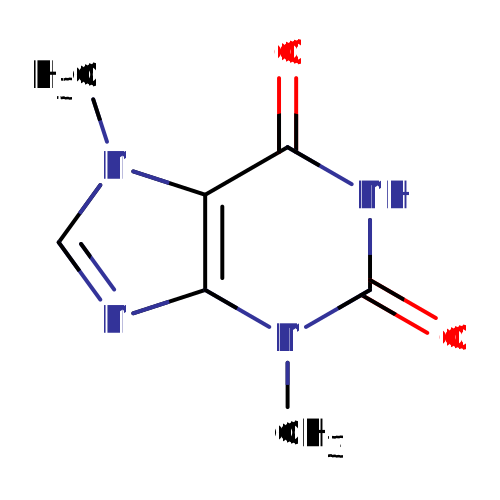
Theobromine (3,7-dimethylxanthine) is the principle alkaloid in Theobroma cacao (the cacao bean) and other plants. A xanthine alkaloid that is used as a bronchodilator and as a vasodilator. It has a weaker diuretic activity than theophylline and is also a less powerful stimulant of smooth muscle. It has practically no stimulant effect on the central nervous system. It was formerly used as a diuretic and in the treatment of angina pectoris and hypertension. (From Martindale, The Extra Pharmacopoeia, 30th ed, pp1318-9)
- Type
- Small Molecule
- Groups
- Investigational
- Structure
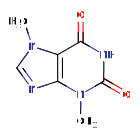
Structure for Theobromine (DB01412)
- Weight
- Average: 180.164
Monoisotopic: 180.06472552 - Chemical Formula
- C7H8N4O2
- Synonyms
- 3,7-dihydro-3,7-dimethyl-1H-purine-2,6-dione
- 3,7-dimethylpurine-2,6-dione
- 3,7-dimethylxanthine
- Theobromin
- Theobromine
- Théobromine
- External IDs
- FEMA NO. 3591
- NSC-5039
- SC 15090
- SC-15090

Pharmacology
- Indication
theobromine is used as a vasodilator, a diuretic, and heart stimulant. And similar to caffeine, it may be useful in management of fatigue and orthostatic hypotension.
 Reduce drug development failure ratesBuild, train, & validate machine-learning modelswith evidence-based and structured datasets.Build, train, & validate predictive machine-learning models with structured datasets.
- Contraindications & Blackbox Warnings
 Prevent Adverse Drug Events TodayTap into our Clinical API for life-saving information on contraindications & blackbox warnings, population restrictions, harmful risks, & more.Avoid life-threatening adverse drug events with our Clinical API
- Pharmacodynamics
Theobromine, a xanthine derivative like caffeine and the bronchodilator theophylline, is used as a CNS stimulant, mild diuretic, and respiratory stimulant (in neonates with apnea of prematurity).
- Mechanism of action
Theobromine stimulates medullary, vagal, vasomotor, and respiratory centers, promoting bradycardia, vasoconstriction, and increased respiratory rate. This action was previously believed to be due primarily to increased intracellular cyclic 3′,5′-adenosine monophosphate (cyclic AMP) following inhibition of phosphodiesterase, the enzyme that degrades cyclic AMP. It is now thought that xanthines such as caffeine and theobromine act as antagonist at adenosine-receptors within the plasma membrane of virtually every cell. As adenosine acts as an autocoid, inhibiting the release of neurotransmitters from presynaptic sites but augmenting the actions of norepinephrine or angiotensin, antagonism of adenosine receptors promotes neurotransmitter release. This explains the stimulatory effects of xanthine derivatives such as theobromine and caffeine. Blockade of the adenosine A1 receptor in the heart leads to the accelerated, pronounced "pounding" of the heart upon caffeine intake.
Target Actions Organism AAdenosine receptor A1 antagonistHumans AAdenosine receptor A2a antagonistHumans UcAMP-specific 3',5'-cyclic phosphodiesterase 4B inhibitorHumans - Absorption
Not Available
- Volume of distribution
Not Available
- Protein binding
Not Available
- Metabolism
- Not Available
- Route of elimination
Not Available
- Half-life
Not Available
- Clearance
Not Available
- Adverse Effects
 Improve decision support & research outcomesWith structured adverse effects data, including: blackbox warnings, adverse reactions, warning & precautions, & incidence rates. View sample adverse effects data in our new Data Library!Improve decision support & research outcomes with our structured adverse effects data.
- Toxicity
Not Available
- Pathways
Pathway Category Caffeine Metabolism Metabolic - Pharmacogenomic Effects/ADRs
- Not Available
Interactions
- Drug Interactions
- This information should not be interpreted without the help of a healthcare provider. If you believe you are experiencing an interaction, contact a healthcare provider immediately. The absence of an interaction does not necessarily mean no interactions exist.
Drug Interaction Integrate drug-drug
interactions in your software1,2-Benzodiazepine The therapeutic efficacy of 1,2-Benzodiazepine can be decreased when used in combination with Theobromine. Abacavir Theobromine may increase the excretion rate of Abacavir which could result in a lower serum level and potentially a reduction in efficacy. Abametapir The serum concentration of Theobromine can be increased when it is combined with Abametapir. Abatacept The metabolism of Theobromine can be increased when combined with Abatacept. Abiraterone The serum concentration of Theobromine can be increased when it is combined with Abiraterone. - Food Interactions
- Not Available
Categories
- ATC Codes
- C03BD01 — Theobromine
- C03BD — Xanthine derivatives
- C03B — LOW-CEILING DIURETICS, EXCL. THIAZIDES
- C03 — DIURETICS
- C — CARDIOVASCULAR SYSTEM
- R03DA — Xanthines
- R03D — OTHER SYSTEMIC DRUGS FOR OBSTRUCTIVE AIRWAY DISEASES
- R03 — DRUGS FOR OBSTRUCTIVE AIRWAY DISEASES
- R — RESPIRATORY SYSTEM
- Drug Categories
- Alkaloids
- Anti-Asthmatic Agents
- Autonomic Agents
- Bronchodilator Agents
- Cardiovascular Agents
- Cytochrome P-450 CYP1A2 Substrates
- Cytochrome P-450 CYP2E1 Substrates
- Cytochrome P-450 Substrates
- Diuretics
- Drugs for Obstructive Airway Diseases
- Heterocyclic Compounds, Fused-Ring
- Low-Ceiling Diuretics, Excl. Thiazides
- Peripheral Nervous System Agents
- Purines
- Purinones
- Respiratory System Agents
- Vasodilating Agents
- Xanthine derivatives
- Chemical TaxonomyProvided by Classyfire
- Description
- This compound belongs to the class of organic compounds known as xanthines. These are purine derivatives with a ketone group conjugated at carbons 2 and 6 of the purine moiety.
- Kingdom
- Organic compounds
- Super Class
- Organoheterocyclic compounds
- Class
- Imidazopyrimidines
- Sub Class
- Purines and purine derivatives
- Direct Parent
- Xanthines
- Alternative Parents
- 6-oxopurines / Alkaloids and derivatives / Pyrimidones / N-substituted imidazoles / Vinylogous amides / Heteroaromatic compounds / Ureas / Lactams / Azacyclic compounds / Organopnictogen compounds show 4 more
- Substituents
- 6-oxopurine / Alkaloid or derivatives / Aromatic heteropolycyclic compound / Azacycle / Azole / Heteroaromatic compound / Hydrocarbon derivative / Imidazole / Lactam / N-substituted imidazole show 12 more
- Molecular Framework
- Aromatic heteropolycyclic compounds
- External Descriptors
- dimethylxanthine (CHEBI:28946) / Purine alkaloids (C07480) / a small molecule (3-7-DIMETHYLXANTHINE)
- Affected organisms
- Not Available
Chemical Identifiers
- UNII
- OBD445WZ5P
- CAS number
- 83-67-0
- InChI Key
- YAPQBXQYLJRXSA-UHFFFAOYSA-N
- InChI
- InChI=1S/C7H8N4O2/c1-10-3-8-5-4(10)6(12)9-7(13)11(5)2/h3H,1-2H3,(H,9,12,13)
- IUPAC Name
- 3,7-dimethyl-2,3,6,7-tetrahydro-1H-purine-2,6-dione
- SMILES
- CN1C=NC2=C1C(=O)NC(=O)N2C
References
- Synthesis Reference
Misako Mizuno, Hiroshi Ashihara, Kouichi Mizuno, Tatsuhito Fujimura, "CAMELLIA SINENSIS GENE ENCODING A CAFFEINE SYNTHESIS ASSOCIATED N-METHYL TRANSFERASE WITH 7-METHYLXANTHINE N3 METHYL TRANSFERASE, THEOBROMINE N1 METHYL TRANSFERASE, AND PARAXANTHINE N3 METHYL TRANSFERASE ACTIVITIES AND USE THEREOF." U.S. Patent US06930227, issued August 16, 2005.
US06930227- General References
- Usmani OS, Belvisi MG, Patel HJ, Crispino N, Birrell MA, Korbonits M, Korbonits D, Barnes PJ: Theobromine inhibits sensory nerve activation and cough. FASEB J. 2005 Feb;19(2):231-3. Epub 2004 Nov 17. [Article]
- Slattery ML, West DW: Smoking, alcohol, coffee, tea, caffeine, and theobromine: risk of prostate cancer in Utah (United States). Cancer Causes Control. 1993 Nov;4(6):559-63. [Article]
- External Links
- Human Metabolome Database
- HMDB0002825
- KEGG Compound
- C07480
- PubChem Compound
- 5429
- PubChem Substance
- 46508574
- ChemSpider
- 5236
- BindingDB
- 50014260
- 10437
- ChEBI
- 28946
- ChEMBL
- CHEMBL1114
- ZINC
- ZINC000000002151
- PharmGKB
- PA451646
- PDBe Ligand
- 37T
- Wikipedia
- Theobromine
- PDB Entries
- 2efj / 6icq / 7vro / 7vrq
- MSDS
- Download (74.2 KB)
Clinical Trials
- Clinical Trials
Phase Status Purpose Conditions Count 3 Completed Treatment Acute Tracheobronchitis 1 3 Completed Treatment Cough 1
Pharmacoeconomics
- Manufacturers
- Not Available
- Packagers
- Not Available
- Dosage Forms
- Not Available
- Prices
- Not Available
- Patents
- Not Available
Properties
- State
- Solid
- Experimental Properties
Property Value Source melting point (°C) 357 °C PhysProp water solubility 330 mg/L (at 25 °C) YALKOWSKY,SH & HE,Y (2003) logP -0.78 HANSCH,C ET AL. (1995) pKa 9.9 KORTUM,G ET AL (1961) - Predicted Properties
Property Value Source Water Solubility 9.74 mg/mL ALOGPS logP -0.46 ALOGPS logP -0.77 Chemaxon logS -1.3 ALOGPS pKa (Strongest Acidic) 9.28 Chemaxon pKa (Strongest Basic) -0.91 Chemaxon Physiological Charge 0 Chemaxon Hydrogen Acceptor Count 3 Chemaxon Hydrogen Donor Count 1 Chemaxon Polar Surface Area 67.23 Å2 Chemaxon Rotatable Bond Count 0 Chemaxon Refractivity 44.93 m3·mol-1 Chemaxon Polarizability 16.85 Å3 Chemaxon Number of Rings 2 Chemaxon Bioavailability 1 Chemaxon Rule of Five Yes Chemaxon Ghose Filter No Chemaxon Veber's Rule No Chemaxon MDDR-like Rule No Chemaxon - Predicted ADMET Features
Property Value Probability Human Intestinal Absorption + 1.0 Blood Brain Barrier + 0.9902 Caco-2 permeable + 0.6172 P-glycoprotein substrate Non-substrate 0.7281 P-glycoprotein inhibitor I Non-inhibitor 0.8939 P-glycoprotein inhibitor II Non-inhibitor 0.911 Renal organic cation transporter Non-inhibitor 0.8807 CYP450 2C9 substrate Non-substrate 0.7738 CYP450 2D6 substrate Non-substrate 0.9117 CYP450 3A4 substrate Non-substrate 0.5974 CYP450 1A2 substrate Non-inhibitor 0.9045 CYP450 2C9 inhibitor Non-inhibitor 0.9933 CYP450 2D6 inhibitor Non-inhibitor 0.9827 CYP450 2C19 inhibitor Non-inhibitor 0.9895 CYP450 3A4 inhibitor Non-inhibitor 0.9616 CYP450 inhibitory promiscuity Low CYP Inhibitory Promiscuity 0.9956 Ames test Non AMES toxic 0.9132 Carcinogenicity Non-carcinogens 0.9447 Biodegradation Ready biodegradable 0.5942 Rat acute toxicity 2.7898 LD50, mol/kg Not applicable hERG inhibition (predictor I) Weak inhibitor 0.8819 hERG inhibition (predictor II) Non-inhibitor 0.8927
Spectra
- Mass Spec (NIST)
- Download (8.9 KB)
- Spectra
- Chromatographic Properties
Collision Cross Sections (CCS)
Adduct CCS Value (Å2) Source type Source [M-H]- 138.6849361 predictedDarkChem Lite v0.1.0 [M-H]- 138.8836361 predictedDarkChem Lite v0.1.0 [M-H]- 138.6400361 predictedDarkChem Lite v0.1.0 [M-H]- 138.6053361 predictedDarkChem Lite v0.1.0 [M-H]- 133.40092 predictedDeepCCS 1.0 (2019) [M+H]+ 139.1440361 predictedDarkChem Lite v0.1.0 [M+H]+ 138.9795361 predictedDarkChem Lite v0.1.0 [M+H]+ 139.0759361 predictedDarkChem Lite v0.1.0 [M+H]+ 138.9908361 predictedDarkChem Lite v0.1.0 [M+H]+ 135.65422 predictedDeepCCS 1.0 (2019) [M+Na]+ 138.8649361 predictedDarkChem Lite v0.1.0 [M+Na]+ 138.7403361 predictedDarkChem Lite v0.1.0 [M+Na]+ 138.7573361 predictedDarkChem Lite v0.1.0 [M+Na]+ 142.52332 predictedDeepCCS 1.0 (2019)
Targets

- Kind
- Protein
- Organism
- Humans
- Pharmacological action
- Yes
- Actions
- Antagonist
- General Function
- Purine nucleoside binding
- Specific Function
- Receptor for adenosine. The activity of this receptor is mediated by G proteins which inhibit adenylyl cyclase.
- Gene Name
- ADORA1
- Uniprot ID
- P30542
- Uniprot Name
- Adenosine receptor A1
- Molecular Weight
- 36511.325 Da
References
- Chou CC, Vickroy TW: Antagonism of adenosine receptors by caffeine and caffeine metabolites in equine forebrain tissues. Am J Vet Res. 2003 Feb;64(2):216-24. [Article]
- Gaytan SP, Saadani-Makki F, Bodineau L, Frugiere A, Larnicol N, Pasaro R: Effect of postnatal exposure to caffeine on the pattern of adenosine A1 receptor distribution in respiration-related nuclei of the rat brainstem. Auton Neurosci. 2006 Jun 30;126-127:339-46. Epub 2006 May 15. [Article]
- Wang SJ: Caffeine facilitation of glutamate release from rat cerebral cortex nerve terminals (synaptosomes) through activation protein kinase C pathway: an interaction with presynaptic adenosine A1 receptors. Synapse. 2007 Jun;61(6):401-11. [Article]
- Rieg T, Schnermann J, Vallon V: Adenosine A1 receptors determine effects of caffeine on total fluid intake but not caffeine appetite. Eur J Pharmacol. 2007 Jan 26;555(2-3):174-7. Epub 2006 Oct 25. [Article]
- Mustafa S, Venkatesh P, Pasha K, Mullangi R, Srinivas NR: Altered intravenous pharmacokinetics of topotecan in rats with acute renal failure (ARF) induced by uranyl nitrate: do adenosine A1 antagonists (selective/non-selective) normalize the altered topotecan kinetics in ARF? Xenobiotica. 2006 Dec;36(12):1239-58. [Article]
- Listos J, Malec D, Fidecka S: Adenosine receptor antagonists intensify the benzodiazepine withdrawal signs in mice. Pharmacol Rep. 2006 Sep-Oct;58(5):643-51. [Article]
- Fisone G, Borgkvist A, Usiello A: Caffeine as a psychomotor stimulant: mechanism of action. Cell Mol Life Sci. 2004 Apr;61(7-8):857-72. [Article]
- Daly JW, Jacobson KA, Ukena D: Adenosine receptors: development of selective agonists and antagonists. Prog Clin Biol Res. 1987;230:41-63. [Article]
- Kind
- Protein
- Organism
- Humans
- Pharmacological action
- Yes
- Actions
- Antagonist
- General Function
- Identical protein binding
- Specific Function
- Receptor for adenosine. The activity of this receptor is mediated by G proteins which activate adenylyl cyclase.
- Gene Name
- ADORA2A
- Uniprot ID
- P29274
- Uniprot Name
- Adenosine receptor A2a
- Molecular Weight
- 44706.925 Da
References
- Chou CC, Vickroy TW: Antagonism of adenosine receptors by caffeine and caffeine metabolites in equine forebrain tissues. Am J Vet Res. 2003 Feb;64(2):216-24. [Article]
- Riksen NP, Franke B, van den Broek P, Smits P, Rongen GA: The 1976C>T polymorphism in the adenosine A2A receptor gene does not affect the vasodilator response to adenosine in humans in vivo. Pharmacogenet Genomics. 2007 Jul;17(7):551-4. [Article]
- Zhao G, Messina E, Xu X, Ochoa M, Sun HL, Leung K, Shryock J, Belardinelli L, Hintze TH: Caffeine attenuates the duration of coronary vasodilation and changes in hemodynamics induced by regadenoson (CVT-3146), a novel adenosine A2A receptor agonist. J Cardiovasc Pharmacol. 2007 Jun;49(6):369-75. [Article]
- Cornelis MC, El-Sohemy A, Campos H: Genetic polymorphism of the adenosine A2A receptor is associated with habitual caffeine consumption. Am J Clin Nutr. 2007 Jul;86(1):240-4. [Article]
- Fisone G, Borgkvist A, Usiello A: Caffeine as a psychomotor stimulant: mechanism of action. Cell Mol Life Sci. 2004 Apr;61(7-8):857-72. [Article]
- Daly JW, Jacobson KA, Ukena D: Adenosine receptors: development of selective agonists and antagonists. Prog Clin Biol Res. 1987;230:41-63. [Article]
- Kind
- Protein
- Organism
- Humans
- Pharmacological action
- Unknown
- Actions
- Inhibitor
- General Function
- Metal ion binding
- Specific Function
- Hydrolyzes the second messenger cAMP, which is a key regulator of many important physiological processes. May be involved in mediating central nervous system effects of therapeutic agents ranging f...
- Gene Name
- PDE4B
- Uniprot ID
- Q07343
- Uniprot Name
- cAMP-specific 3',5'-cyclic phosphodiesterase 4B
- Molecular Weight
- 83342.695 Da
References
- Essayan DM: Cyclic nucleotide phosphodiesterases. J Allergy Clin Immunol. 2001 Nov;108(5):671-80. [Article]
- Fisone G, Borgkvist A, Usiello A: Caffeine as a psychomotor stimulant: mechanism of action. Cell Mol Life Sci. 2004 Apr;61(7-8):857-72. [Article]
- Daly JW: Caffeine analogs: biomedical impact. Cell Mol Life Sci. 2007 Aug;64(16):2153-69. [Article]
- Deree J, Martins JO, Melbostad H, Loomis WH, Coimbra R: Insights into the regulation of TNF-alpha production in human mononuclear cells: the effects of non-specific phosphodiesterase inhibition. Clinics (Sao Paulo). 2008 Jun;63(3):321-8. [Article]
Enzymes
- Kind
- Protein
- Organism
- Humans
- Pharmacological action
- Unknown
- Actions
- Substrate
- Curator comments
- Data are limited to an in vitro study.
- General Function
- Oxidoreductase activity, acting on paired donors, with incorporation or reduction of molecular oxygen, reduced flavin or flavoprotein as one donor, and incorporation of one atom of oxygen
- Specific Function
- Cytochromes P450 are a group of heme-thiolate monooxygenases. In liver microsomes, this enzyme is involved in an NADPH-dependent electron transport pathway. It oxidizes a variety of structurally un...
- Gene Name
- CYP1A2
- Uniprot ID
- P05177
- Uniprot Name
- Cytochrome P450 1A2
- Molecular Weight
- 58293.76 Da
References
- Gates S, Miners JO: Cytochrome P450 isoform selectivity in human hepatic theobromine metabolism. Br J Clin Pharmacol. 1999 Mar;47(3):299-305. [Article]
- Kind
- Protein
- Organism
- Humans
- Pharmacological action
- Unknown
- Actions
- Substrate
- General Function
- Steroid hydroxylase activity
- Specific Function
- Metabolizes several precarcinogens, drugs, and solvents to reactive metabolites. Inactivates a number of drugs and xenobiotics and also bioactivates many xenobiotic substrates to their hepatotoxic ...
- Gene Name
- CYP2E1
- Uniprot ID
- P05181
- Uniprot Name
- Cytochrome P450 2E1
- Molecular Weight
- 56848.42 Da
References
- Gates S, Miners JO: Cytochrome P450 isoform selectivity in human hepatic theobromine metabolism. Br J Clin Pharmacol. 1999 Mar;47(3):299-305. [Article]


Drug created at July 17, 2007 12:41 / Updated at June 12, 2020 16:51