Identification
- Summary
Testosterone propionate is a slow-release anabolic steroid no longer used commonly for the treatment of androgen deficiency or promotion of anabolic effects on muscles.
- Generic Name
- Testosterone propionate
- DrugBank Accession Number
- DB01420
- Background
Testosterone propionate is a slower-releasing anabolic steroid with a short half-life. It is a synthetic androstane steroid derivative of testosterone in the form of 17β propionate ester of testosterone.2 Testosterone propionate was developed initially by Watson labs, and FDA approved on February 5, 1974. Currently, this drug has been discontinued in humans, but the vet application is still available as an OTC.4
- Type
- Small Molecule
- Groups
- Approved, Investigational, Vet approved, Withdrawn
- Structure
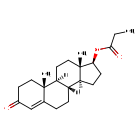
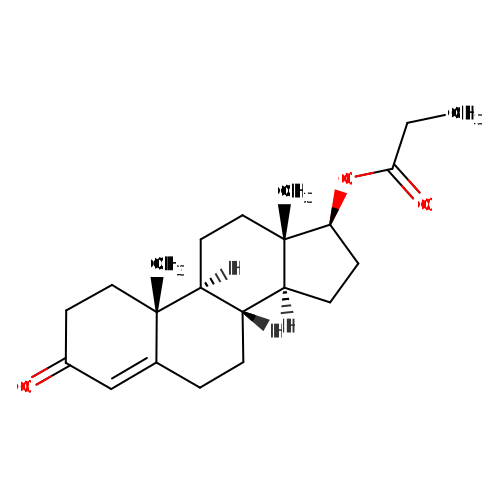
Structure for Testosterone propionate (DB01420)
- Weight
- Average: 344.4877
Monoisotopic: 344.23514489 - Chemical Formula
- C22H32O3
- Synonyms
- Testosterone propionate
- External IDs
- NRB-03689
- NSC-9166

Pharmacology
- Indication
Testosterone propionate is used in veterinary practice in heifers in order to stimulate maximal growth.4
 Reduce drug development failure ratesBuild, train, & validate machine-learning modelswith evidence-based and structured datasets.Build, train, & validate predictive machine-learning models with structured datasets.
- Associated Conditions
Indication Type Indication Combined Product Details Approval Level Age Group Patient Characteristics Dose Form Treatment of Breast cancer •••••••••••• •••••••••• •••••••• Symptomatic treatment of Breast cancer •••••••••••• ••••••••• Treatment of Puberty, delayed •••••••••••• •••••••••• •••••••• Treatment of Puberty, delayed •••••••••••• ••••••••• Treatment of Testosterone deficiency •••••••••••• •••••••••• •••••••• - Contraindications & Blackbox Warnings
 Prevent Adverse Drug Events TodayTap into our Clinical API for life-saving information on contraindications & blackbox warnings, population restrictions, harmful risks, & more.Avoid life-threatening adverse drug events with our Clinical API
- Pharmacodynamics
The administration of testosterone propionate can induce production of proteins related to male sexual development.5 Clinical trials have shown a decrease in plasma LH after the administration of testosterone propionate.1
- Mechanism of action
The effects of testosterone in humans and other vertebrates occur by way of two main mechanisms: by activation of the androgen receptor (directly or as DHT), and by conversion to estradiol and activation of certain estrogen receptors. Free testosterone (T) is transported into the cytoplasm of target tissue cells, where it can bind to the androgen receptor, or can be reduced to 5alpha-dihydrotestosterone (DHT) by the cytoplasmic enzyme 5alpha-reductase. The areas of binding are called hormone response elements (HREs), and influence transcriptional activity of certain genes, producing the androgen effects.
Target Actions Organism AAndrogen receptor agonistHumans - Absorption
Testosterone propionate presents a slow absorption from the intramuscular site of administration. This slow absorption is due to the presence of the less polar ester group.5 The absorption rate of testosterone propionate generates a frequent injection requirement when compared with testosterone enanthate or testosterone cypionate. It presents absorption parameters of AUC and residence time of 180-210 ng h/ml and 40-60 h, respectively.1
- Volume of distribution
The registered volume of distribution for testosterone propionate is in the range of 75-120 L/kg.1
- Protein binding
Even 98% of testosterone in plasma is bound to sex hormone-binding globulin and 2% remains unbound or bound to albumin and other proteins.3
- Metabolism
As all testosterone esters, testosterone propionate is rapidly hydrolysed into free testosterone in plasma.1 Testosterone is metabolized to 17-keto steroids through two different pathways. The major active metabolites are estradiol and dihydrotestosterone (DHT).5
Hover over products below to view reaction partners
- Route of elimination
About 90% of a dose of testosterone given intramuscularly is excreted in the urine as glucuronic and sulfuric acid conjugates of testosterone and its metabolites. From the rest of the dose, approximately 6% of a dose is excreted in the feces, mostly in the unconjugated form.5
- Half-life
Testosterone propionate possesses a relatively short half-life compared with other testosterone esters at approximately 4.5 days.
- Clearance
Testosterone propionate has a reduced clearance rate compared to testosterone.5 The reported clearance rate is of approximately 2000 ml/min.1
- Adverse Effects
 Improve decision support & research outcomesWith structured adverse effects data, including: blackbox warnings, adverse reactions, warning & precautions, & incidence rates. View sample adverse effects data in our new Data Library!Improve decision support & research outcomes with our structured adverse effects data.
- Toxicity
Reports have showed a potential stimulation of cancerous tissue growth. The potential testosterone propionate accumulation in the body produces a high risk of edema secondaryh to water and sodium retention.5
- Pathways
- Not Available
- Pharmacogenomic Effects/ADRs
- Not Available
Interactions
- Drug Interactions
- This information should not be interpreted without the help of a healthcare provider. If you believe you are experiencing an interaction, contact a healthcare provider immediately. The absence of an interaction does not necessarily mean no interactions exist.
Drug Interaction Integrate drug-drug
interactions in your softwareAbacavir The metabolism of Abacavir can be increased when combined with Testosterone propionate. Abametapir The serum concentration of Testosterone propionate can be increased when it is combined with Abametapir. Abciximab Testosterone propionate may increase the anticoagulant activities of Abciximab. Acarbose Testosterone propionate may increase the hypoglycemic activities of Acarbose. Aceclofenac Aceclofenac may decrease the excretion rate of Testosterone propionate which could result in a higher serum level. - Food Interactions
- No interactions found.
Products
 Drug product information from 10+ global regionsOur datasets provide approved product information including:dosage, form, labeller, route of administration, and marketing period.Access drug product information from over 10 global regions.
- Active Moieties
Name Kind UNII CAS InChI Key Testosterone prodrug 3XMK78S47O 58-22-0 MUMGGOZAMZWBJJ-DYKIIFRCSA-N - International/Other Brands
- Testex
- Mixture Products
Name Ingredients Dosage Route Labeller Marketing Start Marketing End Region Image SUSTANON 250 INJECTION Testosterone propionate (30 mg/ml) + Testosterone decanoate (100 mg/ml) + Testosterone isocaproate (60 mg/ml) + Testosterone phenylpropionate (60 mg/ml) Injection Intramuscular DCH AURIGA SINGAPORE 1990-05-31 Not applicable Singapore 
TEST - COMP 250 Testosterone propionate (30 mg/mL) + Testosterone decanoate (100 mg/mL) + Testosterone isocaproate (60 mg/mL) + Testosterone phenylpropionate (60 mg/mL) Injection, solution บริษัท กรุงเทพ ฟาร์มา ดิสทริบิวชั่น จำกัด 2018-06-06 Not applicable Thailand 
Categories
- Drug Categories
- Androgens
- Androstanes
- Androstenes
- Androstenols
- COMT Inhibitors
- Cytochrome P-450 CYP3A Substrates
- Cytochrome P-450 CYP3A4 Substrates
- Cytochrome P-450 Substrates
- Drugs that are Mainly Renally Excreted
- Fused-Ring Compounds
- Gonadal Hormones
- Gonadal Steroid Hormones
- Hormones
- Hormones, Hormone Substitutes, and Hormone Antagonists
- P-glycoprotein substrates
- Steroids
- Testosterone and derivatives
- Testosterone Congeners
- Thyroxine-binding globulin inhibitors
- UGT1A1 Inducers
- Chemical TaxonomyProvided by Classyfire
- Description
- This compound belongs to the class of organic compounds known as steroid esters. These are compounds containing a steroid moiety which bears a carboxylic acid ester group.
- Kingdom
- Organic compounds
- Super Class
- Lipids and lipid-like molecules
- Class
- Steroids and steroid derivatives
- Sub Class
- Steroid esters
- Direct Parent
- Steroid esters
- Alternative Parents
- Androgens and derivatives / 3-oxo delta-4-steroids / Delta-4-steroids / Cyclohexenones / Carboxylic acid esters / Monocarboxylic acids and derivatives / Organic oxides / Hydrocarbon derivatives
- Substituents
- 3-oxo-delta-4-steroid / 3-oxosteroid / Aliphatic homopolycyclic compound / Androgen-skeleton / Androstane-skeleton / Carbonyl group / Carboxylic acid derivative / Carboxylic acid ester / Cyclic ketone / Cyclohexenone
- Molecular Framework
- Aliphatic homopolycyclic compounds
- External Descriptors
- steroid ester (CHEBI:9466) / C19 steroids (androgens) and derivatives (C08158) / C19 steroids (androgens) and derivatives (LMST02020076)
- Affected organisms
- Humans and other mammals
Chemical Identifiers
- UNII
- WI93Z9138A
- CAS number
- 57-85-2
- InChI Key
- PDMMFKSKQVNJMI-BLQWBTBKSA-N
- InChI
- InChI=1S/C22H32O3/c1-4-20(24)25-19-8-7-17-16-6-5-14-13-15(23)9-11-21(14,2)18(16)10-12-22(17,19)3/h13,16-19H,4-12H2,1-3H3/t16-,17-,18-,19-,21-,22-/m0/s1
- IUPAC Name
- (1S,3aS,3bR,9aR,9bS,11aS)-9a,11a-dimethyl-7-oxo-1H,2H,3H,3aH,3bH,4H,5H,7H,8H,9H,9aH,9bH,10H,11H,11aH-cyclopenta[a]phenanthren-1-yl propanoate
- SMILES
- [H][C@@]12CC[C@H](OC(=O)CC)[C@@]1(C)CC[C@@]1([H])[C@@]2([H])CCC2=CC(=O)CC[C@]12C
References
- General References
- Fujioka M, Shinohara Y, Baba S, Irie M, Inoue K: Pharmacokinetic properties of testosterone propionate in normal men. J Clin Endocrinol Metab. 1986 Dec;63(6):1361-4. doi: 10.1210/jcem-63-6-1361. [Article]
- Elks J. and Ganellin C.R. (1990). The dictionary of drugs. Springer Science.
- Woo T.M. and Robinson M. (2016). Pharmacotherapeutics for advanced practice nurse prescribers (4th ed.). Davis Company.
- Dailymed [Link]
- Empowerpharmacy [Link]
- Fittness uncovered [Link]
- External Links
- Human Metabolome Database
- HMDB0015489
- KEGG Drug
- D00959
- KEGG Compound
- C08158
- PubChem Compound
- 5995
- PubChem Substance
- 46508693
- ChemSpider
- 5774
- BindingDB
- 50215709
- 10382
- ChEBI
- 9466
- ChEMBL
- CHEMBL1170
- ZINC
- ZINC000000490791
- PharmGKB
- PA164751373
- Drugs.com
- Drugs.com Drug Page
- Wikipedia
- Testosterone_propionate
- MSDS
- Download (50 KB)
Clinical Trials
- Clinical Trials
Phase Status Purpose Conditions Count 4 Completed Basic Science Dyssocial Behavior 1 1 Completed Other Healthy Volunteers (HV) 2 1, 2 Suspended Treatment Breast Neoplasms / Painful Intercourse / Vaginal Inflammation 1 Not Available Completed Basic Science Anxiety 1
Pharmacoeconomics
- Manufacturers
- Not Available
- Packagers
- C.O. Truxton Inc.
- Cutis Pharma Inc.
- Dispensing Solutions
- Lyne Laboratories Inc.
- Paddock Labs
- Wa Butler Co.
- Dosage Forms
Form Route Strength Liquid Intramuscular 100 mg / mL Injection Intramuscular 100 mg/ml Injection, solution Solution 50 mg/1ml Powder Not applicable 1 g/1g Injection, solution Intramuscular 100 mg Injection, solution Intramuscular 50 mg Solution 25 mg/1ml Suspension 50 mg/1ml - Prices
Unit description Cost Unit Testosterone propionate powder 6.25USD g First-testosterone mc 2% cr 0.91USD g DrugBank does not sell nor buy drugs. Pricing information is supplied for informational purposes only.- Patents
- Not Available
Properties
- State
- Solid
- Experimental Properties
Property Value Source melting point (°C) 118-123 °C Elks. The Dictionary of Drugs. (1990) water solubility 1.48 mg/L (at 25ºC) Yalkowsky, SH & Dannenfelser, RM. (1992) logS -5.37 ADME Research, USCD - Predicted Properties
Property Value Source Water Solubility 0.00502 mg/mL ALOGPS logP 3.65 ALOGPS logP 4.51 Chemaxon logS -4.8 ALOGPS pKa (Strongest Acidic) 18.52 Chemaxon pKa (Strongest Basic) -4.8 Chemaxon Physiological Charge 0 Chemaxon Hydrogen Acceptor Count 2 Chemaxon Hydrogen Donor Count 0 Chemaxon Polar Surface Area 43.37 Å2 Chemaxon Rotatable Bond Count 3 Chemaxon Refractivity 98.21 m3·mol-1 Chemaxon Polarizability 40.45 Å3 Chemaxon Number of Rings 4 Chemaxon Bioavailability 1 Chemaxon Rule of Five Yes Chemaxon Ghose Filter Yes Chemaxon Veber's Rule No Chemaxon MDDR-like Rule No Chemaxon - Predicted ADMET Features
Property Value Probability Human Intestinal Absorption + 1.0 Blood Brain Barrier + 0.974 Caco-2 permeable + 0.6304 P-glycoprotein substrate Substrate 0.6262 P-glycoprotein inhibitor I Inhibitor 0.8746 P-glycoprotein inhibitor II Inhibitor 0.7623 Renal organic cation transporter Non-inhibitor 0.776 CYP450 2C9 substrate Non-substrate 0.8672 CYP450 2D6 substrate Non-substrate 0.9159 CYP450 3A4 substrate Substrate 0.7429 CYP450 1A2 substrate Non-inhibitor 0.9445 CYP450 2C9 inhibitor Non-inhibitor 0.8459 CYP450 2D6 inhibitor Non-inhibitor 0.9301 CYP450 2C19 inhibitor Inhibitor 0.6089 CYP450 3A4 inhibitor Non-inhibitor 0.7576 CYP450 inhibitory promiscuity Low CYP Inhibitory Promiscuity 0.5939 Ames test Non AMES toxic 0.9474 Carcinogenicity Non-carcinogens 0.9046 Biodegradation Not ready biodegradable 0.9777 Rat acute toxicity 2.0463 LD50, mol/kg Not applicable hERG inhibition (predictor I) Weak inhibitor 0.8475 hERG inhibition (predictor II) Non-inhibitor 0.7643
Spectra
- Mass Spec (NIST)
- Download (9.53 KB)
- Spectra
- Chromatographic Properties
Collision Cross Sections (CCS)
Adduct CCS Value (Å2) Source type Source [M-H]- 198.0835187 predictedDarkChem Lite v0.1.0 [M-H]- 196.4586187 predictedDarkChem Lite v0.1.0 [M-H]- 198.7317187 predictedDarkChem Lite v0.1.0 [M-H]- 185.98064 predictedDeepCCS 1.0 (2019) [M+H]+ 198.8095187 predictedDarkChem Lite v0.1.0 [M+H]+ 196.8297187 predictedDarkChem Lite v0.1.0 [M+H]+ 199.8690187 predictedDarkChem Lite v0.1.0 [M+H]+ 188.09769 predictedDeepCCS 1.0 (2019) [M+Na]+ 199.1602187 predictedDarkChem Lite v0.1.0 [M+Na]+ 196.4684187 predictedDarkChem Lite v0.1.0 [M+Na]+ 195.40611 predictedDeepCCS 1.0 (2019)
Targets

- Kind
- Protein
- Organism
- Humans
- Pharmacological action
- Yes
- Actions
- Agonist
- General Function
- Zinc ion binding
- Specific Function
- Steroid hormone receptors are ligand-activated transcription factors that regulate eukaryotic gene expression and affect cellular proliferation and differentiation in target tissues. Transcription ...
- Gene Name
- AR
- Uniprot ID
- P10275
- Uniprot Name
- Androgen receptor
- Molecular Weight
- 98987.9 Da
References
- Small EJ, Ryan CJ: The case for secondary hormonal therapies in the chemotherapy age. J Urol. 2006 Dec;176(6 Pt 2):S66-71. [Article]
- Omwancha J, Brown TR: Selective androgen receptor modulators: in pursuit of tissue-selective androgens. Curr Opin Investig Drugs. 2006 Oct;7(10):873-81. [Article]
- Petraki CD, Sfikas CP: Histopathological changes induced by therapies in the benign prostate and prostate adenocarcinoma. Histol Histopathol. 2007 Jan;22(1):107-18. [Article]
- Maudsley S, Davidson L, Pawson AJ, Freestone SH, Lopez de Maturana R, Thomson AA, Millar RP: Gonadotropin-releasing hormone functionally antagonizes testosterone activation of the human androgen receptor in prostate cells through focal adhesion complexes involving Hic-5. Neuroendocrinology. 2006;84(5):285-300. Epub 2007 Jan 4. [Article]
- Lapauw B, Goemaere S, Crabbe P, Kaufman JM, Ruige JB: Is the effect of testosterone on body composition modulated by the androgen receptor gene CAG repeat polymorphism in elderly men? Eur J Endocrinol. 2007 Mar;156(3):395-401. [Article]
- Yin D, Gao W, Kearbey JD, Xu H, Chung K, He Y, Marhefka CA, Veverka KA, Miller DD, Dalton JT: Pharmacodynamics of selective androgen receptor modulators. J Pharmacol Exp Ther. 2003 Mar;304(3):1334-40. [Article]
Enzymes
- Kind
- Protein
- Organism
- Humans
- Pharmacological action
- Unknown
- Actions
- Inhibitor
- General Function
- O-methyltransferase activity
- Specific Function
- Catalyzes the O-methylation, and thereby the inactivation, of catecholamine neurotransmitters and catechol hormones. Also shortens the biological half-lives of certain neuroactive drugs, like L-DOP...
- Gene Name
- COMT
- Uniprot ID
- P21964
- Uniprot Name
- Catechol O-methyltransferase
- Molecular Weight
- 30036.77 Da
References
- Ladosky W, Schneider HT: Changes in hypothalamic catechol-O-methyl-transferase during sexual differentiation of the brain. Braz J Med Biol Res. 1981 Dec;14(6):409-13. [Article]
- Kind
- Protein
- Organism
- Humans
- Pharmacological action
- Unknown
- Actions
- Inducer
- General Function
- Steroid binding
- Specific Function
- UDPGT is of major importance in the conjugation and subsequent elimination of potentially toxic xenobiotics and endogenous compounds. This isoform glucuronidates bilirubin IX-alpha to form both the...
- Gene Name
- UGT1A1
- Uniprot ID
- P22309
- Uniprot Name
- UDP-glucuronosyltransferase 1-1
- Molecular Weight
- 59590.91 Da
References
- Stern ST, Tallman MN, Miles KK, Ritter JK, Smith PC: Androgen regulation of renal uridine diphosphoglucuronosyltransferase 1A1 in rats. Drug Metab Dispos. 2008 Sep;36(9):1737-9. doi: 10.1124/dmd.108.020610. Epub 2008 May 30. [Article]
- Kind
- Protein group
- Organism
- Humans
- Pharmacological action
- No
- Actions
- Substrate
- General Function
- Electron carrier activity
- Specific Function
- Converts testosterone into 5-alpha-dihydrotestosterone and progesterone or corticosterone into their corresponding 5-alpha-3-oxosteroids. It plays a central role in sexual differentiation and andro...
Components:
| Name | UniProt ID |
|---|---|
| 3-oxo-5-alpha-steroid 4-dehydrogenase 1 | P18405 |
| 3-oxo-5-alpha-steroid 4-dehydrogenase 2 | P31213 |
| Polyprenol reductase | Q9H8P0 |
References
- Empowerpharmacy [Link]
- Kind
- Protein
- Organism
- Humans
- Pharmacological action
- No
- Actions
- Substrate
- General Function
- Vitamin d3 25-hydroxylase activity
- Specific Function
- Cytochromes P450 are a group of heme-thiolate monooxygenases. In liver microsomes, this enzyme is involved in an NADPH-dependent electron transport pathway. It performs a variety of oxidation react...
- Gene Name
- CYP3A4
- Uniprot ID
- P08684
- Uniprot Name
- Cytochrome P450 3A4
- Molecular Weight
- 57342.67 Da
References
- Empowerpharmacy [Link]
Carriers
- Kind
- Protein
- Organism
- Humans
- Pharmacological action
- No
- Actions
- Substrate
- General Function
- Androgen binding
- Specific Function
- Functions as an androgen transport protein, but may also be involved in receptor mediated processes. Each dimer binds one molecule of steroid. Specific for 5-alpha-dihydrotestosterone, testosterone...
- Gene Name
- SHBG
- Uniprot ID
- P04278
- Uniprot Name
- Sex hormone-binding globulin
- Molecular Weight
- 43778.755 Da
References
- Empowerpharmacy [Link]
- Kind
- Protein
- Organism
- Humans
- Pharmacological action
- No
- Actions
- Substrate
- General Function
- Toxic substance binding
- Specific Function
- Serum albumin, the main protein of plasma, has a good binding capacity for water, Ca(2+), Na(+), K(+), fatty acids, hormones, bilirubin and drugs. Its main function is the regulation of the colloid...
- Gene Name
- ALB
- Uniprot ID
- P02768
- Uniprot Name
- Serum albumin
- Molecular Weight
- 69365.94 Da
References
- Empowerpharmacy [Link]
Transporters
- Kind
- Protein
- Organism
- Humans
- Pharmacological action
- No
- Actions
- Substrate
- General Function
- Xenobiotic-transporting atpase activity
- Specific Function
- Energy-dependent efflux pump responsible for decreased drug accumulation in multidrug-resistant cells.
- Gene Name
- ABCB1
- Uniprot ID
- P08183
- Uniprot Name
- Multidrug resistance protein 1
- Molecular Weight
- 141477.255 Da
References
- Empowerpharmacy [Link]


Drug created at July 24, 2007 09:23 / Updated at April 27, 2024 09:44