Identification
- Summary
Valganciclovir is an antiviral medication used to treat cytomegalovirus (CMV) retinitis in patients diagnosed with acquired immunodeficiency syndrome (AIDS).
- Brand Names
- Valcyte
- Generic Name
- Valganciclovir
- DrugBank Accession Number
- DB01610
- Background
Valganciclovir hydrochloride (Valcyte, manufactured by Roche) is an antiviral medication used to treat cytomegalovirus infections. As the L-valyl ester of ganciclovir, it is actually a prodrug for ganciclovir. After oral administration, it is rapidly converted to ganciclovir by intestinal and hepatic esterases.
- Type
- Small Molecule
- Groups
- Approved, Investigational
- Structure
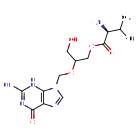
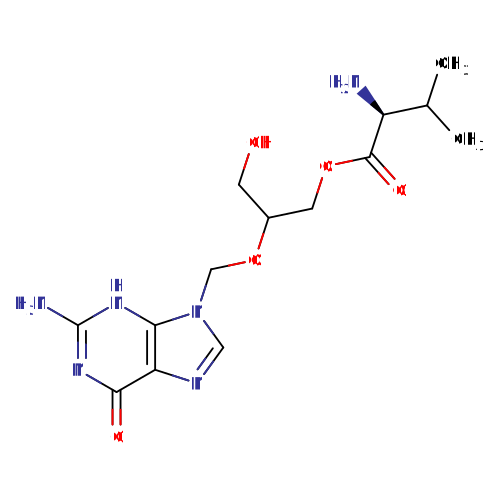
Structure for Valganciclovir (DB01610)
- Weight
- Average: 354.3617
Monoisotopic: 354.165167844 - Chemical Formula
- C14H22N6O5
- Synonyms
- Valganciclovir

Pharmacology
- Indication
Valganciclovir is an antiviral medication used for the treatment of cytomegalovirus infections.
 Reduce drug development failure ratesBuild, train, & validate machine-learning modelswith evidence-based and structured datasets.Build, train, & validate predictive machine-learning models with structured datasets.
- Associated Conditions
Indication Type Indication Combined Product Details Approval Level Age Group Patient Characteristics Dose Form Prophylaxis of Cmv infection •••••••••••• •••••• ••••••••• Prophylaxis of Cmv infection •••••••••••• ••••• Prophylaxis of Cmv infection •••••••••••• •••••• ••••••••• Treatment of Cmv retinitis •••••••••••• - Contraindications & Blackbox Warnings
 Prevent Adverse Drug Events TodayTap into our Clinical API for life-saving information on contraindications & blackbox warnings, population restrictions, harmful risks, & more.Avoid life-threatening adverse drug events with our Clinical API
- Pharmacodynamics
Valganciclovir is an antiviral medication used to treat cytomegalovirus infections. As the L-valyl ester of ganciclovir, it is actually a prodrug for ganciclovir. After oral administration, it is rapidly converted to ganciclovir by intestinal and hepatic esterases. After this, it (being an analogue of guanosine) gets incorporated into DNA and thus cannot be properly read by DNA polymerase. This results in the termination of the elongation of viral DNA.
- Mechanism of action
Valganciclovir is a prodrug of ganciclovir that exists as a mixture of two diastereomers. After administration, these diastereomers are rapidly converted to ganciclovir by hepatic and intestinal esterases. In cytomegalovirus (CMV)-infected cells, ganciclovir is initially phosphorylated to the monophosphate form by viral protein kinase, then it is further phosphorylated via cellular kinases to produce the triphosphate form. This triphosphate form is slowly metabolized intracellularly. The phosphorylation is dependent upon the viral kinase and occurs preferentially in virus-infected cells. The virustatic activity of ganciclovir is due to the inhibition of viral DNA synthesis by ganciclovir triphosphate. Ganciclovir triphosphate is incorporated into the DNA strand replacing many of the adenosine bases. This results in the prevention of DNA synthesis, as phosphodiester bridges can longer to be built, destabilizing the strand. Ganciclovir inhibits viral DNA polymerases more effectively than it does cellular polymerase, and chain elongation resumes when ganciclovir is removed.
Target Actions Organism ADNA adductHumans - Absorption
Valganciclovir is well absorbed from the gastrointestinal tract and the absolute bioavailability from valganciclovir tablets (following administration with food) is approximately 60%.
- Volume of distribution
- 0.703 ± 0.134 L/kg
- Protein binding
Plasma protein binding of ganciclovir is 1% to 2% over concentrations of 0.5 and 51 mg/mL.
- Metabolism
Rapidly hydrolyzed in the intestinal wall and liver to ganciclovir. No other metabolites have been detected.
- Route of elimination
The major route of elimination of valganciclovir is by renal excretion as ganciclovir through glomerular filtration and active tubular secretion.
- Half-life
Approximately 4.08 hours. Increased in patients with renal function impairment.
- Clearance
- 3.07+/- 0.64 mL/min/kg [IV administration]
- 5.3 L/hr [Patient with creatinine clearance of 70.4 mL/min]
- Adverse Effects
 Improve decision support & research outcomesWith structured adverse effects data, including: blackbox warnings, adverse reactions, warning & precautions, & incidence rates. View sample adverse effects data in our new Data Library!Improve decision support & research outcomes with our structured adverse effects data.
- Toxicity
It is expected that an overdose of valganciclovir could also possibly result in increased renal toxicity.
- Pathways
- Not Available
- Pharmacogenomic Effects/ADRs
- Not Available
Interactions
- Drug Interactions
- This information should not be interpreted without the help of a healthcare provider. If you believe you are experiencing an interaction, contact a healthcare provider immediately. The absence of an interaction does not necessarily mean no interactions exist.
Drug Interaction Integrate drug-drug
interactions in your softwareAbacavir The risk or severity of cytopenia can be increased when Valganciclovir is combined with Abacavir. Aceclofenac Aceclofenac may decrease the excretion rate of Valganciclovir which could result in a higher serum level. Acemetacin Acemetacin may decrease the excretion rate of Valganciclovir which could result in a higher serum level. Acetaminophen Acetaminophen may decrease the excretion rate of Valganciclovir which could result in a higher serum level. Acetazolamide The therapeutic efficacy of Acetazolamide can be decreased when used in combination with Valganciclovir. - Food Interactions
- Take with food.
Products
 Drug product information from 10+ global regionsOur datasets provide approved product information including:dosage, form, labeller, route of administration, and marketing period.Access drug product information from over 10 global regions.
- Product Ingredients
Ingredient UNII CAS InChI Key Valganciclovir hydrochloride 4P3T9QF9NZ 175865-59-5 ZORWARFPXPVJLW-MTFPJWTKSA-N - Active Moieties
Name Kind UNII CAS InChI Key Ganciclovir prodrug P9G3CKZ4P5 82410-32-0 IRSCQMHQWWYFCW-UHFFFAOYSA-N - Product Images


- International/Other Brands
- Cymeval / Valcyt
- Brand Name Prescription Products
Name Dosage Strength Route Labeller Marketing Start Marketing End Region Image Valcyte Tablet 450 mg Oral Cheplapharm Arzneimittel Gmbh 2002-07-16 Not applicable Canada 
Valcyte Powder, for solution 50 mg/1mL Oral H2-Pharma, LLC 2009-08-28 Not applicable US 
Valcyte Powder, for solution 50 mg/1mL Oral Genentech, Inc. 2009-08-28 Not applicable US Valcyte Tablet, film coated 450 mg/1 Oral H2-Pharma, LLC 2001-03-29 Not applicable US Valcyte Tablet, film coated 450 mg/1 Oral Genentech, Inc. 2001-03-29 Not applicable US - Generic Prescription Products
Name Dosage Strength Route Labeller Marketing Start Marketing End Region Image Apo-valganciclovir Tablet 450 mg Oral Apotex Corporation 2013-07-09 Not applicable Canada Auro-valganciclovir Powder, for solution 50 mg / mL Oral Auro Pharma Inc 2023-09-13 Not applicable Canada Auro-valganciclovir Tablet 450 mg Oral Auro Pharma Inc 2015-04-10 Not applicable Canada Mint-valganciclovir Tablet 450 mg Oral Mint Pharmaceuticals Inc 2020-05-27 Not applicable Canada Mylan-valganciclovir Tablet 450 mg Oral Mylan Pharmaceuticals Not applicable Not applicable Canada


Categories
- ATC Codes
- J05AB14 — Valganciclovir
- Drug Categories
- Agents that reduce seizure threshold
- Anti-Infective Agents
- Antiinfectives for Systemic Use
- Antiviral Agents
- Antivirals for Systemic Use
- Cytomegalovirus Nucleoside Analog DNA Polymerase Inhibitor
- Direct Acting Antivirals
- Drugs that are Mainly Renally Excreted
- Ganciclovir and prodrug
- Heterocyclic Compounds, Fused-Ring
- Nucleic Acid Synthesis Inhibitors
- Nucleoside Analog Antiviral
- Nucleosides and Nucleotides
- Nucleosides and Nucleotides Excl. Reverse Transcriptase Inhibitors
- Purines
- Purinones
- Chemical TaxonomyProvided by Classyfire
- Description
- This compound belongs to the class of organic compounds known as alpha amino acid esters. These are ester derivatives of alpha amino acids.
- Kingdom
- Organic compounds
- Super Class
- Organic acids and derivatives
- Class
- Carboxylic acids and derivatives
- Sub Class
- Amino acids, peptides, and analogues
- Direct Parent
- Alpha amino acid esters
- Alternative Parents
- Valine and derivatives / Purines and purine derivatives / Fatty acid esters / Glycerolipids / Hydroxypyrimidines / N-substituted imidazoles / Heteroaromatic compounds / Carboxylic acid esters / Azacyclic compounds / Monocarboxylic acids and derivatives show 6 more
- Substituents
- Alcohol / Alpha-amino acid ester / Amine / Aromatic heteropolycyclic compound / Azacycle / Azole / Carbonyl group / Carboxylic acid ester / Fatty acid ester / Fatty acyl show 21 more
- Molecular Framework
- Aromatic heteropolycyclic compounds
- External Descriptors
- purines, L-valinyl ester (CHEBI:63635)
- Affected organisms
- Human Herpes Virus
Chemical Identifiers
- UNII
- GCU97FKN3R
- CAS number
- 175865-60-8
- InChI Key
- WPVFJKSGQUFQAP-GKAPJAKFSA-N
- InChI
- InChI=1S/C14H22N6O5/c1-7(2)9(15)13(23)24-4-8(3-21)25-6-20-5-17-10-11(20)18-14(16)19-12(10)22/h5,7-9,21H,3-4,6,15H2,1-2H3,(H3,16,18,19,22)/t8?,9-/m0/s1
- IUPAC Name
- 2-[(2-amino-6-oxo-6,9-dihydro-3H-purin-9-yl)methoxy]-3-hydroxypropyl (2S)-2-amino-3-methylbutanoate
- SMILES
- CC(C)[C@H](N)C(=O)OCC(CO)OCN1C=NC2=C1NC(N)=NC2=O
References
- Synthesis Reference
Romi Singh, Vishnubhotla Nagaprasad, Nidhi Singh, "Processes for the Preparation of Solid Dosage Forms of Amorphous Valganciclovir Hydrochloride." U.S. Patent US20070292499, issued December 20, 2007.
US20070292499- General References
- Umapathy NS, Ganapathy V, Ganapathy ME: Transport of amino acid esters and the amino-acid-based prodrug valganciclovir by the amino acid transporter ATB(0,+). Pharm Res. 2004 Jul;21(7):1303-10. [Article]
- External Links
- Human Metabolome Database
- HMDB0015548
- KEGG Drug
- D02495
- PubChem Compound
- 64147
- PubChem Substance
- 46505524
- ChemSpider
- 57721
- 275891
- ChEBI
- 63635
- ChEMBL
- CHEMBL1201314
- Therapeutic Targets Database
- DAP000646
- PharmGKB
- PA10227
- RxList
- RxList Drug Page
- Drugs.com
- Drugs.com Drug Page
- PDRhealth
- PDRhealth Drug Page
- Wikipedia
- Valganciclovir
Clinical Trials
- Clinical Trials
Phase Status Purpose Conditions Count 4 Completed Other Cytomegalovirus (CMV) Infections 1 4 Completed Prevention Cytomegalovirus Disease 1 4 Completed Prevention Infection in Solid Organ Transplant Recipients 1 4 Completed Prevention Kidney Transplantation, Cytomegalovirus Infections 1 4 Completed Treatment Chronic Lymphocytic Leukemia 1
Pharmacoeconomics
- Manufacturers
- Not Available
- Packagers
- F Hoffmann-La Roche Ltd.
- Murfreesboro Pharmaceutical Nursing Supply
- Patheon Inc.
- Dosage Forms
Form Route Strength Powder, for solution Oral Tablet Oral 496.30 mg Tablet Oral 496.300 mg Tablet Oral 450.00 mg Powder, for solution Oral 50 mg / mL Tablet Oral 450 mg Tablet Oral 450.000 mg Tablet, film coated Oral Powder, for solution Oral 50 mg/ml Tablet Oral 450 mg/1 Tablet, film coated Oral 450 mg/1 For solution Oral 50 mg/1mL Powder, for solution Oral 50 mg/1mL Tablet, film coated Oral 496.3 MG Tablet, coated Oral 45000000 mg Tablet, film coated Oral 450 mg Tablet, coated Oral 450 mg - Prices
Unit description Cost Unit Valcyte 48.87USD tablet Valcyte 450 mg tablet 46.99USD tablet DrugBank does not sell nor buy drugs. Pricing information is supplied for informational purposes only.- Patents
Patent Number Pediatric Extension Approved Expires (estimated) Region CA2154721 No 2001-01-02 2015-07-26 Canada US6083953 Yes 2000-07-04 2015-09-29 US US9642911 No 2017-05-09 2027-12-11 US US8889109 No 2014-11-18 2027-12-11 US
Properties
- State
- Solid
- Experimental Properties
- Not Available
- Predicted Properties
Property Value Source Water Solubility 4.79 mg/mL ALOGPS logP -0.81 ALOGPS logP -0.69 Chemaxon logS -1.9 ALOGPS pKa (Strongest Acidic) 11.98 Chemaxon pKa (Strongest Basic) 7.48 Chemaxon Physiological Charge 1 Chemaxon Hydrogen Acceptor Count 9 Chemaxon Hydrogen Donor Count 4 Chemaxon Polar Surface Area 167.08 Å2 Chemaxon Rotatable Bond Count 9 Chemaxon Refractivity 86.6 m3·mol-1 Chemaxon Polarizability 34.88 Å3 Chemaxon Number of Rings 2 Chemaxon Bioavailability 1 Chemaxon Rule of Five Yes Chemaxon Ghose Filter No Chemaxon Veber's Rule No Chemaxon MDDR-like Rule No Chemaxon - Predicted ADMET Features
Property Value Probability Human Intestinal Absorption + 0.9104 Blood Brain Barrier + 0.9383 Caco-2 permeable - 0.8874 P-glycoprotein substrate Substrate 0.6534 P-glycoprotein inhibitor I Non-inhibitor 0.9314 P-glycoprotein inhibitor II Non-inhibitor 0.9395 Renal organic cation transporter Non-inhibitor 0.9026 CYP450 2C9 substrate Non-substrate 0.8915 CYP450 2D6 substrate Non-substrate 0.8351 CYP450 3A4 substrate Non-substrate 0.5362 CYP450 1A2 substrate Non-inhibitor 0.8981 CYP450 2C9 inhibitor Non-inhibitor 0.8585 CYP450 2D6 inhibitor Non-inhibitor 0.889 CYP450 2C19 inhibitor Non-inhibitor 0.8334 CYP450 3A4 inhibitor Non-inhibitor 0.9232 CYP450 inhibitory promiscuity Low CYP Inhibitory Promiscuity 0.918 Ames test Non AMES toxic 0.6023 Carcinogenicity Non-carcinogens 0.8588 Biodegradation Not ready biodegradable 0.9356 Rat acute toxicity 2.1981 LD50, mol/kg Not applicable hERG inhibition (predictor I) Weak inhibitor 0.9804 hERG inhibition (predictor II) Non-inhibitor 0.8918
Spectra
- Mass Spec (NIST)
- Not Available
- Spectra
- Chromatographic Properties
Collision Cross Sections (CCS)
Adduct CCS Value (Å2) Source type Source [M-H]- 197.3604704 predictedDarkChem Lite v0.1.0 [M-H]- 190.8087704 predictedDarkChem Lite v0.1.0 [M-H]- 176.76726 predictedDeepCCS 1.0 (2019) [M+H]+ 196.3523704 predictedDarkChem Lite v0.1.0 [M+H]+ 190.3922704 predictedDarkChem Lite v0.1.0 [M+H]+ 179.12526 predictedDeepCCS 1.0 (2019) [M+Na]+ 196.5571704 predictedDarkChem Lite v0.1.0 [M+Na]+ 186.25465 predictedDeepCCS 1.0 (2019)
Targets

References
- Martin M, Azzi A, Lin SX, Boivin G: Opposite effect of two cytomegalovirus DNA polymerase mutations on replicative capacity and polymerase activity. Antivir Ther. 2010;15(4):579-86. doi: 10.3851/IMP1565. [Article]
- Boivin G, Goyette N, Gilbert C, Covington E: Analysis of cytomegalovirus DNA polymerase (UL54) mutations in solid organ transplant patients receiving valganciclovir or ganciclovir prophylaxis. J Med Virol. 2005 Nov;77(3):425-9. [Article]
- Marfori JE, Exner MM, Marousek GI, Chou S, Drew WL: Development of new cytomegalovirus UL97 and DNA polymerase mutations conferring drug resistance after valganciclovir therapy in allogeneic stem cell recipients. J Clin Virol. 2007 Feb;38(2):120-5. Epub 2006 Dec 8. [Article]
- Potena L, Holweg CT, Chin C, Luikart H, Weisshaar D, Narasimhan B, Fearon WF, Lewis DB, Cooke JP, Mocarski ES, Valantine HA: Acute rejection and cardiac allograft vascular disease is reduced by suppression of subclinical cytomegalovirus infection. Transplantation. 2006 Aug 15;82(3):398-405. [Article]
Transporters
- Kind
- Protein
- Organism
- Humans
- Pharmacological action
- Unknown
- General Function
- Proton-dependent oligopeptide secondary active transmembrane transporter activity
- Specific Function
- Proton-coupled intake of oligopeptides of 2 to 4 amino acids with a preference for dipeptides. May constitute a major route for the absorption of protein digestion end-products.
- Gene Name
- SLC15A1
- Uniprot ID
- P46059
- Uniprot Name
- Solute carrier family 15 member 1
- Molecular Weight
- 78805.265 Da
References
- Sugawara M, Huang W, Fei YJ, Leibach FH, Ganapathy V, Ganapathy ME: Transport of valganciclovir, a ganciclovir prodrug, via peptide transporters PEPT1 and PEPT2. J Pharm Sci. 2000 Jun;89(6):781-9. [Article]
- Kind
- Protein
- Organism
- Humans
- Pharmacological action
- Unknown
- General Function
- Peptide:proton symporter activity
- Specific Function
- Proton-coupled intake of oligopeptides of 2 to 4 amino acids with a preference for dipeptides.
- Gene Name
- SLC15A2
- Uniprot ID
- Q16348
- Uniprot Name
- Solute carrier family 15 member 2
- Molecular Weight
- 81782.77 Da
References
- Sugawara M, Huang W, Fei YJ, Leibach FH, Ganapathy V, Ganapathy ME: Transport of valganciclovir, a ganciclovir prodrug, via peptide transporters PEPT1 and PEPT2. J Pharm Sci. 2000 Jun;89(6):781-9. [Article]
- Kind
- Protein
- Organism
- Humans
- Pharmacological action
- Unknown
- General Function
- Neurotransmitter:sodium symporter activity
- Specific Function
- Mediates the uptake of a broad range of neutral and cationic amino acids (with the exception of proline) in a Na(+)/Cl(-)-dependent manner.
- Gene Name
- SLC6A14
- Uniprot ID
- Q9UN76
- Uniprot Name
- Sodium- and chloride-dependent neutral and basic amino acid transporter B(0+)
- Molecular Weight
- 72152.145 Da
References
- Umapathy NS, Ganapathy V, Ganapathy ME: Transport of amino acid esters and the amino-acid-based prodrug valganciclovir by the amino acid transporter ATB(0,+). Pharm Res. 2004 Jul;21(7):1303-10. [Article]

Drug created at August 29, 2007 19:52 / Updated at April 26, 2024 00:45