Identification
- Summary
Vorinostat is a histone deacetylase (HDAC) inhibitor used for the treatment of cutaneous manifestations in patients with progressive, persistent, or recurrent cutaneous T- cell lymphoma (CTCL) following prior systemic therapies.
- Brand Names
- Zolinza
- Generic Name
- Vorinostat
- DrugBank Accession Number
- DB02546
- Background
Vorinostat (rINN) or suberoylanilide hydroxamic acid (SAHA), is a drug currently under investigation for the treatment of cutaneous T cell lymphoma (CTCL), a type of skin cancer, to be used when the disease persists, gets worse, or comes back during or after treatment with other medicines. It is the first in a new class of agents known as histone deacetylase inhibitors. A recent study suggested that vorinostat also possesses some activity against recurrent glioblastoma multiforme, resulting in a median overall survival of 5.7 months (compared to 4 - 4.4 months in earlier studies). Further brain tumor trials are planned using combinations of vorinostat with other drugs.
- Type
- Small Molecule
- Groups
- Approved, Investigational
- Structure
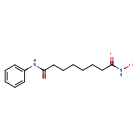
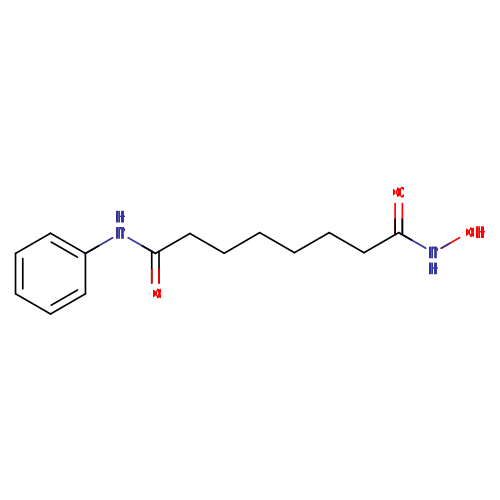
Structure for Vorinostat (DB02546)
- Weight
- Average: 264.3202
Monoisotopic: 264.147392516 - Chemical Formula
- C14H20N2O3
- Synonyms
- Octanedioic acid hydroxyamide phenylamide
- SAHA
- SHH
- Suberanilohydroxamic acid
- Suberoylanilide hydroxamic acid
- Vorinostat
- Vorinostatum
- External IDs
- MK-0683
- MK0683

Pharmacology
- Indication
For the treatment of cutaneous manifestations in patients with cutaneous T-cell lymphoma who have progressive, persistent or recurrent disease on or following two systemic therapies.
 Reduce drug development failure ratesBuild, train, & validate machine-learning modelswith evidence-based and structured datasets.Build, train, & validate predictive machine-learning models with structured datasets.
- Associated Conditions
Indication Type Indication Combined Product Details Approval Level Age Group Patient Characteristics Dose Form Management of Persistent cutaneous t-cell lymphoma •••••••••••• Management of Progressive cutaneous t-cell lymphoma •••••••••••• Management of Recurrent cutaneous t-cell lymphoma •••••••••••• - Contraindications & Blackbox Warnings
 Prevent Adverse Drug Events TodayTap into our Clinical API for life-saving information on contraindications & blackbox warnings, population restrictions, harmful risks, & more.Avoid life-threatening adverse drug events with our Clinical API
- Pharmacodynamics
Not Available
- Mechanism of action
Vorinostat inhibits the enzymatic activity of histone deacetylases HDAC1, HDAC2 and HDAC3 (Class I) and HDAC6 (Class II) at nanomolar concentrations (IC50< 86 nM). These enzymes catalyze the removal of acetyl groups from the lysine residues of histones proteins. In some cancer cells, there is an overexpression of HDACs, or an aberrant recruitment of HDACs to oncogenic transcription factors causing hypoacetylation of core nucleosomal histones. By inhibiting histone deacetylase, vorinostat causes the accumulation of acetylated histones and induces cell cycle arrest and/or apoptosis of some transformed cells. The mechanism of the antineoplastic effect of vorinostat has not been fully characterized.
Target Actions Organism AHistone deacetylase 1 inhibitorHumans AHistone deacetylase 2 inhibitorHumans AHistone deacetylase 3 inhibitorHumans AHistone deacetylase 6 inhibitorHumans UHistone deacetylase 8 Not Available Humans UAcetoin utilization protein Not Available Aquifex aeolicus (strain VF5) UHistone deacetylase inhibitorHumans - Absorption
Not Available
- Volume of distribution
Not Available
- Protein binding
71%
- Metabolism
The major pathways of vorinostat metabolism involve glucuronidation and hydrolysis followed by β-oxidation. Human serum levels of two metabolites, O-glucuronide of vorinostat and 4-anilino-4-oxobutanoic acid were measured. Both metabolites are pharmacologically inactive. Compared to vorinostat, the mean steady state serum exposures in humans of the O-glucuronide of vorinostat and 4-anilino-4-oxobutanoic acid were 4-fold and 13-fold higher, respectively. In vitro studies using human liver microsomes indicate negligible biotransformation by cytochromes P450 (CYP).
Hover over products below to view reaction partners
- Route of elimination
In vitro studies using human liver microsomes indicate negligible biotransformation by cytochromes P450 (CYP). Vorinostat is eliminated predominantly through metabolism with less than 1% of the dose recovered as unchanged drug in urine, indicating that renal excretion does not play a role in the elimination of vorinostat. However, renal excretion does not play a role in the elimination of vorinostat.
- Half-life
2 hours
- Clearance
Not Available
- Adverse Effects
 Improve decision support & research outcomesWith structured adverse effects data, including: blackbox warnings, adverse reactions, warning & precautions, & incidence rates. View sample adverse effects data in our new Data Library!Improve decision support & research outcomes with our structured adverse effects data.
- Toxicity
Not Available
- Pathways
- Not Available
- Pharmacogenomic Effects/ADRs
- Not Available
Interactions
- Drug Interactions
- This information should not be interpreted without the help of a healthcare provider. If you believe you are experiencing an interaction, contact a healthcare provider immediately. The absence of an interaction does not necessarily mean no interactions exist.
Drug Interaction Integrate drug-drug
interactions in your softwareAbatacept The risk or severity of adverse effects can be increased when Abatacept is combined with Vorinostat. Abciximab The risk or severity of bleeding can be increased when Abciximab is combined with Vorinostat. Acarbose The therapeutic efficacy of Acarbose can be decreased when used in combination with Vorinostat. Acenocoumarol Vorinostat may increase the anticoagulant activities of Acenocoumarol. Acetohexamide The therapeutic efficacy of Acetohexamide can be decreased when used in combination with Vorinostat. - Food Interactions
- Take with food.
Products
 Drug product information from 10+ global regionsOur datasets provide approved product information including:dosage, form, labeller, route of administration, and marketing period.Access drug product information from over 10 global regions.
- Brand Name Prescription Products
Name Dosage Strength Route Labeller Marketing Start Marketing End Region Image Zolinza Capsule 100 mg/1 Oral Merck Sharp & Dohme Llc 2006-10-06 Not applicable US 
Zolinza Capsule 100 mg Oral Merck Ltd. 2009-06-29 Not applicable Canada 
Categories
- ATC Codes
- L01XH01 — Vorinostat
- Drug Categories
- Amides
- Amines
- Anilides
- Aniline Compounds
- Antineoplastic Agents
- Antineoplastic and Immunomodulating Agents
- Enzyme Inhibitors
- Histone deacetylase (HDAC) inhibitors
- Histone Deacetylase Inhibitors
- Hydroxamic Acids
- Hydroxy Acids
- Hydroxylamines
- Hyperglycemia-Associated Agents
- Immunosuppressive Agents
- Myelosuppressive Agents
- Narrow Therapeutic Index Drugs
- Potential QTc-Prolonging Agents
- QTc Prolonging Agents
- Chemical TaxonomyProvided by Classyfire
- Description
- This compound belongs to the class of organic compounds known as benzene and substituted derivatives. These are aromatic compounds containing one monocyclic ring system consisting of benzene.
- Kingdom
- Organic compounds
- Super Class
- Benzenoids
- Class
- Benzene and substituted derivatives
- Sub Class
- Not Available
- Direct Parent
- Benzene and substituted derivatives
- Alternative Parents
- Propargyl-type 1,3-dipolar organic compounds / Carboximidic acids / Organopnictogen compounds / Organooxygen compounds / Organonitrogen compounds / Hydrocarbon derivatives
- Substituents
- Aromatic homomonocyclic compound / Carboximidic acid / Carboximidic acid derivative / Hydrocarbon derivative / Monocyclic benzene moiety / Organic 1,3-dipolar compound / Organic nitrogen compound / Organic oxygen compound / Organonitrogen compound / Organooxygen compound
- Molecular Framework
- Aromatic homomonocyclic compounds
- External Descriptors
- dicarboxylic acid diamide, hydroxamic acid (CHEBI:45716)
- Affected organisms
- Humans and other mammals
Chemical Identifiers
- UNII
- 58IFB293JI
- CAS number
- 149647-78-9
- InChI Key
- WAEXFXRVDQXREF-UHFFFAOYSA-N
- InChI
- InChI=1S/C14H20N2O3/c17-13(15-12-8-4-3-5-9-12)10-6-1-2-7-11-14(18)16-19/h3-5,8-9,19H,1-2,6-7,10-11H2,(H,15,17)(H,16,18)
- IUPAC Name
- N-hydroxy-N'-phenyloctanediamide
- SMILES
- ONC(=O)CCCCCCC(=O)NC1=CC=CC=C1
References
- Synthesis Reference
Vinayak G. Gore, Madhukar S. Patil, Rahul A. Bhalerao, Hemant M. Mande, Sandeep G. Mekde, "PROCESS FOR THE PREPARATION OF VORINOSTAT." U.S. Patent US20110263712, issued October 27, 2011.
US20110263712- General References
- External Links
- Human Metabolome Database
- HMDB0015568
- KEGG Drug
- D06320
- PubChem Compound
- 5311
- PubChem Substance
- 46508989
- ChemSpider
- 5120
- BindingDB
- 19149
- 194337
- ChEBI
- 45716
- ChEMBL
- CHEMBL98
- ZINC
- ZINC000001543873
- Therapeutic Targets Database
- DAP001082
- PharmGKB
- PA164748224
- PDBe Ligand
- SHH
- RxList
- RxList Drug Page
- Drugs.com
- Drugs.com Drug Page
- Wikipedia
- Vorinostat
- PDB Entries
- 1c3s / 1t69 / 1zz1 / 3c0z / 4bz6 / 4lxz / 4qa0 / 4qa2 / 4r7l / 5eei … show 4 more
Clinical Trials
- Clinical Trials
Phase Status Purpose Conditions Count 3 Completed Treatment Acute Myeloid Leukemia / Untreated Adult Acute Myeloid Leukemia 1 3 Completed Treatment Cutaneous T-Cell Lymphoma (CTCL) 1 3 Completed Treatment Lung Cancer / Mesothelioma 1 3 Completed Treatment Multiple Myeloma (MM) 1 3 Unknown Status Treatment Multiple Myeloma (MM) 1
Pharmacoeconomics
- Manufacturers
- Not Available
- Packagers
- Merck & Co.
- Patheon Inc.
- Dosage Forms
Form Route Strength Capsule Oral 100 mg Capsule Oral 100 mg/1 Capsule Oral 100.000 mg Capsule, coated Oral 100 mg - Prices
Unit description Cost Unit Zolinza 100 mg capsule 83.11USD capsule DrugBank does not sell nor buy drugs. Pricing information is supplied for informational purposes only.- Patents
Patent Number Pediatric Extension Approved Expires (estimated) Region US6087367 No 2000-07-11 2011-10-04 US CA2120619 No 2006-11-21 2012-10-05 Canada US7399787 No 2008-07-15 2025-02-09 US US7732490 No 2010-06-08 2023-03-04 US US7851509 No 2010-12-14 2024-02-21 US US8067472 No 2011-11-29 2023-03-04 US US8101663 No 2012-01-24 2023-03-04 US US8450372 No 2013-05-28 2028-03-18 US US7456219 No 2008-11-25 2027-03-11 US US8093295 No 2012-01-10 2026-05-16 US USRE38506 No 2004-04-20 2015-07-07 US US7652069 No 2010-01-26 2023-03-04 US
Properties
- State
- Solid
- Experimental Properties
Property Value Source pKa 9.2 Not Available - Predicted Properties
Property Value Source Water Solubility 0.0716 mg/mL ALOGPS logP 1.88 ALOGPS logP 2 Chemaxon logS -3.6 ALOGPS pKa (Strongest Acidic) 8.91 Chemaxon pKa (Strongest Basic) -3.5 Chemaxon Physiological Charge 0 Chemaxon Hydrogen Acceptor Count 3 Chemaxon Hydrogen Donor Count 3 Chemaxon Polar Surface Area 78.43 Å2 Chemaxon Rotatable Bond Count 8 Chemaxon Refractivity 73.81 m3·mol-1 Chemaxon Polarizability 28.39 Å3 Chemaxon Number of Rings 1 Chemaxon Bioavailability 1 Chemaxon Rule of Five Yes Chemaxon Ghose Filter Yes Chemaxon Veber's Rule No Chemaxon MDDR-like Rule No Chemaxon - Predicted ADMET Features
Property Value Probability Human Intestinal Absorption + 0.8458 Blood Brain Barrier + 0.9861 Caco-2 permeable - 0.8957 P-glycoprotein substrate Non-substrate 0.6928 P-glycoprotein inhibitor I Non-inhibitor 0.8741 P-glycoprotein inhibitor II Non-inhibitor 0.9317 Renal organic cation transporter Non-inhibitor 0.9169 CYP450 2C9 substrate Non-substrate 0.8437 CYP450 2D6 substrate Non-substrate 0.8345 CYP450 3A4 substrate Non-substrate 0.6536 CYP450 1A2 substrate Non-inhibitor 0.824 CYP450 2C9 inhibitor Non-inhibitor 0.9084 CYP450 2D6 inhibitor Non-inhibitor 0.9204 CYP450 2C19 inhibitor Non-inhibitor 0.88 CYP450 3A4 inhibitor Non-inhibitor 0.9347 CYP450 inhibitory promiscuity Low CYP Inhibitory Promiscuity 0.9336 Ames test AMES toxic 0.7891 Carcinogenicity Non-carcinogens 0.7278 Biodegradation Not ready biodegradable 0.8297 Rat acute toxicity 1.9954 LD50, mol/kg Not applicable hERG inhibition (predictor I) Weak inhibitor 0.9603 hERG inhibition (predictor II) Non-inhibitor 0.8674
Spectra
- Mass Spec (NIST)
- Not Available
- Spectra
- Chromatographic Properties
Collision Cross Sections (CCS)
Adduct CCS Value (Å2) Source type Source [M-H]- 178.1972662 predictedDarkChem Lite v0.1.0 [M-H]- 178.6766662 predictedDarkChem Lite v0.1.0 [M-H]- 162.11702 predictedDeepCCS 1.0 (2019) [M+H]+ 179.5752662 predictedDarkChem Lite v0.1.0 [M+H]+ 180.3169662 predictedDarkChem Lite v0.1.0 [M+H]+ 164.47502 predictedDeepCCS 1.0 (2019) [M+Na]+ 178.3458662 predictedDarkChem Lite v0.1.0 [M+Na]+ 178.5241662 predictedDarkChem Lite v0.1.0 [M+Na]+ 170.56816 predictedDeepCCS 1.0 (2019)
Targets

- Kind
- Protein
- Organism
- Humans
- Pharmacological action
- Yes
- Actions
- Inhibitor
- General Function
- Transcription regulatory region sequence-specific dna binding
- Specific Function
- Responsible for the deacetylation of lysine residues on the N-terminal part of the core histones (H2A, H2B, H3 and H4). Histone deacetylation gives a tag for epigenetic repression and plays an impo...
- Gene Name
- HDAC1
- Uniprot ID
- Q13547
- Uniprot Name
- Histone deacetylase 1
- Molecular Weight
- 55102.615 Da
References
- Kind
- Protein
- Organism
- Humans
- Pharmacological action
- Yes
- Actions
- Inhibitor
- General Function
- Transcription factor binding
- Specific Function
- Responsible for the deacetylation of lysine residues on the N-terminal part of the core histones (H2A, H2B, H3 and H4). Histone deacetylation gives a tag for epigenetic repression and plays an impo...
- Gene Name
- HDAC2
- Uniprot ID
- Q92769
- Uniprot Name
- Histone deacetylase 2
- Molecular Weight
- 55363.855 Da
References
- Xu WS, Parmigiani RB, Marks PA: Histone deacetylase inhibitors: molecular mechanisms of action. Oncogene. 2007 Aug 13;26(37):5541-52. [Article]
- Kind
- Protein
- Organism
- Humans
- Pharmacological action
- Yes
- Actions
- Inhibitor
- General Function
- Transcription factor binding
- Specific Function
- Responsible for the deacetylation of lysine residues on the N-terminal part of the core histones (H2A, H2B, H3 and H4), and some other non-histone substrates. Histone deacetylation gives a tag for ...
- Gene Name
- HDAC3
- Uniprot ID
- O15379
- Uniprot Name
- Histone deacetylase 3
- Molecular Weight
- 48847.385 Da
References
- Xu WS, Parmigiani RB, Marks PA: Histone deacetylase inhibitors: molecular mechanisms of action. Oncogene. 2007 Aug 13;26(37):5541-52. [Article]
- Kind
- Protein
- Organism
- Humans
- Pharmacological action
- Yes
- Actions
- Inhibitor
- General Function
- Zinc ion binding
- Specific Function
- Responsible for the deacetylation of lysine residues on the N-terminal part of the core histones (H2A, H2B, H3 and H4). Histone deacetylation gives a tag for epigenetic repression and plays an impo...
- Gene Name
- HDAC6
- Uniprot ID
- Q9UBN7
- Uniprot Name
- Histone deacetylase 6
- Molecular Weight
- 131418.19 Da
References
- Xu WS, Parmigiani RB, Marks PA: Histone deacetylase inhibitors: molecular mechanisms of action. Oncogene. 2007 Aug 13;26(37):5541-52. [Article]
- Kind
- Protein
- Organism
- Humans
- Pharmacological action
- Unknown
- General Function
- Transcription factor binding
- Specific Function
- Responsible for the deacetylation of lysine residues on the N-terminal part of the core histones (H2A, H2B, H3 and H4). Histone deacetylation gives a tag for epigenetic repression and plays an impo...
- Gene Name
- HDAC8
- Uniprot ID
- Q9BY41
- Uniprot Name
- Histone deacetylase 8
- Molecular Weight
- 41757.29 Da
- Kind
- Protein
- Organism
- Aquifex aeolicus (strain VF5)
- Pharmacological action
- Unknown
- General Function
- Metal ion binding
- Specific Function
- Not Available
- Gene Name
- acuC1
- Uniprot ID
- O67135
- Uniprot Name
- Acetoin utilization protein
- Molecular Weight
- 42662.46 Da
- Kind
- Protein group
- Organism
- Humans
- Pharmacological action
- Unknown
- Actions
- Inhibitor
- General Function
- Transcription regulatory region sequence-specific dna binding
- Specific Function
- Responsible for the deacetylation of lysine residues on the N-terminal part of the core histones (H2A, H2B, H3 and H4). Histone deacetylation gives a tag for epigenetic repression and plays an impo...
Components:
References
- Wang ZT, Chen ZJ, Jiang GM, Wu YM, Liu T, Yi YM, Zeng J, Du J, Wang HS: Histone deacetylase inhibitors suppress mutant p53 transcription via HDAC8/YY1 signals in triple negative breast cancer cells. Cell Signal. 2016 May;28(5):506-515. doi: 10.1016/j.cellsig.2016.02.006. Epub 2016 Feb 11. [Article]
- Mates JM, de Silva S, Lustberg M, Van Deusen K, Baiocchi RA, Wu L, Kwiek JJ: A Novel Histone Deacetylase Inhibitor, AR-42, Reactivates HIV-1 from Chronically and Latently Infected CD4(+) T-cells. Retrovirology (Auckl). 2015;7:1-5. doi: 10.4137/RRT.S31632. Epub 2015 Oct 15. [Article]
- Kouraklis G, Theocharis S: Histone deacetylase inhibitors: a novel target of anticancer therapy (review). Oncol Rep. 2006 Feb;15(2):489-94. [Article]
- Kouraklis G, Theocharis S: Histone deacetylase inhibitors and anticancer therapy. Curr Med Chem Anticancer Agents. 2002 Jul;2(4):477-84. doi: 10.2174/1568011023353921. [Article]
- Giuliano M, Pellerito C, Celesia A, Fiore T, Emanuele S: Tributyltin(IV) Butyrate: A Novel Epigenetic Modifier with ER Stress- and Apoptosis-Inducing Properties in Colon Cancer Cells. Molecules. 2021 Aug 19;26(16). pii: molecules26165010. doi: 10.3390/molecules26165010. [Article]
- Jaime-Ramirez AC, Yu JG, Caserta E, Yoo JY, Zhang J, Lee TJ, Hofmeister C, Lee JH, Kumar B, Pan Q, Kumar P, Baiocchi R, Teknos T, Pichiorri F, Kaur B, Old M: Reolysin and Histone Deacetylase Inhibition in the Treatment of Head and Neck Squamous Cell Carcinoma. Mol Ther Oncolytics. 2017 May 10;5:87-96. doi: 10.1016/j.omto.2017.05.002. eCollection 2017 Jun 16. [Article]

Drug created at June 13, 2005 13:24 / Updated at April 26, 2024 00:45