Identification
- Summary
Nebivolol is a beta blocking agent used to treat hypertension and aid in the management of heart failure.
- Brand Names
- Bystolic
- Generic Name
- Nebivolol
- DrugBank Accession Number
- DB04861
- Background
Nebivolol is a racemic mixture of 2 enantiomers where one is a beta adrenergic antagonist and the other acts as a cardiac stimulant without beta adrenergic activity.2 Treatment with nebivolol leads to a greater decrease in systolic and diastolic blood pressure than atenolol, propranolol, or pindolol.2 Nebivolol and other beta blockers are generally not first line therapies as many patients are first treated with thiazide diuretics.8
Nebivolol was granted FDA approval on 17 December 2007.9
- Type
- Small Molecule
- Groups
- Approved, Investigational
- Structure
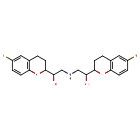
Structure for Nebivolol (DB04861)

- Weight
- Average: 405.435
Monoisotopic: 405.175164703 - Chemical Formula
- C22H25F2NO4
- Synonyms
- Narbivolol
- Nebivolol
- Nebivololum
- External IDs
- PI-21858
- R-65824
- R65,824

Pharmacology
- Indication
Nebivolol is indicated to treat hypertension.1,2,9,10
 Reduce drug development failure ratesBuild, train, & validate machine-learning modelswith evidence-based and structured datasets.Build, train, & validate predictive machine-learning models with structured datasets.
- Associated Conditions
Indication Type Indication Combined Product Details Approval Level Age Group Patient Characteristics Dose Form Used in combination to manage Hypertension Combination Product in combination with: Valsartan (DB00177) •••••••••••• •••••• Used in combination to manage Hypertension Combination Product in combination with: Valsartan (DB00177) •••••••••••• Management of Hypertension •••••••••••• - Contraindications & Blackbox Warnings
 Prevent Adverse Drug Events TodayTap into our Clinical API for life-saving information on contraindications & blackbox warnings, population restrictions, harmful risks, & more.Avoid life-threatening adverse drug events with our Clinical API
- Pharmacodynamics
Nebivolol is a selective beta-1 adrenergic receptor antagonist that decreases vascular resistance, increases stroke volume and cardiac output, and does not negatively affect left ventricular function.2,3 It has a long duration of action as effects can be seen 48 hours after stopping the medication and a wide therapeutic window as patients generally take 5-40mg daily.2,9 Patients should not abruptly stop taking this medication as this may lead to exacerbation of coronary artery disease.9 Diabetic patients should monitor their blood glucose levels as beta blockers may mask signs of hypoglycemia.9
- Mechanism of action
Nebivolol is a highly selective beta-1 adrenergic receptor antagonist2 with weak beta-2 adrenergic receptor antagonist activity.3 Blocking beta-1 adrenergic receptors by d-nebivolol leads to decreased resting heart rate, exercise heart rate, myocardial contracility, systolic blood pressure, and diastolic blood pressure.4,2,3,5 The selectivity of d-nebivolol limits the magnitude of beta blocker adverse effects in the airways or relating to insulin sensitivity.5 Nebivolol also inhibits aldosterone, and beta-1 antagonism in the juxtaglomerular apparatus also inhibits the release of renin.5 Decreased aldosterone leads to decreased blood volume, and decreased renin leads to reduced vasoconstriction.5 l-nebivolol is responsible for beta-3 adrenergic receptor agonist activity that stimulates endothelial nitric oxide synthase, increasing nitric oxide levels; leading to vasodilation, decreased peripheral vascular resistance, increased stroke volume, ejection fraction, and cardiac output.1,4,2,3,5 The vasodilation, reduced oxidative stress, and reduced platelet volume and aggregation of nebivolol may lead to benefits in heart failure patients.4
Target Actions Organism ABeta-1 adrenergic receptor antagonistHumans UBeta-2 adrenergic receptor antagonistHumans UBeta-3 adrenergic receptor agonistHumans - Absorption
The absorption of nebivolol is not affected by food.9 Nebivolol has a Tmax of 1.5-4 hours.9 Bioavailability can range from 12-96% for extensive to poor CYP2D6 metabolizers.6,7 For a 20mg dose, d-nebivolol has a Cmax of 2.75±1.55ng/mL, l-nebivolol has a Cmax of 5.29±2.06ng/mL, both enantiomers have a Cmax of 8.02±3.47ng/mL, and nebivolol glucuronides have a Cmax of 68.34±44.68ng/mL.6 For a 20mg dose, d-nebivolol has an AUC of 13.78±15.27ng*h/mL, l-nebivolol has an AUC of 27.72±15.32ng*h/mL, both enantiomers have an AUC of 41.50±29.76ng*h/mL, and nebivolol glucuronides have an AUC of 396.78±297.94ng*h/mL.6
- Volume of distribution
For a 20mg dose, d-nebivolol has an apparent volume of distribution of 10,290.81±3911.72L, l-nebivolol has an apparent volume of distribution of 8,066.66±4,055.50L, and both enantiomers together have a volume of distribution of 10,423.42±6796.50L.6
- Protein binding
Nebivolol is 98% bound to plasma proteins, mostly to serum albumin.9
- Metabolism
Nebivolol is metabolized mainly by glucuronidation and CYP2D6 mediated hydroxylation.1,4 Metabolism involves n-dealkylation, hydroxylation, oxidation, and glucuronidation.7 Aromatic hydroxyl and acyclic oxide metabolites are active, while n-dealkylated and glucuronides are inactive.7
Hover over products below to view reaction partners
- Route of elimination
In extensive CYP2D6 metabolizers, 38% is eliminated in the urine and 44% in the feces.9 In poor CYP2D6 metabolizers, 67% is eliminated in the urine and 13% in the feces.9 <1% of a dose is excreted as the unmetabolized drug.5
- Half-life
d-nebivolol has a half life of 12 hours in CYP2D6 extensive metabolizers and 19 hours in poor metabolizers.5,9
- Clearance
For a 20mg dose, the clearance of d-nebivolol is 1241.63±749.77L/h, l-nebivolol is 435.53±180.93L/h, and both enantiomers is 635.31±300.25L/h.6
- Adverse Effects
 Improve decision support & research outcomesWith structured adverse effects data, including: blackbox warnings, adverse reactions, warning & precautions, & incidence rates. View sample adverse effects data in our new Data Library!Improve decision support & research outcomes with our structured adverse effects data.
- Toxicity
Patients experiencing an overdose may present with bradycardia, hypotension, cardiac failure, dizziness, hypoglycemia, fatigue, vomiting, bronchospasm and heart block.9 Treat overdose with general supportive measures including intravenous atropine for bradycardia, vasopressors and intravenous fluids for hypotension, isoproterenol infusion for heart block, digitalis glycosides and diuretics for congestive heart failure, bronchodilators for bronchospasm, and intravenous glucose for hypoglycemia.9
- Pathways
Pathway Category Nebivolol Action Pathway Drug action - Pharmacogenomic Effects/ADRs
Interacting Gene/Enzyme Allele name Genotype(s) Defining Change(s) Type(s) Description Details Cytochrome P450 2D6 CYP2D6*3 Not Available C allele Effect Inferred Poor drug metabolizer. Details Cytochrome P450 2D6 CYP2D6*4 Not Available C allele Effect Inferred Poor drug metabolizer. Details Cytochrome P450 2D6 CYP2D6*5 Not Available Whole-gene deletion Effect Inferred Poor drug metabolizer. Details Cytochrome P450 2D6 CYP2D6*6 Not Available 1707delT Effect Inferred Poor drug metabolizer. Details Cytochrome P450 2D6 CYP2D6*7 Not Available 2935A>C Effect Inferred Poor drug metabolizer. Details Cytochrome P450 2D6 CYP2D6*8 Not Available 1758G>T Effect Inferred Poor drug metabolizer. Details Cytochrome P450 2D6 CYP2D6*11 Not Available 883G>C Effect Inferred Poor drug metabolizer. Details Cytochrome P450 2D6 CYP2D6*12 Not Available 124G>A Effect Inferred Poor drug metabolizer. Details Cytochrome P450 2D6 CYP2D6*13 Not Available CYP2D7/2D6 hybrid gene structure Effect Inferred Poor drug metabolizer. Details Cytochrome P450 2D6 CYP2D6*14A Not Available 1758G>A Effect Inferred Poor drug metabolizer. Details Cytochrome P450 2D6 CYP2D6*15 Not Available 137insT, 137_138insT Effect Inferred Poor drug metabolizer. Details Cytochrome P450 2D6 CYP2D6*19 Not Available 2539_2542delAACT Effect Inferred Poor drug metabolizer. Details Cytochrome P450 2D6 CYP2D6*20 Not Available 1973_1974insG Effect Inferred Poor drug metabolizer. Details Cytochrome P450 2D6 CYP2D6*21 Not Available 2573insC Effect Inferred Poor drug metabolizer. Details Cytochrome P450 2D6 CYP2D6*31 Not Available -1770G>A / -1584C>G … show all Effect Inferred Poor drug metabolizer. Details Cytochrome P450 2D6 CYP2D6*36 Not Available 100C>T / -1426C>T … show all Effect Inferred Poor drug metabolizer. Details Cytochrome P450 2D6 CYP2D6*38 Not Available 2587_2590delGACT Effect Inferred Poor drug metabolizer. Details Cytochrome P450 2D6 CYP2D6*40 Not Available 1863_1864ins(TTT CGC CCC)2 Effect Inferred Poor drug metabolizer. Details Cytochrome P450 2D6 CYP2D6*42 Not Available 3259_3260insGT Effect Inferred Poor drug metabolizer. Details Cytochrome P450 2D6 CYP2D6*44 Not Available 2950G>C Effect Inferred Poor drug metabolizer. Details Cytochrome P450 2D6 CYP2D6*47 Not Available 100C>T / -1426C>T … show all Effect Inferred Poor drug metabolizer. Details Cytochrome P450 2D6 CYP2D6*51 Not Available -1584C>G / -1235A>G … show all Effect Inferred Poor drug metabolizer. Details Cytochrome P450 2D6 CYP2D6*56 Not Available 3201C>T Effect Inferred Poor drug metabolizer. Details Cytochrome P450 2D6 CYP2D6*57 Not Available 100C>T / 310G>T … show all Effect Inferred Poor drug metabolizer. Details Cytochrome P450 2D6 CYP2D6*62 Not Available 4044C>T Effect Inferred Poor drug metabolizer. Details Cytochrome P450 2D6 CYP2D6*68A Not Available -1426C>T / -1235A>G … show all Effect Inferred Poor drug metabolizer. Details Cytochrome P450 2D6 CYP2D6*68B Not Available Similar but not identical switch region compared to CYP2D6*68A. Found in tandem arrangement with CYP2D6*4. Effect Inferred Poor drug metabolizer. Details Cytochrome P450 2D6 CYP2D6*69 Not Available 2988G>A / -1426C>T … show all Effect Inferred Poor drug metabolizer. Details Cytochrome P450 2D6 CYP2D6*92 Not Available 1995delC Effect Inferred Poor drug metabolizer. Details Cytochrome P450 2D6 CYP2D6*100 Not Available -1426C>T / -1235A>G … show all Effect Inferred Poor drug metabolizer. Details Cytochrome P450 2D6 CYP2D6*101 Not Available -1426C>T / -1235A>G … show all Effect Inferred Poor drug metabolizer. Details
Interactions
- Drug Interactions
- This information should not be interpreted without the help of a healthcare provider. If you believe you are experiencing an interaction, contact a healthcare provider immediately. The absence of an interaction does not necessarily mean no interactions exist.
Drug Interaction Integrate drug-drug
interactions in your softwareAbaloparatide The risk or severity of adverse effects can be increased when Nebivolol is combined with Abaloparatide. Abametapir The serum concentration of Nebivolol can be increased when it is combined with Abametapir. Abatacept The metabolism of Nebivolol can be increased when combined with Abatacept. Abiraterone The metabolism of Nebivolol can be decreased when combined with Abiraterone. Abrocitinib The metabolism of Abrocitinib can be decreased when combined with Nebivolol. - Food Interactions
- Avoid alcohol.
- Take with or without food.
Products
 Drug product information from 10+ global regionsOur datasets provide approved product information including:dosage, form, labeller, route of administration, and marketing period.Access drug product information from over 10 global regions.
- Product Ingredients
Ingredient UNII CAS InChI Key Nebivolol hydrochloride JGS34J7L9I 152520-56-4 JWEXHQAEWHKGCW-VCVZPGOSSA-N - Product Images
- International/Other Brands
- Lobivon / Nebicard / Nebilet / Nebilong / Nodon / Nubeta
- Brand Name Prescription Products
Name Dosage Strength Route Labeller Marketing Start Marketing End Region Image Bystolic Tablet 5 mg/1 Oral Physicians Total Care, Inc. 2008-10-02 Not applicable US 

Bystolic Tablet 10 mg Oral Abbvie 2013-04-02 Not applicable Canada 
Bystolic Tablet 5 mg/1 Oral Cardinal Health 2008-01-22 2023-06-30 US 
Bystolic Tablet 5 mg/1 Oral Avera McKennan Hospital 2015-03-19 2017-05-24 US 
Bystolic Tablet 5 mg/1 Oral A-S Medication Solutions 2008-01-22 Not applicable US 
- Generic Prescription Products
Name Dosage Strength Route Labeller Marketing Start Marketing End Region Image Apo-nebivolol Tablet 2.5 mg Oral Apotex Corporation Not applicable Not applicable Canada Apo-nebivolol Tablet 20 mg Oral Apotex Corporation Not applicable Not applicable Canada Apo-nebivolol Tablet 5 mg Oral Apotex Corporation Not applicable Not applicable Canada Jamp Nebivolol Tablet 20 mg Oral Jamp Pharma Corporation Not applicable Not applicable Canada Jamp Nebivolol Tablet 5 mg Oral Jamp Pharma Corporation Not applicable Not applicable Canada - Mixture Products
Name Ingredients Dosage Route Labeller Marketing Start Marketing End Region Image ALONEB Nebivolol (5 MG) + Hydrochlorothiazide (25 MG) Tablet, coated Oral Menarini International Operations Luxembourg S.A. 2014-07-08 Not applicable Italy 
ALONEB Nebivolol (5 MG) + Hydrochlorothiazide (12.5 MG) Tablet, coated Oral Menarini International Operations Luxembourg S.A. 2014-07-08 Not applicable Italy ALONEB Nebivolol (5 MG) + Hydrochlorothiazide (12.5 MG) Tablet, coated Oral Menarini International Operations Luxembourg S.A. 2014-07-08 Not applicable Italy ALONEB Nebivolol (5 MG) + Hydrochlorothiazide (25 MG) Tablet, coated Oral Menarini International Operations Luxembourg S.A. 2014-07-08 Not applicable Italy ALONEB Nebivolol (5 MG) + Hydrochlorothiazide (25 MG) Tablet, coated Oral Menarini International Operations Luxembourg S.A. 2014-07-08 Not applicable Italy


Categories
- ATC Codes
- C07FB12 — Nebivolol and amlodipine
- C07FB — Beta blocking agents and calcium channel blockers
- C07F — BETA BLOCKING AGENTS, OTHER COMBINATIONS
- C07 — BETA BLOCKING AGENTS
- C — CARDIOVASCULAR SYSTEM
- C09DX — Angiotensin II receptor blockers (ARBs), other combinations
- C09D — ANGIOTENSIN II RECEPTOR BLOCKERS (ARBs), COMBINATIONS
- C09 — AGENTS ACTING ON THE RENIN-ANGIOTENSIN SYSTEM
- C — CARDIOVASCULAR SYSTEM
- C07BB — Beta blocking agents, selective, and thiazides
- C07B — BETA BLOCKING AGENTS AND THIAZIDES
- C07 — BETA BLOCKING AGENTS
- C — CARDIOVASCULAR SYSTEM
- Drug Categories
- Adrenergic Agents
- Adrenergic Agonists
- Adrenergic Antagonists
- Adrenergic beta-1 Receptor Agonists
- Adrenergic beta-Agonists
- Adrenergic beta-Antagonists
- Agents causing hyperkalemia
- Alcohols
- Amines
- Amino Alcohols
- Antiarrhythmic agents
- Antihypertensive Agents
- Antihypertensive Agents Indicated for Hypertension
- Benzopyrans
- Beta blocking agents and calcium channel blockers
- Beta Blocking Agents and Thiazides
- Beta Blocking Agents, Selective
- Beta Blocking Agents, Selective, and Thiazides
- Beta-Blockers (Beta1 Selective)
- Bradycardia-Causing Agents
- Cardiovascular Agents
- Cytochrome P-450 CYP2C19 Substrates
- Cytochrome P-450 CYP2D6 Substrates
- Cytochrome P-450 CYP3A Substrates
- Cytochrome P-450 CYP3A4 Substrates
- Cytochrome P-450 Substrates
- Ethanolamines
- Heterocyclic Compounds, Fused-Ring
- Hypotensive Agents
- Neurotransmitter Agents
- Pyrans
- Vasodilating Agents
- Chemical TaxonomyProvided by Classyfire
- Description
- This compound belongs to the class of organic compounds known as 1-benzopyrans. These are organic aromatic compounds that 1-benzopyran, a bicyclic compound made up of a benzene ring fused to a pyran, so that the oxygen atom is at the 1-position.
- Kingdom
- Organic compounds
- Super Class
- Organoheterocyclic compounds
- Class
- Benzopyrans
- Sub Class
- 1-benzopyrans
- Direct Parent
- 1-benzopyrans
- Alternative Parents
- Aralkylamines / Alkyl aryl ethers / Benzenoids / Aryl fluorides / Secondary alcohols / 1,2-aminoalcohols / Oxacyclic compounds / Dialkylamines / Organopnictogen compounds / Organofluorides show 1 more
- Substituents
- 1,2-aminoalcohol / 1-benzopyran / Alcohol / Alkyl aryl ether / Amine / Aralkylamine / Aromatic heteropolycyclic compound / Aryl fluoride / Aryl halide / Benzenoid show 13 more
- Molecular Framework
- Aromatic heteropolycyclic compounds
- External Descriptors
- organofluorine compound, secondary alcohol, secondary amino compound, diol, chromanes (CHEBI:64019)
- Affected organisms
- Humans and other mammals
Chemical Identifiers
- UNII
- 030Y90569U
- CAS number
- 118457-14-0
- InChI Key
- KOHIRBRYDXPAMZ-UHFFFAOYSA-N
- InChI
- InChI=1S/C22H25F2NO4/c23-15-3-7-19-13(9-15)1-5-21(28-19)17(26)11-25-12-18(27)22-6-2-14-10-16(24)4-8-20(14)29-22/h3-4,7-10,17-18,21-22,25-27H,1-2,5-6,11-12H2
- IUPAC Name
- 1-(6-fluoro-3,4-dihydro-2H-1-benzopyran-2-yl)-2-{[2-(6-fluoro-3,4-dihydro-2H-1-benzopyran-2-yl)-2-hydroxyethyl]amino}ethan-1-ol
- SMILES
- OC(CNCC(O)C1CCC2=C(O1)C=CC(F)=C2)C1CCC2=C(O1)C=CC(F)=C2
References
- Synthesis Reference
Thomas Bader, Alfred Stutz, Harald Hofmeier, Hans-Ulrich Bichsel, "Process for preparation of racemic Nebivolol." U.S. Patent US20070149612, issued June 28, 2007.
US20070149612- General References
- Gielen W, Cleophas TJ, Agrawal R: Nebivolol: a review of its clinical and pharmacological characteristics. Int J Clin Pharmacol Ther. 2006 Aug;44(8):344-57. [Article]
- De Cree J, Cobo C, Geukens H, Verhaegen H: Comparison of the subacute hemodynamic effects of atenolol, propranolol, pindolol, and nebivolol. Angiology. 1990 Feb;41(2):95-105. doi: 10.1177/000331979004100202. [Article]
- Van de Water A, Janssens W, Van Neuten J, Xhonneux R, De Cree J, Verhaegen H, Reneman RS, Janssen PA: Pharmacological and hemodynamic profile of nebivolol, a chemically novel, potent, and selective beta 1-adrenergic antagonist. J Cardiovasc Pharmacol. 1988 May;11(5):552-63. doi: 10.1097/00005344-198805000-00007. [Article]
- Fongemie J, Felix-Getzik E: A Review of Nebivolol Pharmacology and Clinical Evidence. Drugs. 2015 Aug;75(12):1349-71. doi: 10.1007/s40265-015-0435-5. [Article]
- Giles TD, Cockcroft JR, Pitt B, Jakate A, Wright HM: Rationale for nebivolol/valsartan combination for hypertension: review of preclinical and clinical data. J Hypertens. 2017 Sep;35(9):1758-1767. doi: 10.1097/HJH.0000000000001412. [Article]
- Chen CL, Desai-Krieger D, Ortiz S, Kerolous M, Wright HM, Ghahramani P: A Single-Center, Open-Label, 3-Way Crossover Trial to Determine the Pharmacokinetic and Pharmacodynamic Interaction Between Nebivolol and Valsartan in Healthy Volunteers at Steady State. Am J Ther. 2015 Sep-Oct;22(5):e130-40. doi: 10.1097/MJT.0000000000000247. [Article]
- Briciu C, Neag M, Muntean D, Bocsan C, Buzoianu A, Antonescu O, Gheldiu AM, Achim M, Popa A, Vlase L: Phenotypic differences in nebivolol metabolism and bioavailability in healthy volunteers. Clujul Med. 2015;88(2):208-13. doi: 10.15386/cjmed-395. Epub 2015 Apr 15. [Article]
- Hilas O, Ezzo D: Nebivolol (bystolic), a novel Beta blocker for hypertension. P T. 2009 Apr;34(4):188-92. [Article]
- FDA Approved Drug Products: Nebivolol Tablets [Link]
- FDA Approved Drug Products: Nebivolol and Valsartan Tablets [Link]
- External Links
- Human Metabolome Database
- HMDB0015594
- KEGG Drug
- D05127
- PubChem Compound
- 71301
- PubChem Substance
- 99443225
- ChemSpider
- 64421
- BindingDB
- 84735
- 31555
- ChEBI
- 64019
- ChEMBL
- CHEMBL434394
- Therapeutic Targets Database
- DAP000942
- PharmGKB
- PA151958426
- RxList
- RxList Drug Page
- Drugs.com
- Drugs.com Drug Page
- PDRhealth
- PDRhealth Drug Page
- Wikipedia
- Nebivolol
- MSDS
- Download (69.1 KB)
Clinical Trials
- Clinical Trials
Phase Status Purpose Conditions Count 4 Completed Basic Science Aortic Blood Pressure 1 4 Completed Basic Science Syndrome, Metabolic 1 4 Completed Diagnostic Hypertension 2 4 Completed Health Services Research JNC 7 Stage 1 or 2 Hypertension 1 4 Completed Other Cardiac Failure / Cardiovascular Disease (CVD) / Heart Failure / Heart Failure With Preserved Ejection Fraction (HFpEF) / Heart Failure, Diastolic 2
Pharmacoeconomics
- Manufacturers
- Not Available
- Packagers
- Forest Laboratories Inc.
- Forest Pharmaceuticals
- Mylan
- Physicians Total Care Inc.
- Dosage Forms
Form Route Strength Tablet Oral Tablet Oral 10 mg Tablet Oral 10 mg/1 Tablet Oral 2.5 mg Tablet Oral 2.5 mg/1 Tablet Oral 20 mg/1 Tablet Oral 20 mg Tablet Oral 5 mg/1 Tablet, film coated Oral Tablet Oral 5.450 mg Tablet Oral Tablet, film coated Oral Tablet, coated Oral Tablet Oral 500000 mg Tablet, coated Tablet Oral 5.000 mg Tablet Oral 5 mg - Prices
Unit description Cost Unit Bystolic 10 mg tablet 2.09USD tablet Bystolic 20 mg tablet 2.09USD tablet Bystolic 2.5 mg tablet 2.06USD tablet Bystolic 5 mg tablet 2.06USD tablet DrugBank does not sell nor buy drugs. Pricing information is supplied for informational purposes only.- Patents
Patent Number Pediatric Extension Approved Expires (estimated) Region US5759580 No 1998-06-02 2015-06-02 US US6545040 No 2003-04-08 2021-12-17 US US7803838 No 2010-09-28 2026-08-29 US US7838552 No 2010-11-23 2027-10-04 US
Properties
- State
- Solid
- Experimental Properties
Property Value Source melting point (°C) 223.0-228.0 https://www.tcichemicals.com/eshop/en/gb/commodity/N0954/ water solubility 0.091g/100mL http://www.medicines.org.au/files/txpnebiv.pdf logP 4.183 https://www.sigmaaldrich.com/MSDS/MSDS/DisplayMSDSPage.do?country=CA&language=en&productNumber=N1915&brand=SIGMA&PageToGoToURL=https%3A%2F%2Fwww.sigmaaldrich.com%2Fcatalog%2Fproduct%2Fsigma%2Fn1915%3Flang%3Den pKa 8.13 http://www.medicines.org.au/files/txpnebiv.pdf - Predicted Properties
Property Value Source Water Solubility 0.0403 mg/mL ALOGPS logP 2.44 ALOGPS logP 3.21 Chemaxon logS -4 ALOGPS pKa (Strongest Acidic) 13.52 Chemaxon pKa (Strongest Basic) 8.9 Chemaxon Physiological Charge 1 Chemaxon Hydrogen Acceptor Count 5 Chemaxon Hydrogen Donor Count 3 Chemaxon Polar Surface Area 70.95 Å2 Chemaxon Rotatable Bond Count 6 Chemaxon Refractivity 103.32 m3·mol-1 Chemaxon Polarizability 41.98 Å3 Chemaxon Number of Rings 4 Chemaxon Bioavailability 1 Chemaxon Rule of Five Yes Chemaxon Ghose Filter Yes Chemaxon Veber's Rule No Chemaxon MDDR-like Rule Yes Chemaxon - Predicted ADMET Features
Property Value Probability Human Intestinal Absorption + 0.8483 Blood Brain Barrier + 0.7802 Caco-2 permeable - 0.5549 P-glycoprotein substrate Substrate 0.7928 P-glycoprotein inhibitor I Non-inhibitor 0.7443 P-glycoprotein inhibitor II Non-inhibitor 0.567 Renal organic cation transporter Non-inhibitor 0.8016 CYP450 2C9 substrate Non-substrate 0.8738 CYP450 2D6 substrate Non-substrate 0.7248 CYP450 3A4 substrate Non-substrate 0.6822 CYP450 1A2 substrate Inhibitor 0.5145 CYP450 2C9 inhibitor Non-inhibitor 0.7876 CYP450 2D6 inhibitor Non-inhibitor 0.5994 CYP450 2C19 inhibitor Non-inhibitor 0.5923 CYP450 3A4 inhibitor Non-inhibitor 0.9441 CYP450 inhibitory promiscuity Low CYP Inhibitory Promiscuity 0.8336 Ames test Non AMES toxic 0.7132 Carcinogenicity Non-carcinogens 0.9402 Biodegradation Not ready biodegradable 0.9953 Rat acute toxicity 2.7228 LD50, mol/kg Not applicable hERG inhibition (predictor I) Strong inhibitor 0.5769 hERG inhibition (predictor II) Inhibitor 0.8381
Spectra
- Mass Spec (NIST)
- Not Available
- Spectra
Spectrum Spectrum Type Splash Key Predicted GC-MS Spectrum - GC-MS Predicted GC-MS splash10-0fl0-5961000000-db2c9843ee0cc7cd22d4 Predicted MS/MS Spectrum - 10V, Positive (Annotated) Predicted LC-MS/MS splash10-0a4i-0001900000-c22ff323abf8a4ab4550 Predicted MS/MS Spectrum - 10V, Negative (Annotated) Predicted LC-MS/MS splash10-0fss-0529400000-6d042709add1953f8caf Predicted MS/MS Spectrum - 20V, Positive (Annotated) Predicted LC-MS/MS splash10-052r-0393200000-7325262050f7c3fc5ef4 Predicted MS/MS Spectrum - 20V, Negative (Annotated) Predicted LC-MS/MS splash10-0002-0932200000-a8fefdc409edc1b57211 Predicted MS/MS Spectrum - 40V, Positive (Annotated) Predicted LC-MS/MS splash10-0zfr-1950100000-1aa1bb58ea4b84610bbc Predicted MS/MS Spectrum - 40V, Negative (Annotated) Predicted LC-MS/MS splash10-0fb9-0930100000-88ad25beaec1962bbd39 Predicted 1H NMR Spectrum 1D NMR Not Applicable Predicted 13C NMR Spectrum 1D NMR Not Applicable - Chromatographic Properties
Collision Cross Sections (CCS)
Adduct CCS Value (Å2) Source type Source [M-H]- 202.3883319 predictedDarkChem Lite v0.1.0 [M-H]- 195.98903 predictedDeepCCS 1.0 (2019) [M+H]+ 202.0785319 predictedDarkChem Lite v0.1.0 [M+H]+ 198.35449 predictedDeepCCS 1.0 (2019) [M+Na]+ 202.5001319 predictedDarkChem Lite v0.1.0 [M+Na]+ 205.51564 predictedDeepCCS 1.0 (2019)
Targets
- Kind
- Protein
- Organism
- Humans
- Pharmacological action
- Yes
- Actions
- Antagonist
- General Function
- Receptor signaling protein activity
- Specific Function
- Beta-adrenergic receptors mediate the catecholamine-induced activation of adenylate cyclase through the action of G proteins. This receptor binds epinephrine and norepinephrine with approximately e...
- Gene Name
- ADRB1
- Uniprot ID
- P08588
- Uniprot Name
- Beta-1 adrenergic receptor
- Molecular Weight
- 51322.1 Da
References
- Gielen W, Cleophas TJ, Agrawal R: Nebivolol: a review of its clinical and pharmacological characteristics. Int J Clin Pharmacol Ther. 2006 Aug;44(8):344-57. [Article]
- Chen X, Ji ZL, Chen YZ: TTD: Therapeutic Target Database. Nucleic Acids Res. 2002 Jan 1;30(1):412-5. [Article]
- de Boer RA, Voors AA, van Veldhuisen DJ: Nebivolol: third-generation beta-blockade. Expert Opin Pharmacother. 2007 Jul;8(10):1539-50. [Article]
- Kind
- Protein
- Organism
- Humans
- Pharmacological action
- Unknown
- Actions
- Antagonist
- General Function
- Protein homodimerization activity
- Specific Function
- Beta-adrenergic receptors mediate the catecholamine-induced activation of adenylate cyclase through the action of G proteins. The beta-2-adrenergic receptor binds epinephrine with an approximately ...
- Gene Name
- ADRB2
- Uniprot ID
- P07550
- Uniprot Name
- Beta-2 adrenergic receptor
- Molecular Weight
- 46458.32 Da
References
- Nuttall SL, Routledge HC, Kendall MJ: A comparison of the beta1-selectivity of three beta1-selective beta-blockers. J Clin Pharm Ther. 2003 Jun;28(3):179-86. [Article]
- Kind
- Protein
- Organism
- Humans
- Pharmacological action
- Unknown
- Actions
- Agonist
- General Function
- Protein homodimerization activity
- Specific Function
- Beta-adrenergic receptors mediate the catecholamine-induced activation of adenylate cyclase through the action of G proteins. Beta-3 is involved in the regulation of lipolysis and thermogenesis.
- Gene Name
- ADRB3
- Uniprot ID
- P13945
- Uniprot Name
- Beta-3 adrenergic receptor
- Molecular Weight
- 43518.615 Da
References
- Gielen W, Cleophas TJ, Agrawal R: Nebivolol: a review of its clinical and pharmacological characteristics. Int J Clin Pharmacol Ther. 2006 Aug;44(8):344-57. [Article]
- Fongemie J, Felix-Getzik E: A Review of Nebivolol Pharmacology and Clinical Evidence. Drugs. 2015 Aug;75(12):1349-71. doi: 10.1007/s40265-015-0435-5. [Article]
- De Cree J, Cobo C, Geukens H, Verhaegen H: Comparison of the subacute hemodynamic effects of atenolol, propranolol, pindolol, and nebivolol. Angiology. 1990 Feb;41(2):95-105. doi: 10.1177/000331979004100202. [Article]
- Van de Water A, Janssens W, Van Neuten J, Xhonneux R, De Cree J, Verhaegen H, Reneman RS, Janssen PA: Pharmacological and hemodynamic profile of nebivolol, a chemically novel, potent, and selective beta 1-adrenergic antagonist. J Cardiovasc Pharmacol. 1988 May;11(5):552-63. doi: 10.1097/00005344-198805000-00007. [Article]
- Giles TD, Cockcroft JR, Pitt B, Jakate A, Wright HM: Rationale for nebivolol/valsartan combination for hypertension: review of preclinical and clinical data. J Hypertens. 2017 Sep;35(9):1758-1767. doi: 10.1097/HJH.0000000000001412. [Article]
Enzymes
- Kind
- Protein
- Organism
- Humans
- Pharmacological action
- Unknown
- Actions
- Substrate
- General Function
- Vitamin d3 25-hydroxylase activity
- Specific Function
- Cytochromes P450 are a group of heme-thiolate monooxygenases. In liver microsomes, this enzyme is involved in an NADPH-dependent electron transport pathway. It performs a variety of oxidation react...
- Gene Name
- CYP3A4
- Uniprot ID
- P08684
- Uniprot Name
- Cytochrome P450 3A4
- Molecular Weight
- 57342.67 Da
References
- Hocht C, Bertera FM, Mayer MA, Taira CA: Issues in drug metabolism of major antihypertensive drugs: beta-blockers, calcium channel antagonists and angiotensin receptor blockers. Expert Opin Drug Metab Toxicol. 2010 Feb;6(2):199-211. doi: 10.1517/17425250903397381. [Article]
- Kind
- Protein
- Organism
- Humans
- Pharmacological action
- Unknown
- Actions
- Substrate
- General Function
- Steroid hydroxylase activity
- Specific Function
- Responsible for the metabolism of a number of therapeutic agents such as the anticonvulsant drug S-mephenytoin, omeprazole, proguanil, certain barbiturates, diazepam, propranolol, citalopram and im...
- Gene Name
- CYP2C19
- Uniprot ID
- P33261
- Uniprot Name
- Cytochrome P450 2C19
- Molecular Weight
- 55930.545 Da
References
- Hu X, Lan T, Dai D, Xu RA, Yuan L, Zhou Q, Li Y, Cai J, Hu G: Evaluation of 24 CYP2D6 Variants on the Metabolism of Nebivolol In Vitro. Drug Metab Dispos. 2016 Nov;44(11):1828-1831. doi: 10.1124/dmd.116.071811. Epub 2016 Aug 18. [Article]
- Kind
- Protein
- Organism
- Humans
- Pharmacological action
- Unknown
- Actions
- Substrate
- General Function
- Steroid hydroxylase activity
- Specific Function
- Responsible for the metabolism of many drugs and environmental chemicals that it oxidizes. It is involved in the metabolism of drugs such as antiarrhythmics, adrenoceptor antagonists, and tricyclic...
- Gene Name
- CYP2D6
- Uniprot ID
- P10635
- Uniprot Name
- Cytochrome P450 2D6
- Molecular Weight
- 55768.94 Da
References
Carriers
- Kind
- Protein
- Organism
- Humans
- Pharmacological action
- Unknown
- Actions
- Binder
- General Function
- Toxic substance binding
- Specific Function
- Serum albumin, the main protein of plasma, has a good binding capacity for water, Ca(2+), Na(+), K(+), fatty acids, hormones, bilirubin and drugs. Its main function is the regulation of the colloid...
- Gene Name
- ALB
- Uniprot ID
- P02768
- Uniprot Name
- Serum albumin
- Molecular Weight
- 69365.94 Da
References
- FDA Approved Drug Products: Nebivolol Tablets [Link]

Drug created at October 19, 2007 21:00 / Updated at April 23, 2024 11:38