Identification
- Generic Name
- Chloropyramine
- DrugBank Accession Number
- DB08800
- Background
Chlorpyramine is a first generation antihistamine used in Eastern European countries to treat bronchial asthma as well as allergice rhinitis, allergic conjunctivitis, and other allergic reactions. It is also indicated for Quincke's edema, allergic reactions to insect bites, food and drug allergies, and anaphylactic shock.
- Type
- Small Molecule
- Groups
- Experimental
- Structure
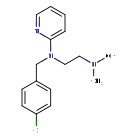
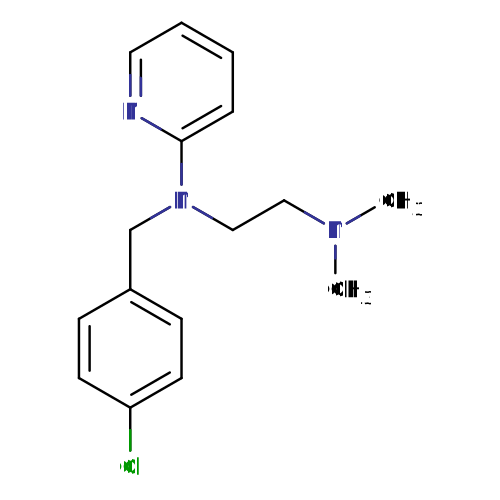
Structure for Chloropyramine (DB08800)
- Weight
- Average: 289.803
Monoisotopic: 289.134575362 - Chemical Formula
- C16H20ClN3
- Synonyms
- Chloropyramine
- Chloropyraminum
- Chlorpyramine
- Cloropiramina
- Halopyramine

Pharmacology
- Indication
For the treatment of allergic conjunctivitis, allergic rhinitis, bronchial asthma, and other atopic (allergic) conditions.
 Reduce drug development failure ratesBuild, train, & validate machine-learning modelswith evidence-based and structured datasets.Build, train, & validate predictive machine-learning models with structured datasets.
- Contraindications & Blackbox Warnings
 Prevent Adverse Drug Events TodayTap into our Clinical API for life-saving information on contraindications & blackbox warnings, population restrictions, harmful risks, & more.Avoid life-threatening adverse drug events with our Clinical API
- Pharmacodynamics
Chlorpyramine is a competitive reversible H1 receptor antagonist. This inhibits vasodilation, increases in vascular permeability, and tissue edema associated with histamine release. In addition, chloropyramine has some anticholinergic properties. These effects, along with its ability to pass through the blood-brain barrier lead to side effects such as drowsiness, weakness, vertigo, fatigue, dryness in the mouth, constipation, and rarely - visual disturbances and increase of intraocular pressure.
- Mechanism of action
Chloropyramine binds to the histamine H1 receptor. This blocks the action of endogenous histamine, which subsequently leads to temporary relief of the negative symptoms brought on by histamine.
Target Actions Organism AHistamine H1 receptor antagonistHumans - Absorption
Not Available
- Volume of distribution
Not Available
- Protein binding
Not Available
- Metabolism
- Not Available
- Route of elimination
Not Available
- Half-life
Not Available
- Clearance
Not Available
- Adverse Effects
 Improve decision support & research outcomesWith structured adverse effects data, including: blackbox warnings, adverse reactions, warning & precautions, & incidence rates. View sample adverse effects data in our new Data Library!Improve decision support & research outcomes with our structured adverse effects data.
- Toxicity
Oral (LD50): Acute: 142 mg/kg [Rat]. 135 mg/kg [Mouse]. DUST (LC50): Acute: 209 mg/m 2 hours [Rat].
- Pathways
Pathway Category Chloropyramine H1-Antihistamine Action Drug action - Pharmacogenomic Effects/ADRs
- Not Available
Interactions
- Drug Interactions
- This information should not be interpreted without the help of a healthcare provider. If you believe you are experiencing an interaction, contact a healthcare provider immediately. The absence of an interaction does not necessarily mean no interactions exist.
Drug Interaction Integrate drug-drug
interactions in your softwareAmphetamine Amphetamine may decrease the sedative activities of Chloropyramine. Benzphetamine Benzphetamine may decrease the sedative activities of Chloropyramine. Benzylpenicilloyl polylysine Chloropyramine may decrease effectiveness of Benzylpenicilloyl polylysine as a diagnostic agent. Betahistine The therapeutic efficacy of Betahistine can be decreased when used in combination with Chloropyramine. Dextroamphetamine Dextroamphetamine may decrease the sedative activities of Chloropyramine. - Food Interactions
- Not Available
Products
 Drug product information from 10+ global regionsOur datasets provide approved product information including:dosage, form, labeller, route of administration, and marketing period.Access drug product information from over 10 global regions.
- Product Ingredients
Ingredient UNII CAS InChI Key Chloropyramine hydrochloride FWA92Z14NN 6170-42-9 VEYWWAGBHABATA-UHFFFAOYSA-N - International/Other Brands
- Avapena / Suprastin / Synopen
Categories
- ATC Codes
- D04AA09 — Chloropyramine
- D04AA — Antihistamines for topical use
- D04A — ANTIPRURITICS, INCL. ANTIHISTAMINES, ANESTHETICS, ETC.
- D04 — ANTIPRURITICS, INCL. ANTIHISTAMINES, ANESTHETICS, ETC.
- D — DERMATOLOGICALS
- R06AC — Substituted ethylene diamines
- R06A — ANTIHISTAMINES FOR SYSTEMIC USE
- R06 — ANTIHISTAMINES FOR SYSTEMIC USE
- R — RESPIRATORY SYSTEM
- Drug Categories
- Chemical TaxonomyProvided by Classyfire
- Description
- This compound belongs to the class of organic compounds known as 2-benzylaminopyridines. These are aromatic compounds containing pyridine ring substituted at the 2-position by a benzylamine group.
- Kingdom
- Organic compounds
- Super Class
- Benzenoids
- Class
- Benzene and substituted derivatives
- Sub Class
- Benzylamines
- Direct Parent
- 2-benzylaminopyridines
- Alternative Parents
- Dialkylarylamines / Chlorobenzenes / Aminopyridines and derivatives / Imidolactams / Aryl chlorides / Heteroaromatic compounds / Trialkylamines / Azacyclic compounds / Organopnictogen compounds / Organochlorides show 1 more
- Substituents
- 2-benzylaminopyridine / Amine / Aminopyridine / Aromatic heteromonocyclic compound / Aryl chloride / Aryl halide / Azacycle / Chlorobenzene / Dialkylarylamine / Halobenzene show 12 more
- Molecular Framework
- Aromatic heteromonocyclic compounds
- External Descriptors
- Not Available
- Affected organisms
- Humans and other mammals
Chemical Identifiers
- UNII
- 2K3L8O9SOV
- CAS number
- 59-32-5
- InChI Key
- ICKFFNBDFNZJSX-UHFFFAOYSA-N
- InChI
- InChI=1S/C16H20ClN3/c1-19(2)11-12-20(16-5-3-4-10-18-16)13-14-6-8-15(17)9-7-14/h3-10H,11-13H2,1-2H3
- IUPAC Name
- N-[(4-chlorophenyl)methyl]-N-[2-(dimethylamino)ethyl]pyridin-2-amine
- SMILES
- CN(C)CCN(CC1=CC=C(Cl)C=C1)C1=CC=CC=N1
References
- Synthesis Reference
- US2607778
- General References
- Not Available
- External Links
- Human Metabolome Database
- HMDB0015690
- KEGG Drug
- D07195
- PubChem Compound
- 25295
- PubChem Substance
- 99445270
- ChemSpider
- 23628
- 20861
- ChEBI
- 94767
- ChEMBL
- CHEMBL1194287
- ZINC
- ZINC000020148995
- PharmGKB
- PA165958419
- PDBe Ligand
- C4C
- Wikipedia
- Chloropyramine
- MSDS
- Download (49.4 KB)
Clinical Trials
Pharmacoeconomics
- Manufacturers
- Not Available
- Packagers
- Not Available
- Dosage Forms
Form Route Strength Solution Parenteral 20.000 mg Tablet Oral 25.000 mg - Prices
- Not Available
- Patents
- Not Available
Properties
- State
- Solid
- Experimental Properties
Property Value Source melting point (°C) < 25 °C PhysProp boiling point (°C) 154.5 °C at 2.00E-01 mm Hg PhysProp water solubility Insoluble MSDS - Predicted Properties
Property Value Source Water Solubility 0.441 mg/mL ALOGPS logP 3.79 ALOGPS logP 3.81 Chemaxon logS -2.8 ALOGPS pKa (Strongest Basic) 8.76 Chemaxon Physiological Charge 1 Chemaxon Hydrogen Acceptor Count 3 Chemaxon Hydrogen Donor Count 0 Chemaxon Polar Surface Area 19.37 Å2 Chemaxon Rotatable Bond Count 6 Chemaxon Refractivity 86.08 m3·mol-1 Chemaxon Polarizability 32.25 Å3 Chemaxon Number of Rings 2 Chemaxon Bioavailability 1 Chemaxon Rule of Five Yes Chemaxon Ghose Filter Yes Chemaxon Veber's Rule Yes Chemaxon MDDR-like Rule No Chemaxon - Predicted ADMET Features
Property Value Probability Human Intestinal Absorption + 0.941 Blood Brain Barrier + 0.9171 Caco-2 permeable + 0.7061 P-glycoprotein substrate Substrate 0.783 P-glycoprotein inhibitor I Non-inhibitor 0.9316 P-glycoprotein inhibitor II Non-inhibitor 0.927 Renal organic cation transporter Inhibitor 0.741 CYP450 2C9 substrate Non-substrate 0.8112 CYP450 2D6 substrate Non-substrate 0.734 CYP450 3A4 substrate Substrate 0.5631 CYP450 1A2 substrate Inhibitor 0.8437 CYP450 2C9 inhibitor Non-inhibitor 0.9071 CYP450 2D6 inhibitor Inhibitor 0.8932 CYP450 2C19 inhibitor Inhibitor 0.8994 CYP450 3A4 inhibitor Non-inhibitor 0.9686 CYP450 inhibitory promiscuity Low CYP Inhibitory Promiscuity 0.6062 Ames test Non AMES toxic 0.9301 Carcinogenicity Non-carcinogens 0.8833 Biodegradation Not ready biodegradable 1.0 Rat acute toxicity 2.5294 LD50, mol/kg Not applicable hERG inhibition (predictor I) Weak inhibitor 0.6398 hERG inhibition (predictor II) Inhibitor 0.8005
Spectra
- Mass Spec (NIST)
- Not Available
- Spectra
Spectrum Spectrum Type Splash Key Predicted GC-MS Spectrum - GC-MS Predicted GC-MS splash10-0a6r-9530000000-b6ae851a4ae80a823d03 Predicted MS/MS Spectrum - 10V, Positive (Annotated) Predicted LC-MS/MS splash10-0006-0090000000-9613cbc108436b475d17 Predicted MS/MS Spectrum - 10V, Negative (Annotated) Predicted LC-MS/MS splash10-000l-1090000000-fdddd8306564e91c9762 Predicted MS/MS Spectrum - 20V, Positive (Annotated) Predicted LC-MS/MS splash10-002g-1290000000-93957110fde187ced738 Predicted MS/MS Spectrum - 20V, Negative (Annotated) Predicted LC-MS/MS splash10-014i-4980000000-07f591b34bd3dae295a9 Predicted MS/MS Spectrum - 40V, Positive (Annotated) Predicted LC-MS/MS splash10-014i-4900000000-58459b72f5c9a778222c Predicted MS/MS Spectrum - 40V, Negative (Annotated) Predicted LC-MS/MS splash10-001i-9200000000-ecf6f9da1d9c0e0595c8 Predicted 1H NMR Spectrum 1D NMR Not Applicable Predicted 13C NMR Spectrum 1D NMR Not Applicable - Chromatographic Properties
Collision Cross Sections (CCS)
Adduct CCS Value (Å2) Source type Source [M-H]- 171.912566 predictedDarkChem Lite v0.1.0 [M-H]- 162.97586 predictedDeepCCS 1.0 (2019) [M+H]+ 172.037266 predictedDarkChem Lite v0.1.0 [M+H]+ 165.33388 predictedDeepCCS 1.0 (2019) [M+Na]+ 172.486566 predictedDarkChem Lite v0.1.0 [M+Na]+ 171.42702 predictedDeepCCS 1.0 (2019)
Targets

- Kind
- Protein
- Organism
- Humans
- Pharmacological action
- Yes
- Actions
- Antagonist
- General Function
- Histamine receptor activity
- Specific Function
- In peripheral tissues, the H1 subclass of histamine receptors mediates the contraction of smooth muscles, increase in capillary permeability due to contraction of terminal venules, and catecholamin...
- Gene Name
- HRH1
- Uniprot ID
- P35367
- Uniprot Name
- Histamine H1 receptor
- Molecular Weight
- 55783.61 Da
References
- Kurenova EV, Hunt DL, He D, Magis AT, Ostrov DA, Cance WG: Small molecule chloropyramine hydrochloride (C4) targets the binding site of focal adhesion kinase and vascular endothelial growth factor receptor 3 and suppresses breast cancer growth in vivo. J Med Chem. 2009 Aug 13;52(15):4716-24. doi: 10.1021/jm900159g. [Article]

Drug created at October 14, 2010 20:21 / Updated at December 02, 2023 06:59