Identification
- Summary
Methocarbamol is a CNS depressant indicated with rest, physical therapy and other treatments to control the discomfort associated with various acute musculoskeletal conditions.
- Brand Names
- Robaxacet, Robaxacet-8, Robaxin, Robaxisal
- Generic Name
- Methocarbamol
- DrugBank Accession Number
- DB00423
- Background
Methocarbamol was developed in the early 1950s as a treatment for muscle spasticity and the associated pain.6,7 It is a guaiacol glyceryl ether.7
Methocarbamol tablets and intramuscular injections are prescription medicines indicated in the United States as an adjunct to rest, physical therapy, and other measures for the relief of discomforts associated with acute, painful musculoskeletal conditions.Label,9 In Canada, methocarbamol can be sold as an over the counter oral medicine at a lower dose that may be combined with acetaminophen or ibuprofen.10 A combination product with acetylsalicylic acid and codeine is available in Canada by prescription.10
Methocarbamol was FDA approved on 16 July 1957.8
- Type
- Small Molecule
- Groups
- Approved, Vet approved
- Structure
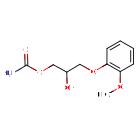
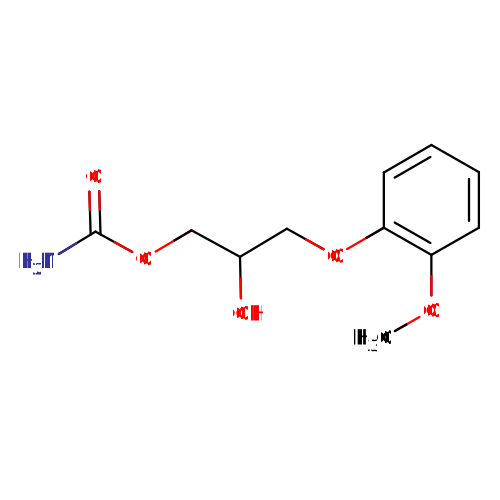
Structure for Methocarbamol (DB00423)
- Weight
- Average: 241.2405
Monoisotopic: 241.095022595 - Chemical Formula
- C11H15NO5
- Synonyms
- (RS)-2-hydroxy-3-(2-methoxyphenoxy)propyl carbamate
- Methocarbamol
- Méthocarbamol
- Methocarbamolum
- Metocarbamol
- Metocarbamolo

Pharmacology
- Indication
Methocarbamol tablets and intramuscular injections are indicated in the United States as an adjunct to rest, physical therapy, and other measures for the relief of discomforts associated with acute, painful musculoskeletal conditions.Label,9 Oral methocarbamol in America may be given up to 1500mg 4 times daily for 2-3 days.3
In Canada, methocarbamol containing oral formulations are sold over the counter for pain associated with muscle spasm.10 However, if these combination formulations include codeine, they are prescription only.10
 Reduce drug development failure ratesBuild, train, & validate machine-learning modelswith evidence-based and structured datasets.Build, train, & validate predictive machine-learning models with structured datasets.
- Associated Conditions
Indication Type Indication Combined Product Details Approval Level Age Group Patient Characteristics Dose Form Used in combination to treat Arthritis Combination Product in combination with: Indomethacin (DB00328) •••••••••••• •••••• Adjunct therapy in treatment of Discomfort •••••••••••• •••••••••• •••••• Used in combination to treat Gouty arthritis Combination Product in combination with: Indomethacin (DB00328) •••••••••••• •••••• Adjunct therapy in treatment of Muscle pain •••••••••••• •••••••••• •••••• Used in combination for symptomatic treatment of Muscle spasm Mixture Product in combination with: Codeine (DB00318), Acetylsalicylic acid (DB00945) •••••••••••• •••••• - Contraindications & Blackbox Warnings
 Prevent Adverse Drug Events TodayTap into our Clinical API for life-saving information on contraindications & blackbox warnings, population restrictions, harmful risks, & more.Avoid life-threatening adverse drug events with our Clinical API
- Pharmacodynamics
Methacarbamol is a skeletal muscle relaxant with an unknown mechanism of action.5 Methacarbamol has been shown to block spinal polysynaptic reflexes, decrease nerve transmission in spinal and supraspinal polysynaptic pathways, and prolong the refractory period of muscle cells.5,4 Methocarbamol does not act as a local anesthetic upon injection.4 In animal studies, methocarbamol also prevents convulsions after electric shock.5
- Mechanism of action
The mechanism of action of methocarbamol is thought to be dependant on its central nervous system depressant activity.3 This action may be mediated through blocking spinal polysynaptic reflexes, decreasing nerve transmission in spinal and supraspinal polysynaptic pathways, and prolonging the refractory period of muscle cells.5,4 Methocarbamol has been found to have no effect on contraction of muscle fibres, motor end plates, or nerve fibres.9
Target Actions Organism NCarbonic anhydrase 1 inhibitorHumans - Absorption
The time to maximum concentration is 1.1 hours for both healthy patients and those on hemodialysis.1 The maximum plasma concentration is 21.3mg/L for healthy patients and 28.7mg/L in hemodialysis patients.1 The area under the curve for healthy patients is 52.5mg/L*hr and 87.1mg/L*hr in hemodialysis patients.1 AUC% based on terminal elimination half life is 2% for healthy patients and 4% for hemodialysis patients.1
Older studies report maximum plasma concentrations in 0.5 hours.2
- Volume of distribution
Volume of distribution data in humans is scarce. In horses, the volume of distribution is 515-942mL/kg at steady state or 724-1130mL/kg.5
- Protein binding
Methocarbamol is 46-50% protein bound in healthy patients and 47.3-48.9% protein bound in hemodialysis patients.1
- Metabolism
Methocarbamol is metabolized in the liver by demethylation to 3-(2-hydroxyphenoxy)-1,2-propanediol-1-carbamate or hydroxylation to 3-(4-hydroxy-2-methoxyphenoxy)-1,2-propanediol-1-carbamate.2 Methocarbamol and its metabolites are conjugated through glucuronidation or sulfation.2
Hover over products below to view reaction partners
- Route of elimination
In humans the majority of the dose is eliminated in the urine.2 In dogs, 88.85% of the dose is eliminated in urine and 2.14% in the feces.2 In rats, 84.5-92.5% of the dose is eliminated in the urine and 0-13.3% is eliminated in the feces.2
- Half-life
The elimination half life is 1.14 hours in healthy subjects and 1.24 hours in subjects with renal insufficiency.1 Older studies report half lives of 1.6-2.15 hours.2
- Clearance
0.2-0.8L/h/kg.9
- Adverse Effects
 Improve decision support & research outcomesWith structured adverse effects data, including: blackbox warnings, adverse reactions, warning & precautions, & incidence rates. View sample adverse effects data in our new Data Library!Improve decision support & research outcomes with our structured adverse effects data.
- Toxicity
Overdose of methocarbamol may be associated with alcohol and other central nervous system depressants.Label Patients may experience nausea, drowsiness, blurred vision, hypotension, seizures, and coma.Label Treatment of overdose is generally through airway maintenance, monitoring urinary output, vital signs, and giving fluid intravenously if necessary.Label
The oral LD50 in rats is 3576.2mg/kg.10
The FDA has classified methocarbamol as pregnancy category C.Label Animal and human studies have not been performed to determine the risks to a fetus, however fetal and congenital abnormalities have been reported.Label Methocarbamol is excreted in the milk of dogs, however it is unknown if this is also the case for humans.Label Caution should be exercised when taking methocarbamol while breastfeeding.Label
Studies to assess the carcinogenicity, mutagenicity, or effects on fertility of methocarbamol have not been performed.Label
- Pathways
- Not Available
- Pharmacogenomic Effects/ADRs
- Not Available
Interactions
- Drug Interactions
- This information should not be interpreted without the help of a healthcare provider. If you believe you are experiencing an interaction, contact a healthcare provider immediately. The absence of an interaction does not necessarily mean no interactions exist.
Drug Interaction Integrate drug-drug
interactions in your software1,2-Benzodiazepine The risk or severity of CNS depression can be increased when Methocarbamol is combined with 1,2-Benzodiazepine. Acetazolamide The risk or severity of CNS depression can be increased when Methocarbamol is combined with Acetazolamide. Acetophenazine The risk or severity of CNS depression can be increased when Methocarbamol is combined with Acetophenazine. Agomelatine The risk or severity of CNS depression can be increased when Methocarbamol is combined with Agomelatine. Alfentanil The risk or severity of CNS depression can be increased when Methocarbamol is combined with Alfentanil. - Food Interactions
- Avoid alcohol.
- Take with or without food. The absorption is unaffected by food.
Products
 Drug product information from 10+ global regionsOur datasets provide approved product information including:dosage, form, labeller, route of administration, and marketing period.Access drug product information from over 10 global regions.
- Product Images
- International/Other Brands
- Bolaxin (Ying Yuan) / Carbaflex (Paill) / Delaxin / DoloVisan (Dr.Kade Pharmaceutische Fabrik) / Fubaxin (Grape King) / Lumirelax (Juvise) / Metocarbamol (AZ Pharma) / Mioflex (Labinco) / Miorel (Cheminter) / Musxan (Pharmasant) / Ortoton (Recordati) / Rebamol (Winston) / Robaxin-750 (Pfizer) / Robinax (Khandelwal) / Sinaxar (Armofar) / Taspan (Honten)
- Brand Name Prescription Products
Name Dosage Strength Route Labeller Marketing Start Marketing End Region Image Methocarb 500-EZS Kit 500 mg/1 Oral PureTek Corporation 2018-10-23 Not applicable US 
Methocarbamol Tablet 750 mg/1 Oral Lannett Company, Inc. 2007-06-19 Not applicable US Methocarbamol Tablet 750 mg/1 Oral Vintage Pharmaceuticals, LLC 2007-09-13 2007-09-13 US Methocarbamol Tablet 500 mg/1 Oral Lannett Company, Inc. 2007-06-19 Not applicable US Methocarbamol Tablet 500 mg/1 Oral Vintage Pharmaceuticals, LLC 2007-09-13 2007-09-13 US - Generic Prescription Products
Name Dosage Strength Route Labeller Marketing Start Marketing End Region Image Methcarbamol Tablet 500 mg/1 Oral Central Packaging 2013-03-20 Not applicable US Methocarbamol Tablet 750 mg/1 Oral Dispensing Solutions, Inc. 2003-01-29 Not applicable US 
Methocarbamol Tablet 500 mg/1 Oral Par Pharmaceutical 2003-01-29 2019-09-30 US 
Methocarbamol Tablet 500 mg/1 Oral Physicians Total Care, Inc. 2009-07-21 Not applicable US Methocarbamol Tablet 750 mg/1 Oral Central Packaging 2013-03-20 Not applicable US - Over the Counter Products
Name Dosage Strength Route Labeller Marketing Start Marketing End Region Image Robaxin Tablet 500 mg Oral Glaxosmithkline Consumer Healthcare Ulc 1958-12-31 Not applicable Canada 
Robaxin 750 Tablet 750 mg Oral Glaxosmithkline Consumer Healthcare Ulc 1993-12-31 Not applicable Canada - Mixture Products
Name Ingredients Dosage Route Labeller Marketing Start Marketing End Region Image A.S.A. With Methocarbamol Night-time Extra Strength Methocarbamol (400 mg) + Acetylsalicylic acid (500 mg) Tablet Oral Cellchem Pharmaceuticals Inc. Not applicable Not applicable Canada Acetaminophen 325mg + Methocarbamol 400mg Caplets Methocarbamol (400 mg) + Acetaminophen (325 mg) Tablet Oral Marcan Pharmaceuticals Inc Not applicable Not applicable Canada Acetaminophen 500mg + Methocarbamol 400mg Extra Strength Caplets Methocarbamol (400 mg) + Acetaminophen (500 mg) Tablet Oral Marcan Pharmaceuticals Inc Not applicable Not applicable Canada Advil Back Pain Methocarbamol (500 mg) + Ibuprofen (200 mg) Tablet Oral Glaxosmithkline Consumer Healthcare Ulc Not applicable Not applicable Canada Analgesic and Muscle Relaxant Methocarbamol (500 mg) + Ibuprofen (400 mg) Tablet Oral Pharmascience Inc 2012-03-20 Not applicable Canada - Unapproved/Other Products
Name Ingredients Dosage Route Labeller Marketing Start Marketing End Region Image Methocarb 500-EZS Methocarbamol (500 mg/1) Kit Oral PureTek Corporation 2018-10-23 Not applicable US


Categories
- ATC Codes
- M03BA73 — Methocarbamol, combinations with psycholeptics
- M03BA — Carbamic acid esters
- M03B — MUSCLE RELAXANTS, CENTRALLY ACTING AGENTS
- M03 — MUSCLE RELAXANTS
- M — MUSCULO-SKELETAL SYSTEM
- M03BA — Carbamic acid esters
- M03B — MUSCLE RELAXANTS, CENTRALLY ACTING AGENTS
- M03 — MUSCLE RELAXANTS
- M — MUSCULO-SKELETAL SYSTEM
- Drug Categories
- Acids, Acyclic
- Benzene Derivatives
- Carbamates
- Carbamic Acid Esters
- Catechols
- Central Nervous System Agents
- Central Nervous System Depressants
- Centrally-mediated Muscle Relaxation
- Ethers
- Methyl Ethers
- Muscle Relaxants
- Muscle Relaxants, Centrally Acting Agents
- Musculo-Skeletal System
- Peripheral Nervous System Agents
- Phenols
- Phenyl Ethers
- Phenylcarbamates
- Chemical TaxonomyProvided by Classyfire
- Description
- This compound belongs to the class of organic compounds known as anisoles. These are organic compounds containing a methoxybenzene or a derivative thereof.
- Kingdom
- Organic compounds
- Super Class
- Benzenoids
- Class
- Phenol ethers
- Sub Class
- Anisoles
- Direct Parent
- Anisoles
- Alternative Parents
- Phenoxy compounds / Methoxybenzenes / Alkyl aryl ethers / Carbamate esters / Secondary alcohols / Organic carbonic acids and derivatives / Organopnictogen compounds / Organonitrogen compounds / Organic oxides / Hydrocarbon derivatives show 1 more
- Substituents
- Alcohol / Alkyl aryl ether / Anisole / Aromatic homomonocyclic compound / Carbamic acid ester / Carbonic acid derivative / Carbonyl group / Ether / Hydrocarbon derivative / Methoxybenzene show 9 more
- Molecular Framework
- Aromatic homomonocyclic compounds
- External Descriptors
- carbamate ester, aromatic ether, secondary alcohol (CHEBI:77498)
- Affected organisms
- Humans and other mammals
Chemical Identifiers
- UNII
- 125OD7737X
- CAS number
- 532-03-6
- InChI Key
- GNXFOGHNGIVQEH-UHFFFAOYSA-N
- InChI
- InChI=1S/C11H15NO5/c1-15-9-4-2-3-5-10(9)16-6-8(13)7-17-11(12)14/h2-5,8,13H,6-7H2,1H3,(H2,12,14)
- IUPAC Name
- 2-hydroxy-3-(2-methoxyphenoxy)propyl carbamate
- SMILES
- COC1=C(OCC(O)COC(N)=O)C=CC=C1
References
- General References
- Sica DA, Comstock TJ, Davis J, Manning L, Powell R, Melikian A, Wright G: Pharmacokinetics and protein binding of methocarbamol in renal insufficiency and normals. Eur J Clin Pharmacol. 1990;39(2):193-4. [Article]
- Bruce RB, Turnbull LB, Newman JH: Metabolism of methocarbamol in the rat, dog, and human. J Pharm Sci. 1971 Jan;60(1):104-6. [Article]
- Witenko C, Moorman-Li R, Motycka C, Duane K, Hincapie-Castillo J, Leonard P, Valaer C: Considerations for the appropriate use of skeletal muscle relaxants for the management of acute low back pain. P T. 2014 Jun;39(6):427-35. [Article]
- Crankshaw DP, Raper C: Mephenesin, methocarbamol, chlordiazepoxide and diazepam: actions on spinal reflexes and ventral root potentials. Br J Pharmacol. 1970 Jan;38(1):148-56. doi: 10.1111/j.1476-5381.1970.tb10343.x. [Article]
- Muir WW 3rd, Sams RA, Ashcraft S: The pharmacology and pharmacokinetics of high-dose methocarbamol in horses. Equine Vet J Suppl. 1992 Feb;(11):41-4. [Article]
- Authors unspecified: Methocarbamol-A New Lissive Agent. Can Med Assoc J. 1958 Dec 15;79(12):1008-9. [Article]
- O'DOHERTY DS, SHIELDS CD: Methocarbamol; new agent in treatment of neurological and neuromuscular diseases. J Am Med Assoc. 1958 May 10;167(2):160-3. [Article]
- FDA Approved Drug Products: Robaxin [Link]
- FDA Approved Drug Products: Robaxin Intramuscular Injection [Link]
- Pfizer Canada: Robax [Link]
- External Links
- Human Metabolome Database
- HMDB0014567
- KEGG Drug
- D00402
- PubChem Compound
- 4107
- PubChem Substance
- 46507761
- ChemSpider
- 3964
- BindingDB
- 50239995
- 6845
- ChEBI
- 77498
- ChEMBL
- CHEMBL1201117
- PharmGKB
- PA164749506
- RxList
- RxList Drug Page
- Drugs.com
- Drugs.com Drug Page
- PDRhealth
- PDRhealth Drug Page
- Wikipedia
- Methocarbamol
- FDA label
- Download (121 KB)
- MSDS
- Download (78.8 KB)
Clinical Trials
- Clinical Trials
Phase Status Purpose Conditions Count 4 Completed Treatment Back Pain Lower Back 1 4 Completed Treatment Rib Fractures / Wounds and Injuries 1 4 Recruiting Treatment Back Pain Lower Back 1 4 Recruiting Treatment Hip Arthroscopy 1 4 Recruiting Treatment Inguinal Hernias / Ventral Hernias 1
Pharmacoeconomics
- Manufacturers
- Marsam pharmaceuticals llc
- Watson laboratories inc
- Baxter healthcare corp anesthesia critical care
- Ferndale laboratories inc
- Forest laboratories inc
- Able laboratories inc
- American therapeutics inc
- Ascot hosp pharmaceuticals inc div travenol laboratories inc
- Clonmel healthcare ltd
- Heather drug co inc
- Hetero drugs ltd
- Impax laboratories inc
- Inwood laboratories inc sub forest laboratories inc
- Ivax pharmaceuticals inc sub teva pharmaceuticals usa
- Kv pharmaceutical co
- Lannett co inc
- Mutual pharmaceutical co inc
- Mylan pharmaceuticals inc
- Nylos trading co inc
- Pharmeral inc
- Pioneer pharmaceuticals inc
- Purepac pharmaceutical co
- Roxane laboratories inc
- Sandoz inc
- Solco healthcare us llc
- Solvay pharmaceuticals
- Superpharm corp
- Tablicaps inc
- Upsher smith laboratories inc
- Vintage pharmaceuticals inc
- West ward pharmaceutical corp
- Schwarz pharma inc
- Packagers
- Aidarex Pharmacuticals LLC
- Amerisource Health Services Corp.
- Amneal Pharmaceuticals
- Apical Pharmaceutical Corporation
- Apotheca Inc.
- A-S Medication Solutions LLC
- Baxter International Inc.
- Blenheim Pharmacal
- Bryant Ranch Prepack
- C.O. Truxton Inc.
- Cardinal Health
- Caremark LLC
- Carlisle Laboratories Inc.
- Comprehensive Consultant Services Inc.
- Corepharma LLC
- Coupler Enterprises Inc.
- Direct Dispensing Inc.
- DispenseXpress Inc.
- Dispensing Solutions
- Diversified Healthcare Services Inc.
- Group Health Cooperative
- H and H Laboratories
- H.J. Harkins Co. Inc.
- Heartland Repack Services LLC
- Hetero Drugs Ltd.
- Innoviant Pharmacy Inc.
- Ivax Pharmaceuticals
- Kaiser Foundation Hospital
- Keltman Pharmaceuticals Inc.
- Lake Erie Medical and Surgical Supply
- Lannett Co. Inc.
- Liberty Pharmaceuticals
- Major Pharmaceuticals
- Marisol Corp.
- Martin Surgical Supply
- Mckesson Corp.
- Medisca Inc.
- Merit Pharmaceuticals
- Murfreesboro Pharmaceutical Nursing Supply
- Nucare Pharmaceuticals Inc.
- Palmetto Pharmaceuticals Inc.
- Par Pharmaceuticals
- Patient First Corp.
- PCA LLC
- PD-Rx Pharmaceuticals Inc.
- Pharmaceutical Utilization Management Program VA Inc.
- Pharmacy Service Center
- Pharmedix
- Pharmpak Inc.
- Physicians Total Care Inc.
- Preferred Pharmaceuticals Inc.
- Prepackage Specialists
- Prepak Systems Inc.
- Qualitest
- Rebel Distributors Corp.
- Redpharm Drug
- Remedy Repack
- Resource Optimization and Innovation LLC
- Sandoz
- Schein Pharmaceutical Inc.
- Schwarz Pharma Inc.
- Southwood Pharmaceuticals
- St Mary's Medical Park Pharmacy
- Stat Rx Usa
- Talbert Medical Management Corp.
- United Research Laboratories Inc.
- Va Cmop Dallas
- Vangard Labs Inc.
- Vintage Pharmaceuticals Inc.
- Watson Pharmaceuticals
- West-Ward Pharmaceuticals
- Dosage Forms
Form Route Strength Capsule Oral Tablet, film coated Oral Kit Oral 500 mg/1 Injection Intramuscular; Intravenous 100 mg/1mL Injection Parenteral 100 mg/1mL Injection, solution Intramuscular; Intravenous 1000 mg/10mL Powder Not applicable 1 kg/1kg Tablet Oral 500 mg/1 Tablet Oral 750 mg/1 Tablet, coated Oral 1000 mg/1 Tablet, coated Oral 500 mg/1 Tablet, coated Oral 750 mg/1 Tablet Oral Powder Not applicable 90 mg/1001 Powder 90 mg/100mg Solution Intramuscular; Intravenous 0.1 g Solution Parenteral 500 mg Tablet, delayed release Oral 750 mg Solution Intramuscular; Intravenous 1 g Tablet Oral 750 mg Tablet, coated Oral 750 mg Tablet, film coated Oral 750 mg Tablet, coated Oral Injection, solution Intramuscular; Intravenous 100 mg/1mL Tablet, film coated Oral 500 mg/1 Tablet, film coated Oral 750 mg/1 Solution Parenteral 1 g Liquid Intramuscular; Intravenous 100 mg / mL Tablet Oral 75000000 mg Tablet Oral 500 mg - Prices
Unit description Cost Unit Robaxin-750 750 mg tablet 2.48USD tablet Robaxin 100 mg/ml vial 2.2USD ml Robaxin-750 tablet 1.99USD tablet Robaxin 500 mg tablet 1.68USD tablet Methocarbamol powder 0.95USD g Methocarbamol 750 mg tablet 0.49USD tablet Methocarbamol 500 mg tablet 0.38USD tablet DrugBank does not sell nor buy drugs. Pricing information is supplied for informational purposes only.- Patents
- Not Available
Properties
- State
- Solid
- Experimental Properties
Property Value Source melting point (°C) 92 MSDS water solubility 2.5g/100mL MSDS logP 0.61 CHEM INSPECT TEST INST (1992) - Predicted Properties
Property Value Source Water Solubility 4.21 mg/mL ALOGPS logP 0.63 ALOGPS logP 0.45 Chemaxon logS -1.8 ALOGPS pKa (Strongest Acidic) 13.6 Chemaxon pKa (Strongest Basic) -3.4 Chemaxon Physiological Charge 0 Chemaxon Hydrogen Acceptor Count 4 Chemaxon Hydrogen Donor Count 2 Chemaxon Polar Surface Area 91.01 Å2 Chemaxon Rotatable Bond Count 7 Chemaxon Refractivity 59.07 m3·mol-1 Chemaxon Polarizability 24.28 Å3 Chemaxon Number of Rings 1 Chemaxon Bioavailability 1 Chemaxon Rule of Five Yes Chemaxon Ghose Filter Yes Chemaxon Veber's Rule No Chemaxon MDDR-like Rule No Chemaxon - Predicted ADMET Features
Property Value Probability Human Intestinal Absorption + 0.9638 Blood Brain Barrier + 0.5747 Caco-2 permeable - 0.6689 P-glycoprotein substrate Non-substrate 0.6452 P-glycoprotein inhibitor I Non-inhibitor 0.9411 P-glycoprotein inhibitor II Non-inhibitor 0.8887 Renal organic cation transporter Non-inhibitor 0.9105 CYP450 2C9 substrate Non-substrate 0.8431 CYP450 2D6 substrate Non-substrate 0.7658 CYP450 3A4 substrate Non-substrate 0.606 CYP450 1A2 substrate Inhibitor 0.9107 CYP450 2C9 inhibitor Non-inhibitor 0.9302 CYP450 2D6 inhibitor Non-inhibitor 0.9231 CYP450 2C19 inhibitor Non-inhibitor 0.9066 CYP450 3A4 inhibitor Non-inhibitor 0.9338 CYP450 inhibitory promiscuity Low CYP Inhibitory Promiscuity 0.9542 Ames test Non AMES toxic 0.5776 Carcinogenicity Non-carcinogens 0.9406 Biodegradation Not ready biodegradable 0.8358 Rat acute toxicity 2.2930 LD50, mol/kg Not applicable hERG inhibition (predictor I) Weak inhibitor 0.984 hERG inhibition (predictor II) Non-inhibitor 0.9411
Spectra
- Mass Spec (NIST)
- Not Available
- Spectra
- Chromatographic Properties
Collision Cross Sections (CCS)
Adduct CCS Value (Å2) Source type Source [M-H]- 162.8634797 predictedDarkChem Lite v0.1.0 [M-H]- 149.81157 predictedDeepCCS 1.0 (2019) [M+H]+ 161.3932797 predictedDarkChem Lite v0.1.0 [M+H]+ 152.16959 predictedDeepCCS 1.0 (2019) [M+Na]+ 161.5678797 predictedDarkChem Lite v0.1.0 [M+Na]+ 160.42867 predictedDeepCCS 1.0 (2019)
Targets

- Kind
- Protein
- Organism
- Humans
- Pharmacological action
- No
- Actions
- Inhibitor
- General Function
- Zinc ion binding
- Specific Function
- Reversible hydration of carbon dioxide. Can hydrates cyanamide to urea.
- Gene Name
- CA1
- Uniprot ID
- P00915
- Uniprot Name
- Carbonic anhydrase 1
- Molecular Weight
- 28870.0 Da
References
- Parr JS, Khalifah RG: Inhibition of carbonic anhydrases I and II by N-unsubstituted carbamate esters. J Biol Chem. 1992 Dec 15;267(35):25044-50. [Article]

Drug created at June 13, 2005 13:24 / Updated at May 07, 2024 09:01