Identification
- Summary
Megestrol acetate is a progestin that is administered orally to treat anorexia and cachexia or serious unexplained weight loss and is also used as an antineoplastic agent to treat certain types of malignancy.
- Brand Names
- Megace
- Generic Name
- Megestrol acetate
- DrugBank Accession Number
- DB00351
- Background
17-Hydroxy-6-methylpregna-3,6-diene-3,20-dione. A progestational hormone used most commonly as the acetate ester. As the acetate, it is more potent than progesterone both as a progestagen and as an ovulation inhibitor. It has also been used in the palliative treatment of breast cancer.
- Type
- Small Molecule
- Groups
- Approved, Investigational, Vet approved
- Structure
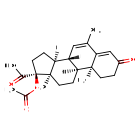
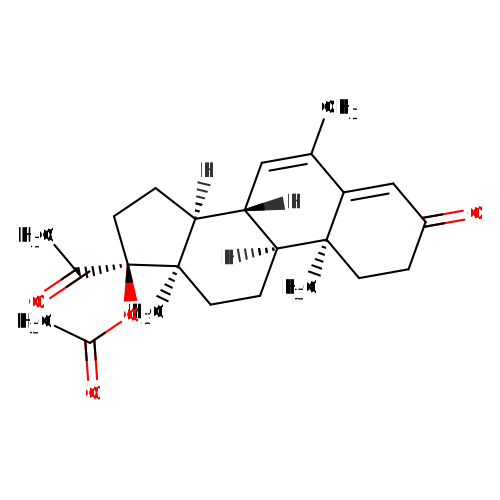
Structure for Megestrol acetate (DB00351)
- Weight
- Average: 384.516
Monoisotopic: 384.23005951 - Chemical Formula
- C24H32O4
- Synonyms
- 17-Acetoxy-6-methylpregna-4,6-diene-3,20-dione
- 17-Hydroxy-6-methylpregna-4,6-diene-3,20-dione 17-acetate
- 17alpha-Acetoxy-6-dehydro-6-methylprogesterone
- 17alpha-Hydroxy-6-methylpregna-4,6-diene-3,20-dione acetate
- 17α-Acetoxy-6-dehydro-6-methylprogesterone
- 17α-Hydroxy-6-methylpregna-4,6-diene-3,20-dione acetate
- 6-Dehydro-6-methyl-17alpha-acetoxyprogesterone
- 6-Dehydro-6-methyl-17α-acetoxyprogesterone
- 6-Methyl-17alpha-acetoxypregna-4,6-diene-3,20-dione
- 6-Methyl-17alpha-hydroxy-delta(sup 6)-progesterone acetate
- 6-Methyl-17α-acetoxypregna-4,6-diene-3,20-dione
- 6-Methyl-17α-hydroxy-delta(sup 6)-progesterone acetate
- 6-Methyl-6-dehydro-17alpha-acetoxyprogesterone
- 6-Methyl-6-dehydro-17α-acetoxyprogesterone
- 6-Methyl-delta(sup 4,6)-pregnadien-17alpha-ol-3,20-dione acetate
- 6-Methyl-delta(sup 4,6)-pregnadien-17α-ol-3,20-dione acetate
- 6-Methyl-delta(sup 6)-dehydro-17alpha-acetoxyprogesterone
- 6-Methyl-delta(sup 6)-dehydro-17α-acetoxyprogesterone
- Megestrol acetate
- MGA
- External IDs
- BDH 1298
- BDH-1298
- NSC-71423
- SC 10363
- SC-10363

Pharmacology
- Indication
For the treatment of anorexia, cachexia, or an unexplained, significant weight loss in patients with a diagnosis of acquired immunodeficiency syndrome (AIDS). Also used for the palliative management of recurrent, inoperable, or metastatic breast cancer, endometrial cancer, and prostate cancer in Canada and some other countries.
 Reduce drug development failure ratesBuild, train, & validate machine-learning modelswith evidence-based and structured datasets.Build, train, & validate predictive machine-learning models with structured datasets.
- Associated Conditions
Indication Type Indication Combined Product Details Approval Level Age Group Patient Characteristics Dose Form Treatment of Anorexia •••••••••••• •••••••••• Treatment of Cachexia ••• ••••• •••••••••• Treatment of Cachexia •••••••••••• •••••••••• Treatment of Inoperable carcinoma of breast •••••••••••• •••••• Treatment of Inoperable endometrial carcinoma •••••••••••• •••••• - Associated Therapies
- Contraindications & Blackbox Warnings
 Prevent Adverse Drug Events TodayTap into our Clinical API for life-saving information on contraindications & blackbox warnings, population restrictions, harmful risks, & more.Avoid life-threatening adverse drug events with our Clinical API
- Pharmacodynamics
Megestrol is a synthetic progestin and has the same physiologic effects as natural progesterone. These effects include induction of secretory changes in the endometrium, increase in basal body temperature, pituitary inhibition, and production of withdrawal bleeding in the presence of estrogen. Mestrogel has slight glucocorticoid activity and very slight mineralocorticoid activity. This drug has no estrogenic, androgenic, or anabolic activity. The precise mechanism of megestrol’s antianorexic and anticachetic effects is unknown. Initially developed as a contraceptive, it was first evaluated in breast cancer treatment in 1967.
- Mechanism of action
The precise mechanism by which megestrol acetate produces effects in anorexia and cachexia is unknown at the present time, but its progestin antitumour activity may involve suppression of luteinizing hormone by inhibition of pituitary function. Studies also suggest that the megestrol's weight gain effect is related to its appetite-stimulant or metabolic effects rather than its glucocorticoid-like effects or the production of edema. It has also been suggested that megestrol may alter metabolic pathyways via interferences with the production or action of mediators such as cachectin, a hormone that inhibits adipocyte lipogenic enzymes.
Target Actions Organism AProgesterone receptor agonistHumans UGlucocorticoid receptor agonistHumans - Absorption
Variable, but well absorbed orally.
- Volume of distribution
Not Available
- Protein binding
Not Available
- Metabolism
Primarily hepatic. Megestrol metabolites which were identified in urine constituted 5% to 8% of the dose administered. Respiratory excretion as labeled carbon dioxide and fat storage may have accounted for at least part of the radioactivity not found in urine and feces. No active metabolites have been identified.
- Route of elimination
The major route of drug elimination in humans is urine. Respiratory excretion as labeled carbon dioxide and fat storage may have accounted for at least part of the radioactivity not found in urine and feces.
- Half-life
34 hours
- Clearance
Not Available
- Adverse Effects
 Improve decision support & research outcomesWith structured adverse effects data, including: blackbox warnings, adverse reactions, warning & precautions, & incidence rates. View sample adverse effects data in our new Data Library!Improve decision support & research outcomes with our structured adverse effects data.
- Toxicity
No serious unexpected side effects have resulted from studies involving megestrol acetate oral suspension administered in dosages as high as 1200 mg/day. Treatment with megestrol acetate, an orexigenic agent, has also resulted in iatrogenic adrenal suppression. The mechanism is presumably related to the glucocorticoid properties of megestrol acetate [PMID: 12872362].
- Pathways
- Not Available
- Pharmacogenomic Effects/ADRs
- Not Available
Interactions
- Drug Interactions
- This information should not be interpreted without the help of a healthcare provider. If you believe you are experiencing an interaction, contact a healthcare provider immediately. The absence of an interaction does not necessarily mean no interactions exist.
Drug Interaction Integrate drug-drug
interactions in your softwareAbacavir Megestrol acetate may decrease the excretion rate of Abacavir which could result in a higher serum level. Abametapir The serum concentration of Megestrol acetate can be increased when it is combined with Abametapir. Abciximab The risk or severity of adverse effects can be increased when Megestrol acetate is combined with Abciximab. Acarbose The therapeutic efficacy of Acarbose can be decreased when used in combination with Megestrol acetate. Aceclofenac Aceclofenac may decrease the excretion rate of Megestrol acetate which could result in a higher serum level. - Food Interactions
- Take with food.
Products
 Drug product information from 10+ global regionsOur datasets provide approved product information including:dosage, form, labeller, route of administration, and marketing period.Access drug product information from over 10 global regions.
- Product Images
- International/Other Brands
- Maygace / Megestat / Megestil / Megestin
- Brand Name Prescription Products
Name Dosage Strength Route Labeller Marketing Start Marketing End Region Image Linmegestrol - Tab 160mg Tablet 160 mg Oral Linson Pharma Co. 1995-12-31 2006-05-29 Canada 
Linmegestrol - Tab 40mg Tablet 40 mg Oral Linson Pharma Co. 1995-12-31 2004-08-05 Canada Megace Tablet 40 mg/1 Oral E.R. Squibb & Sons, L.L.C. 2005-01-01 2006-08-31 US 
Megace Tablet 160 mg Oral Bristol Myers Squibb 1987-12-31 2009-03-09 Canada Megace Suspension 40 mg/1mL Oral E.R. Squibb & Sons, L.L.C. 2009-06-01 2019-03-31 US - Generic Prescription Products
Name Dosage Strength Route Labeller Marketing Start Marketing End Region Image Apo-megestrol Tablet 160 mg Oral Apotex Corporation Not applicable Not applicable Canada Apo-megestrol Tablet 40 mg Oral Apotex Corporation Not applicable Not applicable Canada Megestol Suspension 40 mg/1mL Oral Stat Rx USA 2002-02-15 Not applicable US Megestrol Acetate Tablet 20 mg/1 Oral Cardinal Health 2011-05-13 2016-09-30 US Megestrol Acetate Suspension 40 mg/1mL Oral Rxchange Co 2001-07-25 Not applicable US


Categories
- ATC Codes
- G03FB04 — Megestrol and estrogen
- G03FB — Progestogens and estrogens, sequential preparations
- G03F — PROGESTOGENS AND ESTROGENS IN COMBINATION
- G03 — SEX HORMONES AND MODULATORS OF THE GENITAL SYSTEM
- G — GENITO URINARY SYSTEM AND SEX HORMONES
- G03DB — Pregnadien derivatives
- G03D — PROGESTOGENS
- G03 — SEX HORMONES AND MODULATORS OF THE GENITAL SYSTEM
- G — GENITO URINARY SYSTEM AND SEX HORMONES
- G03FA — Progestogens and estrogens, fixed combinations
- G03F — PROGESTOGENS AND ESTROGENS IN COMBINATION
- G03 — SEX HORMONES AND MODULATORS OF THE GENITAL SYSTEM
- G — GENITO URINARY SYSTEM AND SEX HORMONES
- G03AC — Progestogens
- G03A — HORMONAL CONTRACEPTIVES FOR SYSTEMIC USE
- G03 — SEX HORMONES AND MODULATORS OF THE GENITAL SYSTEM
- G — GENITO URINARY SYSTEM AND SEX HORMONES
- L02AB — Progestogens
- L02A — HORMONES AND RELATED AGENTS
- L02 — ENDOCRINE THERAPY
- L — ANTINEOPLASTIC AND IMMUNOMODULATING AGENTS
- G03AA — Progestogens and estrogens, fixed combinations
- G03A — HORMONAL CONTRACEPTIVES FOR SYSTEMIC USE
- G03 — SEX HORMONES AND MODULATORS OF THE GENITAL SYSTEM
- G — GENITO URINARY SYSTEM AND SEX HORMONES
- Drug Categories
- Adrenal Cortex Hormones
- Antineoplastic Agents
- Antineoplastic Agents, Hormonal
- Antineoplastic and Immunomodulating Agents
- Appetite Stimulants
- Central Nervous System Agents
- Central Nervous System Stimulants
- Combination Contraceptives (with Estrogen and derivatives)
- Contraceptive Agents, Female
- Contraceptive Agents, Hormonal
- Contraceptives, Oral
- Contraceptives, Oral, Hormonal
- Contraceptives, Oral, Synthetic
- Cytochrome P-450 CYP3A Substrates
- Cytochrome P-450 CYP3A4 Substrates
- Cytochrome P-450 Substrates
- Drugs that are Mainly Renally Excreted
- Endocrine Therapy
- Fused-Ring Compounds
- Genito Urinary System and Sex Hormones
- Hormonal Contraceptives for Systemic Use
- Hormones and Related Agents
- Hyperglycemia-Associated Agents
- Megestrol
- P-glycoprotein inhibitors
- Pregnadien Derivatives
- Pregnadienes
- Pregnanes
- Progestin Contraceptives
- Progestins
- Progestogens and Estrogens, Sequential Preparations
- Reproductive Control Agents
- Sex Hormones and Modulators of the Genital System
- Steroids
- Chemical TaxonomyProvided by Classyfire
- Description
- This compound belongs to the class of organic compounds known as gluco/mineralocorticoids, progestogins and derivatives. These are steroids with a structure based on a hydroxylated prostane moiety.
- Kingdom
- Organic compounds
- Super Class
- Lipids and lipid-like molecules
- Class
- Steroids and steroid derivatives
- Sub Class
- Pregnane steroids
- Direct Parent
- Gluco/mineralocorticoids, progestogins and derivatives
- Alternative Parents
- Steroid esters / 20-oxosteroids / 3-oxosteroids / Cyclohexenones / Alpha-acyloxy ketones / Carboxylic acid esters / Monocarboxylic acids and derivatives / Organic oxides / Hydrocarbon derivatives
- Substituents
- 20-oxosteroid / 3-oxosteroid / Aliphatic homopolycyclic compound / Alpha-acyloxy ketone / Carbonyl group / Carboxylic acid derivative / Carboxylic acid ester / Cyclic ketone / Cyclohexenone / Hydrocarbon derivative
- Molecular Framework
- Aliphatic homopolycyclic compounds
- External Descriptors
- C21 steroids (gluco/mineralocorticoids, progestogens) and derivatives (C08151) / C21 steroids (gluco/mineralocorticoids, progestogins) and derivatives (LMST02030118)
- Affected organisms
- Humans and other mammals
Chemical Identifiers
- UNII
- TJ2M0FR8ES
- CAS number
- 595-33-5
- InChI Key
- RQZAXGRLVPAYTJ-GQFGMJRRSA-N
- InChI
- InChI=1S/C24H32O4/c1-14-12-18-19(22(4)9-6-17(27)13-21(14)22)7-10-23(5)20(18)8-11-24(23,15(2)25)28-16(3)26/h12-13,18-20H,6-11H2,1-5H3/t18-,19+,20+,22-,23+,24+/m1/s1
- IUPAC Name
- (1S,2R,10R,11S,14R,15S)-14-acetyl-2,8,15-trimethyl-5-oxotetracyclo[8.7.0.0²,⁷.0¹¹,¹⁵]heptadeca-6,8-dien-14-yl acetate
- SMILES
- [H][C@@]12CC[C@](OC(C)=O)(C(C)=O)[C@@]1(C)CC[C@@]1([H])[C@@]2([H])C=C(C)C2=CC(=O)CC[C@]12C
References
- Synthesis Reference
Klaus ANNEN, Thomas Linz, Karl-Heinz Neff, Rolf Bohlmann, Henry Laurent, "PROCESS FOR PREPARING 17ALPHA-ACETOXY-6-METHYLENEPREGN-4-ENE-3,20-DIONE, MEDROXYPROGESTERONE ACETATE AND MEGESTROL ACETATE." U.S. Patent US20090012321, issued January 08, 2009.
US20090012321- General References
- Berenstein EG, Ortiz Z: Megestrol acetate for the treatment of anorexia-cachexia syndrome. Cochrane Database Syst Rev. 2005 Apr 18;(2):CD004310. [Article]
- Pascual Lopez A, Roque i Figuls M, Urrutia Cuchi G, Berenstein EG, Almenar Pasies B, Balcells Alegre M, Herdman M: Systematic review of megestrol acetate in the treatment of anorexia-cachexia syndrome. J Pain Symptom Manage. 2004 Apr;27(4):360-9. [Article]
- Rao GG, Miller DS: Hormonal therapy in epithelial ovarian cancer. Expert Rev Anticancer Ther. 2006 Jan;6(1):43-7. [Article]
- Schindler AE, Campagnoli C, Druckmann R, Huber J, Pasqualini JR, Schweppe KW, Thijssen JH: Classification and pharmacology of progestins. Maturitas. 2008 Sep-Oct;61(1-2):171-80. [Article]
- Orme LM, Bond JD, Humphrey MS, Zacharin MR, Downie PA, Jamsen KM, Mitchell SL, Robinson JM, Grapsas NA, Ashley DM: Megestrol acetate in pediatric oncology patients may lead to severe, symptomatic adrenal suppression. Cancer. 2003 Jul 15;98(2):397-405. [Article]
- External Links
- KEGG Drug
- D00952
- KEGG Compound
- C08151
- PubChem Compound
- 11683
- PubChem Substance
- 46505827
- ChemSpider
- 11192
- BindingDB
- 50238674
- 29451
- ChEBI
- 6723
- ChEMBL
- CHEMBL1201139
- ZINC
- ZINC000004097467
- Therapeutic Targets Database
- DAP000861
- PharmGKB
- PA450351
- RxList
- RxList Drug Page
- Drugs.com
- Drugs.com Drug Page
- Wikipedia
- Megestrol
- FDA label
- Download (278 KB)
- MSDS
- Download (71.9 KB)
Clinical Trials
- Clinical Trials
Phase Status Purpose Conditions Count 4 Completed Other Cognitive Impairment (CI) 1 4 Completed Treatment Anorexia / Cachexia / Human Immunodeficiency Virus (HIV) Infections 1 4 Completed Treatment Idiopathic Precocious Puberty 1 4 Recruiting Treatment Feeding Behaviors / Feeding Disorder of Infancy or Early Childhood 1 4 Unknown Status Treatment Cancer, Therapy-Related 1
Pharmacoeconomics
- Manufacturers
- Bristol myers squibb
- Par pharmaceutical inc
- Apotex inc richmond hill
- Roxane laboratories inc
- Teva pharmaceuticals usa
- Wockhardt eu operations (swiss) ag
- Barr laboratories inc
- Teva pharmaceuticals usa inc
- Usl pharma inc
- Packagers
- Advanced Pharmaceutical Services Inc.
- Apotex Inc.
- A-S Medication Solutions LLC
- Atlantic Biologicals Corporation
- Barr Pharmaceuticals
- Bristol-Myers Squibb Co.
- Cardinal Health
- Carlisle Laboratories Inc.
- Dept Health Central Pharmacy
- Goldline Laboratories Inc.
- Major Pharmaceuticals
- Martec USA LLC
- Mckesson Corp.
- Mead Johnson and Co.
- Murfreesboro Pharmaceutical Nursing Supply
- Mylan
- Nucare Pharmaceuticals Inc.
- Par Pharmaceuticals
- Pharmaceutical Association
- Pharmaceutical Utilization Management Program VA Inc.
- Pharmachemie BV
- Physicians Total Care Inc.
- Precision Dose Inc.
- Prepak Systems Inc.
- Professional Co.
- Qualitest
- Resource Optimization and Innovation LLC
- Roxane Labs
- Sandhills Packaging Inc.
- Southwood Pharmaceuticals
- Stat Rx Usa
- Teva Pharmaceutical Industries Ltd.
- Tya Pharmaceuticals
- UDL Laboratories
- United Research Laboratories Inc.
- Vangard Labs Inc.
- Vistapharm Inc.
- Wockhardt Ltd.
- Dosage Forms
Form Route Strength Suspension Oral 40 mg/ml Tablet Oral 20 mg/1 Tablet Oral 40 mg/1 Suspension Oral 125 mg/1mL Suspension Oral 40 mg / mL Granule, for suspension Oral 160 MG Suspension Oral 40 mg/1mL Suspension Oral 400 mg/10mL Suspension Oral 625 mg/5mL Suspension Oral 800 mg/20mL Suspension Oral Tablet Oral Tablet Oral 160 mg Tablet Oral 40 mg - Prices
Unit description Cost Unit Megestrol Acetate 40 mg/ml Suspension 480ml Bottle 297.92USD bottle Megestrol Acetate 40 mg/ml Suspension 240ml Bottle 149.71USD bottle Megestrol acetate powder 30.6USD g Megestrol 40 mg tablet 1.17USD tablet Megestrol Acetate 40 mg tablet 1.15USD tablet Megestrol Acetate 20 mg tablet 0.72USD tablet Megace 40 mg/ml oral suspension 0.71USD ml Megestrol 20 mg tablet 0.65USD tablet DrugBank does not sell nor buy drugs. Pricing information is supplied for informational purposes only.- Patents
Patent Number Pediatric Extension Approved Expires (estimated) Region US5145684 No 1992-09-08 2011-01-25 US US7101576 No 2006-09-05 2024-04-22 US US9101540 No 2015-08-11 2024-04-22 US US9101549 No 2015-08-11 2024-04-22 US US9107827 No 2015-08-18 2024-04-22 US US9040088 No 2015-05-26 2024-04-22 US US6592903 No 2003-07-15 2020-09-21 US
Properties
- State
- Solid
- Experimental Properties
Property Value Source melting point (°C) 218.0-220.0 °C Not Available water solubility 2 µg/mL (at 37 °C for the acetate salt) Not Available logP 3.2 Not Available - Predicted Properties
Property Value Source Water Solubility 0.00336 mg/mL ALOGPS logP 3.71 ALOGPS logP 3.72 Chemaxon logS -5.1 ALOGPS pKa (Strongest Acidic) 17.83 Chemaxon pKa (Strongest Basic) -4.9 Chemaxon Physiological Charge 0 Chemaxon Hydrogen Acceptor Count 3 Chemaxon Hydrogen Donor Count 0 Chemaxon Polar Surface Area 60.44 Å2 Chemaxon Rotatable Bond Count 3 Chemaxon Refractivity 108.66 m3·mol-1 Chemaxon Polarizability 43.51 Å3 Chemaxon Number of Rings 4 Chemaxon Bioavailability 1 Chemaxon Rule of Five Yes Chemaxon Ghose Filter Yes Chemaxon Veber's Rule No Chemaxon MDDR-like Rule No Chemaxon - Predicted ADMET Features
Property Value Probability Human Intestinal Absorption + 0.9959 Blood Brain Barrier + 0.9617 Caco-2 permeable + 0.651 P-glycoprotein substrate Substrate 0.6107 P-glycoprotein inhibitor I Inhibitor 0.9149 P-glycoprotein inhibitor II Inhibitor 0.7016 Renal organic cation transporter Non-inhibitor 0.7753 CYP450 2C9 substrate Non-substrate 0.8642 CYP450 2D6 substrate Non-substrate 0.908 CYP450 3A4 substrate Substrate 0.7744 CYP450 1A2 substrate Non-inhibitor 0.9045 CYP450 2C9 inhibitor Non-inhibitor 0.8907 CYP450 2D6 inhibitor Non-inhibitor 0.9532 CYP450 2C19 inhibitor Non-inhibitor 0.9025 CYP450 3A4 inhibitor Non-inhibitor 0.8095 CYP450 inhibitory promiscuity Low CYP Inhibitory Promiscuity 0.899 Ames test Non AMES toxic 0.9775 Carcinogenicity Non-carcinogens 0.9273 Biodegradation Not ready biodegradable 0.9354 Rat acute toxicity 1.8121 LD50, mol/kg Not applicable hERG inhibition (predictor I) Weak inhibitor 0.9429 hERG inhibition (predictor II) Non-inhibitor 0.7761
Spectra
- Mass Spec (NIST)
- Not Available
- Spectra
- Chromatographic Properties
Collision Cross Sections (CCS)
Adduct CCS Value (Å2) Source type Source [M-H]- 206.0675871 predictedDarkChem Lite v0.1.0 [M-H]- 205.6765871 predictedDarkChem Lite v0.1.0 [M-H]- 194.49805 predictedDeepCCS 1.0 (2019) [M+H]+ 206.1705871 predictedDarkChem Lite v0.1.0 [M+H]+ 206.5095871 predictedDarkChem Lite v0.1.0 [M+H]+ 196.39345 predictedDeepCCS 1.0 (2019) [M+Na]+ 206.2695871 predictedDarkChem Lite v0.1.0 [M+Na]+ 202.66893 predictedDeepCCS 1.0 (2019)
Targets

- Kind
- Protein
- Organism
- Humans
- Pharmacological action
- Yes
- Actions
- Agonist
- General Function
- Zinc ion binding
- Specific Function
- The steroid hormones and their receptors are involved in the regulation of eukaryotic gene expression and affect cellular proliferation and differentiation in target tissues. Progesterone receptor ...
- Gene Name
- PGR
- Uniprot ID
- P06401
- Uniprot Name
- Progesterone receptor
- Molecular Weight
- 98979.96 Da
References
- Vadivelu S, Sharer L, Schulder M: Regression of multiple intracranial meningiomas after cessation of long-term progesterone agonist therapy. J Neurosurg. 2010 May;112(5):920-4. doi: 10.3171/2009.8.JNS09201. [Article]
- Mokbel K: Focus on anastrozole and breast cancer. Curr Med Res Opin. 2003;19(8):683-8. [Article]
- Wentling GK, Sevin BU, Geiger XJ, Bridges MD: Benign metastasizing leiomyoma responsive to megestrol: case report and review of the literature. Int J Gynecol Cancer. 2005 Nov-Dec;15(6):1213-7. [Article]
- Gruber T, Dare AO, Balos LL, Lele S, Fenstermaker RA: Multiple meningiomas arising during long-term therapy with the progesterone agonist megestrol acetate. Case report. J Neurosurg. 2004 Feb;100(2):328-31. [Article]
- Schindler AE, Campagnoli C, Druckmann R, Huber J, Pasqualini JR, Schweppe KW, Thijssen JH: Classification and pharmacology of progestins. Maturitas. 2008 Sep-Oct;61(1-2):171-80. [Article]
- Wermers RA, Hurley DL, Kearns AE: Osteoporosis associated with megestrol acetate. Mayo Clin Proc. 2004 Dec;79(12):1557-61. [Article]
- Wiedemann K, Hirschmann M, Knaudt K, Rupprecht R, Seier FE, Holsboer F: Sleep endocrine effects of megestrol acetate in healthy men. J Neuroendocrinol. 1998 Sep;10(9):719-27. [Article]
- Lamberts SW, Uitterlinden P, Bons EG, Verleun T: Comparison of the actions of RU 38486 and megestrol acetate in the model of a transplantable adrenocorticotropin- and prolactin-secreting rat pituitary tumor. Cancer Res. 1985 Mar;45(3):1015-9. [Article]
- Chen X, Ji ZL, Chen YZ: TTD: Therapeutic Target Database. Nucleic Acids Res. 2002 Jan 1;30(1):412-5. [Article]
- Kind
- Protein
- Organism
- Humans
- Pharmacological action
- Unknown
- Actions
- Agonist
- General Function
- Zinc ion binding
- Specific Function
- Receptor for glucocorticoids (GC). Has a dual mode of action: as a transcription factor that binds to glucocorticoid response elements (GRE), both for nuclear and mitochondrial DNA, and as a modula...
- Gene Name
- NR3C1
- Uniprot ID
- P04150
- Uniprot Name
- Glucocorticoid receptor
- Molecular Weight
- 85658.57 Da
References
- Wermers RA, Hurley DL, Kearns AE: Osteoporosis associated with megestrol acetate. Mayo Clin Proc. 2004 Dec;79(12):1557-61. [Article]
- Gonzalez Villarroel P, Fernandez Perez I, Paramo C, Gentil Gonzalez M, Carnero Lopez B, Vazquez Tunas ML, Carrasco Alvarez JA: Megestrol acetate-induced adrenal insufficiency. Clin Transl Oncol. 2008 Apr;10(4):235-7. [Article]
- Wiedemann K, Hirschmann M, Knaudt K, Rupprecht R, Seier FE, Holsboer F: Sleep endocrine effects of megestrol acetate in healthy men. J Neuroendocrinol. 1998 Sep;10(9):719-27. [Article]
- Chao Y, Chan WK, Wang SS, Lai KH, Chi CW, Lin CY, Chan A, Whang-Peng J, Lui WY, Lee SD: Phase II study of megestrol acetate in the treatment of hepatocellular carcinoma. J Gastroenterol Hepatol. 1997 Apr;12(4):277-81. [Article]
- Lamberts SW, Uitterlinden P, Bons EG, Verleun T: Comparison of the actions of RU 38486 and megestrol acetate in the model of a transplantable adrenocorticotropin- and prolactin-secreting rat pituitary tumor. Cancer Res. 1985 Mar;45(3):1015-9. [Article]
- Kontula K, Paavonen T, Luukkainen T, Andersson LC: Binding of progestins to the glucocorticoid receptor. Correlation to their glucocorticoid-like effects on in vitro functions of human mononuclear leukocytes. Biochem Pharmacol. 1983 May 1;32(9):1511-8. [Article]
Enzymes
- Kind
- Protein
- Organism
- Humans
- Pharmacological action
- No
- Actions
- Substrate
- General Function
- Vitamin d3 25-hydroxylase activity
- Specific Function
- Cytochromes P450 are a group of heme-thiolate monooxygenases. In liver microsomes, this enzyme is involved in an NADPH-dependent electron transport pathway. It performs a variety of oxidation react...
- Gene Name
- CYP3A4
- Uniprot ID
- P08684
- Uniprot Name
- Cytochrome P450 3A4
- Molecular Weight
- 57342.67 Da
References
- House L, Seminerio MJ, Mirkov S, Ramirez J, Skor M, Sachleben JR, Isikbay M, Singhal H, Greene GL, Vander Griend D, Conzen SD, Ratain MJ: Metabolism of megestrol acetate in vitro and the role of oxidative metabolites. Xenobiotica. 2018 Oct;48(10):973-983. doi: 10.1080/00498254.2017.1386335. Epub 2017 Nov 10. [Article]
Transporters
- Kind
- Protein
- Organism
- Humans
- Pharmacological action
- Unknown
- Actions
- Inhibitor
- General Function
- Xenobiotic-transporting atpase activity
- Specific Function
- Energy-dependent efflux pump responsible for decreased drug accumulation in multidrug-resistant cells.
- Gene Name
- ABCB1
- Uniprot ID
- P08183
- Uniprot Name
- Multidrug resistance protein 1
- Molecular Weight
- 141477.255 Da
References
- Wang L, Yang CP, Horwitz SB, Trail PA, Casazza AM: Reversal of the human and murine multidrug-resistance phenotype with megestrol acetate. Cancer Chemother Pharmacol. 1994;34(2):96-102. [Article]

Drug created at June 13, 2005 13:24 / Updated at April 27, 2024 09:44