Identification
- Summary
Pentostatin is an adenosine deaminase inhibitor used to treat hairy cell leukemia.
- Brand Names
- Nipent
- Generic Name
- Pentostatin
- DrugBank Accession Number
- DB00552
- Background
A potent inhibitor of adenosine deaminase. The drug is effective in the treatment of many lymphoproliferative malignancies, particularly hairy-cell leukemia. It is also synergistic with some other antineoplastic agents and has immunosuppressive activity.
- Type
- Small Molecule
- Groups
- Approved, Investigational
- Structure
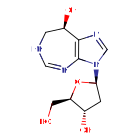
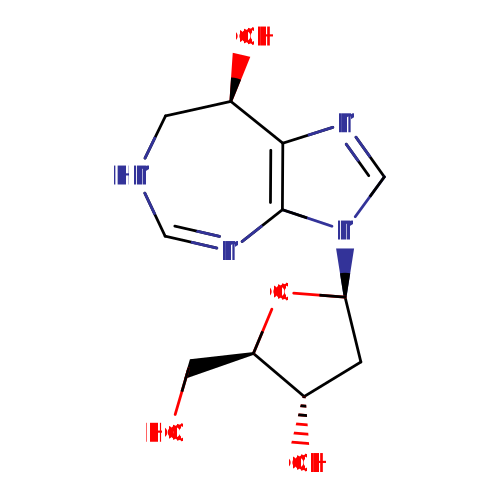
Structure for Pentostatin (DB00552)
- Weight
- Average: 268.2691
Monoisotopic: 268.11715502 - Chemical Formula
- C11H16N4O4
- Synonyms
- Co-vidarabine
- Pentostatin
- Pentostatina
- Pentostatine
- Pentostatinum
- External IDs
- CI 825
- CI-825
- NSC 218321
- NSC-218321
- PD 81565
- PD-81565
- PD-ADI
- YK-176

Pharmacology
- Indication
For the treatment of hairy cell leukaemia refractory to alpha interferon.
 Reduce drug development failure ratesBuild, train, & validate machine-learning modelswith evidence-based and structured datasets.Build, train, & validate predictive machine-learning models with structured datasets.
- Associated Conditions
Indication Type Indication Combined Product Details Approval Level Age Group Patient Characteristics Dose Form Treatment of Acute graft versus host disease ••• ••••• Treatment of Chronic lymphocytic leukemia ••• ••••• Treatment of Hairy cell leukaemia •••••••••••• Treatment of Mycosis fungoides ••• ••••• Treatment of Sezary syndrome ••• ••••• - Contraindications & Blackbox Warnings
 Prevent Adverse Drug Events TodayTap into our Clinical API for life-saving information on contraindications & blackbox warnings, population restrictions, harmful risks, & more.Avoid life-threatening adverse drug events with our Clinical API
- Pharmacodynamics
Pentostatin is an antineoplastic anti-metabolite used in the treatment of several forms of leukemia including acute nonlymphocytic leukemia and hairy cell leukemia. Anti-metabolites masquerade as purine or pyrimidine - which become the building blocks of DNA. They prevent these substances becoming incorporated in to DNA during the "S" phase (of the cell cycle), stopping normal development and division. It is a 6-thiopurine analogue of the naturally occurring purine bases hypoxanthine and guanine. Intracellular activation results in incorporation into DNA as a false purine base. An additional cytotoxic effect is related to its incorporation into RNA. Cytotoxicity is cell cycle phase-specific (S-phase).
- Mechanism of action
Pentostatin is a potent transition state inhibitor of adenosine deaminase (ADA), the greatest activity of which is found in cells of the lymphoid system. T-cells have higher ADA activity than B-cells, and T-cell malignancies have higher activity than B-cell malignancies. The cytotoxicity that results from prevention of catabolism of adenosine or deoxyadenosine is thought to be due to elevated intracellular levels of dATP, which can block DNA synthesis through inhibition of ribonucleotide reductase. Intracellular activation results in incorporation into DNA as a false purine base. An additional cytotoxic effect is related to its incorporation into RNA. Cytotoxicity is cell cycle phase-specific (S-phase).
Target Actions Organism AAdenosine deaminase inhibitorHumans - Absorption
Not absorbed orally, crosses blood brain barrier.
- Volume of distribution
Not Available
- Protein binding
4%
- Metabolism
Primarily hepatic, but only small amounts are metabolized.
- Route of elimination
In man, following a single dose of 4 mg/m2 of pentostatin infused over 5 minutes, approximately 90% of the dose was excreted in the urine as unchanged pentostatin and/or metabolites as measured by adenosine deaminase inhibitory activity.
- Half-life
5.7 hours (with a range between 2.6 and 16 hrs)
- Clearance
- 68 mL/min/m2
- Adverse Effects
 Improve decision support & research outcomesWith structured adverse effects data, including: blackbox warnings, adverse reactions, warning & precautions, & incidence rates. View sample adverse effects data in our new Data Library!Improve decision support & research outcomes with our structured adverse effects data.
- Toxicity
LD50=128 mg/kg (mouse), side effects include lethargy, rash, fatigue, nausea and myelosuppression.
- Pathways
- Not Available
- Pharmacogenomic Effects/ADRs
- Not Available
Interactions
- Drug Interactions
- This information should not be interpreted without the help of a healthcare provider. If you believe you are experiencing an interaction, contact a healthcare provider immediately. The absence of an interaction does not necessarily mean no interactions exist.
Drug Interaction Integrate drug-drug
interactions in your softwareAbacavir Abacavir may decrease the excretion rate of Pentostatin which could result in a higher serum level. Abatacept The risk or severity of adverse effects can be increased when Pentostatin is combined with Abatacept. Abciximab The risk or severity of bleeding can be increased when Abciximab is combined with Pentostatin. Aceclofenac Aceclofenac may decrease the excretion rate of Pentostatin which could result in a higher serum level. Acemetacin Acemetacin may decrease the excretion rate of Pentostatin which could result in a higher serum level. - Food Interactions
- No interactions found.
Products
 Drug product information from 10+ global regionsOur datasets provide approved product information including:dosage, form, labeller, route of administration, and marketing period.Access drug product information from over 10 global regions.
- Brand Name Prescription Products
Name Dosage Strength Route Labeller Marketing Start Marketing End Region Image Nipent Injection, powder, lyophilized, for solution 2 mg/1mL Intravenous Hospira, Inc. 2007-08-15 Not applicable US 
Nipent Pws 10mg/vial Powder, for solution 10 mg / vial Intravenous Parke Davis Division, Warner Lambert Canada Inc. 1993-12-31 1997-08-25 Canada 
- Generic Prescription Products
Name Dosage Strength Route Labeller Marketing Start Marketing End Region Image Pentostatin Injection, powder, lyophilized, for solution 2 mg/1mL Intravenous Mylan Institutional LLC 2014-09-19 Not applicable US Pentostatin Injection, powder, lyophilized, for solution 10 mg/5mL Intravenous Bedford Pharmaceuticals 2007-08-13 2012-08-31 US
Categories
- ATC Codes
- L01XX08 — Pentostatin
- Drug Categories
- Adenosine Deaminase Inhibitors
- Antineoplastic Agents
- Antineoplastic and Immunomodulating Agents
- Cancer immunotherapy
- Cardiotoxic antineoplastic agents
- Coformycin
- Deoxyribonucleosides
- Drugs that are Mainly Renally Excreted
- Drugs that are Mainly Renally Excreted with a Narrow Therapeutic Index
- Enzyme Inhibitors
- Formycins
- Immunosuppressive Agents
- Immunotherapy
- Myelosuppressive Agents
- Narrow Therapeutic Index Drugs
- Nucleic Acid Synthesis Inhibitors
- Nucleic Acids, Nucleotides, and Nucleosides
- Nucleoside Metabolic Inhibitor
- Nucleosides
- Pyrimidine Nucleosides
- Pyrimidines
- Chemical TaxonomyProvided by Classyfire
- Description
- This compound belongs to the class of organic compounds known as imidazodiazepines. These are organic compounds containing an imidazole ring fused to a diazepine ring. Imidazole is 5-membered ring consisting of three carbon atoms, and two nitrogen centers at the 1- and 3-positions. Diazepine is a 7-membered ring consisting of five carbon and two nitrogen atoms.
- Kingdom
- Organic compounds
- Super Class
- Organoheterocyclic compounds
- Class
- Imidazodiazepines
- Sub Class
- Not Available
- Direct Parent
- Imidazodiazepines
- Alternative Parents
- 1,3-diazepines / N-substituted imidazoles / Tetrahydrofurans / Heteroaromatic compounds / Secondary alcohols / Propargyl-type 1,3-dipolar organic compounds / Oxacyclic compounds / Formamidines / Carboxamidines / Azacyclic compounds show 3 more
- Substituents
- Alcohol / Amidine / Aromatic heteropolycyclic compound / Azacycle / Azole / Carboxylic acid amidine / Formamidine / Heteroaromatic compound / Hydrocarbon derivative / Imidazo-meta-diazepine show 15 more
- Molecular Framework
- Aromatic heteropolycyclic compounds
- External Descriptors
- Not Available
- Affected organisms
- Humans and other mammals
- Mycobacterium tuberculosis
- Pseudomonas aeruginosa
- Leptospira interrogans
- Borrelia burgdorferi
- Vibrio cholerae
- Escherichia coli
- Salmonella typhi
- Staphylococcus aureus
- Serratia marcescens
- Proteus vulgaris
- Klebsiella
- Shigella
Chemical Identifiers
- UNII
- 395575MZO7
- CAS number
- 53910-25-1
- InChI Key
- FPVKHBSQESCIEP-JQCXWYLXSA-N
- InChI
- InChI=1S/C11H16N4O4/c16-3-8-6(17)1-9(19-8)15-5-14-10-7(18)2-12-4-13-11(10)15/h4-9,16-18H,1-3H2,(H,12,13)/t6-,7+,8+,9+/m0/s1
- IUPAC Name
- (8R)-3-[(2R,4S,5R)-4-hydroxy-5-(hydroxymethyl)oxolan-2-yl]-3H,6H,7H,8H-imidazo[4,5-d][1,3]diazepin-8-ol
- SMILES
- OC[C@H]1O[C@H](C[C@@H]1O)N1C=NC2=C1N=CNC[C@H]2O
References
- Synthesis Reference
Nadji Sourena, "Process for the production of pentostatin aglycone and pentostatin." U.S. Patent US20040181052, issued September 16, 2004.
US20040181052- General References
- Not Available
- External Links
- Human Metabolome Database
- HMDB0014692
- KEGG Drug
- D00155
- KEGG Compound
- C02267
- PubChem Compound
- 439693
- PubChem Substance
- 46507116
- ChemSpider
- 388759
- BindingDB
- 22925
- 8011
- ChEBI
- 27834
- ChEMBL
- CHEMBL1580
- ZINC
- ZINC000003806262
- Therapeutic Targets Database
- DAP000566
- PharmGKB
- PA450863
- PDBe Ligand
- DCF
- Drugs.com
- Drugs.com Drug Page
- Wikipedia
- Pentostatin
- PDB Entries
- 1a4l / 2pgr / 6n91 / 6n9m
- MSDS
- Download (56.7 KB)
Clinical Trials
- Clinical Trials
Phase Status Purpose Conditions Count 4 Unknown Status Treatment Chronic Lymphocytic Leukemia 1 3 Completed Treatment Acute Lymphoblastic Leukemia (ALL) / Acute Myeloid Leukemia / Chronic Myeloid Leukemia (CML) / Hodgkins Disease (HD) / Myelodysplastic Syndrome 1 3 Completed Treatment B-Cell Chronic Lymphocytic Leukemia 1 3 Completed Treatment Graft-versus-host Disease (GVHD) 1 2 Active Not Recruiting Treatment Hairy Cell Leukemia (HCL) 1
Pharmacoeconomics
- Manufacturers
- Hospira inc
- Bedford laboratories
- Packagers
- Bedford Labs
- Ben Venue Laboratories Inc.
- Hospira Inc.
- JHP Pharmaceuticals LLC
- SuperGen Inc.
- Dosage Forms
Form Route Strength Tablet, coated Oral 500 mg Injection, powder, lyophilized, for solution Intravenous 2 mg/1mL Powder, for solution Intravenous 10 mg Powder, for solution Intravenous 10 mg / vial Injection, powder, lyophilized, for solution Intravenous 10 mg/5mL - Prices
Unit description Cost Unit Pentostatin 10 mg vial 2280.0USD vial Nipent 10 mg vial 1891.31USD vial DrugBank does not sell nor buy drugs. Pricing information is supplied for informational purposes only.- Patents
- Not Available
Properties
- State
- Solid
- Experimental Properties
Property Value Source melting point (°C) 220 °C PhysProp water solubility 30 mg/mL Not Available logP -1.1 Not Available pKa 5.2 MERCK INDEX (1996) - Predicted Properties
Property Value Source Water Solubility 10.7 mg/mL ALOGPS logP -2 ALOGPS logP -2 Chemaxon logS -1.4 ALOGPS pKa (Strongest Acidic) 13.06 Chemaxon pKa (Strongest Basic) 8.33 Chemaxon Physiological Charge 1 Chemaxon Hydrogen Acceptor Count 7 Chemaxon Hydrogen Donor Count 4 Chemaxon Polar Surface Area 112.13 Å2 Chemaxon Rotatable Bond Count 2 Chemaxon Refractivity 64.98 m3·mol-1 Chemaxon Polarizability 26.34 Å3 Chemaxon Number of Rings 3 Chemaxon Bioavailability 1 Chemaxon Rule of Five Yes Chemaxon Ghose Filter No Chemaxon Veber's Rule No Chemaxon MDDR-like Rule No Chemaxon - Predicted ADMET Features
Property Value Probability Human Intestinal Absorption + 0.8204 Blood Brain Barrier + 0.911 Caco-2 permeable - 0.7031 P-glycoprotein substrate Substrate 0.6194 P-glycoprotein inhibitor I Non-inhibitor 0.8993 P-glycoprotein inhibitor II Non-inhibitor 0.89 Renal organic cation transporter Non-inhibitor 0.8513 CYP450 2C9 substrate Non-substrate 0.7946 CYP450 2D6 substrate Non-substrate 0.7974 CYP450 3A4 substrate Substrate 0.5207 CYP450 1A2 substrate Non-inhibitor 0.8771 CYP450 2C9 inhibitor Non-inhibitor 0.9117 CYP450 2D6 inhibitor Non-inhibitor 0.9211 CYP450 2C19 inhibitor Non-inhibitor 0.8969 CYP450 3A4 inhibitor Non-inhibitor 0.9421 CYP450 inhibitory promiscuity Low CYP Inhibitory Promiscuity 0.9626 Ames test Non AMES toxic 0.7627 Carcinogenicity Non-carcinogens 0.8039 Biodegradation Not ready biodegradable 0.9961 Rat acute toxicity 2.2716 LD50, mol/kg Not applicable hERG inhibition (predictor I) Weak inhibitor 0.987 hERG inhibition (predictor II) Non-inhibitor 0.6424
Spectra
- Mass Spec (NIST)
- Not Available
- Spectra
Spectrum Spectrum Type Splash Key Predicted GC-MS Spectrum - GC-MS Predicted GC-MS splash10-000f-9280000000-53989a5cd0535c5bb1c0 Predicted MS/MS Spectrum - 10V, Positive (Annotated) Predicted LC-MS/MS splash10-0uy0-0940000000-a88656b673e87d4ddcf2 Predicted MS/MS Spectrum - 10V, Negative (Annotated) Predicted LC-MS/MS splash10-014i-0190000000-afde3d1df779eba4994b Predicted MS/MS Spectrum - 20V, Positive (Annotated) Predicted LC-MS/MS splash10-000i-0900000000-14738a737e65dcd87d0f Predicted MS/MS Spectrum - 40V, Positive (Annotated) Predicted LC-MS/MS splash10-0f79-0920000000-7f9e2d4f716b5e306d38 Predicted MS/MS Spectrum - 20V, Negative (Annotated) Predicted LC-MS/MS splash10-00lr-0930000000-95e87132ba6fb03553fd Predicted MS/MS Spectrum - 40V, Negative (Annotated) Predicted LC-MS/MS splash10-0a59-0900000000-51b08dc9c03d76205489 Predicted 1H NMR Spectrum 1D NMR Not Applicable Predicted 13C NMR Spectrum 1D NMR Not Applicable - Chromatographic Properties
Collision Cross Sections (CCS)
Adduct CCS Value (Å2) Source type Source [M-H]- 168.7090928 predictedDarkChem Lite v0.1.0 [M-H]- 169.0596928 predictedDarkChem Lite v0.1.0 [M-H]- 168.8442928 predictedDarkChem Lite v0.1.0 [M-H]- 151.88477 predictedDeepCCS 1.0 (2019) [M+H]+ 169.2249928 predictedDarkChem Lite v0.1.0 [M+H]+ 169.3066928 predictedDarkChem Lite v0.1.0 [M+H]+ 169.2039928 predictedDarkChem Lite v0.1.0 [M+H]+ 154.28032 predictedDeepCCS 1.0 (2019) [M+Na]+ 169.1211928 predictedDarkChem Lite v0.1.0 [M+Na]+ 168.9916928 predictedDarkChem Lite v0.1.0 [M+Na]+ 168.8924928 predictedDarkChem Lite v0.1.0 [M+Na]+ 160.62367 predictedDeepCCS 1.0 (2019)
Targets

- Kind
- Protein
- Organism
- Humans
- Pharmacological action
- Yes
- Actions
- Inhibitor
- General Function
- Zinc ion binding
- Specific Function
- Catalyzes the hydrolytic deamination of adenosine and 2-deoxyadenosine. Plays an important role in purine metabolism and in adenosine homeostasis. Modulates signaling by extracellular adenosine, an...
- Gene Name
- ADA
- Uniprot ID
- P00813
- Uniprot Name
- Adenosine deaminase
- Molecular Weight
- 40764.13 Da
References
- Chen X, Ji ZL, Chen YZ: TTD: Therapeutic Target Database. Nucleic Acids Res. 2002 Jan 1;30(1):412-5. [Article]
- Jackson RC, Leopold WR, Ross DA: The biochemical pharmacology of (2'-R)-chloropentostatin, a novel inhibitor of adenosine deaminase. Adv Enzyme Regul. 1986;25:125-39. [Article]
- Newman DJ, Cragg GM: Natural products as sources of new drugs over the last 25 years. J Nat Prod. 2007 Mar;70(3):461-77. Epub 2007 Feb 20. [Article]
- Cabanillas F: Purine nucleoside analogs in indolent non-Hodgkin's lymphoma. Oncology (Williston Park). 2000 Jun;14(6 Suppl 2):13-5. [Article]

Drug created at June 13, 2005 13:24 / Updated at April 09, 2024 18:14