Identification
- Summary
Oxytetracycline is a tetracycline antibiotic used to treat a wide variety of susceptible bacterial infections.
- Brand Names
- Terramycin, Urobiotic
- Generic Name
- Oxytetracycline
- DrugBank Accession Number
- DB00595
- Background
A tetracycline analog isolated from the actinomycete streptomyces rimosus and used in a wide variety of clinical conditions.
- Type
- Small Molecule
- Groups
- Approved, Investigational, Vet approved
- Structure
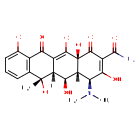
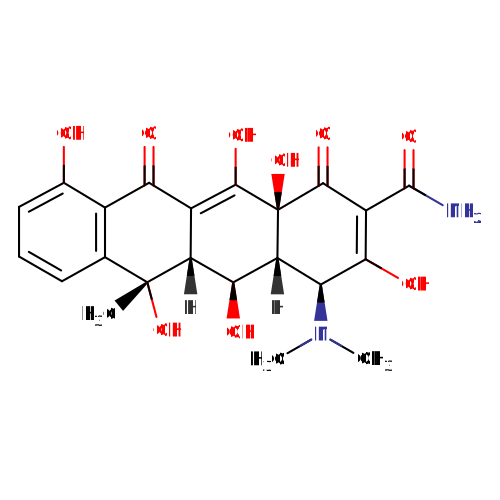
Structure for Oxytetracycline (DB00595)
- Weight
- Average: 460.434
Monoisotopic: 460.148180376 - Chemical Formula
- C22H24N2O9
- Synonyms
- 5-Hydroxytetracycline
- Embryostat
- Hydroxytetracyclinum
- Mepatar
- Ossitetraciclina
- Oxitetraciclina
- Oxyterracin
- Oxyterracine
- Oxytetracyclin
- Oxytétracycline
- Oxytetracycline
- Oxytetracycline (anhydrous)
- Oxytetracycline amphoteric
- Oxytetracyclinum

Pharmacology
- Indication
Oxytetracycline is indicated for treatment of infections caused by a variety of Gram positive and Gram negative microorganisms including Mycoplasma pneumoniae, Pasteurella pestis, Escherichia coli, Haemophilus influenzae (respiratory infections), and Diplococcus pneumoniae.
 Reduce drug development failure ratesBuild, train, & validate machine-learning modelswith evidence-based and structured datasets.Build, train, & validate predictive machine-learning models with structured datasets.
- Associated Conditions
Indication Type Indication Combined Product Details Approval Level Age Group Patient Characteristics Dose Form Used in combination to treat Localized infection Combination Product in combination with: Polymyxin B (DB00781) •••••••••••• •••••••• Used in combination for prophylaxis of Skin infections Combination Product in combination with: Polymyxin B (DB00781) •••••••••••• •••••••• Used in combination for prophylaxis of Skin infections Combination Product in combination with: Polymyxin B (DB00781) •••••••••••• •••••••• Used in combination to treat Superficial ocular infections Combination Product in combination with: Polymyxin B (DB00781) •••••••••••• •••••••• Treatment of Susceptible bacteria •••••••••••• - Contraindications & Blackbox Warnings
 Prevent Adverse Drug Events TodayTap into our Clinical API for life-saving information on contraindications & blackbox warnings, population restrictions, harmful risks, & more.Avoid life-threatening adverse drug events with our Clinical API
- Pharmacodynamics
Oxytetracycline is known as a broad-spectrum antibiotic due to its activity against such a wide range of infections. It was the second of the tetracyclines to be discovered. Oxytetracycline, like other tetracyclines, is used to treat many infections common and rare. Its better absorption profile makes it preferable to tetracycline for moderately severe acne, but alternatives sould be sought if no improvement occurs by 3 months.
- Mechanism of action
Oxytetracycline inhibits cell growth by inhibiting translation. It binds to the 30S ribosomal subunit and prevents the amino-acyl tRNA from binding to the A site of the ribosome. The binding is reversible in nature. Oxytetracycline is lipophilic and can easily pass through the cell membrane or passively diffuses through porin channels in the bacterial membrane.
Target Actions Organism A30S ribosomal protein S9 inhibitorEscherichia coli (strain K12) A30S ribosomal protein S4 inhibitorEscherichia coli (strain K12) U16S ribosomal RNA inhibitorEnteric bacteria and other eubacteria - Absorption
Readily absorbed following oral administration.
- Volume of distribution
Not Available
- Protein binding
Not Available
- Metabolism
- Not Available
- Route of elimination
Not Available
- Half-life
Not Available
- Clearance
Not Available
- Adverse Effects
 Improve decision support & research outcomesWith structured adverse effects data, including: blackbox warnings, adverse reactions, warning & precautions, & incidence rates. View sample adverse effects data in our new Data Library!Improve decision support & research outcomes with our structured adverse effects data.
- Toxicity
Adverse effects may include stomach or bowel upsets and rarely allergic reactions. Very rarely severe headache and vision problems may be signs of dangerous intracranial hypertenion.
- Pathways
Pathway Category Oxytetracycline Action Pathway Drug action - Pharmacogenomic Effects/ADRs
- Not Available
Interactions
- Drug Interactions
- This information should not be interpreted without the help of a healthcare provider. If you believe you are experiencing an interaction, contact a healthcare provider immediately. The absence of an interaction does not necessarily mean no interactions exist.
Drug Interaction Integrate drug-drug
interactions in your softwareAcamprosate The excretion of Acamprosate can be decreased when combined with Oxytetracycline. Acenocoumarol Oxytetracycline may increase the anticoagulant activities of Acenocoumarol. Acetylcysteine The therapeutic efficacy of Acetylcysteine can be decreased when used in combination with Oxytetracycline. Acetylsalicylic acid The excretion of Oxytetracycline can be decreased when combined with Acetylsalicylic acid. Acitretin The risk or severity of pseudotumor cerebri can be increased when Acitretin is combined with Oxytetracycline. - Food Interactions
- Avoid milk and dairy products. Take at least 1 hour before or two hours after consuming dairy products.
- Take separate from meals. Take at least one hour before or two hours after a meal.
Products
 Drug product information from 10+ global regionsOur datasets provide approved product information including:dosage, form, labeller, route of administration, and marketing period.Access drug product information from over 10 global regions.
- Product Ingredients
Ingredient UNII CAS InChI Key Oxytetracycline calcium C8MRZ07FDV 13303-91-8 KIPLYOUQVMMOHB-MXWBXKMOSA-L Oxytetracycline dihydrate X20I9EN955 6153-64-6 SRRPEXWCHWWJOC-JEKSYDDFSA-N Oxytetracycline hydrochloride 4U7K4N52ZM 2058-46-0 UBDNTYUBJLXUNN-IFLJXUKPSA-N Oxytetracycline monocalcium M90SJ24J2X 7179-50-2 QJHKFWPAQRFQBG-IFLJXUKPSA-L - International/Other Brands
- Adamycin (Teva) / Anglocycline (Anglopak) / Corsamycin (Corsa Industries) / Oxacin (Doctor's Chemical Works) / Oxypan (Adcock Ingram Pharmaceuticals) / Oxyterracyna (Chema) / Terrados (Pfizer) / Tetran (Wagner Pharmafax) / Tetrasona (Medifarma)
- Brand Name Prescription Products
Name Dosage Strength Route Labeller Marketing Start Marketing End Region Image Terramycin Capsule 250 mg/1 Oral Pfizer Labs 2005-12-07 Not applicable US 
- Mixture Products
Name Ingredients Dosage Route Labeller Marketing Start Marketing End Region Image GEOTRIL POMAD Oxytetracycline hydrochloride (30 mg/g) + Polymyxin B sulfate (1.25 mg/g) Ointment Topical İ.E. ULAGAY İLAÇ SAN. TÜRK A.Ş. 2020-08-14 2021-03-18 Turkey 
HEKSA 30 MG/G + 10000 I.U./G MERHEM Oxytetracycline (30 mg/g) + Polymyxin B (10000 IU/g) Ointment Topical POLİFARMA İLAÇ SAN. VE TİC. A.Ş. 1986-07-09 Not applicable Turkey HEKSA DERI MERHEMI Oxytetracycline (30 mg/g) + Polymyxin B (10000 IU/g) Ointment Topical POLİFARMA İLAÇ SAN. VE TİC. A.Ş. 1986-07-09 2024-01-23 Turkey OXYLIM Oxytetracycline dihydrate (100 MG/2ML) + Lidocaine (40 MG/2ML) Solution บริษัท โรงงานเภสัชกรรมแอตแลนติค จำกัด 1985-04-24 2020-09-29 Thailand 
POLIMISIN DERI MERHEMI, 14.2 G Oxytetracycline hydrochloride (30 mg/g) + Polymyxin B sulfate (10000 U) Ointment Topical KOÇAK FARMA İLAÇ VE KİMYA SAN. A.Ş. 2009-07-30 Not applicable Turkey
Categories
- ATC Codes
- J01AA06 — Oxytetracycline
- J01AA — Tetracyclines
- J01A — TETRACYCLINES
- J01 — ANTIBACTERIALS FOR SYSTEMIC USE
- J — ANTIINFECTIVES FOR SYSTEMIC USE
- G01AA — Antibiotics
- G01A — ANTIINFECTIVES AND ANTISEPTICS, EXCL. COMBINATIONS WITH CORTICOSTEROIDS
- G01 — GYNECOLOGICAL ANTIINFECTIVES AND ANTISEPTICS
- G — GENITO URINARY SYSTEM AND SEX HORMONES
- A01AB — Antiinfectives and antiseptics for local oral treatment
- A01A — STOMATOLOGICAL PREPARATIONS
- A01 — STOMATOLOGICAL PREPARATIONS
- A — ALIMENTARY TRACT AND METABOLISM
- J01AA — Tetracyclines
- J01A — TETRACYCLINES
- J01 — ANTIBACTERIALS FOR SYSTEMIC USE
- J — ANTIINFECTIVES FOR SYSTEMIC USE
- D06AA — Tetracycline and derivatives
- D06A — ANTIBIOTICS FOR TOPICAL USE
- D06 — ANTIBIOTICS AND CHEMOTHERAPEUTICS FOR DERMATOLOGICAL USE
- D — DERMATOLOGICALS
- Drug Categories
- Agents that produce neuromuscular block (indirect)
- Alimentary Tract and Metabolism
- Anti-Bacterial Agents
- Anti-Infective Agents
- Antibacterials for Systemic Use
- Antibiotics for Topical Use
- Antiinfectives and Antiseptics for Local Oral Treatment
- Antiinfectives for Systemic Use
- Dermatologicals
- Genito Urinary System and Sex Hormones
- Gynecological Antiinfectives and Antiseptics
- Naphthacenes
- OAT1/SLC22A6 inhibitors
- OAT3/SLC22A8 Inhibitors
- OAT3/SLC22A8 Substrates
- Ophthalmologicals
- Sensory Organs
- Stomatological Preparations
- Tetracyclines
- Chemical TaxonomyProvided by Classyfire
- Description
- This compound belongs to the class of organic compounds known as tetracyclines. These are polyketides having an octahydrotetracene-2-carboxamide skeleton, substituted with many hydroxy and other groups.
- Kingdom
- Organic compounds
- Super Class
- Phenylpropanoids and polyketides
- Class
- Tetracyclines
- Sub Class
- Not Available
- Direct Parent
- Tetracyclines
- Alternative Parents
- Naphthacenes / Anthracenecarboxylic acids and derivatives / Tetralins / Aryl ketones / 1-hydroxy-2-unsubstituted benzenoids / 1-hydroxy-4-unsubstituted benzenoids / Aralkylamines / Cyclohexenones / Tertiary alcohols / Vinylogous acids show 9 more
- Substituents
- 1-hydroxy-2-unsubstituted benzenoid / 1-hydroxy-4-unsubstituted benzenoid / Alcohol / Amine / Amino acid or derivatives / Anthracene carboxylic acid or derivatives / Aralkylamine / Aromatic homopolycyclic compound / Aryl ketone / Benzenoid show 24 more
- Molecular Framework
- Aromatic homopolycyclic compounds
- External Descriptors
- tetracyclines (CHEBI:27701) / Linear tetracyclines, Antibiotic fungicides (C06624) / Linear tetracyclines (LMPK07000005)
- Affected organisms
- Enteric bacteria and other eubacteria
Chemical Identifiers
- UNII
- SLF0D9077S
- CAS number
- 79-57-2
- InChI Key
- IWVCMVBTMGNXQD-PXOLEDIWSA-N
- InChI
- InChI=1S/C22H24N2O9/c1-21(32)7-5-4-6-8(25)9(7)15(26)10-12(21)17(28)13-14(24(2)3)16(27)11(20(23)31)19(30)22(13,33)18(10)29/h4-6,12-14,17,25,27-29,32-33H,1-3H3,(H2,23,31)/t12-,13-,14+,17+,21-,22+/m1/s1
- IUPAC Name
- (4S,4aR,5S,5aR,6S,12aS)-4-(dimethylamino)-3,5,6,10,12,12a-hexahydroxy-6-methyl-1,11-dioxo-1,4,4a,5,5a,6,11,12a-octahydrotetracene-2-carboxamide
- SMILES
- [H][C@@]12[C@@H](O)[C@@]3([H])C(C(=O)C4=C(C=CC=C4O)[C@@]3(C)O)=C(O)[C@]1(O)C(=O)C(C(N)=O)=C(O)[C@H]2N(C)C
References
- Synthesis Reference
Janos Balint, Laszlo Cseke, Ferenc Fabian, Lajos Kun, Miklos Szarvas, "Process for the preparation of an oxytetracycline-calcium silicate complex salt from fermentation broth." U.S. Patent US4584135, issued April, 1951.
US4584135- General References
- Agwuh KN, MacGowan A: Pharmacokinetics and pharmacodynamics of the tetracyclines including glycylcyclines. J Antimicrob Chemother. 2006 Aug;58(2):256-65. Epub 2006 Jul 1. [Article]
- External Links
- KEGG Compound
- C06624
- PubChem Compound
- 54675779
- PubChem Substance
- 46507025
- ChemSpider
- 10482174
- 7821
- ChEBI
- 133011
- ChEMBL
- CHEMBL1517
- ZINC
- ZINC000095626782
- Therapeutic Targets Database
- DAP000401
- PharmGKB
- PA450757
- PDBe Ligand
- OTC
- RxList
- RxList Drug Page
- Wikipedia
- Oxytetracycline
- PDB Entries
- 2xpw
- MSDS
- Download (73.1 KB)
Clinical Trials
- Clinical Trials
Phase Status Purpose Conditions Count 4 Not Yet Recruiting Treatment 0.5-14 Year Old Children With Nephroblastoma 1 3 Unknown Status Treatment Acne Vulgaris II or III Degree / Furuncle 1 0 Terminated Treatment Osteomyelitis 1
Pharmacoeconomics
- Manufacturers
- Pfizer laboratories div pfizer inc
- John j ferrante
- Impax laboratories inc
- Proter laboratory spa
- Purepac pharmaceutical co
- West ward pharmaceutical corp
- Packagers
- Chifeng Pharmaceutical Co. Ltd.
- Medisca Inc.
- Norbrook Laboratories Ltd.
- Pfizer Inc.
- Proter SPA
- Veterina Animal Health Ltd.
- West-Ward Pharmaceuticals
- Dosage Forms
Form Route Strength Ointment Topical Injection Solution Capsule Oral 250 mg Ointment Suspension Ophthalmic Injection Topical 100 mg/2mL Injection Topical 250 mg/2mL Injection Topical 50 mg/mL Tablet Buccal 135.870 mg Capsule Oral 250 mg/1 Ointment Ophthalmic Ointment Ophthalmic Ointment Conjunctival; Ophthalmic Capsule Oral 500.000 mg Capsule Oral Solution 50 mg/1ml Injection, solution - Prices
Unit description Cost Unit Terramycin-polymyx eye ointm 3.85USD g Oxytetracycline hcl powder 3.59USD g Terramycin 250 mg/2 ml ampul 2.22USD ml Terramycin im 100 mg/2 ml amp 1.24USD ml DrugBank does not sell nor buy drugs. Pricing information is supplied for informational purposes only.- Patents
- Not Available
Properties
- State
- Solid
- Experimental Properties
Property Value Source melting point (°C) 184.5 °C PhysProp water solubility 313 mg/L (at 25 °C) YALKOWSKY,SH & DANNENFELSER,RM (1992) logP -0.90 SANGSTER (1994) logS -3.14 ADME Research, USCD pKa 3.27 (at 25 °C) KORTUM,G ET AL (1961) - Predicted Properties
Property Value Source Water Solubility 1.4 mg/mL ALOGPS logP -0.99 ALOGPS logP -4.5 Chemaxon logS -2.5 ALOGPS pKa (Strongest Acidic) 2.84 Chemaxon pKa (Strongest Basic) 7.41 Chemaxon Physiological Charge 0 Chemaxon Hydrogen Acceptor Count 10 Chemaxon Hydrogen Donor Count 7 Chemaxon Polar Surface Area 201.85 Å2 Chemaxon Rotatable Bond Count 2 Chemaxon Refractivity 115.4 m3·mol-1 Chemaxon Polarizability 43.22 Å3 Chemaxon Number of Rings 4 Chemaxon Bioavailability 0 Chemaxon Rule of Five No Chemaxon Ghose Filter No Chemaxon Veber's Rule No Chemaxon MDDR-like Rule No Chemaxon - Predicted ADMET Features
Property Value Probability Human Intestinal Absorption + 0.85 Blood Brain Barrier - 0.9881 Caco-2 permeable - 0.8706 P-glycoprotein substrate Substrate 0.699 P-glycoprotein inhibitor I Non-inhibitor 0.8038 P-glycoprotein inhibitor II Non-inhibitor 0.8628 Renal organic cation transporter Non-inhibitor 0.9562 CYP450 2C9 substrate Non-substrate 0.8008 CYP450 2D6 substrate Non-substrate 0.9116 CYP450 3A4 substrate Substrate 0.6551 CYP450 1A2 substrate Non-inhibitor 0.9045 CYP450 2C9 inhibitor Non-inhibitor 0.9144 CYP450 2D6 inhibitor Non-inhibitor 0.9293 CYP450 2C19 inhibitor Non-inhibitor 0.9099 CYP450 3A4 inhibitor Non-inhibitor 0.8567 CYP450 inhibitory promiscuity Low CYP Inhibitory Promiscuity 0.8086 Ames test Non AMES toxic 0.9132 Carcinogenicity Non-carcinogens 0.8632 Biodegradation Not ready biodegradable 0.9941 Rat acute toxicity 2.3159 LD50, mol/kg Not applicable hERG inhibition (predictor I) Weak inhibitor 0.9946 hERG inhibition (predictor II) Non-inhibitor 0.7466
Spectra
- Mass Spec (NIST)
- Not Available
- Spectra
Spectrum Spectrum Type Splash Key Predicted MS/MS Spectrum - 10V, Positive (Annotated) Predicted LC-MS/MS splash10-03dl-0000900000-23a1c6d515e29eb3dfe8 Predicted MS/MS Spectrum - 10V, Negative (Annotated) Predicted LC-MS/MS splash10-0a4i-0004900000-00d3ce620d8f5b16a54a Predicted MS/MS Spectrum - 20V, Positive (Annotated) Predicted LC-MS/MS splash10-004l-0000900000-cdf8f82431134deda95e Predicted MS/MS Spectrum - 20V, Negative (Annotated) Predicted LC-MS/MS splash10-00di-0019400000-6697d3b1fd7b0cfe11e5 Predicted MS/MS Spectrum - 40V, Positive (Annotated) Predicted LC-MS/MS splash10-0fdp-2897500000-209455e4c8a2f04229f8 Predicted MS/MS Spectrum - 40V, Negative (Annotated) Predicted LC-MS/MS splash10-00ku-1191300000-3b66ecf3a012220a72fb Predicted 1H NMR Spectrum 1D NMR Not Applicable Predicted 13C NMR Spectrum 1D NMR Not Applicable - Chromatographic Properties
Collision Cross Sections (CCS)
Adduct CCS Value (Å2) Source type Source [M-H]- 211.3668821 predictedDarkChem Lite v0.1.0 [M-H]- 212.9238821 predictedDarkChem Lite v0.1.0 [M-H]- 211.8188821 predictedDarkChem Lite v0.1.0 [M-H]- 201.128 predictedDeepCCS 1.0 (2019) [M+H]+ 214.2909821 predictedDarkChem Lite v0.1.0 [M+H]+ 213.6928821 predictedDarkChem Lite v0.1.0 [M+H]+ 213.3443821 predictedDarkChem Lite v0.1.0 [M+H]+ 203.14767 predictedDeepCCS 1.0 (2019) [M+Na]+ 214.2028821 predictedDarkChem Lite v0.1.0 [M+Na]+ 213.6908821 predictedDarkChem Lite v0.1.0 [M+Na]+ 213.1063821 predictedDarkChem Lite v0.1.0 [M+Na]+ 209.0692 predictedDeepCCS 1.0 (2019)
Targets

- Kind
- Protein
- Organism
- Escherichia coli (strain K12)
- Pharmacological action
- Yes
- Actions
- Inhibitor
- General Function
- Trna binding
- Specific Function
- The C-terminal tail plays a role in the affinity of the 30S P site for different tRNAs. Mutations that decrease this affinity are suppressed in the 70S ribosome.
- Gene Name
- rpsI
- Uniprot ID
- P0A7X3
- Uniprot Name
- 30S ribosomal protein S9
- Molecular Weight
- 14856.105 Da
References
- Kind
- Protein
- Organism
- Escherichia coli (strain K12)
- Pharmacological action
- Yes
- Actions
- Inhibitor
- General Function
- Translation repressor activity, nucleic acid binding
- Specific Function
- One of two assembly initiator proteins for the 30S subunit, it binds directly to 16S rRNA where it nucleates assembly of the body of the 30S subunit.With S5 and S12 plays an important role in trans...
- Gene Name
- rpsD
- Uniprot ID
- P0A7V8
- Uniprot Name
- 30S ribosomal protein S4
- Molecular Weight
- 23468.915 Da
References
References
- Engemann CA, Adams L, Knapp CW, Graham DW: Disappearance of oxytetracycline resistance genes in aquatic systems. FEMS Microbiol Lett. 2006 Oct;263(2):176-82. [Article]
- Tsai HJ, Huang CW: Phenotypic and molecular characterization of isolates of Ornithobacterium rhinotracheale from chickens and pigeons in Taiwan. Avian Dis. 2006 Dec;50(4):502-7. [Article]
Carriers
- Kind
- Protein
- Organism
- Humans
- Pharmacological action
- Unknown
- Actions
- Binder
- General Function
- Toxic substance binding
- Specific Function
- Serum albumin, the main protein of plasma, has a good binding capacity for water, Ca(2+), Na(+), K(+), fatty acids, hormones, bilirubin and drugs. Its main function is the regulation of the colloid...
- Gene Name
- ALB
- Uniprot ID
- P02768
- Uniprot Name
- Serum albumin
- Molecular Weight
- 69365.94 Da
References
- Keswani N, Choudhary S, Kishore N: Quantitative aspects of recognition of the antibiotic drug oxytetracycline by bovine serum albumin: Calorimetric and spectroscopic studies The Journal of Chemical Thermodynamics. 2013 Mar;58:196-205. [Article]
Transporters
- Kind
- Protein
- Organism
- Humans
- Pharmacological action
- Unknown
- Actions
- SubstrateInhibitor
- General Function
- Sodium-independent organic anion transmembrane transporter activity
- Specific Function
- Involved in the renal elimination of endogenous and exogenous organic anions. Functions as organic anion exchanger when the uptake of one molecule of organic anion is coupled with an efflux of one ...
- Gene Name
- SLC22A6
- Uniprot ID
- Q4U2R8
- Uniprot Name
- Solute carrier family 22 member 6
- Molecular Weight
- 61815.78 Da
References
- Babu E, Takeda M, Narikawa S, Kobayashi Y, Yamamoto T, Cha SH, Sekine T, Sakthisekaran D, Endou H: Human organic anion transporters mediate the transport of tetracycline. Jpn J Pharmacol. 2002 Jan;88(1):69-76. [Article]
- Kind
- Protein
- Organism
- Humans
- Pharmacological action
- Unknown
- Actions
- Substrate
- General Function
- Sodium-independent organic anion transmembrane transporter activity
- Specific Function
- Plays an important role in the excretion/detoxification of endogenous and exogenous organic anions, especially from the brain and kidney. Involved in the transport basolateral of steviol, fexofenad...
- Gene Name
- SLC22A8
- Uniprot ID
- Q8TCC7
- Uniprot Name
- Solute carrier family 22 member 8
- Molecular Weight
- 59855.585 Da
References
- Babu E, Takeda M, Narikawa S, Kobayashi Y, Yamamoto T, Cha SH, Sekine T, Sakthisekaran D, Endou H: Human organic anion transporters mediate the transport of tetracycline. Jpn J Pharmacol. 2002 Jan;88(1):69-76. [Article]
- Kind
- Protein
- Organism
- Humans
- Pharmacological action
- Unknown
- Actions
- SubstrateInhibitor
- General Function
- Sodium-independent organic anion transmembrane transporter activity
- Specific Function
- Mediates saturable uptake of estrone sulfate, dehydroepiandrosterone sulfate and related compounds.
- Gene Name
- SLC22A11
- Uniprot ID
- Q9NSA0
- Uniprot Name
- Solute carrier family 22 member 11
- Molecular Weight
- 59970.945 Da
References
- Babu E, Takeda M, Narikawa S, Kobayashi Y, Yamamoto T, Cha SH, Sekine T, Sakthisekaran D, Endou H: Human organic anion transporters mediate the transport of tetracycline. Jpn J Pharmacol. 2002 Jan;88(1):69-76. [Article]
- Kind
- Protein
- Organism
- Humans
- Pharmacological action
- Unknown
- Actions
- SubstrateInhibitor
- General Function
- Sodium-independent organic anion transmembrane transporter activity
- Specific Function
- Mediates sodium-independent multispecific organic anion transport. Transport of prostaglandin E2, prostaglandin F2, tetracycline, bumetanide, estrone sulfate, glutarate, dehydroepiandrosterone sulf...
- Gene Name
- SLC22A7
- Uniprot ID
- Q9Y694
- Uniprot Name
- Solute carrier family 22 member 7
- Molecular Weight
- 60025.025 Da
References
- Babu E, Takeda M, Narikawa S, Kobayashi Y, Yamamoto T, Cha SH, Sekine T, Sakthisekaran D, Endou H: Human organic anion transporters mediate the transport of tetracycline. Jpn J Pharmacol. 2002 Jan;88(1):69-76. [Article]

Drug created at June 13, 2005 13:24 / Updated at March 03, 2024 02:33