Identification
- Summary
Mefenamic acid is an NSAID used to treat mild to moderate pain for no more than a week, and primary dysmenorrhea.
- Brand Names
- Mefenamic, Ponstel
- Generic Name
- Mefenamic acid
- DrugBank Accession Number
- DB00784
- Background
A non-steroidal anti-inflammatory agent with analgesic, anti-inflammatory, and antipyretic properties. It is an inhibitor of cyclooxygenase.
- Type
- Small Molecule
- Groups
- Approved
- Structure
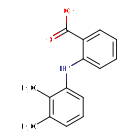
Structure for Mefenamic acid (DB00784)
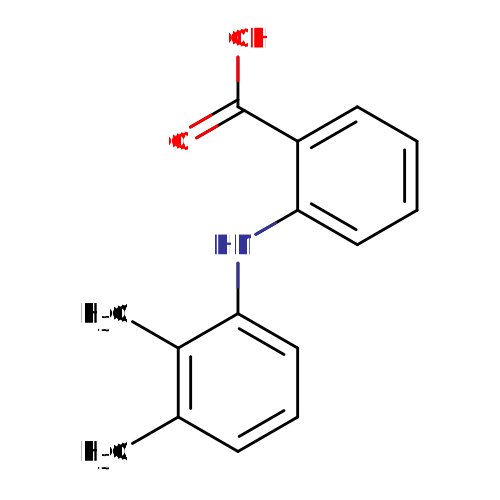
- Weight
- Average: 241.2851
Monoisotopic: 241.110278729 - Chemical Formula
- C15H15NO2
- Synonyms
- Acide méfénamique
- ácido mefenámico
- Acidum mefenamicum
- Mefenamic acid
- Mefenaminsäure
- N-(2,3-xylyl)-2-aminobenzoic acid
- N-2,3-xylylanthranilic acid
- External IDs
- CI 473
- CI-473
- CN 35355
- CN-35355
- INF 3355
- INF-3355
- J2.344B
- M01AG01

Pharmacology
- Indication
For the treatment of rheumatoid arthritis, osteoarthritis, dysmenorrhea, and mild to moderate pain, inflammation, and fever.
 Reduce drug development failure ratesBuild, train, & validate machine-learning modelswith evidence-based and structured datasets.Build, train, & validate predictive machine-learning models with structured datasets.
- Associated Conditions
Indication Type Indication Combined Product Details Approval Level Age Group Patient Characteristics Dose Form Treatment of Primary dysmenorrhea •••••••••••• Used in combination to treat Gastrointestinal cramps Combination Product in combination with: Dicyclomine (DB00804) •••••••••••• ••••••• ••••••• •••••• Treatment of Mild pain •••••••••••• Treatment of Moderate pain •••••••••••• - Contraindications & Blackbox Warnings
 Prevent Adverse Drug Events TodayTap into our Clinical API for life-saving information on contraindications & blackbox warnings, population restrictions, harmful risks, & more.Avoid life-threatening adverse drug events with our Clinical API
- Pharmacodynamics
Mefenamic acid, an anthranilic acid derivative, is a member of the fenamate group of nonsteroidal anti-inflammatory drugs (NSAIDs). It exhibits anti-inflammatory, analgesic, and antipyretic activities. Similar to other NSAIDs, mefenamic acid inhibits prostaglandin synthetase.
- Mechanism of action
Mefenamic acid binds the prostaglandin synthetase receptors COX-1 and COX-2, inhibiting the action of prostaglandin synthetase. As these receptors have a role as a major mediator of inflammation and/or a role for prostanoid signaling in activity-dependent plasticity, the symptoms of pain are temporarily reduced.
Target Actions Organism AProstaglandin G/H synthase 2 inhibitorHumans UProstaglandin G/H synthase 1 inhibitorHumans - Absorption
Mefenamic acid is rapidly absorbed after oral administration.
- Volume of distribution
- 1.06 L/kg [Normal Healthy Adults (18-45 yr)]
- Protein binding
90%
- Metabolism
Mefenamic acid undergoes metabolism by CYP2C9 to 3-hydroxymethyl mefenamic acid, and further oxidation to a 3-carboxymefenamic acid may occur. The activity of these metabolites has not been studied. Mefenamic acid is also glucuronidated directly.
Hover over products below to view reaction partners
- Route of elimination
The fecal route of elimination accounts for up to 20% of the dose, mainly in the form of unconjugated 3-carboxymefenamic acid.3 The elimination half-life of mefenamic acid is approximately two hours. Mefenamic acid, its metabolites and conjugates are primarily excreted by the kidneys. Both renal and hepatic excretion are significant pathways of elimination.
- Half-life
2 hours
- Clearance
- Oral cl=21.23 L/hr [Healthy adults (18-45 yrs)]
- Adverse Effects
 Improve decision support & research outcomesWith structured adverse effects data, including: blackbox warnings, adverse reactions, warning & precautions, & incidence rates. View sample adverse effects data in our new Data Library!Improve decision support & research outcomes with our structured adverse effects data.
- Toxicity
Oral, rat LD50: 740 mg/kg. Symptoms of overdose may include severe stomach pain, coffee ground-like vomit, dark stool, ringing in the ears, change in amount of urine, unusually fast or slow heartbeat, muscle weakness, slow or shallow breathing, confusion, severe headache or loss of consciousness.
- Pathways
Pathway Category Mefenamic Acid Action Pathway Drug action - Pharmacogenomic Effects/ADRs
- Not Available
Interactions
- Drug Interactions
- This information should not be interpreted without the help of a healthcare provider. If you believe you are experiencing an interaction, contact a healthcare provider immediately. The absence of an interaction does not necessarily mean no interactions exist.
Drug Interaction Integrate drug-drug
interactions in your softwareAbacavir Mefenamic acid may decrease the excretion rate of Abacavir which could result in a higher serum level. Abametapir The serum concentration of Mefenamic acid can be increased when it is combined with Abametapir. Abatacept The metabolism of Mefenamic acid can be increased when combined with Abatacept. Abciximab The risk or severity of bleeding and hemorrhage can be increased when Mefenamic acid is combined with Abciximab. Abiraterone The serum concentration of Mefenamic acid can be increased when it is combined with Abiraterone. - Food Interactions
- Avoid alcohol.
- Take with food.
Products
 Drug product information from 10+ global regionsOur datasets provide approved product information including:dosage, form, labeller, route of administration, and marketing period.Access drug product information from over 10 global regions.
- Product Images

- International/Other Brands
- Coslan (Parke Davis) / Lysalgo (SIT) / Mefacit (SecFarm) / Parkemed (Pfizer) / Ponalar (Coronet Crown) / Ponstan Forte (Pfizer) / Ponstyl (Pfizer) / Ponstyl Fort (Pfizer) / Pontal (Daiichi Sankyo) / Tanston (Pfizer)
- Brand Name Prescription Products
Name Dosage Strength Route Labeller Marketing Start Marketing End Region Image Mefenamic Capsule 250 mg Oral Aa Pharma Inc 1996-11-06 Not applicable Canada 
Mefenamic-250 Capsule 250 mg Oral Pro Doc Limitee 1997-08-06 2009-07-23 Canada Ponstan Capsule 250 mg Oral Aa Pharma Inc 1966-12-31 Not applicable Canada Ponstel Capsule 250 mg/1 Oral SHIONOGI INC. 1967-03-28 2019-12-31 US 
- Generic Prescription Products
Name Dosage Strength Route Labeller Marketing Start Marketing End Region Image Dom-mefenamic Acid Capsule 250 mg Oral Dominion Pharmacal 1998-09-17 2023-05-08 Canada Mefenamic acid Capsule 250 mg/1 Oral Micro Labs Limited 2010-11-19 Not applicable US Mefenamic Acid Capsule 250 mg/1 Oral Prasco Laboratories 1967-03-28 2019-12-31 US Mefenamic Acid Capsule 250 mg/1 Oral Qualitest 2014-06-02 2017-07-31 US Mefenamic Acid Capsule 250 mg/1 Oral Misemer Pharmaceuticals, Inc 2021-11-01 Not applicable US - Over the Counter Products
Name Dosage Strength Route Labeller Marketing Start Marketing End Region Image ซีนามิค 500 Tablet, coated 500 mg Oral บริษัท ซีฟาม จำกัด จำกัด 2001-03-21 Not applicable Thailand 
เมดนิล - 500 ชนิดเม็ด Tablet, coated 500 mg Oral บริษัท สหแพทย์เภสัช จำกัด 2007-04-10 Not applicable Thailand - Mixture Products
Name Ingredients Dosage Route Labeller Marketing Start Marketing End Region Image ORCIGESIC CAPSULE Mefenamic acid (250 mg) + Orphenadrine citrate (35 mg) Capsule Oral SUNWARD PHARMACEUTICAL PRIVATE LIMITED 1992-10-07 Not applicable Singapore 
ORCIGESIC TABLETS Mefenamic acid (250 mg) + Orphenadrine citrate (35 mg) Tablet, film coated Oral SUNWARD PHARMACEUTICAL PRIVATE LIMITED 1991-05-24 Not applicable Singapore ยูเทอร์แกน Mefenamic acid (250 MG) + Dicyclomine (10 MG) Tablet ห้างหุ้นส่วนจำกัด โรงงานเลิศสิงห์เภสัชกรรม 1997-01-09 Not applicable Thailand เมนนอกซ์ Mefenamic acid (250 MG) + Dicyclomine (15 MG) Tablet, film coated บริษัท เจริญเภสัชแล็บ จำกัด 1983-12-15 Not applicable Thailand แอนพัส 520 Mefenamic acid (500 MG) + Dicyclomine (20 MG) Tablet, film coated บริษัท ไทยนครพัฒนา จำกัด 2009-08-11 Not applicable Thailand

Categories
- ATC Codes
- M01AG01 — Mefenamic acid
- Drug Categories
- Acids, Carbocyclic
- Agents causing hyperkalemia
- Agents that produce hypertension
- Amines
- Aminobenzoates
- Analgesics
- Analgesics, Non-Narcotic
- Aniline Compounds
- Anti-Inflammatory Agents
- Anti-Inflammatory Agents, Non-Steroidal
- Anti-Inflammatory Agents, Non-Steroidal (Non-Selective)
- Antiinflammatory and Antirheumatic Products
- Antiinflammatory and Antirheumatic Products, Non-Steroids
- Antirheumatic Agents
- Benzene Derivatives
- Benzoates
- Central Nervous System Agents
- Cyclooxygenase Inhibitors
- Cytochrome P-450 CYP1A2 Inhibitors
- Cytochrome P-450 CYP1A2 Inhibitors (weak)
- Cytochrome P-450 CYP1A2 Substrates
- Cytochrome P-450 CYP2C8 Inhibitors
- Cytochrome P-450 CYP2C8 Inhibitors (strength unknown)
- Cytochrome P-450 CYP2C9 Inhibitors
- Cytochrome P-450 CYP2C9 Inhibitors (weak)
- Cytochrome P-450 CYP2C9 Substrates
- Cytochrome P-450 Enzyme Inhibitors
- Cytochrome P-450 Substrates
- Drugs causing inadvertant photosensitivity
- Enzyme Inhibitors
- Fenamates
- Musculo-Skeletal System
- Nephrotoxic agents
- ortho-Aminobenzoates
- Other Nonsteroidal Anti-inflammatory Agents
- Peripheral Nervous System Agents
- Photosensitizing Agents
- Sensory System Agents
- UGT1A9 Inhibitors
- UGT2B7 Inhibitors
- Chemical TaxonomyProvided by Classyfire
- Description
- This compound belongs to the class of organic compounds known as aminobenzoic acids. These are benzoic acids containing an amine group attached to the benzene moiety.
- Kingdom
- Organic compounds
- Super Class
- Benzenoids
- Class
- Benzene and substituted derivatives
- Sub Class
- Benzoic acids and derivatives
- Direct Parent
- Aminobenzoic acids
- Alternative Parents
- Benzoic acids / o-Xylenes / Benzoyl derivatives / Aniline and substituted anilines / Vinylogous amides / Amino acids / Secondary amines / Monocarboxylic acids and derivatives / Carboxylic acids / Organopnictogen compounds show 3 more
- Substituents
- Amine / Amino acid / Amino acid or derivatives / Aminobenzoic acid / Aniline or substituted anilines / Aromatic homomonocyclic compound / Benzoic acid / Benzoyl / Carboxylic acid / Carboxylic acid derivative show 12 more
- Molecular Framework
- Aromatic homomonocyclic compounds
- External Descriptors
- secondary amino compound, aminobenzoic acid (CHEBI:6717)
- Affected organisms
- Humans and other mammals
Chemical Identifiers
- UNII
- 367589PJ2C
- CAS number
- 61-68-7
- InChI Key
- HYYBABOKPJLUIN-UHFFFAOYSA-N
- InChI
- InChI=1S/C15H15NO2/c1-10-6-5-9-13(11(10)2)16-14-8-4-3-7-12(14)15(17)18/h3-9,16H,1-2H3,(H,17,18)
- IUPAC Name
- 2-[(2,3-dimethylphenyl)amino]benzoic acid
- SMILES
- CC1=C(C)C(NC2=CC=CC=C2C(O)=O)=CC=C1
References
- General References
- Not Available
- External Links
- Human Metabolome Database
- HMDB0014922
- KEGG Drug
- D00151
- KEGG Compound
- C02168
- PubChem Compound
- 4044
- PubChem Substance
- 46505405
- ChemSpider
- 3904
- BindingDB
- 50134036
- 6693
- ChEBI
- 6717
- ChEMBL
- CHEMBL686
- ZINC
- ZINC000000020241
- Therapeutic Targets Database
- DAP000779
- PharmGKB
- PA450347
- Guide to Pharmacology
- GtP Drug Page
- PDBe Ligand
- ID8
- RxList
- RxList Drug Page
- Drugs.com
- Drugs.com Drug Page
- Wikipedia
- Mefenamic_acid
- PDB Entries
- 2xn3 / 3r43 / 4g2z / 4jqa / 5ikr
- FDA label
- Download (135 KB)
- MSDS
- Download (59.7 KB)
Clinical Trials
- Clinical Trials
Phase Status Purpose Conditions Count 4 Completed Treatment Chronic Lower Back Pain (CLBP) 2 4 Completed Treatment Primary Dysmenorrhoea 1 4 Completed Treatment Sub-acute Back Pain 1 4 Completed Treatment Uterine Hemorrhage 1 3 Completed Treatment Improve Quality of Life / Menstrual Bleeding, Heavy 1
Pharmacoeconomics
- Manufacturers
- Shionogi pharma inc
- Packagers
- PD-Rx Pharmaceuticals Inc.
- Prescript Pharmaceuticals
- Professional Co.
- Sciele Pharma Inc.
- West-Ward Pharmaceuticals
- Dosage Forms
Form Route Strength Injection, powder, for suspension Parenteral 500 mg Tablet; tablet, film coated Oral 500 MG Suspension Oral 50 MG/5ML Tablet, delayed release Oral Syrup Oral Tablet, sugar coated Oral Suspension Oral Tablet, film coated Oral Tablet; tablet, film coated Oral Capsule Oral 250 mg/1 Tablet Oral Suspension Oral Capsule Oral Tablet, film coated Oral 250 mg Suppository 125 mg Suppository 500 mg Syrup Oral 50 mg/5ml Tablet Oral 500.000 mg Capsule Oral 50 mg Capsule Oral 500 mg Suspension Oral 125 mg/5ml Capsule, coated Oral 500 mg Capsule Oral Tablet, delayed release Oral 500 mg Tablet, coated Oral 500 mg Tablet Capsule Oral 250 mg Tablet, film coated Oral 250 mg Tablet, film coated Oral 500 mg Tablet, coated Oral 250 mg Tablet Oral 250 mg Tablet Oral 500 mg Tablet, film coated - Prices
Unit description Cost Unit Ponstel 250 mg capsule 11.85USD capsule Mefenamic acid powder 2.85USD g Ponstel 250 mg kapseals 1.59USD each Apo-Mefenamic 250 mg Capsule 0.52USD capsule DrugBank does not sell nor buy drugs. Pricing information is supplied for informational purposes only.- Patents
- Not Available
Properties
- State
- Solid
- Experimental Properties
Property Value Source melting point (°C) 230-231 °C PhysProp water solubility 20 mg/L (at 30 °C) YALKOWSKY,SH & DANNENFELSER,RM (1992) logP 5.12 HANSCH,C ET AL. (1995) logS -3.78 ADME Research, USCD pKa 4.2 SANGSTER (1994) - Predicted Properties
Property Value Source Water Solubility 0.0137 mg/mL ALOGPS logP 4.58 ALOGPS logP 5.4 Chemaxon logS -4.2 ALOGPS pKa (Strongest Acidic) 3.89 Chemaxon pKa (Strongest Basic) -1.6 Chemaxon Physiological Charge -1 Chemaxon Hydrogen Acceptor Count 3 Chemaxon Hydrogen Donor Count 2 Chemaxon Polar Surface Area 49.33 Å2 Chemaxon Rotatable Bond Count 3 Chemaxon Refractivity 71.88 m3·mol-1 Chemaxon Polarizability 26.22 Å3 Chemaxon Number of Rings 2 Chemaxon Bioavailability 1 Chemaxon Rule of Five No Chemaxon Ghose Filter Yes Chemaxon Veber's Rule No Chemaxon MDDR-like Rule No Chemaxon - Predicted ADMET Features
Property Value Probability Human Intestinal Absorption + 0.9156 Blood Brain Barrier + 0.762 Caco-2 permeable + 0.8866 P-glycoprotein substrate Non-substrate 0.7948 P-glycoprotein inhibitor I Non-inhibitor 0.8632 P-glycoprotein inhibitor II Non-inhibitor 0.9147 Renal organic cation transporter Non-inhibitor 0.9191 CYP450 2C9 substrate Non-substrate 0.6814 CYP450 2D6 substrate Non-substrate 0.9116 CYP450 3A4 substrate Non-substrate 0.7019 CYP450 1A2 substrate Inhibitor 0.9107 CYP450 2C9 inhibitor Inhibitor 0.8949 CYP450 2D6 inhibitor Non-inhibitor 0.9483 CYP450 2C19 inhibitor Non-inhibitor 0.9025 CYP450 3A4 inhibitor Non-inhibitor 0.9175 CYP450 inhibitory promiscuity Low CYP Inhibitory Promiscuity 0.6613 Ames test Non AMES toxic 0.812 Carcinogenicity Non-carcinogens 0.5833 Biodegradation Not ready biodegradable 0.822 Rat acute toxicity 2.5445 LD50, mol/kg Not applicable hERG inhibition (predictor I) Weak inhibitor 0.9727 hERG inhibition (predictor II) Non-inhibitor 0.8706
Spectra
- Mass Spec (NIST)
- Not Available
- Spectra
- Chromatographic Properties
Collision Cross Sections (CCS)
Adduct CCS Value (Å2) Source type Source [M-H]- 166.5072124 predictedDarkChem Lite v0.1.0 [M-H]- 154.916232 predictedDarkChem Lite v0.1.0 [M-H]- 166.5825124 predictedDarkChem Lite v0.1.0 [M-H]- 151.12675 predictedDeepCCS 1.0 (2019) [M+H]+ 166.7130124 predictedDarkChem Lite v0.1.0 [M+H]+ 168.2685124 predictedDarkChem Lite v0.1.0 [M+H]+ 168.1066124 predictedDarkChem Lite v0.1.0 [M+H]+ 153.48476 predictedDeepCCS 1.0 (2019) [M+Na]+ 167.0256124 predictedDarkChem Lite v0.1.0 [M+Na]+ 171.5570481 predictedDarkChem Lite v0.1.0 [M+Na]+ 167.0705124 predictedDarkChem Lite v0.1.0 [M+Na]+ 159.5779 predictedDeepCCS 1.0 (2019)
Targets

- Kind
- Protein
- Organism
- Humans
- Pharmacological action
- Yes
- Actions
- Inhibitor
- General Function
- Prostaglandin-endoperoxide synthase activity
- Specific Function
- Converts arachidonate to prostaglandin H2 (PGH2), a committed step in prostanoid synthesis. Constitutively expressed in some tissues in physiological conditions, such as the endothelium, kidney and...
- Gene Name
- PTGS2
- Uniprot ID
- P35354
- Uniprot Name
- Prostaglandin G/H synthase 2
- Molecular Weight
- 68995.625 Da
References
- Gierse JK, Hauser SD, Creely DP, Koboldt C, Rangwala SH, Isakson PC, Seibert K: Expression and selective inhibition of the constitutive and inducible forms of human cyclo-oxygenase. Biochem J. 1995 Jan 15;305 ( Pt 2):479-84. [Article]
- Bhat AS, Tandan SK, Kumar D, Krishna V, Prakash VR: Interaction between inhibitors of inducible nitric oxide synthase and cyclooxygenase in adjuvant-induced arthritis in female albino rats: an isobolographic study. Eur J Pharmacol. 2007 Feb 5;556(1-3):190-9. Epub 2006 Oct 27. [Article]
- Bhat AS, Tandan SK, Kumar D, Krishna V, Prakash VR: Interaction between inhibitors of inducible nitric oxide synthase and cyclooxygenase in Brewer's yeast induced pyrexia in mice: an isobolographic study. Eur J Pharmacol. 2005 Mar 28;511(2-3):137-42. [Article]
- Cryer B, Feldman M: Cyclooxygenase-1 and cyclooxygenase-2 selectivity of widely used nonsteroidal anti-inflammatory drugs. Am J Med. 1998 May;104(5):413-21. [Article]
- Walton LJ, Franklin IJ, Bayston T, Brown LC, Greenhalgh RM, Taylor GW, Powell JT: Inhibition of prostaglandin E2 synthesis in abdominal aortic aneurysms: implications for smooth muscle cell viability, inflammatory processes, and the expansion of abdominal aortic aneurysms. Circulation. 1999 Jul 6;100(1):48-54. [Article]
- Chen X, Ji ZL, Chen YZ: TTD: Therapeutic Target Database. Nucleic Acids Res. 2002 Jan 1;30(1):412-5. [Article]
- Kind
- Protein
- Organism
- Humans
- Pharmacological action
- Unknown
- Actions
- Inhibitor
- General Function
- Prostaglandin-endoperoxide synthase activity
- Specific Function
- Converts arachidonate to prostaglandin H2 (PGH2), a committed step in prostanoid synthesis. Involved in the constitutive production of prostanoids in particular in the stomach and platelets. In gas...
- Gene Name
- PTGS1
- Uniprot ID
- P23219
- Uniprot Name
- Prostaglandin G/H synthase 1
- Molecular Weight
- 68685.82 Da
References
- Sinniah R, Lye WC: Acute renal failure from hemoglobinuric and interstitial nephritis secondary to iodine and mefenamic acid. Clin Nephrol. 2001 Mar;55(3):254-8. [Article]
- Joo Y, Kim HS, Woo RS, Park CH, Shin KY, Lee JP, Chang KA, Kim S, Suh YH: Mefenamic acid shows neuroprotective effects and improves cognitive impairment in in vitro and in vivo Alzheimer's disease models. Mol Pharmacol. 2006 Jan;69(1):76-84. Epub 2005 Oct 13. [Article]
- Cryer B, Feldman M: Cyclooxygenase-1 and cyclooxygenase-2 selectivity of widely used nonsteroidal anti-inflammatory drugs. Am J Med. 1998 May;104(5):413-21. [Article]
- Gierse JK, Hauser SD, Creely DP, Koboldt C, Rangwala SH, Isakson PC, Seibert K: Expression and selective inhibition of the constitutive and inducible forms of human cyclo-oxygenase. Biochem J. 1995 Jan 15;305 ( Pt 2):479-84. [Article]
- Laudanno OM, Cesolari JA, Esnarriaga J, Flaherty P, Vada J, Guastalli G, San Miguel P, Bedini OA: [In vivo selectivity of nonsteroidal anti-inflammatory drugs on COX-1-COX-2 and gastrointestinal ulcers, in rats]. Acta Gastroenterol Latinoam. 1998;28(3):249-55. [Article]
Enzymes
- Kind
- Protein
- Organism
- Humans
- Pharmacological action
- Unknown
- Actions
- SubstrateInhibitor
- General Function
- Steroid hydroxylase activity
- Specific Function
- Cytochromes P450 are a group of heme-thiolate monooxygenases. In liver microsomes, this enzyme is involved in an NADPH-dependent electron transport pathway. It oxidizes a variety of structurally un...
- Gene Name
- CYP2C9
- Uniprot ID
- P11712
- Uniprot Name
- Cytochrome P450 2C9
- Molecular Weight
- 55627.365 Da
References
- Venkataraman H, den Braver MW, Vermeulen NP, Commandeur JN: Cytochrome P450-mediated bioactivation of mefenamic acid to quinoneimine intermediates and inactivation by human glutathione S-transferases. Chem Res Toxicol. 2014 Dec 15;27(12):2071-81. doi: 10.1021/tx500288b. Epub 2014 Nov 18. [Article]
- Wang JF, Yan JY, Wei DQ, Chou KC: Binding of CYP2C9 with diverse drugs and its implications for metabolic mechanism. Med Chem. 2009 May;5(3):263-70. [Article]
- Lee B, Ji HK, Lee T, Liu KH: Simultaneous Screening of Activities of Five Cytochrome P450 and Four Uridine 5'-Diphospho-glucuronosyltransferase Enzymes in Human Liver Microsomes Using Cocktail Incubation and Liquid Chromatography-Tandem Mass Spectrometry. Drug Metab Dispos. 2015 Jul;43(7):1137-46. doi: 10.1124/dmd.114.063016. Epub 2015 Apr 22. [Article]
- Mefenamic Acid FDA label [File]
- Kind
- Protein
- Organism
- Humans
- Pharmacological action
- Unknown
- Actions
- SubstrateInhibitor
- General Function
- Oxidoreductase activity, acting on paired donors, with incorporation or reduction of molecular oxygen, reduced flavin or flavoprotein as one donor, and incorporation of one atom of oxygen
- Specific Function
- Cytochromes P450 are a group of heme-thiolate monooxygenases. In liver microsomes, this enzyme is involved in an NADPH-dependent electron transport pathway. It oxidizes a variety of structurally un...
- Gene Name
- CYP1A2
- Uniprot ID
- P05177
- Uniprot Name
- Cytochrome P450 1A2
- Molecular Weight
- 58293.76 Da
References
- Venkataraman H, den Braver MW, Vermeulen NP, Commandeur JN: Cytochrome P450-mediated bioactivation of mefenamic acid to quinoneimine intermediates and inactivation by human glutathione S-transferases. Chem Res Toxicol. 2014 Dec 15;27(12):2071-81. doi: 10.1021/tx500288b. Epub 2014 Nov 18. [Article]
- Lee B, Ji HK, Lee T, Liu KH: Simultaneous Screening of Activities of Five Cytochrome P450 and Four Uridine 5'-Diphospho-glucuronosyltransferase Enzymes in Human Liver Microsomes Using Cocktail Incubation and Liquid Chromatography-Tandem Mass Spectrometry. Drug Metab Dispos. 2015 Jul;43(7):1137-46. doi: 10.1124/dmd.114.063016. Epub 2015 Apr 22. [Article]
- Kind
- Protein
- Organism
- Humans
- Pharmacological action
- No
- Actions
- Inhibitor
- General Function
- Retinoic acid binding
- Specific Function
- UDPGT is of major importance in the conjugation and subsequent elimination of potentially toxic xenobiotics and endogenous compounds. This isoform has specificity for phenols. Isoform 2 lacks trans...
- Gene Name
- UGT1A9
- Uniprot ID
- O60656
- Uniprot Name
- UDP-glucuronosyltransferase 1-9
- Molecular Weight
- 59940.495 Da
- Kind
- Protein
- Organism
- Humans
- Pharmacological action
- Unknown
- Actions
- Inhibitor
- General Function
- Glucuronosyltransferase activity
- Specific Function
- UDPGT is of major importance in the conjugation and subsequent elimination of potentially toxic xenobiotics and endogenous compounds.Its unique specificity for 3,4-catechol estrogens and estriol su...
- Gene Name
- UGT2B7
- Uniprot ID
- P16662
- Uniprot Name
- UDP-glucuronosyltransferase 2B7
- Molecular Weight
- 60694.12 Da
References
- Lee B, Ji HK, Lee T, Liu KH: Simultaneous Screening of Activities of Five Cytochrome P450 and Four Uridine 5'-Diphospho-glucuronosyltransferase Enzymes in Human Liver Microsomes Using Cocktail Incubation and Liquid Chromatography-Tandem Mass Spectrometry. Drug Metab Dispos. 2015 Jul;43(7):1137-46. doi: 10.1124/dmd.114.063016. Epub 2015 Apr 22. [Article]
- Kind
- Protein
- Organism
- Humans
- Pharmacological action
- Unknown
- Actions
- Inhibitor
- General Function
- Steroid hydroxylase activity
- Specific Function
- Cytochromes P450 are a group of heme-thiolate monooxygenases. In liver microsomes, this enzyme is involved in an NADPH-dependent electron transport pathway. It oxidizes a variety of structurally un...
- Gene Name
- CYP2C8
- Uniprot ID
- P10632
- Uniprot Name
- Cytochrome P450 2C8
- Molecular Weight
- 55824.275 Da
References
- Backman JT, Filppula AM, Niemi M, Neuvonen PJ: Role of Cytochrome P450 2C8 in Drug Metabolism and Interactions. Pharmacol Rev. 2016 Jan;68(1):168-241. doi: 10.1124/pr.115.011411. [Article]
- Jenkins SM, Zvyaga T, Johnson SR, Hurley J, Wagner A, Burrell R, Turley W, Leet JE, Philip T, Rodrigues AD: Studies to further investigate the inhibition of human liver microsomal CYP2C8 by the acyl-beta-glucuronide of gemfibrozil. Drug Metab Dispos. 2011 Dec;39(12):2421-30. doi: 10.1124/dmd.111.041947. Epub 2011 Sep 12. [Article]
Carriers
- Kind
- Protein
- Organism
- Humans
- Pharmacological action
- Unknown
- General Function
- Toxic substance binding
- Specific Function
- Serum albumin, the main protein of plasma, has a good binding capacity for water, Ca(2+), Na(+), K(+), fatty acids, hormones, bilirubin and drugs. Its main function is the regulation of the colloid...
- Gene Name
- ALB
- Uniprot ID
- P02768
- Uniprot Name
- Serum albumin
- Molecular Weight
- 69365.94 Da
References
- Dasgupta A, Emerson L: Interaction of valproic acid with nonsteroidal antiinflammatory drugs mefenamic acid and fenoprofen in normal and uremic sera: lack of interaction in uremic sera due to the presence of endogenous factors. Ther Drug Monit. 1996 Dec;18(6):654-9. [Article]

Drug created at June 13, 2005 13:24 / Updated at April 26, 2024 00:45