Identification
- Summary
Emtricitabine is a nucleoside reverse transcriptase inhibitor used for the treatment and prophylaxis of HIV.
- Brand Names
- Atripla, Biktarvy, Complera, Descovy, Emtriva, Genvoya, Odefsey, Stribild, Truvada
- Generic Name
- Emtricitabine
- DrugBank Accession Number
- DB00879
- Background
Emtricitabine is a nucleoside reverse transcriptase inhibitor (NRTI) indicated for the treatment of HIV infection in adults6 or combined with tenofovir alafenamide for the prevention of HIV-1 infection in high risk adolescents and adults.5 Emtricitabine is a cytidine analogue.6 The drug works by inhibiting HIV reverse transcriptase, preventing transcription of HIV RNA to DNA.6
Emtricitabine was granted FDA approval on 2 July 2003.6
- Type
- Small Molecule
- Groups
- Approved, Investigational
- Structure
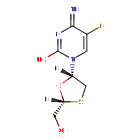
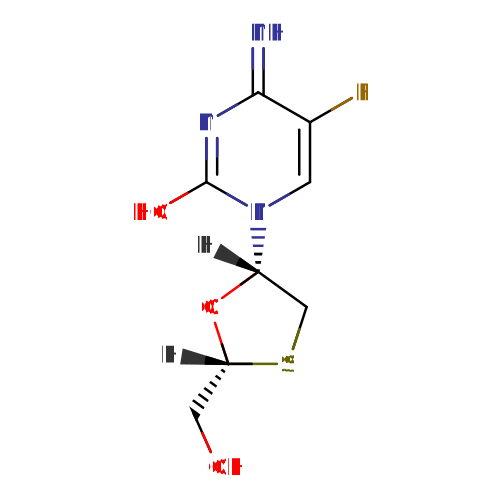
Structure for Emtricitabine (DB00879)
- Weight
- Average: 247.247
Monoisotopic: 247.042690096 - Chemical Formula
- C8H10FN3O3S
- Synonyms
- (−)-(2R,5S)-5-fluoro-1-[2-(hydroxymethyl)-1,3-oxathiolan-5-yl]cytosine
- (−)-2'-deoxy-5-fluoro-3'-thiacytidine
- (−)-cis-4-amino-5-fluoro-1-(2-hydroxymethyl-1,3-oxathiolan-5-yl)-(1H)-pyrimidin-2-one
- (−)-FTC
- (−)-β-2',3'-dideoxy-5-fluoro-3'-thiacytidine
- (2R-cis)-4-amino-5-fluoro-1-(2-(hydroxymethyl)-1,3-oxathiolan-5-yl)-2(1H)-pyrimidinone
- 4-amino-5-fluoro-1-((2R,5S)-2-(hydroxymethyl)-1,3-oxathiolan-5-yl)pyrimidin-2(1H)-one
- 4-Amino-5-fluoro-1-((2R,5S)-2-hydroxymethyl-[1,3]oxathiolan-5-yl)-1H-pyrimidin-2-one
- 5-fluoro-1-((2R,5S)-2-(hydroxymethyl)-1,3-oxathiolan-5-yl)cytosine
- Emtricitabin
- Emtricitabina
- Emtricitabine
- Emtricitabinum
- External IDs
- 524-W-91
- 524W91
- BW-524W91

Pharmacology
- Indication
Emtricitabine is indicated in combination with other medications for the treatment of HIV-1 infections in adults and children.6,11,10,9,12,14,13,15,16,17 As different products of emtricitabine are approved for use in patients with certain characteristics, refer to the individual drug product for patient eligibility for drug treatment. It may be used for pre-exposure prophylaxis of HIV-1 in adolescents and adults.7,5
 Reduce drug development failure ratesBuild, train, & validate machine-learning modelswith evidence-based and structured datasets.Build, train, & validate predictive machine-learning models with structured datasets.
- Associated Conditions
Indication Type Indication Combined Product Details Approval Level Age Group Patient Characteristics Dose Form Prophylaxis of Hiv infection ••• ••••• Management of Hiv-1 infection •••••••••••• Treatment of Hiv-1-infection •••••••••••• •••••• ••• ••••••••• •••••••• •••••••• •• ••••• •• •• Used in combination for prophylaxis of Human immunodeficiency virus type 1 (hiv-1) infection Combination Product in combination with: Tenofovir alafenamide (DB09299) •••••••••••• ••••••••••• ••••• •••••• •• ••••• •• ••• ••• •••• ••••••••• •• •••• ••• ••• •••••• Used as adjunct in combination to treat Human immunodeficiency virus type 1 (hiv-1) infection Combination Product in combination with: Tenofovir alafenamide (DB09299) •••••••••••• ••••••••• ••• ••••••••• ••••• ••••••••••• •••••• •• ••••• •• •• •••••• - Associated Therapies
- Contraindications & Blackbox Warnings
 Prevent Adverse Drug Events TodayTap into our Clinical API for life-saving information on contraindications & blackbox warnings, population restrictions, harmful risks, & more.Avoid life-threatening adverse drug events with our Clinical API
- Pharmacodynamics
Emtricitabine is a cytidine analog that competes with the natural substrate of HIV-1 reverse transcriptase to be incorporated into newly formed DNA, terminating its transcription.6 It is administered once daily so it has a long duration of action. Patients should be counselled regarding the risk of lactic acidosis and hepatomegaly with steatosis.6
- Mechanism of action
Emtricitabine is a cytidine analog which, when phosphorylated to emtricitabine 5'-triphosphate, competes with deoxycytidine 5'-triphosphate for HIV-1 reverse transcriptase.6 As HIV-1 reverse transcriptase incorporates emtricitabine into forming DNA strands, new nucleotides are unable to be incorporated, leading to viral DNA chain termination.6 Inhibition of reverse transcriptase prevents transcription of viral RNA into DNA, therefore the virus is unable to incorporate its DNA into host DNA and replicate using host cell machinery. This reduces viral load.3
Target Actions Organism AReverse transcriptase/RNaseH inhibitorHuman immunodeficiency virus 1 - Absorption
Emtricitabine reaches a Cmax of 1.8±0.7µg/mL with a Tmax of 1-2 hours, and has an AUC of 10±3.1µg*hr/mL.6 The bioavailability of emtricitabine capsules is 93% and the bioavailability of the oral solution is 75%.6 Taking emtricitabine with food decreases the Cmax by 29%.[L9019
- Volume of distribution
The apparent central volume of distribution is 42.3L and the peripheral volume of distribution is 55.4L.2
- Protein binding
Emtricitabine is <4% bound to plasma proteins,6 mainly serum albumin.4
- Metabolism
Emtricitabine is approximately 86% unmetabolized.6 Approximately 9% of a dose is metabolized to 3'-sulfoxide diastereomers, 4% to the 2'-O-glucuronide, and a minor amount is converted to 5-fluorocytosine.1,6
Hover over products below to view reaction partners
- Route of elimination
Emtricitabine is 86% recovered in the urine and 14% recovered in feces.6 13% of the dose is recovered in the urine as metabolites; 9% as 3'-sulfoxide diastereomers and 4% as 2'-O-glucuronide.6
- Half-life
The half life of emtricitabine is approximately 10 hours.6
- Clearance
Emtricitabine has an apparent elimination rate of 15.1L/h.2 This rate is closely linked to creatinine clearance.2
- Adverse Effects
 Improve decision support & research outcomesWith structured adverse effects data, including: blackbox warnings, adverse reactions, warning & precautions, & incidence rates. View sample adverse effects data in our new Data Library!Improve decision support & research outcomes with our structured adverse effects data.
- Toxicity
The LD50 of emtricitabine is not readily available.[9019,L9818]
Symptoms of emtricitabine toxicity include hepatotoxicity with steatosis, as well as lactic acidosis.6 Treat overdose with symptomatic and supportive measures, including hemodialysis.6
- Pathways
Pathway Category Emtricitabine Action Pathway Drug action - Pharmacogenomic Effects/ADRs
- Not Available
Interactions
- Drug Interactions
- This information should not be interpreted without the help of a healthcare provider. If you believe you are experiencing an interaction, contact a healthcare provider immediately. The absence of an interaction does not necessarily mean no interactions exist.
Drug Interaction Integrate drug-drug
interactions in your softwareAbemaciclib The excretion of Abemaciclib can be decreased when combined with Emtricitabine. Acyclovir The excretion of Emtricitabine can be decreased when combined with Acyclovir. Adenovirus type 7 vaccine live The therapeutic efficacy of Adenovirus type 7 vaccine live can be decreased when used in combination with Emtricitabine. Anthrax vaccine The therapeutic efficacy of Anthrax vaccine can be decreased when used in combination with Emtricitabine. Bacillus calmette-guerin substrain connaught live antigen The therapeutic efficacy of Bacillus calmette-guerin substrain connaught live antigen can be decreased when used in combination with Emtricitabine. - Food Interactions
- Take with or without food. The absorption is unaffected by food.
Products
 Drug product information from 10+ global regionsOur datasets provide approved product information including:dosage, form, labeller, route of administration, and marketing period.Access drug product information from over 10 global regions.
- Product Images
- International/Other Brands
- Coviracil
- Brand Name Prescription Products
Name Dosage Strength Route Labeller Marketing Start Marketing End Region Image Emtriva Capsule 200 mg/1 Oral Remedy Repack 2008-05-17 2017-04-28 US 
Emtriva Solution 10 mg/1mL Oral Gilead Sciences, Inc. 2005-09-28 Not applicable US Emtriva Capsule 200 mg/1 Oral Physicians Total Care, Inc. 2003-07-10 Not applicable US Emtriva Capsule 200 mg Oral Gilead Sciences 2006-03-03 Not applicable Canada 
Emtriva Capsule 200 mg Oral Gilead Sciences Ireland Uc 2020-12-22 Not applicable EU 
- Generic Prescription Products
Name Dosage Strength Route Labeller Marketing Start Marketing End Region Image Emtricitabine Capsule 200 mg/1 Oral Aurobindo Pharma Limited 2023-03-15 Not applicable US Emtricitabine Capsule 200 mg/1 Oral REMEDYREPACK INC. 2020-10-12 Not applicable US Emtricitabine Capsule 200 mg/1 Oral Cipla USA Inc. 2020-08-31 Not applicable US - Mixture Products
Name Ingredients Dosage Route Labeller Marketing Start Marketing End Region Image Ag-emtricitabine / Tenofovir Disoproxil Fumarate Emtricitabine (200 mg) + Tenofovir disoproxil fumarate (300 mg) Tablet Oral Angita Pharma Inc. 2020-11-09 Not applicable Canada Apo-efavirenz-emtricitabine-tenofovir Emtricitabine (200 mg) + Efavirenz (600 mg) + Tenofovir disoproxil fumarate (300 mg) Tablet Oral Apotex Corporation 2018-09-04 Not applicable Canada Apo-emtricitabine-tenofovir Emtricitabine (200 mg) + Tenofovir disoproxil fumarate (300 mg) Tablet Oral Apotex Corporation 2017-07-26 Not applicable Canada Atripla Emtricitabine (200 mg/1) + Efavirenz (600 mg/1) + Tenofovir disoproxil fumarate (300 mg/1) Tablet, film coated Oral REMEDYREPACK INC. 2017-03-20 Not applicable US Atripla Emtricitabine (200 mg/1) + Efavirenz (600 mg/1) + Tenofovir disoproxil fumarate (300 mg/1) Tablet, film coated Oral Gilead Sciences, Llc 2006-07-20 Not applicable US


Categories
- ATC Codes
- J05AR19 — Emtricitabine, tenofovir alafenamide and rilpivirine
- J05AR — Antivirals for treatment of HIV infections, combinations
- J05A — DIRECT ACTING ANTIVIRALS
- J05 — ANTIVIRALS FOR SYSTEMIC USE
- J — ANTIINFECTIVES FOR SYSTEMIC USE
- J05AR — Antivirals for treatment of HIV infections, combinations
- J05A — DIRECT ACTING ANTIVIRALS
- J05 — ANTIVIRALS FOR SYSTEMIC USE
- J — ANTIINFECTIVES FOR SYSTEMIC USE
- J05AR — Antivirals for treatment of HIV infections, combinations
- J05A — DIRECT ACTING ANTIVIRALS
- J05 — ANTIVIRALS FOR SYSTEMIC USE
- J — ANTIINFECTIVES FOR SYSTEMIC USE
- J05AF — Nucleoside and nucleotide reverse transcriptase inhibitors
- J05A — DIRECT ACTING ANTIVIRALS
- J05 — ANTIVIRALS FOR SYSTEMIC USE
- J — ANTIINFECTIVES FOR SYSTEMIC USE
- J05AR — Antivirals for treatment of HIV infections, combinations
- J05A — DIRECT ACTING ANTIVIRALS
- J05 — ANTIVIRALS FOR SYSTEMIC USE
- J — ANTIINFECTIVES FOR SYSTEMIC USE
- J05AR — Antivirals for treatment of HIV infections, combinations
- J05A — DIRECT ACTING ANTIVIRALS
- J05 — ANTIVIRALS FOR SYSTEMIC USE
- J — ANTIINFECTIVES FOR SYSTEMIC USE
- J05AR — Antivirals for treatment of HIV infections, combinations
- J05A — DIRECT ACTING ANTIVIRALS
- J05 — ANTIVIRALS FOR SYSTEMIC USE
- J — ANTIINFECTIVES FOR SYSTEMIC USE
- J05AR — Antivirals for treatment of HIV infections, combinations
- J05A — DIRECT ACTING ANTIVIRALS
- J05 — ANTIVIRALS FOR SYSTEMIC USE
- J — ANTIINFECTIVES FOR SYSTEMIC USE
- J05AR — Antivirals for treatment of HIV infections, combinations
- J05A — DIRECT ACTING ANTIVIRALS
- J05 — ANTIVIRALS FOR SYSTEMIC USE
- J — ANTIINFECTIVES FOR SYSTEMIC USE
- Drug Categories
- Anti-HIV Agents
- Anti-Infective Agents
- Anti-Retroviral Agents
- Antiinfectives for Systemic Use
- Antiviral Agents
- Antivirals for Systemic Use
- Antivirals used in combination for the treatment of HIV infections
- Carbohydrates
- Deoxycytidine
- Deoxyribonucleosides
- Dideoxynucleosides
- Direct Acting Antivirals
- Enzyme Inhibitors
- Glycosides
- Human Immunodeficiency Virus Nucleoside Analog Reverse Transcriptase Inhibitor
- MATE 1 Substrates
- MATE substrates
- Nucleic Acid Synthesis Inhibitors
- Nucleic Acids, Nucleotides, and Nucleosides
- Nucleoside and Nucleotide Reverse Transcriptase Inhibitors
- Nucleoside Reverse Transcriptase Inhibitors
- Nucleosides
- Pyrimidine Nucleosides
- Pyrimidines
- Reverse Transcriptase Inhibitors
- Ribonucleosides
- Chemical TaxonomyProvided by Classyfire
- Description
- This compound belongs to the class of organic compounds known as 3'-thia pyrimidine nucleosides. These are nucleoside analogues with a structure that consists of a pyrimidine base, which is N-substituted at the 1-position with a 3'-thia derivative (1,3-oxazolidine) of the ribose moiety that is characteristic of nucleosides.
- Kingdom
- Organic compounds
- Super Class
- Nucleosides, nucleotides, and analogues
- Class
- Nucleoside and nucleotide analogues
- Sub Class
- 3'-thia pyrimidine nucleosides
- Direct Parent
- 3'-thia pyrimidine nucleosides
- Alternative Parents
- Pyrimidones / Aminopyrimidines and derivatives / Halopyrimidines / Aryl fluorides / Hydropyrimidines / Imidolactams / Oxathiolanes / Heteroaromatic compounds / Monothioacetals / Oxacyclic compounds show 7 more
- Substituents
- 3'-thia pyrimidine nucleoside / Alcohol / Amine / Aminopyrimidine / Aromatic heteromonocyclic compound / Aryl fluoride / Aryl halide / Azacycle / Halopyrimidine / Heteroaromatic compound show 19 more
- Molecular Framework
- Aromatic heteromonocyclic compounds
- External Descriptors
- organofluorine compound, pyrimidone, nucleoside analogue, monothioacetal (CHEBI:31536)
- Affected organisms
- Human Immunodeficiency Virus
Chemical Identifiers
- UNII
- G70B4ETF4S
- CAS number
- 143491-57-0
- InChI Key
- XQSPYNMVSIKCOC-NTSWFWBYSA-N
- InChI
- InChI=1S/C8H10FN3O3S/c9-4-1-12(8(14)11-7(4)10)5-3-16-6(2-13)15-5/h1,5-6,13H,2-3H2,(H2,10,11,14)/t5-,6+/m0/s1
- IUPAC Name
- 5-fluoro-1-[(2R,5S)-2-(hydroxymethyl)-1,3-oxathiolan-5-yl]-4-imino-1,4-dihydropyrimidin-2-ol
- SMILES
- NC1=NC(=O)N(C=C1F)[C@@H]1CS[C@H](CO)O1
References
- Synthesis Reference
- US5538975
- General References
- Shockcor JP, Wurm RM, Frick LW, Sanderson PN, Farrant RD, Sweatman BC, Lindon JC: Hplc-nmr identification of the human urinary metabolites of (-)-cis-5-fluoro-1-[2-(hydroxymethyl)-1,3-oxathiolan-5-yl] cytosine, a nucleoside analogue active against human immunodeficiency virus (HIV). Xenobiotica. 1996 Feb;26(2):189-99. doi: 10.3109/00498259609046699. [Article]
- Valade E, Treluyer JM, Bouazza N, Ghosn J, Foissac F, Benaboud S, Fauchet F, Viard JP, Urien S, Hirt D: Population pharmacokinetics of emtricitabine in HIV-1-infected adult patients. Antimicrob Agents Chemother. 2014;58(4):2256-61. doi: 10.1128/AAC.02058-13. Epub 2014 Feb 3. [Article]
- Orkin C, Llibre JM, Gallien S, Antinori A, Behrens G, Carr A: Nucleoside reverse transcriptase inhibitor-reducing strategies in HIV treatment: assessing the evidence. HIV Med. 2018 Jan;19(1):18-32. doi: 10.1111/hiv.12534. Epub 2017 Jul 24. [Article]
- Bocedi A, Notaril S, Narciso P, Bolli A, Fasano M, Ascenzi P: Binding of anti-HIV drugs to human serum albumin. IUBMB Life. 2004 Oct;56(10):609-14. [Article]
- FDA Press Announcements: FDA approves second drug to prevent HIV infection as part of ongoing efforts to end the HIV epidemic [Link]
- FDA Approved Drug Products: Emtriva (Emtricitabine) Oral Capsules [Link]
- FDA Approved Drug Products: Descovy (Emtricitabine and Tenofovir Alafenamide) Oral Tablets [Link]
- Cayman Chemicals: Emtricitabine MSDS [Link]
- FDA Approved Drug Products: Truvada (emtricitabine and tenofovir disoproxil fumarate) tablets for oral use [Link]
- FDA Approved Drug Products: Symtuza (Darunavir, Cobicistat, Emtricitabine, and Tenofovir Alafenamide) Oral Tablets [Link]
- FDA Approved Drug Products: Stribild (elvitegravir, cobicistat, emtricitabine, tenofovir disoproxil fumarate) tablets for oral use [Link]
- FDA Approved Drug Products: Odefsey (Emtricitabine, Rilpivirine, and Tenofovir Alafenamide) [Link]
- FDA Approved Drug Products: Genvoya (Elvitegravir, Cobicistat, Emtricitabine, and Tenofovir Alafenamide) Oral Tablets [Link]
- FDA Approved Drug Products: Complera (emtricitabine, rilpivirine, tenofovir disoproxil fumarate) tablets for oral use [Link]
- FDA Approved Drug Products: Biktarvy (Bictegravir, Emtricitabine, and Tenofovir Alafenamide) Oral Tablets [Link]
- FDA Approved Drug Products: Atripla (efavirenz, emtricitabine, and tenofovir disoproxil fumarate) tablets for oral use [Link]
- EMA Approved Drug Products: Biktarvy (bictegravir, emtricitabine, tenofovir alafenamide) Oral Tablets [Link]
- External Links
- Human Metabolome Database
- HMDB0015017
- KEGG Drug
- D01199
- KEGG Compound
- C12599
- PubChem Compound
- 60877
- PubChem Substance
- 46507606
- ChemSpider
- 54859
- BindingDB
- 50107843
- 276237
- ChEBI
- 31536
- ChEMBL
- CHEMBL885
- ZINC
- ZINC000003629271
- Therapeutic Targets Database
- DAP001084
- PharmGKB
- PA10069
- PDBe Ligand
- ETV
- RxList
- RxList Drug Page
- Drugs.com
- Drugs.com Drug Page
- Wikipedia
- Emtricitabine
- PDB Entries
- 2no6
- FDA label
- Download (328 KB)
Clinical Trials
- Clinical Trials
Phase Status Purpose Conditions Count 4 Active Not Recruiting Health Services Research Human Immunodeficiency Virus (HIV) Infections 1 4 Active Not Recruiting Prevention Hormone Therapy / Human Immunodeficiency Virus (HIV) Infections 1 4 Active Not Recruiting Prevention Human Immunodeficiency Virus (HIV) Infections / Substance Use Disorders (SUD) 1 4 Active Not Recruiting Prevention PrEP Adherence Monitoring 1 4 Active Not Recruiting Treatment Acute HIV Infection 1
Pharmacoeconomics
- Manufacturers
- Gilead sciences inc
- Packagers
- Abbott Laboratories Ltd.
- Excella GmbH
- Gilead Sciences Inc.
- Kaiser Foundation Hospital
- Quality Care
- Remedy Repack
- Synthetics China
- Dosage Forms
Form Route Strength Tablet, coated Oral Tablet, film coated Oral 245 MG Capsule Oral 200 mg/1 Capsule Oral 200 mg Solution Oral 10 mg/1mL Solution Oral 10 mg/ml Tablet Oral 200.000 mg Capsule Oral 200.000 mg Tablet Oral Tablet, film coated Oral 150 mg Tablet Oral 800.000 mg Tablet, film coated Oral Tablet, film coated Oral 200 mg/1 Tablet, film coated Oral 200 mg - Prices
Unit description Cost Unit Emtriva 200 mg capsule 21.75USD capsule DrugBank does not sell nor buy drugs. Pricing information is supplied for informational purposes only.- Patents
Patent Number Pediatric Extension Approved Expires (estimated) Region US7402588 No 2008-07-22 2010-02-01 US CA2075189 No 2004-11-30 2011-01-31 Canada US7800788 No 2010-09-21 2022-02-02 US US5914331 Yes 1999-06-22 2018-01-02 US US6043230 Yes 2000-03-28 2018-01-25 US US5814639 Yes 1998-09-29 2017-03-29 US US6939964 Yes 2005-09-06 2018-07-20 US US6639071 Yes 2003-10-28 2018-08-14 US US6642245 Yes 2003-11-04 2021-05-04 US US6703396 Yes 2004-03-09 2021-09-09 US US5922695 Yes 1999-07-13 2018-01-25 US US5935946 Yes 1999-08-10 2018-01-25 US US5977089 Yes 1999-11-02 2018-01-25 US US8592397 No 2013-11-26 2024-01-13 US US8716264 No 2014-05-06 2024-01-13 US US9018192 No 2015-04-28 2026-06-13 US US8598185 No 2013-12-03 2028-05-01 US US7470506 Yes 2008-12-30 2019-12-23 US US8597876 Yes 2013-12-03 2019-12-23 US US7700645 Yes 2010-04-20 2027-06-26 US US8518987 Yes 2013-08-27 2024-08-16 US US7125879 Yes 2006-10-24 2025-10-21 US US6838464 No 2005-01-04 2021-02-26 US US8080551 No 2011-12-20 2023-04-11 US US8101629 No 2012-01-24 2022-08-09 US US7067522 No 2006-06-27 2019-12-20 US US8148374 Yes 2012-04-03 2030-03-03 US US7635704 Yes 2009-12-22 2027-04-26 US US7176220 Yes 2007-02-13 2027-02-27 US US8981103 Yes 2015-03-17 2027-04-26 US US8633219 Yes 2014-01-21 2030-10-24 US US8841310 No 2014-09-23 2025-12-09 US US9296769 Yes 2016-03-29 2033-02-15 US US7803788 No 2010-09-28 2022-02-02 US US8754065 Yes 2014-06-17 2033-02-15 US US7390791 Yes 2008-06-24 2025-10-17 US US9545414 No 2017-01-17 2026-06-13 US US9457036 No 2016-10-04 2024-01-13 US US9744181 No 2017-08-29 2024-01-13 US US9891239 Yes 2018-02-13 2030-03-03 US US9889115 Yes 2018-02-13 2019-12-23 US US9216996 No 2015-12-22 2033-12-19 US US9708342 No 2017-07-18 2035-06-19 US US9732092 No 2017-08-15 2033-12-19 US US10039718 Yes 2018-08-07 2033-04-06 US US10385067 No 2019-08-20 2035-06-19 US US10548846 No 2020-02-04 2036-11-08 US US10786515 No 2020-09-29 2038-07-19 US US10786518 No 2020-09-29 2038-07-19 US US10857102 No 2020-12-08 2033-01-14 US US11744802 No 2016-11-08 2036-11-08 US
Properties
- State
- Solid
- Experimental Properties
Property Value Source melting point (°C) 136-138 ChemSpider boiling point (°C) 443.28 ChemSpider water solubility 112 mg/mL FDA Label logP -0.43 FDA Label pKa 2.65 FDA Label - Predicted Properties
Property Value Source Water Solubility 0.268 mg/mL ALOGPS logP -0.3 ALOGPS logP 0.082 Chemaxon logS -3 ALOGPS pKa (Strongest Acidic) 5.47 Chemaxon pKa (Strongest Basic) 0.56 Chemaxon Physiological Charge 0 Chemaxon Hydrogen Acceptor Count 6 Chemaxon Hydrogen Donor Count 3 Chemaxon Polar Surface Area 89.14 Å2 Chemaxon Rotatable Bond Count 2 Chemaxon Refractivity 66.78 m3·mol-1 Chemaxon Polarizability 22.15 Å3 Chemaxon Number of Rings 2 Chemaxon Bioavailability 1 Chemaxon Rule of Five Yes Chemaxon Ghose Filter Yes Chemaxon Veber's Rule No Chemaxon MDDR-like Rule No Chemaxon - Predicted ADMET Features
Property Value Probability Human Intestinal Absorption + 0.9944 Blood Brain Barrier + 0.9742 Caco-2 permeable - 0.7053 P-glycoprotein substrate Non-substrate 0.7363 P-glycoprotein inhibitor I Non-inhibitor 0.933 P-glycoprotein inhibitor II Non-inhibitor 0.9806 Renal organic cation transporter Non-inhibitor 0.8614 CYP450 2C9 substrate Non-substrate 0.7945 CYP450 2D6 substrate Non-substrate 0.8401 CYP450 3A4 substrate Non-substrate 0.625 CYP450 1A2 substrate Non-inhibitor 0.7748 CYP450 2C9 inhibitor Non-inhibitor 0.7384 CYP450 2D6 inhibitor Non-inhibitor 0.8666 CYP450 2C19 inhibitor Non-inhibitor 0.7947 CYP450 3A4 inhibitor Non-inhibitor 0.6915 CYP450 inhibitory promiscuity Low CYP Inhibitory Promiscuity 0.7653 Ames test AMES toxic 0.5304 Carcinogenicity Non-carcinogens 0.7394 Biodegradation Not ready biodegradable 1.0 Rat acute toxicity 2.4133 LD50, mol/kg Not applicable hERG inhibition (predictor I) Weak inhibitor 0.9861 hERG inhibition (predictor II) Non-inhibitor 0.7827
Spectra
- Mass Spec (NIST)
- Not Available
- Spectra
- Chromatographic Properties
Collision Cross Sections (CCS)
Adduct CCS Value (Å2) Source type Source [M-H]- 156.9307908 predictedDarkChem Lite v0.1.0 [M-H]- 147.98068 predictedDeepCCS 1.0 (2019) [M+H]+ 156.3067908 predictedDarkChem Lite v0.1.0 [M+H]+ 150.37624 predictedDeepCCS 1.0 (2019) [M+Na]+ 155.9454908 predictedDarkChem Lite v0.1.0 [M+Na]+ 156.39497 predictedDeepCCS 1.0 (2019)
Targets

- Kind
- Protein
- Organism
- Human immunodeficiency virus 1
- Pharmacological action
- Yes
- Actions
- Inhibitor
- General Function
- Rna-dna hybrid ribonuclease activity
- Specific Function
- Not Available
- Gene Name
- pol
- Uniprot ID
- Q72547
- Uniprot Name
- Reverse transcriptase/RNaseH
- Molecular Weight
- 65223.615 Da
References
- Modrzejewski KA, Herman RA: Emtricitabine: a once-daily nucleoside reverse transcriptase inhibitor. Ann Pharmacother. 2004 Jun;38(6):1006-14. Epub 2004 Apr 30. [Article]
- Bang LM, Scott LJ: Emtricitabine: an antiretroviral agent for HIV infection. Drugs. 2003;63(22):2413-24; discussion 2425-6. [Article]
- Molina JM, Cox SL: Emtricitabine: a novel nucleoside reverse transcriptase inhibitor. Drugs Today (Barc). 2005 Apr;41(4):241-52. [Article]
- FDA Approved Drug Products: Emtriva (Emtricitabine) Oral Capsules [Link]
Enzymes
- Kind
- Protein
- Organism
- Humans
- Pharmacological action
- Unknown
- Actions
- Substrate
- General Function
- Protein homodimerization activity
- Specific Function
- Required for the phosphorylation of the deoxyribonucleosides deoxycytidine (dC), deoxyguanosine (dG) and deoxyadenosine (dA). Has broad substrate specificity, and does not display selectivity based...
- Gene Name
- DCK
- Uniprot ID
- P27707
- Uniprot Name
- Deoxycytidine kinase
- Molecular Weight
- 30518.315 Da
References
- Bethell R, De Muys J, Lippens J, Richard A, Hamelin B, Ren C, Collins P: In vitro interactions between apricitabine and other deoxycytidine analogues. Antimicrob Agents Chemother. 2007 Aug;51(8):2948-53. Epub 2007 May 21. [Article]
Carriers
- Kind
- Protein
- Organism
- Humans
- Pharmacological action
- Unknown
- Actions
- Binder
- General Function
- Toxic substance binding
- Specific Function
- Serum albumin, the main protein of plasma, has a good binding capacity for water, Ca(2+), Na(+), K(+), fatty acids, hormones, bilirubin and drugs. Its main function is the regulation of the colloid...
- Gene Name
- ALB
- Uniprot ID
- P02768
- Uniprot Name
- Serum albumin
- Molecular Weight
- 69365.94 Da
References
- Bocedi A, Notaril S, Narciso P, Bolli A, Fasano M, Ascenzi P: Binding of anti-HIV drugs to human serum albumin. IUBMB Life. 2004 Oct;56(10):609-14. [Article]
- Bocedi A, Notari S, Menegatti E, Fanali G, Fasano M, Ascenzi P: Allosteric modulation of anti-HIV drug and ferric heme binding to human serum albumin. FEBS J. 2005 Dec;272(24):6287-96. [Article]
Transporters
- Kind
- Protein
- Organism
- Humans
- Pharmacological action
- Unknown
- Actions
- Substrate
- General Function
- Monovalent cation:proton antiporter activity
- Specific Function
- Solute transporter for tetraethylammonium (TEA), 1-methyl-4-phenylpyridinium (MPP), cimetidine, N-methylnicotinamide (NMN), metformin, creatinine, guanidine, procainamide, topotecan, estrone sulfat...
- Gene Name
- SLC47A1
- Uniprot ID
- Q96FL8
- Uniprot Name
- Multidrug and toxin extrusion protein 1
- Molecular Weight
- 61921.585 Da
References
- Reznicek J, Ceckova M, Cerveny L, Muller F, Staud F: Emtricitabine is a substrate of MATE1 but not of OCT1, OCT2, P-gp, BCRP or MRP2 transporters. Xenobiotica. 2017 Jan;47(1):77-85. doi: 10.3109/00498254.2016.1158886. Epub 2016 Apr 6. [Article]

Drug created at June 13, 2005 13:24 / Updated at April 27, 2024 09:44