Identification
- Summary
Mepivacaine is a local anesthetic used for local or regional analgesia or anesthesia.
- Brand Names
- Carbocaine, Carbocaine With Neocobefrin, Isocaine, Isocaine With Levonordefrin, Polocaine, Scandonest, Scandonest L, Scandonest Plain
- Generic Name
- Mepivacaine
- DrugBank Accession Number
- DB00961
- Background
A local anesthetic that is chemically related to bupivacaine but pharmacologically related to lidocaine. It is indicated for infiltration, nerve block, and epidural anesthesia. Mepivacaine is effective topically only in large doses and therefore should not be used by this route. (From AMA Drug Evaluations, 1994, p168)
- Type
- Small Molecule
- Groups
- Approved, Vet approved
- Structure
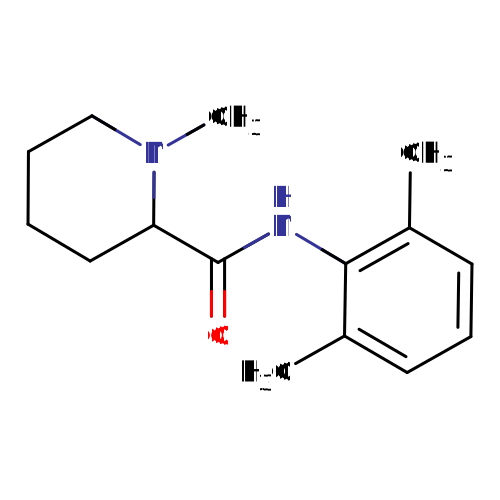
Structure for Mepivacaine (DB00961)
- Weight
- Average: 246.348
Monoisotopic: 246.173213336 - Chemical Formula
- C15H22N2O
- Synonyms
- (+-)-1-Methyl-2',6'-pipecoloxylidide
- 1-methyl-2',6'-pipecoloxylidide
- DL-Mepivacaine
- Mepivacaina
- Mepivacaine
- Mepivacainum
- N-(2,6-Dimethylphenyl)-1-methyl-2-piperidinecarboxamide
- N-(2,6-Dimethylphenyl)-1-methylpiperidine-2-carboxamide

Pharmacology
- Indication
For production of local or regional analgesia and anesthesia by local infiltration, peripheral nerve block techniques, and central neural techniques including epidural and caudal blocks.
 Reduce drug development failure ratesBuild, train, & validate machine-learning modelswith evidence-based and structured datasets.Build, train, & validate predictive machine-learning models with structured datasets.
- Associated Conditions
Indication Type Indication Combined Product Details Approval Level Age Group Patient Characteristics Dose Form Used in combination to treat Anaemia vitamin b6 deficiency Combination Product in combination with: Fursultiamine (DB08966), Pyridoxine (DB00165), Hydroxocobalamin (DB00200) •••••••••••• •••••••••• •••••••• Used in combination for symptomatic treatment of Anemia Combination Product in combination with: Pyridoxine (DB00165), Fursultiamine (DB08966), Hydroxocobalamin (DB00200) •••••••••••• •••••••••• •••••••• Used in combination to treat Blood loss anemia Combination Product in combination with: Hydroxocobalamin (DB00200), Fursultiamine (DB08966), Pyridoxine (DB00165) •••••••••••• •••••••••• •••••••• Used in combination for symptomatic treatment of Diabetic peripheral neuropathy (dpn) Combination Product in combination with: Fursultiamine (DB08966), Hydroxocobalamin (DB00200), Pyridoxine (DB00165) •••••••••••• •••••••••• •••••••• - Associated Therapies
- Contraindications & Blackbox Warnings
 Prevent Adverse Drug Events TodayTap into our Clinical API for life-saving information on contraindications & blackbox warnings, population restrictions, harmful risks, & more.Avoid life-threatening adverse drug events with our Clinical API
- Pharmacodynamics
Mepivicaine is an amide local anesthetic. Mepivicaine as a reasonably rapid onset and medium duration and is known by the proprietary names as Carbocaine and Polocaine. Mepivicaine is used in local infiltration and regional anesthesia. Systemic absorption of local anesthetics produces effects on the cardiovascular and central nervous systems. At blood concentrations achieved with normal therapeutic doses, changes in cardiac conduction, excitability, refractoriness, contractility, and peripheral vascular resistance are minimal.
- Mechanism of action
Local anesthetics block the generation and the conduction of nerve impulses, presumably by increasing the threshold for electrical excitation in the nerve, by slowing the propagation of the nerve impulse, and by reducing the rate of rise of the action potential. In general, the progression of anesthesia is related to the diameter, myelination, and conduction velocity of affected nerve fibers. Clinically, the order of loss of nerve function is as follows: pain, temperature, touch, proprioception, and skeletal muscle tone.
Target Actions Organism ASodium channel protein type 10 subunit alpha inhibitorHumans - Absorption
Absorbed locally. The rate of systemic absorption of local anesthetics is dependent upon the total dose and concentration of drug administered, the route of administration, the vascularity of the administration site, and the presence or absence of epinephrine in the anesthetic solution.
- Volume of distribution
Not Available
- Protein binding
Mepivacaine is approximately 75% bound to plasma proteins. Generally, the lower the plasma concentration of drug, the higher the percentage of drug bound to plasma.
- Metabolism
Rapidly metabolized, with only a small percentage of the anesthetic (5 percent to 10 percent) being excreted unchanged in the urine. The liver is the principal site of metabolism, with over 50% of the administered dose being excreted into the bile as metabolites.
- Route of elimination
It is rapidly metabolized, with only a small percentage of the anesthetic (5 percent to 10 percent) being excreted unchanged in the urine.The liver is the principal site of metabolism, with over 50% of the administered dose being excreted into the bile as metabolites.
- Half-life
The half-life of mepivacaine in adults is 1.9 to 3.2 hours and in neonates 8.7 to 9 hours.
- Clearance
Not Available
- Adverse Effects
 Improve decision support & research outcomesWith structured adverse effects data, including: blackbox warnings, adverse reactions, warning & precautions, & incidence rates. View sample adverse effects data in our new Data Library!Improve decision support & research outcomes with our structured adverse effects data.
- Toxicity
The mean seizure dosage of mepivacaine in rhesus monkeys was found to be 18.8 mg/kg with mean arterial plasma concentration of 24.4 µg/mL. The intravenous and subcutaneous LD 50 in mice is 23 mg/kg to 35 mg/kg and 280 mg/kg respectively.
- Pathways
Pathway Category Mepivacaine Action Pathway Drug action - Pharmacogenomic Effects/ADRs
- Not Available
Interactions
- Drug Interactions
- This information should not be interpreted without the help of a healthcare provider. If you believe you are experiencing an interaction, contact a healthcare provider immediately. The absence of an interaction does not necessarily mean no interactions exist.
Drug Interaction Integrate drug-drug
interactions in your software1,2-Benzodiazepine The risk or severity of CNS depression can be increased when Mepivacaine is combined with 1,2-Benzodiazepine. Abacavir Mepivacaine may decrease the excretion rate of Abacavir which could result in a higher serum level. Abemaciclib The risk or severity of methemoglobinemia can be increased when Abemaciclib is combined with Mepivacaine. Abiraterone The risk or severity of methemoglobinemia can be increased when Abiraterone is combined with Mepivacaine. Acebutolol The serum concentration of Mepivacaine can be increased when it is combined with Acebutolol. - Food Interactions
- No interactions found.
Products
 Drug product information from 10+ global regionsOur datasets provide approved product information including:dosage, form, labeller, route of administration, and marketing period.Access drug product information from over 10 global regions.
- Product Ingredients
Ingredient UNII CAS InChI Key Mepivacaine hydrochloride 4VFX2L7EM5 1722-62-9 RETIMRUQNCDCQB-UHFFFAOYSA-N - International/Other Brands
- Scandicaine
- Brand Name Prescription Products
Name Dosage Strength Route Labeller Marketing Start Marketing End Region Image 3% Polocaine Dental Liquid 30 mg / mL Infiltration Dentsply Pharmaceutical 2009-10-19 Not applicable Canada 
Carbocaine Injection, solution 10 mg/1mL Infiltration Hospira, Inc. 2007-10-10 2022-12-01 US 
Carbocaine Injection, solution 15 mg/1mL Epidural; Infiltration Hospira, Inc. 2006-04-28 2020-03-01 US Carbocaine Injection, solution 20 mg/1mL Infiltration Hospira, Inc. 2006-09-27 2020-01-01 US Carbocaine Injection, solution 10 mg/1mL Epidural; Infiltration Hospira, Inc. 2006-03-23 2020-07-01 US - Generic Prescription Products
Name Dosage Strength Route Labeller Marketing Start Marketing End Region Image Carbocaine Injection, solution 30 mg/1mL Submucosal Septodont, Inc. 2018-06-21 Not applicable US Carbocaine Injection, solution 30 mg/1mL Subcutaneous Caresteam Health, Inc. 2011-01-01 Not applicable US IQ Dental Mepivacaine Injection, solution 30 mg/1mL Submucosal Iq Dental 2012-08-15 Not applicable US Isocaine Injection, solution 30 mg/1mL Subcutaneous Novocol Inc. 2010-08-20 Not applicable US Mepivacaine Injection, solution 30 mg/1mL Submucosal Darby Dental Supply, LLC 2011-01-14 Not applicable US - Mixture Products
Name Ingredients Dosage Route Labeller Marketing Start Marketing End Region Image 2% Polocaine Dental With Levonordefrin 1:20,000 Mepivacaine hydrochloride (20 mg / mL) + Levonordefrin (0.05 mg / mL) Solution Infiltration Dentsply Pharmaceutical 1990-12-31 2011-08-04 Canada Carbocaine 2% With Neo-cobefrin Mepivacaine hydrochloride (20 mg / mL) + Levonordefrin (0.05 mg / mL) Solution Infiltration Carestream Health Inc. 2006-09-01 2018-09-06 Canada Carbocaine 2% With Neo-cobefrin Mepivacaine hydrochloride (20 mg / mL) + Levonordefrin (0.05 mg / mL) Solution Infiltration Kodak Canada Inc. 2005-04-22 2008-07-14 Canada Carbocaine 2% With Neo-cobefrin Mepivacaine hydrochloride (20 mg / mL) + Levonordefrin (0.05 mg / mL) Solution Infiltration Novocol Inc. 2019-07-30 2023-03-20 Canada Carbocaine with Neo-Cobefrin Mepivacaine hydrochloride (30 mg/1mL) + Levonordefrin (0.05 mg/1mL) Injection, solution Subcutaneous Septodont, Inc. 2018-11-19 Not applicable US
Categories
- ATC Codes
- N01BB53 — Mepivacaine, combinationsN01BB03 — Mepivacaine
- Drug Categories
- Amides
- Anesthetics
- Anesthetics, Local
- Central Nervous System Agents
- Central Nervous System Depressants
- Drugs that are Mainly Renally Excreted
- Local Anesthesia
- Local Anesthetics (Amide)
- Methemoglobinemia Associated Agents
- Nervous System
- Peripheral Nervous System Agents
- Piperidines
- Sensory System Agents
- Chemical TaxonomyProvided by Classyfire
- Description
- This compound belongs to the class of organic compounds known as piperidinecarboxamides. These are compounds containing a piperidine ring substituted with a carboxamide functional group.
- Kingdom
- Organic compounds
- Super Class
- Organoheterocyclic compounds
- Class
- Piperidines
- Sub Class
- Piperidinecarboxylic acids and derivatives
- Direct Parent
- Piperidinecarboxamides
- Alternative Parents
- m-Xylenes / Trialkylamines / Propargyl-type 1,3-dipolar organic compounds / Carboximidic acids / Azacyclic compounds / Organopnictogen compounds / Organooxygen compounds / Hydrocarbon derivatives
- Substituents
- 2-piperidinecarboxamide / Amine / Aromatic heteromonocyclic compound / Azacycle / Benzenoid / Carboximidic acid / Carboximidic acid derivative / Hydrocarbon derivative / M-xylene / Monocyclic benzene moiety
- Molecular Framework
- Aromatic heteromonocyclic compounds
- External Descriptors
- piperidinecarboxamide (CHEBI:6759)
- Affected organisms
- Humans and other mammals
Chemical Identifiers
- UNII
- B6E06QE59J
- CAS number
- 96-88-8
- InChI Key
- INWLQCZOYSRPNW-UHFFFAOYSA-N
- InChI
- InChI=1S/C15H22N2O/c1-11-7-6-8-12(2)14(11)16-15(18)13-9-4-5-10-17(13)3/h6-8,13H,4-5,9-10H2,1-3H3,(H,16,18)
- IUPAC Name
- N-(2,6-dimethylphenyl)-1-methylpiperidine-2-carboxamide
- SMILES
- CN1CCCCC1C(=O)NC1=C(C)C=CC=C1C
References
- Synthesis Reference
- US2799679
- General References
- Not Available
- External Links
- Human Metabolome Database
- HMDB0015096
- KEGG Drug
- D08181
- KEGG Compound
- C07528
- PubChem Compound
- 4062
- PubChem Substance
- 46507857
- ChemSpider
- 3922
- BindingDB
- 50417964
- 6759
- ChEBI
- 6759
- ChEMBL
- CHEMBL1087
- Therapeutic Targets Database
- DAP001232
- PharmGKB
- PA164748741
- RxList
- RxList Drug Page
- Drugs.com
- Drugs.com Drug Page
- Wikipedia
- Mepivacaine
- FDA label
- Download (180 KB)
- MSDS
- Download (73.2 KB)
Clinical Trials
- Clinical Trials
Phase Status Purpose Conditions Count 4 Completed Basic Science Bladder Cancer 1 4 Completed Supportive Care Ankle Fusion / Intraoperative Hypertension / Total Ankle Arthroplasty / Tourniquet Hypertension 1 4 Completed Supportive Care Pain 1 4 Completed Treatment Ambulatory Surgical Procedures / Arthroplasties, Replacement, Knee / Early Ambulation / Pain Management / Spinal Anesthesia therapy 1 4 Completed Treatment Anesthesia therapy / Pain / Surgery / Varicosities of the great saphenous vein 1
Pharmacoeconomics
- Manufacturers
- Solvay pharmaceuticals
- Eastman kodak co
- Hospira inc
- Novocol pharmaceutical inc
- Graham chemical co
- International medication system
- Watson laboratories inc
- App pharmaceuticals llc
- Dentsply pharmaceutical
- Deproco inc
- Packagers
- American Dental Cooperative Inc.
- APP Pharmaceuticals
- Ato Zizine Sarl
- Benco Dental Co.
- Cardent International Inc.
- Carestream Health Inc.
- Carlisle Laboratories Inc.
- Darby Dental Supply Co. Inc.
- DENTSPLY International
- Eastman Kodak Co. Dental Products
- H Meer Dental Supply Co.
- Henry Schein Inc.
- Hospira Inc.
- Kent Dental
- Les Laboratoires Medis S A
- Novocol Pharmaceutical Canada
- Patterson Dental Supply Inc.
- Safco Dental Supply Co.
- Septodont Inc.
- Spectrum Pharmaceuticals
- Veratex Corp.
- Dosage Forms
Form Route Strength Solution Parenteral 51 mg Solution Parenteral 30 mg Injection Parenteral 100 mg Injection Parenteral 200 mg Injection, solution Solution Epidural; Intracaudal 10 mg / mL Solution Infiltration 10 mg / mL Solution Epidural; Intracaudal 20 mg / mL Liquid Epidural; Intracaudal 10 mg / mL Liquid Intraspinal 20 mg / mL Liquid Epidural; Intracaudal 1 % Liquid Infiltration 1 % Liquid Epidural; Intracaudal 20 mg / mL Injection, solution 30 MG/ML Injection, solution Dental 30 mg/ml Solution Intravenous Injection Subcutaneous 30 mg/mL Injection, solution Infiltration Injection Parenteral 54 mg Injection, solution Infiltration Injection Parenteral 0.5 % Injection, solution Epidural; Intradermal; Intramuscular; Perineural 0.5 % Injection, solution Epidural; Intradermal; Intramuscular; Perineural 1 % Injection Parenteral 1 % Injection, solution Epidural; Perineural 2 % Injection Parenteral 2 % Solution Parenteral 54.000 mg Solution Subcutaneous Injection, solution Parenteral Solution Parenteral 1000 mg Injection, solution 1 % Injection, solution 10 MG/ML Injection, solution 2 % Injection, solution 20 MG/ML Injection, solution 3 % Injection, solution Parenteral 20 MG/ML Injection, solution Infiltration 3 % Injection, solution Dental; Infiltration 30 mg/1mL Solution Parenteral 200 mg Injection Buccal 30 mg/ml Solution Infiltration 30 mg / mL Solution Parenteral 10 mg Solution Parenteral 50 mg Solution Parenteral 20 mg Injection, solution Parenteral Solution Dental Solution Infiltration 30 mg Injection Dental 30 mg/1mL Injection Infiltration 10 mg/1mL Injection Infiltration 15 mg/1mL Injection Infiltration 20 mg/1mL Injection Subcutaneous Injection, solution Infiltration 10 mg/1mL Injection, solution Infiltration 20 mg/1mL Injection Dental Injection, solution Epidural; Infiltration 10 mg/1mL Injection, solution Epidural; Infiltration 15 mg/1mL Injection, solution Epidural; Infiltration 20 mg/1mL Solution Injection, solution Infiltration; Perineural 30 mg/ml Solution Infiltration Liquid Infiltration Injection Intramuscular Injection, solution Parenteral 3 % Injection, solution Buccal 3 % Injection, solution Buccal Injection, solution Submucosal 30 mg/1mL Liquid Infiltration 30 mg / mL Injection Intramuscular 54 mg/1.8ml Injection, solution Subcutaneous Injection, solution Subcutaneous 30 mg/1mL Solution Infiltration 54 mg Solution Subcutaneous 54.000 mg Solution Parenteral Solution Parenteral 54 mg Solution 30 mg/1ml - Prices
Unit description Cost Unit Mepivacaine hcl powder 318.33USD g Mepivacaine hcl 3% cartridge 0.46USD ml Carbocaine 1% vial 0.26USD ml Polocaine 1% vial 0.25USD ml Polocaine 2% vial 0.24USD ml Carbocaine 2% vial 0.19USD ml DrugBank does not sell nor buy drugs. Pricing information is supplied for informational purposes only.- Patents
- Not Available
Properties
- State
- Solid
- Experimental Properties
Property Value Source melting point (°C) 150.5 °C PhysProp water solubility 7000 mg/L (at 23 °C) YALKOWSKY,SH & DANNENFELSER,RM (1992) logP 1.95 HANSCH,C ET AL. (1995) logS -1.55 ADME Research, USCD pKa 7.7 SANGSTER (1994) - Predicted Properties
Property Value Source Water Solubility 0.621 mg/mL ALOGPS logP 2.16 ALOGPS logP 3.19 Chemaxon logS -2.6 ALOGPS pKa (Strongest Acidic) 13.62 Chemaxon pKa (Strongest Basic) 7.25 Chemaxon Physiological Charge 1 Chemaxon Hydrogen Acceptor Count 2 Chemaxon Hydrogen Donor Count 1 Chemaxon Polar Surface Area 32.34 Å2 Chemaxon Rotatable Bond Count 2 Chemaxon Refractivity 76.32 m3·mol-1 Chemaxon Polarizability 28.61 Å3 Chemaxon Number of Rings 2 Chemaxon Bioavailability 1 Chemaxon Rule of Five Yes Chemaxon Ghose Filter Yes Chemaxon Veber's Rule Yes Chemaxon MDDR-like Rule No Chemaxon - Predicted ADMET Features
Property Value Probability Human Intestinal Absorption + 0.9568 Blood Brain Barrier + 0.9749 Caco-2 permeable + 0.6836 P-glycoprotein substrate Substrate 0.7866 P-glycoprotein inhibitor I Inhibitor 0.6872 P-glycoprotein inhibitor II Non-inhibitor 0.8665 Renal organic cation transporter Non-inhibitor 0.5878 CYP450 2C9 substrate Non-substrate 0.7853 CYP450 2D6 substrate Substrate 0.7423 CYP450 3A4 substrate Substrate 0.7726 CYP450 1A2 substrate Non-inhibitor 0.7996 CYP450 2C9 inhibitor Non-inhibitor 0.933 CYP450 2D6 inhibitor Inhibitor 0.6146 CYP450 2C19 inhibitor Non-inhibitor 0.9387 CYP450 3A4 inhibitor Non-inhibitor 0.5395 CYP450 inhibitory promiscuity Low CYP Inhibitory Promiscuity 0.7497 Ames test Non AMES toxic 0.8252 Carcinogenicity Non-carcinogens 0.9333 Biodegradation Not ready biodegradable 0.939 Rat acute toxicity 1.7237 LD50, mol/kg Not applicable hERG inhibition (predictor I) Weak inhibitor 0.908 hERG inhibition (predictor II) Inhibitor 0.6936
Spectra
- Mass Spec (NIST)
- Download (7.1 KB)
- Spectra
- Chromatographic Properties
Collision Cross Sections (CCS)
Adduct CCS Value (Å2) Source type Source [M-H]- 165.305815 predictedDarkChem Lite v0.1.0 [M-H]- 159.3912 predictedDeepCCS 1.0 (2019) [M+H]+ 167.826115 predictedDarkChem Lite v0.1.0 [M+H]+ 161.7492 predictedDeepCCS 1.0 (2019) [M+Na]+ 165.468015 predictedDarkChem Lite v0.1.0 [M+Na]+ 167.84235 predictedDeepCCS 1.0 (2019)
Targets

- Kind
- Protein
- Organism
- Humans
- Pharmacological action
- Yes
- Actions
- Inhibitor
- General Function
- Voltage-gated sodium channel activity
- Specific Function
- Tetrodotoxin-resistant channel that mediates the voltage-dependent sodium ion permeability of excitable membranes. Assuming opened or closed conformations in response to the voltage difference acro...
- Gene Name
- SCN10A
- Uniprot ID
- Q9Y5Y9
- Uniprot Name
- Sodium channel protein type 10 subunit alpha
- Molecular Weight
- 220623.605 Da
References
- Overington JP, Al-Lazikani B, Hopkins AL: How many drug targets are there? Nat Rev Drug Discov. 2006 Dec;5(12):993-6. [Article]
- Imming P, Sinning C, Meyer A: Drugs, their targets and the nature and number of drug targets. Nat Rev Drug Discov. 2006 Oct;5(10):821-34. [Article]
- Leffler A, Reckzeh J, Nau C: Block of sensory neuronal Na+ channels by the secreolytic ambroxol is associated with an interaction with local anesthetic binding sites. Eur J Pharmacol. 2010 Mar 25;630(1-3):19-28. doi: 10.1016/j.ejphar.2009.12.027. Epub 2010 Jan 4. [Article]


Drug created at June 13, 2005 13:24 / Updated at April 26, 2024 00:46