Identification
- Summary
Dimenhydrinate is a medication used to prevent and treat nausea, vomiting, vertigo, and motion sickness.
- Brand Names
- Dramamine, Driminate, Gravol
- Generic Name
- Dimenhydrinate
- DrugBank Accession Number
- DB00985
- Background
Dimehydrinate was first described in the literature in 1949,5 and patented in 1950.11 Early research into dimenhydrinate focused on its role as an antihistamine for urticaria; the treatment of motion sickness was an accidental discovery.7
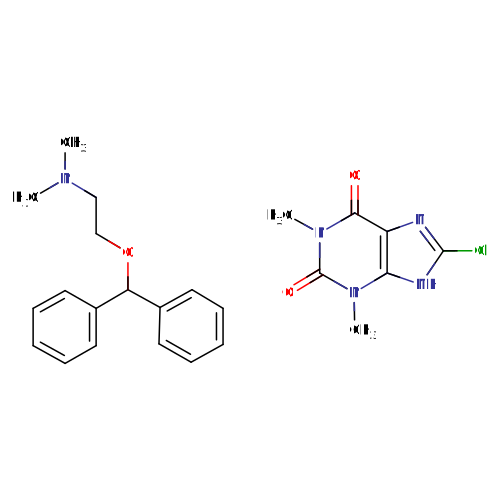
Dimenhydrinate, also known as B-dimethylaminoethyl benzohydrol ether 8-chlorotheophyllinate, is indicated to prevent nausea, vomiting, and dizziness caused by motion sickness.9,10,11 Dimenhydrinate is a combination of Diphenhydramine and 8-chlorotheophylline in a salt form, with 53%-55.5% dried diphenhydramine, and 44%-47% died 8-chlorotheophylline.10
The antiemetic properties of dimenhydrinate are primarily thought to be produced by diphenhydramine's antagonism of H1 histamine receptors in the vestibular system2 while the excitatory effects are thought to be produced by 8-chlorotheophylline's adenosine receptor blockade.3
When used in large doses, dimenhydrinate has been shown to cause a "high" characterized by hallucinations, excitement, incoordination, and disorientation.1
Dimenhydrinate was granted FDA approval on 31 May 1972.8
- Type
- Small Molecule
- Groups
- Approved
- Structure
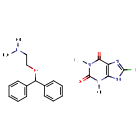
Structure for Dimenhydrinate (DB00985)
- Weight
- Average: 469.97
Monoisotopic: 469.1880675 - Chemical Formula
- C24H28ClN5O3
- Synonyms
- (O-benzhydryl(dimethylamino)ethanol) 8-chlorotheophyllinate
- 8-chloro-1,3-dimethyl-3,7-dihydro-1H-purine-2,6-dione - 2-(diphenylmethoxy)-N,N-dimethylethanamine (1:1)
- Benzhydryl-β-dimethylaminoethylether 8-chlorotheophylline
- Dimenhidrinato
- Dimenhydrinate
- Dimenhydrinatum
- diphenhydramine 8-chlorotheophyllinate
- diphenhydramine 8-chlorotheophylline
- Diphenhydramine theoclate
- N,N-dimethyl-2-diphenylmethoxyethylamine 8-chlorotheophyllinate
- O-benzhydryldimethylaminoethanol 8-chlorotheophyllinate
- β-dimethylaminoethyl benzhydryl ether 1,3-dimethyl-8-chloroxanthine

Pharmacology
- Indication
Dimenhydrinate is indicated for the prevention and treatment of nausea, vomiting, or vertigo of motion sickness.9,10
 Reduce drug development failure ratesBuild, train, & validate machine-learning modelswith evidence-based and structured datasets.Build, train, & validate predictive machine-learning models with structured datasets.
- Associated Conditions
Indication Type Indication Combined Product Details Approval Level Age Group Patient Characteristics Dose Form Used in combination for symptomatic treatment of Dizziness Combination Product in combination with: Pyridoxine (DB00165) •••••••••••• Symptomatic treatment of Labyrinthine disorder •••••••••••• Symptomatic treatment of Meniere's disease •••••••••••• Used in combination to treat Morning sickness Combination Product in combination with: Pyridoxine (DB00165) •••••••••••• Prophylaxis of Motion sickness ••• ••• - Contraindications & Blackbox Warnings
 Prevent Adverse Drug Events TodayTap into our Clinical API for life-saving information on contraindications & blackbox warnings, population restrictions, harmful risks, & more.Avoid life-threatening adverse drug events with our Clinical API
- Pharmacodynamics
Dimenhydrinate is indicated for the prevention and treatment of nausea, vomiting, or vertigo of motion sickness.9,10 It has a short duration of action of 4-8 hours.4 Patients should be counselled regarding pronounced drowsiness, avoiding alcohol and other sedatives, and exercising caution when operating a motor vehicle or heavy machinery.9
- Mechanism of action
Dimenhydrinate is a theoclate salt that separates into diphenhydramine and 8-chlorotheophylline.10,13 While the exact mechanism of action is unknown, diphenhydramine is theorized to reduce disturbances to equilibrium through antimuscarinic effects or histamine H1 antagonism.7 8-chlorotheophylline may produce excitation through blocking adenosine receptors, reducing the drowsiness produced by diphenhydramine.13
Target Actions Organism AHistamine H1 receptor antagonistHumans - Absorption
A 50 mg oral film coated tablet reaches a Cmax of 72.6 ng/mL with a Tmax of 2.7 hours.12 A 100 mg suppository reaches a Cmax of 112.2 ng/mL with a Tmax of 5.3 hours.13
- Volume of distribution
The volume of distribution of dimenhydrinate is 3-4 L/kg.12
- Protein binding
Dimenhydrinate is 70-85% protein bound in plasma.12
- Metabolism
Dimenhydrinate is a theoclate salt that separates into diphenhydramine and 8-chlorotheophylline.10 diphenhydramine can either be N-glucuronidated by UGTs to diphenhydramine N-glucuronide or N-demethylated by CYP2D6, CYP1A2, CYP2C9, and CYP2C19 to N-desmethyldiphenhydramine.6 N-desmethyldiphenhydramine can be N-demethylated again by the same enzymes to N,N-didesmethyldiphenhydramine, which undergoes oxidative deamination to form diphenylmethoxyacetic acid.6
Hover over products below to view reaction partners
- Route of elimination
Dimenhydrinate is predominantly eliminated in the urine.12 1-3% of the dissociated diphenhydramine is eliminated in the urine unchanged, while 64% of diphenhydramine is eliminated in the urine as metabolites.13 The elimination of dimenhydrinate has not been fully studied.13
- Half-life
The plasma elimination half life of dimenhydrinate is 5-8 hours.12
- Clearance
Not Available
- Adverse Effects
 Improve decision support & research outcomesWith structured adverse effects data, including: blackbox warnings, adverse reactions, warning & precautions, & incidence rates. View sample adverse effects data in our new Data Library!Improve decision support & research outcomes with our structured adverse effects data.
- Toxicity
Infants and children experiencing an overdose may lead to hallucinations, convulsions, or death.10 Adults experiencing an overdose may present with drowsiness, convulsions, coma, or respiratory depression.10 Treat overdoses with symptomatic and supportive measures including mechanically assisted ventilation.10
In mice the oral LD50 is 203 mg/kg, while in rats it is 1320 mg/kg.10 The intraperitoneal LD50 in mice is 149 mg/kg.10
- Pathways
- Not Available
- Pharmacogenomic Effects/ADRs
- Not Available
Interactions
- Drug Interactions
- This information should not be interpreted without the help of a healthcare provider. If you believe you are experiencing an interaction, contact a healthcare provider immediately. The absence of an interaction does not necessarily mean no interactions exist.
Drug Interaction Integrate drug-drug
interactions in your software1,2-Benzodiazepine The risk or severity of CNS depression can be increased when Dimenhydrinate is combined with 1,2-Benzodiazepine. Acetazolamide The risk or severity of CNS depression can be increased when Acetazolamide is combined with Dimenhydrinate. Acetophenazine The risk or severity of CNS depression can be increased when Dimenhydrinate is combined with Acetophenazine. Acrivastine The risk or severity of QTc prolongation can be increased when Acrivastine is combined with Dimenhydrinate. Adenosine The risk or severity of QTc prolongation can be increased when Adenosine is combined with Dimenhydrinate. - Food Interactions
- Avoid alcohol.
Products
 Drug product information from 10+ global regionsOur datasets provide approved product information including:dosage, form, labeller, route of administration, and marketing period.Access drug product information from over 10 global regions.
- Active Moieties
Name Kind UNII CAS InChI Key Diphenhydramine salt 8GTS82S83M 58-73-1 ZZVUWRFHKOJYTH-UHFFFAOYSA-N 8-chlorotheophylline salt GE2UA340FM 85-18-7 RYIGNEOBDRVTHA-UHFFFAOYSA-N - Product Images


- International/Other Brands
- Gravol (Church & Dwight) / Vertirosan (Astellas) / Vomex A (Astellas) / Xamamina (Adilna)
- Brand Name Prescription Products
Name Dosage Strength Route Labeller Marketing Start Marketing End Region Image Dimenhydrinate Inj 10mg/ml Liquid 10 mg / mL Intravenous Astra Pharma Inc. 1986-12-31 1999-07-29 Canada 
Dimenhydrinate Injection 50mg/ml Solution 50 mg / mL Intramuscular; Intravenous Astra Zeneca 1986-12-31 2005-05-31 Canada Dimenhydrinate Injection USP Solution 10 mg / mL Intravenous Sandoz Canada Incorporated 1973-12-31 Not applicable Canada Dimenhydrinate Injection USP Solution 50 mg / mL Intramuscular; Intravenous Sandoz Canada Incorporated Not applicable Not applicable Canada Dimenhydrinate Injection USP Solution 50 mg / mL Intramuscular; Intravenous Sandoz Canada Incorporated 1973-12-31 Not applicable Canada - Generic Prescription Products
Name Dosage Strength Route Labeller Marketing Start Marketing End Region Image Dimenhydrinate Injection, solution 50 mg/1mL Intramuscular; Intravenous Fresenius Kabi USA, LLC 2004-11-29 Not applicable US 
- Over the Counter Products
Name Dosage Strength Route Labeller Marketing Start Marketing End Region Image Ag-dimenhydrinate Tablet 50 mg Oral Angita Pharma Inc. Not applicable Not applicable Canada Airmit Ace Tablet 25 mg/1 Oral Sato Pharmaceutical Co., Ltd. 2005-03-11 Not applicable US Anti-nauseant Tablet 50 mg Oral TEVA Canada Limited Not applicable Not applicable Canada Anti-nauseant Tablet 50 mg Oral Pharmascience Inc Not applicable Not applicable Canada Anti-nauseant Tablet 50 mg Oral Pharmascience Inc 2002-08-23 Not applicable Canada - Mixture Products
Name Ingredients Dosage Route Labeller Marketing Start Marketing End Region Image Arlevert 20 mg/40 mg Tabletten Dimenhydrinate (40 mg) + Cinnarizine (20 mg) Tablet Oral Hennig Arzneimittel Gmb H & Co Kg 2007-09-06 Not applicable Austria 
Gravergol Capsules Dimenhydrinate (50 mg) + Caffeine (100 mg) + Ergotamine tartrate (1 mg) Capsule Oral Can Med Pharma Inc. 1957-12-31 2011-12-07 Canada Neo - Emedyl - Dragees Dimenhydrinate (50 mg) + Caffeine (50 mg) Tablet, sugar coated Oral Pharmazeutische Fabrik Montavit Gmb H 1965-05-20 Not applicable Austria Vertirosan Vitamin B6 - Manteldragees Dimenhydrinate (50 mg) + Pyridoxine hydrochloride (25 mg) Tablet, coated Oral Sigmapharm Arzneimittel Gmb H 1962-03-29 Not applicable Austria Vertirosan Vitamin B6 - Zäpfchen Dimenhydrinate (50 mg) + Pyridoxine hydrochloride (50 mg) Suppository Rectal Umip Limited 1962-03-29 Not applicable Austria


Categories
- ATC Codes
- R06AA11 — Dimenhydrinate
- R06AA — Aminoalkyl ethers
- R06A — ANTIHISTAMINES FOR SYSTEMIC USE
- R06 — ANTIHISTAMINES FOR SYSTEMIC USE
- R — RESPIRATORY SYSTEM
- Drug Categories
- Alkaloids
- Amines
- Aminoalkyl Ethers
- Antiemetics
- Antihistamines for Systemic Use
- Autonomic Agents
- Benzene Derivatives
- Benzhydryl Compounds
- Central Nervous System Agents
- Central Nervous System Depressants
- Ethanolamine Derivatives
- Ethylamines
- Gastrointestinal Agents
- Heterocyclic Compounds, Fused-Ring
- Histamine Agents
- Histamine Antagonists
- Histamine H1 Antagonists
- Moderate Risk QTc-Prolonging Agents
- Neurotransmitter Agents
- Peripheral Nervous System Agents
- Pharmaceutical Preparations
- Purines
- Purinones
- QTc Prolonging Agents
- Classification
- Not classified
- Affected organisms
- Humans and other mammals
Chemical Identifiers
- UNII
- JB937PER5C
- CAS number
- 523-87-5
- InChI Key
- NFLLKCVHYJRNRH-UHFFFAOYSA-N
- InChI
- InChI=1S/C17H21NO.C7H7ClN4O2/c1-18(2)13-14-19-17(15-9-5-3-6-10-15)16-11-7-4-8-12-16;1-11-4-3(9-6(8)10-4)5(13)12(2)7(11)14/h3-12,17H,13-14H2,1-2H3;1-2H3,(H,9,10)
- IUPAC Name
- 8-chloro-1,3-dimethyl-2,3,6,9-tetrahydro-1H-purine-2,6-dione; [2-(diphenylmethoxy)ethyl]dimethylamine
- SMILES
- CN1C2=C(N=C(Cl)N2)C(=O)N(C)C1=O.CN(C)CCOC(C1=CC=CC=C1)C1=CC=CC=C1
References
- Synthesis Reference
Cusic, J.W.; U.S. Patent 2,499,058; February 28,1950; assigned to G.D. Searle & Co. Cusic, J.W.; U.S. Patent 2,534,813; December 19,1950; assigned to G.D. Searle & Co.
- General References
- Halpert AG, Olmstead MC, Beninger RJ: Mechanisms and abuse liability of the anti-histamine dimenhydrinate. Neurosci Biobehav Rev. 2002 Jan;26(1):61-7. [Article]
- Jaju BP, Wang SC: Effects of diphenhydramine and dimenhydrinate on vestibular neuronal activity of cat: a search for the locus of their antimotion sickness action. J Pharmacol Exp Ther. 1971 Mar;176(3):718-24. [Article]
- Spealman RD: Psychomotor stimulant effects of methylxanthines in squirrel monkeys: relation to adenosine antagonism. Psychopharmacology (Berl). 1988;95(1):19-24. [Article]
- Koch A, Cascorbi I, Westhofen M, Dafotakis M, Klapa S, Kuhtz-Buschbeck JP: The Neurophysiology and Treatment of Motion Sickness. Dtsch Arztebl Int. 2018 Oct 12;115(41):687-696. doi: 10.3238/arztebl.2018.0687. [Article]
- FLEMING JF: New drug effective in motion sickness. Hosp Top. 1949 Mar;27(3):26. [Article]
- Zhou SF, Zhou ZW, Yang LP, Cai JP: Substrates, inducers, inhibitors and structure-activity relationships of human Cytochrome P450 2C9 and implications in drug development. Curr Med Chem. 2009;16(27):3480-675. Epub 2009 Sep 1. [Article]
- FERMIN H, van DEINSE JB, HAMMELBURG E: The effect of dimenhydrinate upon the labyrinth; (an experimental study). Acta Otolaryngol. 1950 Dec;38(6):543-9. doi: 10.3109/00016485009118417. [Article]
- FDA Approved Drug Products: Dimenhydrinate Oral Liquid (Discontinued) [Link]
- Dailymed: Dimenhydrinate Oral Tablet [Link]
- Dailymed: Dimenhydrinate Intramuscular and Intravenous Injection [Link]
- US Patent: US2499058A [Link]
- Sandoz Canada: Dimenhydrinate Intramuscular and Intravenous Injection [Link]
- Heads of Medicines Agencies Public Assessment Report: Dimenhydrinate Oral Lozenge [Link]
- External Links
- Human Metabolome Database
- HMDB0015120
- KEGG Drug
- D00520
- PubChem Compound
- 441281
- PubChem Substance
- 46504881
- ChemSpider
- 10210
- 3444
- ChEBI
- 94848
- ChEMBL
- CHEMBL1200406
- Therapeutic Targets Database
- DAP000333
- PharmGKB
- PA449338
- Drugs.com
- Drugs.com Drug Page
- Wikipedia
- Dimenhydrinate
- MSDS
- Download (72 KB)
Clinical Trials
- Clinical Trials
Phase Status Purpose Conditions Count 4 Completed Prevention Post Operative Nausea and Vomiting (PONV) 1 4 Completed Treatment Gastroenteritis 1 4 Completed Treatment Nausea / Vertigo / Vomiting 1 4 Completed Treatment Pain / Postoperative pain 1 4 Completed Treatment Vertigo, Peripheral 1
Pharmacoeconomics
- Manufacturers
- App pharmaceuticals llc
- Baxter healthcare corp anesthesia and critical care
- Watson laboratories inc
- Wyeth ayerst laboratories
- Alra laboratories inc
- Heather drug co inc
- Nexgen pharma inc
- Packagers
- APP Pharmaceuticals
- C.O. Truxton Inc.
- Consolidated Midland Corp.
- Dispensing Solutions
- Hospira Inc.
- Ivax Pharmaceuticals
- Major Pharmaceuticals
- Martin Surgical Supply
- Medisca Inc.
- Nexgen Pharma Inc.
- Pfizer Inc.
- Pharmacia Inc.
- Prescript Pharmaceuticals
- Southwood Pharmaceuticals
- Dosage Forms
Form Route Strength Tablet Oral 25 mg/1 Suspension Tablet, coated Oral 50 mg Solution Oral 15 mg / 5 mL Suppository Rectal 50 mg Syrup Oral 250.000 mg Injection, solution Intramuscular; Intravenous 50 mg/1mL Tablet Oral Tablet Oral 50 mg/1 Tablet, film coated Oral 50 mg/1 Liquid Intravenous 10 mg / mL Solution Intramuscular; Intravenous 250 mg / 5 mL Solution Intramuscular; Intravenous 50 mg / mL Solution Intravenous 10 mg / mL Liquid Oral 15 mg / 5 mL Capsule Oral 50.0 mg Tablet Oral 50.0 mg Tablet, chewable Oral 50 mg/1 Tablet, chewable Oral 25 mg/1 Tablet Oral Syrup Oral 12.5 MG/5ML Capsule Oral Capsule, liquid filled Oral 50 mg/1 Capsule, extended release Oral 75 mg Tablet, chewable Oral 50 mg Tablet Oral 15 mg Solution Intramuscular 50 mg / mL Tablet, multilayer Oral 100 mg Capsule Oral 50 mg Tablet, extended release Oral 75 mg Suppository Rectal 100 mg Tablet Oral 25 mg Capsule Oral 50.0000 mg Tablet, chewable Oral 15 mg Syrup Oral 15 mg / 5 mL Suppository Rectal 25 mg Tablet Oral 0.05 g Syrup Oral 25 mg/5ml Syrup Oral Tablet, coated Oral 50 mg/1 Solution Oral 0.25 g Syrup Oral 3 mg / mL Suppository Rectal Gum, chewing Oral Gum, chewing Oral 20 MG Tablet, sugar coated Oral 20 mg Tablet, coated Oral 100 MG Tablet, coated Oral 25 MG Injection, solution Intramuscular; Intravenous 150 mg/ml Injection, solution Intramuscular; Intravenous 50 mg/ml Solution / drops Oral 92.5 mg/ml Tablet, coated Oral Suppository Rectal Tablet Oral 5000000 mg Suppository Rectal 150 MG Suppository Rectal 70 MG Suppository Rectal 40 MG Tablet, orally disintegrating Sublingual 50 MG Solution Oral 25.000 mg Solution Parenteral 50.000 mg Tablet Oral 50.000 mg Injection Intramuscular; Intravenous 50 mg/ml Injection Intramuscular; Intravenous Tablet, film coated Oral 50 mg Tablet Capsule Tablet, sugar coated Oral Solution 50 mg/1ml Tablet Oral 50 mg Tablet, sugar coated Oral 50 mg Syrup Oral 15 mg/5ml - Prices
Unit description Cost Unit Dimenhydrinate 50 mg/ml vial 5.7USD ml Dimenhydrinate I.M. 50 mg/ml 1.17USD ml Meclizine 12.5 mg tablet 0.62USD tablet Dramamine less drowsy tablet 0.42USD tablet Dimenhydrinate I.V. 10 mg/ml 0.32USD ml Dramamine 50 mg tablet 0.28USD tablet Novamine 15% iv solution 0.09USD ml Dimenhydrinate 100% powder 0.07USD g Driminate 50 mg tablet 0.05USD tablet Dimenhydrinate 50 mg tablet 0.03USD tablet DrugBank does not sell nor buy drugs. Pricing information is supplied for informational purposes only.- Patents
- Not Available
Properties
- State
- Solid
- Experimental Properties
Property Value Source melting point (°C) 103-104 Cusic, J.W.; U.S. Patent 2,499,058; February 28,1950; assigned to G.D. Searle & Co. Cusic, J.W.; U.S. Patent 2,534,813; December 19,1950; assigned to G.D. Searle & Co. water solubility 3000 mg/L MERCK INDEX (1996); approx. - Predicted Properties
Property Value Source Water Solubility 9.86 mg/mL ALOGPS logP 0.44 ALOGPS logP 3.65 Chemaxon logS -1.3 ALOGPS pKa (Strongest Basic) 8.87 Chemaxon Physiological Charge 1 Chemaxon Hydrogen Acceptor Count 2 Chemaxon Hydrogen Donor Count 0 Chemaxon Polar Surface Area 12.47 Å2 Chemaxon Rotatable Bond Count 6 Chemaxon Refractivity 79.93 m3·mol-1 Chemaxon Polarizability 30.02 Å3 Chemaxon Number of Rings 4 Chemaxon Bioavailability 1 Chemaxon Rule of Five Yes Chemaxon Ghose Filter Yes Chemaxon Veber's Rule Yes Chemaxon MDDR-like Rule Yes Chemaxon - Predicted ADMET Features
Property Value Probability Human Intestinal Absorption + 0.9975 Blood Brain Barrier + 0.8551 Caco-2 permeable + 0.5198 P-glycoprotein substrate Substrate 0.7863 P-glycoprotein inhibitor I Non-inhibitor 0.6923 P-glycoprotein inhibitor II Inhibitor 0.6502 Renal organic cation transporter Non-inhibitor 0.6507 CYP450 2C9 substrate Non-substrate 0.7536 CYP450 2D6 substrate Non-substrate 0.8181 CYP450 3A4 substrate Substrate 0.7086 CYP450 1A2 substrate Inhibitor 0.5287 CYP450 2C9 inhibitor Non-inhibitor 0.6308 CYP450 2D6 inhibitor Non-inhibitor 0.8589 CYP450 2C19 inhibitor Non-inhibitor 0.5817 CYP450 3A4 inhibitor Non-inhibitor 0.9028 CYP450 inhibitory promiscuity Low CYP Inhibitory Promiscuity 0.5738 Ames test Non AMES toxic 0.5629 Carcinogenicity Non-carcinogens 0.7548 Biodegradation Not ready biodegradable 0.8211 Rat acute toxicity 2.4087 LD50, mol/kg Not applicable hERG inhibition (predictor I) Weak inhibitor 0.5364 hERG inhibition (predictor II) Inhibitor 0.5405
Spectra
- Mass Spec (NIST)
- Not Available
- Spectra
Spectrum Spectrum Type Splash Key Predicted 1H NMR Spectrum 1D NMR Not Applicable Predicted 13C NMR Spectrum 1D NMR Not Applicable - Chromatographic Properties
Collision Cross Sections (CCS)
Not Available
Targets

- Kind
- Protein
- Organism
- Humans
- Pharmacological action
- Yes
- Actions
- Antagonist
- General Function
- Histamine receptor activity
- Specific Function
- In peripheral tissues, the H1 subclass of histamine receptors mediates the contraction of smooth muscles, increase in capillary permeability due to contraction of terminal venules, and catecholamin...
- Gene Name
- HRH1
- Uniprot ID
- P35367
- Uniprot Name
- Histamine H1 receptor
- Molecular Weight
- 55783.61 Da
References

Drug created at June 13, 2005 13:24 / Updated at April 27, 2024 09:44