Identification
- Summary
Oxtriphylline is a bronchodilator used for the treatment of asthma, bronchitis, COPD, and emphysema.
- Brand Names
- Choledyl
- Generic Name
- Oxtriphylline
- DrugBank Accession Number
- DB01303
- Background
Oxtriphylline is the choline salt form of theophylline. Once in the body, theophylline is released and acts as a phosphodiesterase inhibitor, adenosine receptor blocker, and histone deacetylase activator. Its main physiological reponse is to dilate the bronchioles. As such, oxytriphylline is indicated mainly for asthma, bronchospasm, and COPD (i.e. all the same indications as the other theophyllines). It is marketed under the name Choledyl SA, and several forms of oxytriphylline have been discontinued. In the US, oxtriphylline is no longer available.
- Type
- Small Molecule
- Groups
- Approved
- Structure
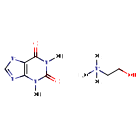
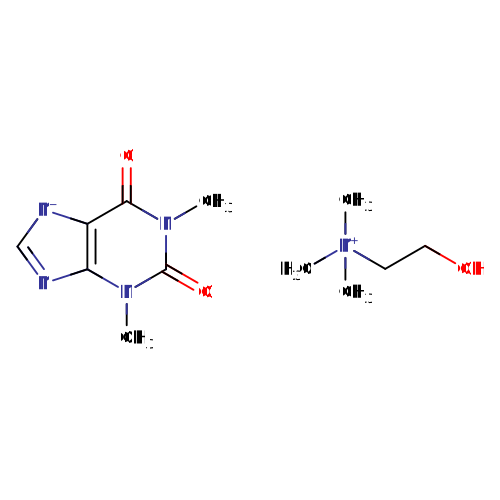
Structure for Oxtriphylline (DB01303)
- Weight
- Average: 283.3268
Monoisotopic: 283.164439563 - Chemical Formula
- C12H21N5O3
- Synonyms
- Choline theophyllinate
- Choline theophylline
- Cholini theophyllinas
- Oxtriphylline
- Teofilinato de colina
- Theocolin
- Theophyllinate de choline

Pharmacology
- Indication
Used to treat the symptoms of asthma, bronchitis, COPD, and emphysema.
 Reduce drug development failure ratesBuild, train, & validate machine-learning modelswith evidence-based and structured datasets.Build, train, & validate predictive machine-learning models with structured datasets.
- Associated Conditions
Indication Type Indication Combined Product Details Approval Level Age Group Patient Characteristics Dose Form Treatment of Bronchoconstriction •••••••••••• Used in combination to treat Bronchoconstriction Combination Product in combination with: Guaifenesin (DB00874) •••••••••••• Treatment of Bronchoconstriction •••••••••••• Treatment of Bronchoconstriction •••••••••••• - Contraindications & Blackbox Warnings
 Prevent Adverse Drug Events TodayTap into our Clinical API for life-saving information on contraindications & blackbox warnings, population restrictions, harmful risks, & more.Avoid life-threatening adverse drug events with our Clinical API
- Pharmacodynamics
Oxtriphylline is a bronchodilator. Oxtriphylline works in several ways: it relaxes muscles in your lungs and chest to allow more air in, decreases the sensitivity of your lungs to allergens and other substances that cause inflammation, and increases the contractions of your diaphragm to draw more air into the lungs.
- Mechanism of action
Oxtriphylline is a choline salt of theophylline. After ingestion, theophylline is released from oxytriphylline, and theophylline relaxes the smooth muscle of the bronchial airways and pulmonary blood vessels and reduces airway responsiveness to histamine, methacholine, adenosine, and allergen. Theophylline competitively inhibits type III and type IV phosphodiesterase (PDE), the enzyme responsible for breaking down cyclic AMP in smooth muscle cells, possibly resulting in bronchodilation. Theophylline also binds to the adenosine A2B receptor and blocks adenosine mediated bronchoconstriction. In inflammatory states, theophylline activates histone deacetylase to prevent transcription of inflammatory genes that require the acetylation of histones for transcription to begin.
Target Actions Organism AcGMP-inhibited 3',5'-cyclic phosphodiesterase A inhibitorHumans AcAMP-specific 3',5'-cyclic phosphodiesterase 4A inhibitorHumans AAdenosine receptor A2a antagonistHumans AAdenosine receptor A1 antagonistHumans AHistone deacetylase 2 activatorHumans - Absorption
After ingestion, theophylline is released from oxytriphylline in the acidic environment of the stomach.
- Volume of distribution
Theophylline has an apparent volume of distribution of 0.3–0.7 L/kg in children and adults, and the Vd is about twice that of an adult in premature infants.
- Protein binding
With a serum concentrations of 17 mcg/mL, adults and children have about 56% theophylline bound to plasma protein, and premature infants have about 36%.
- Metabolism
Theophylline undergoes hepatic metabolism to 1,3-dimethyluric acid, 1-methyluric acid, and 3-methylxanthine.
- Route of elimination
The kidneys are the main route of elimination for both theophylline and its metabolites, but some unchanged theophylline is eliminated in the feces.
- Half-life
The serum half life varies greatly between patients and in age. The half life range for a healthy, nonsmoking adult is 3-12.8 hours, for children is 1.5–9.5 hours, and for for premature infants is 15–58 hours.
- Clearance
Theophylline has an average clearance in children (over 6 months) of 1.45 mL/kg per minute, and in healthy, nonsmoking adults of 0.65 mL/kg per hour.
- Adverse Effects
 Improve decision support & research outcomesWith structured adverse effects data, including: blackbox warnings, adverse reactions, warning & precautions, & incidence rates. View sample adverse effects data in our new Data Library!Improve decision support & research outcomes with our structured adverse effects data.
- Toxicity
Symptoms of toxicity include abdominal pain (continuing or severe), confusion or change in behavior, convulsions (seizures), dark or bloody vomit, diarrhea, dizziness or lightheadedness, fast and/or irregular heartbeat, nervousness or restlessness (continuing), and trembling (continuing).
- Pathways
- Not Available
- Pharmacogenomic Effects/ADRs
- Not Available
Interactions
- Drug Interactions
- This information should not be interpreted without the help of a healthcare provider. If you believe you are experiencing an interaction, contact a healthcare provider immediately. The absence of an interaction does not necessarily mean no interactions exist.
Drug Interaction Integrate drug-drug
interactions in your software1,2-Benzodiazepine The therapeutic efficacy of 1,2-Benzodiazepine can be decreased when used in combination with Oxtriphylline. Abametapir The serum concentration of Oxtriphylline can be increased when it is combined with Abametapir. Abatacept The metabolism of Oxtriphylline can be increased when combined with Abatacept. Abiraterone The serum concentration of Oxtriphylline can be increased when it is combined with Abiraterone. Acebutolol The risk or severity of adverse effects can be increased when Acebutolol is combined with Oxtriphylline. - Food Interactions
- Limit caffeine intake.
- Take with food. Food reduces irritation.
Products
 Drug product information from 10+ global regionsOur datasets provide approved product information including:dosage, form, labeller, route of administration, and marketing period.Access drug product information from over 10 global regions.
- International/Other Brands
- Choledyl (Warner Chilcott) / Theocolin (Sannova)
- Brand Name Prescription Products
Name Dosage Strength Route Labeller Marketing Start Marketing End Region Image Choledyl Solution 100 mg / 5 mL Oral Searchlight Pharma Inc 1976-12-31 Not applicable Canada 
Choledyl Pediatric Syr 50mg/5ml Syrup 50 mg / 5 mL Oral Parke Davis Division, Warner Lambert Canada Inc. 1981-12-31 1999-08-13 Canada Choledyl Sa Tablets 400mg Tablet, extended release 400 mg Oral Erfa Canada 2012 Inc 1983-12-31 2005-07-13 Canada Choledyl Sa Tablets 600mg Tablet, extended release 600 mg Oral Erfa Canada 2012 Inc 1982-12-31 2005-07-13 Canada Choledyl Tab 200mg Tablet 200 mg / tab Oral Parke Davis Division, Warner Lambert Canada Inc. 1951-12-31 1999-04-08 Canada - Generic Prescription Products
Name Dosage Strength Route Labeller Marketing Start Marketing End Region Image Apo Oxtriphylline Tab 100mg Tablet 100 mg Oral Apotex Corporation 1982-12-31 2019-01-16 Canada Apo Oxtriphylline Tab 200mg Tablet 200 mg Oral Apotex Corporation 1982-12-31 2019-01-16 Canada Apo Oxtriphylline Tab 300mg Tablet 300 mg Oral Apotex Corporation 1982-12-31 2019-01-16 Canada Novo-triphyl Tab 100mg Tablet 100 mg Oral Novopharm Limited 1981-12-31 2005-08-10 Canada Novo-triphyl Tab 200mg Tablet 200 mg Oral Novopharm Limited 1981-12-31 2005-08-10 Canada - Mixture Products
Name Ingredients Dosage Route Labeller Marketing Start Marketing End Region Image Choledyl Expectorant Oxtriphylline (100 mg / 5 mL) + Guaifenesin (50 mg / 5 mL) Solution Oral Searchlight Pharma Inc 1981-12-31 Not applicable Canada PMS-oxtriphylline Elixir Oxtriphylline (20 mg / mL) + Ethanol (.2 mL / mL) Elixir Oral Pharmascience Inc 1992-12-31 2016-10-28 Canada บรองโคดีล ไซรับ Oxtriphylline (100 MG/5mL) + Guaifenesin (50 MG/5mL) Syrup ห้างหุ้นส่วนจำกัด สุพงษ์เภสัช 1985-02-22 Not applicable Thailand 
Categories
- ATC Codes
- R03DA20 — Combinations of xanthines
- R03DA — Xanthines
- R03D — OTHER SYSTEMIC DRUGS FOR OBSTRUCTIVE AIRWAY DISEASES
- R03 — DRUGS FOR OBSTRUCTIVE AIRWAY DISEASES
- R — RESPIRATORY SYSTEM
- R03DB — Xanthines and adrenergics
- R03D — OTHER SYSTEMIC DRUGS FOR OBSTRUCTIVE AIRWAY DISEASES
- R03 — DRUGS FOR OBSTRUCTIVE AIRWAY DISEASES
- R — RESPIRATORY SYSTEM
- Drug Categories
- Alcohols
- Alkaloids
- Amines
- Amino Alcohols
- Anti-Asthmatic Agents
- Autonomic Agents
- Bronchodilator Agents
- Cytochrome P-450 CYP1A2 Substrates
- Cytochrome P-450 Substrates
- Drugs for Obstructive Airway Diseases
- Ethanolamines
- Heterocyclic Compounds, Fused-Ring
- Onium Compounds
- Peripheral Nervous System Agents
- Purines
- Purinones
- Quaternary Ammonium Compounds
- Respiratory Smooth Muscle Relaxants
- Respiratory System Agents
- Trimethyl Ammonium Compounds
- Xanthine derivatives
- Xanthines and Adrenergics
- Chemical TaxonomyProvided by Classyfire
- Description
- This compound belongs to the class of organic compounds known as xanthines. These are purine derivatives with a ketone group conjugated at carbons 2 and 6 of the purine moiety.
- Kingdom
- Organic compounds
- Super Class
- Organoheterocyclic compounds
- Class
- Imidazopyrimidines
- Sub Class
- Purines and purine derivatives
- Direct Parent
- Xanthines
- Alternative Parents
- 6-oxopurines / Alkaloids and derivatives / Pyrimidones / Cholines / Vinylogous amides / Tetraalkylammonium salts / Imidazoles / Heteroaromatic compounds / Ureas / 1,2-aminoalcohols show 8 more
- Substituents
- 1,2-aminoalcohol / 6-oxopurine / Alcohol / Alkaloid or derivatives / Alkanolamine / Amine / Aromatic heteropolycyclic compound / Azacycle / Azole / Choline show 21 more
- Molecular Framework
- Not Available
- External Descriptors
- Not Available
- Affected organisms
- Humans and other mammals
Chemical Identifiers
- UNII
- 3K045XR58X
- CAS number
- 4499-40-5
- InChI Key
- RLANKEDHRWMNRO-UHFFFAOYSA-M
- InChI
- InChI=1S/C7H8N4O2.C5H14NO/c1-10-5-4(8-3-9-5)6(12)11(2)7(10)13;1-6(2,3)4-5-7/h3H,1-2H3,(H,8,9,12);7H,4-5H2,1-3H3/q;+1/p-1
- IUPAC Name
- (2-hydroxyethyl)trimethylazanium; 1,3-dimethyl-2,6-dioxo-2,3,6,7-tetrahydro-1H-purin-7-ide
- SMILES
- C[N+](C)(C)CCO.CN1C2=C([N-]C=N2)C(=O)N(C)C1=O
References
- Synthesis Reference
Ladenburg, K., Duesel, B.F. and Fand,T.I.; U S . Patent 2,776,287; January 1,1957; assigned to Nepera Chemical Co., Inc.
- General References
- Not Available
- External Links
- Human Metabolome Database
- HMDB0015415
- KEGG Drug
- D02017
- PubChem Compound
- 656652
- PubChem Substance
- 46507376
- ChemSpider
- 25044543
- 20976
- ChEMBL
- CHEMBL1200434
- Therapeutic Targets Database
- DAP000868
- PharmGKB
- PA164748137
- Drugs.com
- Drugs.com Drug Page
- Wikipedia
- Oxtriphylline
Clinical Trials
Pharmacoeconomics
- Manufacturers
- Not Available
- Packagers
- Warner Chilcott Co. Inc.
- Dosage Forms
Form Route Strength Solution Oral 100 mg / 5 mL Solution Oral Syrup Oral 50 mg / 5 mL Tablet, extended release Oral 400 mg Tablet, extended release Oral 600 mg Tablet Oral 100 mg Tablet Oral 200 mg Tablet Oral 300 mg Tablet Oral 300 mg / tab Elixir Oral Syrup Oral 10 mg / mL Tablet Oral 100 mg / tab Tablet Oral 200 mg / tab Suppository Syrup - Prices
Unit description Cost Unit Choledyl 20 mg/ml Elixir 0.04USD ml Pms-Oxtriphylline 20 mg/ml Elixir 0.02USD ml DrugBank does not sell nor buy drugs. Pricing information is supplied for informational purposes only.- Patents
- Not Available
Properties
- State
- Solid
- Experimental Properties
Property Value Source water solubility Soluble in alcohol and water. From Lexicomp. - Predicted Properties
Property Value Source Water Solubility 3.84 mg/mL ALOGPS logP -0.99 ALOGPS logP -0.77 Chemaxon logS -1.9 ALOGPS pKa (Strongest Acidic) 7.82 Chemaxon pKa (Strongest Basic) -0.78 Chemaxon Physiological Charge 0 Chemaxon Hydrogen Acceptor Count 4 Chemaxon Hydrogen Donor Count 0 Chemaxon Polar Surface Area 66.4 Å2 Chemaxon Rotatable Bond Count 2 Chemaxon Refractivity 45.51 m3·mol-1 Chemaxon Polarizability 16.49 Å3 Chemaxon Number of Rings 2 Chemaxon Bioavailability 1 Chemaxon Rule of Five Yes Chemaxon Ghose Filter No Chemaxon Veber's Rule No Chemaxon MDDR-like Rule No Chemaxon - Predicted ADMET Features
Property Value Probability Human Intestinal Absorption + 0.585 Blood Brain Barrier + 0.7679 Caco-2 permeable - 0.5861 P-glycoprotein substrate Substrate 0.718 P-glycoprotein inhibitor I Non-inhibitor 0.9763 P-glycoprotein inhibitor II Non-inhibitor 0.9261 Renal organic cation transporter Non-inhibitor 0.8496 CYP450 2C9 substrate Non-substrate 0.7126 CYP450 2D6 substrate Non-substrate 0.8089 CYP450 3A4 substrate Substrate 0.5699 CYP450 1A2 substrate Non-inhibitor 0.7873 CYP450 2C9 inhibitor Non-inhibitor 0.937 CYP450 2D6 inhibitor Non-inhibitor 0.9259 CYP450 2C19 inhibitor Non-inhibitor 0.9227 CYP450 3A4 inhibitor Non-inhibitor 0.9707 CYP450 inhibitory promiscuity Low CYP Inhibitory Promiscuity 0.9716 Ames test Non AMES toxic 0.6337 Carcinogenicity Non-carcinogens 0.8347 Biodegradation Ready biodegradable 0.9052 Rat acute toxicity 2.5809 LD50, mol/kg Not applicable hERG inhibition (predictor I) Weak inhibitor 0.8706 hERG inhibition (predictor II) Non-inhibitor 0.8959
Spectra
- Mass Spec (NIST)
- Not Available
- Spectra
Spectrum Spectrum Type Splash Key Predicted 1H NMR Spectrum 1D NMR Not Applicable Predicted 13C NMR Spectrum 1D NMR Not Applicable - Chromatographic Properties
Collision Cross Sections (CCS)
Adduct CCS Value (Å2) Source type Source [M-H]- 140.4610474 predictedDarkChem Lite v0.1.0 [M-H]- 157.75244 predictedDeepCCS 1.0 (2019) [M+H]+ 141.2269474 predictedDarkChem Lite v0.1.0 [M+H]+ 160.11044 predictedDeepCCS 1.0 (2019) [M+Na]+ 140.5053474 predictedDarkChem Lite v0.1.0 [M+Na]+ 166.2036 predictedDeepCCS 1.0 (2019)
Targets

- Kind
- Protein
- Organism
- Humans
- Pharmacological action
- Yes
- Actions
- Inhibitor
- General Function
- Metal ion binding
- Specific Function
- Cyclic nucleotide phosphodiesterase with a dual-specificity for the second messengers cAMP and cGMP, which are key regulators of many important physiological processes.
- Gene Name
- PDE3A
- Uniprot ID
- Q14432
- Uniprot Name
- cGMP-inhibited 3',5'-cyclic phosphodiesterase A
- Molecular Weight
- 124978.06 Da
References
- Rickards KJ, Andrews MJ, Waterworth TH, Alexander GB, Cunningham FM: Differential effects of phosphodiesterase inhibitors on platelet activating factor (PAF)- and adenosine diphosphate (ADP)-induced equine platelet aggregation. J Vet Pharmacol Ther. 2003 Aug;26(4):277-82. [Article]
- Wu BN, Lin RJ, Lo YC, Shen KP, Wang CC, Lin YT, Chen IJ: KMUP-1, a xanthine derivative, induces relaxation of guinea-pig isolated trachea: the role of the epithelium, cyclic nucleotides and K+ channels. Br J Pharmacol. 2004 Aug;142(7):1105-14. Epub 2004 Jul 5. [Article]
- Kajikawa S, Kigami D, Nakayama H, Doi K: Changes in submaxillary gland gene expression in F344 rats by multiple dosing of theophylline. Exp Anim. 2006 Apr;55(2):143-6. [Article]
- Kind
- Protein
- Organism
- Humans
- Pharmacological action
- Yes
- Actions
- Inhibitor
- General Function
- Metal ion binding
- Specific Function
- Hydrolyzes the second messenger cAMP, which is a key regulator of many important physiological processes.
- Gene Name
- PDE4A
- Uniprot ID
- P27815
- Uniprot Name
- cAMP-specific 3',5'-cyclic phosphodiesterase 4A
- Molecular Weight
- 98142.155 Da
References
- Wang K, Chen JQ, Chen Z, Chen JC: Inhibition of human phosphodiesterase 4A expressed in yeast cell GL62 by theophylline, rolipram, and acetamide-45. Acta Pharmacol Sin. 2002 Nov;23(11):1013-7. [Article]
- Haider S: Cyclic AMP level and phosphodiesterase activity during 17alpha,20beta-dihydroxy-4-pregnen-3-one induction and theophylline inhibition of oocyte maturation in the catfish, Clarias batrachus. Comp Biochem Physiol A Mol Integr Physiol. 2003 Feb;134(2):267-74. [Article]
- Rickards KJ, Andrews MJ, Waterworth TH, Alexander GB, Cunningham FM: Differential effects of phosphodiesterase inhibitors on platelet activating factor (PAF)- and adenosine diphosphate (ADP)-induced equine platelet aggregation. J Vet Pharmacol Ther. 2003 Aug;26(4):277-82. [Article]
- Usta C, Sadan G, Tuncel B: The effect of the indomethacin on phosphodiesterase inhibitors mediated responses in isolated trachea preparations. Prostaglandins Leukot Essent Fatty Acids. 2004 Sep;71(3):137-41. [Article]
- Lee JM, Zemans RL, Hejazi M, Chin BB, Ladenson PW, Caturegli P: Modulation of thyroidal radioiodine uptake by theophylline. Exp Mol Pathol. 2004 Oct;77(2):116-20. [Article]
- Kind
- Protein
- Organism
- Humans
- Pharmacological action
- Yes
- Actions
- Antagonist
- General Function
- Identical protein binding
- Specific Function
- Receptor for adenosine. The activity of this receptor is mediated by G proteins which activate adenylyl cyclase.
- Gene Name
- ADORA2A
- Uniprot ID
- P29274
- Uniprot Name
- Adenosine receptor A2a
- Molecular Weight
- 44706.925 Da
References
- Pechlivanova DM, Georgiev VP: Effects of single and long-term theophylline treatment on the threshold of mechanical nociception: contribution of adenosine A1 and alpha2-adrenoceptors. Methods Find Exp Clin Pharmacol. 2005 Nov;27(9):659-64. [Article]
- Daly JW, Jacobson KA, Ukena D: Adenosine receptors: development of selective agonists and antagonists. Prog Clin Biol Res. 1987;230:41-63. [Article]
- Kind
- Protein
- Organism
- Humans
- Pharmacological action
- Yes
- Actions
- Antagonist
- General Function
- Purine nucleoside binding
- Specific Function
- Receptor for adenosine. The activity of this receptor is mediated by G proteins which inhibit adenylyl cyclase.
- Gene Name
- ADORA1
- Uniprot ID
- P30542
- Uniprot Name
- Adenosine receptor A1
- Molecular Weight
- 36511.325 Da
References
- Nantwi KD, Basura GJ, Goshgarian HG: Adenosine A1 receptor mRNA expression and the effects of systemic theophylline administration on respiratory function 4 months after C2 hemisection. J Spinal Cord Med. 2003 Winter;26(4):364-71. [Article]
- Daly JW, Jacobson KA, Ukena D: Adenosine receptors: development of selective agonists and antagonists. Prog Clin Biol Res. 1987;230:41-63. [Article]
- Kind
- Protein
- Organism
- Humans
- Pharmacological action
- Yes
- Actions
- Activator
- General Function
- Transcription factor binding
- Specific Function
- Responsible for the deacetylation of lysine residues on the N-terminal part of the core histones (H2A, H2B, H3 and H4). Histone deacetylation gives a tag for epigenetic repression and plays an impo...
- Gene Name
- HDAC2
- Uniprot ID
- Q92769
- Uniprot Name
- Histone deacetylase 2
- Molecular Weight
- 55363.855 Da
References
- Cosio BG, Tsaprouni L, Ito K, Jazrawi E, Adcock IM, Barnes PJ: Theophylline restores histone deacetylase activity and steroid responses in COPD macrophages. J Exp Med. 2004 Sep 6;200(5):689-95. Epub 2004 Aug 30. [Article]
- Ito K, Lim S, Caramori G, Cosio B, Chung KF, Adcock IM, Barnes PJ: A molecular mechanism of action of theophylline: Induction of histone deacetylase activity to decrease inflammatory gene expression. Proc Natl Acad Sci U S A. 2002 Jun 25;99(13):8921-6. Epub 2002 Jun 17. [Article]
Enzymes
- Kind
- Protein
- Organism
- Humans
- Pharmacological action
- Unknown
- Actions
- Substrate
- General Function
- Oxidoreductase activity, acting on paired donors, with incorporation or reduction of molecular oxygen, reduced flavin or flavoprotein as one donor, and incorporation of one atom of oxygen
- Specific Function
- Cytochromes P450 are a group of heme-thiolate monooxygenases. In liver microsomes, this enzyme is involved in an NADPH-dependent electron transport pathway. It oxidizes a variety of structurally un...
- Gene Name
- CYP1A2
- Uniprot ID
- P05177
- Uniprot Name
- Cytochrome P450 1A2
- Molecular Weight
- 58293.76 Da
References
- Brosen K: Drug interactions and the cytochrome P450 system. The role of cytochrome P450 1A2. Clin Pharmacokinet. 1995;29 Suppl 1:20-5. [Article]
- Wang B, Zhou SF: Synthetic and natural compounds that interact with human cytochrome P450 1A2 and implications in drug development. Curr Med Chem. 2009;16(31):4066-218. [Article]
- Sarkar MA, Hunt C, Guzelian PS, Karnes HT: Characterization of human liver cytochromes P-450 involved in theophylline metabolism. Drug Metab Dispos. 1992 Jan-Feb;20(1):31-7. [Article]
- Thorn CF, Aklillu E, Klein TE, Altman RB: PharmGKB summary: very important pharmacogene information for CYP1A2. Pharmacogenet Genomics. 2012 Jan;22(1):73-7. doi: 10.1097/FPC.0b013e32834c6efd. [Article]
- Flockhart Table of Drug Interactions [Link]
Transporters
- Kind
- Protein
- Organism
- Humans
- Pharmacological action
- Unknown
- Actions
- Inhibitor
- General Function
- Sodium-independent organic anion transmembrane transporter activity
- Specific Function
- Mediates sodium-independent multispecific organic anion transport. Transport of prostaglandin E2, prostaglandin F2, tetracycline, bumetanide, estrone sulfate, glutarate, dehydroepiandrosterone sulf...
- Gene Name
- SLC22A7
- Uniprot ID
- Q9Y694
- Uniprot Name
- Solute carrier family 22 member 7
- Molecular Weight
- 60025.025 Da
References
- Kobayashi Y, Sakai R, Ohshiro N, Ohbayashi M, Kohyama N, Yamamoto T: Possible involvement of organic anion transporter 2 on the interaction of theophylline with erythromycin in the human liver. Drug Metab Dispos. 2005 May;33(5):619-22. Epub 2005 Feb 11. [Article]

Drug created at June 30, 2007 14:28 / Updated at April 27, 2024 09:44