Identification
- Summary
Aminophenazone is an analgesic drug used to treat acute migraine attacks in combination with ergotamine and caffeine.
- Generic Name
- Aminophenazone
- DrugBank Accession Number
- DB01424
- Background
Aminophenazone is a pyrazolone with analgesic, anti-inflammatory, and antipyretic properties that carries a risk of agranulocytosis. In biomedical applications, radiolabelled (13C-labeled) aminophenazone has been used in breath tests to measure the cytochrome P-450 metabolic activity in liver function tests. The FDA suspended the use of aminophenazone due to its association with agranulocytosis, a life-threatening side effect.2,3
- Type
- Small Molecule
- Groups
- Approved, Withdrawn
- Structure
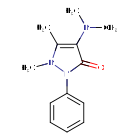
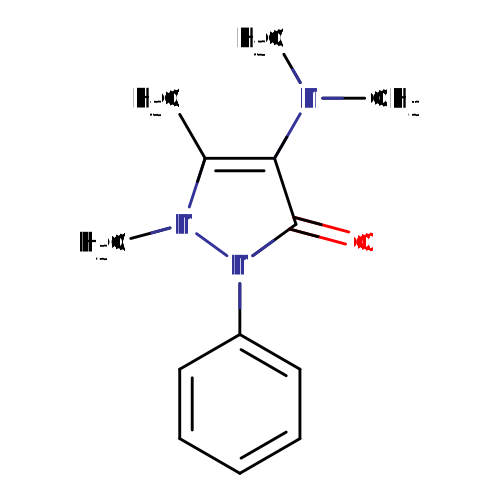
Structure for Aminophenazone (DB01424)
- Weight
- Average: 231.2936
Monoisotopic: 231.137162181 - Chemical Formula
- C13H17N3O
- Synonyms
- (Dimethylamino)phenazone
- 1-Phenyl-2,3-dimethyl-4-(dimethylamino)-5-pyrazolone
- 1-Phenyl-2,3-dimethyl-4-dimethylaminopyrazol-5-one
- 1,5-Dimethyl-4-dimethylamino-2-phenyl-3-pyrazolone
- 2,3-Dimethyl-4-dimethylamino-1-phenyl-5-pyrazolone
- 3-Keto-1,5-dimethyl-4-dimethylamino-2-phenyl-2,3-dihydropyrazole
- 4-(Dimethylamino)-1,2-dihydro-1,5-dimethyl-2-phenyl-3H-pyrazol-3-one
- 4-(Dimethylamino)-1,5-dimethyl-2-phenyl-1,2-dihydro-3H-pyrazol-3-one
- 4-(Dimethylamino)antipyrine
- 4-Dimethylamino-1-phenyl-2,3-dimethylpyrazolone
- 4-Dimethylamino-2,3-dimethyl-1-phenyl-3-pyrazolin-5-one
- 4-Dimethylamino-2,3-dimethyl-1-phenyl-5-pyrazolone
- 4-Dimethylaminoantipyrine
- 4-Dimethylaminophenazone
- Aminofenazona
- Aminofenazone
- Aminophenazon
- Aminophenazone
- Aminophenazonum
- Aminopyrine
- Dimethylaminoantipyrine
- Dimethylaminoazophene
- Dimethylaminophenazon
- Dimethylaminophenazone
- Dimethylaminophenyldimethylpyrazolone
- Dipyrine
- External IDs
- NSC-4993

Pharmacology
- Indication
Formerly widely used as an antipyretic and analgesic in rheumatism, neuritis, and common colds. Currently used to measure total body water.
 Reduce drug development failure ratesBuild, train, & validate machine-learning modelswith evidence-based and structured datasets.Build, train, & validate predictive machine-learning models with structured datasets.
- Associated Conditions
Indication Type Indication Combined Product Details Approval Level Age Group Patient Characteristics Dose Form Used in combination for symptomatic treatment of Acute migraine Combination Product in combination with: Caffeine (DB00201), Ergotamine (DB00696) •••••••••••• ••••••••••• - Contraindications & Blackbox Warnings
 Prevent Adverse Drug Events TodayTap into our Clinical API for life-saving information on contraindications & blackbox warnings, population restrictions, harmful risks, & more.Avoid life-threatening adverse drug events with our Clinical API
- Pharmacodynamics
Aminophenazone exhibits analgesic, anti-inflammatory, and antipyretic properties.
- Mechanism of action
Aminophenazone is metabolized very slowly by normal newborn babies. In older infants, a higher amount of exhaled 13-CO2 is observed.
- Absorption
Not Available
- Volume of distribution
Not Available
- Protein binding
Not Available
- Metabolism
Hover over products below to view reaction partners
- Route of elimination
Not Available
- Half-life
Not Available
- Clearance
Not Available
- Adverse Effects
 Improve decision support & research outcomesWith structured adverse effects data, including: blackbox warnings, adverse reactions, warning & precautions, & incidence rates. View sample adverse effects data in our new Data Library!Improve decision support & research outcomes with our structured adverse effects data.
- Toxicity
Can cause life-threatening agranulocytosis.
- Pathways
- Not Available
- Pharmacogenomic Effects/ADRs
- Not Available
Interactions
- Drug Interactions
- This information should not be interpreted without the help of a healthcare provider. If you believe you are experiencing an interaction, contact a healthcare provider immediately. The absence of an interaction does not necessarily mean no interactions exist.
Drug Interaction Integrate drug-drug
interactions in your softwareAbacavir Aminophenazone may decrease the excretion rate of Abacavir which could result in a higher serum level. Abametapir The serum concentration of Aminophenazone can be increased when it is combined with Abametapir. Abatacept The metabolism of Aminophenazone can be increased when combined with Abatacept. Abciximab The risk or severity of bleeding and hemorrhage can be increased when Aminophenazone is combined with Abciximab. Abiraterone The serum concentration of Aminophenazone can be increased when it is combined with Abiraterone. - Food Interactions
- Not Available
Products
 Drug product information from 10+ global regionsOur datasets provide approved product information including:dosage, form, labeller, route of administration, and marketing period.Access drug product information from over 10 global regions.
- Mixture Products
Name Ingredients Dosage Route Labeller Marketing Start Marketing End Region Image VIRDEX Aminophenazone (250 MG) + Caffeine (100 MG) + Ergotamine tartrate (0.5 MG) Suppository Rectal Fulton Medicinali S.P.A. 2014-07-08 Not applicable Italy 
VIRDEX Aminophenazone (250 MG) + Caffeine (100 MG) + Ergotamine tartrate (2 MG) Suppository Rectal Fulton Medicinali S.P.A. 2014-07-08 Not applicable Italy
Categories
- ATC Codes
- N02BB53 — Aminophenazone, combinations excl. psycholepticsN02BB03 — AminophenazoneN02BB73 — Aminophenazone, combinations with psycholeptics
- Drug Categories
- Agents causing hyperkalemia
- Agents that produce hypertension
- Analgesics
- Anti-Inflammatory Agents
- Anti-Inflammatory Agents, Non-Steroidal
- Cytochrome P-450 CYP1A2 Substrates
- Cytochrome P-450 CYP2C18 Substrates
- Cytochrome P-450 CYP2C19 Inhibitors
- Cytochrome P-450 CYP2C19 Substrates
- Cytochrome P-450 CYP2C8 Substrates
- Cytochrome P-450 CYP2C9 Substrates
- Cytochrome P-450 CYP2D6 Substrates
- Cytochrome P-450 CYP3A Substrates
- Cytochrome P-450 CYP3A4 Substrates
- Cytochrome P-450 Enzyme Inhibitors
- Cytochrome P-450 Substrates
- Nephrotoxic agents
- Nervous System
- Non COX-2 selective NSAIDS
- OAT1/SLC22A6 inhibitors
- Pyrazoles
- Pyrazolones
- Chemical TaxonomyProvided by Classyfire
- Description
- This compound belongs to the class of organic compounds known as phenylpyrazoles. These are compounds containing a phenylpyrazole skeleton, which consists of a pyrazole bound to a phenyl group.
- Kingdom
- Organic compounds
- Super Class
- Organoheterocyclic compounds
- Class
- Azoles
- Sub Class
- Pyrazoles
- Direct Parent
- Phenylpyrazoles
- Alternative Parents
- Dialkylarylamines / Pyrazolones / Benzene and substituted derivatives / Vinylogous amides / Heteroaromatic compounds / Lactams / Azacyclic compounds / Organopnictogen compounds / Organooxygen compounds / Organic oxides show 1 more
- Substituents
- Amine / Aromatic heteromonocyclic compound / Azacycle / Benzenoid / Dialkylarylamine / Heteroaromatic compound / Hydrocarbon derivative / Lactam / Monocyclic benzene moiety / Organic nitrogen compound show 10 more
- Molecular Framework
- Aromatic heteromonocyclic compounds
- External Descriptors
- tertiary amino compound, pyrazolone (CHEBI:160246)
- Affected organisms
- Humans and other mammals
Chemical Identifiers
- UNII
- 01704YP3MO
- CAS number
- 58-15-1
- InChI Key
- RMMXTBMQSGEXHJ-UHFFFAOYSA-N
- InChI
- InChI=1S/C13H17N3O/c1-10-12(14(2)3)13(17)16(15(10)4)11-8-6-5-7-9-11/h5-9H,1-4H3
- IUPAC Name
- 4-(dimethylamino)-1,5-dimethyl-2-phenyl-2,3-dihydro-1H-pyrazol-3-one
- SMILES
- CN(C)C1=C(C)N(C)N(C1=O)C1=CC=CC=C1
References
- General References
- Rating D, Langhans CD: Breath tests: concepts, applications and limitations. Eur J Pediatr. 1997 Aug;156 Suppl 1:S18-23. [Article]
- Chan TY, Chan AW: Aminopyrine-induced blood dyscrasias--still a problem in many parts of the world. Pharmacoepidemiol Drug Saf. 1996 Jul;5(4):215-9. doi: 10.1002/(SICI)1099-1557(199607)5:4<215::AID-PDS208>3.0.CO;2-5. [Article]
- Code of Federal Regulations 216.24: Drug products withdrawn or removed from the market for reasons of safety or effectiveness. [Link]
- External Links
- Human Metabolome Database
- HMDB0015493
- KEGG Drug
- D00556
- KEGG Compound
- C07539
- PubChem Compound
- 6009
- PubChem Substance
- 46504975
- ChemSpider
- 5787
- BindingDB
- 74258
- 695
- ChEBI
- 160246
- ChEMBL
- CHEMBL288470
- ZINC
- ZINC000000057115
- PharmGKB
- PA164748135
- Wikipedia
- Aminophenazone
Clinical Trials
Pharmacoeconomics
- Manufacturers
- Not Available
- Packagers
- Not Available
- Dosage Forms
Form Route Strength Tablet, film coated Oral Solution Oral Suppository Rectal - Prices
- Not Available
- Patents
- Not Available
Properties
- State
- Solid
- Experimental Properties
Property Value Source melting point (°C) 134.5 °C PhysProp water solubility 5.44E+004 mg/L (at 30 °C) YALKOWSKY,SH & DANNENFELSER,RM (1992) logP 1.00 HANSCH,C ET AL. (1995) logS -0.63 ADME Research, USCD Caco2 permeability -4.44 ADME Research, USCD pKa 5 SANGSTER (1994) - Predicted Properties
Property Value Source Water Solubility 22.5 mg/mL ALOGPS logP 0.94 ALOGPS logP 1.15 Chemaxon logS -1 ALOGPS pKa (Strongest Basic) 3.66 Chemaxon Physiological Charge 0 Chemaxon Hydrogen Acceptor Count 3 Chemaxon Hydrogen Donor Count 0 Chemaxon Polar Surface Area 26.79 Å2 Chemaxon Rotatable Bond Count 2 Chemaxon Refractivity 70.11 m3·mol-1 Chemaxon Polarizability 25.86 Å3 Chemaxon Number of Rings 2 Chemaxon Bioavailability 1 Chemaxon Rule of Five Yes Chemaxon Ghose Filter Yes Chemaxon Veber's Rule Yes Chemaxon MDDR-like Rule No Chemaxon - Predicted ADMET Features
Property Value Probability Human Intestinal Absorption + 1.0 Blood Brain Barrier + 0.9845 Caco-2 permeable + 0.8867 P-glycoprotein substrate Non-substrate 0.7772 P-glycoprotein inhibitor I Non-inhibitor 0.7283 P-glycoprotein inhibitor II Non-inhibitor 0.8382 Renal organic cation transporter Non-inhibitor 0.8779 CYP450 2C9 substrate Non-substrate 0.7595 CYP450 2D6 substrate Substrate 0.8154 CYP450 3A4 substrate Substrate 0.7049 CYP450 1A2 substrate Inhibitor 0.9107 CYP450 2C9 inhibitor Non-inhibitor 0.9337 CYP450 2D6 inhibitor Non-inhibitor 0.9231 CYP450 2C19 inhibitor Non-inhibitor 0.957 CYP450 3A4 inhibitor Non-inhibitor 0.8309 CYP450 inhibitory promiscuity Low CYP Inhibitory Promiscuity 0.6183 Ames test AMES toxic 0.6234 Carcinogenicity Non-carcinogens 0.835 Biodegradation Not ready biodegradable 0.9871 Rat acute toxicity 2.8773 LD50, mol/kg Not applicable hERG inhibition (predictor I) Weak inhibitor 0.9691 hERG inhibition (predictor II) Non-inhibitor 0.7392
Spectra
- Mass Spec (NIST)
- Download (8.35 KB)
- Spectra
- Chromatographic Properties
Collision Cross Sections (CCS)
Adduct CCS Value (Å2) Source type Source [M-H]- 161.911232 predictedDarkChem Lite v0.1.0 [M-H]- 154.737173 predictedDarkChem Lite v0.1.0 [M-H]- 162.291932 predictedDarkChem Lite v0.1.0 [M-H]- 158.22194 predictedDeepCCS 1.0 (2019) [M+H]+ 163.105332 predictedDarkChem Lite v0.1.0 [M+H]+ 158.8144779 predictedDarkChem Lite v0.1.0 [M+H]+ 163.035732 predictedDarkChem Lite v0.1.0 [M+H]+ 160.57994 predictedDeepCCS 1.0 (2019) [M+Na]+ 162.397032 predictedDarkChem Lite v0.1.0 [M+Na]+ 165.2300379 predictedDarkChem Lite v0.1.0 [M+Na]+ 166.6731 predictedDeepCCS 1.0 (2019)
Enzymes
- Kind
- Protein
- Organism
- Humans
- Pharmacological action
- Unknown
- Actions
- Substrate
- General Function
- Steroid hydroxylase activity
- Specific Function
- Cytochromes P450 are a group of heme-thiolate monooxygenases. In liver microsomes, this enzyme is involved in an NADPH-dependent electron transport pathway. It oxidizes a variety of structurally un...
- Gene Name
- CYP2C9
- Uniprot ID
- P11712
- Uniprot Name
- Cytochrome P450 2C9
- Molecular Weight
- 55627.365 Da
References
- Zhou SF, Zhou ZW, Yang LP, Cai JP: Substrates, inducers, inhibitors and structure-activity relationships of human Cytochrome P450 2C9 and implications in drug development. Curr Med Chem. 2009;16(27):3480-675. Epub 2009 Sep 1. [Article]
- Rendic S: Summary of information on human CYP enzymes: human P450 metabolism data. Drug Metab Rev. 2002 Feb-May;34(1-2):83-448. [Article]
- Niwa T, Sato R, Yabusaki Y, Ishibashi F, Katagiri M: Contribution of human hepatic cytochrome P450s and steroidogenic CYP17 to the N-demethylation of aminopyrine. Xenobiotica. 1999 Feb;29(2):187-93. doi: 10.1080/004982599238731 . [Article]
- Kind
- Protein
- Organism
- Humans
- Pharmacological action
- Unknown
- Actions
- Substrate
- General Function
- Steroid hydroxylase activity
- Specific Function
- Responsible for the metabolism of many drugs and environmental chemicals that it oxidizes. It is involved in the metabolism of drugs such as antiarrhythmics, adrenoceptor antagonists, and tricyclic...
- Gene Name
- CYP2D6
- Uniprot ID
- P10635
- Uniprot Name
- Cytochrome P450 2D6
- Molecular Weight
- 55768.94 Da
References
- Zhou SF, Zhou ZW, Yang LP, Cai JP: Substrates, inducers, inhibitors and structure-activity relationships of human Cytochrome P450 2C9 and implications in drug development. Curr Med Chem. 2009;16(27):3480-675. Epub 2009 Sep 1. [Article]
- Niwa T, Sato R, Yabusaki Y, Ishibashi F, Katagiri M: Contribution of human hepatic cytochrome P450s and steroidogenic CYP17 to the N-demethylation of aminopyrine. Xenobiotica. 1999 Feb;29(2):187-93. doi: 10.1080/004982599238731 . [Article]
- Kind
- Protein
- Organism
- Humans
- Pharmacological action
- Unknown
- Actions
- Substrate
- General Function
- Vitamin d3 25-hydroxylase activity
- Specific Function
- Cytochromes P450 are a group of heme-thiolate monooxygenases. In liver microsomes, this enzyme is involved in an NADPH-dependent electron transport pathway. It performs a variety of oxidation react...
- Gene Name
- CYP3A4
- Uniprot ID
- P08684
- Uniprot Name
- Cytochrome P450 3A4
- Molecular Weight
- 57342.67 Da
References
- Zhou SF, Zhou ZW, Yang LP, Cai JP: Substrates, inducers, inhibitors and structure-activity relationships of human Cytochrome P450 2C9 and implications in drug development. Curr Med Chem. 2009;16(27):3480-675. Epub 2009 Sep 1. [Article]
- Niwa T, Sato R, Yabusaki Y, Ishibashi F, Katagiri M: Contribution of human hepatic cytochrome P450s and steroidogenic CYP17 to the N-demethylation of aminopyrine. Xenobiotica. 1999 Feb;29(2):187-93. doi: 10.1080/004982599238731 . [Article]
- Kind
- Protein
- Organism
- Humans
- Pharmacological action
- Unknown
- Actions
- Substrate
- General Function
- Steroid hydroxylase activity
- Specific Function
- Cytochromes P450 are a group of heme-thiolate monooxygenases. In liver microsomes, this enzyme is involved in an NADPH-dependent electron transport pathway. It oxidizes a variety of structurally un...
- Gene Name
- CYP2C18
- Uniprot ID
- P33260
- Uniprot Name
- Cytochrome P450 2C18
- Molecular Weight
- 55710.075 Da
References
- Zhou SF, Zhou ZW, Yang LP, Cai JP: Substrates, inducers, inhibitors and structure-activity relationships of human Cytochrome P450 2C9 and implications in drug development. Curr Med Chem. 2009;16(27):3480-675. Epub 2009 Sep 1. [Article]
- Niwa T, Sato R, Yabusaki Y, Ishibashi F, Katagiri M: Contribution of human hepatic cytochrome P450s and steroidogenic CYP17 to the N-demethylation of aminopyrine. Xenobiotica. 1999 Feb;29(2):187-93. doi: 10.1080/004982599238731 . [Article]
- Kind
- Protein
- Organism
- Humans
- Pharmacological action
- Unknown
- Actions
- Substrate
- General Function
- Steroid 17-alpha-monooxygenase activity
- Specific Function
- Conversion of pregnenolone and progesterone to their 17-alpha-hydroxylated products and subsequently to dehydroepiandrosterone (DHEA) and androstenedione. Catalyzes both the 17-alpha-hydroxylation ...
- Gene Name
- CYP17A1
- Uniprot ID
- P05093
- Uniprot Name
- Steroid 17-alpha-hydroxylase/17,20 lyase
- Molecular Weight
- 57369.995 Da
References
- Niwa T, Sato R, Yabusaki Y, Ishibashi F, Katagiri M: Contribution of human hepatic cytochrome P450s and steroidogenic CYP17 to the N-demethylation of aminopyrine. Xenobiotica. 1999 Feb;29(2):187-93. doi: 10.1080/004982599238731 . [Article]
- Kind
- Protein
- Organism
- Humans
- Pharmacological action
- Unknown
- Actions
- Substrate
- General Function
- Steroid hydroxylase activity
- Specific Function
- Responsible for the metabolism of a number of therapeutic agents such as the anticonvulsant drug S-mephenytoin, omeprazole, proguanil, certain barbiturates, diazepam, propranolol, citalopram and im...
- Gene Name
- CYP2C19
- Uniprot ID
- P33261
- Uniprot Name
- Cytochrome P450 2C19
- Molecular Weight
- 55930.545 Da
References
- Zhou SF, Zhou ZW, Yang LP, Cai JP: Substrates, inducers, inhibitors and structure-activity relationships of human Cytochrome P450 2C9 and implications in drug development. Curr Med Chem. 2009;16(27):3480-675. Epub 2009 Sep 1. [Article]
- Niwa T, Tsutsui M, Kishimoto K, Yabusaki Y, Ishibashi F, Katagiri M: Inhibition of drug-metabolizing enzyme activity in human hepatic cytochrome P450s by bisphenol A. Biol Pharm Bull. 2000 Apr;23(4):498-501. [Article]
- Kind
- Protein
- Organism
- Humans
- Pharmacological action
- Unknown
- Actions
- Substrate
- Curator comments
- Data for this enzyme action is limited to an in vitro study.
- General Function
- Oxidoreductase activity, acting on paired donors, with incorporation or reduction of molecular oxygen, reduced flavin or flavoprotein as one donor, and incorporation of one atom of oxygen
- Specific Function
- Cytochromes P450 are a group of heme-thiolate monooxygenases. In liver microsomes, this enzyme is involved in an NADPH-dependent electron transport pathway. It oxidizes a variety of structurally un...
- Gene Name
- CYP1A2
- Uniprot ID
- P05177
- Uniprot Name
- Cytochrome P450 1A2
- Molecular Weight
- 58293.76 Da
References
- Niwa T, Sato R, Yabusaki Y, Ishibashi F, Katagiri M: Contribution of human hepatic cytochrome P450s and steroidogenic CYP17 to the N-demethylation of aminopyrine. Xenobiotica. 1999 Feb;29(2):187-93. doi: 10.1080/004982599238731 . [Article]
- Kind
- Protein
- Organism
- Humans
- Pharmacological action
- Unknown
- Actions
- Substrate
- General Function
- Steroid hydroxylase activity
- Specific Function
- Cytochromes P450 are a group of heme-thiolate monooxygenases. In liver microsomes, this enzyme is involved in an NADPH-dependent electron transport pathway. It oxidizes a variety of structurally un...
- Gene Name
- CYP2C8
- Uniprot ID
- P10632
- Uniprot Name
- Cytochrome P450 2C8
- Molecular Weight
- 55824.275 Da
References
- Zhou SF, Zhou ZW, Yang LP, Cai JP: Substrates, inducers, inhibitors and structure-activity relationships of human Cytochrome P450 2C9 and implications in drug development. Curr Med Chem. 2009;16(27):3480-675. Epub 2009 Sep 1. [Article]
- Niwa T, Sato R, Yabusaki Y, Ishibashi F, Katagiri M: Contribution of human hepatic cytochrome P450s and steroidogenic CYP17 to the N-demethylation of aminopyrine. Xenobiotica. 1999 Feb;29(2):187-93. doi: 10.1080/004982599238731 . [Article]
Transporters
- Kind
- Protein
- Organism
- Humans
- Pharmacological action
- Unknown
- Actions
- Inhibitor
- General Function
- Sodium-independent organic anion transmembrane transporter activity
- Specific Function
- Involved in the renal elimination of endogenous and exogenous organic anions. Functions as organic anion exchanger when the uptake of one molecule of organic anion is coupled with an efflux of one ...
- Gene Name
- SLC22A6
- Uniprot ID
- Q4U2R8
- Uniprot Name
- Solute carrier family 22 member 6
- Molecular Weight
- 61815.78 Da
References
- Apiwattanakul N, Sekine T, Chairoungdua A, Kanai Y, Nakajima N, Sophasan S, Endou H: Transport properties of nonsteroidal anti-inflammatory drugs by organic anion transporter 1 expressed in Xenopus laevis oocytes. Mol Pharmacol. 1999 May;55(5):847-54. [Article]


Drug created at July 24, 2007 11:44 / Updated at November 11, 2022 16:49