Identification
- Summary
Silver sulfadiazine is a topical sulfonamide antibiotic that acts on the bacterial cell wall and cell membrane; approved for the treatment of burns.
- Brand Names
- Flamazine, Silvadene, Ssd, Thermazene
- Generic Name
- Silver sulfadiazine
- DrugBank Accession Number
- DB05245
- Background
Silver sulfadiazine is a sulfa derivative topical antibacterial used primarily on second- and third-degree burns.
- Type
- Small Molecule
- Groups
- Approved, Vet approved
- Structure
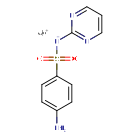
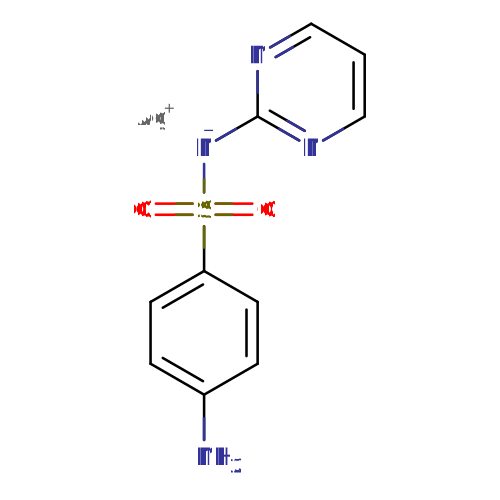
Structure for Silver sulfadiazine (DB05245)
- Weight
- Average: 357.137
Monoisotopic: 355.949714262 - Chemical Formula
- C10H9AgN4O2S
- Synonyms
- Silver sulfadiazinate
- Silver sulfadiazine
- Silver sulphadiazine
- Sulfadiazine silver
- Sulfadiazine silver salt

Pharmacology
- Indication
Indicated as an adjunct for the prevention and treatment of wound sepsis in patients with second- and third-degree burns.
 Reduce drug development failure ratesBuild, train, & validate machine-learning modelswith evidence-based and structured datasets.Build, train, & validate predictive machine-learning models with structured datasets.
- Associated Conditions
Indication Type Indication Combined Product Details Approval Level Age Group Patient Characteristics Dose Form Used as adjunct in combination to prevent Wound sepsis Combination Product in combination with: Chlorhexidine (DB00878) •••••••••••• Adjunct therapy in prophylaxis of Wound sepsis •••••••••••• Adjunct therapy in treatment of Wound sepsis •••••••••••• Adjunct therapy in prophylaxis of Wound sepsis •••••••••••• Adjunct therapy in treatment of Wound sepsis •••••••••••• - Contraindications & Blackbox Warnings
 Prevent Adverse Drug Events TodayTap into our Clinical API for life-saving information on contraindications & blackbox warnings, population restrictions, harmful risks, & more.Avoid life-threatening adverse drug events with our Clinical API
- Pharmacodynamics
Silver sulfadiazine has broad antimicrobial activity. It is bactericidal for many gram- negative and gram-positive bacteria as well as being effective against yeast. Silver sulfadiazine is not a carbonic anhydrase inhibitor and may be useful in situations where such agents are contraindicated.
- Mechanism of action
Studies utilizing radioactive micronized silver sulfadiazine, electron microscopy, and biochemical techniques have revealed that the mechanism of action of silver sulfadiazine on bacteria differs from silver nitrate and sodium sulfadiazine. Silver sulfadiazine acts only on the cell membrane and cell wall to produce its bactericidal effect. A specific mechanism of action has not been determined, but silver sulfadiazine's effectiveness may possibly be from a synergistic interaction, or the action of each component. Silver is a biocide, which binds to a broad range of targets. Silver ions bind to nucleophilic amino acids, as well as sulfhydryl, amino, imidazole, phosphate, and carboxyl groups in proteins, causing protein denaturation and enzyme inhibition. Silver binds to surface membranes and proteins, causing proton leaks in the membrane, leading to cell death. Sulfadiazine is a competitive inhibitor of bacterial para-aminobenzoic acid (PABA), a substrate of the enzyme dihydropteroate synthetase. The inhibited reaction is necessary in these organisms for the synthesis of folic acid.
Target Actions Organism ADNA binderHumans - Absorption
Very limited penetration through the skin. Only when applied to very large area burns is absorption into the body generally an issue.
- Volume of distribution
Not Available
- Protein binding
Not Available
- Metabolism
- Not Available
- Route of elimination
Not Available
- Half-life
Not Available
- Clearance
Not Available
- Adverse Effects
 Improve decision support & research outcomesWith structured adverse effects data, including: blackbox warnings, adverse reactions, warning & precautions, & incidence rates. View sample adverse effects data in our new Data Library!Improve decision support & research outcomes with our structured adverse effects data.
- Toxicity
Acute oral toxicity (LD50) in rat is 10001 mg/kg.
- Pathways
- Not Available
- Pharmacogenomic Effects/ADRs
- Not Available
Interactions
- Drug Interactions
- This information should not be interpreted without the help of a healthcare provider. If you believe you are experiencing an interaction, contact a healthcare provider immediately. The absence of an interaction does not necessarily mean no interactions exist.
Drug Interaction Integrate drug-drug
interactions in your softwareAllogeneic cultured keratinocytes and dermal fibroblasts in murine collagen The therapeutic efficacy of Allogeneic cultured keratinocytes and dermal fibroblasts in murine collagen can be decreased when used in combination with Silver sulfadiazine. Ambroxol The risk or severity of methemoglobinemia can be increased when Silver sulfadiazine is combined with Ambroxol. Articaine The risk or severity of methemoglobinemia can be increased when Silver sulfadiazine is combined with Articaine. Benzocaine The risk or severity of methemoglobinemia can be increased when Silver sulfadiazine is combined with Benzocaine. Benzyl alcohol The risk or severity of methemoglobinemia can be increased when Silver sulfadiazine is combined with Benzyl alcohol. - Food Interactions
- No interactions found.
Products
 Drug product information from 10+ global regionsOur datasets provide approved product information including:dosage, form, labeller, route of administration, and marketing period.Access drug product information from over 10 global regions.
- Active Moieties
Name Kind UNII CAS InChI Key Sulfadiazine unknown 0N7609K889 68-35-9 SEEPANYCNGTZFQ-UHFFFAOYSA-N Silver cation ionic 57N7B0K90A 14701-21-4 FOIXSVOLVBLSDH-UHFFFAOYSA-N - International/Other Brands
- Dermazin / Flamazine / Silverol
- Brand Name Prescription Products
Name Dosage Strength Route Labeller Marketing Start Marketing End Region Image Dermazin Crm 1% Cream 1 % Topical Pharmascience Inc 1993-12-31 2016-10-28 Canada 
Flamazine Cream 1 % Topical Smith & Nephew, Inc. 1974-12-31 Not applicable Canada Silvadene Cream 10 mg/1g Topical Lake Erie Medical & Surgical Supply DBA Quality Care Products LLC 1973-11-26 2019-10-11 US 
Silvadene Cream 10 mg/1g Topical Physicians Total Care, Inc. 1973-11-26 2011-07-31 US Silvadene Cream 10 mg/1g Topical A S Medication Solutions 1973-11-26 Not applicable US - Generic Prescription Products
Name Dosage Strength Route Labeller Marketing Start Marketing End Region Image Silver Sulfadiazine Cream 10 mg/1g Topical Greenstone LLC 2018-01-15 Not applicable US Silver Sulfadiazine Cream 10 g/1000g Topical Lake Erie Medical &Surgical Supply Dba Quality Care Products Llc 2012-03-22 Not applicable US Silver Sulfadiazine Cream 10 mg/1g Topical Keltman Pharmaceuticals Inc. 2007-03-10 Not applicable US - Over the Counter Products
Name Dosage Strength Route Labeller Marketing Start Marketing End Region Image Hydrogel AG Silver Antimicrobial Wound Dressing Gel 1 kg/1kg Topical Gentell, Inc. 2018-01-01 Not applicable US ชิลเวอร์ซิน ครีม Cream 1 %w/w Topical บริษัท ฟาร์สเป็ค จำกัด จำกัด 1998-03-10 Not applicable Thailand 
ซันเดอร์มา ครีม Cream 1 %w/w Topical บริษัท บางกอกแล็ป แอนด์ คอสเมติค จำกัด จำกัด 2006-04-04 2019-10-21 Thailand ซิลเว็กซ์ ครีม Cream 1 %w/w Topical บริษัท โอสถ อินเตอร์ แลบบอราทอรีส์ จำกัด จำกัด 2003-06-13 Not applicable Thailand ซิลเวอร์ซัล Cream 1 %w/w Topical บริษัท เอเชี่ยนยูเนี่ยนแล็บบอราตอรี่ จำกัด จำกัด 1988-07-25 Not applicable Thailand - Mixture Products
Name Ingredients Dosage Route Labeller Marketing Start Marketing End Region Image DERİSİV PLUS KREM, 50 GRAM Silver sulfadiazine (10 mg/g) + Lidocaine (50 mg/g) Cream Topical RDC İLAÇ ARAŞTIRMA VE GELİŞTİRME SAN. A.Ş. 2020-08-14 Not applicable Turkey 
Flamazine C Silver sulfadiazine (10 mg / g) + Chlorhexidine gluconate (2 mg / g) Cream Topical Smith & Nephew, Inc. 1987-12-31 2001-07-01 Canada SILVAZINE CREAM Silver sulfadiazine (10 mg/g) + Chlorhexidine gluconate (2 mg/g) Cream Topical SMITH & NEPHEW PTE LIMITED 1990-02-22 Not applicable Singapore 
SİLVERDİN PLUS %1 + %5 KREM, 50 G Silver sulfadiazine (1 %) + Lidocaine (5 %) Cream Topical Deva Holding A.S. 2013-12-31 Not applicable Turkey SILVIN CREAM Silver sulfadiazine (1 % w/v) + Chlorhexidine gluconate (0.2 % w/v) Cream Topical ICM PHARMA PTE. LTD. 1998-02-10 Not applicable Singapore - Unapproved/Other Products
Name Ingredients Dosage Route Labeller Marketing Start Marketing End Region Image Hydrogel AG Silver Antimicrobial Wound Dressing Silver sulfadiazine (1 kg/1kg) Gel Topical Gentell, Inc. 2018-01-01 Not applicable US RayaSore Kit Silver sulfadiazine (10 mg/1g) + Povidone-iodine (10 mg/1mL) Kit Topical Raya Pharmaceuticals LLC 2022-08-23 Not applicable US SILVADIAZIN 40 GR KREM Silver sulfadiazine (40 gr) Cream Topical TOPRAK İLAÇ VE KİMYEVİ MADDELER SAN.VE TİC. A.Ş. 2013-01-29 Not applicable Turkey
Categories
- ATC Codes
- D06BA01 — Silver sulfadiazine
- D06BA — Sulfonamides
- D06B — CHEMOTHERAPEUTICS FOR TOPICAL USE
- D06 — ANTIBIOTICS AND CHEMOTHERAPEUTICS FOR DERMATOLOGICAL USE
- D — DERMATOLOGICALS
- G01AE — Sulfonamides
- G01A — ANTIINFECTIVES AND ANTISEPTICS, EXCL. COMBINATIONS WITH CORTICOSTEROIDS
- G01 — GYNECOLOGICAL ANTIINFECTIVES AND ANTISEPTICS
- G — GENITO URINARY SYSTEM AND SEX HORMONES
- Drug Categories
- Amides
- Amines
- Aniline Compounds
- Anti-Bacterial Agents
- Anti-Infective Agents
- Anti-Infective Agents, Local
- Benzene Derivatives
- Benzenesulfonamides
- Dermatologicals
- Genito Urinary System and Sex Hormones
- Gynecological Antiinfectives and Antiseptics
- Miscellaneous Local Anti-infectives
- Sulfanilamides
- Sulfonamide Antibacterial
- Sulfonamides
- Sulfones
- Sulfur Compounds
- Chemical TaxonomyProvided by Classyfire
- Description
- This compound belongs to the class of organic compounds known as benzenesulfonamides. These are organic compounds containing a sulfonamide group that is S-linked to a benzene ring.
- Kingdom
- Organic compounds
- Super Class
- Benzenoids
- Class
- Benzene and substituted derivatives
- Sub Class
- Benzenesulfonamides
- Direct Parent
- Benzenesulfonamides
- Alternative Parents
- Benzenesulfonyl compounds / Aniline and substituted anilines / Pyrimidines and pyrimidine derivatives / Sulfonyls / Organosulfonic acids and derivatives / Heteroaromatic compounds / Azacyclic compounds / Primary amines / Organopnictogen compounds / Organic zwitterions show 3 more
- Substituents
- Amine / Aniline or substituted anilines / Aromatic heteromonocyclic compound / Azacycle / Benzenesulfonamide / Benzenesulfonyl group / Heteroaromatic compound / Hydrocarbon derivative / Organic nitrogen compound / Organic oxide show 14 more
- Molecular Framework
- Aromatic heteromonocyclic compounds
- External Descriptors
- silver salt, sulfonamidate, pyrimidines (CHEBI:9142)
- Affected organisms
- Yeast and other fungi
- Candida albicans and other yeasts
- Various gram-negative and gram-positive eubacteria
- Pseudomonas aeruginosa
- Staphylococcus aureus
Chemical Identifiers
- UNII
- W46JY43EJR
- CAS number
- 22199-08-2
- InChI Key
- UEJSSZHHYBHCEL-UHFFFAOYSA-N
- InChI
- InChI=1S/C10H9N4O2S.Ag/c11-8-2-4-9(5-3-8)17(15,16)14-10-12-6-1-7-13-10;/h1-7H,11H2;/q-1;+1
- IUPAC Name
- silver(1+) 4-{[(pyrimidin-2-yl)azanidyl]sulfonyl}aniline
- SMILES
- [Ag+].NC1=CC=C(C=C1)S(=O)(=O)[N-]C1=NC=CC=N1
References
- Synthesis Reference
Charles L. Fox, Jr., Shanta M. Modak, Paul Fox, "Wound dressing comprising silver sulfadiazine incorporated in animal tissue and method of preparation." U.S. Patent US4599226, issued September, 1977.
US4599226- General References
- Fox CL Jr, Modak SM: Mechanism of silver sulfadiazine action on burn wound infections. Antimicrob Agents Chemother. 1974 Jun;5(6):582-8. [Article]
- Russell AD, Hugo WB: Antimicrobial activity and action of silver. Prog Med Chem. 1994;31:351-70. [Article]
- Percival SL, Bowler PG, Russell D: Bacterial resistance to silver in wound care. J Hosp Infect. 2005 May;60(1):1-7. [Article]
- External Links
- Human Metabolome Database
- HMDB0015610
- KEGG Drug
- D00433
- PubChem Compound
- 441244
- PubChem Substance
- 46507881
- ChemSpider
- 390017
- 9793
- ChEBI
- 9142
- ChEMBL
- CHEMBL1382627
- Therapeutic Targets Database
- DAP001321
- PharmGKB
- PA164744951
- RxList
- RxList Drug Page
- Drugs.com
- Drugs.com Drug Page
- Wikipedia
- Silver_sulfadiazine
- MSDS
- Download (73.2 KB)
Clinical Trials
- Clinical Trials
Phase Status Purpose Conditions Count 4 Completed Prevention Burns 1 4 Completed Treatment Burns 1 4 Completed Treatment Second Degree Burns 1 4 Terminated Treatment Superficial Partial Thickness Burns 1 3 Completed Treatment Burns 1
Pharmacoeconomics
- Manufacturers
- Not Available
- Packagers
- Advanced Pharmaceutical Services Inc.
- Ascend Laboratories LLC
- BASF Corp.
- DispenseXpress Inc.
- Dispensing Solutions
- Diversified Healthcare Services Inc.
- Doctor Reddys Laboratories Ltd.
- Innoviant Pharmacy Inc.
- Keltman Pharmaceuticals Inc.
- King Pharmaceuticals Inc.
- Monarch Pharmacy
- Palmetto Pharmaceuticals Inc.
- Par Pharmaceuticals
- Pharmedix
- Physicians Total Care Inc.
- Preferred Pharmaceuticals Inc.
- Quality Care
- Rebel Distributors Corp.
- Sanofi-Aventis Inc.
- Sherwood Medical
- Stat Rx Usa
- Tyco Healthcare Group LP
- Watson Pharmaceuticals
- Dosage Forms
Form Route Strength Suspension Topical 1.000 g Cream Topical 1.000 g Cream Cutaneous 1 g Cream Topical Cream Occlusive dressing technique Cream Topical Cream Topical 1 % Cream Topical 1 % w/w Cream Topical 10 mg/g Gel Topical 1 kg/1kg Cream Cutaneous 1.000 g Aerosol Topical 1 g Kit Topical Spray; suspension Topical 1 % Cream Topical 40 gr Cream Topical 2 mg/g Cream Topical 10 g/1000g Cream Topical 100000 g Lotion Topical 1 g Suspension Topical 10 mg Cream Topical 1 g Powder Topical 1000 mg Cream Topical 10 mg/1g Powder Topical 1 g Cream Cutaneous 1.00 g Cream Topical 1 %w/w - Prices
Unit description Cost Unit Silvadene 1% Cream 400 gm Jar 73.48USD jar Silvadene 1% Cream 85 gm Tube 38.47USD tube Silver Sulfadiazine 1% Cream 400 gm Jar 36.48USD jar Silvadene 1% Cream 20 gm Tube 27.94USD tube Silver Sulfadiazine 1% Cream 50 gm Jar 21.99USD jar Silver Sulfadiazine 1% Cream 85 gm Jar 19.99USD jar Silver Sulfadiazine 1% Cream 25 gm Jar 13.99USD jar Silvadene 1% cream 0.93USD g Flamazine 1 % Cream 0.33USD g Ssd af 1% cream 0.21USD g Thermazene 1% cream 0.19USD g Ssd 1% cream 0.12USD g Silver sulfadiazine 1% crm 0.09USD g DrugBank does not sell nor buy drugs. Pricing information is supplied for informational purposes only.- Patents
- Not Available
Properties
- State
- Solid
- Experimental Properties
Property Value Source melting point (°C) 285 °C Not Available - Predicted Properties
Property Value Source Water Solubility 7.87 mg/mL ALOGPS logP 0.19 ALOGPS logP 0.39 Chemaxon logS -1.7 ALOGPS pKa (Strongest Acidic) 6.99 Chemaxon pKa (Strongest Basic) 2.01 Chemaxon Physiological Charge -1 Chemaxon Hydrogen Acceptor Count 6 Chemaxon Hydrogen Donor Count 1 Chemaxon Polar Surface Area 95.17 Å2 Chemaxon Rotatable Bond Count 2 Chemaxon Refractivity 63.4 m3·mol-1 Chemaxon Polarizability 24.1 Å3 Chemaxon Number of Rings 2 Chemaxon Bioavailability 1 Chemaxon Rule of Five Yes Chemaxon Ghose Filter Yes Chemaxon Veber's Rule No Chemaxon MDDR-like Rule No Chemaxon - Predicted ADMET Features
Property Value Probability Human Intestinal Absorption + 0.9711 Blood Brain Barrier + 0.9438 Caco-2 permeable + 0.621 P-glycoprotein substrate Non-substrate 0.9127 P-glycoprotein inhibitor I Non-inhibitor 0.9363 P-glycoprotein inhibitor II Non-inhibitor 0.9097 Renal organic cation transporter Non-inhibitor 0.8426 CYP450 2C9 substrate Non-substrate 0.7881 CYP450 2D6 substrate Non-substrate 0.8443 CYP450 3A4 substrate Non-substrate 0.7321 CYP450 1A2 substrate Non-inhibitor 0.9233 CYP450 2C9 inhibitor Non-inhibitor 0.8439 CYP450 2D6 inhibitor Non-inhibitor 0.9385 CYP450 2C19 inhibitor Non-inhibitor 0.8978 CYP450 3A4 inhibitor Non-inhibitor 0.8894 CYP450 inhibitory promiscuity Low CYP Inhibitory Promiscuity 0.8721 Ames test Non AMES toxic 0.8603 Carcinogenicity Non-carcinogens 0.9406 Biodegradation Not ready biodegradable 0.9517 Rat acute toxicity 2.1559 LD50, mol/kg Not applicable hERG inhibition (predictor I) Weak inhibitor 0.9314 hERG inhibition (predictor II) Non-inhibitor 0.8823
Spectra
- Mass Spec (NIST)
- Not Available
- Spectra
Spectrum Spectrum Type Splash Key Predicted GC-MS Spectrum - GC-MS Predicted GC-MS splash10-0udi-7691000000-b8839be77eb55e7132fd - Chromatographic Properties
Collision Cross Sections (CCS)
Adduct CCS Value (Å2) Source type Source [M-H]- 163.0191073 predictedDarkChem Lite v0.1.0 [M-H]- 163.2836073 predictedDarkChem Lite v0.1.0 [M+H]+ 163.9857073 predictedDarkChem Lite v0.1.0 [M+H]+ 163.7030073 predictedDarkChem Lite v0.1.0 [M+Na]+ 163.3189073 predictedDarkChem Lite v0.1.0 [M+Na]+ 163.0250073 predictedDarkChem Lite v0.1.0
Targets

References
- McDonnell G, Russell AD: Antiseptics and disinfectants: activity, action, and resistance. Clin Microbiol Rev. 1999 Jan;12(1):147-79. [Article]

Drug created at October 28, 2007 14:21 / Updated at April 26, 2024 00:46