Identification
- Summary
Naphazoline is a sympathomimetic vasoconstrictor used for the symptomatic relief of redness and itching of the eye, and nasal congestion.
- Brand Names
- Advanced Eye Relief Redness Instant Relief, Ak-con, Clear Eyes Complete, Clear Eyes Cooling Comfort, Clear Eyes Redness Relief Reformulated Nov 2011, Naphcon, Naphcon A, Opcon-A, Privine, Vasocon, Visine-A
- Generic Name
- Naphazoline
- DrugBank Accession Number
- DB06711
- Background
Naphazoline is a rapid acting imidazoline sympathomimetic vasoconstrictor of ocular or nasal artierioles6,7. It acts to decrease congestion and is found in many over the counter (OTC) eye drops and nasal preparations6,7.
Naphazoline was first developed in 1942 as a nasal formulation for congestion4.
- Type
- Small Molecule
- Groups
- Approved, Investigational
- Structure
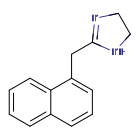
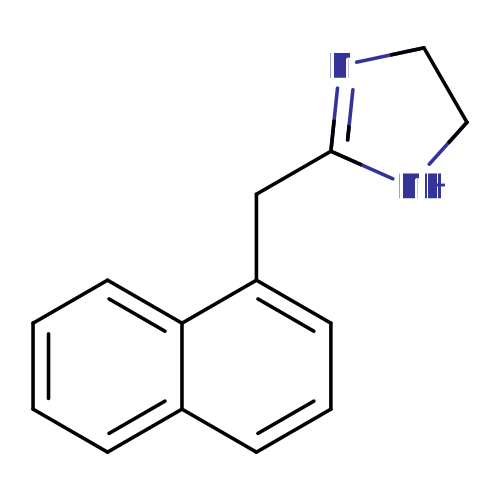
Structure for Naphazoline (DB06711)
- Weight
- Average: 210.2744
Monoisotopic: 210.115698458 - Chemical Formula
- C14H14N2
- Synonyms
- Nafazolin
- Nafazolina
- Naphazoline

Pharmacology
- Indication
Naphazoline is indicated for use as OTC eyedrops for ocular vasoconstriction or as a nasal preparation for nasal congestion1,6,7.
 Reduce drug development failure ratesBuild, train, & validate machine-learning modelswith evidence-based and structured datasets.Build, train, & validate predictive machine-learning models with structured datasets.
- Associated Conditions
Indication Type Indication Combined Product Details Approval Level Age Group Patient Characteristics Dose Form Used in combination to treat Bacterial conjunctivitis Combination Product in combination with: Tetracycline (DB00759), Betamethasone (DB00443) •••••••••••• ••••••• ••• ••••••••• ••••••••• •••••••• • ••••• Used in combination to treat Blepharoconjunctivitis Combination Product in combination with: Betamethasone (DB00443), Tetracycline (DB00759) •••••••••••• ••••••• ••• ••••••••• ••••••••• •••••••• • ••••• Used in combination to treat Conjunctivitis Combination Product in combination with: Pheniramine (DB01620) •••••••••••• •••••••• Used in combination for symptomatic treatment of Conjunctivitis Combination Product in combination with: Zinc sulfate (DB09322) •••••••••••• •••••••• • ••••• Used in combination for symptomatic treatment of Conjunctivitis Combination Product in combination with: Dexamethasone (DB01234) •••••••••••• •••••••• - Associated Therapies
- Contraindications & Blackbox Warnings
 Prevent Adverse Drug Events TodayTap into our Clinical API for life-saving information on contraindications & blackbox warnings, population restrictions, harmful risks, & more.Avoid life-threatening adverse drug events with our Clinical API
- Pharmacodynamics
Naphazoline is a sympathomimetic alpha adrenergic agonist that acts to vasoconstrict nasal or ocular arterioles, resulting in reduced congestion at the site of administration6,7.
- Mechanism of action
Naphazoline is a vasoconstrictor that functions by stimulating alpha adrenergic receptors in arterioles leading to decreased congestion at the site of administration6.
Naphazoline causes the release of norepinephrine in sympathetic nerves3. Norepinephrine binds to alpha adrenergic receptors and causes vasoconstriction3. Naphazoline is also a mild beta adrenergic receptor agonist, which can cause rebound vasodilation after the alpha adrenergic stimulation has ended3. Naphazoline's release of norepinephrine also triggers a negative feedback loop which decreases production of norepinephrine, which can lead to rhinitis medicamentosa after long term use when naphazoline is stopped3.
Target Actions Organism AAlpha-2A adrenergic receptor agonistHumans AAlpha-1A adrenergic receptor agonistHumans - Absorption
Absorption data for naphazoline are scarce but imidazoline compounds in general are weakly basic and lipophilic, with high bioavailability from the gastrointestinal tract5.
- Volume of distribution
Distribution data for naphazoline are scarce but imidazoline compounds are distributed throughout the body, and can cross the blood-brain barrier5.
- Protein binding
Protein binding data for naphazoline is unavailable12.
- Metabolism
Metabolism data for naphazoline are scarce. Imidazoline compounds undergo some hepatic metabolism but a large fraction of the dose may be excreted unchanged in the urine5.
- Route of elimination
Imidazoline compounds undergo some hepatic metabolism but a large fraction of the dose may be excreted unchanged in the urine5. Urinary excretion is higher with more acidic urine5.
- Half-life
Half life has not been determined but effects last for 4 to 8 hours7. Other imidazoline compounds have half lives varying from 2 to 12 hours5.
- Clearance
Clearance data for naphazoline is unavailable12.
- Adverse Effects
 Improve decision support & research outcomesWith structured adverse effects data, including: blackbox warnings, adverse reactions, warning & precautions, & incidence rates. View sample adverse effects data in our new Data Library!Improve decision support & research outcomes with our structured adverse effects data.
- Toxicity
In high doses or when ingested, naphazoline can lead to central nervous system depression (which can progress to coma and death), hypothermia, bradycardia, and death1. This effect is especially pronounced in children under 6 years1,2.
Long term use of naphazoline can lead to rhinitis medicamentosa once naphazoline is stopped3. This condition is a result of norepinephrine release by naphazoline triggering a negative feedback loop3.
Safety and effectiveness in children under 12 has not been established12. Studies in elderly patients have yet to be performed12. Risk in pregnancy, breast feeding, and on overall fertility have not been established, though pregnant and breast feeding patients should consider the risk and benefit before starting naphazoline treatment12.
- Pathways
- Not Available
- Pharmacogenomic Effects/ADRs
- Not Available
Interactions
- Drug Interactions
- This information should not be interpreted without the help of a healthcare provider. If you believe you are experiencing an interaction, contact a healthcare provider immediately. The absence of an interaction does not necessarily mean no interactions exist.
Drug Interaction Integrate drug-drug
interactions in your softwareAcebutolol The therapeutic efficacy of Naphazoline can be decreased when used in combination with Acebutolol. Aceclofenac The risk or severity of hypertension can be increased when Naphazoline is combined with Aceclofenac. Acemetacin The risk or severity of hypertension can be increased when Naphazoline is combined with Acemetacin. Acetyldigitoxin The risk or severity of Cardiac Arrhythmia can be increased when Naphazoline is combined with Acetyldigitoxin. Acetylsalicylic acid The risk or severity of hypertension can be increased when Acetylsalicylic acid is combined with Naphazoline. - Food Interactions
- No interactions found.
Products
 Drug product information from 10+ global regionsOur datasets provide approved product information including:dosage, form, labeller, route of administration, and marketing period.Access drug product information from over 10 global regions.
- Product Ingredients
Ingredient UNII CAS InChI Key Naphazoline hydrochloride MZ1131787D 550-99-2 DJDFFEBSKJCGHC-UHFFFAOYSA-N Naphazoline nitrate SC99GR1T5S 5144-52-5 ZAHXYMFVNNUHCP-UHFFFAOYSA-N - Brand Name Prescription Products
Name Dosage Strength Route Labeller Marketing Start Marketing End Region Image Naphcon Solution 1 mg/1mL Ophthalmic Alcon 2006-09-26 Not applicable US 
Vasocon Solution 1 mg/1mL Ophthalmic Ciba Vision 2006-08-31 Not applicable US - Generic Prescription Products
Name Dosage Strength Route Labeller Marketing Start Marketing End Region Image AK-Con Solution / drops 1 mg/1mL Ophthalmic Physicians Total Care, Inc. 2000-07-28 2012-06-30 US AK-Con Solution 1 mg/1mL Ophthalmic Rebel Distributors 1974-08-22 Not applicable US AK-Con Solution / drops 1 mg/1mL Ophthalmic Preferreed Pharmaceuticals Inc. 2005-03-24 2018-01-23 US Albalon Solution 1 mg/1mL Ophthalmic Allergan Inc. 1984-11-01 2008-10-21 US Naphazoline Solution / drops 1 mg/1mL Ophthalmic A S Medication Solutions 1995-12-19 Not applicable US - Over the Counter Products
Name Dosage Strength Route Labeller Marketing Start Marketing End Region Image Albalon Solution / drops .1 % Ophthalmic Abbvie 1970-12-31 Not applicable Canada 
Clear Eyes Liquid .012 % Ophthalmic Prestige Brands Inc 2004-03-24 Not applicable Canada Clear Eyes By Murine Eye Dps Liquid .012 % Ophthalmic Abbott 1970-12-31 2003-10-10 Canada Diopticon Liq 0.1% Solution 0.1 % Ophthalmic Pharma Stulln Inc. 1994-12-31 Not applicable Canada Nafasolina Solution / drops 0.376 mg/100mg Nasal DUY DRUGS, INC 2021-02-15 Not applicable US - Mixture Products
Name Ingredients Dosage Route Labeller Marketing Start Marketing End Region Image 7 Select Redness Relief Naphazoline hydrochloride (0.00012 mg/1mL) + Glycerin (0.0025 mg/1mL) Solution / drops Ophthalmic 7-Select, Inc 2017-03-28 Not applicable US Advanced Eye Relief/ Redness Instant Relief Naphazoline hydrochloride (0.1 mg/1mL) + Polyethylene glycol 300 (2 mg/1mL) Solution / drops Ophthalmic Bausch & Lomb Incorporated 2010-09-13 Not applicable US Advanced Eye Relief/ Redness Maximum Relief Naphazoline hydrochloride (0.3 mg/1mL) + Hypromellose (5 mg/1mL) Solution / drops Ophthalmic Preferreed Pharmaceuticals Inc. 2010-09-02 Not applicable US Advanced Eye Relief/ Redness Maximum Relief Naphazoline hydrochloride (0.3 mg/1mL) + Hypromellose (5 mg/1mL) Solution / drops Ophthalmic Bausch & Lomb Incorporated 2010-09-02 Not applicable US Albalon A Naphazoline hydrochloride (.05 %) + Antazoline phosphate (.5 %) Liquid Ophthalmic Allergan 1978-12-31 2017-07-26 Canada
Categories
- ATC Codes
- R01AB02 — Naphazoline
- R01AB — Sympathomimetics, combinations excl. corticosteroids
- R01A — DECONGESTANTS AND OTHER NASAL PREPARATIONS FOR TOPICAL USE
- R01 — NASAL PREPARATIONS
- R — RESPIRATORY SYSTEM
- S01GA — Sympathomimetics used as decongestants
- S01G — DECONGESTANTS AND ANTIALLERGICS
- S01 — OPHTHALMOLOGICALS
- S — SENSORY ORGANS
- S01GA — Sympathomimetics used as decongestants
- S01G — DECONGESTANTS AND ANTIALLERGICS
- S01 — OPHTHALMOLOGICALS
- S — SENSORY ORGANS
- Drug Categories
- Adrenergic Agents
- Adrenergic Agonists
- Adrenergic alpha-1 Receptor Agonists
- Adrenergic alpha-2 Receptor Agonists
- Adrenergic alpha-Agonists
- Agents producing tachycardia
- Agents that produce hypertension
- Cardiovascular Agents
- Decongestants and Antiallergics
- Imidazoles
- Nasal Decongestants
- Nasal Preparations
- Neurotransmitter Agents
- Ophthalmologicals
- Respiratory System Agents
- Sensory Organs
- Sympathomimetics
- Sympathomimetics Used as Decongestants
- Sympathomimetics, Plain
- Vasoconstrictor Agents
- Chemical TaxonomyProvided by Classyfire
- Description
- This compound belongs to the class of organic compounds known as naphthalenes. These are compounds containing a naphthalene moiety, which consists of two fused benzene rings.
- Kingdom
- Organic compounds
- Super Class
- Benzenoids
- Class
- Naphthalenes
- Sub Class
- Not Available
- Direct Parent
- Naphthalenes
- Alternative Parents
- Imidolactams / Imidazolines / Propargyl-type 1,3-dipolar organic compounds / Carboximidamides / Carboxamidines / Azacyclic compounds / Organopnictogen compounds / Hydrocarbon derivatives
- Substituents
- 2-imidazoline / Amidine / Aromatic heteropolycyclic compound / Azacycle / Carboximidamide / Carboxylic acid amidine / Hydrocarbon derivative / Imidolactam / Naphthalene / Organic 1,3-dipolar compound
- Molecular Framework
- Aromatic heteropolycyclic compounds
- External Descriptors
- Not Available
- Affected organisms
- Not Available
Chemical Identifiers
- UNII
- H231GF11BV
- CAS number
- 835-31-4
- InChI Key
- CNIIGCLFLJGOGP-UHFFFAOYSA-N
- InChI
- InChI=1S/C14H14N2/c1-2-7-13-11(4-1)5-3-6-12(13)10-14-15-8-9-16-14/h1-7H,8-10H2,(H,15,16)
- IUPAC Name
- 2-[(naphthalen-1-yl)methyl]-4,5-dihydro-1H-imidazole
- SMILES
- C(C1=NCCN1)C1=CC=CC2=CC=CC=C12
References
- Synthesis Reference
Roy W. Bryant, Ravi Parihar, Thomas Rowe, Susan Caballa, "Methods of Making and Using Stable Pharmaceutical Compositions Comprising Ketotifen and Naphazoline." U.S. Patent US20110312998, issued December 22, 2011.
US20110312998- General References
- Vitezic D, Rozmanic V, Franulovic J, Ahel V, Matesic D: Naphazoline nasal drops intoxication in children. Arh Hig Rada Toksikol. 1994 Mar;45(1):25-9. [Article]
- Mahieu LM, Rooman RP, Goossens E: Imidazoline intoxication in children. Eur J Pediatr. 1993 Nov;152(11):944-6. [Article]
- Ramey JT, Bailen E, Lockey RF: Rhinitis medicamentosa. J Investig Allergol Clin Immunol. 2006;16(3):148-55. [Article]
- HAINSWORTH WC: Accidental poisoning with naphazoline (privine) hydrochloride. Am J Dis Child. 1948 Jan;75(1):76-80. [Article]
- Dalefield, Rosalind (2015). 12. In Veterinary Toxicology for Australia and New Zealand (pp. 170-171). Elsevier. [ISBN:978-0-12-420227-6]
- Naphazoline Hydrochloride Solution/Drops [Link]
- Toxnet: Naphazoline Hydrochloride [Link]
- INVIMA Product Authorization: Osmocrom-N (sodium cromoglycate/naphazoline hydrochloride) ophthalmic drops [Link]
- INVIMA Product Authorization: Ocunid (dexamethasone/naphazoline) ophthalmic solution [Link]
- BASG Product Information: Coldistan (diphenhydramine hydrochloride/naphazoline hydrochloride) nasal drops [Link]
- BASG Product Information: Coldistan (diphenhydramine hydrochloride/naphazoline hydrochloride) ophthalmic drops [Link]
- New Zealand Data Sheet: Naphcon-A Eye Drops [File]
- External Links
- Human Metabolome Database
- HMDB0015656
- KEGG Drug
- D08253
- PubChem Compound
- 4436
- PubChem Substance
- 99443263
- ChemSpider
- 4283
- BindingDB
- 50001922
- 7247
- ChEBI
- 93363
- ChEMBL
- CHEMBL761
- ZINC
- ZINC000000119717
- PharmGKB
- PA165958384
- Wikipedia
- Naphazoline
- MSDS
- Download (115 KB)
Clinical Trials
- Clinical Trials
Phase Status Purpose Conditions Count 4 Unknown Status Treatment Allergic Conjunctivitis (AC) 1 3 Completed Treatment Allergic Conjunctivitis (AC) 2 3 Completed Treatment Allergic Disorder of Respiratory System / Cold / Flu caused by Influenza 1 3 Completed Treatment Nasal Congestion 1 1 Completed Treatment Hyperemia Eye 1
Pharmacoeconomics
- Manufacturers
- Not Available
- Packagers
- Not Available
- Dosage Forms
Form Route Strength Solution Nasal 1.000 mg Solution Ophthalmic 0.100 g Solution Conjunctival; Ophthalmic 100000 mg Solution Ophthalmic 0.012 % Solution / drops Nasal 0.2 % Solution / drops Ophthalmic 0.1 % Spray Nasal 0.2 % Solution Ophthalmic 0.500 mg Liquid Ophthalmic .012 % Liquid Ophthalmic Solution / drops Ophthalmic 1 mg/ml Solution / drops Nasal 1 mg/ml Spray Nasal 1 mg/ml Solution / drops; suspension / drops Nasal Solution / drops Ophthalmic 0.2 mg/ml Solution Conjunctival; Ophthalmic; Topical Spray Nasal Solution / drops; suspension / drops Ophthalmic 0.6 mg/m0.6mL Solution Nasal 0.01 g/10ml Solution Conjunctival; Ophthalmic 1 mg Solution Ophthalmic 1.0000 mg Solution / drops Ophthalmic Spray Nasal 3 mg/ml Solution / drops Topical Solution / drops Conjunctival Solution Ophthalmic 0.001 g Solution Conjunctival; Ophthalmic 0.001 g Solution / drops Nasal 0.376 mg/100mg Solution Ophthalmic Spray Nasal Solution Ophthalmic 1 mg Solution / drops Ophthalmic 1 mg/1mL Solution Ophthalmic 0.25 mg/ml Liquid Nasal 50 mg/100mL Solution Ophthalmic 1.0000 mg Solution / drops Ophthalmic 0.2 mg/1mL Solution Ophthalmic .1 % Solution Ophthalmic 1.000 mg Solution / drops Ophthalmic .1 % Solution Ophthalmic 0.1 % w/v Solution Conjunctival; Ophthalmic 0.1 mg Solution Conjunctival; Ophthalmic 0.5 mg Solution Conjunctival; Ophthalmic Solution / drops Ophthalmic 1 mg/1 Solution / drops Nasal 1 mg/1 Spray Nasal 0.1 mL/20mL Suspension / drops Nasal 0.125 mL/25mL Liquid Ophthalmic .1 % Solution Ophthalmic 0.1 % Liquid Nasal Solution / drops; suspension / drops Nasal 1 mg/ml Solution / drops; suspension / drops Nasal 1.05 mg/ml Cream Nasal 25 MG/100G Solution / drops Nasal Solution / drops Ophthalmic Solution / drops Ophthalmic 12 mg/100mL Solution Conjunctival; Ophthalmic 0.125 mg Solution / drops Ophthalmic 0.012 % w/v Solution / drops; suspension / drops Ophthalmic 1 mg/mL Solution Ophthalmic 1 mg/1mL Solution / drops Ophthalmic 1 mg / mL Solution Ophthalmic Spray Nasal 100 mg/100ml Liquid Ophthalmic 1 mg/1ml - Prices
- Not Available
- Patents
- Not Available
Properties
- State
- Solid
- Experimental Properties
Property Value Source boiling point (°C) 440.466 http://www.chemspider.com/Chemical-Structure.4283.html logP 3.881 http://www.chemspider.com/Chemical-Structure.4283.html - Predicted Properties
Property Value Source Water Solubility 0.0381 mg/mL ALOGPS logP 3.44 ALOGPS logP 2.19 Chemaxon logS -3.7 ALOGPS pKa (Strongest Basic) 10.19 Chemaxon Physiological Charge 1 Chemaxon Hydrogen Acceptor Count 2 Chemaxon Hydrogen Donor Count 1 Chemaxon Polar Surface Area 24.39 Å2 Chemaxon Rotatable Bond Count 2 Chemaxon Refractivity 65.52 m3·mol-1 Chemaxon Polarizability 23.77 Å3 Chemaxon Number of Rings 3 Chemaxon Bioavailability 1 Chemaxon Rule of Five Yes Chemaxon Ghose Filter Yes Chemaxon Veber's Rule Yes Chemaxon MDDR-like Rule No Chemaxon - Predicted ADMET Features
Property Value Probability Human Intestinal Absorption + 0.9936 Blood Brain Barrier + 0.9693 Caco-2 permeable - 0.6307 P-glycoprotein substrate Substrate 0.7448 P-glycoprotein inhibitor I Non-inhibitor 0.8385 P-glycoprotein inhibitor II Non-inhibitor 0.6449 Renal organic cation transporter Inhibitor 0.8506 CYP450 2C9 substrate Non-substrate 0.8202 CYP450 2D6 substrate Substrate 0.7094 CYP450 3A4 substrate Non-substrate 0.7297 CYP450 1A2 substrate Non-inhibitor 0.9046 CYP450 2C9 inhibitor Non-inhibitor 0.92 CYP450 2D6 inhibitor Inhibitor 0.8931 CYP450 2C19 inhibitor Non-inhibitor 0.9479 CYP450 3A4 inhibitor Non-inhibitor 0.9206 CYP450 inhibitory promiscuity Low CYP Inhibitory Promiscuity 0.889 Ames test Non AMES toxic 0.8156 Carcinogenicity Non-carcinogens 0.9476 Biodegradation Not ready biodegradable 0.9961 Rat acute toxicity 2.6904 LD50, mol/kg Not applicable hERG inhibition (predictor I) Weak inhibitor 0.7043 hERG inhibition (predictor II) Non-inhibitor 0.5354
Spectra
- Mass Spec (NIST)
- Not Available
- Spectra
- Chromatographic Properties
Collision Cross Sections (CCS)
Adduct CCS Value (Å2) Source type Source [M-H]- 154.3603249 predictedDarkChem Lite v0.1.0 [M-H]- 154.2499249 predictedDarkChem Lite v0.1.0 [M-H]- 141.58623 predictedDeepCCS 1.0 (2019) [M+H]+ 155.3885249 predictedDarkChem Lite v0.1.0 [M+H]+ 154.9620249 predictedDarkChem Lite v0.1.0 [M+H]+ 143.94421 predictedDeepCCS 1.0 (2019) [M+Na]+ 154.2022249 predictedDarkChem Lite v0.1.0 [M+Na]+ 154.2102249 predictedDarkChem Lite v0.1.0 [M+Na]+ 150.81941 predictedDeepCCS 1.0 (2019)
Targets

- Kind
- Protein
- Organism
- Humans
- Pharmacological action
- Yes
- Actions
- Agonist
- General Function
- Thioesterase binding
- Specific Function
- Alpha-2 adrenergic receptors mediate the catecholamine-induced inhibition of adenylate cyclase through the action of G proteins. The rank order of potency for agonists of this receptor is oxymetazo...
- Gene Name
- ADRA2A
- Uniprot ID
- P08913
- Uniprot Name
- Alpha-2A adrenergic receptor
- Molecular Weight
- 48956.275 Da
References
- Piletz JE, Zhu H, Chikkala DN: Comparison of ligand binding affinities at human I1-imidazoline binding sites and the high affinity state of alpha-2 adrenoceptor subtypes. J Pharmacol Exp Ther. 1996 Nov;279(2):694-702. [Article]
- Fukushima H, Norimoto K, Seki T, Nishiguchi T, Nakamura T, Konobu T, Nishio K, Okuchi K: Acute pulmonary edema associated with naphazoline ingestion. Clin Toxicol (Phila). 2008 Mar;46(3):254-6. [Article]
- Ogidigben MJ, Chu TC, Potter DE: Naphazoline-induced suppression of aqueous humor pressure and flow: involvement of central and peripheral alpha(2)/I(1) receptors. Exp Eye Res. 2001 Mar;72(3):331-9. [Article]
- Kind
- Protein
- Organism
- Humans
- Pharmacological action
- Yes
- Actions
- Agonist
- General Function
- Protein heterodimerization activity
- Specific Function
- This alpha-adrenergic receptor mediates its action by association with G proteins that activate a phosphatidylinositol-calcium second messenger system. Its effect is mediated by G(q) and G(11) prot...
- Gene Name
- ADRA1A
- Uniprot ID
- P35348
- Uniprot Name
- Alpha-1A adrenergic receptor
- Molecular Weight
- 51486.005 Da
References
- Bogacka E: [Decongestants in treatment of nasal obstruction]. Otolaryngol Pol. 1999;53(3):347-52. [Article]
- Leonardi A: Emerging drugs for ocular allergy. Expert Opin Emerg Drugs. 2005 Aug;10(3):505-20. [Article]
- Piletz JE, Zhu H, Chikkala DN: Comparison of ligand binding affinities at human I1-imidazoline binding sites and the high affinity state of alpha-2 adrenoceptor subtypes. J Pharmacol Exp Ther. 1996 Nov;279(2):694-702. [Article]
- Hrometz SL, Edelmann SE, McCune DF, Olges JR, Hadley RW, Perez DM, Piascik MT: Expression of multiple alpha1-adrenoceptors on vascular smooth muscle: correlation with the regulation of contraction. J Pharmacol Exp Ther. 1999 Jul;290(1):452-63. [Article]
- Kai T: [Effects of topical alpha 1- and beta 2-adrenoceptor stimulants on nasal nitric oxide level]. Nihon Jibiinkoka Gakkai Kaiho. 1999 Jul;102(7):898-906. [Article]
- Ogidigben MJ, Chu TC, Potter DE: Naphazoline-induced suppression of aqueous humor pressure and flow: involvement of central and peripheral alpha(2)/I(1) receptors. Exp Eye Res. 2001 Mar;72(3):331-9. [Article]

Drug created at May 16, 2010 17:05 / Updated at April 27, 2024 09:44