Identification
- Summary
Clodronic acid is a bisphosphonate used to treat osteoporosis in postmenopausal women, hypercalcemia of malignancy, and osteolysis.
- Brand Names
- Clasteon
- Generic Name
- Clodronic acid
- DrugBank Accession Number
- DB00720
- Background
Clodronic acid is a first generation bisphosphonate similar to etidronic acid and tiludronic acid.1 These drugs were developed to mimic the action of pyrophosphate, a regulator of calcification and decalcification.2 clodronate’s use has decreased over the years in favor of the third generation, nitrogen containing bisphosphonate zoledronic acid, ibandronic acid, minodronic acid, and risedronic acid.1
Clodronic acid is not FDA approved, but is approved in Canada.8
- Type
- Small Molecule
- Groups
- Approved, Investigational, Vet approved
- Structure
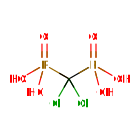
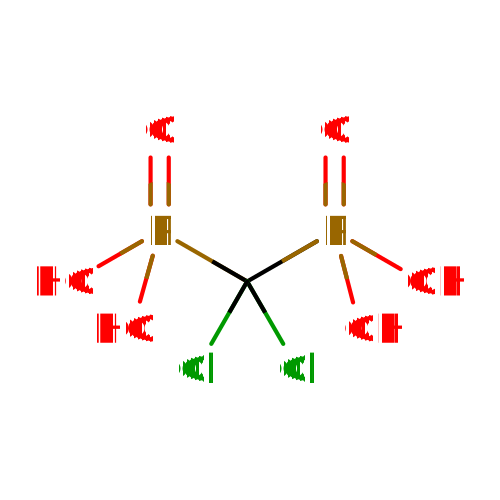
Structure for Clodronic acid (DB00720)
- Weight
- Average: 244.892
Monoisotopic: 243.886016298 - Chemical Formula
- CH4Cl2O6P2
- Synonyms
- (Dichloro-phosphono-methyl)-phosphonic acid
- (dichloromethylene)bisphosphonic acid
- (dichloromethylene)diphosphonic acid
- Acide clodronique
- Acido clodronico
- Acidum clodronicum
- Clodronate
- Clodronic acid
- Clodronsaeure
- Clodronsäure
- dichloromethylene-1,1-bisphosphonic acid
- dichloromethylene-1,1-diphosphonic acid
- Dichloromethylidene diphosphonate
- External IDs
- BM 06.011

Pharmacology
- Indication
Clodronic acid is indicated as an adjunct in the management of osteolysis from bone metastases of malignant tumors and for management of hypercalcemia of malignancy.8
 Reduce drug development failure ratesBuild, train, & validate machine-learning modelswith evidence-based and structured datasets.Build, train, & validate predictive machine-learning models with structured datasets.
- Associated Conditions
Indication Type Indication Combined Product Details Approval Level Age Group Patient Characteristics Dose Form Management of Hypercalcemia of malignancy •••••••••••• Management of Osteolytic bone metastases •••••••••••• - Contraindications & Blackbox Warnings
 Prevent Adverse Drug Events TodayTap into our Clinical API for life-saving information on contraindications & blackbox warnings, population restrictions, harmful risks, & more.Avoid life-threatening adverse drug events with our Clinical API
- Pharmacodynamics
Clodronic acid is a first generation bisphosphonate that inhibits osteoclast mediated bone resorption.8 It has a wide therapeutic index as a large overdose is required for significant toxicity and a long duration of action due to the slow release from bone.8 Patients should be counselled regarding the risk of hypocalcemia, hypovolemia, renal insufficiency, transient hyperphosphatemia, and transient hyperparathyroidism.8
- Mechanism of action
Bisphosphonates are taken into the bone where they bind to hydroxyapatite. Bone resorption by osteoclasts causes local acidification, releasing the bisphosphonate, which is taken into the osteoclast by fluid-phase endocytosis.5 Endocytic vesicles become acidified, releasing bisphosphonates into the cytosol of osteoclasts where they act.5
Osteoclasts mediate resorption of bone.6 When osteoclasts bind to bone they form podosomes, ring structures of F-actin.6 Disruption of the podosomes causes osteoclasts to detach from bones, preventing bone resorption.6
First generation bisphosphonates closely mimic the structure of pyrophosphate, which can be incorporated into ATP anologues that cannot be hydrolyzed, disrupting all ATP mediated actions of osteoclasts.7
Target Actions Organism AHydroxylapatite antagonistHumans AADP/ATP translocase 1 inhibitorHumans AADP/ATP translocase 2 inhibitorHumans AADP/ATP translocase 3 inhibitorHumans - Absorption
Oral clodronic acid has a bioavailability of 1-2%.4 A 200mg intravenous dose reaches a Cmax of 16.1mg/L with an AUC of 44.2mg*h/L.4 A 200mg intramuscular dose reaches a Cmax of 12.8mg/L with an AUC of 47.5mg*h/L.4 Further pharmacokinetic data for clodronic acid are not readily available.8
- Volume of distribution
Not Available
- Protein binding
Clodronic acid is 36% protein bound in plasma.3
- Metabolism
Clodronate is not metabolized in humans.8
- Route of elimination
Clodronate is eliminated unchanged in the urine.8
- Half-life
The mean plasma half life of clodronate is 5.6h.8
- Clearance
The renal clearance of clodronate is approximately 90mL/min.8
- Adverse Effects
 Improve decision support & research outcomesWith structured adverse effects data, including: blackbox warnings, adverse reactions, warning & precautions, & incidence rates. View sample adverse effects data in our new Data Library!Improve decision support & research outcomes with our structured adverse effects data.
- Toxicity
Patients experiencing an overdose may present with hypocalcemia, while severe overdoses can present with kidney failure, liver damage, and unconsciousness.8 Overdose can be managed through symptomatic and supportive care, including monitoring and administration of electrolytes including calcium.8 Gastric lavage may remove unabsorbed drug in the gastrointestinal tract.8
- Pathways
- Not Available
- Pharmacogenomic Effects/ADRs
- Not Available
Interactions
- Drug Interactions
- This information should not be interpreted without the help of a healthcare provider. If you believe you are experiencing an interaction, contact a healthcare provider immediately. The absence of an interaction does not necessarily mean no interactions exist.
Drug Interaction Integrate drug-drug
interactions in your softwareAceclofenac The risk or severity of gastrointestinal bleeding can be increased when Aceclofenac is combined with Clodronic acid. Acemetacin The risk or severity of gastrointestinal bleeding can be increased when Acemetacin is combined with Clodronic acid. Acetylsalicylic acid The risk or severity of gastrointestinal bleeding can be increased when Acetylsalicylic acid is combined with Clodronic acid. Acyclovir The risk or severity of nephrotoxicity and hypocalcemia can be increased when Acyclovir is combined with Clodronic acid. Adefovir dipivoxil The risk or severity of nephrotoxicity and hypocalcemia can be increased when Adefovir dipivoxil is combined with Clodronic acid. - Food Interactions
- Take on an empty stomach. Co-administration with food may decrease absorption.
Products
 Drug product information from 10+ global regionsOur datasets provide approved product information including:dosage, form, labeller, route of administration, and marketing period.Access drug product information from over 10 global regions.
- Product Ingredients
Ingredient UNII CAS InChI Key Clodronate disodium N030400H8J 88416-50-6 XWHPUCFOTRBMGS-UHFFFAOYSA-L - International/Other Brands
- Lodronat (Boehringer Ingelheim) / Loron (Roche) / Lytos (Roche) / Ostac (Roche) / Sindronat (Sindan)
- Brand Name Prescription Products
Name Dosage Strength Route Labeller Marketing Start Marketing End Region Image Bonefos Solution 60 mg / mL Intravenous Bayer 1992-12-31 2018-12-27 Canada 
Bonefos Capsule 400 mg Oral Bayer 1992-12-31 2018-03-27 Canada Clasteon Capsule 400 mg Oral Sumitomo Pharma Canada, Inc. 2004-05-13 Not applicable Canada Ostac Cap 400mg Capsule 400 mg Oral Hoffmann La Roche 1994-12-31 2006-10-11 Canada - Mixture Products
Name Ingredients Dosage Route Labeller Marketing Start Marketing End Region Image CLASTEON Clodronic acid (100 MG/3.3ML) + Lidocaine (1 %) Injection, solution Intramuscular Abiogen Pharma S.P.A. 2014-07-08 Not applicable Italy 
CLASTEON Clodronic acid (100 MG/3.3ML) + Lidocaine (1 %) Injection, solution Intramuscular Abiogen Pharma S.P.A. 2014-07-08 Not applicable Italy CLASTEON Clodronic acid (200 MG/4ML) + Lidocaine (1 %) Injection, solution Intramuscular Abiogen Pharma S.P.A. 2014-07-08 Not applicable Italy CLASTEON Clodronic acid (200 MG/4ML) + Lidocaine (1 %) Injection, solution Intramuscular Abiogen Pharma S.P.A. 2014-07-08 Not applicable Italy CLODRON Clodronic acid (100 mg/3.3mL) + Lidocaine hydrochloride (33 mg/3.3mL) Injection, solution Intramuscular Abiogen Pharma S.P.A. 2014-07-08 Not applicable Italy
Categories
- ATC Codes
- M05BA02 — Clodronic acid
- Drug Categories
- Chemical TaxonomyProvided by Classyfire
- Description
- This compound belongs to the class of organic compounds known as bisphosphonates. These are organic compounds containing two phosphonate groups linked together through a carbon atoms.
- Kingdom
- Organic compounds
- Super Class
- Organic acids and derivatives
- Class
- Organic phosphonic acids and derivatives
- Sub Class
- Bisphosphonates
- Direct Parent
- Bisphosphonates
- Alternative Parents
- Organic phosphonic acids / Organopnictogen compounds / Organophosphorus compounds / Organochlorides / Organic oxides / Hydrocarbon derivatives / Alkyl chlorides
- Substituents
- Aliphatic acyclic compound / Alkyl chloride / Alkyl halide / Bisphosphonate / Hydrocarbon derivative / Organic oxide / Organic oxygen compound / Organochloride / Organohalogen compound / Organophosphonic acid
- Molecular Framework
- Aliphatic acyclic compounds
- External Descriptors
- one-carbon compound, organochlorine compound, 1,1-bis(phosphonic acid) (CHEBI:110423)
- Affected organisms
- Humans and other mammals
Chemical Identifiers
- UNII
- 0813BZ6866
- CAS number
- 10596-23-3
- InChI Key
- ACSIXWWBWUQEHA-UHFFFAOYSA-N
- InChI
- InChI=1S/CH4Cl2O6P2/c2-1(3,10(4,5)6)11(7,8)9/h(H2,4,5,6)(H2,7,8,9)
- IUPAC Name
- [dichloro(phosphono)methyl]phosphonic acid
- SMILES
- OP(O)(=O)C(Cl)(Cl)P(O)(O)=O
References
- Synthesis Reference
Fritz Demmer, Berthold Stemmle, "Clodronate-containing medicaments and a process for the preparation thereof." U.S. Patent US4859472, issued September, 1980.
US4859472- General References
- Cremers S, Drake MT, Ebetino FH, Bilezikian JP, Russell RGG: Pharmacology of bisphosphonates. Br J Clin Pharmacol. 2019 Jun;85(6):1052-1062. doi: 10.1111/bcp.13867. Epub 2019 Feb 28. [Article]
- Sansom LN, Necciari J, Thiercelin JF: Human pharmacokinetics of tiludronate. Bone. 1995 Nov;17(5 Suppl):479S-483S. [Article]
- Pentikainen PJ, Elomaa I, Nurmi AK, Karkkainen S: Pharmacokinetics of clodronate in patients with metastatic breast cancer. Int J Clin Pharmacol Ther Toxicol. 1989 May;27(5):222-8. [Article]
- Frediani B, Cavalieri L, Cremonesi G: Clodronic acid formulations available in Europe and their use in osteoporosis: a review. Clin Drug Investig. 2009;29(6):359-79. doi: 10.2165/00044011-200929060-00001. [Article]
- Russell RG, Watts NB, Ebetino FH, Rogers MJ: Mechanisms of action of bisphosphonates: similarities and differences and their potential influence on clinical efficacy. Osteoporos Int. 2008 Jun;19(6):733-59. doi: 10.1007/s00198-007-0540-8. [Article]
- Murakami H, Takahashi N, Tanaka S, Nakamura I, Udagawa N, Nakajo S, Nakaya K, Abe M, Yuda Y, Konno F, Barbier A, Suda T: Tiludronate inhibits protein tyrosine phosphatase activity in osteoclasts. Bone. 1997 May;20(5):399-404. [Article]
- Russell RG: Bisphosphonates: the first 40 years. Bone. 2011 Jul;49(1):2-19. doi: 10.1016/j.bone.2011.04.022. Epub 2011 May 1. [Article]
- Health Canada Approved Drug Products: Clodronate Oral Capsules [Link]
- External Links
- Human Metabolome Database
- HMDB0014858
- PubChem Compound
- 25419
- PubChem Substance
- 46508646
- ChemSpider
- 23731
- BindingDB
- 50216172
- 3350
- ChEBI
- 110423
- ChEMBL
- CHEMBL12318
- ZINC
- ZINC000029747100
- Therapeutic Targets Database
- DAP000564
- PharmGKB
- PA10239
- Wikipedia
- Clodronic_acid
- MSDS
- Download (120 KB)
Clinical Trials
- Clinical Trials
Phase Status Purpose Conditions Count 3 Completed Treatment Breast Cancer 2 3 Completed Treatment Pain / Prostate Cancer / Quality of Life (QOL) 1 3 Completed Treatment Postmenopausal Osteoporosis 1 3 Completed Treatment Radiation Induced Brachial Plexopathy 1 3 Not Yet Recruiting Treatment Osteoradionecrosis / Osteoradionecrosis of Jaw / Osteoradionecrosis of the Mandible 1
Pharmacoeconomics
- Manufacturers
- Not Available
- Packagers
- Not Available
- Dosage Forms
Form Route Strength Injection, solution, concentrate Intravenous 75 mg Capsule Oral Solution Intravenous 60 mg / mL Tablet, film coated Oral Tablet Oral 800 mg Capsule Oral 400 mg Injection, solution Intramuscular Injection, solution Intramuscular 100 MG Injection, solution, concentrate Intravenous 300 MG/10ML Tablet, film coated Oral 800 mg/1 Injection Intravenous Injection, solution Intravenous; Parenteral 300 MG/10ML Injection, solution Parenteral 100 MG/3.3ML Injection, solution Injection, solution Intramuscular Injection, solution Intramuscular 100 MG/3.3ML Injection, solution, concentrate Intramuscular 100 MG/3.3ML Injection, solution, concentrate Intravenous; Parenteral 300 MG/10ML Injection, solution 100 MG/3.3ML Injection, solution Intramuscular 200 MG/4ML Injection, solution, concentrate Intramuscular Tablet Oral 800.000 mg Injection, solution Intravenous 300 MG/10ML Injection, solution, concentrate Intravenous Tablet, film coated Oral 520 mg Injection, solution 100 MG Injection, solution 300 MG/10ML Tablet Oral 999.520 mg Injection, solution Intravenous Solution Intravenous - Prices
Unit description Cost Unit Bonefos 60 mg/ml 13.69USD ml Bonefos 400 mg Capsule 2.04USD capsule Clasteon 400 mg Capsule 1.36USD capsule DrugBank does not sell nor buy drugs. Pricing information is supplied for informational purposes only.- Patents
- Not Available
Properties
- State
- Solid
- Experimental Properties
Property Value Source melting point (°C) 250 °C PhysProp - Predicted Properties
Property Value Source Water Solubility 7.47 mg/mL ALOGPS logP 0.16 ALOGPS logP -0.067 Chemaxon logS -1.5 ALOGPS pKa (Strongest Acidic) 0.62 Chemaxon Physiological Charge -3 Chemaxon Hydrogen Acceptor Count 6 Chemaxon Hydrogen Donor Count 4 Chemaxon Polar Surface Area 115.06 Å2 Chemaxon Rotatable Bond Count 2 Chemaxon Refractivity 38.21 m3·mol-1 Chemaxon Polarizability 15.3 Å3 Chemaxon Number of Rings 0 Chemaxon Bioavailability 1 Chemaxon Rule of Five Yes Chemaxon Ghose Filter No Chemaxon Veber's Rule No Chemaxon MDDR-like Rule No Chemaxon - Predicted ADMET Features
Property Value Probability Human Intestinal Absorption - 0.8406 Blood Brain Barrier + 0.9481 Caco-2 permeable - 0.8956 P-glycoprotein substrate Non-substrate 0.8597 P-glycoprotein inhibitor I Non-inhibitor 0.9701 P-glycoprotein inhibitor II Non-inhibitor 0.9903 Renal organic cation transporter Non-inhibitor 0.958 CYP450 2C9 substrate Non-substrate 0.7693 CYP450 2D6 substrate Non-substrate 0.8234 CYP450 3A4 substrate Non-substrate 0.697 CYP450 1A2 substrate Non-inhibitor 0.8539 CYP450 2C9 inhibitor Non-inhibitor 0.8878 CYP450 2D6 inhibitor Non-inhibitor 0.9091 CYP450 2C19 inhibitor Non-inhibitor 0.8449 CYP450 3A4 inhibitor Non-inhibitor 0.9061 CYP450 inhibitory promiscuity Low CYP Inhibitory Promiscuity 0.9743 Ames test Non AMES toxic 0.7328 Carcinogenicity Carcinogens 0.6575 Biodegradation Not ready biodegradable 0.927 Rat acute toxicity 2.6142 LD50, mol/kg Not applicable hERG inhibition (predictor I) Weak inhibitor 0.9321 hERG inhibition (predictor II) Non-inhibitor 0.9427
Spectra
- Mass Spec (NIST)
- Not Available
- Spectra
Spectrum Spectrum Type Splash Key Predicted GC-MS Spectrum - GC-MS Predicted GC-MS splash10-001i-9040000000-af3c2e18902e147f8d42 Predicted MS/MS Spectrum - 10V, Positive (Annotated) Predicted LC-MS/MS splash10-0006-0290000000-35292d18edf7f79c6fb4 Predicted MS/MS Spectrum - 20V, Positive (Annotated) Predicted LC-MS/MS splash10-03e9-4900000000-e59a5dd2322d5b2b27ad Predicted MS/MS Spectrum - 10V, Negative (Annotated) Predicted LC-MS/MS splash10-0006-0090000000-392ca20c6d6e769bff83 Predicted MS/MS Spectrum - 40V, Positive (Annotated) Predicted LC-MS/MS splash10-001i-9000000000-c3f24a0383ac6f63b181 Predicted MS/MS Spectrum - 20V, Negative (Annotated) Predicted LC-MS/MS splash10-01t9-9400000000-921b6edd013d422befcb Predicted MS/MS Spectrum - 40V, Negative (Annotated) Predicted LC-MS/MS splash10-0229-4090000000-b7b0877699e378087744 Predicted 1H NMR Spectrum 1D NMR Not Applicable Predicted 13C NMR Spectrum 1D NMR Not Applicable - Chromatographic Properties
Collision Cross Sections (CCS)
Adduct CCS Value (Å2) Source type Source [M-H]- 132.5205541 predictedDarkChem Lite v0.1.0 [M-H]- 115.8194 predictedDeepCCS 1.0 (2019) [M+H]+ 119.40242 predictedDeepCCS 1.0 (2019) [M+Na]+ 129.1094 predictedDeepCCS 1.0 (2019)
Targets

References
- Ganguli A, Steward C, Butler SL, Philips GJ, Meikle ST, Lloyd AW, Grant MH: Bacterial adhesion to bisphosphonate coated hydroxyapatite. J Mater Sci Mater Med. 2005 Apr;16(4):283-7. [Article]
- Nancollas GH, Tang R, Phipps RJ, Henneman Z, Gulde S, Wu W, Mangood A, Russell RG, Ebetino FH: Novel insights into actions of bisphosphonates on bone: differences in interactions with hydroxyapatite. Bone. 2006 May;38(5):617-27. Epub 2005 Jul 20. [Article]
- Kind
- Protein
- Organism
- Humans
- Pharmacological action
- Yes
- Actions
- Inhibitor
- General Function
- Adenine transmembrane transporter activity
- Specific Function
- Catalyzes the exchange of cytoplasmic ADP with mitochondrial ATP across the mitochondrial inner membrane.
- Gene Name
- SLC25A4
- Uniprot ID
- P12235
- Uniprot Name
- ADP/ATP translocase 1
- Molecular Weight
- 33064.265 Da
References
- Lehenkari PP, Kellinsalmi M, Napankangas JP, Ylitalo KV, Monkkonen J, Rogers MJ, Azhayev A, Vaananen HK, Hassinen IE: Further insight into mechanism of action of clodronate: inhibition of mitochondrial ADP/ATP translocase by a nonhydrolyzable, adenine-containing metabolite. Mol Pharmacol. 2002 May;61(5):1255-62. [Article]
- Chen X, Ji ZL, Chen YZ: TTD: Therapeutic Target Database. Nucleic Acids Res. 2002 Jan 1;30(1):412-5. [Article]
- Kind
- Protein
- Organism
- Humans
- Pharmacological action
- Yes
- Actions
- Inhibitor
- General Function
- Ubiquitin protein ligase binding
- Specific Function
- Catalyzes the exchange of cytoplasmic ADP with mitochondrial ATP across the mitochondrial inner membrane. As part of the mitotic spindle-associated MMXD complex it may play a role in chromosome seg...
- Gene Name
- SLC25A5
- Uniprot ID
- P05141
- Uniprot Name
- ADP/ATP translocase 2
- Molecular Weight
- 32851.965 Da
References
- Lehenkari PP, Kellinsalmi M, Napankangas JP, Ylitalo KV, Monkkonen J, Rogers MJ, Azhayev A, Vaananen HK, Hassinen IE: Further insight into mechanism of action of clodronate: inhibition of mitochondrial ADP/ATP translocase by a nonhydrolyzable, adenine-containing metabolite. Mol Pharmacol. 2002 May;61(5):1255-62. [Article]
- Kind
- Protein
- Organism
- Humans
- Pharmacological action
- Yes
- Actions
- Inhibitor
- General Function
- Atp:adp antiporter activity
- Specific Function
- Catalyzes the exchange of cytoplasmic ADP with mitochondrial ATP across the mitochondrial inner membrane. May participate in the formation of the permeability transition pore complex (PTPC) respons...
- Gene Name
- SLC25A6
- Uniprot ID
- P12236
- Uniprot Name
- ADP/ATP translocase 3
- Molecular Weight
- 32866.025 Da
References
- Lehenkari PP, Kellinsalmi M, Napankangas JP, Ylitalo KV, Monkkonen J, Rogers MJ, Azhayev A, Vaananen HK, Hassinen IE: Further insight into mechanism of action of clodronate: inhibition of mitochondrial ADP/ATP translocase by a nonhydrolyzable, adenine-containing metabolite. Mol Pharmacol. 2002 May;61(5):1255-62. [Article]
Enzymes
- Kind
- Protein
- Organism
- Humans
- Pharmacological action
- Unknown
- Actions
- Inhibitor
- General Function
- Prostaglandin-endoperoxide synthase activity
- Specific Function
- Converts arachidonate to prostaglandin H2 (PGH2), a committed step in prostanoid synthesis. Constitutively expressed in some tissues in physiological conditions, such as the endothelium, kidney and...
- Gene Name
- PTGS2
- Uniprot ID
- P35354
- Uniprot Name
- Prostaglandin G/H synthase 2
- Molecular Weight
- 68995.625 Da
References
- Liu L, Igarashi K, Kanzaki H, Chiba M, Shinoda H, Mitani H: Clodronate inhibits PGE(2) production in compressed periodontal ligament cells. J Dent Res. 2006 Aug;85(8):757-60. [Article]

Drug created at June 13, 2005 13:24 / Updated at April 26, 2024 00:46