Identification
- Summary
Benzoic acid is an antimicrobial food additive.
- Brand Names
- Ammonul, Hyophen
- Generic Name
- Benzoic acid
- DrugBank Accession Number
- DB03793
- Background
A fungistatic compound that is widely used as a food preservative. It is conjugated to GLYCINE in the liver and excreted as hippuric acid. As the sodium salt form, sodium benzoate is used as a treatment for urea cycle disorders due to its ability to bind amino acids. This leads to excretion of these amino acids and a decrease in ammonia levels. Recent research shows that sodium benzoate may be beneficial as an add-on therapy (1 gram/day) in schizophrenia. Total Positive and Negative Syndrome Scale scores dropped by 21% compared to placebo.
- Type
- Small Molecule
- Groups
- Approved, Investigational
- Structure
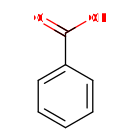
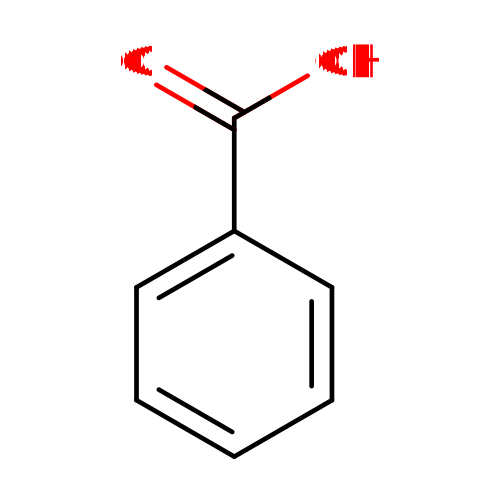
Structure for Benzoic acid (DB03793)
- Weight
- Average: 122.123
Monoisotopic: 122.036779433 - Chemical Formula
- C7H6O2
- Synonyms
- Benzoic acid
- External IDs
- E-210
- FEMA NO. 2131
- INS NO.210
- INS-210
- NSC-149

Pharmacology
- Indication
Not Available
 Reduce drug development failure ratesBuild, train, & validate machine-learning modelswith evidence-based and structured datasets.Build, train, & validate predictive machine-learning models with structured datasets.
- Associated Conditions
Indication Type Indication Combined Product Details Approval Level Age Group Patient Characteristics Dose Form Used in combination to treat Infections, fungal Combination Product in combination with: Resorcinol (DB11085), Salicylic acid (DB00936) •••••••••••• Used in combination for symptomatic treatment of Oropharyngeal pain Combination Product in combination with: Benzyl alcohol (DB06770) ••• ••• ••••••• Used in combination to treat Pain Combination Product in combination with: Amylocaine (DB09088) ••• ••• ••••• Used in combination to treat Ringworm Combination Product in combination with: Salicylic acid (DB00936) ••• ••• •••••• Used in combination to treat Ringworm Combination Product in combination with: Salicylic acid (DB00936) •••••••••••• •••••••• - Contraindications & Blackbox Warnings
 Prevent Adverse Drug Events TodayTap into our Clinical API for life-saving information on contraindications & blackbox warnings, population restrictions, harmful risks, & more.Avoid life-threatening adverse drug events with our Clinical API
- Pharmacodynamics
Not Available
- Mechanism of action
Target Actions Organism USolute carrier family 15 member 1 Not Available Humans UCocaine esterase product ofRhodococcus sp. (strain MB1 Bresler) UD-amino-acid oxidase Not Available Humans UChlorocatechol 1,2-dioxygenase substrateRhodococcus opacus U2-hydroxy-6-oxo-7-methylocta-2,4-dienoate hydrolase Not Available Pseudomonas fluorescens UNon-heme chloroperoxidase Not Available Streptomyces aureofaciens UOxygen-insensitive NAD(P)H nitroreductase Not Available Enterobacter cloacae UHydroxyquinol 1,2-dioxygenase Not Available Nocardioides simplex UReplication protein Not Available Pseudomonas syringae - Absorption
Not Available
- Volume of distribution
Not Available
- Protein binding
Not Available
- Metabolism
Hover over products below to view reaction partners
- Route of elimination
Not Available
- Half-life
Not Available
- Clearance
Not Available
- Adverse Effects
 Improve decision support & research outcomesWith structured adverse effects data, including: blackbox warnings, adverse reactions, warning & precautions, & incidence rates. View sample adverse effects data in our new Data Library!Improve decision support & research outcomes with our structured adverse effects data.
- Toxicity
Not Available
- Pathways
- Not Available
- Pharmacogenomic Effects/ADRs
- Not Available
Interactions
- Drug Interactions
- This information should not be interpreted without the help of a healthcare provider. If you believe you are experiencing an interaction, contact a healthcare provider immediately. The absence of an interaction does not necessarily mean no interactions exist.
Drug Interaction Integrate drug-drug
interactions in your softwareAcamprosate The excretion of Acamprosate can be decreased when combined with Benzoic acid. Acenocoumarol The therapeutic efficacy of Acenocoumarol can be increased when used in combination with Benzoic acid. Acyclovir The excretion of Acyclovir can be decreased when combined with Benzoic acid. Allopurinol The excretion of Allopurinol can be decreased when combined with Benzoic acid. Aminohippuric acid The excretion of Aminohippuric acid can be decreased when combined with Benzoic acid. - Food Interactions
- No interactions found.
Products
 Drug product information from 10+ global regionsOur datasets provide approved product information including:dosage, form, labeller, route of administration, and marketing period.Access drug product information from over 10 global regions.
- Product Ingredients
Ingredient UNII CAS InChI Key Calcium benzoate 3QDE968MKD 2090-05-3 Not applicable Sodium benzoate OJ245FE5EU 532-32-1 WXMKPNITSTVMEF-UHFFFAOYSA-M - Active Moieties
Name Kind UNII CAS InChI Key Sodium cation ionic LYR4M0NH37 17341-25-2 FKNQFGJONOIPTF-UHFFFAOYSA-N - Product Images

- Over the Counter Products
Name Dosage Strength Route Labeller Marketing Start Marketing End Region Image Eyelids Wipes Cloth 0.1 g/100g Topical Ningbo Riway Industrial Co., Ltd. 2020-09-28 Not applicable US 
Oriox Cool Breath Oral Rinse Mild Liquid 0.3 g/100mL Topical LCC LTD 2022-03-25 Not applicable US S Panax All In One Mist Liquid 0.5 g/100mL Topical S AND PANAX CO LTD 2021-05-18 Not applicable US S Panax Mist Liquid 0.5 g/100mL Topical seo jeong ho hwang chill 2020-07-24 Not applicable US S Panax Mist for Refill Liquid 0.5 g/100mL Topical seo jeong ho hwang chill 2021-03-19 Not applicable US - Mixture Products
Name Ingredients Dosage Route Labeller Marketing Start Marketing End Region Image Acerbine - Lösung Benzoic acid (1.5 mg/g) + Malic acid (21.5 mg/g) + Salicylic acid (0.4 mg/g) Solution Topical Pharmazeutische Fabrik Montavit Gmb H 1972-08-28 Not applicable Austria 
Acerbine - Salbe Benzoic acid (0.5 mg/g) + Malic acid (7 mg/g) + Salicylic acid (0.133 mg/g) Ointment Topical Pharmazeutische Fabrik Montavit Gmb H 1977-11-17 Not applicable Austria Ammonul Sodium benzoate (100 mg/1mL) + Sodium phenylacetate (100 mg/1mL) Injection, solution, concentrate Intravenous Bausch Health US LLC 2005-02-17 Not applicable US Ammonul Sodium benzoate (100 mg/1mL) + Sodium phenylacetate (100 mg/1mL) Injection, solution, concentrate Intravenous Ucyclyd Pharma Inc. 2005-02-17 Not applicable US Ammonul Sodium benzoate (100 mg/1mL) + Sodium phenylacetate (100 mg/1mL) Injection, solution, concentrate Intravenous Cangene Bio Pharma 2005-02-01 2010-02-18 US - Unapproved/Other Products
Name Ingredients Dosage Route Labeller Marketing Start Marketing End Region Image Eyelids Wipes Benzoic acid (0.1 g/100g) Cloth Topical Ningbo Riway Industrial Co., Ltd. 2020-09-28 Not applicable US HydroGold 9 Sodium benzoate (0.5 mg/100mg) + Acetyl hexapeptide-3 (0.01 mg/100mg) + Adenosine (0.04 mg/100mg) + Allantoin (0.2 mg/100mg) + Butylene glycol (2 mg/100mg) + Castor oil (0.4 mg/100mg) + Dimethicone (0.01 mg/100mg) + Glycerin (20 mg/100mg) + Gold (0.0001 mg/100mg) + Nicotinamide (2 mg/100mg) + Phenoxyethanol (0.5 mg/100mg) + Potassium chloride (0.01 mg/100mg) + Titanium dioxide (0.43 mg/100mg) + Xanthan gum (0.5 mg/100mg) Patch Topical Bhmbg Global Branding Inc. 2018-03-09 2019-12-31 US Hyophen Benzoic acid (9 mg/1) + Hyoscyamine sulfate dihydrate (0.12 mg/1) + Methenamine (81.6 mg/1) + Methylene blue trihydrate (10.8 mg/1) + Phenyl salicylate (36.2 mg/1) Tablet Oral Star Pharmaceuticals, Llc 2010-09-21 Not applicable US 
Hyophen Benzoic acid (9 mg/1) + Hyoscyamine sulfate dihydrate (0.12 mg/1) + Methenamine (81.6 mg/1) + Methylene blue trihydrate (10.8 mg/1) + Phenyl salicylate (36.2 mg/1) Tablet Oral Biocomp Pharma, Inc. 2010-09-21 2023-12-31 US Methylphen Benzoic acid (9 mg/1) + Hyoscyamine sulfate dihydrate (.12 mg/1) + Methenamine (81.6 mg/1) + Methylene blue trihydrate (10.8 mg/1) + Phenyl salicylate (36.2 mg/1) Tablet Oral Kylemore Pharmaceuticals, LLC 2010-01-13 2010-01-14 US


Categories
- ATC Codes
- A16AX30 — Sodium benzoate and sodium phenylacetate
- A16AX — Various alimentary tract and metabolism products
- A16A — OTHER ALIMENTARY TRACT AND METABOLISM PRODUCTS
- A16 — OTHER ALIMENTARY TRACT AND METABOLISM PRODUCTS
- A — ALIMENTARY TRACT AND METABOLISM
- A16AX — Various alimentary tract and metabolism products
- A16A — OTHER ALIMENTARY TRACT AND METABOLISM PRODUCTS
- A16 — OTHER ALIMENTARY TRACT AND METABOLISM PRODUCTS
- A — ALIMENTARY TRACT AND METABOLISM
- Drug Categories
- Acids, Carbocyclic
- Alimentary Tract and Metabolism
- Ammonium Ion Binding Activity
- Anti-Infective Agents
- Antifungal Agents
- Benzene Derivatives
- Benzoates
- Compounds used in a research, industrial, or household setting
- Diagnostic Agents
- Diet, Food, and Nutrition
- Food
- Food Additives
- Food Ingredients
- Food Preservatives
- Nitrogen Binding Agent
- OAT3/SLC22A8 Inhibitors
- Organic Anion Transporting Polypeptide 2B1 Inhibitors
- Physiological Phenomena
- Tests for Gastric Secretion
- Urea Cycle Disorder Agents
- Various Alimentary Tract and Metabolism Products
- Chemical TaxonomyProvided by Classyfire
- Description
- This compound belongs to the class of organic compounds known as benzoic acids. These are organic Compounds containing a benzene ring which bears at least one carboxyl group.
- Kingdom
- Organic compounds
- Super Class
- Benzenoids
- Class
- Benzene and substituted derivatives
- Sub Class
- Benzoic acids and derivatives
- Direct Parent
- Benzoic acids
- Alternative Parents
- Benzoyl derivatives / Monocarboxylic acids and derivatives / Carboxylic acids / Organooxygen compounds / Organic oxides / Hydrocarbon derivatives
- Substituents
- Aromatic homomonocyclic compound / Benzoic acid / Benzoyl / Carboxylic acid / Carboxylic acid derivative / Hydrocarbon derivative / Monocarboxylic acid or derivatives / Organic oxide / Organic oxygen compound / Organooxygen compound
- Molecular Framework
- Aromatic homomonocyclic compounds
- External Descriptors
- benzoic acids (CHEBI:30746)
- Affected organisms
- Not Available
Chemical Identifiers
- UNII
- 8SKN0B0MIM
- CAS number
- 65-85-0
- InChI Key
- WPYMKLBDIGXBTP-UHFFFAOYSA-N
- InChI
- InChI=1S/C7H6O2/c8-7(9)6-4-2-1-3-5-6/h1-5H,(H,8,9)
- IUPAC Name
- benzoic acid
- SMILES
- OC(=O)C1=CC=CC=C1
References
- Synthesis Reference
Ludovicus A. L. Kleintjens, Hubertus M. J. Grooten, "Process for the preparation of benzoic acid." U.S. Patent US4539425, issued March, 1932.
US4539425- General References
- Not Available
- External Links
- Human Metabolome Database
- HMDB0001870
- KEGG Drug
- D00038
- KEGG Compound
- C00180
- PubChem Compound
- 243
- PubChem Substance
- 46504911
- ChemSpider
- 238
- BindingDB
- 197302
- 18989
- ChEBI
- 30746
- ChEMBL
- CHEMBL541
- ZINC
- ZINC000000001011
- PharmGKB
- PA448578
- PDBe Ligand
- BEZ
- Wikipedia
- Benzoic_acid
- PDB Entries
- 1a8u / 1djr / 1gxs / 1gyx / 1h4o / 1hd2 / 1hkq / 1hz4 / 1i69 / 1i7q … show 190 more
Clinical Trials
- Clinical Trials
Phase Status Purpose Conditions Count 4 Completed Treatment Fungal Foot Infection 1 2 Completed Other Schizoaffective Disorders / Schizophrenia / Schizophreniform Disorders 1 2 Completed Supportive Care Cancer / Pain 1 2 Completed Treatment Amino Acid Metabolism, Inborn Errors 1 2 Not Yet Recruiting Treatment Schizoaffective Disorders / Schizophrenia / Symptoms, Cognitive 1
Pharmacoeconomics
- Manufacturers
- Not Available
- Packagers
- Not Available
- Dosage Forms
Form Route Strength Injection, solution, concentrate Intravenous Suspension Oral 2.000 g Tincture Oral Solution Rectal Paste, dentifrice Dental Cloth Topical 0.1 g/100g Patch Topical Lozenge Oral Solution Topical Tablet Oral Liquid Topical Tablet, orally disintegrating Oral Tablet, soluble Oral Ointment Topical Liquid Topical 0.3 g/100mL Liquid Dental Ointment Topical 6 % w/w Liquid Topical 0.5 g/100mL Cream Topical Injection Intravenous Liquid Oral Tablet, coated Oral Ointment Cutaneous Syrup Oral Lotion Topical - Prices
- Not Available
- Patents
- Not Available
Properties
- State
- Solid
- Experimental Properties
Property Value Source melting point (°C) 122.4 °C PhysProp boiling point (°C) 249.2 °C PhysProp water solubility 3400 mg/L (at 25 °C) YALKOWSKY,SH & DANNENFELSER,RM (1992) logP 1.87 HANSCH,C ET AL. (1995) logS -1.55 ADME Research, USCD pKa 4.19 (at 25 °C) LIDE,DR (1996) - Predicted Properties
Property Value Source Water Solubility 7.08 mg/mL ALOGPS logP 1.72 ALOGPS logP 1.63 Chemaxon logS -1.2 ALOGPS pKa (Strongest Acidic) 4.08 Chemaxon Physiological Charge -1 Chemaxon Hydrogen Acceptor Count 2 Chemaxon Hydrogen Donor Count 1 Chemaxon Polar Surface Area 37.3 Å2 Chemaxon Rotatable Bond Count 1 Chemaxon Refractivity 33.31 m3·mol-1 Chemaxon Polarizability 11.97 Å3 Chemaxon Number of Rings 1 Chemaxon Bioavailability 1 Chemaxon Rule of Five Yes Chemaxon Ghose Filter No Chemaxon Veber's Rule Yes Chemaxon MDDR-like Rule No Chemaxon - Predicted ADMET Features
Property Value Probability Human Intestinal Absorption + 0.9886 Blood Brain Barrier + 0.9557 Caco-2 permeable + 0.9187 P-glycoprotein substrate Non-substrate 0.8494 P-glycoprotein inhibitor I Non-inhibitor 0.9914 P-glycoprotein inhibitor II Non-inhibitor 0.9941 Renal organic cation transporter Non-inhibitor 0.9136 CYP450 2C9 substrate Non-substrate 0.8003 CYP450 2D6 substrate Non-substrate 0.9672 CYP450 3A4 substrate Non-substrate 0.8374 CYP450 1A2 substrate Non-inhibitor 0.8532 CYP450 2C9 inhibitor Non-inhibitor 0.9861 CYP450 2D6 inhibitor Non-inhibitor 0.957 CYP450 2C19 inhibitor Non-inhibitor 0.9878 CYP450 3A4 inhibitor Non-inhibitor 0.9822 CYP450 inhibitory promiscuity Low CYP Inhibitory Promiscuity 0.9863 Ames test Non AMES toxic 0.9923 Carcinogenicity Non-carcinogens 0.6024 Biodegradation Ready biodegradable 0.8983 Rat acute toxicity 1.7896 LD50, mol/kg Not applicable hERG inhibition (predictor I) Weak inhibitor 0.9708 hERG inhibition (predictor II) Non-inhibitor 0.9882
Spectra
- Mass Spec (NIST)
- Not Available
- Spectra
- Chromatographic Properties
Collision Cross Sections (CCS)
Adduct CCS Value (Å2) Source type Source [M-H]- 121.4804474 predictedDarkChem Lite v0.1.0 [M-H]- 126.0665922 predictedDarkChem Standard v0.1.0 [M-H]- 121.2776474 predictedDarkChem Lite v0.1.0 [M-H]- 120.1701 predictedDeepCCS 1.0 (2019) [M-H]- 121.4804474 predictedDarkChem Lite v0.1.0 [M-H]- 126.0665922 predictedDarkChem Standard v0.1.0 [M-H]- 121.2776474 predictedDarkChem Lite v0.1.0 [M-H]- 120.1701 predictedDeepCCS 1.0 (2019) [M+H]+ 123.370995 predictedDeepCCS 1.0 (2019) [M+H]+ 123.370995 predictedDeepCCS 1.0 (2019) [M+Na]+ 132.1631 predictedDeepCCS 1.0 (2019) [M+Na]+ 132.1631 predictedDeepCCS 1.0 (2019)
Targets

- Kind
- Protein
- Organism
- Humans
- Pharmacological action
- Unknown
- General Function
- Proton-dependent oligopeptide secondary active transmembrane transporter activity
- Specific Function
- Proton-coupled intake of oligopeptides of 2 to 4 amino acids with a preference for dipeptides. May constitute a major route for the absorption of protein digestion end-products.
- Gene Name
- SLC15A1
- Uniprot ID
- P46059
- Uniprot Name
- Solute carrier family 15 member 1
- Molecular Weight
- 78805.265 Da
References
- Omkvist DH, Trangbaek DJ, Mildon J, Paine JS, Brodin B, Begtrup M, Nielsen CU: Affinity and translocation relationships via hPEPT1 of H-X aa-Ser-OH dipeptides: evaluation of H-Phe-Ser-OH as a pro-moiety for ibuprofen and benzoic acid prodrugs. Eur J Pharm Biopharm. 2011 Feb;77(2):327-31. doi: 10.1016/j.ejpb.2010.12.009. Epub 2010 Dec 13. [Article]
- Kind
- Protein
- Organism
- Rhodococcus sp. (strain MB1 Bresler)
- Pharmacological action
- Unknown
- Actions
- Product of
- General Function
- Dipeptidyl-peptidase activity
- Specific Function
- Hydrolyzes cocaine to benzoate and ecgonine methyl ester, endowing the bacteria with the ability to utilize cocaine as a sole source of carbon and energy for growth, as this bacterium lives in the ...
- Gene Name
- cocE
- Uniprot ID
- Q9L9D7
- Uniprot Name
- Cocaine esterase
- Molecular Weight
- 62131.125 Da
References
- Bresler MM, Rosser SJ, Basran A, Bruce NC: Gene cloning and nucleotide sequencing and properties of a cocaine esterase from Rhodococcus sp. strain MB1. Appl Environ Microbiol. 2000 Mar;66(3):904-8. [Article]
- Lister DL, Sproule RF, Britt AJ, Lowe CR, Bruce NC: Degradation of cocaine by a mixed culture of Pseudomonas fluorescens MBER and Comamonas acidovorans MBLF. Appl Environ Microbiol. 1996 Jan;62(1):94-9. [Article]
- Kind
- Protein
- Organism
- Humans
- Pharmacological action
- Unknown
- General Function
- Receptor binding
- Specific Function
- Regulates the level of the neuromodulator D-serine in the brain. Has high activity towards D-DOPA and contributes to dopamine synthesis. Could act as a detoxifying agent which removes D-amino acids...
- Gene Name
- DAO
- Uniprot ID
- P14920
- Uniprot Name
- D-amino-acid oxidase
- Molecular Weight
- 39473.75 Da
References
- Overington JP, Al-Lazikani B, Hopkins AL: How many drug targets are there? Nat Rev Drug Discov. 2006 Dec;5(12):993-6. [Article]
- Imming P, Sinning C, Meyer A: Drugs, their targets and the nature and number of drug targets. Nat Rev Drug Discov. 2006 Oct;5(10):821-34. [Article]
- Berman HM, Westbrook J, Feng Z, Gilliland G, Bhat TN, Weissig H, Shindyalov IN, Bourne PE: The Protein Data Bank. Nucleic Acids Res. 2000 Jan 1;28(1):235-42. [Article]
- Kind
- Protein
- Organism
- Rhodococcus opacus
- Pharmacological action
- Unknown
- Actions
- Substrate
- Curator comments
- Literature referenced utilizes Stenotrophomonas maltophilia as their organism.
- General Function
- Ferric iron binding
- Specific Function
- Not Available
- Gene Name
- clcA
- Uniprot ID
- O67987
- Uniprot Name
- Chlorocatechol 1,2-dioxygenase
- Molecular Weight
- 28952.3 Da
References
- Guzik U, Hupert-Kocurek K, Sitnik M, Wojcieszynska D: High activity catechol 1,2-dioxygenase from Stenotrophomonas maltophilia strain KB2 as a useful tool in cis,cis-muconic acid production. Antonie Van Leeuwenhoek. 2013 Jun;103(6):1297-307. doi: 10.1007/s10482-013-9910-8. Epub 2013 Mar 28. [Article]
- Kind
- Protein
- Organism
- Pseudomonas fluorescens
- Pharmacological action
- Unknown
- General Function
- Hydrolase activity
- Specific Function
- Not Available
- Gene Name
- cumD
- Uniprot ID
- P96965
- Uniprot Name
- 2-hydroxy-6-oxo-7-methylocta-2,4-dienoate hydrolase
- Molecular Weight
- 31489.385 Da
- Kind
- Protein
- Organism
- Streptomyces aureofaciens
- Pharmacological action
- Unknown
- General Function
- Chloride peroxidase activity
- Specific Function
- Not Available
- Gene Name
- cpo
- Uniprot ID
- O31168
- Uniprot Name
- Non-heme chloroperoxidase
- Molecular Weight
- 30354.465 Da
- Kind
- Protein
- Organism
- Enterobacter cloacae
- Pharmacological action
- Unknown
- General Function
- Oxidoreductase activity
- Specific Function
- Reduction of a variety of nitroaromatic compounds using NADH (and to lesser extent NADPH) as source of reducing equivalents; two electrons are transferred.
- Gene Name
- nfsB
- Uniprot ID
- Q01234
- Uniprot Name
- Oxygen-insensitive NAD(P)H nitroreductase
- Molecular Weight
- 23949.98 Da
- Kind
- Protein
- Organism
- Nocardioides simplex
- Pharmacological action
- Unknown
- General Function
- Hydroxyquinol 1,2-dioxygenase activity
- Specific Function
- Catalyzes the ortho-cleavage of the aromatic ring of hydroxyquinol.
- Gene Name
- chqB
- Uniprot ID
- Q5PXQ6
- Uniprot Name
- Hydroxyquinol 1,2-dioxygenase
- Molecular Weight
- 31966.33 Da
- Kind
- Protein
- Organism
- Pseudomonas syringae
- Pharmacological action
- Unknown
- General Function
- Dna-directed dna polymerase activity
- Specific Function
- Not Available
- Gene Name
- repA
- Uniprot ID
- Q52546
- Uniprot Name
- Replication protein
- Molecular Weight
- 26728.84 Da
Transporters
- Kind
- Protein
- Organism
- Humans
- Pharmacological action
- Unknown
- Actions
- Inhibitor
- General Function
- Sodium-independent organic anion transmembrane transporter activity
- Specific Function
- Mediates the Na(+)-independent transport of organic anions such as taurocholate, the prostaglandins PGD2, PGE1, PGE2, leukotriene C4, thromboxane B2 and iloprost.
- Gene Name
- SLCO2B1
- Uniprot ID
- O94956
- Uniprot Name
- Solute carrier organic anion transporter family member 2B1
- Molecular Weight
- 76709.98 Da
References
- Kobayashi D, Nozawa T, Imai K, Nezu J, Tsuji A, Tamai I: Involvement of human organic anion transporting polypeptide OATP-B (SLC21A9) in pH-dependent transport across intestinal apical membrane. J Pharmacol Exp Ther. 2003 Aug;306(2):703-8. Epub 2003 Apr 30. [Article]
- Kind
- Protein
- Organism
- Humans
- Pharmacological action
- Unknown
- Actions
- Inhibitor
- General Function
- Sodium-independent organic anion transmembrane transporter activity
- Specific Function
- Plays an important role in the excretion/detoxification of endogenous and exogenous organic anions, especially from the brain and kidney. Involved in the transport basolateral of steviol, fexofenad...
- Gene Name
- SLC22A8
- Uniprot ID
- Q8TCC7
- Uniprot Name
- Solute carrier family 22 member 8
- Molecular Weight
- 59855.585 Da
References
- Ohtsuki S, Asaba H, Takanaga H, Deguchi T, Hosoya K, Otagiri M, Terasaki T: Role of blood-brain barrier organic anion transporter 3 (OAT3) in the efflux of indoxyl sulfate, a uremic toxin: its involvement in neurotransmitter metabolite clearance from the brain. J Neurochem. 2002 Oct;83(1):57-66. [Article]
- Kind
- Protein
- Organism
- Humans
- Pharmacological action
- Unknown
- General Function
- Symporter activity
- Specific Function
- Proton-coupled monocarboxylate transporter. Catalyzes the rapid transport across the plasma membrane of many monocarboxylates such as lactate, pyruvate, branched-chain oxo acids derived from leucin...
- Gene Name
- SLC16A1
- Uniprot ID
- P53985
- Uniprot Name
- Monocarboxylate transporter 1
- Molecular Weight
- 53943.685 Da
References
- Kido Y, Tamai I, Okamoto M, Suzuki F, Tsuji A: Functional clarification of MCT1-mediated transport of monocarboxylic acids at the blood-brain barrier using in vitro cultured cells and in vivo BUI studies. Pharm Res. 2000 Jan;17(1):55-62. [Article]

Drug created at June 13, 2005 13:24 / Updated at February 02, 2024 22:52