Identification
- Summary
Isopropamide is a long-acting anticholinergic drug used to relieve symptoms of spastic and painful symptoms of gastrointestinal conditions and symptoms of flu, colds, and related conditions.
- Generic Name
- Isopropamide
- DrugBank Accession Number
- DB01625
- Background
Isopropamide iodide is a long-acting quaternary anticholinergic drug. It is used in the treatment of peptic ulcer and other gastrointestinal disorders marked by hyperacidity and hypermotility.
- Type
- Small Molecule
- Groups
- Approved, Vet approved
- Structure

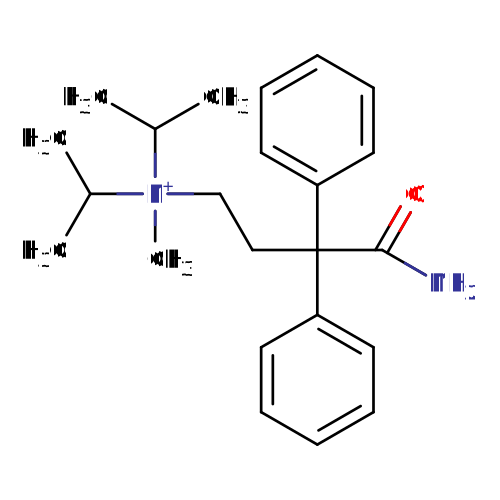
Structure for Isopropamide (DB01625)
- Weight
- Average: 353.5209
Monoisotopic: 353.259288688 - Chemical Formula
- C23H33N2O
- Synonyms
- Isopropamide

Pharmacology
- Indication
For the treatment of a wide range of gastrointestinal disorders, including such conditions as peptic ulcer, gastritis, hyperchlorhydria, functional diarrhea, irritable or spastic colon, pyloroduodenal irritability, pylorospasm, acute nonspecific gastroenteritis, biliary dyskinesia and chronic cholelithiasis, duodenitis, gastrointestinal spasm; it may also be used to treat genitourinary spasm.
 Reduce drug development failure ratesBuild, train, & validate machine-learning modelswith evidence-based and structured datasets.Build, train, & validate predictive machine-learning models with structured datasets.
- Associated Conditions
Indication Type Indication Combined Product Details Approval Level Age Group Patient Characteristics Dose Form Used in combination for symptomatic treatment of Common cold Combination Product in combination with: Caffeine (DB00201), Acetaminophen (DB00316), Ascorbic acid (DB00126), Chlorpheniramine (DB01114) ••• ••• ••••••• •••••••••••• Used in combination to treat Fever Combination Product in combination with: Ascorbic acid (DB00126), Caffeine (DB00201), Chlorpheniramine (DB01114), Acetaminophen (DB00316) ••• ••• ••••••• •••••••••••• Used in combination for symptomatic treatment of Flu caused by influenza Combination Product in combination with: Chlorpheniramine (DB01114), Acetaminophen (DB00316), Caffeine (DB00201), Ascorbic acid (DB00126) ••• ••• ••••••• •••••••••••• Used in combination for symptomatic treatment of Nasal congestion Combination Product in combination with: Ascorbic acid (DB00126), Caffeine (DB00201), Chlorpheniramine (DB01114), Acetaminophen (DB00316) ••• ••• ••••••• •••••••••••• Used in combination for symptomatic treatment of Pain Combination Product in combination with: Caffeine (DB00201), Chlorpheniramine (DB01114), Acetaminophen (DB00316), Ascorbic acid (DB00126) ••• ••• ••••••• •••••••••••• - Associated Therapies
- Contraindications & Blackbox Warnings
 Prevent Adverse Drug Events TodayTap into our Clinical API for life-saving information on contraindications & blackbox warnings, population restrictions, harmful risks, & more.Avoid life-threatening adverse drug events with our Clinical API
- Pharmacodynamics
Isopropamide is a long-acting quaternary anticholinergic drug. It is used in the treatment of peptic ulcer and other gastrointestinal disorders marked by hyperacidity and hypermotility.
- Mechanism of action
Anticholinergics are a class of medications that inhibit parasympathetic nerve impulses by selectively blocking the binding of the neurotransmitter acetylcholine to its receptor in nerve cells. The nerve fibers of the parasympathetic system are responsible for the involuntary movements of smooth muscles present in the gastrointestinal tract. Inhibition here decreases acidity and motility, aiding in the treatment of gastrointestinal disorders.
Target Actions Organism AMuscarinic acetylcholine receptor M3 antagonistHumans UMuscarinic acetylcholine receptor M4 antagonistHumans - Absorption
Not Available
- Volume of distribution
Not Available
- Protein binding
Not Available
- Metabolism
- Not Available
- Route of elimination
Not Available
- Half-life
Not Available
- Clearance
Not Available
- Adverse Effects
 Improve decision support & research outcomesWith structured adverse effects data, including: blackbox warnings, adverse reactions, warning & precautions, & incidence rates. View sample adverse effects data in our new Data Library!Improve decision support & research outcomes with our structured adverse effects data.
- Toxicity
Symptoms of overdose include dryness of mouth, dysphagia, thirst, blurred vision, dilated pupils, photophobia, fever, rapid pulse and respiration, disorientation. Depression and circulatory collapse may result from severe overdosage.
- Pathways
- Not Available
- Pharmacogenomic Effects/ADRs
- Not Available
Interactions
- Drug Interactions
- This information should not be interpreted without the help of a healthcare provider. If you believe you are experiencing an interaction, contact a healthcare provider immediately. The absence of an interaction does not necessarily mean no interactions exist.
Drug Interaction Integrate drug-drug
interactions in your softwareAclidinium The risk or severity of adverse effects can be increased when Isopropamide is combined with Aclidinium. Adenosine The risk or severity of Tachycardia can be increased when Adenosine is combined with Isopropamide. Albuterol The risk or severity of Tachycardia can be increased when Salbutamol is combined with Isopropamide. Alfentanil The risk or severity of adverse effects can be increased when Isopropamide is combined with Alfentanil. Alloin The therapeutic efficacy of Alloin can be decreased when used in combination with Isopropamide. - Food Interactions
- No interactions found.
Products
 Drug product information from 10+ global regionsOur datasets provide approved product information including:dosage, form, labeller, route of administration, and marketing period.Access drug product information from over 10 global regions.
- Product Ingredients
Ingredient UNII CAS InChI Key Isopropamide chloride F97R3WDS0Q 24353-18-2 YDLRIMWTVADYID-UHFFFAOYSA-N Isopropamide iodide E0KNA372SZ 71-81-8 BFSMWENDZZIWPW-UHFFFAOYSA-N - Mixture Products
Name Ingredients Dosage Route Labeller Marketing Start Marketing End Region Image INFLUMED Isopropamide iodide (0.2 mg) + Acetaminophen (500 mg) + Ascorbic acid (500 mg) + Caffeine (25 mg) + Chlorpheniramine maleate (8 mg) Tablet Oral Iodosan S.P.A. 2014-07-08 2023-06-16 Italy 
INFLUMED Isopropamide iodide (0.2 mg) + Acetaminophen (500 mg) + Ascorbic acid (500 mg) + Caffeine (25 mg) + Chlorpheniramine maleate (8 mg) Tablet Oral Iodosan S.P.A. 2014-07-08 2023-06-16 Italy Stelabid Forte Isopropamide iodide (7.5 mg) + Trifluoperazine hydrochloride (2 mg) Tablet Oral Glaxosmithkline Inc 1993-12-31 2002-07-31 Canada 
Stelabid No 1 Isopropamide iodide (5 mg) + Trifluoperazine hydrochloride (1 mg) Tablet Oral Glaxosmithkline Inc 1993-12-31 2002-01-29 Canada Stelabid No 2 Isopropamide iodide (5 mg) + Trifluoperazine hydrochloride (2 mg) Tablet Oral Glaxosmithkline Inc 1993-12-31 2002-01-29 Canada
Categories
- ATC Codes
- A03CA01 — Isopropamide and psycholeptics
- A03CA — Synthetic anticholinergic agents in combination with psycholeptics
- A03C — ANTISPASMODICS IN COMBINATION WITH PSYCHOLEPTICS
- A03 — DRUGS FOR FUNCTIONAL GASTROINTESTINAL DISORDERS
- A — ALIMENTARY TRACT AND METABOLISM
- Drug Categories
- Chemical TaxonomyProvided by Classyfire
- Description
- This compound belongs to the class of organic compounds known as diphenylmethanes. These are compounds containing a diphenylmethane moiety, which consists of a methane wherein two hydrogen atoms are replaced by two phenyl groups.
- Kingdom
- Organic compounds
- Super Class
- Benzenoids
- Class
- Benzene and substituted derivatives
- Sub Class
- Diphenylmethanes
- Direct Parent
- Diphenylmethanes
- Alternative Parents
- Aralkylamines / Tetraalkylammonium salts / Carboximidic acids / Organopnictogen compounds / Organooxygen compounds / Organic salts / Hydrocarbon derivatives / Organic cations
- Substituents
- Amine / Aralkylamine / Aromatic homomonocyclic compound / Carboximidic acid / Carboximidic acid derivative / Diphenylmethane / Hydrocarbon derivative / Organic cation / Organic nitrogen compound / Organic oxygen compound
- Molecular Framework
- Aromatic homomonocyclic compounds
- External Descriptors
- diarylmethane (CHEBI:6043)
- Affected organisms
- Humans and other mammals
Chemical Identifiers
- UNII
- 8B9I31H724
- CAS number
- 7492-32-2
- InChI Key
- JTPUMZTWMWIVPA-UHFFFAOYSA-O
- InChI
- InChI=1S/C23H32N2O/c1-18(2)25(5,19(3)4)17-16-23(22(24)26,20-12-8-6-9-13-20)21-14-10-7-11-15-21/h6-15,18-19H,16-17H2,1-5H3,(H-,24,26)/p+1
- IUPAC Name
- (3-carbamoyl-3,3-diphenylpropyl)(methyl)bis(propan-2-yl)azanium
- SMILES
- CC(C)[N+](C)(CCC(C(N)=O)(C1=CC=CC=C1)C1=CC=CC=C1)C(C)C
References
- Synthesis Reference
U.S. Patent 2,823,233.
- General References
- Not Available
- External Links
- Human Metabolome Database
- HMDB0015562
- KEGG Compound
- C07055
- PubChem Compound
- 3775
- PubChem Substance
- 46507726
- ChemSpider
- 3643
- BindingDB
- 82074
- 89784
- ChEBI
- 6043
- ChEMBL
- CHEMBL1201232
- ZINC
- ZINC000001530668
- PharmGKB
- PA164781398
- Wikipedia
- Isopropamide
Clinical Trials
Pharmacoeconomics
- Manufacturers
- Not Available
- Packagers
- Gallipot
- Dosage Forms
Form Route Strength Tablet Oral - Prices
Unit description Cost Unit Isopropamide iodide powder 6.72USD g DrugBank does not sell nor buy drugs. Pricing information is supplied for informational purposes only.- Patents
- Not Available
Properties
- State
- Solid
- Experimental Properties
Property Value Source melting point (°C) 182-184 U.S. Patent 2,823,233. - Predicted Properties
Property Value Source Water Solubility 4.24e-05 mg/mL ALOGPS logP 2.27 ALOGPS logP 0.14 Chemaxon logS -7 ALOGPS pKa (Strongest Acidic) 16.31 Chemaxon pKa (Strongest Basic) -3.3 Chemaxon Physiological Charge 1 Chemaxon Hydrogen Acceptor Count 1 Chemaxon Hydrogen Donor Count 1 Chemaxon Polar Surface Area 43.09 Å2 Chemaxon Rotatable Bond Count 8 Chemaxon Refractivity 120.74 m3·mol-1 Chemaxon Polarizability 41.28 Å3 Chemaxon Number of Rings 2 Chemaxon Bioavailability 1 Chemaxon Rule of Five Yes Chemaxon Ghose Filter Yes Chemaxon Veber's Rule No Chemaxon MDDR-like Rule No Chemaxon - Predicted ADMET Features
Property Value Probability Human Intestinal Absorption - 0.8295 Blood Brain Barrier + 0.9878 Caco-2 permeable + 0.6521 P-glycoprotein substrate Substrate 0.657 P-glycoprotein inhibitor I Non-inhibitor 0.9503 P-glycoprotein inhibitor II Non-inhibitor 0.8809 Renal organic cation transporter Inhibitor 0.5178 CYP450 2C9 substrate Non-substrate 0.7878 CYP450 2D6 substrate Non-substrate 0.715 CYP450 3A4 substrate Substrate 0.69 CYP450 1A2 substrate Non-inhibitor 0.9046 CYP450 2C9 inhibitor Non-inhibitor 0.9071 CYP450 2D6 inhibitor Inhibitor 0.8932 CYP450 2C19 inhibitor Non-inhibitor 0.9026 CYP450 3A4 inhibitor Non-inhibitor 0.8492 CYP450 inhibitory promiscuity Low CYP Inhibitory Promiscuity 0.953 Ames test Non AMES toxic 0.8654 Carcinogenicity Non-carcinogens 0.7639 Biodegradation Not ready biodegradable 0.8598 Rat acute toxicity 2.5213 LD50, mol/kg Not applicable hERG inhibition (predictor I) Weak inhibitor 0.9906 hERG inhibition (predictor II) Inhibitor 0.5525
Spectra
- Mass Spec (NIST)
- Not Available
- Spectra
Spectrum Spectrum Type Splash Key Predicted GC-MS Spectrum - GC-MS Predicted GC-MS splash10-052o-7449000000-f279105f11d6b98a55c8 Predicted 1H NMR Spectrum 1D NMR Not Applicable Predicted 13C NMR Spectrum 1D NMR Not Applicable - Chromatographic Properties
Collision Cross Sections (CCS)
Adduct CCS Value (Å2) Source type Source [M-H]- 198.9482214 predictedDarkChem Lite v0.1.0 [M-H]- 186.49382 predictedDeepCCS 1.0 (2019) [M+H]+ 199.7581214 predictedDarkChem Lite v0.1.0 [M+H]+ 188.85182 predictedDeepCCS 1.0 (2019) [M+Na]+ 199.7057214 predictedDarkChem Lite v0.1.0 [M+Na]+ 195.60283 predictedDeepCCS 1.0 (2019)
Targets

- Kind
- Protein
- Organism
- Humans
- Pharmacological action
- Yes
- Actions
- Antagonist
- General Function
- Receptor activity
- Specific Function
- The muscarinic acetylcholine receptor mediates various cellular responses, including inhibition of adenylate cyclase, breakdown of phosphoinositides and modulation of potassium channels through the...
- Gene Name
- CHRM3
- Uniprot ID
- P20309
- Uniprot Name
- Muscarinic acetylcholine receptor M3
- Molecular Weight
- 66127.445 Da
References
- Eglen RM, Whiting RL: Competitive and non-competitive antagonism exhibited by 'selective' antagonists at atrial and ileal muscarinic receptor subtypes. Br J Pharmacol. 1987 Apr;90(4):701-7. [Article]
- Lane MA: Muscarinic cholinergic activation of mouse spleen cells cytotoxic to tumor cells in vitro. J Natl Cancer Inst. 1978 Sep;61(3):923-6. [Article]
- Kind
- Protein
- Organism
- Humans
- Pharmacological action
- Unknown
- Actions
- Antagonist
- General Function
- Guanyl-nucleotide exchange factor activity
- Specific Function
- The muscarinic acetylcholine receptor mediates various cellular responses, including inhibition of adenylate cyclase, breakdown of phosphoinositides and modulation of potassium channels through the...
- Gene Name
- CHRM4
- Uniprot ID
- P08173
- Uniprot Name
- Muscarinic acetylcholine receptor M4
- Molecular Weight
- 53048.65 Da
References
- Lane MA: Muscarinic cholinergic activation of mouse spleen cells cytotoxic to tumor cells in vitro. J Natl Cancer Inst. 1978 Sep;61(3):923-6. [Article]
- Eglen RM, Whiting RL: Competitive and non-competitive antagonism exhibited by 'selective' antagonists at atrial and ileal muscarinic receptor subtypes. Br J Pharmacol. 1987 Apr;90(4):701-7. [Article]

Drug created at August 29, 2007 20:22 / Updated at December 02, 2023 07:00