Identification
- Summary
Isoleucine is an amino acid commonly found as a component of total parenteral nutrition.
- Brand Names
- Aminosyn II 7 %, Sulfite-free, Aminosyn-PF 7%, Clinimix 2.75/5, Clinimix E 2.75/5, Clinisol 15, Freamine 6.9, Freamine III 10, Hepatamine 8, Nephramine, Olimel, Periolimel, Plenamine, Premasol, Primene, Procalamine 3, Prosol, Travasol 10, Trophamine 10 %
- Generic Name
- Isoleucine
- DrugBank Accession Number
- DB00167
- Background
An essential branched-chain aliphatic amino acid found in many proteins. It is an isomer of leucine. It is important in hemoglobin synthesis and regulation of blood sugar and energy levels.
- Type
- Small Molecule
- Groups
- Investigational, Nutraceutical
- Structure
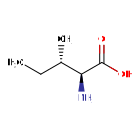
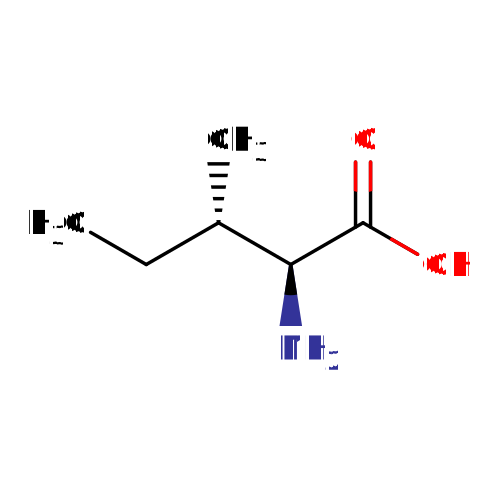
Structure for Isoleucine (DB00167)
- Weight
- Average: 131.1729
Monoisotopic: 131.094628665 - Chemical Formula
- C6H13NO2
- Synonyms
- (2S,3S)-2-Amino-3-methylpentanoic acid
- 2-Amino-3-methylvaleric acid
- alpha-amino-beta-methylvaleric acid
- Ile
- Isoleucina
- Isoleucine
- Isoleucinum
- L-Isoleucine
- α-amino-β-methylvaleric acid

Pharmacology
- Indication
The branched-chain amino acids may have antihepatic encephalopathy activity in some. They may also have anticatabolic and antitardive dyskinesia activity.
 Reduce drug development failure ratesBuild, train, & validate machine-learning modelswith evidence-based and structured datasets.Build, train, & validate predictive machine-learning models with structured datasets.
- Associated Therapies
- Contraindications & Blackbox Warnings
 Prevent Adverse Drug Events TodayTap into our Clinical API for life-saving information on contraindications & blackbox warnings, population restrictions, harmful risks, & more.Avoid life-threatening adverse drug events with our Clinical API
- Pharmacodynamics
They provide ingredients for the manufacturing of other essential biochemical components in the body, some of which are utilized for the production of energy, stimulants to the upper brain and helping you to be more alert.
- Mechanism of action
(Applies to Valine, Leucine and Isoleucine) This group of essential amino acids are identified as the branched-chain amino acids, BCAAs. Because this arrangement of carbon atoms cannot be made by humans, these amino acids are an essential element in the diet. The catabolism of all three compounds initiates in muscle and yields NADH and FADH2 which can be utilized for ATP generation. The catabolism of all three of these amino acids uses the same enzymes in the first two steps. The first step in each case is a transamination using a single BCAA aminotransferase, with a-ketoglutarate as amine acceptor. As a result, three different a-keto acids are produced and are oxidized using a common branched-chain a-keto acid dehydrogenase, yielding the three different CoA derivatives. Subsequently the metabolic pathways diverge, producing many intermediates. The principal product from valine is propionylCoA, the glucogenic precursor of succinyl-CoA. Isoleucine catabolism terminates with production of acetylCoA and propionylCoA; thus isoleucine is both glucogenic and ketogenic. Leucine gives rise to acetylCoA and acetoacetylCoA, and is thus classified as strictly ketogenic. There are a number of genetic diseases associated with faulty catabolism of the BCAAs. The most common defect is in the branched-chain a-keto acid dehydrogenase. Since there is only one dehydrogenase enzyme for all three amino acids, all three a-keto acids accumulate and are excreted in the urine. The disease is known as Maple syrup urine disease because of the characteristic odor of the urine in afflicted individuals. Mental retardation in these cases is extensive. Unfortunately, since these are essential amino acids, they cannot be heavily restricted in the diet; ultimately, the life of afflicted individuals is short and development is abnormal The main neurological problems are due to poor formation of myelin in the CNS.
Target Actions Organism UShort/branched chain specific acyl-CoA dehydrogenase, mitochondrial Not Available Humans UBranched-chain-amino-acid aminotransferase, cytosolic Not Available Humans UBranched-chain-amino-acid aminotransferase, mitochondrial Not Available Humans UIsoleucine--tRNA ligase, cytoplasmic Not Available Humans UIsoleucine--tRNA ligase, mitochondrial Not Available Humans - Absorption
Absorbed from the small intestine by a sodium-dependent active-transport process
- Volume of distribution
Not Available
- Protein binding
Not Available
- Metabolism
Hepatic
- Route of elimination
Not Available
- Half-life
Not Available
- Clearance
Not Available
- Adverse Effects
 Improve decision support & research outcomesWith structured adverse effects data, including: blackbox warnings, adverse reactions, warning & precautions, & incidence rates. View sample adverse effects data in our new Data Library!Improve decision support & research outcomes with our structured adverse effects data.
- Toxicity
Symptoms of hypoglycemia, increased mortality in ALS patients taking large doses of BCAAs
- Pathways
- Pharmacogenomic Effects/ADRs
- Not Available
Interactions
- Drug Interactions
- This information should not be interpreted without the help of a healthcare provider. If you believe you are experiencing an interaction, contact a healthcare provider immediately. The absence of an interaction does not necessarily mean no interactions exist.Not Available
- Food Interactions
- Not Available
Products
 Drug product information from 10+ global regionsOur datasets provide approved product information including:dosage, form, labeller, route of administration, and marketing period.Access drug product information from over 10 global regions.
- Mixture Products
Name Ingredients Dosage Route Labeller Marketing Start Marketing End Region Image 2.5% Travasol Amino Acid Injection With Electrolytes In 10% Dextrose Isoleucine (150 mg / 100 mL) + Alanine (520 mg / 100 mL) + Arginine (290 mg / 100 mL) + Dextrose, unspecified form (10 g / 100 mL) + Dipotassium phosphate (130.5 mg / 100 mL) + Glycine (260 mg / 100 mL) + Histidine (120 mg / 100 mL) + Leucine (182.5 mg / 100 mL) + Lysine hydrochloride (145 mg / 100 mL) + Magnesium chloride (25.5 mg / 100 mL) + Methionine (100 mg / 100 mL) + Phenylalanine (140 mg / 100 mL) + Proline (170 mg / 100 mL) + Serine (125 mg / 100 mL) + Sodium acetate (170 mg / 100 mL) + Sodium chloride (29.3 mg / 100 mL) + Threonine (105 mg / 100 mL) + Tryptophan (45 mg / 100 mL) + Tyrosine (10 mg / 100 mL) + Valine (145 mg / 100 mL) Solution Intravenous Baxter Corporation Clintec Nutrition Division 1996-12-31 2015-08-05 Canada 
2.5% Travasol Amino Acid Injection With Electrolytes In 10% Dextrose Clinimix Isoleucine (120 mg / 100 mL) + Alanine (520 mg / 100 mL) + Arginine (260 mg / 100 mL) + Dextrose, unspecified form (10 g / 100 mL) + Dipotassium phosphate (130.5 mg / 100 mL) + Glycine (520 mg / 100 mL) + Histidine (110 mg / 100 mL) + L-Leucine hydrochloride (155 mg / 100 mL) + Lysine hydrochloride (145 mg / 100 mL) + Magnesium chloride (25.5 mg / 100 mL) + Methionine (145 mg / 100 mL) + Phenylalanine hydrochloride (155 mg / 100 mL) + Proline (105 mg / 100 mL) + Sodium acetate (170 mg / 100 mL) + Sodium chloride (29.3 mg / 100 mL) + Threonine (105 mg / 100 mL) + Tryptophan (45 mg / 100 mL) + Tyrosine (10 mg / 100 mL) + Valine (115 mg / 100 mL) Solution Intravenous Baxter Corporation Clintec Nutrition Division 1993-12-31 2015-08-05 Canada 2.5% Travasol Amino Acid Injection Without Electrolytes In 10% Dextrose Quickmix Isoleucine (120 mg / 100 mL) + Alanine (520 mg / 100 mL) + Arginine (260 mg / 100 mL) + Dextrose, unspecified form (10 g / 100 mL) + Glycine (520 mg / 100 mL) + Histidine (110 mg / 100 mL) + L-Leucine hydrochloride (155 mg / 100 mL) + Lysine hydrochloride (195 mg / 100 mL) + Methionine (195 mg / 100 mL) + Phenylalanine hydrochloride (155 mg / 100 mL) + Proline (105 mg / 100 mL) + Threonine (105 mg / 100 mL) + Tryptophan (45 mg / 100 mL) + Tyrosine (10 mg / 100 mL) + Valine (115 mg / 100 mL) Solution Intravenous Baxter Corporation Clintec Nutrition Division 1995-12-31 2007-08-02 Canada 2.5%travasol Amino Acid InJ.W.eleC.W.25%dex Isoleucine (150 mg / 100 mL) + Alanine (520 mg / 100 mL) + Arginine (290 mg / 100 mL) + Dextrose, unspecified form (25 g / 100 mL) + Dipotassium phosphate (130.5 mg / 100 mL) + Glycine (260 mg / 100 mL) + Histidine (120 mg / 100 mL) + Leucine (182.5 mg / 100 mL) + Lysine hydrochloride (145 mg / 100 mL) + Magnesium chloride (25.5 mg / 100 mL) + Methionine (100 mg / 100 mL) + Phenylalanine (140 mg / 100 mL) + Proline (170 mg / 100 mL) + Serine (125 mg / 100 mL) + Sodium acetate (170 mg / 100 mL) + Sodium chloride (29.3 mg / 100 mL) + Threonine (105 mg / 100 mL) + Tryptophan (45 mg / 100 mL) + Tyrosine (10 mg / 100 mL) + Valine (145 mg / 100 mL) Liquid Intravenous Clintec Nutrition Company 1996-07-30 1998-08-13 Canada 2.75% Travas. Amino Acid InJ.W.elecw.25%dex Isoleucine (165 mg / 100 mL) + Alanine (570 mg / 100 mL) + Arginine (316 mg / 100 mL) + Dextrose, unspecified form (25 g / 100 mL) + Dipotassium phosphate (261 mg / 100 mL) + Glycine (283 mg / 100 mL) + Histidine (132 mg / 100 mL) + Leucine (201 mg / 100 mL) + Lysine hydrochloride (159.5 mg / 100 mL) + Magnesium chloride (51 mg / 100 mL) + Methionine (110 mg / 100 mL) + Phenylalanine (154 mg / 100 mL) + Proline (187 mg / 100 mL) + Serine (137.5 mg / 100 mL) + Sodium acetate (215.5 mg / 100 mL) + Sodium chloride (112 mg / 100 mL) + Threonine (115.5 mg / 100 mL) + Tryptophan (49.5 mg / 100 mL) + Tyrosine (11 mg / 100 mL) + Valine (159.5 mg / 100 mL) Liquid Intravenous Clintec Nutrition Company 1996-07-30 1998-08-13 Canada - Unapproved/Other Products
Name Ingredients Dosage Route Labeller Marketing Start Marketing End Region Image ASCE plus Derma Signal Kit SRLV Isoleucine (0.01 mg/20mg) + Isoleucine (0.0025 g/5.0mL) + Leucine (0.01 mg/20mg) + Leucine (0.0025 g/5.0mL) Kit Topical Exocobio Inc. 2021-10-01 Not applicable US 
ASCE plus Derma Signal Kit SRLV Isoleucine (0.01 mg/20mg) + Isoleucine (0.0025 g/5.0mL) + Leucine (0.01 mg/20mg) + Leucine (0.0025 g/5.0mL) Kit Topical Exocobio Inc. 2021-10-01 Not applicable US ASCE plus Derma Signal Kit SRLV S Isoleucine (0.0006 mg/20mg) + Isoleucine (0.0001 g/5.0mL) + Leucine (0.0008 mg/20mg) + Leucine (0.0002 g/5.0mL) Kit Topical Exocobio Inc. 2019-03-01 Not applicable US ASCE plus Derma Signal Kit SRLV S Isoleucine (0.0006 mg/20mg) + Isoleucine (0.0001 g/5.0mL) + Leucine (0.0008 mg/20mg) + Leucine (0.0002 g/5.0mL) Kit Topical Exocobio Inc. 2019-03-01 Not applicable US Clinimix Isoleucine (5.10 g/2L) + Alanine (17.60 g/2L) + Arginine (9.78 g/2L) + Calcium chloride dihydrate (0.66 g/2L) + D-glucose monohydrate (300.00 g/2L) + Dipotassium phosphate (5.22 g/2L) + Glycine (8.76 g/2L) + Histidine (4.08 g/2L) + Leucine (6.20 g/2L) + Lysine (4.93 g/2L) + Magnesium chloride hexahydrate (1.02 g/2L) + Methionine (3.40 g/2L) + Phenylalanine (4.76 g/2L) + Proline (5.78 g/2L) + Serine (4.25 g/2L) + Sodium acetate trihydrate (5.94 g/2L) + Sodium chloride (1.54 g/2L) + Threonine (3.57 g/2L) + Tryptophan (1.53 g/2L) + Tyrosine (0.34 g/2L) + Valine (4.93 g/2L) Solution Intravenous Baxter Healthcare Corporation 2017-10-25 2019-11-30 US
Categories
- Drug Categories
- Chemical TaxonomyProvided by Classyfire
- Description
- This compound belongs to the class of organic compounds known as isoleucine and derivatives. These are compounds containing isoleucine or a derivative thereof resulting from reaction of isoleucine at the amino group or the carboxy group, or from the replacement of any hydrogen of glycine by a heteroatom.
- Kingdom
- Organic compounds
- Super Class
- Organic acids and derivatives
- Class
- Carboxylic acids and derivatives
- Sub Class
- Amino acids, peptides, and analogues
- Direct Parent
- Isoleucine and derivatives
- Alternative Parents
- L-alpha-amino acids / Methyl-branched fatty acids / Amino acids / Monocarboxylic acids and derivatives / Carboxylic acids / Organopnictogen compounds / Organic oxides / Monoalkylamines / Hydrocarbon derivatives / Carbonyl compounds
- Substituents
- Aliphatic acyclic compound / Alpha-amino acid / Amine / Amino acid / Branched fatty acid / Carbonyl group / Carboxylic acid / Fatty acid / Fatty acyl / Hydrocarbon derivative
- Molecular Framework
- Aliphatic acyclic compounds
- External Descriptors
- aspartate family amino acid, proteinogenic amino acid, L-alpha-amino acid, isoleucine (CHEBI:17191) / Common amino acids (C00407) / Amino fatty acids (LMFA01100047)
- Affected organisms
- Humans and other mammals
Chemical Identifiers
- UNII
- 04Y7590D77
- CAS number
- 73-32-5
- InChI Key
- AGPKZVBTJJNPAG-WHFBIAKZSA-N
- InChI
- InChI=1S/C6H13NO2/c1-3-4(2)5(7)6(8)9/h4-5H,3,7H2,1-2H3,(H,8,9)/t4-,5-/m0/s1
- IUPAC Name
- (2S,3S)-2-amino-3-methylpentanoic acid
- SMILES
- CC[C@H](C)[C@H](N)C(O)=O
References
- Synthesis Reference
Nelli I. Zhdanova, Tatyana V. Leonova, Ljudmila F. Kozyreva, "Method of producing L-isoleucine using Brevibacterium flavum." U.S. Patent US4237228, issued February, 1962.
US4237228- General References
- Not Available
- External Links
- Human Metabolome Database
- HMDB0000172
- KEGG Drug
- D00065
- KEGG Compound
- C00407
- PubChem Compound
- 6306
- PubChem Substance
- 46506864
- ChemSpider
- 6067
- BindingDB
- 18140
- 6033
- ChEBI
- 17191
- ChEMBL
- CHEMBL1233584
- ZINC
- ZINC000003581355
- PharmGKB
- PA164750430
- Guide to Pharmacology
- GtP Drug Page
- PDBe Ligand
- ILE
- PDRhealth
- PDRhealth Drug Page
- Wikipedia
- Isoleucine
- MSDS
- Download (72.8 KB)
Clinical Trials
- Clinical Trials
Phase Status Purpose Conditions Count 4 Active Not Recruiting Treatment Critically Ill Patients / Starvation 1 4 Recruiting Basic Science Healthy Volunteers (HV) / Obesity / Type 2 Diabetes Mellitus 1 4 Recruiting Prevention Intestinal Obstruction / Laparotomies / Mesenteric vascular insufficiency 1 4 Terminated Supportive Care Cancer-related Malnutrition 1 4 Terminated Supportive Care Critically Ill Patients 1
Pharmacoeconomics
- Manufacturers
- Not Available
- Packagers
- Spectrum Pharmaceuticals
- Dosage Forms
Form Route Strength Solution Intravenous 10.50 g/1000ml Injection Intravenous 0.5 g/l Injection Intravenous 0.25 g/1000ml Solution, concentrate Intravenous Injection Intravenous 0.52 g/l Injection Intravenous 11.000 g/1000ml Solution Intravenous 18.5 g/L Injection Intravenous 5.5 g/1000ml Kit Topical Liquid Intravenous Tablet Oral Injection, solution Intravenous Injection, emulsion Intravenous Emulsion Intravenous 0.468 g Powder Topical Liquid Topical Injection Intravenous 16 g/1000ml Capsule Oral Emulsion Parenteral 20.000 g Injection Intravenous 1.6 g/l Solution Parenteral Injection Intravenous 0.37 g/l Injection, solution, concentrate Intravenous Injection, emulsion Parenteral Emulsion Intravenous 0.466 g Injection, emulsion; injection, solution Intravenous Emulsion Parenteral Emulsion Intravenous Injection, solution Injection, emulsion Intravenous 4.656 g/1000ml Injection, emulsion Intravenous 6.792 g/1000ml Solution Intraperitoneal Injection, solution Intraperitoneal Liquid Hemodialysis Solution Intraperitoneal 0.184 g/l Emulsion Intravenous 176 g/l Emulsion Intravenous 4 g Emulsion Intravenous 3 g Solution Intravenous Injection Intravenous 4 g/l Injection Intravenous 0.21 g/100ml Emulsion Intravenous 13.000 g Emulsion Parenteral 42.00 g Injection, emulsion Intravenous 14 g/1000ml Injection Intravenous 10.30 g/l Injection Intravenous Granule - Prices
Unit description Cost Unit L-isoleucine powder 3.21USD g DrugBank does not sell nor buy drugs. Pricing information is supplied for informational purposes only.- Patents
- Not Available
Properties
- State
- Solid
- Experimental Properties
Property Value Source melting point (°C) 285.5 dec °C PhysProp water solubility 3.44E+004 mg/L (at 25 °C) YALKOWSKY,SH & DANNENFELSER,RM (1992) logP -1.70 HANSCH,C ET AL. (1995) pKa 2.37 (at 0 °C) KORTUM,G ET AL (1961) - Predicted Properties
Property Value Source Water Solubility 114.0 mg/mL ALOGPS logP -1.7 ALOGPS logP -1.5 Chemaxon logS -0.06 ALOGPS pKa (Strongest Acidic) 2.79 Chemaxon pKa (Strongest Basic) 9.59 Chemaxon Physiological Charge 0 Chemaxon Hydrogen Acceptor Count 3 Chemaxon Hydrogen Donor Count 2 Chemaxon Polar Surface Area 63.32 Å2 Chemaxon Rotatable Bond Count 3 Chemaxon Refractivity 34.09 m3·mol-1 Chemaxon Polarizability 14.11 Å3 Chemaxon Number of Rings 0 Chemaxon Bioavailability 1 Chemaxon Rule of Five Yes Chemaxon Ghose Filter No Chemaxon Veber's Rule No Chemaxon MDDR-like Rule No Chemaxon - Predicted ADMET Features
Property Value Probability Human Intestinal Absorption + 0.9677 Blood Brain Barrier + 0.78 Caco-2 permeable - 0.7966 P-glycoprotein substrate Non-substrate 0.7385 P-glycoprotein inhibitor I Non-inhibitor 0.9825 P-glycoprotein inhibitor II Non-inhibitor 0.9739 Renal organic cation transporter Non-inhibitor 0.9696 CYP450 2C9 substrate Non-substrate 0.8513 CYP450 2D6 substrate Non-substrate 0.8372 CYP450 3A4 substrate Non-substrate 0.7827 CYP450 1A2 substrate Non-inhibitor 0.8536 CYP450 2C9 inhibitor Non-inhibitor 0.8762 CYP450 2D6 inhibitor Non-inhibitor 0.9 CYP450 2C19 inhibitor Non-inhibitor 0.9386 CYP450 3A4 inhibitor Non-inhibitor 0.9155 CYP450 inhibitory promiscuity Low CYP Inhibitory Promiscuity 0.97 Ames test Non AMES toxic 0.903 Carcinogenicity Non-carcinogens 0.632 Biodegradation Ready biodegradable 0.5166 Rat acute toxicity 1.5846 LD50, mol/kg Not applicable hERG inhibition (predictor I) Weak inhibitor 0.9921 hERG inhibition (predictor II) Non-inhibitor 0.9735
Spectra
- Mass Spec (NIST)
- Download (2.96 KB)
- Spectra
- Chromatographic Properties
Collision Cross Sections (CCS)
Adduct CCS Value (Å2) Source type Source [M-H]- 129.4252458 predictedDarkChem Lite v0.1.0 [M-H]- 127.3373271 predictedDarkChem Standard v0.1.0 [M-H]- 129.3127458 predictedDarkChem Lite v0.1.0 [M-H]- 128.3165458 predictedDarkChem Lite v0.1.0 [M-H]- 127.389885 predictedDeepCCS 1.0 (2019) [M+H]+ 129.9852458 predictedDarkChem Lite v0.1.0 [M+H]+ 129.6017458 predictedDarkChem Lite v0.1.0 [M+H]+ 129.8003458 predictedDarkChem Lite v0.1.0 [M+H]+ 128.5690458 predictedDarkChem Lite v0.1.0 [M+H]+ 131.21724 predictedDeepCCS 1.0 (2019) [M+Na]+ 129.3641458 predictedDarkChem Lite v0.1.0 [M+Na]+ 129.3149458 predictedDarkChem Lite v0.1.0 [M+Na]+ 129.2581458 predictedDarkChem Lite v0.1.0 [M+Na]+ 128.2558458 predictedDarkChem Lite v0.1.0 [M+Na]+ 140.3864 predictedDeepCCS 1.0 (2019)
Targets

- Kind
- Protein
- Organism
- Humans
- Pharmacological action
- Unknown
- General Function
- Oxidoreductase activity, acting on the ch-ch group of donors, with a flavin as acceptor
- Specific Function
- Has greatest activity toward short branched chain acyl-CoA derivative such as (s)-2-methylbutyryl-CoA, isobutyryl-CoA, and 2-methylhexanoyl-CoA as well as toward short straight chain acyl-CoAs such...
- Gene Name
- ACADSB
- Uniprot ID
- P45954
- Uniprot Name
- Short/branched chain specific acyl-CoA dehydrogenase, mitochondrial
- Molecular Weight
- 47485.035 Da
References
- Korman SH, Andresen BS, Zeharia A, Gutman A, Boneh A, Pitt JJ: 2-ethylhydracrylic aciduria in short/branched-chain acyl-CoA dehydrogenase deficiency: application to diagnosis and implications for the R-pathway of isoleucine oxidation. Clin Chem. 2005 Mar;51(3):610-7. Epub 2004 Dec 22. [Article]
- Madsen PP, Kibaek M, Roca X, Sachidanandam R, Krainer AR, Christensen E, Steiner RD, Gibson KM, Corydon TJ, Knudsen I, Wanders RJ, Ruiter JP, Gregersen N, Andresen BS: Short/branched-chain acyl-CoA dehydrogenase deficiency due to an IVS3+3A>G mutation that causes exon skipping. Hum Genet. 2006 Feb;118(6):680-90. Epub 2005 Nov 30. [Article]
- Korman SH: Inborn errors of isoleucine degradation: a review. Mol Genet Metab. 2006 Dec;89(4):289-99. Epub 2006 Sep 6. [Article]
- Kind
- Protein
- Organism
- Humans
- Pharmacological action
- Unknown
- General Function
- L-valine transaminase activity
- Specific Function
- Catalyzes the first reaction in the catabolism of the essential branched chain amino acids leucine, isoleucine, and valine.
- Gene Name
- BCAT1
- Uniprot ID
- P54687
- Uniprot Name
- Branched-chain-amino-acid aminotransferase, cytosolic
- Molecular Weight
- 42965.815 Da
References
- Goto M, Miyahara I, Hayashi H, Kagamiyama H, Hirotsu K: Crystal structures of branched-chain amino acid aminotransferase complexed with glutamate and glutarate: true reaction intermediate and double substrate recognition of the enzyme. Biochemistry. 2003 Apr 8;42(13):3725-33. [Article]
- Chen CD, Huang TF, Lin CH, Guan HH, Hsieh YC, Lin YH, Huang YC, Liu MY, Chang WC, Chen CJ: Purification, crystallization and preliminary X-ray crystallographic analysis of branched-chain aminotransferase from Deinococcus radiodurans. Acta Crystallogr Sect F Struct Biol Cryst Commun. 2007 Jun 1;63(Pt 6):492-4. Epub 2007 May 5. [Article]
- Beck HC: Branched-chain fatty acid biosynthesis in a branched-chain amino acid aminotransferase mutant of Staphylococcus carnosus. FEMS Microbiol Lett. 2005 Feb 1;243(1):37-44. [Article]
- Thage BV, Rattray FP, Laustsen MW, Ardo Y, Barkholt V, Houlberg U: Purification and characterization of a branched-chain amino acid aminotransferase from Lactobacillus paracasei subsp. paracasei CHCC 2115. J Appl Microbiol. 2004;96(3):593-602. [Article]
- Madsen SM, Beck HC, Ravn P, Vrang A, Hansen AM, Israelsen H: Cloning and inactivation of a branched-chain-amino-acid aminotransferase gene from Staphylococcus carnosus and characterization of the enzyme. Appl Environ Microbiol. 2002 Aug;68(8):4007-14. [Article]
- Kind
- Protein
- Organism
- Humans
- Pharmacological action
- Unknown
- General Function
- L-valine transaminase activity
- Specific Function
- Catalyzes the first reaction in the catabolism of the essential branched chain amino acids leucine, isoleucine, and valine. May also function as a transporter of branched chain alpha-keto acids.
- Gene Name
- BCAT2
- Uniprot ID
- O15382
- Uniprot Name
- Branched-chain-amino-acid aminotransferase, mitochondrial
- Molecular Weight
- 44287.445 Da
References
- Berger BJ, English S, Chan G, Knodel MH: Methionine regeneration and aminotransferases in Bacillus subtilis, Bacillus cereus, and Bacillus anthracis. J Bacteriol. 2003 Apr;185(8):2418-31. [Article]
- Kind
- Protein
- Organism
- Humans
- Pharmacological action
- Unknown
- General Function
- Isoleucine-trna ligase activity
- Specific Function
- Not Available
- Gene Name
- IARS
- Uniprot ID
- P41252
- Uniprot Name
- Isoleucine--tRNA ligase, cytoplasmic
- Molecular Weight
- 144496.915 Da
References
- Crasto CF, Forrest AK, Karoli T, March DR, Mensah L, O'Hanlon PJ, Nairn MR, Oldham MD, Yue W, Banwell MG, Easton CJ: Synthesis and activity of analogues of the isoleucyl tRNA synthetase inhibitor SB-203207. Bioorg Med Chem. 2003 Jul 3;11(13):2687-94. [Article]
- Wang P, Tang Y, Tirrell DA: Incorporation of trifluoroisoleucine into proteins in vivo. J Am Chem Soc. 2003 Jun 11;125(23):6900-6. [Article]
- Mock ML, Michon T, van Hest JC, Tirrell DA: Stereoselective incorporation of an unsaturated isoleucine analogue into a protein expressed in E. coli. Chembiochem. 2006 Jan;7(1):83-7. [Article]
- Fukunaga R, Fukai S, Ishitani R, Nureki O, Yokoyama S: Crystal structures of the CP1 domain from Thermus thermophilus isoleucyl-tRNA synthetase and its complex with L-valine. J Biol Chem. 2004 Feb 27;279(9):8396-402. Epub 2003 Dec 12. [Article]
- Pezo V, Metzgar D, Hendrickson TL, Waas WF, Hazebrouck S, Doring V, Marliere P, Schimmel P, De Crecy-Lagard V: Artificially ambiguous genetic code confers growth yield advantage. Proc Natl Acad Sci U S A. 2004 Jun 8;101(23):8593-7. Epub 2004 May 26. [Article]
- Kind
- Protein
- Organism
- Humans
- Pharmacological action
- Unknown
- General Function
- Isoleucine-trna ligase activity
- Specific Function
- Not Available
- Gene Name
- IARS2
- Uniprot ID
- Q9NSE4
- Uniprot Name
- Isoleucine--tRNA ligase, mitochondrial
- Molecular Weight
- 113790.565 Da
References
- Wang P, Tang Y, Tirrell DA: Incorporation of trifluoroisoleucine into proteins in vivo. J Am Chem Soc. 2003 Jun 11;125(23):6900-6. [Article]
- Fukunaga R, Fukai S, Ishitani R, Nureki O, Yokoyama S: Crystal structures of the CP1 domain from Thermus thermophilus isoleucyl-tRNA synthetase and its complex with L-valine. J Biol Chem. 2004 Feb 27;279(9):8396-402. Epub 2003 Dec 12. [Article]
- Zhu B, Zhao MW, Eriani G, Wang ED: A present-day aminoacyl-tRNA synthetase with ancestral editing properties. RNA. 2007 Jan;13(1):15-21. Epub 2006 Nov 9. [Article]
- Fukunaga R, Yokoyama S: Crystal structure of leucyl-tRNA synthetase from the archaeon Pyrococcus horikoshii reveals a novel editing domain orientation. J Mol Biol. 2005 Feb 11;346(1):57-71. Epub 2004 Dec 19. [Article]
- Fukunaga R, Yokoyama S: Structural basis for substrate recognition by the editing domain of isoleucyl-tRNA synthetase. J Mol Biol. 2006 Jun 16;359(4):901-12. Epub 2006 Apr 25. [Article]
Transporters
- Kind
- Protein
- Organism
- Humans
- Pharmacological action
- Unknown
- Actions
- Inhibitor
- General Function
- Transporter activity
- Specific Function
- Sodium-independent transporter that mediates the update of aromatic acid. Can function as a net efflux pathway for aromatic amino acids in the basosolateral epithelial cells (By similarity).
- Gene Name
- SLC16A10
- Uniprot ID
- Q8TF71
- Uniprot Name
- Monocarboxylate transporter 10
- Molecular Weight
- 55492.07 Da
References
- Kim DK, Kanai Y, Chairoungdua A, Matsuo H, Cha SH, Endou H: Expression cloning of a Na+-independent aromatic amino acid transporter with structural similarity to H+/monocarboxylate transporters. J Biol Chem. 2001 May 18;276(20):17221-8. Epub 2001 Feb 20. [Article]


Drug created at June 13, 2005 13:24 / Updated at April 09, 2024 18:12